
Wedding Invitation Wording Guide: Kerala Hindu, Christian & Muslim Templates
Ready-to-use Kerala wedding invitation wording for Hindu, Christian, and Muslim ceremonies. 15+ templates in Malayalam and English with formatting rules.

Cultural Heritage Writer
Sujata Iyer is a cultural heritage writer specializing in the rich tapestry of South Indian wedding traditions.
On this page
Kerala wedding invitations follow strict cultural conventions — groom's family first for Hindu ceremonies, bride's family first for Christian, and Bismillah opening for Muslim. Bilingual Malayalam and English text is standard across all three traditions, and name hierarchy errors are noticed and remembered.
Quick Answer
The words on your wedding invitation carry more weight than most couples realise. With 4.6 million weddings taking place during India's peak season and average guest lists of 330 people, the invitation is the first touchpoint for hundreds of individuals. In Kerala, the invitation is not merely a logistical document — it is the family's first public declaration of the wedding, a statement of cultural identity, and for many elder relatives, a reflection of the family's values and social standing. The wording signals which tradition you are honouring, whose home the celebration belongs to, and the degree of formality guests should expect. Get it right and the card becomes a keepsake. Get it wrong — a misplaced name, an omitted title, a cultural convention broken — and the whispers begin before the wedding day.
This guide provides practical, ready-to-use wording templates for Kerala's three major wedding traditions: Hindu, Christian, and Muslim. For each tradition, you will find formal and contemporary versions, bilingual formatting advice, and specific guidance on the cultural conventions that must not be overlooked. We also cover engagement invitations, reception-only wording, and the specific adaptations needed for digital invitations.
For a comprehensive guide on choosing between paper, digital, and hybrid invitation formats — including cost comparisons and etiquette guidance — our digital vs paper invitations guide covers every dimension.
Kerala Hindu Wedding Invitation Wording
Hindu wedding invitations in Kerala follow a structured format that has evolved over centuries. The hierarchy of names, the opening invocation, and the placement of ceremony details all follow conventions that vary slightly by sub-community (Nair, Namboodiri, Ezhava, and others) but share a common framework.
Traditional Formal Format
The traditional Kerala Hindu invitation opens with a Sanskrit shloka — most commonly an invocation to Lord Ganesha (the remover of obstacles) or a verse invoking divine blessings for the couple. This is followed by the hosting family's formal introduction, the couple's names, and the ceremony details.
Template:
|| Sri Ganeshaaya Namah ||
With the blessings of the Almighty and the good wishes of our elders,
Shri [Father's Name] & Smt. [Mother's Name] [Family Name / Tharavad Name] [Place]
cordially invite you to the wedding ceremony of their beloved son / daughter
[Groom's / Bride's Full Name]
with
[Partner's Full Name] Son / Daughter of Shri [Partner's Father's Name] & Smt. [Partner's Mother's Name] [Partner's Family Name / Tharavad Name] [Place]
Muhurtham [Day], [Date] [Month] [Year] [Time] ([Muhurtham details — nakshatra, rashi if applicable])
Venue [Venue Name] [Full Address]
Followed by Sadya
With warm regards, [Hosting Family Names]
Key Conventions for Hindu Invitations
Name ordering: In traditional Kerala Hindu invitations, the hosting family's name appears at the top. For the wedding ceremony (vivah), the groom's family typically hosts and is listed first. For the reception, the bride's family may host and their names appear first on the reception card. In modern practice, many families list both sets of parents equally.
Tharavad name: Including the family's tharavad (ancestral home) name is a mark of heritage pride, particularly among Nair and Namboodiri families. If your family has a recognised tharavad name, include it — elder relatives will notice its presence or absence.
Muhurtham details: The muhurtham (auspicious time) is the most critical piece of information on a Kerala Hindu invitation. Include the exact time, the day of the week, and the month-year. Some families also include the nakshatra (birth star) and thithi (lunar day) that make the timing auspicious. If space permits and your family observes these traditions, include them.
"Followed by Sadya": This line tells guests that a traditional banana-leaf meal will be served after the ceremony. It sets expectations and is especially important for guests travelling from outside Kerala who may not know the format. For more on Kerala wedding catering, our sadhya cost guide breaks down what to expect.
Tip
Modern Casual Hindu Format
For couples who want warmth without excessive formality — particularly for digital invitations shared with friends and colleagues:
Template:
With love and blessings,
[Bride's Parents' Names] and [Groom's Parents' Names]
joyfully invite you to the wedding of
[Bride's Name] & [Groom's Name]
[Day], [Date] [Month] [Year] [Time]
[Venue Name] [Address]
Lunch to follow
We would be honoured by your presence.
This format drops the Sanskrit shloka, uses a more conversational tone, and lists both families equally. It works well for couples where the bride's and groom's families are co-hosting, and for invitations going to a younger, urban audience.
Kerala Christian Wedding Invitation Wording
Christian wedding invitations in Kerala reflect the specific denominational traditions of the state's diverse Christian communities — Syrian Catholic, Latin Catholic, Jacobite (Syrian Orthodox), Mar Thoma, CSI (Church of South India), and others. The invitation typically covers two events: the church ceremony (the sacrament of marriage) and the reception.
Traditional Formal Format
Template:
In the Name of Jesus Christ
"Love is patient, love is kind. It does not envy, it does not boast." — 1 Corinthians 13:4
Mr. [Bride's Father's Name] & Mrs. [Bride's Mother's Name] [Family Name] [Parish / Place]
and
Mr. [Groom's Father's Name] & Mrs. [Groom's Mother's Name] [Family Name] [Parish / Place]
request the honour of your presence at the marriage of their children
[Bride's Full Name] and [Groom's Full Name]
Holy Matrimony [Day], [Date] [Month] [Year] [Time] [Church Name] [Church Address]
Celebrant: Rev. Fr. [Priest's Name]
Reception [Time] [Venue Name] [Venue Address]
Your gracious presence and blessings are requested on this joyous occasion.
[Both Families' Names]
Key Conventions for Christian Invitations
Biblical verse: Opening with a verse is standard for Kerala Christian invitations. The most commonly used verses are 1 Corinthians 13:4-7 (love is patient, love is kind), Genesis 2:24 (a man shall leave his father and mother), and Mark 10:9 (what God has joined together). Choose a verse that resonates with you and your families.
Bride's family first: In Kerala Christian tradition, the bride's family is typically listed first on the invitation, reflecting the custom that the bride's family hosts the wedding. This convention is observed across most denominations.
Church name and celebrant: Include the full name of the church and the officiating priest. For Syrian Catholic and Latin Catholic weddings, the specific rite and parish matter — "Holy Mass and Sacrament of Matrimony at [Church Name], under the [Archdiocese/Diocese]" is the formal phrasing. The celebrant's name (with the correct title — Rev. Fr., Very Rev., or Rt. Rev.) should be confirmed with the church office.
Separate ceremony and reception details: Unlike Hindu invitations where the ceremony and meal happen sequentially at the same venue, Christian weddings in Kerala typically involve a church ceremony followed by a reception at a separate venue (hotel, convention centre, or parish hall). Both should be clearly detailed with separate timings and addresses.
Note
Modern Casual Christian Format
Template:
"And now these three remain: faith, hope and love. But the greatest of these is love." — 1 Corinthians 13:13
[Bride's Name] & [Groom's Name]
Together with their families,
[Bride's Parents' Names] and [Groom's Parents' Names]
invite you to share in the joy of their marriage
Church Ceremony [Date] | [Time] [Church Name, Address]
Reception Dinner [Time] [Venue Name, Address]
We look forward to celebrating with you.
This couple-first format works well for young professional couples in Kochi and Ernakulam who are co-hosting with their parents. It maintains the biblical verse (culturally expected) while adopting a modern, egalitarian structure.
Kerala Muslim (Mappila) Wedding Invitation Wording
Muslim wedding invitations in Kerala, particularly in the Malabar region (Kozhikode, Malappuram, Kannur, Kasaragod), follow Islamic conventions combined with Mappila cultural traditions. The invitation covers the nikah (marriage ceremony) and the walima (wedding feast).
Traditional Formal Format
Template:
بسم الله الرحمن الرحيم Bismillahir Rahmanir Raheem (In the Name of Allah, the Most Gracious, the Most Merciful)
"And among His Signs is that He created for you mates from among yourselves, that you may dwell in tranquility with them, and He has put love and mercy between you." — Surah Ar-Rum (30:21)
[Groom's Father's Name] Son of [Grandfather's Name] [Family Name] [Place]
and
[Bride's Father's Name] Son of [Grandfather's Name] [Family Name] [Place]
request the pleasure of your company at the Nikah ceremony of
[Groom's Full Name] and [Bride's Full Name]
Nikah [Day], [Date] [Month] [Year] [Hijri Date if observed] [Time] [Mosque / Venue Name] [Address]
Walima [Date and Time] [Venue Name] [Address]
Your esteemed presence and duas (prayers) are humbly requested.
[Both Families]
Key Conventions for Muslim Invitations
Bismillah opening: Every Muslim wedding invitation in Kerala begins with "Bismillahir Rahmanir Raheem" — in Arabic calligraphy at the top of the card. This is non-negotiable and is present on invitations across all Muslim communities in the state.
Quranic verse: Including a verse from the Quran about marriage is standard. Surah Ar-Rum 30:21 (quoted above) is the most commonly used. Surah An-Nisa 4:1 and Surah Al-Furqan 25:74 are also popular choices. The verse is typically printed in Arabic with an English or Malayalam translation.
Patrilineal naming: Traditional Mappila invitations use patrilineal naming — the father's name followed by the grandfather's name, then the family name. This convention is deeply rooted in Malabar Muslim culture. Modern invitations increasingly include the mother's name as well, but this varies by family preference.
Nikah and walima as separate events: The nikah (solemnisation) and walima (feast) may happen on the same day or on consecutive days. Each should be listed with its own venue, date, and time. In Malabar tradition, the walima is the grand feast — this is where the Kozhikode biriyani and the full spread are served, and the guest count for the walima is often larger than for the nikah itself.
Hijri date: Some families include the Islamic calendar (Hijri) date alongside the Gregorian date. This is more common in Malappuram and North Kerala families. If your family observes this convention, include it.
Mahr mention: Some invitations include a mention of the Mahr (bridal gift), though this is more common in formal, traditional families. Modern invitations in urban Kerala often omit this from the card while discussing it privately.
Important
Modern Casual Muslim Format
Template:
بسم الله الرحمن الرحيم
With the blessings of Allah,
The families of [Groom's Name] & [Bride's Name]
joyfully invite you to celebrate their union
Nikah Ceremony [Date] | [Time] [Venue]
Walima Feast [Date] | [Time] [Venue]
Your presence and prayers would make this occasion truly blessed.
This format maintains the essential Islamic elements (Bismillah, the concept of blessings) while adopting a warmer, less formal tone suitable for digital invitations and younger guest lists.
Bilingual Invitation Tips (Malayalam + English)
Bilingual invitations are the standard in Kerala across all three traditions. Here is how to handle the dual-language format effectively.
Layout Options
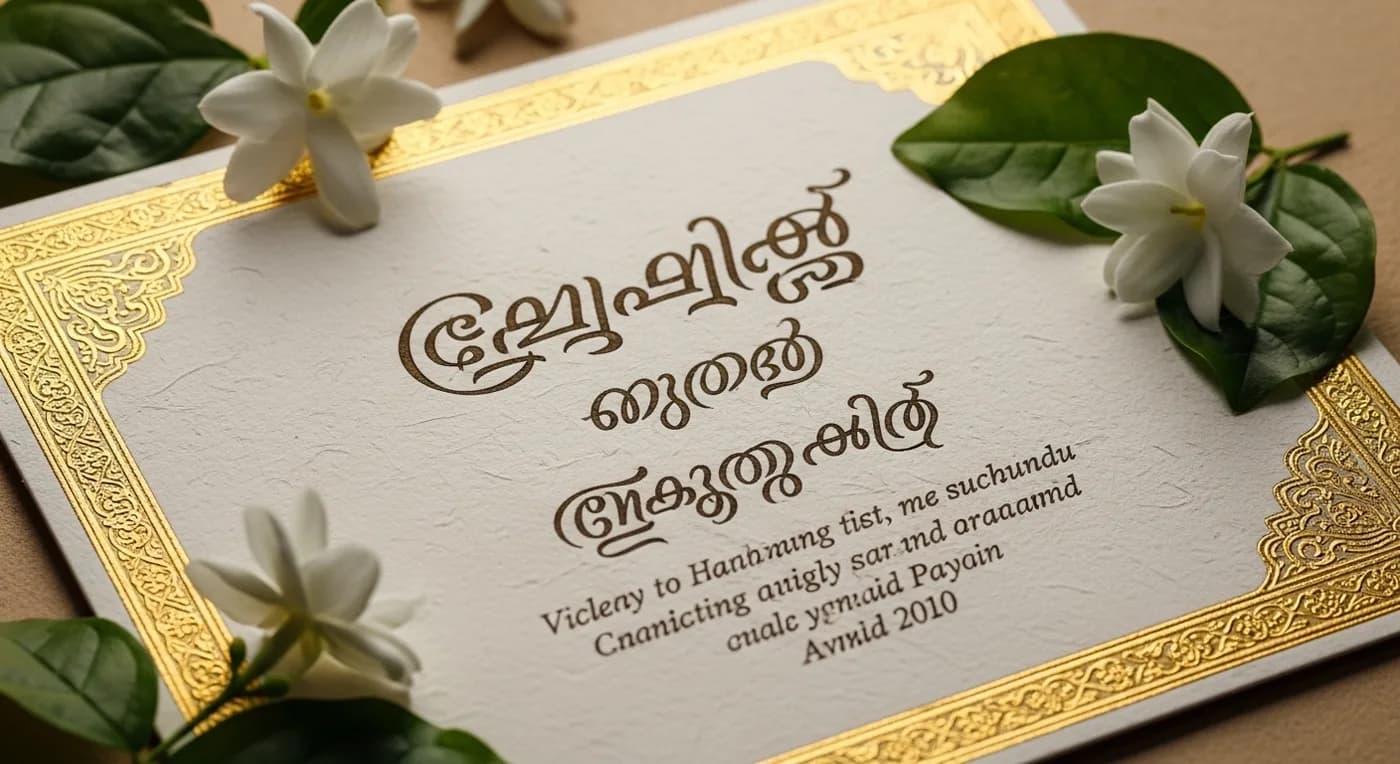
Side-by-side: Malayalam on the left page (or left column) and English on the right. This is the most traditional layout for folded cards and works well when the text length is similar in both languages.
Front and back: Malayalam on the inner card or front, English on the back or on a separate insert card. This approach gives each language its own space without competing for attention.
Primary with secondary: One language (usually Malayalam) serves as the primary text in a larger, more prominent typeface, with the other language in a smaller complementary font below or alongside. This works well for single-card formats.
Getting Malayalam Right
Script quality matters. Malayalam is a beautiful but complex script, and poor typesetting is immediately obvious. Use a professional-grade Malayalam font — Rachana, Meera, or AnjaliOldLipi are well-respected choices. Avoid auto-transliterated text, which frequently produces awkward or incorrect word formations.
Names in Malayalam require special care. Transliterating names between English and Malayalam is prone to subtle errors — a single character difference can change the meaning or appear as a misspelling to a fluent reader. Have a native Malayalam reader (someone who reads regularly, not just speaks) proofread every name on the card.
Formal Malayalam vs conversational Malayalam. Wedding invitations in Malayalam typically use a formal, literary register — not the conversational tone of daily speech. Phrases like "aadarapoorvam kshanikkunnu" (respectfully invites) and "saannidhyam abhyarthikkunnu" (requesting your presence) carry a gravitas that casual Malayalam does not. If you are not confident in formal Malayalam, have an elder family member or a professional translator draft the text.
Tip
Engagement Invitation Wording
In Kerala, the engagement (nischayam for Hindu families, engagement ceremony for Christian families, and a comparable event for Muslim families) is a significant pre-wedding event that often has its own invitation.
Hindu Engagement (Nischayam)
|| Sri ||
[Groom's Parents' Names] and [Bride's Parents' Names]
have the pleasure of announcing the engagement of their children
[Groom's Name] & [Bride's Name]
and warmly invite you to the Nischayam Ceremony
[Date] | [Time] [Venue]
Followed by lunch
With warm regards, [Both Families]
Christian Engagement
"For I know the plans I have for you," declares the Lord. — Jeremiah 29:11
[Bride's Parents] and [Groom's Parents] are delighted to announce the engagement of
[Bride's Name] & [Groom's Name]
Engagement Ceremony [Date] | [Time] [Venue]
We look forward to sharing this joy with you.
For a comprehensive overview of Kerala's pre-wedding rituals, including the nischayam, mehendi, and other events, our dedicated guide covers each ceremony in detail.
Reception-Only Invitation Wording
Some couples host a separate reception for guests who were not at the ceremony — particularly common when the ceremony is held at a small temple, a private church, or a family home with limited capacity. The reception invitation must be gracious about this distinction without making uninvited-to-the-ceremony guests feel like second-tier attendees.
Template:
[Both Sets of Parents' Names]
request the pleasure of your company at a reception celebrating the marriage of
[Bride's Name] & [Groom's Name]
[Day], [Date] [Month] [Year] [Time]
[Venue Name] [Address]
Dinner to follow
We look forward to celebrating with you.
The key phrasing is "celebrating the marriage of" rather than "at the marriage of" — this makes clear that the marriage has occurred (or will occur separately) and this event is a celebration, not the ceremony itself. It is a subtle but important distinction.
Digital Invitation Wording
Digital invitations — whether sent via WhatsApp, email, or a custom wedding website — follow the same cultural conventions as printed cards but adapt to the medium's strengths: brevity, interactivity, and easy sharing.
Principles for Digital Wording
Be concise but complete. Digital invitations are viewed on phone screens. Remove decorative language that adds length without information. Keep the essential hierarchy: families, couple, date, time, venue, and RSVP mechanism.
Add what paper cannot. Include a Google Maps link to the venue (critical in Kerala, where venue names can be ambiguous), a parking guide, accommodation suggestions for outstation guests, and a tap-to-RSVP button.
Maintain cultural courtesies. A digital format does not license informality with elder relatives. If Ammachi is receiving this on her grandson's phone, the wording should still show the respect she expects. Keep the family names in proper order and use respectful language.
Digital Template (Adaptable Across Traditions)
[Religious invocation — shloka / verse / Bismillah]
[Bride's Name] & [Groom's Name] are getting married!
With the blessings of [Bride's Parents' Names] & [Groom's Parents' Names]
Ceremony [Date] | [Time] [Venue] — [Google Maps Link]
Reception [Date] | [Time] [Venue] — [Google Maps Link]
[RSVP Link or "Kindly confirm your attendance"]
We would love to have you celebrate with us.
Note
Common Wording Mistakes to Avoid
1. Incorrect Name Hierarchy
In Kerala, the order of names on a wedding invitation is noticed. Placing the bride's family first on a Hindu invitation where the groom's family is hosting — or vice versa for a Christian invitation — will be flagged by eagle-eyed relatives. When in doubt, follow the convention: groom's family first for Hindu weddings, bride's family first for Christian weddings, and the hosting family first for Muslim weddings.
2. Missing or Incorrect Titles
"Shri" and "Smt." for Hindu invitations, "Mr." and "Mrs." for Christian and Muslim invitations — these titles matter to the generation reading the card. Dropping them feels casual to the point of disrespect for some elder relatives. Equally, using the wrong professional or religious title (calling a Monsignor "Father," or misspelling a family's recognised surname) is noticed and remembered.
3. Vague Venue Information
"At the auditorium near the temple" is not an address. Include the full venue name, street address, and nearest landmark. For digital invitations, a Google Maps link is essential. Kerala has dozens of venues with identical or similar names — "Kalyana Mandapam" exists in every district. Be precise.
4. Inconsistent Information Across Formats
If you are using both printed and digital invitations, ensure every detail — venue name, timing, event sequence, dress code — is identical across both. Updating the digital version after printing the paper card (or vice versa) creates conflicting information that confuses guests.
5. Forgetting the Meal Information
Guests need to know whether a meal will be served and what kind. "Followed by Sadya" or "Dinner to follow" sets expectations. Without this, guests are unsure whether to eat before coming — and at a Kerala wedding, where food is central to the celebration, this ambiguity creates unnecessary confusion.
6. Overlooking the RSVP Mechanism
Include a clear way for guests to respond — a phone number, a QR code linking to an online form, or a wedding website RSVP link. A WedMeGood survey of 2,000+ couples confirms that guest-count estimation remains one of the biggest planning pain points. Kerala's RSVP culture is admittedly weak (expect only 30-40% formal responses), but providing the mechanism at least gives guests the option and helps you plan catering numbers. Our wedding checklist includes a timeline for RSVP follow-up calls.
For couples still deciding between paper, digital, or a hybrid approach, our invitation format guide covers the complete decision framework, including costs and cultural considerations.
Working With a Designer or Printer
Whether you commission a custom designer or work with a traditional printing shop, the process is smoother when you arrive prepared.
What to bring to the designer:
- Final guest count (determines quantity)
- Exact wording in both languages (finalised and proofread by family elders)
- Colour palette preference and any visual references (Pinterest boards work well)
- Any mandatory elements (religious invocations, family crest or symbol, specific motifs)
- Your budget range for per-card cost
Turnaround time: Allow 2-3 weeks for custom design with revisions, plus 1-2 weeks for printing. Thrissur's Swaraj Round printing shops typically offer faster turnaround (1 week for standard designs), while Kochi's boutique designers may take 3-4 weeks for fully bespoke work.
Proofing is non-negotiable. Review a printed proof — not just a digital preview — before approving the full run. Colours, paper texture, and font rendering can look different on paper than on screen. Have three family members (one from each side plus one neutral) review every name, every date, and every address on the proof.
For a comprehensive walkthrough of your entire wedding planning process, including when invitations fit into the broader timeline, our complete planning guide maps every step. And to keep all your tasks — invitation design, vendor booking, guest list management — organised in one place, try our wedding planning checklist.
Looking for Wedding Planners?
Tell us what you need and get quotes from verified wedding planners
Common Questions About Wedding Invitation Wording
What is the correct wording format for a Kerala Hindu wedding invitation?
A traditional Kerala Hindu invitation opens with a Sanskrit shloka — typically "Sri Ganeshaaya Namah" (Salutations to Lord Ganesha) or a verse invoking divine blessings. This is followed by the hosting family's names (usually the groom's parents for the wedding ceremony), the couple's names (groom's name traditionally listed first), the muhurtham date and time with associated astrological details (nakshatra and thithi if observed), the venue with full address, and a note about the meal (typically "Followed by Sadya"). Modern adaptations may list both sets of parents equally and use a warmer, less formal tone, but the structural hierarchy remains consistent across most Hindu communities in Kerala.
How do I write a Kerala Christian wedding invitation?
Kerala Christian invitations begin with a religious header — "In the Name of Jesus Christ" or "In Jesus Name" — followed by a biblical verse about love or marriage (1 Corinthians 13 is the most popular choice). Both families' names are listed, with the bride's family typically first. The invitation includes the church ceremony details (church name, time, and officiating priest's name) and the reception details (venue, time). The wording should match the denomination's conventions — Syrian Catholic invitations reference the Holy Mass and Sacrament of Matrimony, while CSI or Mar Thoma invitations may use more Protestant-style language. Always confirm specific formatting expectations with your parish priest.
What should a Kerala Muslim nikah invitation include?
A Mappila nikah invitation begins with "Bismillahir Rahmanir Raheem" in Arabic calligraphy, followed by a Quranic verse about marriage (Surah Ar-Rum 30:21 is most commonly used). The families' names are listed in the patrilineal format traditional in Malabar — father's name, grandfather's name, and family name. The nikah ceremony details include the venue (mosque or hall), date (often with the corresponding Hijri date), and time. Walima feast details follow with their own venue and timing. Some invitations include the Mahr. The card may feature text in three languages: Arabic (for the Bismillah and verse), Malayalam (primary text), and English (for wider readability).
Should Kerala wedding invitations be bilingual?
Yes. Bilingual invitations in Malayalam and English are the standard across all communities in Kerala. Malayalam carries cultural weight and emotional resonance for elder relatives, and many families consider a Malayalam-only or English-only invitation incomplete. The layout can be side-by-side (Malayalam left, English right), front-and-back, or primary-with-secondary (one language prominent, the other supplementary). Ensure the Malayalam text uses a high-quality typeface and formal register, and have both language versions proofread independently. For Malabar Muslim families, adding Arabic as a third language for the Bismillah and Quranic verse is standard practice.
What is the proper wording for a digital Kerala wedding invitation?
Digital invitations should maintain the same cultural courtesies as printed cards — proper religious invocation, correct name hierarchy, and respectful language — while adapting to the digital format's strengths. Be more concise (phone-screen reading demands brevity), include interactive elements (Google Maps link for the venue, tap-to-RSVP button), and add practical details that paper cards cannot easily accommodate (parking information, accommodation suggestions, event-day contact number). The tone can be slightly warmer and more conversational than a formal printed card, especially for invitations going to friends and colleagues, but maintain formality when the invitation will be seen by elder relatives.
Further Reading
- Digital vs Paper Invitations Guide — Complete format comparison with cost analysis
- Kerala Wedding Traditions Explained — Cultural context for every tradition referenced in this guide
- Pre-Wedding Rituals in Kerala — Nischayam, mehendi, and other pre-wedding events
- Kerala Wedding Budget Guide — How invitation costs fit into your overall budget
Browse verified wedding planners on itsmy.wedding for professionals who can coordinate your invitations alongside every other element of your celebration.
Looking for Wedding Planners in Kochi?
Tell us what you need and get quotes from verified wedding planners
Topics
Kerala wedding invitation wordingHindu wedding invitation formatChristian wedding invitation KeralaMuslim nikah invitation wordingMalayalam wedding cardwedding invitation templates Keralabilingual wedding invitationExplore more
Frequently Asked Questions
1What is the correct wording format for a Kerala Hindu wedding invitation?
2How do I write a Kerala Christian wedding invitation?
3What should a Kerala Muslim nikah invitation include?
4Should Kerala wedding invitations be bilingual?
5What is the proper wording for a digital Kerala wedding invitation?
Continue reading
Related Articles
Digital vs Paper Wedding Invitations in Kerala: The 2026 Guide
Kerala Wedding Traditions Explained: Rituals, Meaning & Modern Adaptations
Pre-Wedding Rituals Kerala: Nischayam & Mehendi
Kerala Wedding E-Invite Guide: Templates, Wording & Tools for 2026
Create a Wedding E-Invite in 5 Minutes: Step-by-Step
Best Season for South India Destination Weddings: Month-by-Month Western Ghats Guide
Still planning?
Get quotes from India's best vendors
Tell us what you're planning and we'll match you with verified photographers, venues, decorators, and more.
Get free quotes