
Kerala Wedding Sadhya & Catering Cost: 2026 Pricing Guide
Complete breakdown of Kerala wedding catering costs — sadya per-plate rates, buffet pricing, caterer selection, menu components, and serving logistics for 2026.

Wedding Finance Advisor
Arjun Das is a wedding finance advisor who helps couples across Kerala plan celebrations that match their vision without breaking the bank.
On this page
A Kerala wedding sadya costs ₹600–₹1,800 per plate in 2026, with the standard tier at ₹800–₹1,000 covering 24–26 dishes and 3 payasam varieties. For 500 guests, expect ₹4–5 lakh at standard tier — 30–40% cheaper than a non-veg buffet. Gourmet sadya with organic ingredients and 7+ payasam varieties runs ₹1,400–₹1,800 per plate.
Quick Answer
Quick answer: Kerala wedding sadya costs ₹600–₹1,800 per plate in 2026. The standard tier (₹800–₹1,000/plate, 24–26 dishes, 3 payasams) is the sweet spot — for 500 guests that's ₹4–5 lakh. Sadya is 30–40% cheaper than an equivalent non-veg buffet. Gourmet sadya with organic ingredients and 7+ payasam varieties runs ₹1,400–₹1,800/plate.
Note
Pricing methodology: Cost ranges in this guide are based on vendor pricing data from the itsmy.wedding marketplace and published industry reports, collected in Q4 2025 – Q1 2026.
Kerala wedding sadya cost is the single line item that keeps more families awake at night than any other part of the wedding budget. It is also the one thing no guest forgets. Ask someone about a wedding they attended three years ago and they will struggle to remember the decor colour or the sangeet playlist — but they will tell you whether the sambar was good, how many payasams were served, and whether the parippu had enough ghee. Food is the centrepiece of a Kerala wedding, and the sadya served on a fresh banana leaf is its purest expression. With India's wedding industry valued at ₹10.79 lakh crore and projected to reach ₹24 lakh crore by 2030 according to IBEF, catering is the single largest spend category for most families.
That reality puts enormous pressure on families to get catering right. Underspend and the whispers start before the second serving of rice. Overspend and you blow a hole in the budget that forces compromises on photography, decor, or the honeymoon. This guide exists to give you the clarity that sits between those two extremes — real numbers, district-level pricing, menu breakdowns, caterer selection advice, and the hidden costs that surface after the contract is signed. Whether you are planning a 200-person intimate ceremony in Palakkad or a 1,000-guest celebration in Ernakulam, the information here is drawn from current 2026 market rates across Kerala.
Sadya Per-Plate Costs in 2026
The first question every family asks is straightforward: how much per plate? The answer depends on the tier of sadya you choose, which is primarily driven by dish count, payasam variety, ingredient sourcing, and the professionalism of the serving crew.
₹600 – ₹1,800Here is how the four tiers break down in practice:
| Tier | Per Plate (INR) | Dish Count | Payasam Varieties | Serving Style |
|---|---|---|---|---|
| Basic | 600 - 800 | 20-22 items | 2 (palada, parippu pradhaman) | Communal serving, minimal staff |
| Standard | 800 - 1,000 | 24-26 items | 3 (adds semiya or ada pradhaman) | Trained servers, coordinated rounds |
| Premium | 1,000 - 1,400 | 26-28 items | 5 (adds pal payasam, gothambu) | Professional crew with team lead |
| Gourmet | 1,400 - 1,800 | 28-32 items | 7+ (includes chakka, kadala, pineapple) | Organic/heirloom ingredients, dedicated service captain |
Basic tier (600-800 per plate) is what you will find at smaller community hall weddings and budget-conscious family events. The food is honest and filling — this is not a compromise on taste, but on variety. You get a well-made sambar, rasam, aviyal, thoran, two payasams, and the core items that define a sadya. Serving is often semi-communal, with large vessels placed at intervals and family members or hired helpers ladling out portions. For a 300-guest wedding, this tier puts your catering bill between 1.8 and 2.4 lakhs.
Standard tier (800-1,000 per plate) is the sweet spot for most Kerala weddings in 2026. The dish count rises to 24-26, which means you get the full traditional spread: kalan, erissery, pachadi, kichadi, olan, and a third payasam variety. Servers are trained to work in coordinated rounds, ensuring every guest receives each dish in the correct order. This is the tier where guests leave the table feeling that the wedding was "done properly." For 500 guests, expect 4 to 5 lakhs.
Premium tier (1,000-1,400 per plate) adds refinement. Ingredients are sourced more carefully — Palakkadan matta rice instead of generic red rice, Wayanadan pepper in the rasam, specific banana varieties for the payasam. The payasam counter expands to five varieties, and the serving crew operates with a team lead who coordinates timing across the hall. This tier is popular in Kochi and Trivandrum among families that want a traditional sadya but with elevated execution.
Gourmet tier (1,400-1,800 per plate) is relatively new to the Kerala wedding market and has gained traction primarily among NRI families and high-budget celebrations. It features organic and heirloom ingredients throughout — everything from the coconut oil to the jaggery is sourced from specific farms. The payasam selection can reach seven or more varieties, including chakka pradhaman, kadala pradhaman, and seasonal fruit payasams. A dedicated service captain manages the entire meal, and some gourmet caterers offer custom banana leaf art or presentation touches. For 500 guests at this tier, you are looking at 7 to 9 lakhs for the sadya alone.
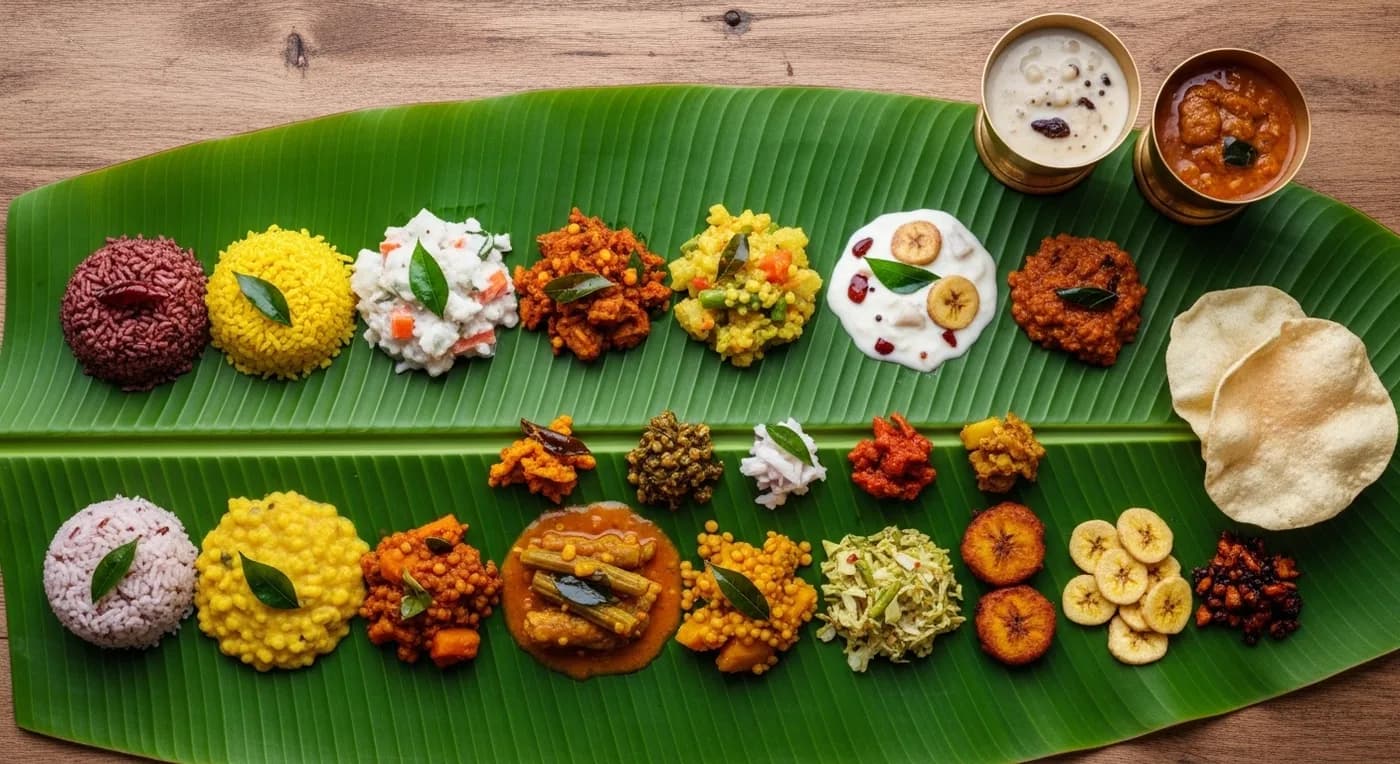
What's in a Wedding Sadya: The Full 26-Item Breakdown
A traditional Kerala wedding sadya is not a random assortment of dishes placed on a leaf. Every item has a designated position, and the order of serving follows a sequence that has been refined over centuries. Understanding this helps you evaluate caterer proposals — if a caterer cannot tell you where the pickle goes on the leaf, that is a red flag.
Tip
Left Side of the Banana Leaf
The left side (from the diner's perspective) holds the smaller portions and accompaniments:
- Upperi / Banana chips — salted and sometimes sweetened, placed at the far left
- Sharkkara varatti — jaggery-coated banana chips, a must-have for any wedding-grade sadya
- Pavakka theeyal — bitter gourd in roasted coconut gravy (often substituted or supplemented with ulli theeyal)
- Kalan — raw banana and yam in thick curd-coconut gravy
- Olan — ash gourd and cowpeas in thin coconut milk, seasoned only with coconut oil and curry leaves
- Pachadi — pineapple or cucumber in sweetened curd preparation
- Kichadi — curd-based side, distinct from pachadi in its use of mustard and ground coconut
Right Side of the Banana Leaf
The right side holds the main vegetable preparations:
- Aviyal — mixed vegetables in thick coconut-curd sauce, the backbone of the sadya
- Erissery — pumpkin and lentil preparation with coconut
- Thoran — dry stir-fried vegetable with grated coconut (cabbage, beans, or drumstick leaves)
- Mezhukkupuratti — vegetables stir-fried in coconut oil with minimal spice
- Pickle varieties — mango pickle (inji puli is non-negotiable), lime pickle, and sometimes a naranga pickle
Top of the Leaf (Above the Rice Area)
- Pappadam — two, placed above the serving area
- Banana — small nendran banana, placed at the top right
Centre of the Leaf (Served with Rice)
- Rice — matta rice or par-boiled rice, served in two to three rounds
- Parippu — dal served first with ghee, the opening course
- Sambar — served with the second round of rice
- Rasam — served with the third round, lighter and spicier
- Pulissery — curd-based curry to settle the palate, served after rasam
- Ghee — ladled generously alongside parippu and rice
Served Last
- Payasam — the grand finale, served in small cups or directly onto the leaf
District Variations
Not every sadya in Kerala is identical. Regional traditions shape the menu in subtle but meaningful ways.
Thrissur-style sadya is widely considered the gold standard for wedding celebrations. Thrissur families tend to insist on higher payasam counts — five varieties is common even at standard-tier budgets — and the use of Thrissur-specific preparations like koottucurry (chickpea and raw banana in coconut gravy) is expected.
Palakkad-style sadya is distinguished by its emphasis on ghee and a slightly different spice balance. Palakkadan sadya uses more tamarind in the sambar, tends toward a tangier rasam, and the parippu is often creamier. Weddings in Palakkad district also frequently include inji curry (ginger preserve) as a separate item, and the banana chips are typically fried in coconut oil sourced locally.
Malabar adaptations in Kozhikode and Malappuram deserve special mention. While the traditional sadya is vegetarian, Malabar Muslim weddings often supplement the leaf meal with non-vegetarian items served alongside — chicken curry, mutton biryani, or fish fry on a separate plate. This hybrid format pushes per-plate costs up by 200-400 rupees but reflects the culinary tradition of the region.
Trivandrum sadya tends to be slightly simpler in item count but places heavy emphasis on the quality of sambar and rasam. Trivandrum caterers also tend to include a separate avial preparation that uses drumstick prominently, which is less common in central Kerala.
Buffet and Multi-Cuisine Catering Options
Not every Kerala wedding sticks to the traditional banana leaf sadya, especially for evening receptions. Many families serve a sadya for the morning ceremony and switch to a buffet spread for the reception. Here is what each format costs.
Vegetarian Buffet
₹800 – ₹1,500A vegetarian buffet typically includes North Indian and South Indian dishes — paneer preparations, gobi manchurian, multiple rice varieties, pasta or noodles, soup, salad counter, and a dessert spread. This is 15-30% more expensive per plate than a sadya because of the wider ingredient variety, chafing dish equipment, and the longer service window (buffets typically run 90 minutes versus the 40-minute sadya).
Non-Vegetarian Multi-Cuisine Buffet
₹1,200 – ₹2,500The non-veg buffet is the default evening reception format for most Kerala weddings outside the strictly vegetarian Hindu ceremony context. Expect chicken (usually two preparations), fish (one or two preparations), and sometimes mutton. Chinese, Continental, and Mughlai counters are common additions. The per-plate range varies enormously because the protein choices drive cost — a simple chicken-and-fish buffet at 1,200 per plate is a different animal from a spread with mutton biryani, prawn masala, and crab malabar at 2,200 per plate.
Live Counters and Premium Formats
₹2,000 – ₹4,000Live counters — dosa stations, pasta bars, tandoor counters, and ice cream sundae setups — have moved from luxury to mainstream in Kochi and Trivandrum weddings. They add theatre to the reception and reduce food waste since items are prepared to order. Live counter costs are usually charged as add-ons to the base buffet rate, adding 300-800 rupees per plate depending on the number of stations. Full premium formats that combine live counters with plated starters and a curated dessert room can push per-plate costs to 3,500-4,000.
Looking for Caterings in Kochi?
Tell us what you need and get quotes from verified caterings
Total Catering Budget by Guest Count
The per-plate rate only tells half the story. What families actually care about is the total bill. Here is a realistic projection across five guest count brackets, covering the three most common catering formats.
| Guest Count | Sadya Only (at 850/plate) | Non-Veg Buffet Only (at 1,800/plate) | Combined: Sadya AM + Light Buffet PM |
|---|---|---|---|
| 200 guests | 1,70,000 | 3,60,000 | 2,90,000 |
| 300 guests | 2,55,000 | 5,40,000 | 4,35,000 |
| 500 guests | 4,25,000 | 9,00,000 | 7,25,000 |
| 700 guests | 5,95,000 | 12,60,000 | 10,15,000 |
| 1,000 guests | 8,50,000 | 18,00,000 | 14,50,000 |
The "Combined" column assumes a standard sadya for the morning ceremony (full guest list) and a lighter buffet for the evening reception (typically 60-70% of the morning guest count attend the evening event). This combined approach is the single most effective catering budget strategy for Kerala weddings.
Tip
Note that these totals do not include the hidden costs discussed below. Add 8-15% to any total you calculate to account for service charges, GST, beverage costs, and banana leaf sourcing fees.
How to Choose a Wedding Caterer in Kerala
Choosing a caterer is not like choosing a photographer, where you can review a portfolio and get a reasonable sense of quality. Food quality varies from event to event depending on ingredient freshness, kitchen setup, and crew coordination on the day. Here is a seven-step process that minimises your risk.
If you are still weighing whether to go with a traditional sadya, a modern buffet, or a combination of both, our sadya vs buffet comparison guide breaks down the pros, cons, and cost differences side by side. And if you are looking for specific caterer recommendations across Kerala, check our best wedding caterers in Kerala directory.
1. Request a Tasting Session
Any caterer bidding on a 200+ guest wedding should offer a complimentary tasting. This is standard practice in Kerala. If a caterer charges for the tasting or refuses to do one, that is a warning sign. During the tasting, pay attention not just to taste but to presentation, temperature (is the sambar served hot?), and consistency of the rice texture. Bring two or three family members — taste is subjective and you want consensus.
2. Check Recent Wedding References
Ask the caterer for three references from weddings they catered in the last six months with a similar guest count to yours. Call these references directly. Ask specifically about: was the food served on time, did they run short on any dish, how was the payasam quality in the final serving rounds, and did the crew clean up properly.
3. Verify Hygiene Certification and Insurance
FSSAI licensing is mandatory for commercial caterers in India. Ask to see the license. Beyond compliance, check whether the caterer carries event liability insurance — this protects you if a guest falls ill. Reputable caterers in Kochi, Thrissur, and Kozhikode increasingly carry this as standard.
4. Confirm Staff Count Per 100 Guests
For a seated sadya, you need a minimum of 8-10 trained servers per 100 guests to ensure coordinated rounds (industry standard for banana-leaf service). For a buffet, 4-6 service staff per 100 guests is adequate. Ask the caterer to specify the exact headcount in writing. Understaffing is the most common cause of chaotic service at Kerala weddings.
5. Clarify Banana Leaf Responsibility
This sounds trivial until the morning of the wedding when the leaf supplier does not show up. Confirm in writing whether banana leaf sourcing and delivery is the caterer's responsibility or yours. Most professional caterers handle this, but budget-tier operators sometimes leave it to the family, which creates last-minute scrambles during peak wedding season when leaf demand spikes.
6. Agree on Serving Coordination and Timing
A 500-guest sadya needs to be served in batches (called "panthi" in Kerala). Confirm the batch size, the gap between batches, and how the caterer coordinates with the wedding ceremony timeline. A good caterer will send a coordinator to the venue a day before the event to walk through the logistics.
7. Get Written Cleanup Terms
Who clears the banana leaves? Who washes the serving vessels? Who handles waste disposal? These responsibilities need to be explicit. At venue-based weddings, leaving dirty banana leaves on the floor for more than an hour after the meal will attract complaints from the venue management and may result in penalty charges.
Important
District-Level Pricing Across Kerala
Catering costs are not uniform across Kerala. Real estate costs, ingredient sourcing logistics, competition density, and local culinary standards all create meaningful price differences between districts.
Kochi (Ernakulam District) — The Most Expensive
Kochi commands the highest catering rates in Kerala, running 15-25% above the state average. A standard sadya that costs 850 per plate in Thrissur will cost 950-1,050 in Kochi. The premium reflects higher venue kitchen rental costs, costlier ingredient sourcing through Ernakulam wholesale markets, and the general cost-of-living markup that touches every service in the city. Non-veg buffet rates in Kochi start at 1,400 per plate — you will struggle to find a reputable caterer who goes below that number for a wedding event.
Thrissur — Strong Tradition, Moderate Pricing
Thrissur is the cultural capital of Kerala and takes its sadya very seriously. Caterers here have deep expertise and generational knowledge. Pricing is moderate — 750-950 per plate for a standard wedding sadya — but the quality expectation is high. Thrissur families will notice if the ada pradhaman is not made from scratch or if the sambar uses pre-ground masala. The caterer ecosystem here is robust, with many operators specializing exclusively in wedding sadya and nothing else.
Looking for Caterings in Thrissur?
Tell us what you need and get quotes from verified caterings
Palakkad — Most Affordable, Distinctive Flavour
Palakkad consistently offers the lowest catering rates in Kerala, running 15-20% below the state average. A standard wedding sadya here costs 600-850 per plate. The lower cost is driven by proximity to Tamil Nadu supply chains (which brings down ingredient costs for certain items), lower venue overheads, and a cultural preference for elegant simplicity over extravagance. Palakkad caterers are known for excellent parippu and sambar — the basics done perfectly.
Kozhikode (Calicut) — The Malabar Premium
Kozhikode pricing sits in the mid-to-high range, particularly for events that include non-vegetarian components. A vegetarian sadya in Kozhikode runs 800-1,000 per plate, comparable to Thrissur. But the Malabar biriyani-and-sadya combination format that is standard at Muslim weddings in the region pushes per-plate costs to 1,100-1,600 because of the protein-heavy menu additions. Kozhikode also has a distinct serving culture — large copper vessels (uruli) and brass plates are common at premium events, adding to the visual appeal but also to the rental cost.
Trivandrum (Thiruvananthapuram) — Government City, Measured Spending
Trivandrum sits at the moderate end of the spectrum, with standard sadya rates between 750-950 per plate. The city's government-employee demographic tends toward measured spending, and caterers have adapted their pricing accordingly. The competition between auditorium-based caterers in areas like Kowdiar, Pattom, and Kazhakkoottam keeps pricing honest. Trivandrum is also one of the few districts where you can still find excellent traditional caterers offering 22-item sadyas in the 600-700 range for smaller weddings.
Hidden Catering Costs That Inflate Your Bill
The per-plate rate your caterer quotes is not the final number. Budget an additional 8-15% for the following items that commonly appear as extras on the final invoice.
Service Staff Surcharge
Some caterers quote per-plate rates that cover food only, with service staff billed separately. This can add 30-60 rupees per plate or a flat fee of 15,000-40,000 depending on the event size. Clarify upfront whether service staff is included in the quoted rate.
Banana Leaf Sourcing Fee
Banana leaves for a 500-guest sadya cost 5,000-10,000 depending on the season and location. During peak wedding months (November-January), leaf prices can double because demand outstrips supply from local farms. Some caterers absorb this cost; others pass it through as a line item.
Water and Beverages
Traditional sadya includes water, but any additions — lime juice, buttermilk counters, soft drinks, or tea/coffee service after the meal — are billed separately. A basic beverage package adds 40-80 rupees per plate. Tea and coffee service for 500 guests costs 15,000-25,000 as a standalone item.
Overtime for Extended Service
Most caterer quotes assume a specific service window — typically 3-4 hours from kitchen setup to cleanup. If the ceremony runs long and the meal starts late, or if you need an extended serving window for VIP guests who arrive after the main batch, overtime charges of 5,000-15,000 per hour can apply.
GST: The 5% vs 18% Threshold
This is the hidden cost that catches the most families off guard. Catering services charged by restaurants or hotel-based caterers with AC facilities attract 18% GST. Independent caterers operating without AC premises charge only 5% GST. For a 5-lakh catering bill, the difference between 5% and 18% GST is 65,000 rupees. Confirm the applicable GST rate before signing any contract.
Important
Venue Corkage and Kitchen Access Fees
Some venues charge a "kitchen access fee" for outside caterers to use the venue's kitchen infrastructure — gas connections, water, storage, and counter space. This ranges from 10,000-50,000 depending on the venue. Hotel venues may charge a corkage fee on top, which is essentially a penalty for not using their in-house caterer.
Money-Saving Tips for Wedding Catering
1. Optimise Your Guest Count Ruthlessly
Every 100 guests you cut saves 85,000-1,50,000 on catering alone. Before finalising numbers, do one honest pass through the guest list with your family. The uncle you have not spoken to in four years does not need to be there. A 400-guest wedding with excellent food is better than a 600-guest wedding with a stretched budget.
2. Serve Sadya for the Morning, Light Buffet for the Evening
This is the most proven cost-saving strategy in Kerala weddings. The morning sadya is traditional, expected, and affordable. The evening reception can be a simpler buffet — pasta, fried rice, a couple of curries, soup, and dessert — at 800-1,000 per plate instead of a full non-veg spread at 1,800-2,500. Combined savings for 500 guests: 1.5-3 lakhs.
3. Book Your Caterer 4-6 Months Early
Early booking locks in current rates. With CAIT reporting 4.6 million weddings and ₹6.5 lakh crore in spending during the November-December 2025 season alone, the demand pressure on caterers is immense. Caterers in Thrissur and Kochi regularly increase prices by 5-10% between January and June for the following wedding season (based on seasonal pricing patterns observed on itsmy.wedding). An early commitment with a written rate lock saves real money.
4. Choose a Specialist Over a Generalist
A caterer who does only wedding sadya — and does 100+ weddings a year — will give you better quality and pricing than a multi-cuisine caterer who treats sadya as one of many offerings. In Thrissur and Palakkad especially, the specialist sadya caterers offer the best value per plate because their supply chains and processes are optimised for exactly this format. For a curated list of proven professionals, browse our best wedding caterers in Kerala directory.
5. Negotiate the Payasam Count Separately
If you want premium payasam varieties (chakka pradhaman, unniyappam with payasam, etc.) but do not need the full gourmet tier, ask your caterer to add specific payasams as add-ons to a standard-tier sadya. Adding two extra payasam varieties typically costs 60-100 per plate — far less than upgrading the entire sadya tier.
6. Avoid Peak-Date Pricing by Choosing Off-Season or Weekday Dates
Caterers in Kochi and Trivandrum charge 10-20% premiums during peak muhurtham dates in November-January. A February or March wedding, or a weekday ceremony, gives you access to the same caterers at lower rates and with more flexibility on menu customisation.
7. Handle Banana Leaves and Beverages Independently
If your family has access to banana plantations (common in rural Kerala), sourcing leaves yourself saves 5,000-10,000. Similarly, buying beverages in bulk from a wholesaler and having family members manage the tea/coffee service is cheaper than paying the caterer's marked-up beverage rate.
Common Questions About Kerala Weddings Sadhya & Catering Cost
How much does a wedding sadya cost per plate in Kerala in 2026?
A standard wedding sadya costs 600 to 1,200 per plate in 2026. Premium sadya with organic ingredients and expanded payasam counters runs 1,000 to 1,800 per plate. The total catering bill for a 500-guest sadya ranges from 3 to 6 lakhs depending on menu complexity — well within the range WedMeGood's survey of 2,000+ couples confirms as typical for catering as a share of total wedding spend. The biggest variables are dish count (20 items versus 30+), payasam varieties (2 versus 7), ingredient sourcing (standard versus organic/heirloom), and whether your caterer provides a full professional serving crew or basic communal service.
Is sadya cheaper than buffet catering for a Kerala wedding?
Yes. Traditional sadya is typically 30-40% cheaper per plate than a multi-cuisine non-veg buffet. A sadya averages 700-1,000 per plate while a non-veg buffet runs 1,200-2,500 per plate. For 500 guests, this difference amounts to 2.5 to 7.5 lakhs in savings. The cost advantage comes from the sadya being entirely vegetarian (no expensive proteins), using simpler equipment (banana leaves versus chafing dishes and buffet infrastructure), and requiring a shorter service window. The one scenario where sadya is not cheaper is the gourmet tier with organic heirloom ingredients, which can approach or exceed the cost of a standard non-veg buffet.
How do I choose a wedding caterer in Kerala?
Ask for a tasting session (most reputable caterers offer this free for 200+ guest bookings), check their experience with your guest count, verify they provide serving staff, confirm they handle banana leaf sourcing, and get written confirmation of the full menu with dish count. Beyond these basics, call at least two recent references who hosted weddings of similar scale. Ask those references specifically about punctuality, whether any dish ran short during later servings, payasam consistency, and post-meal cleanup. The best caterers in Thrissur, Kochi, and Kozhikode will happily provide references because their reputation is built on word-of-mouth within the wedding community.
What is included in a standard Kerala wedding sadya?
A standard wedding sadya includes 20-26 items: rice varieties, sambar, rasam, aviyal, olan, kalan, erissery, pachadi, kichadi, thoran, olan, parippu, ghee, pickle varieties, pappadam, banana chips, payasam (2-3 types), and banana. Premium sadyas add 4-7 additional items including multiple payasam varieties and special rice preparations. Each item has a specific position on the banana leaf and is served in a particular order — this structure is not decorative but functional, designed to balance flavours and aid digestion across the meal. When evaluating caterer proposals, count the individual dishes listed and compare them against this benchmark to assess whether you are getting a genuine wedding-grade sadya or a trimmed-down version.
Should I serve sadya for both the ceremony and reception?
Most couples serve a traditional sadya for the morning ceremony (more affordable, culturally appropriate) and a lighter buffet or multi-cuisine spread for the evening reception. This saves 1-2 lakhs compared to doing full non-veg buffets for both events. The morning sadya honours tradition and is what the older generation of guests expects. The evening reception is more relaxed and social, making a buffet format more practical — guests mingle, eat at their own pace, and enjoy a wider variety of cuisines. If budget allows and your family strongly prefers it, serving sadya at both events is perfectly fine, but the cost savings from splitting formats is significant and the guest experience does not suffer.
Further Reading
If you are building a complete wedding budget, start with our Kerala Wedding Budget Guide for a full breakdown across all expense categories. For couples planning their first Kerala wedding and looking for a step-by-step overview, our How to Plan a Kerala Wedding guide walks through the entire process from engagement to reception. And if your wedding is in Ernakulam district, the Average Wedding Cost in Kochi guide provides neighbourhood-level pricing that complements the catering numbers in this article.
Sadya catering for destination and outstation weddings
If you are bringing Kerala sadya to a destination wedding outside the state — increasingly common for South Indian families hosting in Mumbai, the Andamans, Sri Lanka, or hill stations — catering logistics shift significantly. Banana-leaf service, traditional payasam ingredients, and trained sadya-style waiters typically need to travel with the team, and per-plate costs rise 40–80% over Kerala rates. For full venue-by-venue catering logistics and outstation planning, see our destination wedding cost guide for South India, Mumbai wedding venues with South Indian catering, Andaman destination wedding cost guide, and Sri Lanka destination wedding cost guide — each of which includes catering-specific notes for couples flying a Kerala sadya team to the venue.
Tip
Get your numbers right — use the Wedding Cost Calculator to model your budget by city, guest count, and style. Track spending in real time with the Budget Manager, and generate a personalised planning timeline with the AI Checklist.
Topics
Kerala wedding sadya costwedding catering cost Keralasadya per plate rate 2026Kerala wedding food budgetwedding caterer Kochisadhya catering KeralaExplore more
Frequently Asked Questions
1How much does a wedding sadya cost per plate in Kerala in 2026?
2Is sadya cheaper than buffet catering for a Kerala wedding?
3How do I choose a wedding caterer in Kerala?
4What is included in a standard Kerala wedding sadya?
5Should I serve sadya for both the ceremony and reception?
Continue reading
Related Articles

Kerala Wedding Budget Guide: 2026 Cost Breakdown
How to Plan a Kerala Wedding: The Complete 2026 Guide
Kochi Wedding Cost (2026): ₹8L–50L Budget Breakdown by Neighbourhood
Average Wedding Cost in India (2026): City-by-City Breakdown
Best Season for South India Destination Weddings: Month-by-Month Western Ghats Guide
Destination Wedding Cost in South India 2026: 5-Tier Budget Guide
Still planning?
Get quotes from India's best vendors
Tell us what you're planning and we'll match you with verified photographers, venues, decorators, and more.
Get free quotes