
Foreign Guests at a South Indian Wedding: Host's Brief
A practical brief for NRI couples taking American, British, European, or Australian friends to a South Indian wedding — dress code, food, gifts, etiquette, welcome kits.

On this page
Brief foreign guests 4–6 weeks out with a one-page PDF covering dress code, food, weather, etiquette, and gifts, and they will arrive calm, dressed correctly, and ready to join the celebration rather than spectate.
Quick Answer
The single best thing an NRI couple can do for non-Indian guests is send a written brief 4–6 weeks before the trip. Cover dress code per event, food and water safety, cash-in-envelope gifting (75–150 USD per person), ritual etiquette (shoes off, no crossing the fire), and what to pack. Assign each foreign guest a bilingual culture buddy for the muhurtham. That single document removes 80% of the anxiety they will never admit they are feeling.
When I flew four Boston friends to Thiruvananthapuram (Trivandrum) for my cousin's wedding in December 2023, I realised something the night before the muhurtham. They had read every blog post I sent and were still quietly panicking in the hotel lobby. What they needed was a one-page brief from me, the host — written like a friend, not a travel guide.
This post is that brief, for NRI couples handing American, British, European, or Australian friends something honest and practical. If you are the foreign guest who landed here searching "what to wear to a South Indian wedding as an American," skip to the table below.
Pair this with the NRI South Indian wedding complete guide and the 14-day NRI wedding trip playbook. Corridor versions: USA, UAE and Gulf.
What does a South Indian wedding look like for a first-time foreign guest?
A South Indian wedding is a multi-day, multi-venue celebration centred on a dawn muhurtham, a sadhya lunch on a banana leaf, and an evening reception. The WedMeGood Annual Wedding Industry Report 2024–2025 tracks average guest counts of 300–500 across two to four days. For anyone used to a three-hour evening ceremony, this is the first thing to unlearn.
A typical NRI wedding in Kochi (Cochin), Chennai, or Bengaluru (Bangalore) runs like this. Day minus two is mehendi and sangeet — casual, henna and dinner. Day zero is the muhurtham: the ceremony starts between 5:30 and 7:30 AM because the auspicious time is astrologically fixed, runs 60–90 minutes, and flows into sadhya by 11:30. The evening is a formal-glam reception. Day plus one is often a smaller family lunch.
| Event | Time | Dress Code | What to Expect |
|---|---|---|---|
| Mehendi / Sangeet | Evening, Day -2 | Bright cotton kurta or salwar; floral dress OK | Henna, music, dinner, photos |
| Muhurtham | 5:30–7:30 AM, Day 0 | Saree / anarkali / kurta + trousers; shoes off | Priest-led rituals, garland exchange |
| Sadhya lunch | ~11:30 AM, Day 0 | Same as muhurtham | 20+ dishes on a banana leaf, eaten by hand |
| Reception | 7–11 PM, Day 0 | Formal-glam: gown / lehenga / suit | Stage photos, dinner, music |
| Family lunch | Mid-day, Day +1 | Smart-casual kurta or dress | Informal, fewer guests |
The biggest surprise for foreign guests is the dawn start. Warn your friends early: the muhurtham does not move to a civilised 10 AM just because they are jet-lagged.
What should you tell your foreign friends about dress code?
South Indian wedding dress code for foreign guests is modest, colourful, and event-specific — muhurtham leans traditional, reception leans formal-glam. Kerala Tourism's cultural guidance for visitors flags weddings as occasions where modesty expectations are strictest.
For women, a saree is the gold standard at the muhurtham but the hardest to wear first time; an anarkali, a long kurta with palazzo, or a modest floor-length sleeved dress all work. For men, a kurta with churidar or cotton trousers is ideal; a crisp shirt and trousers works if a kurta feels theatrical. The reception moves to cocktail-formal: gown, lehenga, suit, bandhgala, or sherwani.
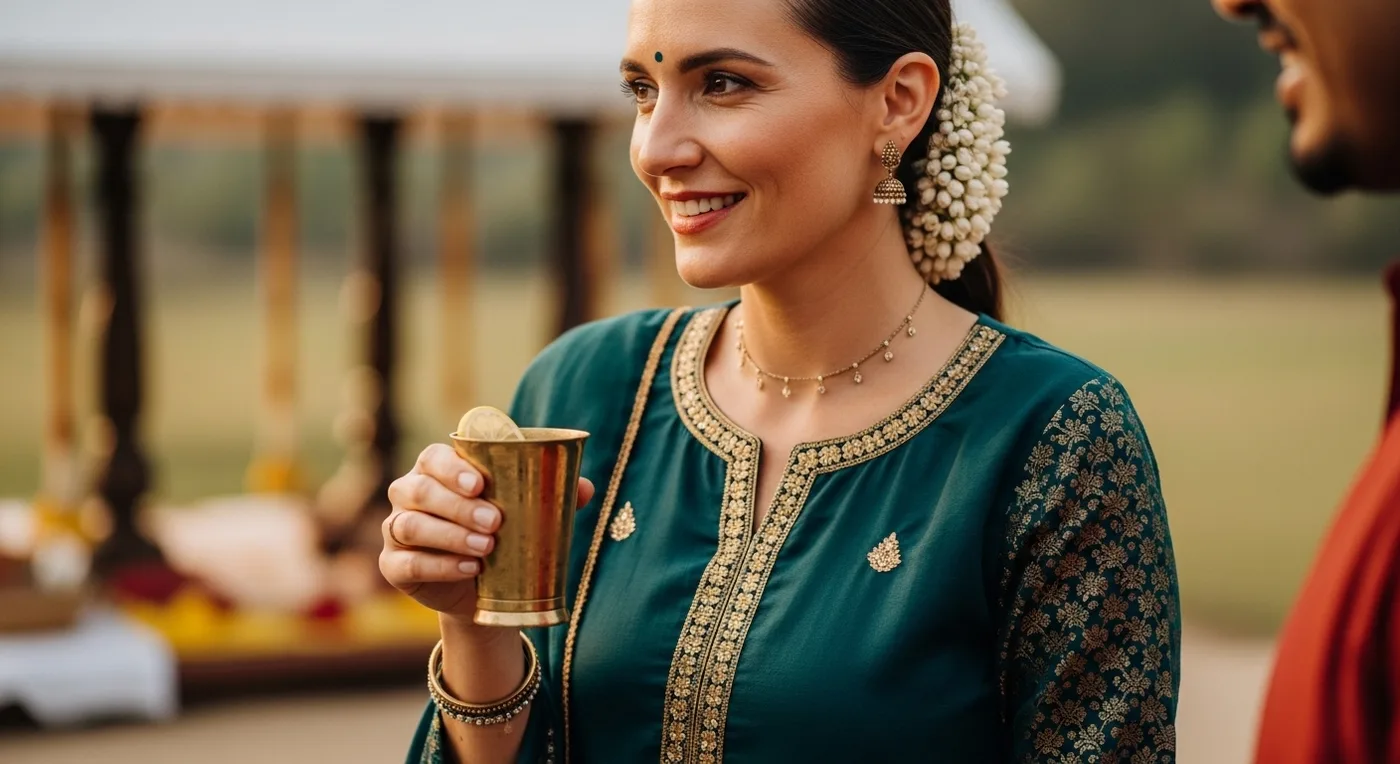
The no-go list is short: no strapless tops at the ceremony, nothing above the knee, no sheer fabrics without a slip, no jeans at the muhurtham, no beachwear anywhere. Pack flat, easy-off sandals — shoes come off at every mandapam, temple, and family home.
Looking for Wedding Planners in Kochi?
Tell us what you need and get quotes from verified wedding planners
How do you brief them on the weather and climate?
Kerala and coastal Tamil Nadu are tropical year-round, and the only comfortable window runs November through February. Kerala Tourism's climate guide lists that window at 24–32°C with low humidity, which is why almost every NRI wedding in Kochi, Thiruvananthapuram, Kumarakom, and Kozhikode (Calicut) clusters there. March to May pushes to 35°C. June to September is monsoon — torrential afternoon rain and flight delays.
Tell your friends three things. Breathable fabrics are non-negotiable: cotton, linen, and lightweight silk survive sadhya; polyester and wool do not. Humidity collapses hair and makeup by lunchtime, so pack blotting sheets. The sun is stronger than it looks through cloud cover, so SPF 50 and a collapsible umbrella (sun and rain) belong in every bag.
Important
If your wedding falls in June through September, explicitly warn foreign guests that monsoon is not "a bit of rain." Afternoon downpours flood roads, transfers run 30–60 minutes late, and open-air reception venues switch to covered backup. Everyone should pack one quick-dry outfit and waterproof shoes. Do not let them assume "tropical monsoon" means Bali in the dry season.
What food allergies and dietary questions should you prep them for?
Most Hindu South Indian weddings serve a fully vegetarian sadhya — a 20-dish feast on a banana leaf, eaten by hand. Syrian Christian Malayali, Kerala Muslim, and some Bunt or Reddy weddings include meat and seafood. The Grand View Research India wedding services market report flags catering as the largest line item in South Indian weddings.
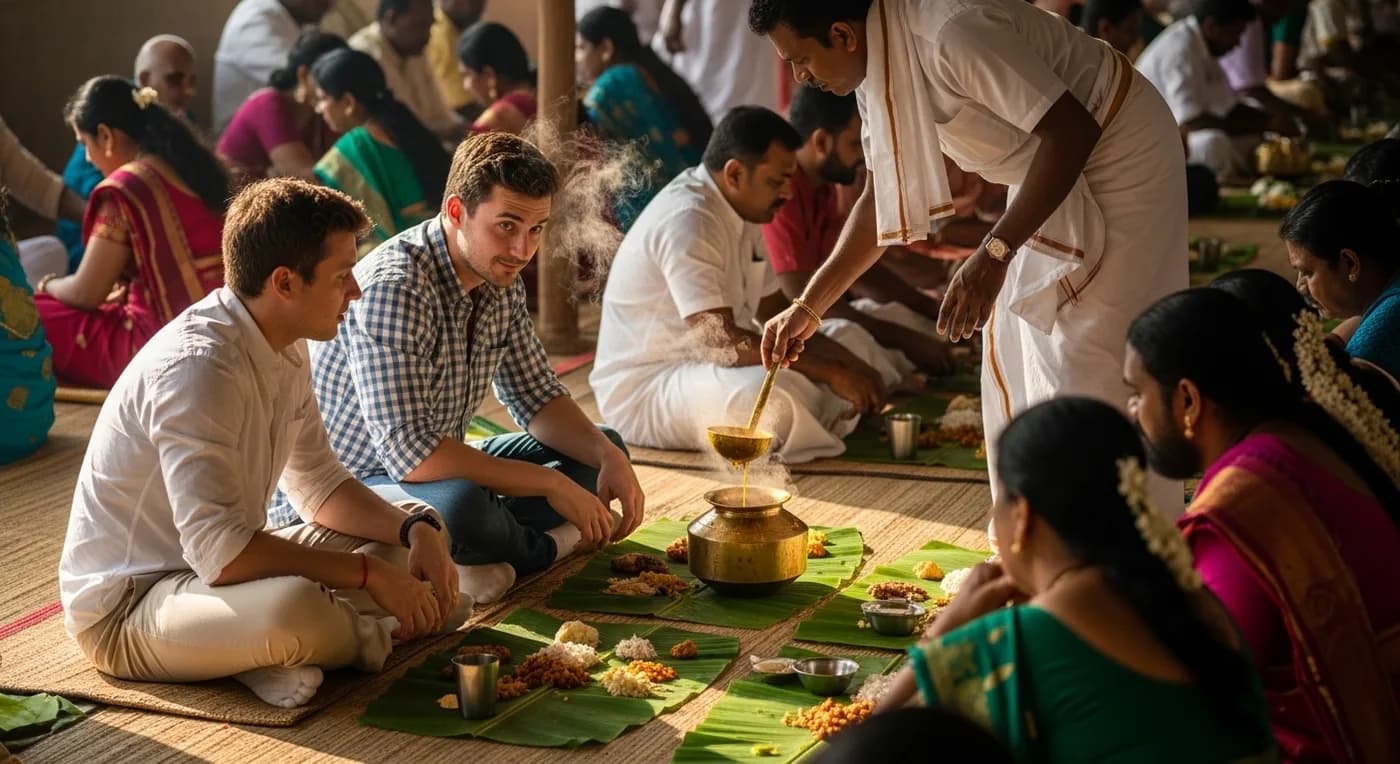
The most common question my American colleagues asked was "how spicy is it?" Sadhya is surprisingly mild — coconut-forward, slightly sweet, with heat concentrated in one or two pickles you can skip. Biryanis at Muslim weddings run medium-hot but rarely punishing. The real allergen risks are coconut (in almost every Kerala dish), curry leaves, mustard seed, and peanut. Guests with nut, coconut, or shellfish allergies should tell the banana-leaf server directly — they will skip items cleanly.
Note
Water, ice, and raw salads are the genuine risks, not spicy food. Tell foreign guests to drink sealed bottled water only (including for brushing teeth), skip ice in welcome drinks unless served at a hotel that filters, and avoid cut fruit from outside the venue. Cooked sadhya food is fine. Pack Travelan, Pepto, and ORS sachets; Kerala pharmacies in Kochi, Kottayam, Kumarakom, and Thiruvananthapuram stock them all over the counter.
How should they handle gifts, cash, and envelopes?
Cash in an envelope is the standard South Indian wedding gift and far more welcome than a wrapped box. Wrapped boxes create storage headaches, get separated from the couple, and sometimes need shipping back to New York or London after the trip. A clean white or red-and-gold envelope, handed to the couple at the reception, solves all of that.
A comfortable per-person gift band for foreign guests:
₹6,000 – ₹12,500That is roughly 75–150 USD at 2026 rates, scaling to 150–250 per couple and more for close colleagues. Foreign currency is fine — most NRI couples hold an NRE account and can deposit USD, GBP, AED, or CAD without friction. If friends prefer a tangible gift, a nice bottle of wine (check first — some states are dry) or a thoughtful book works. Leather is best avoided at traditional Hindu weddings.
What ritual etiquette do foreigners need to know?
Ritual etiquette is less strict than most foreign guests fear and mostly governed by four rules. The MEA marriages booklet and most Indian consulates publish guidance for foreign spouses and guests that converges on the same short list.
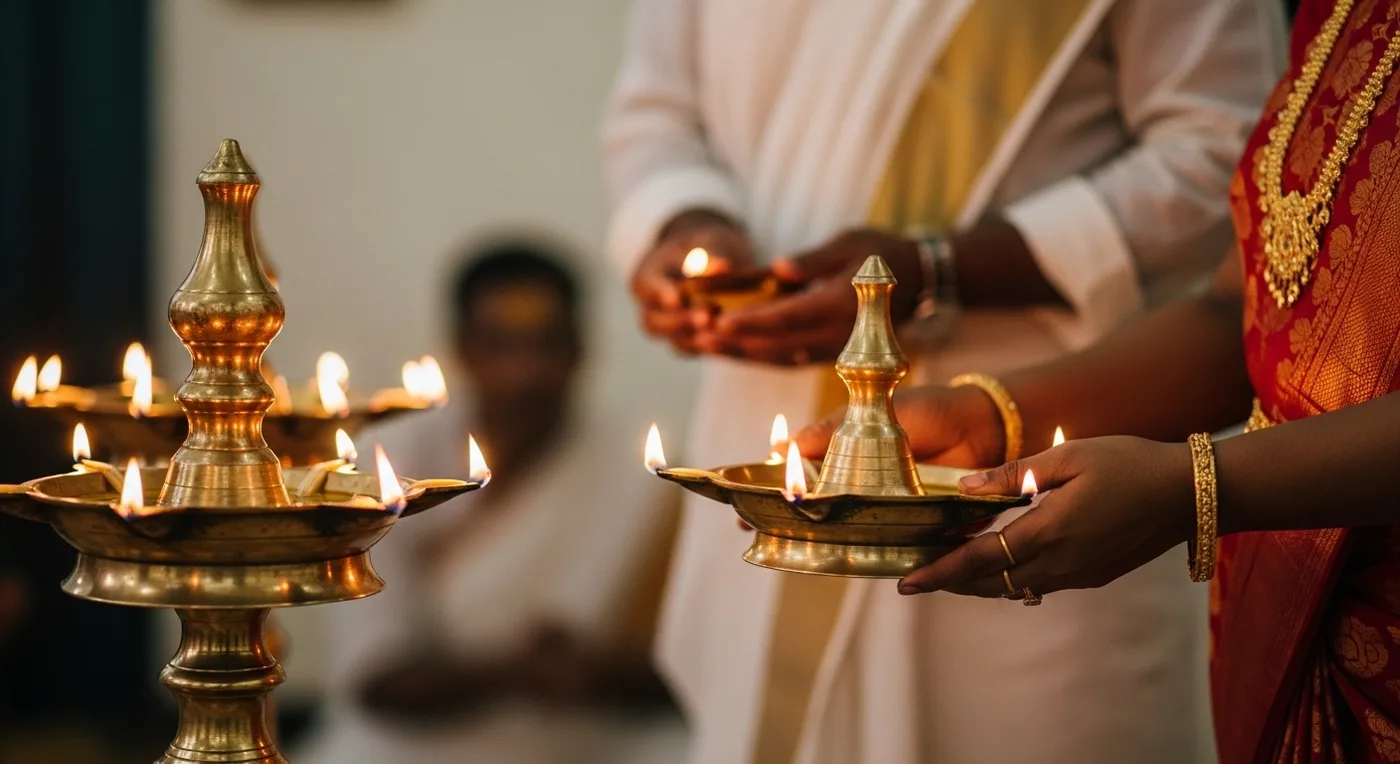
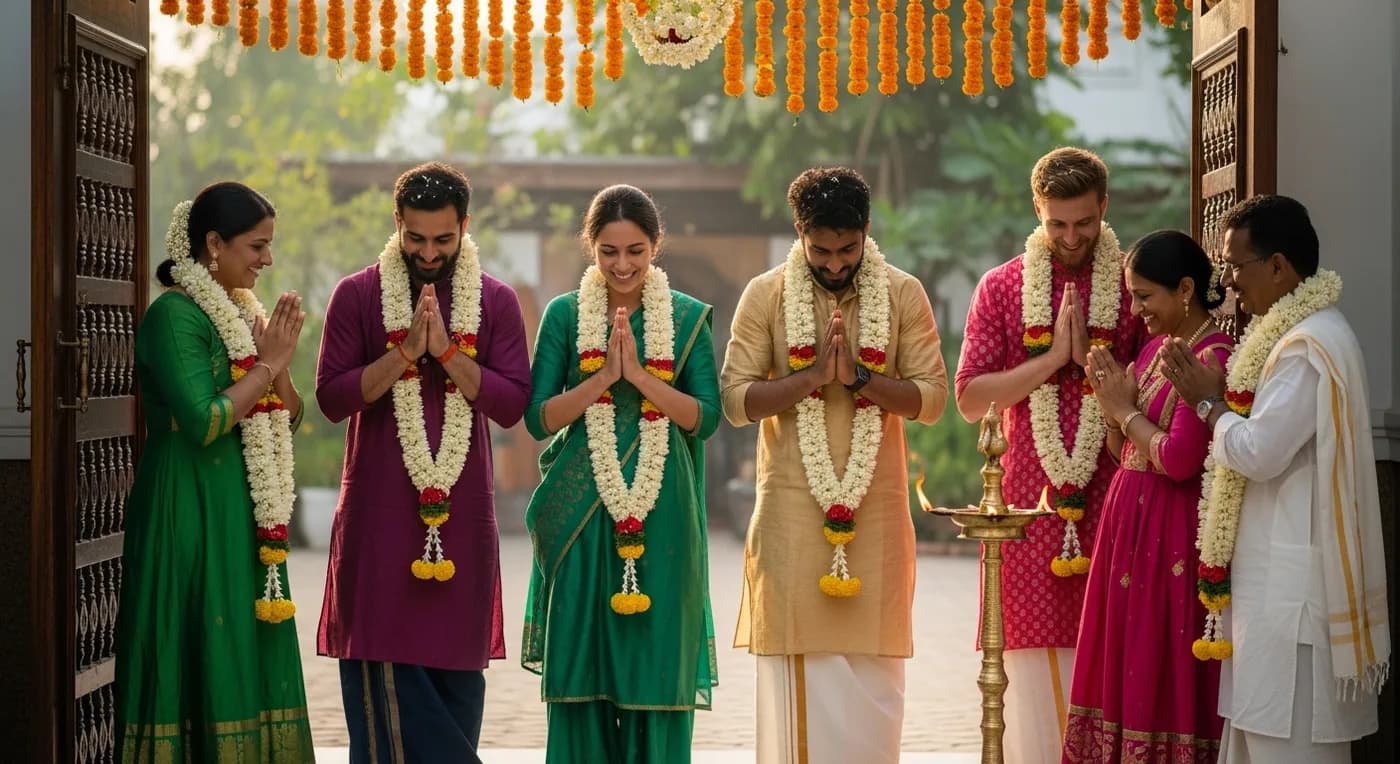
Rule one: remove shoes before stepping onto the mandapam (the raised wedding platform), at any temple, and when entering a family home. Rule two: do not walk in front of the priest or between the priest and the sacred fire; if you must move, circle behind the guests. Rule three: photos from your seat are welcome, but climbing the stage for a selfie during rituals is not — wait for the garland exchange and post-ceremony stage photos. Rule four: when an elder offers a blessing, a slight bow with joined hands (the namaste gesture) is appropriate.
A photographer friend told me his favourite clients are foreign guests — they watch rituals with genuine attention instead of scrolling phones, and they end up in the best candid frames of the day. Your friends will worry about being intrusive. Tell them the truth: South Indian families fold international guests into the celebration within 20 minutes.
How do they handle multi-day attendance?
Multi-day attendance means a different outfit per major event, and foreign guests consistently underestimate this. A two-day wedding needs three outfits: mehendi, muhurtham, reception. A three-day wedding needs four.
A compressed 3-day packing list, written the way you would text it to a friend:
- Mehendi: bright cotton kurta or floral dress, comfortable sandals
- Muhurtham: saree / anarkali / long kurta, slip-off shoes, pashmina if the mandapam has AC
- Sadhya: same outfit as muhurtham, second blotting kit
- Reception: gown / lehenga / suit, real shoes, clutch, foldable umbrella
- Day-after lunch: smart-casual kurta or dress, flat sandals
Carry-on one emergency outfit and check the rest — lost luggage at Kochi (Cochin) or Chennai airport is the single most common disaster I have seen. For the full trip shape, see the 14-day NRI wedding trip playbook.
What should you send them in a welcome kit?
A welcome kit is the highest-leverage hosting gesture for foreign friends. Done well, it answers every question they will have in the first 48 hours. Done badly, it is a tote bag of snacks they never open.
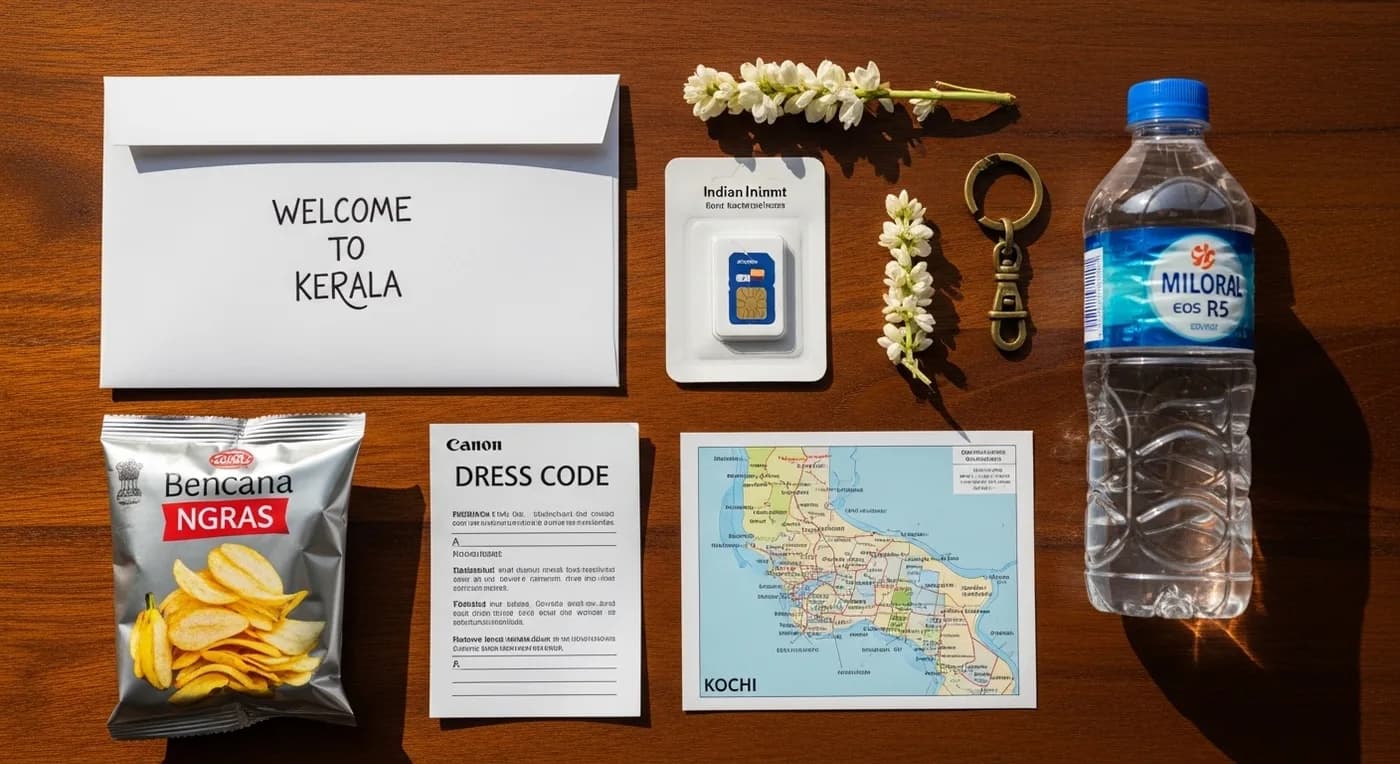
Budget per guest for a Kerala or Tamil Nadu welcome kit:
₹1,500 – ₹4,000Contents: a printed itinerary with start times and dress code per event; a one-page dress code sheet with reference photos; a pre-activated local SIM or eSIM (NORKA publishes overseas-visitor guidance); sealed water, banana chips, halwa; mosquito repellent and ORS sachets; an emergency card with the India lead's phone number, the hotel address in Malayalam or Tamil script, and the nearest hospital; and a phrase sheet with namaskaram (Malayalam/Kannada), vanakkam (Tamil), nandri (thank you), and assalamualaikum if you are marrying into a Muslim family. Add a laminated ritual card for the muhurtham.
Tip
Build your welcome kit around a single printed PDF. Create a three-page guide (itinerary + dress code + emergency info), print it cleanly, and hand it over at hotel check-in. Friends who have been briefed in writing relax within an hour; friends who get verbal instructions at the venue are still confused on day three. The welcome PDF is the artefact that makes this entire post shareable — you can literally forward the link and the kit together.
Looking for Photographers in Chennai?
Tell us what you need and get quotes from verified photographers
How do you handle language barriers during rituals?
Ritual language barriers are easier to solve than most NRI couples assume — the fix is a pre-printed guide sheet plus a bilingual culture buddy per guest. The muhurtham runs in Sanskrit, Malayalam, or Tamil, and the priest (shastrigal in Tamil Brahmin tradition, poojari more generally) does not pause to translate. Whispering English into a friend's ear during the rituals is counterproductive — both of you miss the ceremony.
Prep a one-page ritual guide ahead of time. List every major ritual (kashi yatra, garland exchange, kanyadaan, saptapadi, mangalya dharanam for Tamil Brahmin weddings; equivalents for Malayali Hindu, Syrian Christian, or Kerala Muslim) with a one-sentence plain-English explanation. Hand it out in the welcome kit. Assign each foreign guest a culture buddy — a cousin or sibling who answers questions between segments, not during them. For Tamil Brahmin specifics, fork the glossary in my Tamil Brahmin NRI wedding guide; for Syrian Christian, see the Syrian Christian Malayali NRI wedding guide. For broader guest logistics, pair with Kerala wedding guest logistics and what to wear to a Kerala wedding as a guest.
What are the biggest surprises foreign guests report afterward?
The biggest surprise foreign guests report is never the food or the length — it is the emotional intensity of the hospitality. The Indian Visa Online portal shows tourism from the US, UK, and Australia recovering post-2023, and a growing share is wedding tourism. Every guest I have debriefed lands on the same four observations.
First, duration — seven events over three days is genuinely exhausting. Second, volume — the number of people who introduce themselves, feed you, bless you, and photograph you in the first hour. Third, food abundance — a sadhya has 20 dishes and refusing seconds is harder than accepting. Fourth, the one that changes people: hospitality overload. Foreign guests describe feeling welcomed in a way that does not exist in their home cultures — aunties who learn their name by day two, cousins who adopt them into group photos, grandmothers who quietly ensure they are fed.
Tell your friends this up front. Tell them they are about to be treated like family by people they have not met, and that they will cry a little on the flight home. For corridor-specific versions, see plan a Kerala wedding from the USA; for broader planning, the how to plan a Kerala wedding pillar is the starting point.
The best NRI weddings I have watched are the ones where the couple treated their foreign guest brief as a real piece of writing, not an afterthought. Four to six weeks out, send the PDF. Two weeks out, a warm follow-up. On arrival day, hand over the kit. Then let Kerala, Tamil Nadu, or Karnataka do the rest.
Topics
bringing foreign guests indian weddingamerican guests south indian weddingwhat to wear south indian wedding foreignerindian wedding etiquette for foreignersnri wedding guest briefforeign friends kerala weddingExplore more
Frequently Asked Questions
1What should my American friends wear to my Kerala wedding?
2How much cash should foreign guests bring as a wedding gift?
3Is tap water safe at a South Indian wedding?
4What should I include in a welcome kit for foreign guests?
5How long will my non-Indian friends need to plan for an Indian wedding trip?
Continue reading
Related Articles
NRI South Indian Wedding Guide: Kerala, Tamil Nadu, Karnataka
14-Day NRI Wedding Trip to Kerala: Hour-by-Hour Playbook
Tamil Brahmin NRI Wedding: Rituals, Translations & Logistics
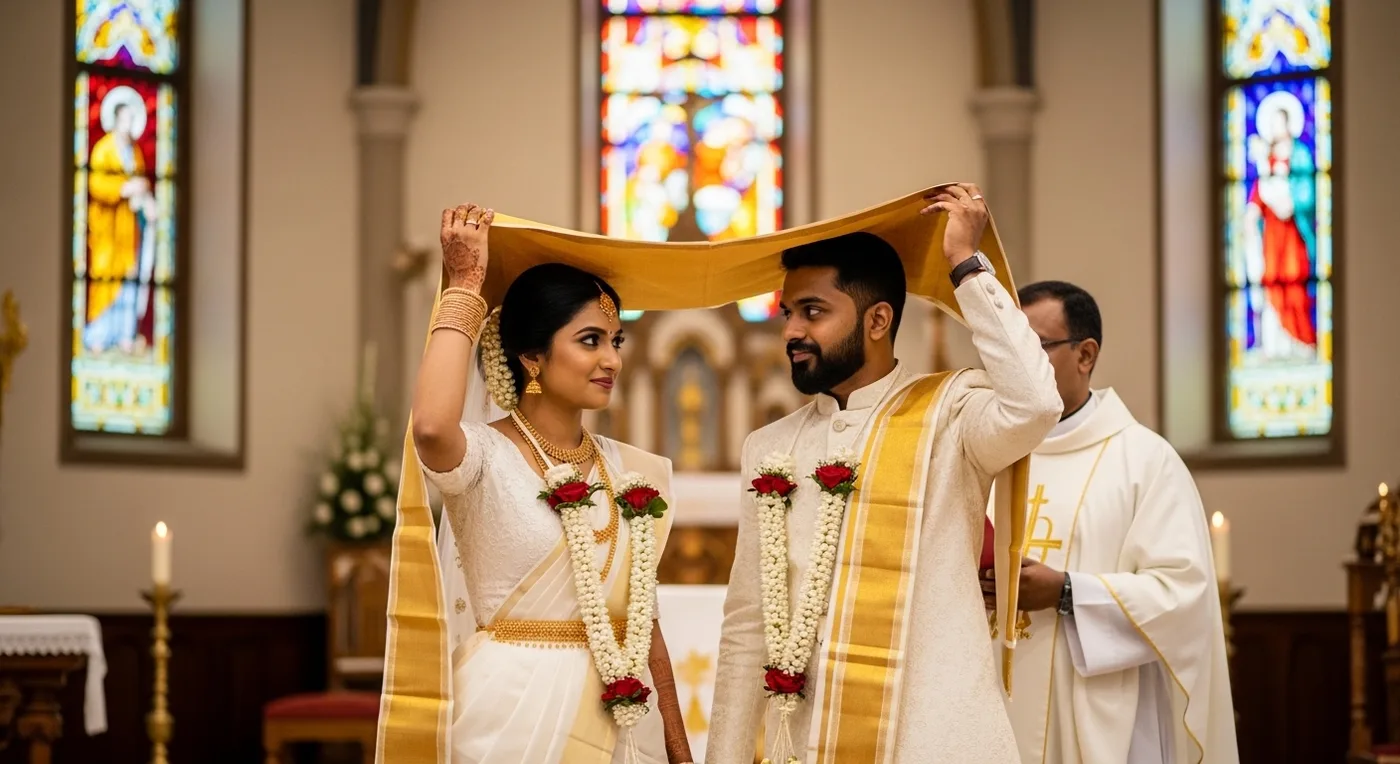
Syrian Christian Malayali NRI Wedding: Kerala Church Guide

Plan a Kerala Wedding from the USA: NRI Playbook (₹15–40L)
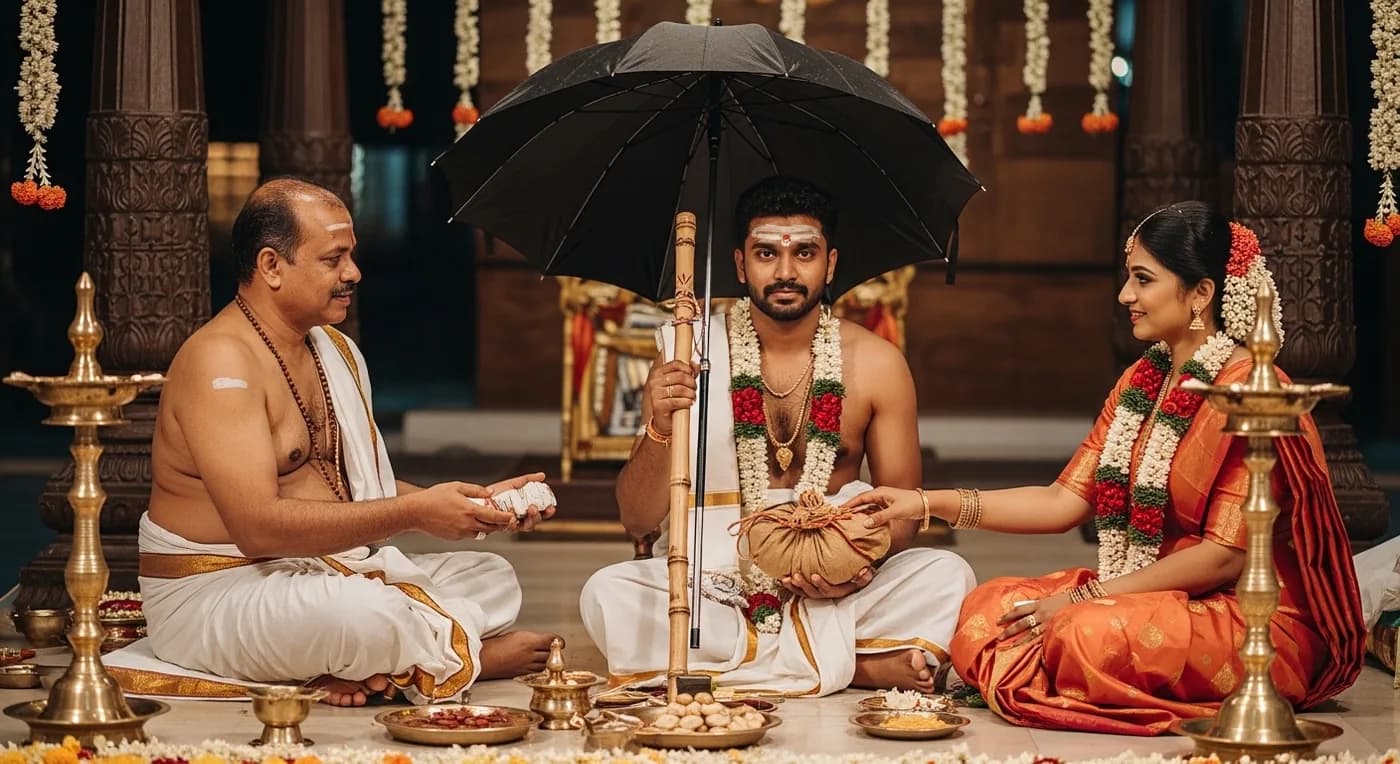
Plan a Kerala Wedding from UAE & Gulf: NRI Guide (₹12–35L)
Still planning?
Get quotes from India's best vendors
Tell us what you're planning and we'll match you with verified photographers, venues, decorators, and more.
Get free quotes