
Kerala Wedding Guest Logistics: Accommodation, Transport, and Hospitality Guide
Kerala wedding guest logistics cost 5-10% of total spend. Hotel block-booking for 15-25% discounts, airport transfers, welcome kits, and NRI guest tips.

Senior Wedding Planner
Priya Nair is a senior wedding planner based in Kochi with over eight years of experience coordinating Hindu, Christian, and destination weddings across Kerala.
On this page
Guest logistics for a 400-person Kerala wedding typically cost 5–10% of total wedding spend — roughly ₹1.5–5 lakhs. Outstation guests (30–50% of any guest list) need 1–3 nights of accommodation; overseas Gulf or NRI guests need full transfer and orientation support at ₹15,000–₹50,000 per person. Block-book hotels 6–9 months ahead for 15–25% group discounts.
Quick Answer
Expect to spend ₹1.5–5 lakh on guest logistics for a 400-person Kerala wedding — roughly 5–10% of total wedding spend. The biggest variable is whether your family hosts outstation guests or provides negotiated hotel rates and lets guests pay directly. Block-booking 15+ rooms typically yields 15–25% off rack rates (based on itsmy.wedding planning data).
Note
Pricing methodology: Cost ranges in this guide are based on vendor pricing data from the itsmy.wedding marketplace and published industry reports, collected in Q4 2025 – Q1 2026.
A Kerala wedding is never a single event — it is a sprawling, multi-day, multi-venue celebration that draws families from across districts, states, and increasingly, continents. With the Indian wedding industry valued at ₹10.79 lakh crore and 4.6 million weddings happening in the peak November-December window alone, venue and hotel inventory gets stretched thin across the country. The muhurtham might happen at a temple in Thrissur at dawn, the reception at a convention centre twenty kilometres away by evening, and a post-wedding lunch at the family home in Palakkad the next afternoon. For your guests — many of whom are navigating unfamiliar roads, humid weather, and an event schedule that can change by the hour — this experience can be either deeply memorable or quietly frustrating. The difference comes down to logistics.
This guide is built from real Kerala wedding planning experience across Ernakulam, Thiruvananthapuram, Kozhikode, Thrissur, Kottayam, Alappuzha, and Kannur. It covers every dimension of guest logistics: estimating who needs what, booking accommodation at the right price tiers, coordinating airport and railway transfers, managing multi-venue transport, hosting overseas guests with care, assembling welcome kits that actually get used, looking after elderly and special needs guests, handling dietary complexity, and budgeting for all of it with 2026 pricing. Whether you are planning a 200-person intimate affair in Kumarakom or a 1,000-guest celebration in Guruvayur, the principles here will save you from the logistical chaos that derails too many otherwise beautiful weddings.
Estimating Your Logistics Needs
Before you book a single hotel room or hire a single vehicle, you need a clear picture of who your guests are and what they actually need from you. The mistake most families make is treating the guest list as a single block. In reality, your guests fall into four distinct categories, each with different logistics requirements and cost implications.
According to WeddingWire India, the average Indian wedding hosts 330 guests — Kerala weddings routinely exceed this with 400-800 guests, making logistics planning even more critical. Local guests — those living within roughly 30 kilometres of your primary venue — are your simplest group. They drive themselves, know the roads, and go home at the end of the night. Your only obligations are clear venue directions, adequate parking, and possibly day-of shuttle service if your venue has limited parking (common at temple complexes in Thrissur and heritage properties in Kottayam).
Outstation guests from other Kerala districts form your next tier. A family traveling from Kozhikode to Ernakulam for a Saturday wedding will typically need one or two nights of accommodation. They will drive or take the train, so your role is to provide hotel recommendations near the venue and clear directions.
Out-of-state guests — relatives from Bangalore, Chennai, Mumbai, Delhi — need a fuller package. They are flying into one of Kerala's airports or arriving by long-distance train, they need two to three nights of accommodation, and they rely on you for transfer coordination because they do not know the local geography.
Overseas guests, particularly the significant Gulf NRI contingent that is part of virtually every Kerala Muslim and many Kerala Christian weddings, plus family members settled in the US, UK, Canada, and Australia, need the most comprehensive support. They need airport transfers, extended accommodation, cultural orientation for younger generation members who may not have attended a Kerala wedding before, local SIM cards, and activity planning for their non-wedding days.
Here is a practical estimation framework based on typical Kerala wedding patterns:
| Guest Category | Typical % of Guest List | Accommodation Nights | Transport Needs | Estimated Budget Per Guest |
|---|---|---|---|---|
| Local (within 30km) | 50-65% | None | Parking, possible shuttle | 200-500 |
| Outstation (other Kerala districts) | 15-25% | 1-2 nights | Hotel recommendation, directions | 3,000-8,000 |
| Out-of-state (other Indian states) | 10-20% | 2-3 nights | Airport/railway transfer, hotel booking | 8,000-20,000 |
| Overseas (Gulf, US, UK, etc.) | 5-15% | 3-5 nights | Full transfer, accommodation, orientation | 15,000-50,000 |
Use this table against your actual guest list. For a 400-guest wedding, you might have 200 local, 100 outstation Kerala, 60 out-of-state, and 40 overseas guests. That ratio fundamentally shapes your logistics budget.
Accommodation Strategy
Accommodation is typically the single largest guest logistics expense, and the decisions you make here ripple through every other aspect of planning. The key is to move early, negotiate smartly, and offer tiered options that respect the economic diversity within any large Kerala wedding guest list.
Block-Booking: How to Negotiate
Block-booking means reserving a batch of rooms at a negotiated group rate with a cutoff date after which unbooked rooms are released back to the hotel. For Kerala weddings in 2026, the mechanics work as follows. Contact hotels at least four to six months before the wedding date. For peak season weddings (November through February), six months is the minimum — eight to nine months is safer. Request a formal group rate quote for a minimum of 15 rooms. Most Kerala hotels will offer a 15-25% discount off their published rack rate for a block of 15 or more rooms. Negotiate the cutoff date carefully: you want it no earlier than two weeks before the wedding, giving your guests maximum flexibility to confirm. Insist on a no-penalty cancellation clause for individual rooms cancelled before the cutoff date. Get the agreement in writing with the rate, room type, inclusions (breakfast, parking), and cancellation terms explicitly stated.
Tiered Options
Never offer just one hotel. Your guest list includes everyone from a retired school teacher uncle to a Dubai-based business executive cousin. Provide three tiers of accommodation near your venue and let guests choose based on their own budget and comfort preferences.
Tip
Block-Booking Strategy: Reserve rooms at 3 price tiers near your venue — budget (1,500-3,000/night), mid-range (3,000-6,000/night), and premium (6,000-15,000/night). Share all three options with your guest list and let them choose. Release unbooked rooms 2 weeks before the wedding to avoid cancellation charges.
For budget-tier accommodation, look at well-maintained business hotels and government guest houses. In cities like Ernakulam, Thrissur, and Kozhikode, you can find clean, air-conditioned rooms with breakfast in the 1,500-3,000 per night range. Mid-range options — branded hotels like Ramada, Lemon Tree, or regional chains like Casino Group — run 3,000-6,000 per night and suit the majority of your guests. Premium options for close family and VIP guests — properties like Crowne Plaza Kochi, Vivanta Trivandrum, or heritage stays like Brunton Boatyard — range from 6,000-15,000 per night.
₹1,500 – ₹15,000Who Pays?
This varies significantly by community and family tradition in Kerala. In many Hindu families, close relatives (parents' siblings, grandparents) are hosted by the wedding family, while other guests book and pay for their own rooms using the provided hotel list. In Muslim families, particularly in Malabar, the hosting family often covers accommodation for the bride's or groom's extended family as a matter of custom. In Christian families, the pattern tends to follow the Hindu model. The modern trend across all communities, especially for larger weddings, is to provide negotiated rates and let guests pay directly. Whatever your approach, communicate it clearly and early — ambiguity about who is paying creates awkwardness.
Airbnb and Homestay Alternatives
For destination weddings in Kumarakom, Alleppey, Munnar, or Wayanad, hotel room inventory near the venue may simply not exist in sufficient quantity. This is where Airbnb properties, Kerala Tourism-certified homestays, and serviced villas become essential. For a 2026 destination wedding in Alappuzha, a well-maintained lakeside homestay runs 2,000-5,000 per night, and a private villa that can house an extended family of eight to ten people costs 8,000-20,000 per night. Book these nine to twelve months in advance for peak season.
Looking for Venues in Kochi?
Tell us what you need and get quotes from verified venues
Airport and Railway Transfers
Kerala is well-served by four international airports, and choosing the right one — and coordinating transfers from it — is a critical logistics decision.
Cochin International Airport (COK) in Nedumbassery serves weddings across Ernakulam, Thrissur, and parts of Kottayam and Idukki. It handles the highest volume of Gulf flights, making it the primary arrival point for NRI guests at most central Kerala weddings.
Important
Kochi Airport Reality: Kochi International Airport (COK) is in Nedumbassery, 25-40km from most wedding venues in the city. Traffic during peak hours can turn a 45-minute drive into 90+ minutes. Always buffer an extra hour for airport pickups during November-February wedding season.
Trivandrum International Airport (TRV) is the gateway for weddings in Thiruvananthapuram, Kollam, and southern Kottayam. It has direct flights from the Gulf, Singapore, and Sri Lanka.
Calicut International Airport (CCJ) at Karipur serves Kozhikode, Malappuram, Wayanad, and northern Palakkad. It is critical for Malabar weddings, handling heavy traffic from Dubai, Abu Dhabi, Doha, and Muscat.
Kannur International Airport (CNN), the newest of the four, serves Kannur, Kasaragod, and parts of northern Wayanad.
Transfer Coordination
The most efficient approach is to collect flight and train details from all incoming guests via a shared Google Form or WhatsApp message, then batch transfers by arrival time. Guests arriving within a 60-90 minute window of each other can share a vehicle. For a wedding with 30-40 arriving flights, you can typically consolidate down to 10-15 transfer runs across the arrival day and the day before.
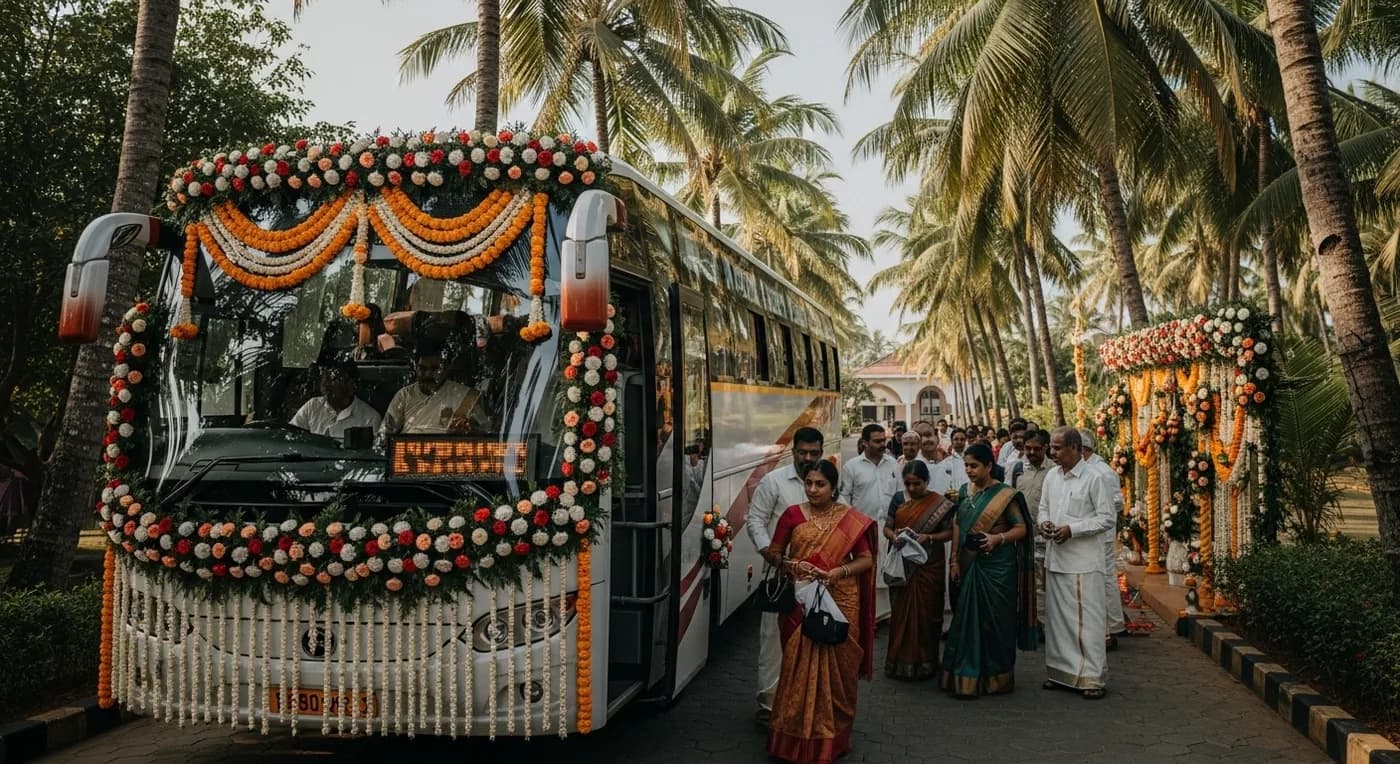
Vehicle options and 2026 costs: A sedan (Innova, Ertiga) costs 2,000-4,000 per airport transfer depending on distance. A Tempo Traveller (12-seater) costs 4,000-6,000 per trip and makes sense when you can batch three to four families arriving within the same window. For VIP guests and elderly relatives, a dedicated sedan with a known driver who will wait at the arrival gate with a name placard is worth the premium.
₹2,000 – ₹8,000For railway transfers, the same batching logic applies. Major junctions like Ernakulam Junction, Thrissur, Kozhikode, and Thiruvananthapuram Central handle most long-distance train arrivals. Station pickups are generally easier than airport pickups because trains arrive at more predictable times and the stations are typically closer to city-centre venues.
Multi-Venue Transport Coordination
This is the uniquely Kerala challenge. A typical wedding day might involve a 5:30 AM muhurtham at a temple, followed by a 10:00 AM sadya at a community hall two kilometres away, a photo session at a heritage property fifteen kilometres out, and an evening reception at a convention centre in a different part of town entirely. Your guests — many of whom do not have their own vehicles — need to get between all of these locations smoothly.
The Transport Plan
Start by mapping every venue transition. For each transition, note the distance, expected travel time (with traffic buffers), number of guests who need transport, and the time window available. Then assign vehicle types to each transition based on group size and guest profile.
| Event Transition | Typical Distance | Vehicle Type | Capacity | Estimated Cost |
|---|---|---|---|---|
| Hotel to temple (muhurtham) | 5-15 km | Mini-bus + sedans | 40-60 guests | 8,000-15,000 |
| Temple to reception hall | 2-10 km | Mini-bus + sedans | 80-120 guests | 10,000-20,000 |
| Hotel to reception (evening) | 5-20 km | Mini-bus fleet | 60-100 guests | 12,000-25,000 |
| Reception to hotel (night) | 5-20 km | Mini-bus + autos | 60-100 guests | 10,000-20,000 |
| Post-wedding lunch (next day) | 10-50 km | Tempo Travellers | 30-50 guests | 8,000-15,000 |
Shuttle Scheduling
For the primary venue transitions — hotel to ceremony and ceremony to reception — run shuttles on a fixed schedule rather than on-demand. A 26-seater mini-bus doing two round trips can move 100 guests in under an hour if the venues are within 10 kilometres of each other. Post the shuttle schedule in the WhatsApp group, display it on the hotel lobby notice board, and include it in the welcome kit.
The Transport Coordinator
Designate one person — a trusted family friend or a hired event assistant — as the transport coordinator. This person does not attend the wedding festivities. Their job is to stand at pickup points, ensure vehicles depart on time, handle stragglers, manage the WhatsApp communication channel, and deal with the inevitable last-minute changes (a bus breaks down, a guest misses the shuttle, a venue transition is delayed). This single role prevents more logistical failures than any other measure you can take.
₹20,000 – ₹80,000Note
WhatsApp Is Your Command Centre: Create a dedicated WhatsApp group for outstation and overseas guests. Use it to share real-time shuttle departure times, venue gate entry points, parking updates, and any schedule changes. Pin the master event schedule and transport coordinator's number at the top.
Managing Overseas Guests
Overseas guests — whether Gulf-based NRIs, US or UK-settled family, or international friends — require a different tier of planning. They are traveling the farthest, spending the most, and are often the least familiar with local logistics. Getting their experience right is both a hospitality priority and a family obligation.
Tip
Gulf Guest Protocol: Kerala weddings often have a significant Gulf NRI contingent. These guests typically arrive 3-5 days early. Arrange a pre-wedding family gathering and coordinate airport transfers in batches based on common flight times from Dubai, Abu Dhabi, and Muscat.
Pre-Arrival Coordination
Send overseas guests a detailed information packet at least six weeks before the wedding. This should include the full event schedule with dates and times, recommended flight booking windows, accommodation options with booking links, weather advisory (Kerala in December is very different from Kerala in May), a dress code guide for each event (many younger NRIs are unsure whether to wear a mundu or a suit to the reception), and your designated point of contact's WhatsApp number. For NRI couples planning the entire wedding from abroad, our NRI South Indian wedding complete guide and bringing foreign guests to a South Indian wedding host's brief cover the diaspora-specific planning workflow.
Currency and Connectivity
Guests arriving from the Gulf or the West need practical support. Advise them on current exchange rates and where to exchange currency (airport forex counters in Kochi and Trivandrum offer competitive rates). For mobile connectivity, either pre-arrange local SIM cards (Jio or Airtel tourist SIMs work well and can be activated at the airport) or ensure the hotel and venue have reliable WiFi. In 2026, most Kerala wedding venues in urban areas offer WiFi, but rural and heritage venues may not — check in advance.
Cultural Briefing
This matters more than most families acknowledge. Second and third-generation NRIs, international spouses, and Western friends may not understand ceremony protocols. Prepare a brief one-page cultural guide covering: when to stand and when to sit during the ceremony, the significance of key rituals (thalikettu, manthrakodi, the sadya sequence), photography etiquette during sacred moments, and basic Malayalam wedding vocabulary. This small gesture prevents awkward moments and helps overseas guests feel included rather than like spectators.
Activity Planning for Non-Wedding Days
Overseas guests often have three to five days in Kerala surrounding a one or two-day wedding. Arrange optional group activities for the non-wedding days. Popular choices include a half-day Kochi heritage walk (Fort Kochi, Chinese fishing nets, Jewish Synagogue), a backwater houseboat cruise from Alappuzha, a day trip to Munnar or Thekkady, or a beach morning in Kovalam for Trivandrum weddings. Partner with a local tour operator to offer these at group rates. Budget 1,500-5,000 per person per activity.
Emergency Preparedness
Provide overseas guests with a card listing emergency contacts: the nearest hospital with an emergency department, the local police station number, the Indian emergency number (112), and two family-side contacts who speak English fluently. For guests with health conditions, identify the nearest hospital that accepts international insurance — in Kochi, that is Aster Medcity or Lakeshore Hospital; in Trivandrum, KIMS or Ananthapuri; in Kozhikode, MIMS or Baby Memorial.
Welcome Kits and Hampers
A well-assembled welcome kit sets the tone for your guests' entire experience. It says: we thought about you, we prepared for your comfort, and we are glad you are here. The best Kerala wedding welcome kits blend local flavour with genuine practicality.
What to Include
Every kit should contain a welcome note — a warm, personal message from the couple with the complete event schedule (times, venues, dress codes). Include a venue map with marked parking areas, entry gates, and key landmarks. Add a contact card with phone numbers for the transport coordinator, accommodation point person, and one family-side emergency contact.
For the local flavour element, include Kerala snacks: banana chips (both the salted ethakka upperi and the sweet sharkara varatti), a small pack of Kozhikodan Halwa for Malabar weddings or Palakkadan mixture for central Kerala weddings, and perhaps a miniature pack of Kerala cardamom tea. These items cost very little but create an immediate sense of place.
For practical items, include a bottle of water, a small first-aid pouch (mosquito repellent patches, antacid tablets, a few paracetamol, band-aids), and a local area information card with WiFi passwords for the hotel and venue, local taxi app recommendations (Uber and Ola both work in major Kerala cities), and a QR code linking to Google Maps directions for each venue.
For overseas guests, add a local SIM card (pre-activated if possible) or instructions for connecting to hotel WiFi, a cultural guide card, and a currency quick-reference (common expenses in INR: auto-rickshaw ride, bottled water, a meal at a local restaurant).
Budget Tiers
| Kit Tier | Contents | Cost Per Kit | Best For |
|---|---|---|---|
| Essential | Welcome note, event schedule, water bottle, venue map, contact card | 200-400 | Local guests, large guest counts |
| Standard | Essential + banana chips, mixture, mosquito repellent, first-aid basics | 400-800 | Outstation and out-of-state guests |
| Premium | Standard + Kozhikodan Halwa, cardamom tea, local SIM, cultural guide, branded tote bag | 800-1,500 | Overseas guests, VIP family members |
Assemble kits one to two weeks before the wedding. Place them in guest rooms before check-in for outstation guests, and distribute at the registration desk for local guests attending the main event. For a 400-guest wedding, you might prepare 50 Premium kits, 80 Standard kits, and 150 Essential kits — total cost between 40,000 and 1,00,000 depending on tier distribution.
Elderly and Special Needs Guest Management
Every Kerala wedding guest list includes elderly relatives — grandparents, great-aunts and great-uncles, senior family friends — who require specific accommodations that are easy to overlook in the rush of planning. This section is not optional. A fall, a heat-related incident, or the simple indignity of not being able to access a restroom at the venue can overshadow the entire wedding in a family's memory.
Important
Accessibility Check: Many traditional Kerala wedding venues — temple halls, heritage homes, and older community halls — have limited wheelchair access. Visit the venue specifically to check for ramps, accessible restrooms, and ground-level seating areas BEFORE booking if you have elderly or mobility-impaired guests.
Accommodation
Reserve ground-floor rooms for elderly guests. If the hotel does not have a lift, this is non-negotiable. Choose accommodation as close to the venue as possible — a five-minute drive, not thirty. If the wedding is in a rural area where the nearest hotel is far from the venue, explore whether a family home or nearby house can be arranged as a rest point for elderly guests during the event.
Transport
Never put elderly guests on shared shuttle buses. The climbing in and out, the waiting at pickup points, the noise — it is uncomfortable and undignified. Arrange dedicated sedan transport with a careful driver who will assist them at both ends. Ideally, pair each elderly guest or couple with a younger family member who rides with them and manages their comfort through the day.
At the Venue
Ensure seating is available throughout the ceremony area, not just in the dining space. Many Kerala wedding ceremonies require guests to stand for extended periods — this is not feasible for elderly guests. Designate a quiet rest area at the venue with comfortable seating, water, and shade (or air conditioning). For the sadya, the traditional floor-seated banana leaf meal, arrange an alternative chair-and-table section. Most caterers and venues in 2026 accommodate this as standard, but confirm it explicitly.
Medical Preparedness
Have a basic first-aid kit at the venue. Know the nearest hospital with an emergency department and keep a vehicle on standby specifically for medical emergencies. If any elderly guest has a known medical condition, ensure their medications are accessible, their dietary restrictions are communicated to the caterer, and the assigned family coordinator is aware of the condition.
Dietary Management
Kerala wedding food is legendary — the sadya, the biriyani, the multi-course non-vegetarian feast — but it is also a logistics challenge when your guest list includes diverse dietary needs.
The Core Split
Most Kerala weddings serve both vegetarian and non-vegetarian options. The sadya is inherently vegetarian (and largely vegan, barring the ghee-based dishes and the buttermilk). Non-vegetarian items appear in separate counters at the reception. Communicate this clearly so guests know what to expect at each event.
Specific Dietary Needs
Jain guests require food prepared without onion, garlic, and root vegetables. This requires a separate preparation line, not just the removal of items from existing dishes. Discuss this with your caterer at least a month before the wedding.
Vegan guests need confirmation that dishes are free of ghee, dairy, and honey. Several sadya items (especially the payasam and aviyal) traditionally use ghee or coconut milk — your caterer can adjust these, but only if asked in advance.
Nut allergies require particular attention in Kerala cuisine, which uses cashew, coconut, and sometimes almond liberally. If you have guests with nut allergies, your caterer must designate separate cooking vessels and serving stations.
Children's options — many caterers can prepare a simplified plate (rice, mild sambar, a sweet, fruit) for children who will not eat a full sadya spread.
RSVP Dietary Collection
Include a dietary requirements field in your RSVP form. A simple dropdown — Vegetarian / Non-Vegetarian / Vegan / Jain / Allergies (please specify) — captures what you need. Collect this at least three weeks before the wedding to give your caterer adequate preparation time.
Note
Kerala Cuisine and Allergies: Kerala cooking relies heavily on coconut (oil, milk, grated) and tree nuts (cashew in gravies, almond in desserts). If any guest has a severe tree-nut or coconut allergy, flag this with your caterer as a high-priority dietary restriction — it requires separate preparation and serving, not just ingredient substitution.
Full Budget Breakdown
Here is a realistic 2026 budget framework for guest logistics at a 400-guest Kerala wedding with approximately 100 outstation and overseas guests:
| Logistics Category | Budget Tier | Mid-Range Tier | Premium Tier |
|---|---|---|---|
| Accommodation hosting (if family covers) | 1,00,000 | 2,50,000 | 5,00,000 |
| Airport/railway transfers (30-40 guests) | 30,000 | 50,000 | 80,000 |
| Inter-venue transport (shuttle + VIP) | 20,000 | 45,000 | 80,000 |
| Welcome kits (100-150 kits) | 15,000 | 40,000 | 1,00,000 |
| Guest activities (overseas guests, 1 day) | 25,000 | 75,000 | 2,00,000 |
| Emergency and contingency fund | 10,000 | 20,000 | 40,000 |
| Total Guest Logistics | 2,00,000 | 4,80,000 | 10,00,000 |
These figures assume guests pay for their own accommodation in the Budget and Mid-Range tiers, with the family only covering a few rooms for close elders. In the Premium tier, the family hosts all outstation guests. Adjust based on your family's traditions and capacity.
₹1,00,000 – ₹5,00,000Looking for Transports in Trivandrum?
Tell us what you need and get quotes from verified transports
Planning Timeline
Guest logistics planning should begin the moment your venues and date are confirmed. Here is a month-by-month framework:
6 months before: Conduct an accessibility audit of all venues (ramps, restrooms, parking capacity, wheelchair access). Research hotels within a 10-kilometre radius of your primary venue at all three price tiers. Begin collecting RSVPs with travel details and dietary requirements.
4 months before: Block-book hotel rooms at your chosen properties. Negotiate rates and confirm cutoff dates in writing. Research and shortlist transport vendors (mini-bus operators, taxi services, Tempo Traveller providers). For overseas guests, send the advance information packet.
2 months before: Share the curated accommodation list with all outstation guests, including booking links and negotiated rate codes. Confirm transport vendor availability and lock in rates. Begin sourcing welcome kit components.
1 month before: Finalize guest headcount for each event and each venue transition. Confirm all airport and railway transfer arrangements based on collected flight and train details. Assemble welcome kits. Confirm dietary requirements with the caterer. Brief the transport coordinator on the full schedule.
1 week before: Set up the guest WhatsApp group and share the final event schedule. Distribute welcome kits to hotels for placement in rooms. Conduct a final walkthrough of the transport route between venues, noting construction, road closures, or traffic patterns. Confirm vehicle assignments for each transition.
Day of the wedding: Transport coordinators in position at every pickup point 30 minutes before the first scheduled departure. Welcome desk staffed at the venue with extra schedules, maps, and contact cards. Dedicated vehicle on standby for elderly guests and emergencies. WhatsApp group actively managed with real-time updates on shuttle departures and any schedule changes.
Common Questions About Kerala Weddings Guest Logistics
How do I arrange accommodation for wedding guests in Kerala?
Start by estimating your outstation guest count — typically 30-50% of your total list needs accommodation. Block-book rooms at two to three hotels near your venue at different price points. For blocks of 15 or more rooms, you can negotiate group rates that offer 15-25% off the published rack rate. Prepare a curated hotel list with options ranging from budget (1,500-3,000 per night) to premium (6,000-15,000 per night) and share it with your guest list at least two months before the wedding. For destination weddings in places like Kumarakom, Wayanad, or Munnar, start accommodation research nine to twelve months ahead because inventory is limited and peak-season rates lock early.
How much should I budget for guest logistics at a Kerala wedding?
A WedMeGood survey of 2,000+ Indian couples found that guest logistics is one of the most underestimated budget categories. For a 400-guest wedding with approximately 100 outstation guests, the typical budget breakdown looks like this: accommodation coordination is free if guests pay their own way, or 2-5 lakhs if the family hosts; airport and railway transfers run 30,000-80,000 depending on the number of incoming flights; welcome kits cost 15,000-50,000 depending on tier and quantity; inter-venue transport coordination ranges from 20,000-60,000 for a standard two-venue wedding; and guest activities for destination weddings can add 50,000-2,00,000. The total guest logistics budget typically represents 5-10% of your overall wedding spend. For a 25-lakh wedding, expect to spend 1.5-2.5 lakhs on logistics; for a 50-lakh wedding, 3-5 lakhs is realistic.
How do I manage elderly guests at a Kerala wedding?
Elderly guest management starts with accommodation: reserve ground-floor rooms at the hotel nearest to the venue. For transport, arrange dedicated sedans rather than shared shuttle buses, and pair each elderly guest with a younger family member who assists them throughout the day. At the venue, ensure wheelchair accessibility (check for ramps, accessible restrooms, and wide doorways before booking), provide seating throughout the ceremony area (not just the dining zone), and set up a quiet resting area with comfortable chairs, water, and either shade or air conditioning. For the sadya, always arrange a chair-and-table section as an alternative to traditional floor seating. Finally, assign a specific family member as the elderly guests' point of contact for the entire event.
What should go in a wedding welcome kit?
A Kerala wedding welcome kit should balance local charm with genuine practicality. The essentials are: a warm welcome note from the couple with the complete event schedule (dates, times, venues, dress codes), a venue map with marked parking and entry points, and a contact card with the transport coordinator's and key family members' phone numbers. Add local Kerala snacks — banana chips (ethakka upperi), a packet of mixture, and Kozhikodan Halwa for Malabar weddings. Include practical items like a bottle of water, mosquito repellent patches, antacid tablets, and a few paracetamol. For overseas guests, add a local SIM card or WiFi connection instructions, a cultural guide card explaining ceremony etiquette, and a currency quick-reference. Kits range from 200 per unit for a basic version to 1,500 per unit for a premium overseas guest package.
How do I coordinate transport for a multi-venue Kerala wedding?
Start by mapping every venue transition: temple to reception hall, hotel to venue, reception to hotel, and any next-day events. For each transition, note the distance, travel time (with traffic buffer), and the number of guests who need transport. Hire two to three mini-buses (26-seater) for group transfers and dedicate sedans for VIP guests and elderly relatives. Run shuttles on a fixed schedule rather than on-demand — post the departure times in the guest WhatsApp group, at the hotel lobby, and in the welcome kit. Station a transport coordinator at each pickup point to ensure vehicles depart on time and no guests are left behind. Always allow a 30-minute buffer between the scheduled arrival at the next venue and the event start time — Kerala traffic, especially during wedding season in Ernakulam and Thrissur, is unpredictable.
Further Reading
Tip
Plan smarter with free tools — generate a personalised timeline with our AI Wedding Checklist, estimate costs with the Wedding Cost Calculator, or create a stunning digital invitation in minutes.
Topics
wedding guest logistics Keralawedding accommodation Keralaguest transport weddingoverseas guests Kerala weddingwelcome kit weddinghotel booking weddingExplore more
Frequently Asked Questions
1How do I arrange accommodation for wedding guests in Kerala?
2How much should I budget for guest logistics at a Kerala wedding?
3How do I manage elderly guests at a Kerala wedding?
4What should go in a wedding welcome kit?
5How do I coordinate transport for a multi-venue Kerala wedding?
Continue reading
Related Articles
How to Plan a Kerala Wedding: The Complete 2026 Guide
Kerala Wedding Checklist: Complete Printable Planner for 2026

Kerala Wedding Budget Guide: 2026 Cost Breakdown
Best Season for South India Destination Weddings: Month-by-Month Western Ghats Guide
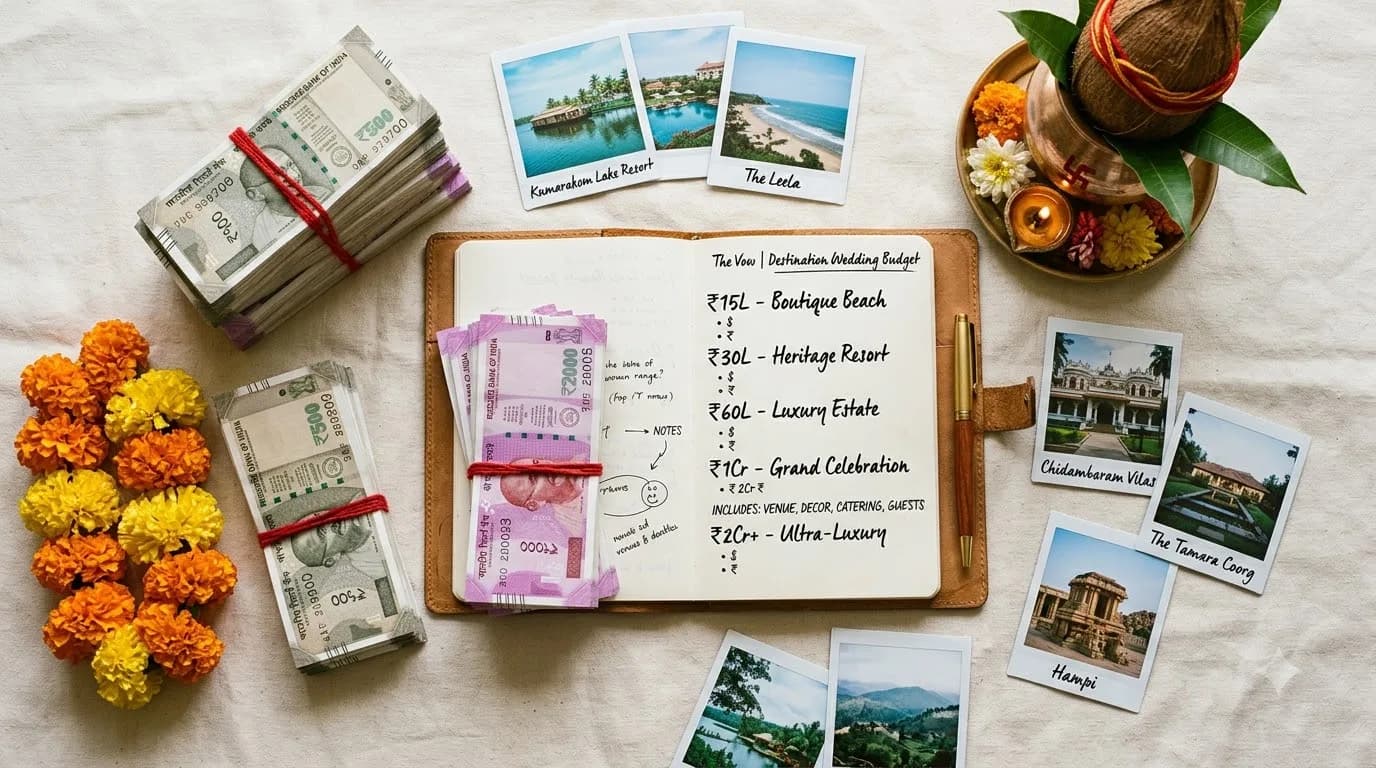
Destination Wedding Cost in South India 2026: 5-Tier Budget Guide
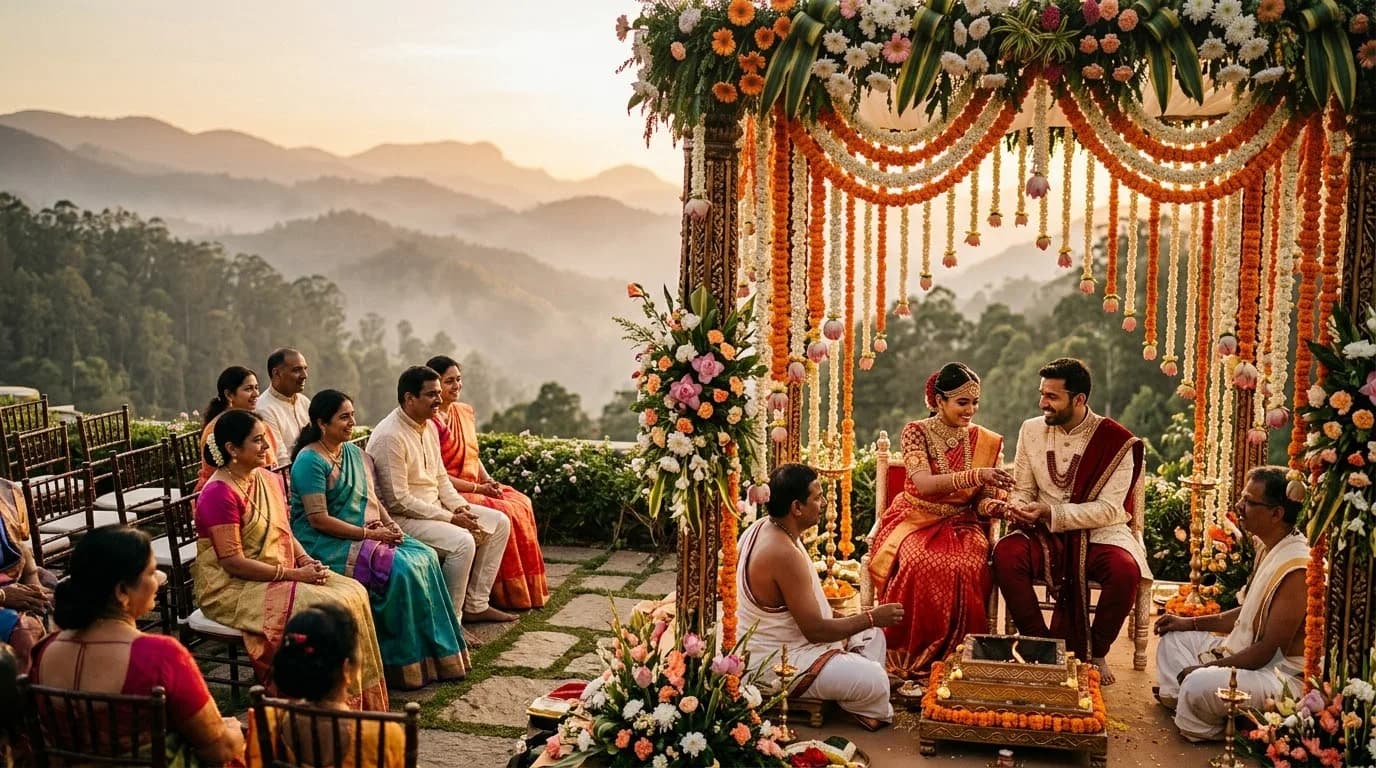
Destination Wedding in South India: Complete 2026 Planning Guide
Still planning?
Get quotes from India's best vendors
Tell us what you're planning and we'll match you with verified photographers, venues, decorators, and more.
Get free quotes