
Syrian Christian Malayali NRI Wedding: Kerala Church Guide
Plan a Syrian Christian Malayali NRI wedding — diocese booking in Kottayam or Pala, Pre-Cana rules, kasavu gown, manthrakodi, and the paperwork USA and Gulf couples miss.

On this page
For Syrian Christian Malayali NRIs, denomination choice drives everything else. A Syro-Malabar wedding in Pala runs on different rules than a Malankara Orthodox ceremony in Thiruvalla or a Mar Thoma service in Kozhikode. Diocese booking sits at six to twelve months, Pre-Cana rules vary by parish, and banns reading falls into a three-to-four-week window before the ceremony. Miss any of these, and the wedding date slides.
Quick Answer
Your denomination is the first decision. Syro-Malabar Catholic, Syro-Malankara Catholic, Malankara Orthodox Syrian, Malankara Jacobite Syriac Orthodox, Mar Thoma Syrian, and the Church of South India each have different liturgical structures, diocese workflows, and Pre-Cana requirements. Start with the parish priest of the home church, not the venue, and build every other decision backwards from the date the diocese confirms.
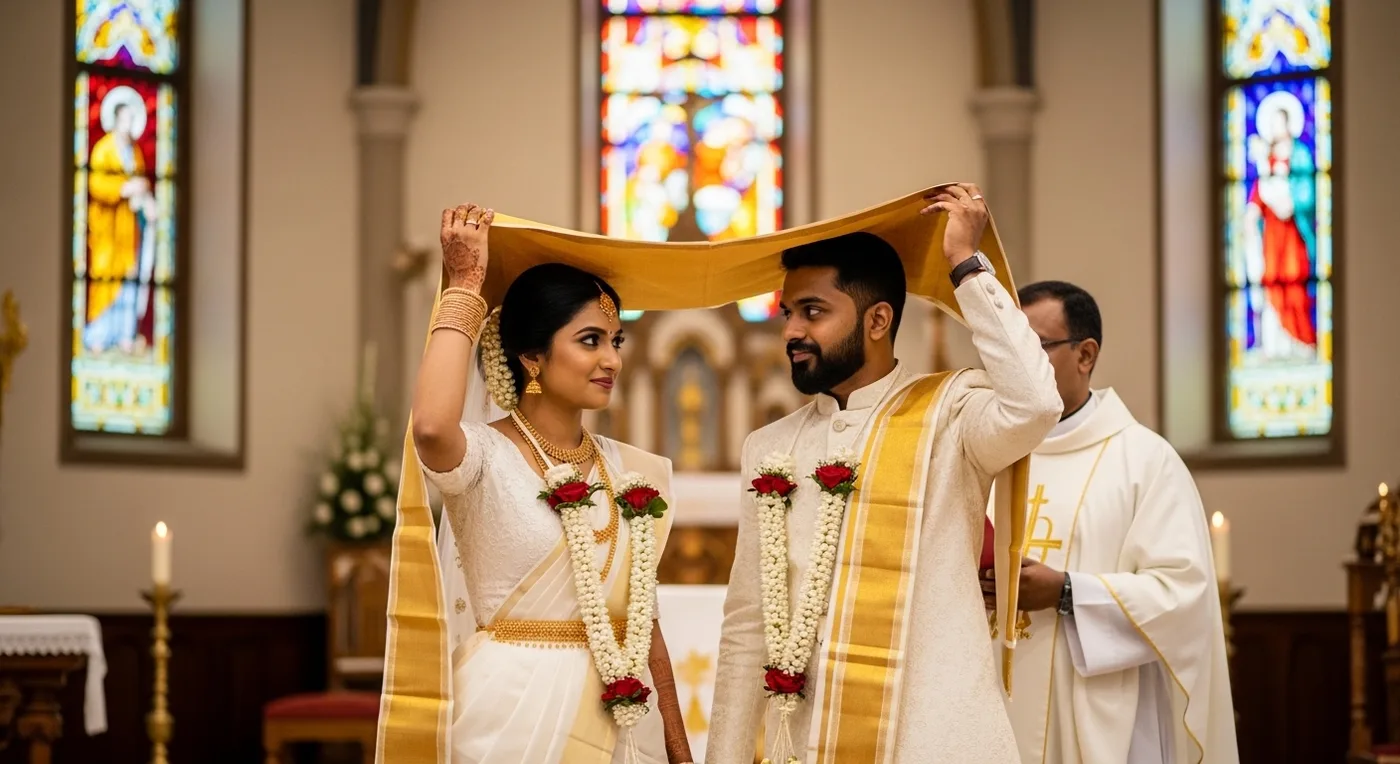
Growing up attending Syrian Christian weddings in Kottayam, I took the liturgical choreography for granted — the Syriac chant, the manthrakodi lifted over the bride's head, the smell of sadhya leaves warming in the hall behind the church. It was only after I started helping NRI families plan their ceremonies from the Gulf and the USA that I understood how invisible the process is to anyone who didn't grow up inside it. Pair this with our NRI South Indian wedding complete guide for the corridor view, and the plan a Kerala wedding from UAE and Gulf post if you're flying from Dubai, Doha, or Muscat.
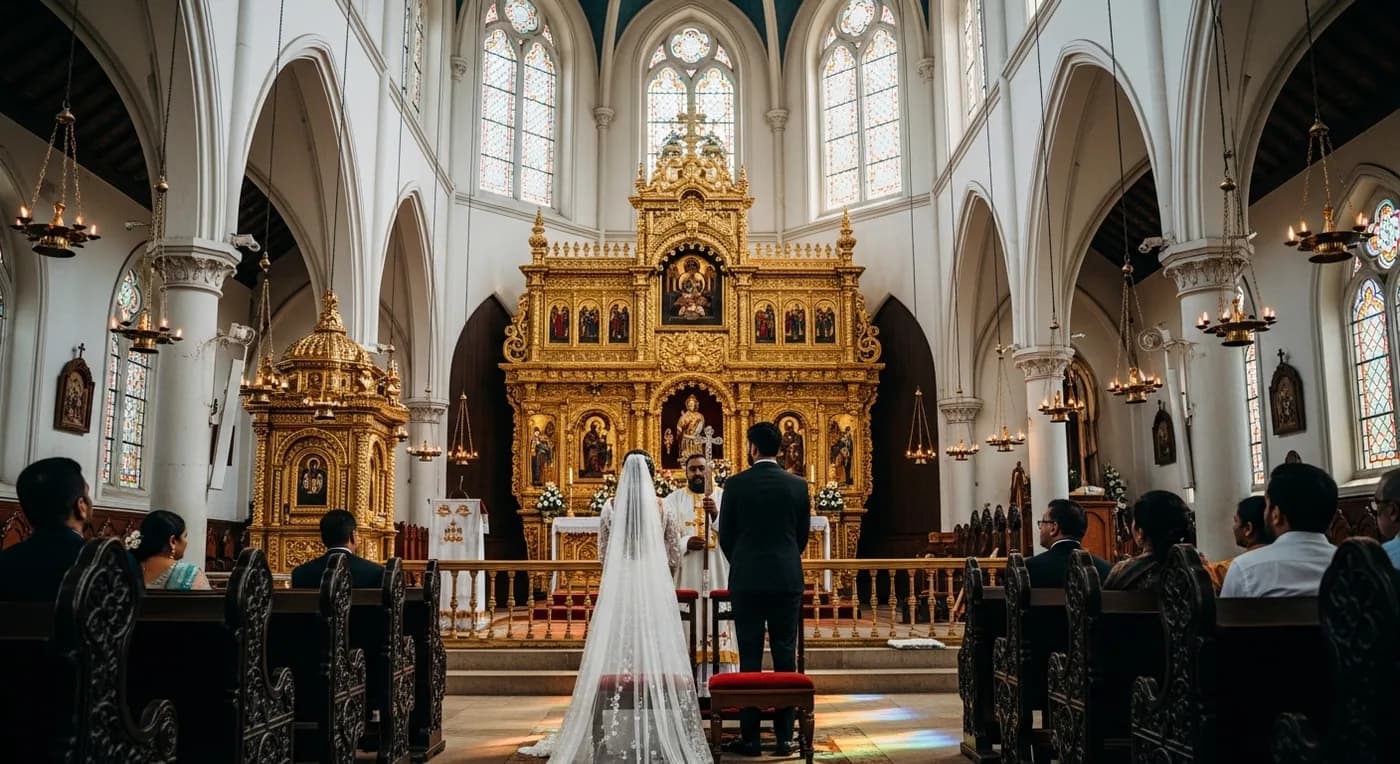
Who are Syrian Christian Malayalis and why do NRIs in this community need their own playbook?
The Syrian Christians of Kerala, historically known as Nasranis or Saint Thomas Christians, trace their origins to the apostle Thomas's arrival on the Malabar Coast in 52 AD. They number roughly six million worldwide, with deep roots in Kottayam, Pala, Thiruvalla, Chengannur, and Ernakulam (Kochi/Cochin), and heavy diaspora presence across the Gulf, USA, UK, and Canada. According to the Ministry of External Affairs (May 2024), there are 15.85 million NRIs and 19.57 million PIOs globally. The Kerala Migration Survey 2023 (IIMAD) counts 2.2 million Kerala emigrants, with 80.5% across the Gulf and a growing Syrian Christian cohort in Houston, New Jersey, Chicago, Toronto, and the West Midlands.
Generic Kerala wedding guides treat "Kerala Christian" as one category. A Syro-Malabar NRI bride in New Jersey marrying a Jacobite groom in Kottayam has a completely different paperwork stack than a Mar Thoma couple from Dubai marrying in Thiruvalla. This post maps that reality.
Which denomination is yours, and how does it affect planning?
Six denominations fall under the Syrian Christian Malayali umbrella, and they are not interchangeable for wedding planning.
- Syro-Malabar Catholic Church — the largest Eastern Catholic church in Kerala, Eastern Syriac liturgy, headquartered at Mount Saint Thomas, Kakkanad (Ernakulam).
- Syro-Malankara Catholic Church — Eastern Catholic, West Syriac (Antiochene) rite, headquartered in Thiruvananthapuram (Trivandrum).
- Malankara Orthodox Syrian Church — Oriental Orthodox, autocephalous under the Catholicos of the East at Devalokam, Kottayam. Famous for the Crowning rite.
- Malankara Jacobite Syriac Orthodox Church — Oriental Orthodox, West Syriac rite, under the Patriarch of Antioch. Liturgically near-identical to Malankara Orthodox.
- Mar Thoma Syrian Church — a reformed Oriental church with a simplified Syriac liturgy and a shorter wedding service.
- Church of South India (CSI) — Protestant, formed in 1947; common in Kozhikode (Calicut) and Thiruvananthapuram.
Why this matters for NRIs: Catholic churches run formal Pre-Cana and require banns on three consecutive Sundays. Orthodox and Jacobite churches have their own preparation, less structured but still requiring a parish meeting. Mar Thoma and CSI run preparation closer to a conversation. Get this wrong and the diocese can refuse the marriage certificate on the day.
How does diocese booking work for NRI couples?
Diocese booking for NRIs opens six to twelve months out. The home parish of either the bride or the groom holds canonical jurisdiction — you cannot simply book any photogenic church. A family I helped plan a Pala wedding last year started by booking a heritage church in Ernakulam, only to discover two months later that Pala had not issued the no-objection letter. The wedding moved back to Pala, which was the right call anyway.
The booking flow for an NRI Syro-Malabar wedding:
- Contact the home parish priest (nine months out)
- Confirm the date against the liturgical calendar (Lent and Advent blackouts apply)
- Submit baptism and confirmation certificates
- Enrol in Pre-Cana — in Kerala or through a recognised eparchy abroad
- File for banns reading (three consecutive Sundays before the wedding)
- Obtain the letter of freedom from each party's home parish
- Civil registration under the Indian Christian Marriage Act 1872
Popular churches in Kottayam, Pala, Thiruvalla, Chengannur, and Ernakulam book out fastest for the November–February peak. Malankara Orthodox and Jacobite calendars differ slightly — check fasting-season blackouts.
Looking for Venues in Kottayam?
Tell us what you need and get quotes from verified venues
What does the Pre-Cana marriage preparation course look like for NRIs?
Pre-Cana is the Catholic marriage preparation course — mandatory in Syro-Malabar and Syro-Malankara churches before the diocese issues permission. It runs two to three days in person or four to six weekly sessions in virtual format, covering communication, family finances, and practical expectations of married life.
Tip
Pre-Cana scheduling: If you're based in the USA, check whether the Syro-Malabar Catholic Eparchy of Chicago or the Syro-Malankara Catholic Eparchy of the USA and Canada runs Pre-Cana near you. Complete it at least three months before flying to Kerala and email the signed certificate to your home parish ahead of time. If the Kerala priest rejects the foreign certificate, you need the buffer to complete an in-person top-up before the banns window opens.
Malankara Orthodox, Jacobite, and Mar Thoma traditions run their own preparation — a meeting or short retreat with the parish priest. CSI uses a pastoral counselling session. None are optional, and all expect both parties to attend together.
What documents do Syrian Christian NRIs need?
Canon law adds its own requirements on top of Indian civil law. Assemble these four months out:
- Baptism certificate — recent copy (within six months) from the parish of baptism
- Confirmation certificate
- Parents' marriage certificate — required in many Kottayam and Pala parishes to verify lineage
- Letter of freedom — from the home parish confirming no canonical impediment
- Single-status affidavit — for civil registration; in the UAE this also needs consulate attestation
- Pre-Cana completion certificate
- Passport and OCI card
- Civil registration under the Indian Christian Marriage Act 1872
For the cross-border paperwork walkthrough and attestation paths for US, UAE, and UK documents, see our NRI marriage registration in South India legal playbook.
What does the bride wear?
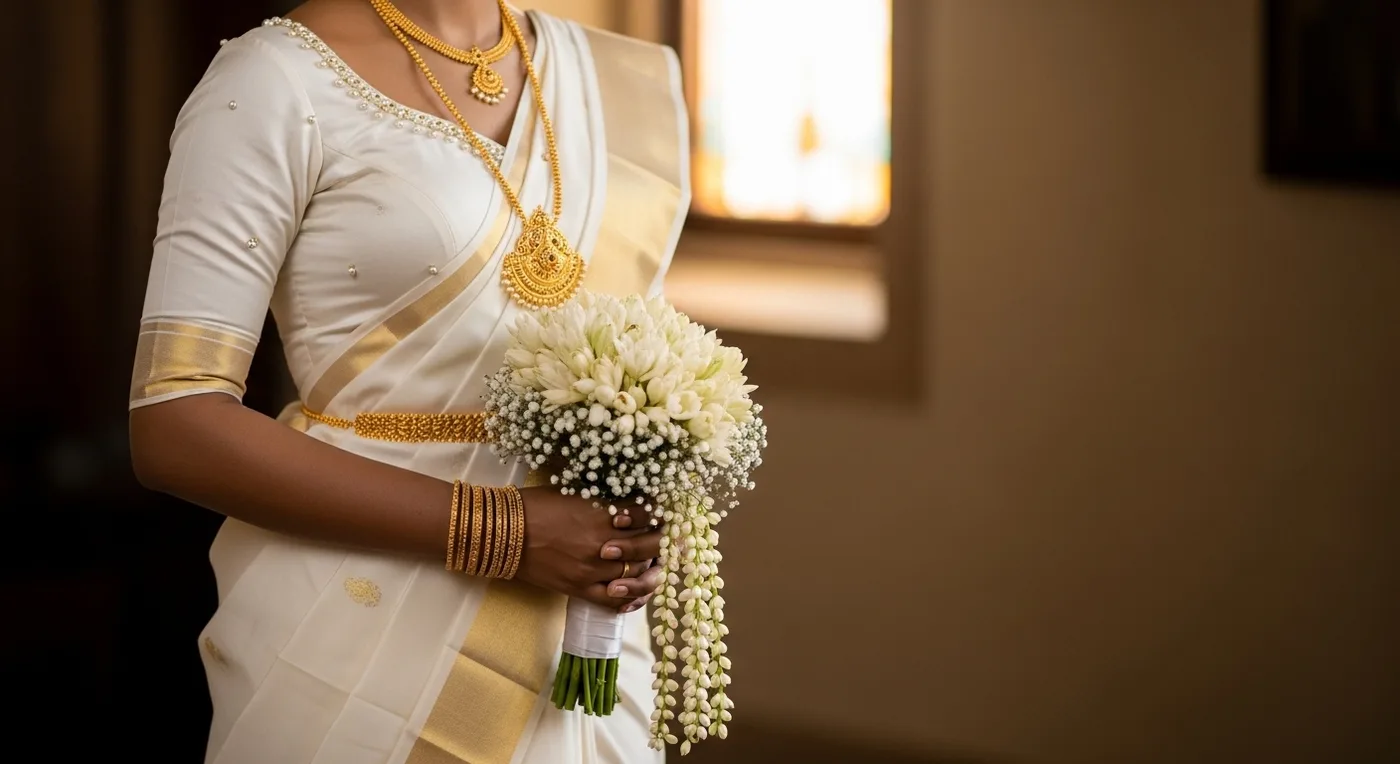
The Syrian Christian Malayali bride wears a kasavu-influenced white wedding gown — a unique silhouette between a Western gown and a Kerala kasavu saree, distinct from Latin Catholic or Goan Catholic bridal attire. The gown is typically ivory silk with a gold kasavu border and see-through net or lace sleeves. Mar Thoma, Orthodox, and Jacobite brides often choose a white kasavu saree over a gown, then change into a designer saree or lehenga for the reception.
Three ritual objects matter:
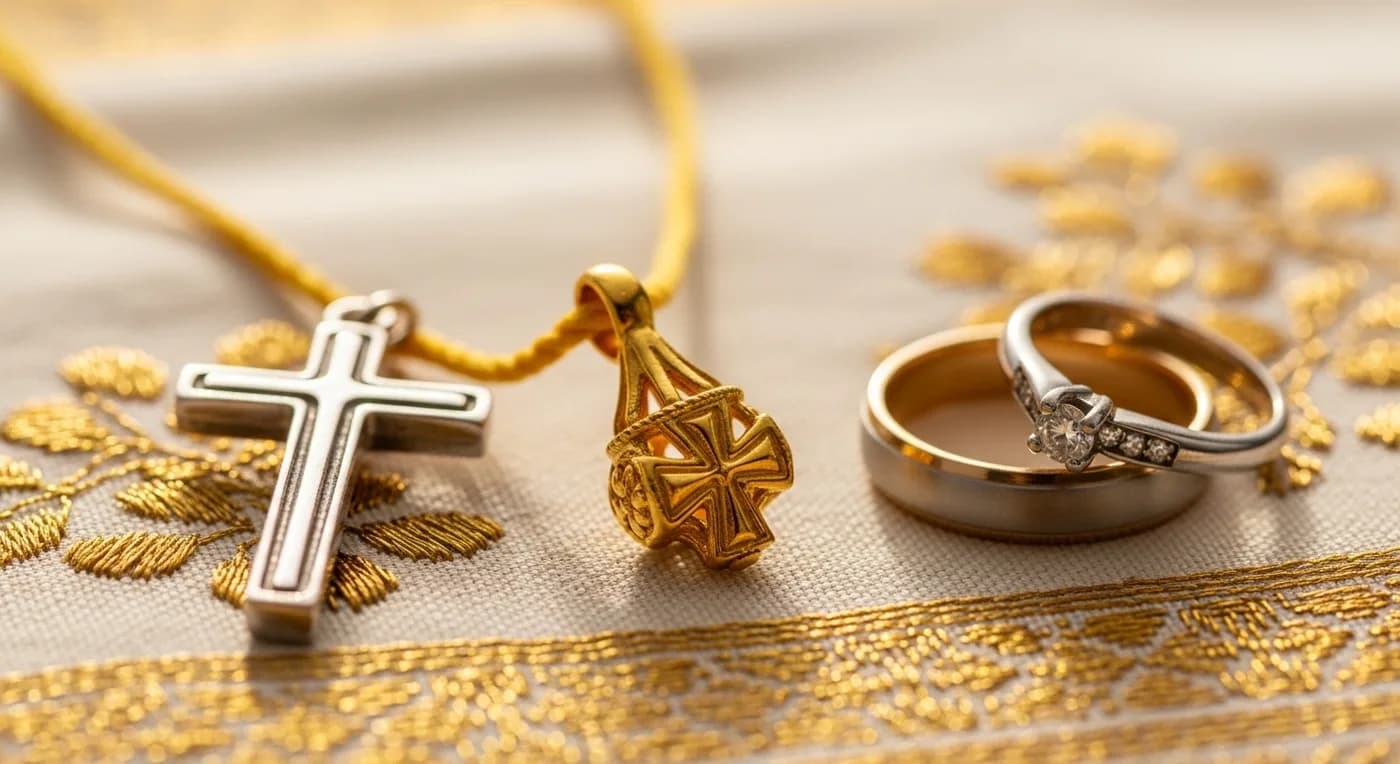
- Minnu (or thali) — a small heart-shaped gold pendant tied on a yellow thread around the bride's neck; later transferred to a gold chain. It differs from the Tamil Hindu thali in shape and symbolism.
- Manthrakodi — a richly woven silk cloth, typically with temple-border motifs, draped by the groom over the bride's head after the minnu is tied. The most photographed moment of the ceremony, unique to Kerala Syrian Christians.
- Gold jewellery — elamakkai chains, kaasu malas, bangles, and earrings, usually handed down as heirlooms. A full wedding set runs ₹5,00,000 – ₹25,00,000.
The gown and manthrakodi together typically cost ₹80,000 – ₹3,50,000.
How does the ceremony flow?
A Kerala Syrian Christian ceremony runs sixty to ninety minutes for a Catholic service and seventy-five to a hundred and twenty minutes for an Orthodox or Jacobite service, depending on whether a full Holy Qurbana is included.
- Procession — bride and groom enter separately with their families.
- Opening prayers and Syriac chants in Syriac, Malayalam, and English.
- Betrothal — rings are blessed and exchanged.
- Scripture readings and homily — a short bilingual sermon.
- Exchange of consent — the canonical "I do" moment.
- Minnu tying and manthrakodi — the priest blesses the minnu, the groom ties it, then drapes the manthrakodi over the bride's head.
- Holy Qurbana (Catholic) or Crowning (Orthodox/Jacobite) — Eucharistic celebration or the crowning of bride and groom.
- Final blessing and recessional.
At a Mar Thoma NRI wedding in Thiruvalla last December, the entire ceremony ran sixty-eight minutes end to end — which surprised the US-based guests who had expected a three-hour marathon.
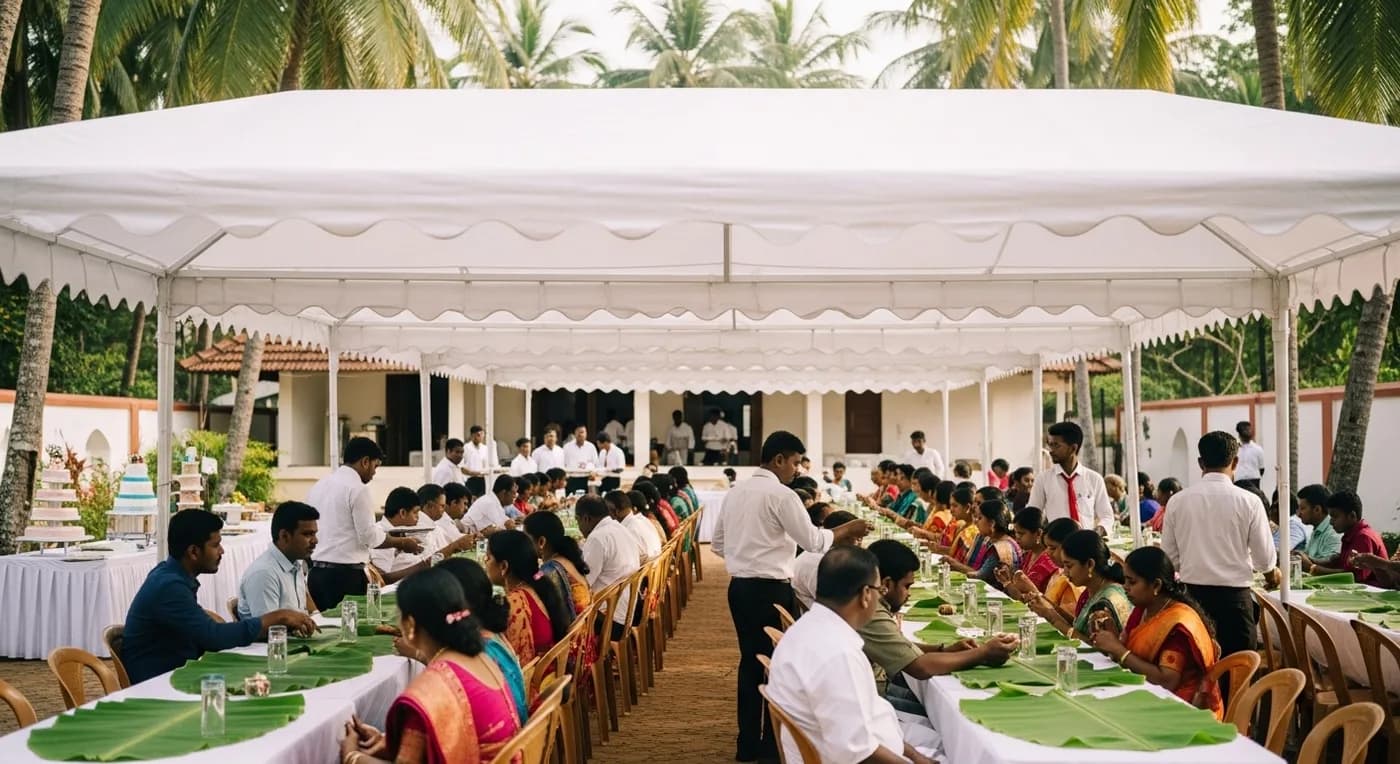
How does the post-church celebration differ from Catholic or Protestant weddings elsewhere?
The biggest post-church difference is food: a full Kerala sadhya served on banana leaf, not a Western buffet. Most families run the sadhya for lunch right after the ceremony, with the evening reserved for a reception.
- Morning church ceremony — 9:00 to 11:00, followed by photographs
- Sadhya lunch — 12:00 to 2:30, banana leaf, 18 to 26 items
- Plum cake cutting — early evening
- Reception — 6:00 to 10:00, live music and multi-cuisine dinner
A mid-range sadhya runs ₹350 – ₹900 per plate. A full reception hall in Kottayam, Ernakulam, or Thiruvalla typically costs ₹2,00,000 – ₹12,00,000 for the evening.
Looking for Caterings in Kochi?
Tell us what you need and get quotes from verified caterings
Note
Denomination distinctions — keep these straight: Syro-Malabar and Syro-Malankara are Eastern Catholic (in full communion with Rome). Malankara Orthodox Syrian and Malankara Jacobite Syriac Orthodox are Oriental Orthodox (not in communion with Rome or Constantinople). Mar Thoma Syrian is a reformed Oriental church. CSI is Protestant. Latin Catholic and Goan Catholic weddings are a different tradition entirely and should not be conflated with the Syrian Christian Malayali celebration described in this guide.
Denomination comparison table
Use this reference sheet to confirm what your specific parish will require.
| Denomination | Diocese region | Pre-Cana / preparation | Typical ceremony length | Banns timeline |
|---|---|---|---|---|
| Syro-Malabar Catholic | Kottayam, Pala, Changanassery, Ernakulam, Thrissur | Formal Pre-Cana, 2–3 days or 4–6 virtual sessions; foreign certificates accepted in most parishes | 75–90 min (with Qurbana) | 3 consecutive Sundays before wedding |
| Syro-Malankara Catholic | Thiruvananthapuram, Pathanamthitta | Formal Pre-Cana; stricter on in-person attendance | 80–100 min | 3 consecutive Sundays |
| Malankara Orthodox Syrian | Kottayam, Thiruvalla, Pathanamthitta | Parish-led preparation; meetings with priest | 90–120 min (includes Crowning) | 3 consecutive Sundays |
| Malankara Jacobite Syriac Orthodox | Kottayam, Ernakulam, Thrissur | Parish-led preparation | 90–120 min (includes Crowning) | 3 consecutive Sundays |
| Mar Thoma Syrian | Thiruvalla, Chengannur, Kozhikode | Pastoral meeting; shorter format | 45–60 min | 2–3 consecutive Sundays |
| Church of South India (CSI) | Thiruvananthapuram, Kozhikode, Ernakulam | Pastoral counselling session | 45–75 min | Varies by diocese |
What are the biggest logistical pitfalls for USA or Gulf Syrian Christian NRIs?
After helping around forty NRI Syrian Christian Malayali families plan weddings, the same mistakes come up every time — almost all trace back to assumptions made from abroad without checking with the home parish.
Important
The banns reading trap: Banns (the public announcement of the intended marriage) must be read in the home parish on three consecutive Sundays before the ceremony. If you arrive in Kerala eight days before your wedding, it is already too late — the banns cycle cannot be compressed, and the diocese will refuse to proceed. File the banns request at least five weeks before the wedding date, and coordinate with both the bride's and groom's home parishes if they're different.
The five most common pitfalls:
- Assuming Pre-Cana can be done in any format abroad. It depends on parish and bishop. Get acceptance in writing six months out.
- Not accounting for the banns window. Three consecutive Sundays is non-negotiable in Catholic parishes.
- Mixing denominations without diocesan clearance. A Syro-Malabar groom marrying an Orthodox bride requires a dispensation — start the conversation nine months out.
- Scheduling a Sunday slot during a busy parish season. Kottayam and Pala run multiple weddings a day in December, and Sunday slots clash with regular Qurbana.
- Ignoring civil registration under the Indian Christian Marriage Act 1872. The church ceremony alone is not the civil record.
For corridor-specific flight, visa, and banking pre-work, read our plan a Kerala wedding from the USA and plan a Kerala wedding from UAE and Gulf playbooks, plus the NRI wedding budget in USD, GBP and AED spoke.
The Grand View Research India Wedding Services Market report valued the Indian wedding services market at $103.93 billion in 2024 at a 14.3% CAGR through 2030. The WedMeGood Annual Wedding Industry Report 2024–2025 shows sustained Kerala destination demand, and Kerala Tourism promotes Kumarakom, Kovalam, and Kochi as NRI-ready destinations. For foreign in-laws flying in, our foreign guests host's brief covers dress code and church protocol, and the Kerala Christian wedding traditions guide is a companion read.
The takeaway
A Syrian Christian Malayali NRI wedding is plannable from Houston, Dubai, or London, but the sequence matters. Start with your denomination, confirm the home parish, lock Pre-Cana acceptance in writing, then back-plan the banns reading, civil registration, and venue. The right first step is an email to your home parish priest in Kottayam, Pala, Thiruvalla, Chengannur, Ernakulam, or Pathanamthitta. Everything else follows.
Looking for Wedding Planners in Kottayam?
Tell us what you need and get quotes from verified wedding planners
Topics
syrian christian malayali nri weddingkerala christian nri weddingnasrani wedding from usa uaesyro-malabar nri weddingkottayam christian wedding nrimanthrakodi weddingkasavu wedding gownExplore more
Frequently Asked Questions
1What is a Syrian Christian Malayali wedding?
2How long does a Syro-Malabar Catholic wedding ceremony take?
3Can NRIs do the Pre-Cana marriage preparation course abroad?
4What does a Syrian Christian bride wear on her wedding day?
5Which Kerala diocese is best for a Syrian Christian NRI wedding?
Continue reading
Related Articles
NRI South Indian Wedding Guide: Kerala, Tamil Nadu, Karnataka
Plan a Kerala Wedding from UAE & Gulf: NRI Guide (₹12–35L)

Plan a Kerala Wedding from the USA: NRI Playbook (₹15–40L)
NRI Marriage Registration in South India: Legal Playbook
NRI South Indian Wedding Budget: ₹15–40L in USD, GBP, AED
Foreign Guests at a South Indian Wedding: Host's Brief
Still planning?
Get quotes from India's best vendors
Tell us what you're planning and we'll match you with verified photographers, venues, decorators, and more.
Get free quotes