
Traditional Kerala Bridal Jewellery: 12 Iconic Pieces Every Bride Should Know
Guide to 12 iconic Kerala bridal jewellery pieces — Manga Mala from ₹4.5 lakh, Kasumalai from ₹3.75 lakh at 2026 gold rates. Significance and styling tips.

Cultural Heritage Writer
Sujata Iyer is a cultural heritage writer specializing in the rich tapestry of South Indian wedding traditions.
On this page
A traditional Kerala bride wears 12 iconic gold ornaments, with Manga Mala costing ₹4.5–9 lakh and Kasumalai running ₹3.75–7.5 lakh at 2026 gold rates. Thrissur remains the goldsmithing capital, producing pieces in 22K using repousse and filigree techniques. Modern brides often choose lightweight hollow-core versions or convertible sets that transition from ceremony to daily wear.
Quick Answer
Quick answer: The 12 essential Kerala bridal jewellery pieces are Manga Mala, Kasumalai, Palakka Mala, Mullamottu Mala, Poothali Mala, Nagapadam Mala, Jhumka earrings, Toda/Kammal studs, Odiyanam waist belt, Nethi Chutti forehead ornament, Vanki upper-arm band, and Bangles. Budget ₹30–60 lakh for the full set at 2026 gold rates; prioritise Manga Mala and Palakka Mala as the most distinctively Kerala pieces. Shop in Thrissur for the widest traditional selection.
There is something unmistakable about a Kerala bride. Before the camera finds her face, it catches light — warm, buttery gold cascading in layers from her neck, each piece telling a story older than the temples it was inspired by. Kerala's goldsmithing tradition stands apart in India not because of dazzling gemstones, but because of its reverence for gold itself. Where Rajasthani jewellery leans into Kundan and Polki, where Hyderabadi sets glitter with pearls, Kerala bridal jewellery speaks a quieter, more ancient language: the curve of a mango, the bud of a jasmine flower, the veined surface of a palakka leaf. Nature, rendered in 22-karat gold, with techniques passed through families of master craftsmen for centuries.
This guide covers the 12 iconic pieces that define the traditional Kerala bridal look. Whether you are a Nair bride preparing for a temple ceremony in Guruvayoor, a Syrian Christian bride in Kottayam, or a Mappila bride in Kozhikode, understanding these ornaments — their origins, significance, and how 2026 brides are reimagining them — will help you make choices that honour tradition while reflecting your personal style.
The Heritage of Kerala Gold
Kerala's relationship with gold is civilizational, and the state's economy — ranked among India's most prosperous — sustains one of the country's highest per-capita gold consumption rates. Ancient spice trade routes brought Roman gold coins to the Malabar coast as early as the 1st century CE, and Chera dynasty rulers channelled this wealth into temple treasuries. Inside these temples — Padmanabhaswamy in Thiruvananthapuram, Vadakkunnathan in Thrissur, Guruvayoor — the aesthetic vocabulary of Kerala jewellery was born. Temple deity ornaments became the templates for bridal sets: the mango motif from Vishnu's garlands, the serpent hood from Ananta Shesha, the coin from Lakshmi's iconography.
The artisans belonged to the Thattan community, hereditary goldsmiths whose workshops around Thrissur became the epicentre of Kerala's jewellery industry. Thrissur remains the "Gold Capital of India," with wholesale workshops in Irinjalakuda and Kodungallur. The core techniques are remarkably consistent: Nagas work (raised serpentine patterns hammered from behind), filigree (twisted gold wire soldered into lace-like patterns), and repousse (relief work from hammering the reverse of a gold sheet). These require years of apprenticeship and an inherited feel for how gold moves under pressure.
Note
Cultural Note: Kerala's goldsmithing tradition traces back over 2,000 years to the Chera dynasty. The designs you see in bridal sets today — the mango motif, the jasmine bud, the rice grain — are direct descendants of temple treasury patterns described in ancient texts.
The 12 Iconic Pieces
Necklaces
1. Manga Mala — The Mango Paisley Necklace
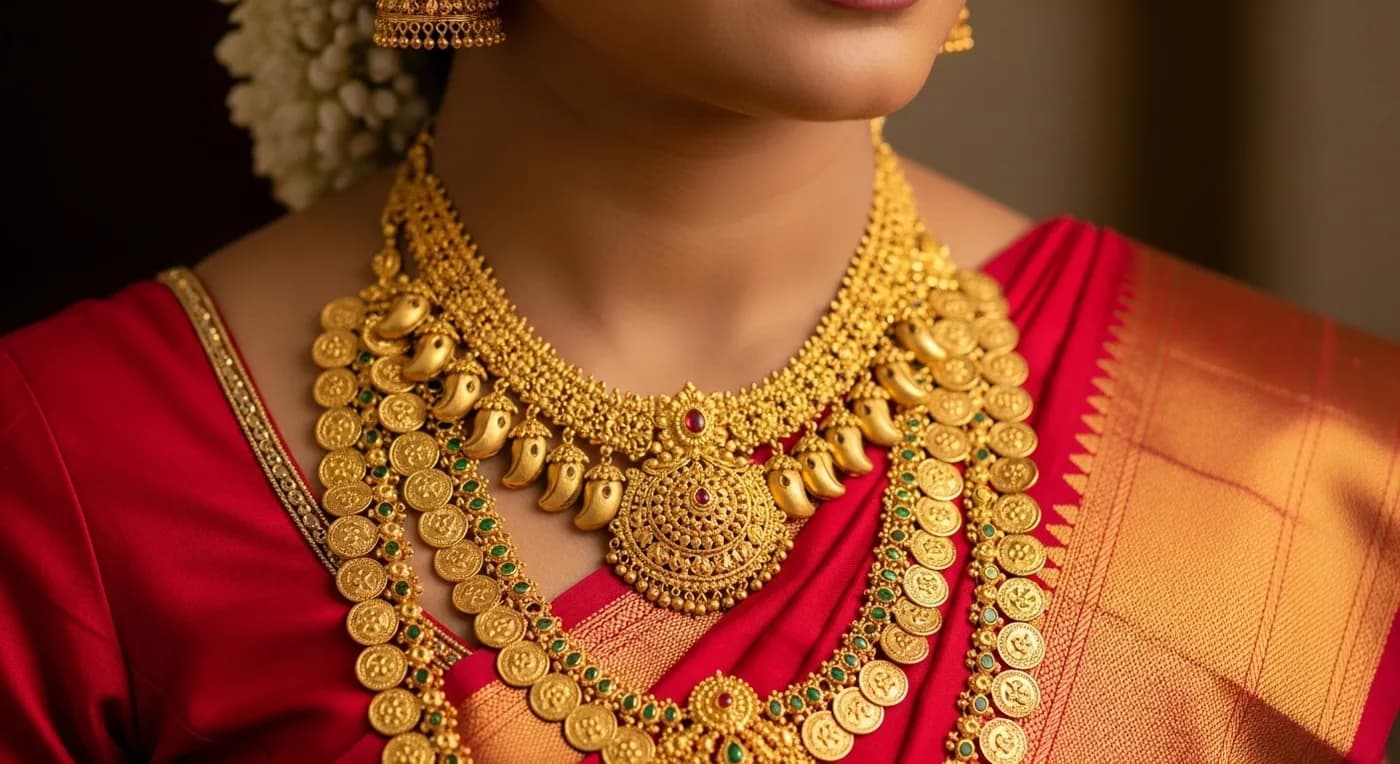
The single most iconic Kerala bridal piece. A series of mango-shaped paisley pendants in graduated sizes — smallest at the clasp, largest at centre — crafted in 22K gold with detailed surface engraving. The mango symbolises fertility, abundance, and the sweetness of married life. Weight: 60–120g. A standard bridal Manga Mala with 15–19 pendants costs Rs 4,50,000–9,00,000 at 2026 rates.
₹4,50,000 – ₹9,00,000Thrissur versions feature rounder, three-dimensional pendants with deep repousse. Malabar-region pieces have flatter, broader pendants with more surface engraving. The Travancore style from Thiruvananthapuram favours elongated pendants with pointed tips. Worn across all communities — Hindu, Christian, and Muslim. Modern lightweight versions use hollow-core pendants (35–50g) and some feature detachable central pendants for post-wedding wear.
2. Kasumalai — The Gold Coin Necklace
A necklace of gold coins (kasu), each 1.5–2 cm across, traditionally embossed with Goddess Lakshmi. The bride is literally draped in the goddess of wealth. Weight: 50–100g. Single-strand cost: Rs 3,75,000–7,50,000. Double or triple-strand ceremonial versions for Nair and Namboodiri brides can exceed Rs 10,00,000.
₹3,75,000 – ₹7,50,000Thrissur Kasumalais have larger coins with high-relief images. Kottayam's Christian tradition sometimes replaces Lakshmi with a cross motif. In Palakkad, coins are smaller but chains longer. The 2026 standout trend: convertible Kasumalais that unclip into a choker, mid-length necklace, or pendant set — costing 10–15% more but delivering tremendous versatility.
3. Palakka Mala — The Green Leaf Necklace
Kerala's most recognizable design — leaf-shaped frames set with green glass representing mango or jackfruit leaves. The green-and-gold combination is visual shorthand for Kerala itself. Traditional versions use green glass (not gemstones) in a gold bezel at choker length. Weight: 40–80g. Cost: Rs 3,00,000–6,00,000.
₹3,00,000 – ₹6,00,000Thrissur versions feature larger, widely spaced leaves; Ernakulam and Kottayam jewellers create tighter arrangements. Coloured enamel is replacing traditional glass in 2026 collections — ruby red, sapphire blue, and white options now coordinate with reception outfits.
Tip
Styling Tip: Layer the Palakka Mala closest to the neck as a choker, with the Manga Mala at mid-length and Kasumalai as the longest piece. This classic three-layer combination is the foundation of the Kerala bridal necklace stack.
4. Mullamottu Mala — The Jasmine Bud Chain
Tiny tear-shaped gold beads — each modelled on an unopened jasmine bud — strung closely together. The effect is organic and textural, like a real jasmine garland dipped in gold. One of the lighter bridal pieces at 30–60g, costing Rs 2,25,000–4,50,000. A favourite among Syrian Christian brides in Kottayam and Ernakulam as a standalone piece with the white wedding saree. Hindu brides layer it as a mid-length chain within the full stack.
₹2,25,000 – ₹4,50,0005. Poothali Mala — The Flower Pendant Chain
Centred on a large, three-dimensional lotus or hibiscus pendant (poothali) suspended from a gold chain, sometimes with a ruby or emerald at centre. A Thrissur specialty. Weight: 40–70g (pendant accounts for roughly half). Cost: Rs 3,00,000–5,25,000. Modern versions offer interchangeable pendants — bridal-size for the ceremony, smaller for daily wear.
₹3,00,000 – ₹5,25,0006. Nagapadam Mala — The Serpent Hood Necklace
A pendant shaped like the hood of a cobra (naga), representing protection, fertility, and the cosmic power of Ananta Shesha. Deep religious significance — traditionally worn by Hindu brides, especially Nair and Namboodiri families. Weight: 50–90g. Cost: Rs 3,75,000–6,75,000. The Thiruvananthapuram style, influenced by Padmanabhaswamy temple, features a multi-headed hood. Thrissur versions favour a single, stylized hood with cleaner lines.
₹3,75,000 – ₹6,75,000Earrings
7. Jhumka (Jimikki) — The Bell-Shaped Earrings
Dome-shaped hanging earrings with a bell-like lower portion, decorated with tiny gold droplets, filigree, or miniature motifs. Called Jimikki in Malayalam. Bridal weight: 15–30g per pair. Cost: Rs 1,12,000–2,25,000. Modern versions use screw-back fittings for comfort and some brides commission hybrid gold-and-pearl pieces for receptions.
₹1,12,000 – ₹2,25,0008. Toda / Kammal — The Kerala Stud Earrings
Flat, broad stud earrings — circular or leaf-shaped — with surface engraving or repousse. Practical and close to the ear. Bridal weight: 10–20g per pair. Cost: Rs 75,000–1,50,000. The Mappila tradition in Malabar favours Pookkuthy Kammal — a larger, flatter stud with floral engraving. Syrian Christian brides often choose leaf-shaped Kammals echoing the Palakka motif.
₹75,000 – ₹1,50,000Other Essential Pieces
9. Odiyanam — The Ceremonial Waist Belt
The heaviest single piece — a wide gold belt of interlocking plates worn over the saree. Holds pleats in place and creates the defined waistline central to the Kerala bridal silhouette. Weight: 80–150g. Cost: Rs 6,00,000–11,25,000. Chain-style versions with lighter links are gaining popularity, and half-belts (front and sides only) reduce weight by 30–40%.
₹6,00,000 – ₹11,25,00010. Nethi Chutti — The Forehead Ornament
Kerala's Maang Tikka — a delicate gold chain with a small pendant at the hairline, simpler than North Indian versions. Weight: 10–25g. Cost: Rs 75,000–1,87,000. Palakkad brides, influenced by Tamil Nadu, sometimes choose broader versions with side chains. Christian brides may skip it entirely or opt for a tiara.
₹75,000 – ₹1,87,00011. Vanki — The Upper Arm Ornament
A V-shaped gold ornament following the curve of the upper arm, featuring Nagas work or floral repousse on the outer face. Connected to temple deity iconography. Weight: 30–60g. Cost: Rs 2,25,000–4,50,000. Worn on the left arm over the saree fabric. In some Namboodiri and Nair families, gifted by the groom's family during the Thaali Kettu ceremony.
₹2,25,000 – ₹4,50,00012. Bangles (Vala)
Solid, substantial gold rings — not thin stamped bangles. Hindu brides wear an odd number (7, 9, or 11 per wrist); Christian brides may wear any count. A full set (14–22 pieces) weighs 80–200g collectively. Cost: Rs 6,00,000–15,00,000. Style options include plain round, twisted rope-texture, and hinged Kadha-style with engraved surfaces. Ernakulam jewellers now offer stackable sets mixing textures for visual depth.
₹6,00,000 – ₹15,00,000Note
Investment Perspective: Unlike diamond or gemstone jewellery, traditional Kerala gold pieces retain nearly 100% of their material value — crafted in high-purity 22K gold with minimal stone content. Many families treat the bridal set as both adornment and financial asset.
Note
Pricing methodology: All jewellery costs in this guide are calculated at 2026 22K gold rates (based on itsmy.wedding market data) and include typical making charges of 5–8%. Prices will vary with gold rate fluctuations; verify current rates with your jeweller before purchasing.
Pricing Reference Table (2026)
| Piece | Weight Range | Approx. Cost (2026) | Daily Wear Potential |
|---|---|---|---|
| Manga Mala | 60–120g | Rs 4,50,000 – 9,00,000 | Low (heavy, ceremonial) |
| Kasumalai | 50–100g | Rs 3,75,000 – 7,50,000 | Medium (convertible versions) |
| Palakka Mala | 40–80g | Rs 3,00,000 – 6,00,000 | Medium (choker length) |
| Mullamottu Mala | 30–60g | Rs 2,25,000 – 4,50,000 | High (elegant, light) |
| Poothali Mala | 40–70g | Rs 3,00,000 – 5,25,000 | Medium (pendant versatile) |
| Nagapadam Mala | 50–90g | Rs 3,75,000 – 6,75,000 | Low (ceremonial, religious) |
| Jhumka (pair) | 15–30g | Rs 1,12,000 – 2,25,000 | High (lighter versions) |
| Toda/Kammal (pair) | 10–20g | Rs 75,000 – 1,50,000 | High (daily staple) |
| Odiyanam | 80–150g | Rs 6,00,000 – 11,25,000 | Low (ceremonial only) |
| Nethi Chutti | 10–25g | Rs 75,000 – 1,87,000 | Low (occasion wear) |
| Vanki | 30–60g | Rs 2,25,000 – 4,50,000 | Low (wedding specific) |
| Bangles (full set) | 80–200g | Rs 6,00,000 – 15,00,000 | High (daily staple) |
Regional Variations
Thrissur — The Temple Jewellery Hub
The undisputed capital of traditional Kerala jewellery. Massive showrooms on Swaraj Round sit alongside family ateliers in Irinjalakuda and Kodungallur. The Thrissur style: heavy, three-dimensional pieces with deep repousse and a warm, slightly matte antique finish. Proximity to Guruvayoor temple makes deity-inspired designs a specialty. If you want the most authentic traditional set, this is where you commission it.
Looking for Jewellerys in Thrissur?
Tell us what you need and get quotes from verified jewellerys
Kottayam — The Syrian Christian Influence
Jewellery here blends Kerala gold aesthetics with Christian symbolism — cross pendants in Kasumalai chains, rosary-inspired bead work alongside Mullamottu Mala. Kottayam brides typically wear fewer layers but choose each piece with more individual character. Slightly lighter, more refined pieces compared to Thrissur.
Malabar (Kozhikode / Malappuram) — The Pathakkam Style
Shaped by Mappila Muslim heritage and historic Arab trade connections. The signature piece: the Pathakkam — a large, flat, ornately engraved pendant worn on a heavy chain. Malabar sets are heavier and more imposing, with emphasis on neck pieces. The gold often has a deeper, more saturated colour from the distinctive Malabar finishing technique.
Thiruvananthapuram — The Padmanabhaswamy Influence
Jewellery here draws from the Padmanabhaswamy temple tradition, with the serpent motif more prominent than anywhere else. The Travancore royal family's patronage gave the work a court-influenced aesthetic: cleaner lines, geometric precision, and a higher polish than Thrissur's organic warmth.
Note
District Shopping Tip: Many brides travel specifically to Thrissur for their main bridal set, even from other districts. Competitive pricing (due to jeweller concentration), wider traditional selection, and custom commissioning capability make it worthwhile. Budget a full day.
Modern Adaptations for 2026
The 2026 bride is not rejecting tradition — she is reinventing it to serve her post-wedding life too. With India's wedding industry valued at ₹10.79 lakh crore and jewellery representing a significant share, the demand for designs that bridge ceremony and everyday wear has reshaped what Thrissur's goldsmiths produce.
Lightweight engineering is the biggest shift. Hollow-core construction and micro-welding let a Manga Mala look identical to a 100g ceremonial piece while weighing 40–50g. Genuine 22K gold, just engineered lighter. The price drops proportionally, making previously unaffordable pieces accessible.
Convertible designs are transforming the market. A Kasumalai that unclips into a choker and pendant. A Manga Mala with detachable central pendants. An Odiyanam that separates into bracelets. These cost 10–15% more but deliver multiple looks from one investment.
Coloured enamel is appearing across Thrissur and Ernakulam collections. Palakka Mala in ruby red, royal blue, and white — letting brides coordinate across wedding events. Rose gold accents bridge traditional and contemporary aesthetics.
Mix-and-match layering dominates reception wear — one traditional statement piece paired with contemporary minimalist chains and diamond studs.
Tip
The Convertible Trend: Ask your jeweller about detachable designs — a long Kasumalai that unclips into a choker and pendant, or a Manga Mala where the central pendant detaches as a standalone piece. These cost 10-15% more but give you multiple looks from one investment.
Styling Guide: Pairing Jewellery with Outfits
With Kasavu / Mundum Neriyathum (Full Traditional)
Go all in. Layer Palakka Mala as choker, Manga Mala at mid-length, Kasumalai longest, optionally Mullamottu Mala filling gaps. Add full Odiyanam, large Jhumkas, Nethi Chutti, Vanki, and a generous bangle stack. The white-and-gold canvas was designed for exactly this.
With Kanchipuram Silk (Hindu Muhurtham)
The silk has its own visual weight. Lean into temple jewellery: one large Manga Mala or Nagapadam Mala, medium Jhumkas, moderate bangle stack. Skip the Odiyanam — silk drapes differently and the belt disrupts pleats.
With Designer Saree or Lehenga (Reception)
Choose one hero traditional piece — Kasumalai or Palakka Mala — as anchor. Pair with contemporary earrings (diamond studs or pearl drops) and minimal bangles. Skip Odiyanam and Vanki.
With Christian White Saree (Church Wedding)
Cross-motif Kasumalai as centrepiece, layered with Mullamottu Mala and sometimes a gold rosary chain. Jhumkas or ornate Kammals for earrings. Tiara or jewelled hair comb instead of Nethi Chutti. Smaller bangle stack (5–7 per wrist).
Outfit Pairing Quick Reference
| Outfit | Necklace Combo | Earring | Extras |
|---|---|---|---|
| Kasavu Saree | Palakka + Manga Mala + Kasumalai + Mullamottu | Large Jhumka | Odiyanam, Vanki, Nethi Chutti, 9–11 bangles/wrist |
| Kanchipuram Silk | Manga Mala or Nagapadam + one shorter chain | Medium Jhumka | Nethi Chutti, 7–9 bangles/wrist |
| Designer Saree / Lehenga | One statement piece (Kasumalai or Palakka) | Diamond studs or pearl drops | Minimal bangles, no Odiyanam |
| Christian White Saree | Cross Kasumalai + Mullamottu Mala | Jhumka or Kammal | 5–7 bangles/wrist, optional tiara |
| Mappila Nikah Set | Pathakkam + Kasumalai + choker | Pookkuthy Kammal | Heavy bangle stack, forehead ornament |
Care and Maintenance
Cleaning: Wipe with a soft cotton cloth dampened with lukewarm water and a drop of mild dish soap after wearing. Avoid scrubbing filigree or Nagas work — fine wire details can deform. Dry thoroughly before storing.
Avoid: Apply perfume, hairspray, and moisturizer before putting on jewellery. Chlorine and harsh chemicals discolour gold over time. Remove all pieces before sleeping.
Storage: Store each piece individually in a soft cloth pouch or velvet-lined box. Stacked pieces tangle, scratch, and loosen stone settings.
Professional servicing: Have your jeweller inspect and ultrasonically clean the set every 12–18 months — checking links, clasps, and stone settings. Most Thrissur and Ernakulam jewellers offer free servicing for pieces purchased from them.
Polishing: Do not over-polish. Kerala gold's warm, slightly matte finish is intentional. A light buff with a jeweller's cloth every few months suffices.
Important
HUID Hallmarking: As of 2026, all new gold jewellery sold in India must carry a HUID (Hallmark Unique Identification) number — a six-digit alphanumeric code laser-engraved on the piece, linked to a BIS database confirming purity. Verify this on every purchase.
Where to Buy Traditional Pieces
For practical advice on budgeting, gold quality, making charges, and the rent-vs-buy decision, see our bridal jewellery buying guide.
Thrissur remains the destination for authentic work. Swaraj Round for major showrooms; lanes behind Vadakkunnathan temple for custom workshops. Allow 4–6 weeks for bespoke fabrication at 5–8% making charges over gold value.
Ernakulam's MG Road and Broadway offer contemporary styling options. Kozhikode's SM Street is the go-to for Malabar-style Pathakkam sets. Thiruvananthapuram's Chalai Bazaar specializes in Travancore temple jewellery.
Several established Kerala jewellers now offer virtual consultations and national shipping — useful for NRI brides. For pieces above Rs 5,00,000, an in-person visit to assess craftsmanship is strongly recommended.
Looking for Jewellerys in Kottayam?
Tell us what you need and get quotes from verified jewellerys
Important
Antique Gold Alert: If buying 'antique' or 'heritage' jewellery, verify it's genuinely old gold being resold (which may lack HUID) vs new jewellery with an antique finish (which must have HUID hallmarking). Legitimate antique dealers provide provenance documentation.
Common Questions About Traditional Kerala Bridal Jewellery
What are the must-have jewellery pieces for a Kerala bride?
The essential pieces are the Manga Mala, Palakka Mala, Kasumalai, Mullamottu Mala, Jhumka earrings, bangles, and Odiyanam. The exact combination varies by community — Hindu brides typically wear the full set, Christian brides may substitute the Nagapadam for a cross-motif chain, and Muslim brides in Malabar add the Pathakkam pendant. Budget-conscious brides should prioritize the Manga Mala and Palakka Mala as the two most visually distinctive pieces.
What is the difference between Manga Mala and Kasumalai?
Manga Mala features graduated mango-shaped paisley pendants — Kerala's most uniquely regional design. Kasumalai is a chain of uniform gold coins embossed with Lakshmi imagery. Both are heavy ceremonial necklaces and the longest in the bridal stack. The core distinction: Manga Mala celebrates the mango (fertility, abundance), Kasumalai celebrates Lakshmi (wealth, prosperity). Most brides wear both at different lengths.
How are traditional Kerala jewellery designs different from North Indian styles?
Kerala jewellery emphasises intricate goldwork with minimal stone use — gold itself is the star. Motifs come from nature (mango, jasmine, serpent, lotus) rather than geometric patterns. The finish is warm and slightly matte, unlike the high-mirror polish preferred up north. North Indian bridal jewellery — Kundan, Polki, Jadau — uses gold primarily as a setting for stones. A 100g Kerala necklace is nearly 100g of 22K gold; a North Indian piece of similar weight might be 60–70g gold with stones, lac, and enamel making up the rest.
Can I modernize traditional Kerala jewellery for my wedding?
Absolutely. Lightweight hollow-core construction halves the weight without changing the look. Detachable Kasumalais convert from ceremonial chain to choker and pendant. Palakka Mala comes in coloured enamel instead of green glass. Stackable bangles mix plain, twisted, and engraved textures. Many Thrissur and Ernakulam jewellers maintain dedicated "contemporary traditional" collections — preserving the motif and craftsmanship while adapting weight and modularity for modern life.
How do I pair traditional jewellery with different saree types?
For a Kasavu saree, commit fully — layer Manga Mala, Kasumalai, and Palakka Mala together with Odiyanam and large Jhumkas. For Kanchipuram silk, scale back to one or two temple-style statement necklaces. For a designer saree or lehenga at the reception, pick one iconic traditional piece as anchor and mix with contemporary earrings and minimal bangles. The outfit's visual weight guides the jewellery load: heavier fabrics need less jewellery, simpler fabrics carry more.
Further Reading
- Bridal Jewellery Buying Guide — Budgeting, selecting, and purchasing your complete bridal jewellery set.
- Kerala Wedding Traditions — The ceremonies, rituals, and cultural context behind every element of a Kerala wedding.
Tip
Planning a traditional wedding? Our AI Wedding Checklist generates a personalised timeline that includes all the rituals and ceremonies for your specific tradition. Estimate your full budget with the Cost Calculator.
Topics
traditional Kerala jewelleryManga MalaPalakka MalaKasumalaiKerala bridal goldtemple jewellery KeralaExplore more
Frequently Asked Questions
1What are the must-have jewellery pieces for a Kerala bride?
2What is the difference between Manga Mala and Kasumalai?
3How are traditional Kerala jewellery designs different from North Indian styles?
4Can I modernize traditional Kerala jewellery for my wedding?
5How do I pair traditional jewellery with different saree types?
Continue reading
Related Articles
Kerala Bridal Jewellery Buying Guide: Gold, Budget, and 2026 Trends
Kerala Wedding Traditions Explained: Rituals, Meaning & Modern Adaptations
Kerala Christian Wedding Traditions: A Complete Guide to Rituals and Customs
Kerala Groom Attire Guide: Mundu vs Sherwani and Everything In Between
Kerala Wedding Mehndi Guide: Mailanchi Designs, Trends & Planning for 2026
Best Season for South India Destination Weddings: Month-by-Month Western Ghats Guide
Still planning?
Get quotes from India's best vendors
Tell us what you're planning and we'll match you with verified photographers, venues, decorators, and more.
Get free quotes