
Kerala Christian Wedding Traditions: A Complete Guide to Rituals and Customs
From the Madhuram Veppu to the Manthrakodi — a comprehensive guide to Kerala Christian wedding rituals across Syrian, Knanaya, Orthodox, Latin Catholic.

South Indian Wedding Editor
Rachel Thomas is a South Indian wedding editor who covers Christian wedding traditions across Kerala and Tamil Nadu.
On this page
Kerala Christian weddings span 5 distinct denominations — Syrian, Knanaya, Orthodox, Jacobite, and Latin Catholic — each with unique rituals. The church ceremony runs 45 minutes to 1.5 hours; the full two-day celebration including Madhuram Veppu and reception costs ₹12–30 lakhs for 400–700 guests. The Knanaya tradition is the most ritual-rich, featuring exclusive Mylanchi Idal and Chantham Chartal ceremonies.
Quick Answer
Quick answer: A Kerala Christian wedding spans two days — the Madhuram Veppu (sweetening ceremony) the evening before, and the church ceremony with Minnukettu (tying the wedding pendant) and Manthrakodi (wedding saree) on the day itself. Total cost typically runs ₹12–30 lakhs for 400–700 guests, with the reception venue and catering as the largest expenses.
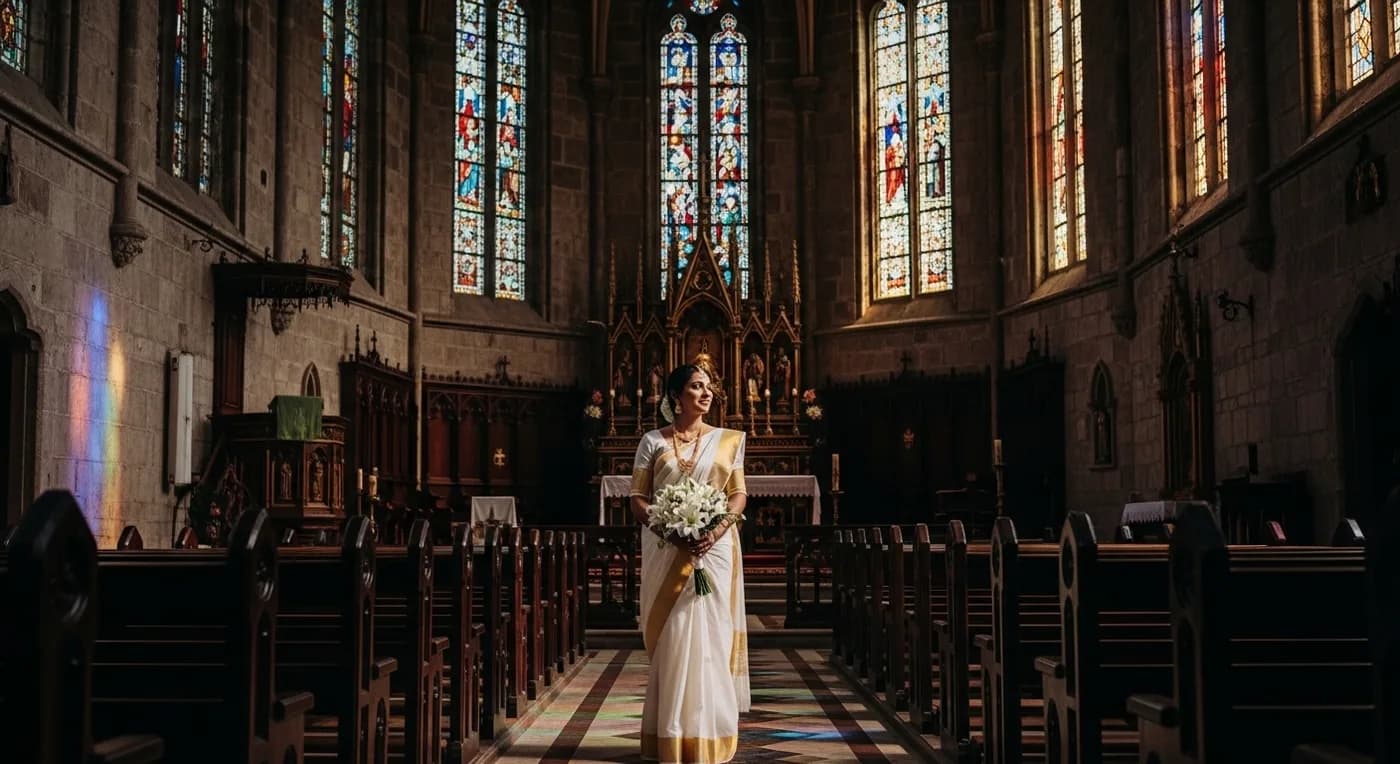
Kerala's Christian community is a vital part of a state that IBEF highlights as one of India's most developed and culturally rich. Walk into a Kerala Christian wedding, and within minutes you will understand why it stands apart from every other Christian celebration in India. The brass nilavilakku flickers at the church entrance. Jasmine garlands hang thick in the humid air. Inside, a Syriac chant from a liturgy that predates most European cathedrals fills the nave while the bride's grandmother hums along from the front pew, her gold kaasu mala catching the light from stained glass windows. This is not simply a Western church wedding transplanted to the tropics. It is two thousand years of Apostolic faith, layered with centuries of Malayali culture, refined by each generation and carried forward with fierce devotion.
What makes Kerala Christian weddings particularly remarkable is the diversity within the community itself. The St. Thomas Christians — who trace their lineage directly to the Apostle Thomas's arrival on the Malabar Coast in 52 AD — branched over the centuries into Syrian Catholics, Marthoma Reformists, Malankara Orthodox, Jacobites, and the endogamous Knanaya community. Along the coast, the Latin Catholics carry a distinct Portuguese-influenced heritage from the colonial era. Each group shares a common faith in Christ but brings its own liturgical language, vestments, music, and wedding customs to the altar. A Knanaya bride in Kottayam will experience rituals on her wedding morning that a Latin Catholic bride in Fort Kochi has never seen, and vice versa. This guide walks you through every ritual across all major denominations — from the sweetening ceremony on the eve of the wedding to the last toast at the reception — so that whether you are planning your own celebration or attending one for the first time, you understand exactly what each moment means.
The Denominations: Understanding the Five Traditions
Before examining the rituals in detail, it helps to understand the major groups, their geographic strongholds, and how their wedding customs diverge. This context is essential because the church you book, the priest who officiates, and the pre-wedding customs your family follows all depend on your denominational tradition.
Syrian Christian (Syro-Malabar Catholic) and Mar Thoma
The largest and most visible group, the Syrian Christians are concentrated in Kottayam, Ernakulam, Thrissur, Pala, and Idukki. The Syro-Malabar Catholic Church, under communion with Rome, follows an Eastern Syriac liturgy rich with ancient Chaldean influences. The Archdiocese of Changanassery and the Diocese of Palai are particularly prominent for grand weddings. The Mar Thoma Syrian Church, a reformed denomination with some Protestant influences rooted in the 19th-century reformation movement, shares many wedding customs with the Syrian Catholics — the Madhuram Veppu, Minnukettu, and Manthrakodi all feature — though the Mar Thoma ceremony is typically shorter, less ornate, and does not include a full Eucharistic celebration.
Knanaya (Southist Community)
The Knanaya Christians, centred in Kottayam and Idukki, are an endogamous community with their own bishop (the Knanaya Catholic Diocese of Kottayam) and a fiercely preserved cultural identity. Their tradition holds that their ancestors arrived in Kerala from Mesopotamia in 345 AD under the merchant leader Thomas of Cana. Knanaya weddings are the most ritual-rich of all Kerala Christian ceremonies, featuring exclusive customs like the Mylanchi Idal (henna night) and Chantham Chartal (beautification ceremony) that you will not find in any other denomination. These are not optional additions — they are core to the Knanaya wedding identity.
Malankara Orthodox Syrian Church
The Orthodox community has a significant presence in Kottayam, Pathanamthitta, Thiruvalla, and Ernakulam. Their wedding ceremony is distinctive for the extensive use of Syriac liturgy and the dramatic Crowning ritual (Muhurtham Kuthal), where the priest places ornate crowns on both the bride and groom. The Malankara Orthodox Catholicate, headquartered at Devalokam in Kottayam, oversees a liturgical tradition that feels closer to the ancient Eastern churches than to anything in the Western world. Their weddings are solemn, deeply symbolic, and unhurried.
Jacobite Syrian Christian Church
Closely related to the Orthodox tradition and also found across central Kerala, the Jacobite Church follows the West Syriac rite and maintains allegiance to the Patriarch of Antioch. Their wedding ceremony is structurally similar to the Orthodox — including the Crowning — but may differ in specific prayers, vestment styles, and the precise order of certain blessings. The two communities share a liturgical DNA, and unless you are well-versed in Syriac ecclesiastical politics, the ceremonies will feel nearly identical to an outside observer.
Latin Catholic
Concentrated along the coastal belt from Thiruvananthapuram through Alappuzha and up to the Thrissur coast, with a major presence in Fort Kochi and Ernakulam, the Latin Catholics follow the Roman Rite familiar to Catholics worldwide. Their weddings feel the most "Western" in structure — a full Nuptial Mass with readings, homily, exchange of consent, ring blessing, and nuptial blessing — but are enriched with distinctly Kerala touches in the reception cuisine, the bridal attire, and the sheer scale of the celebration. The Archdiocese of Verapoly (Kochi) and the Diocese of Cochin are the primary Latin Catholic centres.
Pre-Wedding Rituals
The Kerala Christian wedding experience begins well before anyone enters the church. Pre-wedding rituals serve as the spiritual and emotional foundation — intimate moments for family bonding, ancestral blessings, and building the anticipation that makes the church ceremony feel like a crescendo rather than a starting point.
Nischayam (Engagement Ceremony)
The Nischayam is the formal engagement and, for many families, the moment the wedding becomes official in the eyes of the community. Traditionally held at the bride's home or parish hall, it brings both families together for the Kalyana Charthu — the formal written agreement between the two families, read aloud in the presence of the parish priest and signed by both fathers and designated witnesses. This document traditionally records the wedding date, the chosen church, and any financial arrangements, though the dowry aspect has become increasingly symbolic in progressive families.
Both the bride and groom exchange rings blessed by the priest, and a smaller feast follows — more intimate than the wedding reception but still a significant gathering. In most denominations, the Nischayam takes place two to six months before the wedding. Families in Kottayam and Ernakulam often coordinate the Nischayam with the reading of the Banns — the public announcement of the intended marriage made during Sunday services for three consecutive weeks — since the Banns must be completed before the church will confirm the wedding date.
Madhuram Veppu (The Sweetening Ceremony)
The Madhuram Veppu is perhaps the most beloved pre-wedding ritual across all Syrian, Orthodox, Jacobite, and Knanaya families. Held on the evening before the wedding, this celebration takes place separately at both the bride's and the groom's homes, and it carries an emotional weight that the grander church ceremony often cannot replicate.
The word madhuram means sweetness. The core ritual involves family elders — maternal uncles, grandparents, aunts — placing a piece of ripe banana or a sweet into the bride's or groom's mouth, each elder offering a personal blessing as they do so. The symbolism is layered: sweetness for the marriage ahead, abundance from the elders who built the family, and continuity of a tradition that connects this new couple to every marriage in the family that came before.
The evening unfolds with traditional wedding songs sung by the older women of the family — many in a mix of Malayalam and Syriac phrases handed down through generations. In Syrian and Knanaya families, a Margamkali performance is the highlight: this ancient dance form unique to the St. Thomas Christian community features twelve dancers in white moving in a circle while singing verses about the Apostle Thomas's arrival in Kerala. Family members, parish cultural troupes, or professional Margamkali groups may perform. The evening also includes blessings and anointing — in some families, the mother anoints the bride's or groom's forehead with oil — and a neighbourhood gathering where parish members and neighbours drop in to offer their good wishes, making this a deeply communal event.
Tip
Heritage Touch: Consider hosting your Madhuram Veppu at a traditional Kerala heritage home — brass lamps, white jasmine garlands, and a traditional Vilakku create the perfect ambiance for this intimate gathering.
Mylanchi Idal (Knanaya-Specific Henna Ceremony)
Exclusive to the Knanaya community, the Mylanchi Idal is a henna ceremony held on the evening before the wedding, often alongside or immediately preceding the Madhuram Veppu. The bride's hands and feet are adorned with mylanchi (henna) paste applied by her closest female relatives and friends while devotional songs and traditional Knanaya wedding hymns fill the room.
Unlike the elaborate mehndi ceremonies of North Indian weddings, the Knanaya Mylanchi Idal is quieter and more devotional. The designs tend to be simpler — often covering just the palms and fingertips — and the ceremony carries a prayerful quality. The henna is said to signify beauty, fertility, and the warmth of married life. For the Knanaya bride, this is one of the most cherished memories of her wedding experience, surrounded entirely by the women of her family in a ritual that has been practiced within this community for centuries.
Chantham Chartal (Knanaya-Specific Beautification Ritual)
Also unique to the Knanaya tradition, the Chantham Chartal or beautification ceremony takes place on the wedding morning itself. The bride is ceremonially bathed and anointed with oil by her mother, maternal aunts, and other senior women of the family. Her hair is combed, flowers are carefully placed, and she is dressed in her wedding attire in a meticulously choreographed sequence that follows the same order her grandmother and great-grandmother followed.
This ritual is profoundly significant because it marks the bride's formal transition from her parents' home to her husband's. The women who dress her are symbolically preparing her for a new chapter. The tenderness of this ceremony — mothers adjusting the drape of the saree, grandmothers clasping a necklace, aunts dabbing sandalwood on her wrists — is often the most emotionally charged moment of the entire two-day wedding. It is a private, women-only space, and those who have witnessed it speak of it with deep affection.
The Church Ceremony: A Step-by-Step Walkthrough
The church ceremony is the sacred heart of every Kerala Christian wedding. While specific prayers and liturgical languages differ between denominations, the overall structure follows a recognisable arc that has been refined over centuries. Here is what to expect, moment by moment.
The Groom's Arrival and Welcome
The groom arrives at the church accompanied by his family, groomsmen, and close friends. In many parishes across Kottayam, Pala, Changanassery, and Ernakulam, the bride's family formally welcomes the groom at the church entrance. The bride's brother or a close male relative may garland the groom or offer a ceremonial greeting. In some Orthodox and Jacobite parishes, the groom is led into the church in a small procession while the choir begins the opening hymn. The atmosphere shifts palpably as the groom takes his place near the altar — the ceremony is about to begin.
The Processional
The bride's entrance is the moment the entire congregation has been waiting for. In most denominations, the bride walks down the aisle accompanied by her father or both parents, with bridesmaids and flower girls preceding her in a measured procession. The church organ or choir provides the soundtrack — traditional Syriac hymns in Orthodox and Jacobite churches, English or Malayalam hymns in Marthoma and Latin Catholic settings, and often a blend in Syrian Catholic parishes. The congregation rises to its feet. The groom, standing at the altar with the priest, watches his bride approach — and this, universally, is the moment that stays in the memory longer than any other.
The Holy Mass
In Catholic (Syro-Malabar and Latin) and Orthodox/Jacobite traditions, the wedding is celebrated within a full Holy Mass or Divine Liturgy. This includes opening prayers and hymns, Scripture readings — typically from the Old Testament, the Epistles (1 Corinthians 13 and Ephesians 5 are perennial favourites), and the Gospel — followed by a homily where the priest speaks on the sanctity of marriage, often weaving in personal blessings and advice for the couple. In Catholic and Orthodox ceremonies, the couple receives Holy Communion together, their first act of shared worship as a married pair. In Mar Thoma churches, the ceremony is shorter, centred on Scripture readings and a sermon, and does not always include a full communion service.
The Minnukettu (Tying the Wedding Pendant)
The Minnukettu is the defining moment of the Kerala Christian wedding — equivalent in emotional and ritual significance to the thalikettu in Hindu Kerala weddings. The minnu is a small, leaf-shaped gold pendant strung on a thread (traditionally a simple cotton thread dipped in turmeric, though modern versions often use a delicate gold chain). The leaf shape represents the cross, and tiny gold beads flanking it symbolise the couple.
The groom ties the minnu around the bride's neck while the priest recites the blessing. Three knots, tied firmly — each one symbolising the unbreakable bond of faith, hope, and love. The congregation holds its breath for this moment, and you can hear a pin drop in even the largest churches. After the wedding, the bride traditionally wears the minnu on a gold chain for the rest of her married life, a visible symbol of her married status, though modern brides often commission a pendant-style adaptation for everyday wear.
The Manthrakodi (The Wedding Saree)
Immediately after the Minnukettu, the groom drapes the Manthrakodi — the wedding saree — over the bride's head and shoulders. This is typically a cream or gold-bordered Kerala Kasavu saree, though the specific colour and embellishment vary by family tradition and personal preference. The Manthrakodi symbolises the groom's commitment to protect, honour, and provide for his bride throughout their married life.
The draping is a deeply visual and emotional moment. The bride, already wearing her white ceremony saree, now receives this second garment from the groom's own hands while the congregation breaks into applause or song. In many families, the groom's mother selects and purchases the Manthrakodi, adding a layer of maternal blessing and welcoming the bride into the new family. The quality of the Manthrakodi — its weave, its gold content, its craftsmanship — is a matter of considerable family pride.
The Crowning (Orthodox and Jacobite Traditions)
One of the most visually striking rituals in any Indian wedding, the Crowning or Muhurtham Kuthal is specific to Malankara Orthodox and Jacobite traditions. The priest places ornate gold-coloured crowns on both the bride's and groom's heads while reciting prayers in Syriac. The crowns are connected by a white ribbon, representing the unity of the couple under God.
Note
The Crowning Tradition: The crowning ceremony, unique to Orthodox and Jacobite weddings, traces its roots to the ancient Jewish wedding custom adopted by the early Church. The ornate gold crowns symbolize the couple being crowned as king and queen of their new household.
The crowns remain on the couple's heads for the duration of the ceremony and are removed by the priest at the conclusion, often with a final blessing. This ritual draws directly from Byzantine and Syriac liturgical traditions and carries deep Biblical significance — it references the crowns of glory mentioned in the Psalms and the Book of Revelation. For guests attending an Orthodox or Jacobite wedding for the first time, the Crowning is invariably the moment they remember most vividly.
Exchange of Rings and Panigrahanam
In all denominations, the couple exchanges rings blessed by the priest as a sign of their eternal covenant. In some Orthodox and Jacobite ceremonies, the rings are exchanged three times between the bride and groom, each exchange symbolising a Person of the Holy Trinity.
The Panigrahanam — literally "taking of the hand" — follows. The groom clasps the bride's right hand in his while the priest wraps his stole or a portion of his vestment around their joined hands and pronounces the final blessing. This act symbolises the couple's unity and their shared journey forward. The ceremony concludes with a hymn, and the newly married couple walks down the aisle together, greeted by applause, blessings, and a shower of rice or flower petals at the church door.
Looking for Photographers?
Tell us what you need and get quotes from verified photographers
Denomination-Specific Differences at a Glance
The following table summarises how key rituals differ across the five major Kerala Christian denominations. Use this as a quick reference when planning or attending a wedding from an unfamiliar tradition.
| Ritual / Element | Syrian Catholic / Marthoma | Knanaya | Orthodox (Malankara) | Jacobite (Syriac) | Latin Catholic |
|---|---|---|---|---|---|
| Crowning | No | No | Yes (central ritual) | Yes (central ritual) | No |
| Manthrakodi | Yes (prominent) | Yes (prominent) | Yes | Yes | Less common; Western veil more typical |
| Margamkali dance | Common at Madhuram Veppu | Common at Madhuram Veppu | Occasional | Occasional | Rare |
| Mylanchi Idal (henna) | Not practiced | Yes (exclusive) | Not practiced | Not practiced | Not practiced |
| Mass / Liturgy type | Syro-Malabar Qurbana / shorter Marthoma service | Syro-Malabar Qurbana | Full Divine Liturgy (Syriac) | Full Divine Liturgy (Syriac) | Roman Rite Nuptial Mass |
| Ceremony duration | 60-90 min | 60-90 min | 75-100 min | 75-100 min | 45-75 min |
| Music style | Syriac + Malayalam hymns | Syriac + Malayalam + Knanaya folk songs | Syriac chants | Syriac chants | English/Latin + Malayalam hymns |
| Pre-wedding ceremony | Madhuram Veppu | Madhuram Veppu + Mylanchi + Chantham Chartal | Madhuram Veppu | Madhuram Veppu | Prayer service or novena |
Note
Pricing methodology: Cost figures in this guide are based on itsmy.wedding vendor data, community surveys, and published rates from Kottayam, Ernakulam, and Thrissur venues and caterers (2025–2026). Ranges reflect budget to premium tiers.
The Reception: Where Tradition Meets Modern Celebration
The Kerala Christian wedding reception is the event within the event — often larger, louder, and more financially significant than the church ceremony itself. Held immediately after the church service or in the evening, the reception typically hosts 400 to 800 guests and has evolved considerably in recent years.
Venue Choices in 2026
Most families in Kottayam, Ernakulam, and Thrissur choose between a dedicated convention centre and a hotel banquet hall. Premium convention centres in Pala, Ettumanoor, and Changanassery serve the Kottayam heartland, while the hotel belt along MG Road and Marine Drive in Kochi attracts urban families seeking a more metropolitan setting. In Alappuzha and Kumarakom, waterfront venues overlooking the backwaters have become a sought-after option for families willing to invest in scenic grandeur. A growing 2026 trend is the outdoor reception — lush lawns with canopy tenting, fairy lights, and live greenery installations — particularly popular among younger couples in Ernakulam and Thrissur districts.
The Feast
Catering at a Kerala Christian wedding is a grand, multi-format affair. Unlike the strictly vegetarian sadya at many Hindu weddings, the Christian wedding feast typically features a full Kerala sadya on banana leaves (rice, sambar, avial, thoran, olan, ada pradhaman, and palada payasam) served as the lunch spread, alongside robust non-vegetarian dishes — Kottayam-style duck roast, fish molee, chicken stew with appam, and mutton biryani are particular favourites that guests expect and remember. For evening receptions, a multi-cuisine buffet has become standard, incorporating North Indian, Chinese, and continental options alongside the Kerala staples. The wedding cake — a Western tradition now firmly embedded in Kerala Christian receptions — is often a multi-tiered, custom-designed centrepiece, and the cake-cutting ceremony serves as a focal point for photographs and toasts.
Modern 2026 Reception Trends
This year's Kerala Christian receptions reflect a generation that grew up watching global wedding content but remains deeply proud of local tradition. Key trends include live instrumental ensembles (jazz trios and saxophone-led bands have overtaken the traditional orchestra), plated multi-course dinners replacing the buffet scramble at premium celebrations, interactive food stations (live dosa counters, sushi bars, and wood-fired pizza alongside traditional Kerala snacks), and immersive decor themes — from minimalist white-and-green floral canopies to vintage Kerala tharavad aesthetics with antique brass, cane furniture, and raw cotton draping. Formal toasts and speeches by the best man, chief bridesmaid, and family elders have also become a defining feature, blending Western wedding convention with Malayali warmth and wit.
₹8,00,000 – ₹30,00,000Looking for Venues in Kottayam?
Tell us what you need and get quotes from verified venues
Attire and Jewellery
The Bride
The Kerala Christian bride's attire follows a distinctive two-part tradition that balances solemnity at the altar with celebratory glamour at the reception.
For the church ceremony, the classic choice is a white or cream Kasavu saree — the iconic Kerala handloom cotton with its gold kasavu border — symbolising purity. This look is universal across denominations. Some brides, particularly in Latin Catholic and urban Syrian families, opt for a white gown, a contemporary white lehenga, or a white saree in silk rather than cotton. The Manthrakodi, draped over the bride during the ceremony, is typically a rich gold-bordered saree in cream, off-white, or occasionally a warm ivory. Heavy gold jewellery is essential and culturally expected: a choker necklace (manga mala or kaasu mala), a long chain (elakkathali), statement jhumka earrings, stacked bangles, and sometimes an oddiyanam (waist chain). The Palakka mala — a traditional Kerala necklace with green palakka (leaf) motifs set in gold — is a particularly cherished piece. Kerala Christian brides are known for wearing substantial gold, and 80 to 150 sovereigns is typical in established families (based on itsmy.wedding vendor and community data). A jasmine string woven into a carefully styled bun completes the traditional look.
For the reception, the bride changes into a coloured silk saree, designer saree, or lehenga — often in shades of red, magenta, blush pink, or champagne. This is where personal style takes centre stage, and many brides commission custom pieces from designers in Kochi or Kottayam. Reception jewellery is often lighter and more contemporary — diamond sets, uncut polki, or rose gold pieces that complement the outfit without competing with the ceremony's traditional gold.
The Groom
For the church ceremony, the traditional choice is a white Kerala mundu with a cream or gold-bordered jubba (shirt) — classic, elegant, and perfectly suited to the Kerala climate. Some grooms pair the mundu with a formal blazer, particularly in Marthoma and Latin Catholic weddings, for a hybrid look that reads as both traditional and contemporary.
For the reception, grooms shift to tailored suits, sherwanis, or bandhgala jackets, increasingly commissioning custom-fitted outfits. Navy, charcoal, and ivory are popular suit choices, while sherwanis in muted gold or off-white appeal to grooms who want a more Indian silhouette for the evening.
₹50,000 – ₹3,00,000Key Venues for Kerala Christian Weddings
Famous Wedding Churches
Kerala has some of India's most magnificent and historically significant churches. Booking one of these for your wedding adds centuries of spiritual weight and architectural grandeur to the occasion.
- St. Mary's Forane Church, Manarcad (Kottayam) — one of Kerala's oldest and most revered churches, deeply associated with the Orthodox community. The annual Manarcad Perunnal draws lakhs of devotees, and a wedding here carries immense prestige.
- Arattupuzha Church (Thrissur) — a Syro-Malabar church known for its stunning architecture, spacious interiors, and a grand altar backdrop that photographs beautifully.
- St. George Forane Church, Edappally (Kochi) — a prominent Syro-Malabar parish in the heart of Ernakulam, convenient for families hosting receptions at Kochi hotels and offering a modern, well-maintained sanctuary.
- Kuravilangad Church (Kottayam) — one of the seven churches believed to have been established by St. Thomas the Apostle. A wedding here is steeped in nearly two millennia of Christian heritage.
- St. George Orthodox Cathedral, Puthuppally (Kottayam) — a major Orthodox cathedral with a spacious nave, rich liturgical tradition, and strong associations with the Malankara Orthodox Catholicate.
- Santa Cruz Cathedral Basilica (Fort Kochi) — originally built by the Portuguese in 1505, this basilica is a masterpiece of Gothic and Indo-European architecture and one of the most photogenic churches in South India. A landmark for Latin Catholic weddings.
- Champakulam Valia Palli (Alappuzha) — another of the seven original Apostolic churches, offering a powerful historical setting in the heart of the backwater country.
Reception Venues
The Kottayam-Ernakulam corridor is the heartland of Kerala Christian wedding receptions, with a dense concentration of convention centres and banquet halls. Large auditoriums in Pala, Ettumanoor, and Changanassery serve Kottayam-based families at competitive rates, while the Marine Drive and MG Road hotel belt in Kochi caters to urban celebrations. Families in Thrissur often use convention centres along the Thrissur-Kochi highway, and Alappuzha families favour waterfront venues near the backwaters for scenic evening receptions.
Tip
Venue Tip: Many churches in Kottayam and Idukki districts have attached parish halls that offer excellent rates for receptions. Book early — popular parish halls fill up 8-10 months ahead for peak wedding season.
Planning Timeline
A Kerala Christian wedding requires careful coordination between church requirements, family expectations, and vendor availability. Here is a realistic timeline based on how weddings are actually planned across Kottayam, Ernakulam, Thrissur, and Idukki in 2026.
12-8 months before:
- Select the church and meet with the parish priest to discuss available dates. Popular churches in Kottayam and Ernakulam require booking 8-12 months ahead, especially for Saturday weddings during peak season (November to February).
- Begin the Banns process — understand your diocese's requirements for publishing Banns (announcements during Sunday Mass for three consecutive weeks before the wedding).
- Book your reception venue. Premium convention centres and hotel halls fill up fast for the October-to-March wedding season.
- Start the pre-marriage counselling course if required by your parish (mandatory in most Catholic dioceses — typically 3 to 6 sessions spread over several weeks).
6-4 months before:
- Finalise photographer, videographer, and decorator with written contracts. Top wedding photographers in Kochi and Kottayam book out 6 months ahead.
- Book catering and schedule taste-test sessions — a standard practice with established Kerala caterers.
- Begin attire shopping. Custom bridal sarees, Manthrakodi, and the groom's tailored suit all need 6-8 weeks for crafting.
- Hold the Nischayam (engagement) if not already completed.
3-2 months before:
- Send invitations — both printed cards and digital invitations.
- Coordinate Madhuram Veppu logistics: venue (family home, heritage property, or parish hall), food, music, and Margamkali troupe if desired.
- Finalise the order of ceremony with the priest, including specific hymns, Scripture readings, and whether the service will be bilingual (Malayalam and English).
- Arrange transportation and accommodation for out-of-town guests.
1 month before:
- Final fittings for bridal attire and groom's suit.
- Confirm all vendor bookings with written agreements and advance payments.
- Prepare the Kalyana Charthu document if not already done.
- Order floral arrangements for church and reception.
1 week before:
- Church rehearsal (highly recommended even if not required by the parish).
- Confirm seating and table arrangements for the reception.
- Final coordination call with all vendors — caterer, photographer, decorator, entertainment.
Important
Church Booking Alert: Most Kerala churches require the couple to complete a pre-marriage counselling course (3-6 sessions) before the wedding date can be confirmed. Start this process at least 4 months before your preferred date.
Cost Breakdown for a Kerala Christian Wedding
Kerala Christian weddings are significant financial commitments, and transparency about costs helps families plan realistically. For national context, WeddingWire India reports that the average Indian wedding costs ₹29.6 lakhs with 330 guests — Kerala Christian weddings with 500+ guests often exceed this benchmark. The total depends on guest count, venue choice, catering format, and the family's approach to decor and entertainment. Here is a detailed breakdown for a wedding with approximately 500 guests, presented across three budget tiers reflective of 2026 Kerala pricing.
₹12,00,000 – ₹30,00,000| Category | Budget (INR) | Mid-Range (INR) | Premium (INR) |
|---|---|---|---|
| Church fees and priest | 5,000 | 10,000 | 25,000 |
| Reception venue | 1,50,000 | 3,00,000 | 5,00,000 |
| Catering (sadya + multi-cuisine) | 3,00,000 | 5,50,000 | 10,00,000 |
| Photography and videography | 75,000 | 1,50,000 | 3,00,000 |
| Decoration (church + venue) | 1,00,000 | 2,50,000 | 4,00,000 |
| Bridal attire and jewellery | 50,000 | 1,50,000 | 3,00,000+ |
| Groom's attire | 15,000 | 40,000 | 75,000 |
| Music and entertainment | 25,000 | 75,000 | 1,50,000 |
| Invitations (print + digital) | 15,000 | 35,000 | 60,000 |
| Transportation and logistics | 20,000 | 40,000 | 75,000 |
| Total estimate | ~7,55,000 | ~16,00,000 | ~29,85,000 |
The single largest expense is almost always catering, particularly when families serve both a full sadya at lunch and a multi-cuisine evening buffet. This pattern aligns with IBEF's finding that food and beverage is the dominant cost driver across India's ₹10.79 lakh crore wedding industry. Church fees, by contrast, are refreshingly minimal — most parishes charge a modest donation rather than a formal fee. The wide range in photography costs reflects the gap between a competent local studio and a premium cinematic wedding film team. Families hosting in premium Kochi hotels with 600-plus guests should budget firmly toward the upper end, while those using convention centres in Pala, Changanassery, or Thodupuzha can achieve a beautiful celebration at more moderate cost.
Common Questions About Kerala Christian Wedding Traditions
What are the main rituals in a Kerala Christian wedding?
The key rituals span two full days. On the evening before the wedding, the Madhuram Veppu (sweetening ceremony) takes place at both the bride's and groom's homes, featuring family blessings, traditional songs, and Margamkali performances. The church ceremony on the wedding day centres around three pivotal moments: the Minnukettu (tying the gold wedding pendant around the bride's neck), the Manthrakodi (the groom draping the wedding saree over the bride), and in Orthodox and Jacobite churches, the Crowning (the priest placing ceremonial gold crowns on both the bride and groom). The ceremony also includes Scripture readings, a homily, exchange of rings, and Panigrahanam (joining of hands). The grand reception follows, featuring a multi-course feast, cake cutting, speeches, and celebrations that can last well into the evening.
How do different Kerala Christian denominations differ in their weddings?
The differences are meaningful and worth understanding before you attend or plan a wedding. Syrian Catholics and Marthoma families emphasise the Manthrakodi ceremony and Margamkali dance, with Syriac prayers woven alongside Malayalam in the church service. Knanaya weddings are the most ritual-rich of all, adding the exclusive Mylanchi Idal (henna ceremony) and Chantham Chartal (beautification ritual) that no other denomination practices — these are deeply cultural, women-centred rituals with centuries of heritage. Orthodox and Jacobite weddings are distinguished by the dramatic Crowning ceremony, where ornate crowns are placed on both bride and groom in a ritual rooted in Byzantine tradition, accompanied by an extended Syriac Divine Liturgy. Latin Catholics follow the Roman Rite Nuptial Mass that feels more Western in structure, with greater emphasis on the exchange of vows and consent, and less prominence given to the Manthrakodi.
How long does a Kerala Christian wedding ceremony take?
Duration varies by denomination and whether a full Mass is celebrated. Latin Catholic Nuptial Masses tend to be the most concise at 45-75 minutes. Syrian Catholic and Marthoma ceremonies typically run 60-90 minutes, depending on whether the full Syro-Malabar Qurbana is included. Orthodox and Jacobite services, which feature the complete Divine Liturgy plus the Crowning ritual, can run 75-100 minutes or occasionally longer if the priest delivers an extended homily. Beyond the church itself, the entire wedding experience spans two days when you account for the Madhuram Veppu the evening before, the church ceremony, the photography sessions between the two events, and the reception that follows.
What does a Kerala Christian bride wear?
The Kerala Christian bride follows a distinctive two-outfit tradition. For the church ceremony, the classic and near-universal choice is a white or cream Kasavu saree — the iconic Kerala handloom cotton with its gold border — symbolising purity and reverence. During the ceremony, the groom drapes the Manthrakodi (a gold-bordered saree, usually in cream or off-white) over her shoulders. The bride accessorises with significant gold jewellery: a kaasu mala or manga mala choker, a long elakkathali chain, jhumka earrings, bangles, and sometimes a Palakka mala and oddiyanam waist chain. For the reception, the bride changes into a coloured silk saree, designer saree, or lehenga — often in red, magenta, blush, or champagne tones — with lighter, more contemporary jewellery. Some modern brides, particularly in Latin Catholic and urban settings, choose a white gown for the church, but the Kasavu saree remains the dominant and most culturally resonant choice.
How much does a Kerala Christian wedding cost?
For a typical Kerala Christian wedding with 400-700 guests in 2026, total costs range from 12 to 30 lakhs depending on location, venue tier, and family expectations. Catering is the largest single expense, often accounting for 3-10 lakhs depending on whether the family serves a full sadya, a multi-cuisine evening buffet, or both. The reception venue runs 1.5-5 lakhs, photography and videography 75,000-3 lakhs, and decoration 1-4 lakhs. Church fees remain modest at 5,000-25,000. The significant variable is jewellery and attire, ranging from 50,000 to well over 3 lakhs depending on family tradition and the weight of gold involved. Families hosting at premium Kochi hotels with 600-plus guests should budget toward the 25-30 lakh range, while those using well-appointed convention centres in Kottayam, Pala, or Changanassery can achieve an equally beautiful celebration in the 12-18 lakh range.
Further Reading
For a broader view of Kerala wedding traditions across all communities and more detailed planning resources, explore our companion guides:
- Complete Guide to Kerala Wedding Traditions — our comprehensive pillar guide covering Hindu, Christian, and Muslim traditions across the state.
- Kerala Wedding Ceremony Sequence — a timeline-focused guide to the order of events across different community weddings.
- Kerala Wedding Budget Guide — detailed cost breakdowns, saving strategies, and vendor pricing benchmarks for every budget tier.
Planning a destination Christian wedding?
Many Kerala Christian families today are choosing intimate destination ceremonies — a private church blessing followed by a curated reception at a resort or hill station — instead of the traditional 600-guest convention-centre format. The South India destination circuit offers strong options for this pivot:
- Destination Wedding in South India: Complete 2026 Guide — venue-by-venue comparison across Kerala backwaters, hill stations, and beach resorts.
- Hill Station Wedding Comparison: Munnar, Wayanad, Kodaikanal, Ooty — direct cost and logistics comparison across the four most popular South Indian hill stations for intimate Christian weddings.
- Sri Lanka Christian Wedding Venues — for Kerala Christian families with diaspora attending from the Gulf and UK, Sri Lanka offers visa-friendly destination options with established Christian wedding infrastructure.
Tip
Planning a traditional wedding? Our AI Wedding Checklist generates a personalised timeline that includes all the rituals and ceremonies for your specific tradition. Estimate your full budget with the Cost Calculator.
Topics
Kerala Christian weddingSyrian Christian wedding ritualsKnanaya weddingOrthodox wedding KeralaLatin Catholic wedding KeralaManthrakodi ceremonyExplore more
Frequently Asked Questions
1What are the main rituals in a Kerala Christian wedding?
2How do different Kerala Christian denominations differ in their weddings?
3How long does a Kerala Christian wedding ceremony take?
4What does a Kerala Christian bride wear?
5How much does a Kerala Christian wedding cost?
Continue reading
Related Articles
Kerala Wedding Traditions Explained: Rituals, Meaning & Modern Adaptations
Steps in a Traditional Kerala Wedding: Rituals and Practical Notes
Kerala Wedding Ceremony: Hour-by-Hour Sequence (4 AM-10 PM)
Best Season for South India Destination Weddings: Month-by-Month Western Ghats Guide
Destination Wedding Cost in South India 2026: 5-Tier Budget Guide
Destination Wedding in South India: Complete 2026 Planning Guide
Still planning?
Get quotes from India's best vendors
Tell us what you're planning and we'll match you with verified photographers, venues, decorators, and more.
Get free quotes