
Kerala Groom Attire Guide: Mundu vs Sherwani and Everything In Between
Kerala groom attire guide: mundu sets from ₹3,000, sherwanis from ₹15,000, and total budgets of ₹25K-₹75K. Fabric picks for humidity and styling tips.

Senior Wedding Planner
Priya Nair is a senior wedding planner based in Kochi with over eight years of experience coordinating Hindu, Christian, and destination weddings across Kerala.
On this page
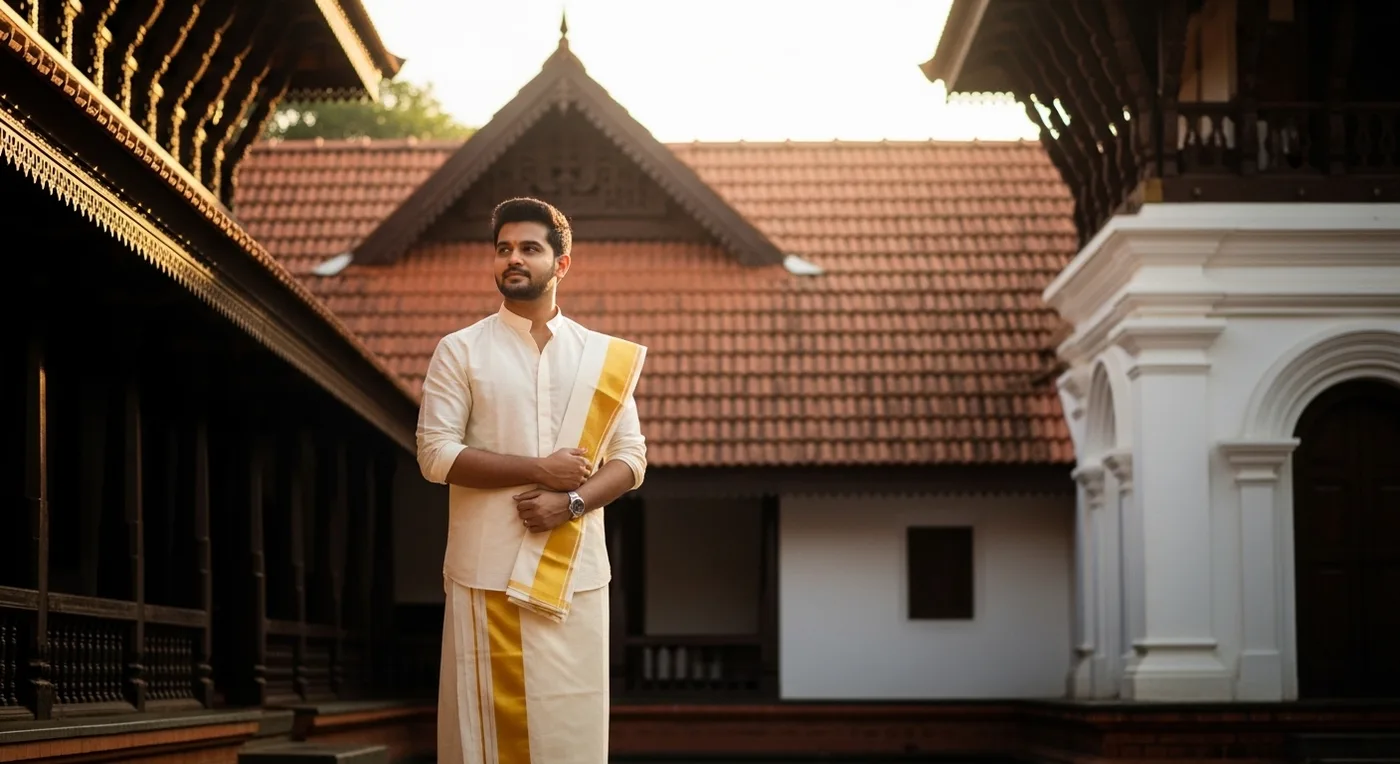
The Kerala groom's core choice is the traditional white mundu-jubba (₹3,000–₹30,000) versus a sherwani (₹15,000–₹1,00,000+). For Hindu temple ceremonies, mundu is standard; sherwanis suit Muslim nikahs and Christian receptions. Cotton-silk blend mundus from Balaramapuram or Kuthampully handlooms are the top recommendation for Kerala's humidity. Most 2026 grooms budget ₹25,000–₹75,000 across all wedding outfits.
Quick Answer
Quick answer: For a Hindu temple ceremony, wear a white cotton-silk mundu with kasavu jubba. For a Muslim nikah, a white sherwani or jubba. For a Christian church wedding, either mundu-jubba or a tailored suit. Switch to Indo-Western or sherwani for the reception. Budget ₹25,000–₹75,000 for all outfits combined; cotton-silk blend fabrics handle Kerala's humidity best.
In an Indian wedding industry worth ₹10.79 lakh crore, groom attire is one of the few categories where tradition and personal expression collide head-on. For every Kerala groom standing in a textile showroom in 2026, the question arrives sooner or later: do you honour the family tradition of white handloom mundu with kasavu border, the garment your father and grandfather wore to their own weddings, or do you step into the embroidered grandeur of a sherwani that your Instagram feed insists is the modern standard? It is a question that sounds simple but carries real weight. Your attire does not just dress you for a ceremony — it sets the visual tone for the entire wedding, determines the palette your photographer works with, signals respect for family and community customs, and, quite practically, decides whether you will be comfortable or miserable across 8 to 12 hours of rituals, photographs, and celebration in Kerala's tropical climate.
This guide is written to help you make that decision — and every smaller decision that branches from it — with clarity and confidence. We cover the traditional mundu in its full depth, the sherwani and when it genuinely belongs at a Kerala wedding, the Indo-Western options that have become the defining trend of 2026, community-specific customs you should not ignore, a fabric guide calibrated for Kerala's humidity, accessory choices, district-by-district shopping recommendations, a multi-look strategy for grooms who want the best of both worlds, and a grooming preparation timeline that starts three months before your wedding day.
The Mundu: Kerala's Timeless Groom Look
History and Cultural Significance
The mundu is not merely a garment — it is Kerala's textile identity. For centuries, the white cotton mundu with its distinctive gold kasavu border has been the formal attire of Kerala men across every community and social stratum. The kasavu (gold zari) border was historically reserved for temple offerings and ceremonial occasions, which is precisely why it became the standard for weddings. Wearing a freshly starched, pristine white mundu with a gleaming kasavu border to your wedding is, in the most literal sense, presenting yourself in your finest to the gods and to your bride's family. That symbolism has not faded in 2026 — if anything, the resurgence of "heritage wedding" aesthetics has made the traditional mundu more aspirational than it has been in two decades.
Types of Mundu
Understanding the distinctions between mundu types prevents expensive mistakes at the textile shop.
Double Mundu (Veshti): This is the formal, full-length garment that wraps around the waist and extends to the ankles. It is a single long piece of cloth, typically 4 metres, worn folded in double to create a neat, structured drape. The double mundu is the standard for wedding ceremonies — anything less formal would be inappropriate at a temple wedding or church ceremony.
Single Mundu: A shorter, thinner garment used for everyday wear. It is not appropriate for a wedding ceremony, though some grooms wear a comfortable single mundu during the post-reception relaxation or travel. Do not confuse the two when shopping.
Kasavu Mundu (Gold Border): The ceremonial variant with zari borders of varying widths. The border width matters: a thin 1-inch kasavu border is understated and traditional, suitable for Nischayam or engagement. A 3 to 5-inch heavy kasavu border is the wedding standard, projecting formality and occasion. In 2026, some designer mundus feature double-sided kasavu borders (kara) or coloured thread work woven into the gold — a subtle contemporary touch that photographs beautifully without departing from tradition.
Fabric Options
The fabric of your mundu determines comfort, drape, and how you look six hours into the celebration.
Balaramapuram Handloom: Woven in the villages around Balaramapuram in Thiruvananthapuram district, these are considered the gold standard for wedding mundus. The cotton is tightly woven with real kasavu (thin gold-plated silver threads), producing a fabric that drapes with weight and structure. A genuine Balaramapuram mundu feels substantial in your hands and holds its pleats through hours of movement.
Kuthampully Handloom: From Kuthampully village near Irinjalakuda in Thrissur district, these mundus are known for their softer texture and slightly more flexible drape. They use a different weaving technique that produces a fabric with a gentle sheen, particularly flattering in natural light photography.
Cotton: Pure handloom cotton is the most practical choice for Kerala weddings, particularly for outdoor temple ceremonies. It breathes in humidity, absorbs sweat without showing stains, and improves in texture with each wash. The wrinkle factor is moderate — a well-starched cotton mundu holds its form for 4 to 5 hours before needing adjustment.
Silk: Pure silk mundus (particularly Kanchipuram-style silk mundus) are luxurious and photograph with a rich lustre, but they are realistically only comfortable in fully air-conditioned venues. In outdoor heat, silk traps body heat, becomes clingy, and shows sweat marks within an hour.
Cotton-Silk Blend: The pragmatic middle ground. These fabrics combine cotton's breathability with silk's sheen, producing a mundu that looks premium in photographs while remaining wearable across 6 to 8 hours of mixed indoor-outdoor events. This is the fabric most wedding stylists in Kochi and Trivandrum recommend in 2026.
Draping Styles
Kerala Style: The standard drape where the mundu is wrapped around the waist, the pleats are formed at the front centre, and the fabric falls straight to the ankles. The bottom edge is then folded up and tucked at the waist on the left side, creating the distinctive "neriyathu" fold that shows the kasavu border prominently. This is the most common style at Kerala weddings.
Tamil Style (Pancha Kacham): A formal five-fold drape where the fabric is pulled between the legs and tucked at the back, creating a more structured, trouser-like appearance. Some Namboodiri families prefer this style for the groom during the actual muhurtham. It is more secure — you will not worry about the mundu loosening — but requires practice to drape correctly.
Pairing with Jubba
The jubba (also called jibba or shirt) is the upper garment that completes the mundu look.
Kasavu Jubba: A white cotton or silk shirt with kasavu borders on the collar, cuffs, and placket. This is the most traditional pairing and the one most families expect for the ceremony. The kasavu work should match your mundu border — if your mundu has a heavy gold border, a jubba with matching weight of kasavu creates visual cohesion.
Silk Jubba: A full silk jubba with subtle texture or self-weave pattern. These are popular for receptions and higher-budget weddings where the couple wants a more regal, formal appearance in photographs.
Cotton Jubba: Crisp, minimal, and extremely comfortable. The plain white cotton jubba with a mandarin collar has become a 2026 favourite among grooms who prefer understated elegance over ornate detailing.
Accessories for Mundu
Thorth (Shoulder Cloth): The traditional angavastram, a thin cotton or silk cloth worn over the left shoulder. For weddings, a kasavu-bordered thorth matching the mundu is standard. It serves a practical purpose — you can use it to wipe sweat discreetly — but it is primarily ceremonial, symbolising readiness and formality.
Gold Buttons: Some jubba designs feature detachable gold or gold-plated buttons. These small details create texture in close-up photographs and signal attention to detail.
Belt (Optional): A slim, concealed belt worn under the mundu helps hold the drape in place through hours of movement, sitting, and standing during rituals. Not traditional, but extremely practical.
When to Wear Mundu
The mundu-jubba combination is expected at Hindu temple ceremonies (Guruvayur, Thrissur Vadakkunnathan, Sabarimala-vicinity weddings), traditional Hindu wedding muhurthams regardless of venue, Nischayam (engagement ceremonies) in most Hindu families, and church weddings in many Syrian Christian families where the groom enters in mundu-jubba and changes to a suit for the reception.
₹3,000 – ₹30,000Tip
Draping Secret: Practice draping your mundu at least 3-4 times before the wedding. A well-draped mundu looks regal; a poorly draped one looks sloppy. Many grooms hire a professional draper (2,000-5,000) for the wedding day — it's worth every rupee.
The Sherwani: North Indian Elegance in Kerala
According to a WedMeGood survey of over 2,000 couples, groom attire spending has risen 30–40% over five years nationally, driven by the sherwani and Indo-Western boom. The sherwani arrived in Kerala's wedding scene roughly fifteen years ago, initially through grooms who had studied or worked in Delhi and Mumbai and brought North Indian wedding aesthetics back with them — the same multi-community wedding cultures that drive Marathi groom attire choices like the dhoti-kurta and pheta turban. Today it has carved a permanent place in the Kerala groom's wardrobe — but context matters. A sherwani worn at the wrong ceremony looks out of place; at the right one, it is magnificent.
When It Is Appropriate
The sherwani is the natural choice for Muslim nikah ceremonies, particularly in the Malabar region from Kozhikode to Kasaragod where it has become the dominant groom attire. For complete Muslim bridal and groom styling advice, see our Kerala Muslim Bridal Look Guide. It also works exceptionally well at wedding receptions regardless of community — the reception is the event where formality and fashion take centre stage, and a well-fitted sherwani commands a room. Fusion weddings, where the couple deliberately blends traditions from different backgrounds, are another setting where the sherwani belongs. Where it does not belong: a traditional Hindu temple ceremony where mundu is expected, or a formal church wedding where a suit or mundu is the norm.
Fabric Choices for Kerala Climate
This is where most Kerala grooms make their costliest mistake. They walk into a Manyavar or Tasva showroom, fall in love with a heavy velvet sherwani that looks spectacular under showroom lighting, and then suffer through their wedding day in a garment designed for a December Delhi wedding, not a January Kochi one.
Raw Silk: The best sherwani fabric for Kerala. It has the structure and sheen of silk without the suffocating weight of velvet. Raw silk breathes reasonably well and photographs with a rich, textured appearance that works in both natural and artificial light.
Georgette: Lightweight, fluid, and surprisingly formal when well-tailored. Georgette sherwanis drape close to the body without bulking, making them ideal for grooms who want a sleek silhouette rather than a heavy, structured one.
Linen Blend: A contemporary choice that is gaining traction in 2026, particularly for daytime receptions and outdoor venues. Linen-silk or linen-cotton blend sherwanis have a relaxed sophistication that pairs beautifully with Kerala's natural backdrops — backwaters, greenery, resort lawns.
Velvet: Only if your entire ceremony and reception are in a fully air-conditioned ballroom. Even then, velvet is heavy, hot, and restricts movement. If you insist on velvet, limit it to detailing — a velvet collar or cuff on a raw silk base is a smart compromise.
Colour Trends 2026
The standard cream-and-gold sherwani remains a safe and popular choice, but the palette has expanded significantly. Ivory with tone-on-tone embroidery is the most requested colour at Kochi tailors in 2026. Sage green has become a surprise favourite, offering a subtle departure from neutrals that works remarkably well against Kerala's green landscapes. Dusty rose and champagne are gaining traction for evening receptions, particularly when the bride is in a contrasting deep-toned outfit. Powder blue and slate grey are emerging choices for grooms who want modern without being dramatic. The key principle: your sherwani colour should complement your partner's outfit, not compete with it.
Pairing and Styling
Churidar vs Trouser: The traditional churidar (gathered at the ankles) creates the classic sherwani silhouette but can feel constricting in heat. Slim-fit straight trousers are the 2026 preference — they look clean, modern, and are far more comfortable across a long day.
Dupatta: A dupatta (stole) draped over one shoulder adds formality and visual interest. For Kerala weddings, keep it lightweight — a chiffon or thin silk dupatta rather than a heavy embroidered one. Some grooms skip the dupatta entirely for a cleaner, more contemporary look.
Footwear: Traditional mojari (embroidered leather juttis) are the classic pairing, but formal leather shoes in tan or burgundy create a more polished Indo-Western aesthetic. Avoid sneakers with a sherwani — it is not the fashion statement some grooms think it is.
Custom vs Ready-Made
Ready-made sherwanis from established brands (Manyavar, Tasva, Raymond Ethnix) offer convenience and consistent quality at prices ranging from 15,000 to 60,000. They are available in standard sizes with minor alterations included. The limitation is fit — if your body does not conform to standard sizing, the sherwani will show it in every photograph.
Custom-tailored sherwanis cost more (25,000 to 1,00,000+) and require 4 to 6 weeks of lead time, but the result is a garment that fits your body precisely. Custom tailoring also allows you to choose exact fabrics, colours, and embroidery patterns. If your wedding budget allows, a custom sherwani is the superior investment — you wear it for one of the most photographed days of your life.
₹15,000 – ₹1,00,000Indo-Western: The 2026 Favourite
If the mundu represents heritage and the sherwani represents North Indian grandeur, the Indo-Western outfit is the 2026 Kerala groom's declaration of personal style. This category has exploded in popularity over the past two years, driven by celebrity weddings, Instagram aesthetics, and a generation of grooms who want to honour tradition without being bound by it.
Bandhgala / Nehru Jacket
The structured, high-collared Nehru jacket worn over a kurta or formal shirt is the entry point into Indo-Western groom wear. It works across body types, is comfortable in Kerala's climate (choose a linen or cotton-silk fabric), and photographs with a sharp, architectural silhouette. In 2026, the trend is toward longer-line Nehru jackets — falling to mid-thigh rather than the hip — in textured fabrics like raw silk or jute-silk blends.
Asymmetric Kurta with Trousers
The asymmetric kurta — featuring an angled hemline or side-sweep closure — paired with slim-fit trousers is a look that carries just enough traditional DNA to feel grounded while reading as thoroughly modern. This is particularly popular at engagement ceremonies and sangeet events where the dress code is festive but not fully formal.
Structured Jacket with Dhoti Pants
The most distinctive Indo-Western groom look of 2026: a tailored jacket (single-button or double-breasted) worn over a kurta or collarless shirt, paired with pleated dhoti pants (loose-fitting trousers that taper at the ankle, mimicking the drape of a dhoti). This outfit bridges Kerala's dhoti/mundu heritage with Western tailoring sensibilities and photographs exceptionally well from every angle.
When It Works
Indo-Western outfits are ideal for receptions, engagement parties, sangeet nights, and any pre-wedding or post-wedding event where the dress code is celebratory but not ceremonial. They are generally not appropriate for the actual wedding ceremony in traditional families — the mundu or sherwani holds that ground.
₹10,000 – ₹60,000Note
The 2026 Trend: The 'structured bandhgala with pleated dhoti pants' has become Kerala's favourite Indo-Western groom look. It bridges traditional and modern perfectly and photographs extremely well. Pair with Kolhapuri chappals for a complete fusion aesthetic.
Community-Specific Customs
Kerala is not a monolith when it comes to wedding attire. Each community carries distinct expectations, and ignoring them — even unintentionally — can create friction with family elders at the worst possible moment. Understanding these norms does not mean surrendering personal choice; it means making informed decisions about when to conform and when to express individuality.
Hindu (Nair / Namboodiri)
The white mundu with kasavu border is mandatory at temple ceremonies. For Namboodiri weddings, the groom often wears a specific style of mundu drape (the Pancha Kacham five-fold style) during the muhurtham. The jubba should be white with kasavu detailing. Gold accessories — a chain, ring, and watch — are standard. The thorth (shoulder cloth) is expected during the ceremony. At the reception, grooms increasingly switch to an Indo-Western outfit or formal suit, though some families prefer the groom to remain in mundu throughout.
Hindu (Ezhava)
The mundu tradition is similar to Nair weddings but often slightly less formal in terms of jubba ornamentation. A clean white mundu-jubba set with a moderate kasavu border is appropriate. The dress code for the reception is more relaxed — suits, Indo-Western outfits, and designer sherwanis are all accepted without family resistance.
Syrian Christian
Syrian Christian weddings offer the groom the most flexibility. At church, a mundu-jubba is traditional and still common, but formal suits (typically in navy, charcoal, or black) are equally accepted and have become the majority choice in urban parishes in Kochi, Kottayam, and Thrissur. The reception is entirely open — suits, tuxedos, Indo-Western outfits, and sherwanis are all standard. The bride's outfit often dictates the groom's palette.
Muslim (Malabar)
For the nikah ceremony, particularly in Kozhikode, Malappuram, and Kannur, the sherwani has become the dominant choice, typically in white or ivory for the mosque ceremony itself. A formal suit is the second most common option. The reception allows for more colour and embellishment — jewel-toned sherwanis, brocade kurtas, and designer suits are all popular. The white prayer cap (taqiyah) is often worn during the nikah ceremony.
Latin Catholic
Western-style suits are the standard for Latin Catholic weddings in Ernakulam, Alappuzha, and Kollam. Navy, charcoal, and black are the most common colours. Tuxedos are gaining popularity for evening ceremonies. The mundu is rarely worn. The reception dress code follows Western wedding norms — suit with tie or bowtie, formal leather shoes.
| Community | Ceremony Attire | Reception Attire | Must-Follow Rules |
|---|---|---|---|
| Hindu (Nair/Namboodiri) | White mundu-jubba, kasavu border | Indo-Western, suit, or mundu | Mundu mandatory at temple; thorth expected |
| Hindu (Ezhava) | White mundu-jubba | Suit, Indo-Western, or sherwani | Mundu expected for ceremony; reception flexible |
| Syrian Christian | Mundu-jubba or formal suit | Suit, tuxedo, or Indo-Western | Church permits both; coordinate with bride |
| Muslim (Malabar) | White sherwani or suit | Designer sherwani or suit | White preferred for nikah; taqiyah for mosque |
| Latin Catholic | Formal suit or tuxedo | Suit or tuxedo | Western formal standard; tie or bowtie expected |
Note
Pricing methodology: All attire costs in this guide are based on itsmy.wedding vendor data, showroom price surveys, and groom outfit spending patterns from Kerala weddings (2025–2026). Ranges cover budget ready-made to premium custom-tailored options.
Fabric Guide for Kerala Climate
Fabric selection is the single decision that most directly determines whether you enjoy your wedding day or endure it. Kerala's wedding season (November through February) brings relative humidity of 70% to 85% in coastal areas like Kochi, Alappuzha, and Kozhikode, 65% to 75% inland in Thrissur and Palakkad, and a more forgiving 55% to 65% in hill stations like Munnar and Wayanad. Your fabric must work within those conditions — not against them.
| Fabric | Breathability | Wrinkle Factor | Humidity Score | Best Venue | Price Range |
|---|---|---|---|---|---|
| Pure Cotton Handloom | Excellent | Moderate | 9/10 | Outdoor, Temple | 3,000-15,000 |
| Cotton-Silk Blend | Very Good | Low-Moderate | 8/10 | Any venue | 5,000-20,000 |
| Pure Silk | Poor | Low | 4/10 | AC venues only | 8,000-30,000 |
| Linen | Good | High | 7/10 | Outdoor, Resort | 6,000-18,000 |
| Raw Silk / Tussar | Good | Low-Moderate | 7/10 | Any venue | 10,000-35,000 |
| Synthetic | Very Poor | Very Low | 2/10 | Never | 1,000-5,000 |
Pure Cotton Handloom is the undisputed champion for outdoor and temple weddings. It absorbs sweat without showing it, allows airflow against the skin, and actually becomes softer and more comfortable as the day progresses. The tradeoff is that cotton wrinkles — but a well-starched handloom mundu holds its form for 4 to 5 hours, which is typically enough to cover the ceremony and initial photographs.
Cotton-Silk Blend is the best all-rounder for 2026 Kerala weddings. It combines cotton's breathability with silk's visual lustre, producing a fabric that looks premium in photographs while remaining wearable across indoor-outdoor transitions. Most wedding stylists in Kochi recommend cotton-silk for grooms who want one fabric that works from morning ceremony to evening reception.
Pure Silk is visually stunning — the lustre, the drape, the way it catches light in photographs is unmatched. But in Kerala's humidity, pure silk becomes sticky against the skin within 60 to 90 minutes, shows sweat patches under the arms and across the back, and can leave the groom visibly uncomfortable in candid shots. Reserve pure silk for fully air-conditioned venues where you will not step outdoors.
Linen has surged in popularity for destination weddings and resort venues in Kumarakom, Marari, and Wayanad. It drapes with an effortless, relaxed sophistication that suits outdoor settings perfectly. The downside: linen wrinkles aggressively. By hour three, your outfit will show creases. Some grooms embrace this as part of linen's character; others find it intolerable.
Raw Silk / Tussar is the recommended fabric for sherwanis in Kerala. It offers silk's visual richness without the suffocating density of pure silk or velvet. Raw silk has a natural, slightly irregular texture that adds depth to photographs and conceals minor wrinkles better than smooth fabrics.
Synthetic Fabrics — polyester, nylon blends, and anything marketed as "wrinkle-free silk look" — should be avoided entirely. They trap body heat, create a visible sheen that looks cheap on camera, do not absorb sweat (leaving it to run visibly), and feel clammy against the skin within 30 minutes in Kerala's humidity. No amount of savings justifies the discomfort and poor photographic results.
Important
Fabric Reality: Pure silk sherwanis and suits look stunning in showroom AC but can become torture in Kerala's humidity at outdoor venues. Unless your entire event is indoors with AC, opt for raw silk, cotton-silk blend, or linen-silk. Test your outfit by wearing it for 2 hours in similar conditions.
Accessorizing the Kerala Groom
Accessories transform a good outfit into a complete, polished wedding look. The key is restraint — a few well-chosen pieces create more impact than an excess of adornment.
Footwear
Kolhapuri Chappals: The handcrafted leather sandals from Maharashtra have become the go-to footwear for Indo-Western groom looks in Kerala. They are comfortable for long hours, look striking in photographs, and bridge traditional and modern aesthetics. Choose a tan or brown shade to complement your outfit.
Mojari / Juttis: Embroidered leather slip-ons are the traditional pairing for sherwanis. Match the embroidery colour to your sherwani's embellishment for a cohesive look. Ensure they are broken in before the wedding — new mojaris can blister within an hour.
Formal Leather Shoes: Oxford or derby shoes in black, tan, or burgundy are the standard for suits and some Indo-Western looks. Invest in a quality pair — cheap shoes are visible in photographs and uncomfortable across a long day.
Barefoot: At temple ceremonies, you will remove your footwear. Plan for this — ensure your mundu length is appropriate for barefoot walking and that your feet are well-groomed (see the grooming timeline below).
Jewellery
Kerala groom jewellery is traditionally minimal compared to North Indian weddings, but the right pieces make a statement.
Gold Chain: A simple chain — not heavy or ornate — is standard for Hindu and Christian grooms. The chain should sit flat under your jubba collar, visible but not prominent.
Watch: A classic analogue watch is the one accessory that works across every outfit and community. Avoid smartwatches and sports watches on your wedding day — they clash with formal attire in photographs.
Cufflinks: Essential if your jubba or shirt has French cuffs. Gold or gold-tone cufflinks with minimal design complement the kasavu aesthetic of traditional attire.
Brooch / Safa Pin: For sherwani looks, a brooch pinned to the chest or a decorative pin on the dupatta adds a focal point for close-up photographs.
Other Details
Pocket Squares: For suits and blazer-based Indo-Western looks, a pocket square in a complementary colour adds refinement. The presidential fold (flat, clean) is safer than elaborate folds for wedding photography.
Ties and Bowties: For suit-wearing grooms, the choice between tie and bowtie depends on formality. Bowties read as more celebratory and are the 2026 preference for evening receptions. Silk ties in muted tones suit church ceremonies.
Sunglasses: A practical and stylish addition for outdoor photo sessions. Classic aviators or wayfarers in gold or tortoiseshell complement formal attire. Remove them for the ceremony — they should appear only in casual, post-ceremony photographs.
Umbrella: This is Kerala. Rain can arrive without warning during any month of wedding season. Coordinate with your wedding planner for matching umbrellas — a black or gold umbrella that complements your attire ensures that even a rain interruption produces good photographs rather than awkward ones.
Where to Shop by District
Kerala's textile heritage means quality groom attire is available across the state, but each district has its specialities. Knowing where to go for what saves time and money.
Thiruvananthapuram (Trivandrum)
Balaramapuram is the pilgrimage destination for handloom mundus. The handloom cooperative societies in Balaramapuram village, about 15 kilometres from Trivandrum city, sell directly from the weavers. Prices are 20 to 40% lower than retail stores for the same quality, and you can often watch your mundu being woven. Visit on a weekday morning for the best selection and personal attention.
Palayam is the hub for formal suits and custom tailoring in Trivandrum. Several established tailors along the Palayam-Statue Road corridor offer custom suit stitching with a 2 to 3-week turnaround. For ready-made sherwanis, the Manyavar and Tasva outlets in the Mall of Travancore and Lulu Mall carry full groom collections.
Kochi (Ernakulam)
MG Road remains the premier tailoring district for grooms who want custom suits, sherwanis, or Indo-Western outfits. The tailors here have decades of experience dressing wedding parties and can work from photographs, swatches, or existing garments. Expect 3 to 4 fittings over 3 to 4 weeks for a perfectly tailored piece.
Lulu Mall and Centre Square house all the major brand showrooms — Manyavar, Tasva, Raymond, Louis Philippe, Van Heusen — where you can see and try complete groom collections under one roof. This is the most efficient way to compare styles and prices.
Kalyan Silks (Ernakulam branch) and Seematti offer extensive collections of designer mundus and silk jubba sets. Their wedding sections carry curated groom sets with matching mundu, jubba, and thorth, taking the guesswork out of coordination.
Thrissur
Kuthampully village, near Irinjalakuda, is the other great handloom centre of Kerala. Kuthampully mundus are renowned for their soft texture and fine kasavu work. The weaving cooperatives here are smaller and more personal than Balaramapuram's, and many families have been weaving for generations.
Swaraj Round area has several textile shops that stock both handloom and designer wedding mundus alongside ready-made sherwanis and suits. The concentration of shops makes comparison shopping straightforward.
Kozhikode (Calicut)
SM Street (Mittai Theruvu) is a fabric lover's paradise. The textile shops here carry an enormous range of fabrics — silk, cotton, linen, blends — at competitive prices. For grooms who want custom-tailored outfits, buying fabric on SM Street and taking it to a Kozhikode tailor is often the most cost-effective approach.
Local tailors in the Mananchira area have extensive experience with sherwani stitching, driven by strong demand from the Malabar Muslim wedding market. Some of the finest sherwani tailoring in Kerala happens here, often at prices significantly below Kochi rates.
Online Shopping
Online platforms (Manyavar.com, Tasva.com, AjioLuxe, Myntra Wedding) offer convenience and occasionally exclusive collections not available in physical stores. The critical precaution: never buy wedding attire online without first trying the brand's sizing in a physical store. Order your exact known size, and ensure the return/exchange window extends at least 2 weeks to allow for alterations.
Looking for Bridal Salon & Spas in Kochi?
Tell us what you need and get quotes from verified bridal salon & spas
The Multi-Look Strategy
The modern Kerala wedding unfolds across 2 to 4 distinct events over 1 to 3 days, each with its own dress code and atmosphere. Planning your wardrobe as a cohesive collection — rather than fixating on a single outfit — is the smarter approach.
Engagement / Nischayam
This is the event where smart casual or light formal works best. A well-fitted kurta with straight-cut trousers, a Nehru jacket with a contrast shirt, or even a blazer with chinos and a pocket square all hit the right register. Save your heaviest, most formal attire for the wedding day itself. Budget allocation: 15 to 20% of your total groom wardrobe.
Ceremony
This is where you invest the most — in quality, in cultural appropriateness, and in comfort. For Hindu weddings, a premium handloom mundu-jubba set. For Muslim weddings, a custom sherwani. For Christian weddings, a well-tailored suit or mundu-jubba depending on family tradition. This outfit will feature in your most important photographs and should feel like an extension of who you are. Budget allocation: 40 to 50% of your total groom wardrobe.
Reception
The reception is your fashion moment. Whether you choose a designer sherwani, a fitted suit in a bold colour, or the signature 2026 bandhgala-with-dhoti-pants, this is where personal expression takes priority over tradition. Coordinate with your partner's reception outfit for a cohesive couple aesthetic — matching colours exactly is outdated; complementary palettes (you in sage green, her in dusty rose, for instance) are the 2026 standard. Budget allocation: 30 to 35% of your total groom wardrobe.
After-Party / Day Two
If your wedding extends to a second day or includes a post-reception gathering, a relaxed smart-casual outfit keeps you looking intentional without overdressing. A casual linen kurta, a well-fitted polo with chinos, or a relaxed blazer with jeans all work. Budget allocation: 5 to 10% of your total groom wardrobe.
₹25,000 – ₹1,50,000Tip
Budget Reality: Most Kerala grooms in 2026 spend between 35,000 and 75,000 on their complete wedding wardrobe across all events. This is 3-5% of the total wedding budget — modest against the national average of ₹29.6 lakh per wedding. Allocate the largest share to the ceremony outfit and the reception outfit — these are the looks that live in photographs forever.
Grooming Prep Timeline
Your outfit is half the equation. The other half is how you look wearing it. A groom who has invested 50,000 in a custom sherwani but has an unruly beard, dry skin, and a haircut from the previous day will not photograph as well as a groom in a 10,000 handloom mundu who has prepared his grooming for three months. Start early.
3 Months Before
Skincare: If you do not already have a routine, start one now. A basic regimen of cleanser, moisturizer, and sunscreen is sufficient. Kerala's sun and humidity cause pigmentation and uneven skin tone — daily sunscreen (SPF 30 or higher) prevents further darkening and allows existing pigmentation to fade. If you have acne or scarring, consult a dermatologist now — most treatments require 8 to 12 weeks to show full results.
Fitness: This is not about dramatic weight loss — crash dieting before a wedding leads to poor energy and a gaunt appearance on camera. Focus on consistent exercise (walking, swimming, gym) that improves posture, reduces stress, and ensures your clothes fit well. If you are ordering custom attire, your measurements need to be stable by the time you get fitted.
2 Months Before
Hair Experimentation: Now is the time to try different haircuts and find the style that suits your face shape and your planned outfit aesthetic. Try a new style, live with it for 2 weeks, assess how it photographs, and adjust. Do not experiment with hair for the first time 2 weeks before the wedding.
Beard Decision: Decide now whether you will be clean-shaven, stubbled, or bearded for the wedding. If growing a beard, start now so it has time to fill in and be shaped. If planning to be clean-shaven, ensure your skin can handle daily shaving without irritation — switch to a gentler shaving routine if needed.
1 Month Before
Professional Facial: Get your first professional facial to address any remaining skin concerns — blackheads, dullness, uneven texture. This gives your skin time to recover from any initial breakouts that sometimes follow a first facial. Schedule a second facial 1 week before the wedding.
Beard Grooming: If you are wearing a beard, have it professionally shaped and trimmed now. This sets the template that you will maintain until the wedding day.
2 Weeks Before
Final Haircut: This is the optimal timing. A haircut taken 10 to 14 days before the wedding has time to settle into a natural shape — the sharp edges soften, the length grows into the intended style, and it looks intentional rather than freshly cut. The "just-cut" look photographs poorly, with visible clipper lines at the temples and an unnaturally clean neckline.
1 Week Before
Second Facial: A gentle, hydrating facial (not an aggressive extraction facial) 5 to 7 days before the wedding gives your skin time to absorb the benefits without risking breakouts or redness on the day.
Beard Trim: A precision trim to clean up the shape set a month ago. Do not reshape — just maintain.
Manicure and Pedicure: Your hands will be in photographs constantly — ring exchanges, garland moments, candid shots. Clean, trimmed nails are a small detail that makes a visible difference. If you are wearing a mundu to a temple ceremony, your bare feet will also be visible — a pedicure is not optional.
Day Of
Mattifying Moisturizer: Kerala's humidity will make your face shine within 30 minutes of stepping outdoors. A mattifying moisturizer with oil-control properties, applied as the last step of your skincare routine, reduces shine in photographs without creating a dry, powdery appearance. Carry blotting papers for touch-ups between events.
Light Fragrance: Apply a fresh, citrus or woody fragrance — nothing heavy or cloying — on pulse points. In humidity, fragrance intensifies, so apply less than you normally would.
Tip
Haircut Timing: Get your final haircut 10-14 days before the wedding, not 2-3 days before. This allows it to grow into a natural shape. The 'just-cut' look photographs poorly. If you're growing out your hair or beard, start 3 months early.
Looking for Bridal Salon & Spas in Thrissur?
Tell us what you need and get quotes from verified bridal salon & spas
Common Questions About Kerala Groom Attire
Should a Kerala groom wear mundu or sherwani?
It depends on the ceremony type and community. For traditional Hindu temple weddings, the mundu with jubba is the standard and expected attire — wearing anything else would feel out of place and may draw disapproval from family elders. For Christian church ceremonies, a formal suit or mundu-jubba both work, with the choice often depending on the parish and family tradition. For Muslim nikah ceremonies, the sherwani is the most common choice across the Malabar region. The practical solution that many 2026 grooms adopt is a multi-look approach: traditional attire for the ceremony (honouring community expectations) and a suit or Indo-Western outfit for the reception (expressing personal style). This approach satisfies both tradition and individuality without compromise.
What fabric is best for a Kerala wedding mundu?
Pure handloom cotton from Balaramapuram or Kuthampully is ideal for Kerala's humidity — it breathes exceptionally well, absorbs sweat without showing it, and drapes with a natural weight that holds its form through hours of ceremony and celebration. For grooms who want a more luxurious visual effect, a cotton-silk blend offers the best of both worlds: cotton's breathability with silk's sheen, making it the most versatile fabric for events that move between outdoor and air-conditioned spaces. Pure silk mundus are beautiful but should be reserved for fully air-conditioned venues — they become sticky, clingy, and uncomfortable within an hour in Kerala's outdoor humidity. Avoid synthetic fabrics entirely. They trap heat, do not absorb sweat, and produce a cheap, plasticky sheen in photographs that no amount of editing can fix.
How much does groom attire cost for a Kerala wedding?
A quality handloom mundu-jubba set costs between 3,000 and 15,000, depending on the fabric and kasavu border weight. Designer mundus with heavy kasavu borders or custom embroidery run 10,000 to 30,000. Ready-made sherwanis from brands like Manyavar and Tasva range from 15,000 to 60,000, while custom-tailored sherwanis from specialist tailors in Kochi or Kozhikode cost 25,000 to 1,00,000 or more depending on fabric and embellishment. Formal suits range from 15,000 for ready-made to 80,000 for bespoke tailoring. Most Kerala grooms in 2026 budget between 25,000 and 75,000 for all wedding outfits combined — ceremony, reception, engagement, and after-party looks. The ceremony outfit typically claims 40 to 50% of this total.
Where can I buy groom wedding attire in Kerala?
For traditional handloom mundus, the two definitive destinations are Balaramapuram village near Trivandrum and Kuthampully village near Thrissur — both offer direct-from-weaver pricing that is 20 to 40% below retail. For designer mundus and silk jubba sets, Kalyan Silks and Seematti in Kochi carry extensive wedding collections. For sherwanis, the Manyavar and Tasva outlets in Lulu Mall Kochi and Mall of Travancore Trivandrum have full groom ranges. For custom suits, the tailors on MG Road in Kochi and the Palayam area in Trivandrum have decades of wedding suit experience. In Kozhikode, SM Street offers outstanding fabric selection, and local tailors in the Mananchira area specialise in sherwani tailoring for the Malabar wedding market.
What grooming should a Kerala groom do before the wedding?
Start 2 to 3 months before the wedding with a basic skincare routine (cleanser, moisturizer, daily sunscreen) and a fitness routine that ensures stable measurements for custom attire fittings. At 2 months out, experiment with haircuts to find your ideal style and decide on your beard plan. Get your final haircut 10 to 14 days before the wedding — not 2 to 3 days before — so it settles into a natural shape rather than looking freshly clipped. One week before, get a hydrating facial, a precision beard trim, and a manicure and pedicure (your hands and potentially your bare feet at temple ceremonies will be in countless photographs). On the wedding day itself, apply a mattifying moisturizer with oil-control properties to manage shine in Kerala's humidity, and carry blotting papers for touch-ups between events.
Further Reading
Tip
Plan your wedding with free tools — try our AI Wedding Checklist for a personalised timeline, or use the Cost Calculator to estimate your budget.
Topics
Kerala groom attiremundu wedding stylesherwani Kerala groomgroom outfit Keralawedding attire men KeralaIndo-Western groomExplore more
Frequently Asked Questions
1Should a Kerala groom wear mundu or sherwani?
2What fabric is best for a Kerala wedding mundu?
3How much does groom attire cost for a Kerala wedding?
4Where can I buy groom wedding attire in Kerala?
5What grooming should a Kerala groom do before the wedding?
Continue reading
Related Articles
How to Plan a Kerala Wedding: The Complete 2026 Guide
Kerala Wedding Traditions Explained: Rituals, Meaning & Modern Adaptations
Kerala Wedding Checklist: Complete Printable Planner for 2026
Kerala Nair Wedding: Complete Guide to Rituals, Checklist & Costs in 2026
Kerala Wedding by Religion: Hindu, Christian & Muslim
Best Season for South India Destination Weddings: Month-by-Month Western Ghats Guide
Still planning?
Get quotes from India's best vendors
Tell us what you're planning and we'll match you with verified photographers, venues, decorators, and more.
Get free quotes