
Kerala Bridal Jewellery Buying Guide: Gold, Budget, and 2026 Trends
Kerala bridal jewellery guide: 22K gold exceeds ₹8,500/gram in 2026, pushing a 100-sovereign set past ₹70 lakh. Rent vs buy, making charges, and more.

Senior Wedding Planner
Priya Nair is a senior wedding planner based in Kochi with over eight years of experience coordinating Hindu, Christian, and destination weddings across Kerala.
On this page
A traditional Kerala bride wears 80–150 sovereigns (640–1,200 grams) of gold; with 22K gold exceeding ₹8,500 per gram in 2026, a 100-sovereign set crosses ₹70 lakh. Making charges run 12–25% of gold value — a 5% difference on 100 sovereigns equals ₹3.5 lakh. Many brides now use a hybrid approach: buy 30–40 sovereigns of rewearable pieces and rent heavy ceremonial sets.
Quick Answer
Quick answer: Kerala bridal jewellery ranges from ₹1 lakh (minimal modern set) to ₹70 lakh+ (traditional 100-sovereign full set). Making charges of 12–25% and 22K gold at ₹8,500+/gram are the key cost drivers. The smartest approach: buy 30–40 sovereigns of rewearable daily pieces and rent heavy ceremonial sets to save 85–90% upfront on the statement pieces.
Note
Pricing methodology: Cost ranges in this guide are based on vendor pricing data from the itsmy.wedding marketplace and published industry reports, collected in Q4 2025 – Q1 2026.
In Kerala, gold is not merely jewellery — it is identity, inheritance, and an unspoken measure of a family's standing. In an Indian wedding industry valued at ₹10.79 lakh crore and projected to reach ₹24 lakh crore by 2030, gold jewellery remains the single largest line item for Kerala families. A bride draped in layers of Manga Mala and Kasumalai carries forward centuries of tradition where gold serves as bridal splendour, financial security, and generational wealth. According to industry estimates, Kerala consumes an estimated 20% of India's total gold demand despite representing just 2.7% of the population, and the bridal purchase remains the single largest gold transaction most families will ever make.
Buying bridal jewellery in 2026 is fundamentally different from even five years ago. Gold prices have surged past Rs 8,500 per gram for 22K, pushing a traditional 100-sovereign set above Rs 70 lakh. The BIS hallmarking mandate has overhauled certification. A new generation of brides is questioning whether 150 sovereigns of heavy ceremonial gold worn exactly once makes more sense than 50 sovereigns of rewearable pieces paired with rented statement sets. This guide covers every dimension of that decision — gold purity, making charges, community-wise expectations, rent-vs-buy economics, the best jewellers across Kerala, and 2026 design trends.
Understanding Gold Quality
Gold jewellery pricing has three components — the gold value itself (weight multiplied by the per-gram rate), making charges (12-25% of gold value), and 3% GST. A 5% difference in making charges on a 100-sovereign purchase amounts to over ₹3.5 lakhs at current rates, making this the single most important variable to compare across jewellers.
The Karat System
Pure gold is 24 karat (24K), but pure gold is too soft for jewellery — it bends, scratches, and cannot hold intricate designs. Kerala bridal jewellery is almost exclusively made in 22 karat (22K), which means the alloy is 91.6% pure gold mixed with 8.4% copper and silver for strength. This is why 22K gold is stamped "916." Some contemporary pieces — particularly diamond-studded designs or western-style bands — use 18 karat (18K, stamped 750), which is 75% pure gold. Never buy bridal gold below 22K unless it is a specific diamond or stone-set piece where 18K is structurally necessary.
BIS Hallmarking and the HUID System
Important
Hallmark Alert: Since June 2021, selling non-hallmarked gold jewellery is illegal in India. Every piece must carry a BIS hallmark with a HUID (Hallmark Unique Identification) number you can verify at bis.gov.in. Reject any piece without this.
Every hallmarked piece carries three marks: the BIS logo (a triangle), the purity grade (916 for 22K, 750 for 18K), and a six-digit alphanumeric HUID unique to that piece. Verify any HUID on the BIS website or the "BIS Care" mobile app. This system replaced the old jeweller's mark in 2022, making it significantly harder to pass off impure gold. Check every single piece for its HUID — not just the necklaces, but bangles, earrings, and nose pins too.
Making Charges: What Is Fair?
Making charges cover the artisan's labour, design complexity, and the jeweller's margin. In Kerala, they range from 12% to 25% of gold value. Simple chains and plain bangles sit at 12-15%. Intricate temple jewellery with nakshi work commands 18-22%. Antique-finish or filigree pieces can reach 25%. Making charges are non-recoverable — on resale, you recover only the gold value. A 5% difference in making charges on a 100-sovereign purchase amounts to over Rs 3.5 lakh at current rates, so comparing across three or four jewellers is essential.
Wastage Charges: Legitimate or Inflated?
Some jewellers quote a separate "wastage" charge for gold lost during manufacturing. Legitimate wastage on handcrafted pieces runs 3-5%, but mass-produced machine-made pieces have near-zero actual wastage. If a jeweller quotes 8-10% wastage on a machine-made bangle, that is inflated margin. Ask whether a piece is handcrafted or machine-made, and choose jewellers who quote an all-inclusive making charge with no separate wastage line.
How Much Gold Does a Kerala Bride Need?
Kerala bridal gold ranges from 40 to 150 sovereigns (320-1,200 grams) depending on community expectations, family financial capacity, and the bride's personal preference. Kerala's sovereignty system — where 1 sovereign equals 8 grams of gold — remains the standard unit for discussing bridal gold.
Community-Wise Expectations
Different Kerala communities carry different gold traditions, and understanding these norms helps families plan realistically without overextending or falling short of social expectations.
| Community | Traditional Range (Sovereigns) | Modern Range (Sovereigns) | Must-Have Pieces |
|---|---|---|---|
| Nair | 50–100 | 30–60 | Manga Mala, Kasumalai, Palakka Mala, bangles, Odiyanam |
| Namboodiri | 80–150 | 50–80 | Full temple set, Mullamottu Mala, Nagapadathali, Odiyanam |
| Syrian Christian | 60–120 | 40–70 | Kasumalai, Manga Mala, Poothali, diamond studs, bangles |
| Muslim | 50–100 | 30–60 | Pathakkam Mala, Jhumkas, bangles, Odiyanam, Maang Tikka |
| Ezhava | 40–80 | 25–50 | Manga Mala, Palakka Mala, bangles, earrings |
(Traditional norms vary by family; sovereign ranges are approximate.)
With the national average wedding cost at ₹29.6 lakh across 330 guests, jewellery often accounts for the largest share in Kerala households. The unmistakable trend across every community is a shift from volume to curation. A 2024-married Nair bride from Palakkad told us she wore 45 sovereigns — all hallmarked, all chosen personally — and felt more authentic than her mother who wore 90 sovereigns three decades ago. The cultural expectation is evolving: what matters in 2026 is not how many sovereigns you wear, but how thoughtfully they are chosen.
₹5,00,000 – ₹50,00,000Rent vs Buy: The Economics
With gold at Rs 8,500+ per gram in early 2026, the rent-vs-buy calculus has shifted dramatically in favour of renting heavy ceremonial pieces. Here is how the numbers break down.
Buying: The Full Cost
When you buy, you pay: gold value (weight x rate per gram) + making charges (12-25%) + 3% GST. A 100-sovereign (800-gram) set at March 2026 rates costs approximately Rs 80-85 lakh all-inclusive. The upside: you retain 85-90% of gold value on resale, the set becomes a family heirloom, and pieces can be redesigned for the next generation.
Renting: The Savings
Rental jewellery typically costs 10-15% of market value for a 2-3 day period, plus a refundable security deposit (20-30% of value). For the same 100-sovereign set, total out-of-pocket cost runs Rs 8-10 lakh — a saving of nearly Rs 72 lakh. Major rental jewellers in Thrissur, Ernakulam, and Trivandrum maintain bridal collections indistinguishable from purchased sets.
The Hybrid Approach
Tip
The Hybrid Strategy: Buy 30-40 sovereigns of versatile pieces you'll wear again (chain, bangles, studs, simple necklace) and rent the heavy ceremonial sets (Manga Mala, Kasumalai, layered temple necklaces). This saves 40-50% while still giving you a full bridal look.
The hybrid model is now the dominant approach among financially savvy Kerala families. Here is a cost comparison for a bride targeting a 100-sovereign bridal look:
| Approach | Gold Owned | Rental Pieces | Total Cost (Approx.) | Resale Value |
|---|---|---|---|---|
| Full Buy (100 sov) | 100 sov | None | Rs 80–85 lakh | Rs 68–72 lakh |
| Hybrid (40 buy + 60 rent) | 40 sov | 60 sov | Rs 39–42 lakh | Rs 27–29 lakh |
| Full Rent (100 sov) | None | 100 sov | Rs 8–10 lakh | Nil |
The hybrid approach gives you heirloom pieces worth Rs 27-29 lakh in gold value while cutting the total outlay nearly in half.
₹5,00,000 – ₹50,00,000The Essential Kerala Bridal Jewellery Set
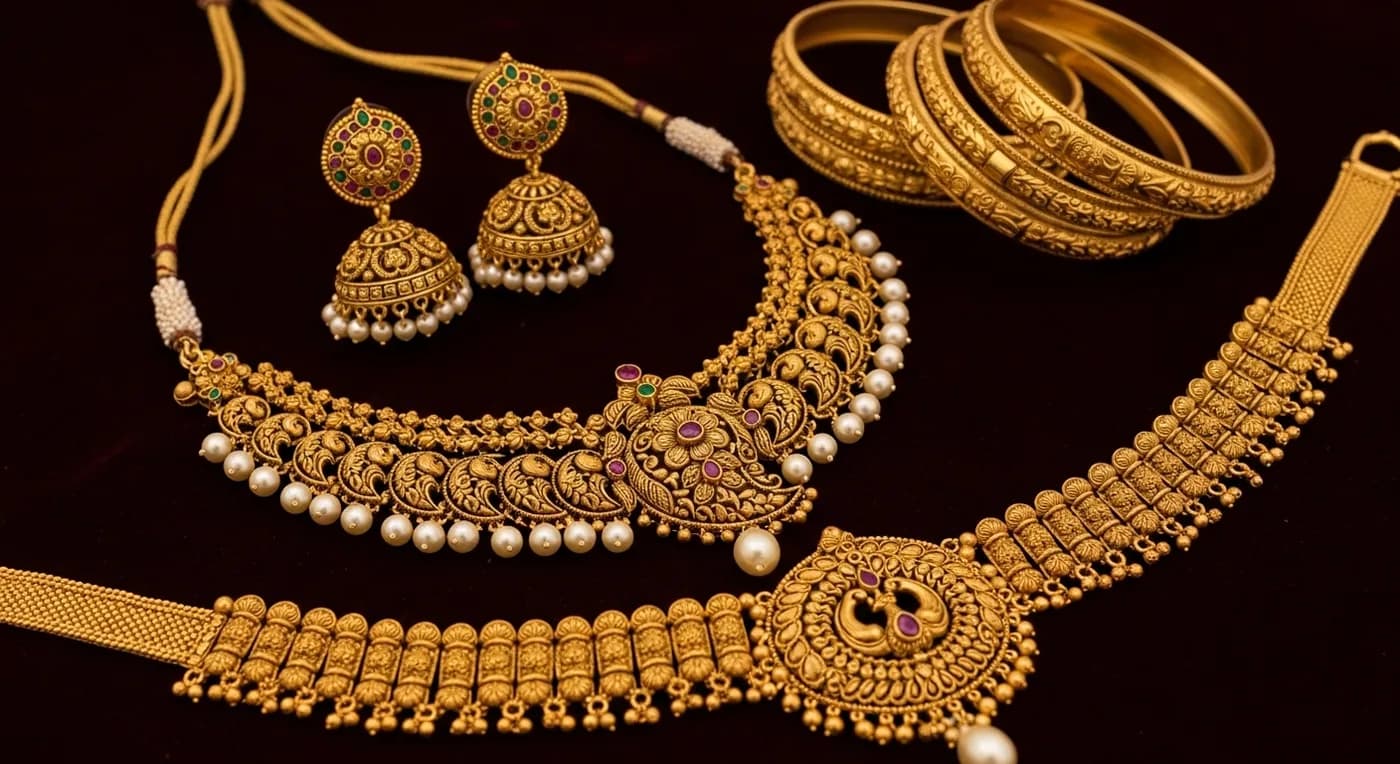
A complete Kerala bridal set comprises 8-12 distinct ornament categories — necklaces in graduated layers, earrings, bangles, waist belt (odiyanam), headpiece (nethi chutti), nose ring, and toe rings — with total weight ranging from 40 to 150 sovereigns. To understand the cultural significance and regional variations of each ornament, read our guide to traditional Kerala bridal jewellery.
Necklaces
Necklaces form the centrepiece of Kerala bridal jewellery, worn in graduated layers from the throat to below the bust.
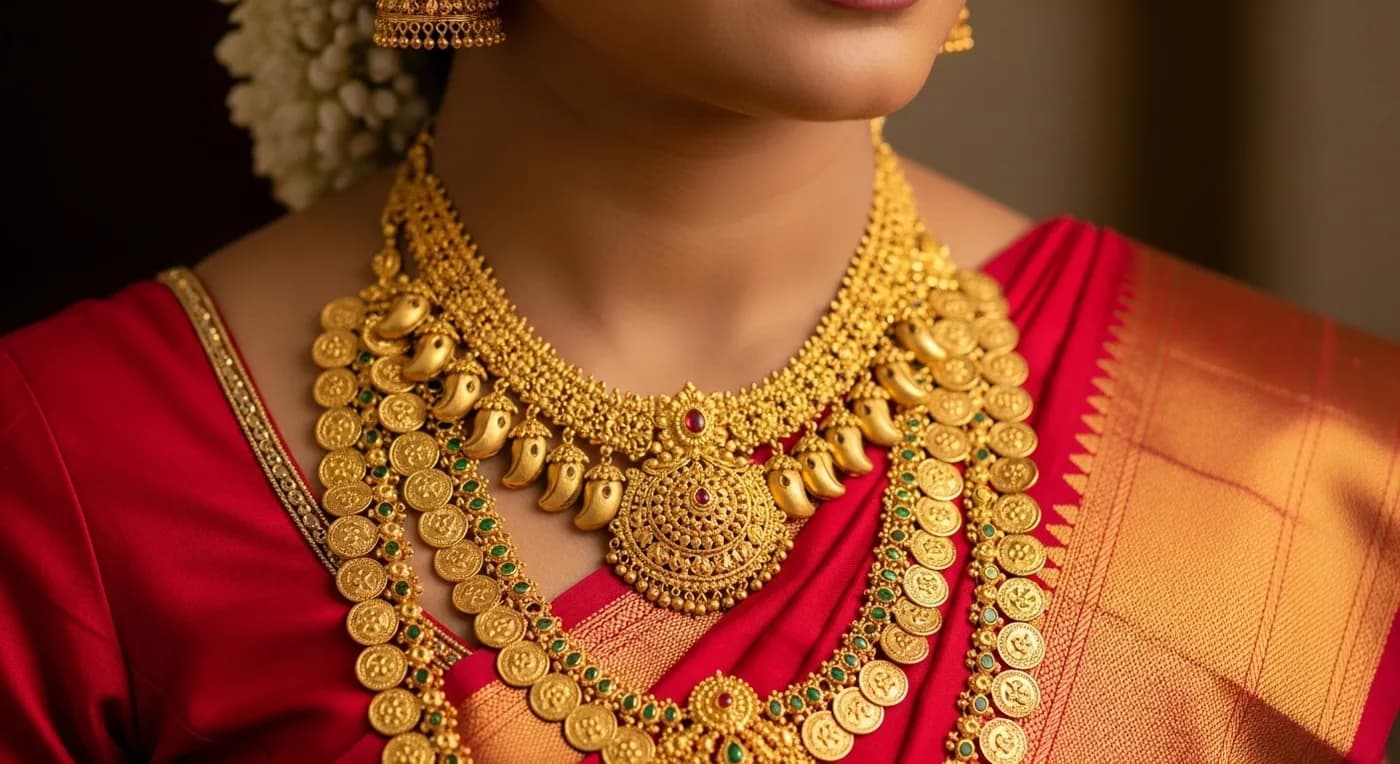
Manga Mala — The quintessential Kerala bridal necklace with mango-shaped pendants filled with red or green enamel. Weighs 8-12 sovereigns, sits as the middle layer. Budget Rs 6,50,000-9,80,000.
Kasumalai — A chain of gold coins stamped with Lakshmi or temple motifs. The longest necklace in the arrangement at 10-15 sovereigns. Budget Rs 8,20,000-12,30,000.
Palakka Mala — A distinctly Keralite design with rectangular green palakka stones set in gold. Traditional versions use glass; premium use emeralds. Weighs 5-8 sovereigns. Budget Rs 5,10,000-8,20,000.
Mullamottu Mala — Jasmine-bud-shaped gold beads forming the innermost, shortest necklace. Lightweight at 3-5 sovereigns and highly rewearable. Budget Rs 3,00,000-5,10,000.
Nagapadathali — Serpent hood motifs associated with Namboodiri and temple traditions. At 10-15 sovereigns with limited re-wearability, this is an ideal rental piece.
Earrings
Jhumkas — Bell-shaped drop earrings, the most universal style across communities. Weigh 1-2 sovereigns. Budget Rs 1,00,000-2,00,000. Toda — Large hoop-style earrings traditional to the Nair community, still a ceremonial staple in north Kerala. Kammal — Stud earrings with ruby, emerald, or diamond centre — the most rewearable option. Budget Rs 50,000-1,50,000.
Bangles
Kerala bridal bangles ("Vala") are broad and hollow. Brides wear 4-12 per wrist, with even numbers preferred and some families mandating 8, 12, or 16 per hand. A set of 8 weighs 6-10 sovereigns. Budget Rs 6,15,000-10,25,000. Bangles are the strongest "buy" candidate — worn regularly post-wedding.
Waist Belt (Odiyanam)
A broad gold belt worn over the saree — universal in Namboodiri and Nair weddings, optional in Christian ceremonies. Weighs 8-15 sovereigns and is rarely worn post-wedding, making it an ideal rental piece. Purchase budget: Rs 8,20,000-15,35,000.
Headpiece (Nethi Chutti)
A gold chain across the forehead, anchored at the hair parting. Designs range from simple pendant chains to elaborate multi-strand pieces. Weight: 2-4 sovereigns. Budget Rs 2,00,000-4,10,000. Hindu brides wear this frequently; Christian brides often substitute with a tiara.
Nose Ring and Toe Rings
The Mookuthi (nose stud) is a small but significant piece — a single gold or diamond stud on the left nostril for Hindu brides. Toe rings (Metti) are worn after the wedding ceremony, typically in silver for Hindu brides (gold on the feet is considered inauspicious in some traditions) and gold for Christian and Muslim brides.
₹2,00,000 – ₹15,00,000Budget Planning and Gold Rate Strategy
Between January 2025 and March 2026, 22K gold in Kerala moved from Rs 6,800 to Rs 8,500 per gram — a 25% increase (IBJA daily rates). Families who bought six months early saved lakhs compared to last-minute buyers. Strategic buying is the single biggest financial decision in Kerala wedding planning.
The 6-9 Month Buying Plan
| Month Before Wedding | Strategy | Action |
|---|---|---|
| 9 months | Research and rate tracking | Set up rate alerts (apps like Gold Price Live or IBJA), visit 3-4 jewellers for making charge comparisons |
| 7-8 months | First tranche (25%) | Buy bangles and daily-wear chains when rate dips below your target |
| 5-6 months | Second tranche (25%) | Buy earrings, Mullamottu Mala, and simpler necklaces |
| 3-4 months | Third tranche (25%) | Buy or order custom pieces (Manga Mala, Palakka Mala) |
| 1-2 months | Final tranche (25%) | Buy remaining pieces, confirm rental orders, do full trial wearing |
Tip
Rate Lock Trick: Major Kerala jewellers like Kalyan, Bhima, and Malabar Gold offer 'Advance Purchase' schemes where you pay at today's rate but collect later. If you're 8-10 months out, consider locking in rates in tranches of 20-25% each month.
Gold Savings Schemes
Every major Kerala jeweller runs monthly gold savings schemes — deposit a fixed amount for 11 months and the jeweller adds the 12th month free, giving an 8-9% bonus. Popular schemes include Kalyan's "My Kalyan," Bhima's "Suvarna Nidhi," and Malabar Gold's "Gold Smart." Start 12-18 months before the wedding. The caveat: your investment is locked into that jeweller, so choose one with competitive making charges.
Several jewellers also offer zero-interest EMI for 6-12 months through Bajaj Finserv, HDFC, and ICICI on purchases above Rs 1 lakh. Read the terms carefully — some "zero-interest" schemes inflate making charges to compensate.
Where to Buy: Kerala's Jewellery Hubs
Kerala's jewellery retail market is among the most competitive in India, with nationally recognized brands headquartered here and a density of showrooms unmatched by any other state.
Thrissur — Kerala's Gold Capital
Thrissur is the undisputed centre of Kerala's gold industry. Bhima Jewellers is known for traditional designs and competitive making charges. Chemmanur International offers aggressive pricing on large purchases. Kalyan Jewellers is the largest pan-India chain from Kerala with strong hallmarking compliance. For temple jewellery connoisseurs, Swarnamahal and Alapatt Gold & Diamonds carry handcrafted pieces that chain stores cannot replicate. A dedicated trip to compare across four showrooms can save Rs 1-3 lakh in making charge differences.
Looking for Jewellerys in Thrissur?
Tell us what you need and get quotes from verified jewellerys
Kochi — Modern Selection and Flagship Stores
Ernakulam and Kochi host flagship showrooms of Joy Alukkas, Malabar Gold & Diamonds, and Jos Alukkas. LuLu Mall, Oberon Mall, and the MG Road stretch offer side-by-side comparison shopping. Kochi showrooms stock a wider range of contemporary and fusion designs, ideal for brides looking for Indo-western or diamond-accent pieces alongside traditional gold.
Trivandrum — All Major Chains Plus Specialists
Every major Kerala chain maintains large-format stores along MG Road and Kazhakkoottam. GRT Jewellers offers South Indian temple jewellery traditions, and Tanishq provides national-brand reliability with guaranteed BIS compliance. For families in Kollam and southern Kerala, Trivandrum is the natural hub.
Kozhikode — Malabar Gold's Heartland
Kozhikode is the headquarters of Malabar Gold & Diamonds. The flagship store offers access to exclusive collections and priority service. The city has a strong tradition of Mappila wedding jewellery, with local artisans specializing in crescent and geometric designs for nikah ceremonies.
Kottayam — Syrian Christian Wedding Specialists
Kottayam and surrounding towns (Pala, Changanassery, Ettumanoor) have jewellers who understand Syrian Christian requirements — the Poothali necklace, cross-pendant chains, and diamond-heavy reception sets. Josco Jewellers has historically served this community well.
2026 Trends in Kerala Bridal Jewellery
Temple Jewellery Revival
The return of authentic temple jewellery — Nagapadathali, Lakshmi motif Kasumalai, and Kemp-stone-studded pieces — is the most pronounced trend of 2025-2026. Instagram and bridal magazines are fuelling this revival, and Thrissur artisans specializing in nakshi work report order backlogs of 3-4 months, according to local jewellers.
Antique and Matte Finishes
Matte, oxidised, and antique finishes are replacing glossy mirror-polish — they photograph better and hide minor scratches during the event. Making charges for antique finishing run 3-5% higher, but the visual impact is significantly superior.
Minimalist Layering
Brides are layering four to five distinct pieces of varying lengths — a choker, mid-length Palakka, long Kasumalai, and waist-length chain — creating depth and dimension. This approach uses less total gold (60-70 sovereigns can look as impactful as 100) and allows individual pieces to be worn post-wedding.
Coloured Stones with Gold
Rubies, emeralds, and uncut diamonds (Polki) set within traditional Kerala gold frameworks are surging in popularity. The Palakka Mala has always used green stones, but 2026 is seeing the colour trend extend to earrings, bangles, and even Odiyanam designs. Ruby-studded jhumkas and emerald-encrusted Nethi Chuttis are among the most requested custom orders at Kerala's top jewellers.
Lightweight Daily-Wear Conversions
Progressive brides are commissioning convertible pieces — a bridal necklace with a detachable pendant, bangles that stack for the wedding but are worn individually later. This modular approach maximizes cost-per-wear and reduces gold sitting unused in a bank locker.
Customised Name and Date Pendants
A quiet trend among younger brides: incorporating the couple's initials or wedding date into a pendant or bangle in Malayalam script. These are lightweight (0.5-1 sovereign), inexpensive relative to the overall set, and carry deep sentimental value.
₹1,00,000 – ₹8,00,000Wedding Day Jewellery Management
Wedding day jewellery management involves coordinating ₹50-85 lakhs worth of gold — transport, wearing, supervision, and rental returns — within a compressed timeline. Poor planning at this stage leads to loss, damage, or injury, making a structured management protocol essential.
Designate a jewellery person. Assign one trusted family member — not the bride or her mother — as the sole person responsible for the jewellery. This person handles the locker, tracks every piece, supervises dressing, collects pieces after the ceremony, and manages rental returns.
Trial wearing is non-negotiable. Every piece must be worn for at least 30 minutes in a trial session one to two weeks before the wedding. Heavy Odiyanams can cause bruising, earrings may be too heavy for the bride's piercings, and Nethi Chuttis can slip without proper anchoring. Discovering problems during the trial gives time to adjust; discovering them on the wedding morning does not.
Insure and transport securely. Insure the full set under a jewellery floater policy for the wedding week — standard home insurance does not cover jewellery in transit. ICICI Lombard, HDFC ERGO, and Bajaj Allianz offer short-term coverage. Transport in a padded, lockable case, never in handbags or plastic covers.
Secure storage at the venue. Do not rely on the venue's safe room. Keep the lockable case with the designated jewellery person at all times. After the ceremony and photography, remove all jewellery immediately. The reception look can use lighter pieces while the heavy set is locked away.
Common Mistakes and Red Flags
Avoid these costly mistakes that surface in Kerala weddings year after year.
1. Not comparing making charges. They vary from 12% in Thrissur to 22% at a Kochi mall for near-identical pieces. Get written quotes from three jewellers minimum — this step alone saves Rs 2-5 lakh.
2. Buying without hallmark verification. Some sellers in smaller towns still offer "KDM" or "tested" gold without HUID stamping. Every piece must carry a verifiable BIS hallmark. No exceptions.
3. Ignoring stone weight deductions. An 80-gram necklace with 5 grams of stones should be priced on 75 grams of gold. Your invoice must separately list net gold weight and stone weight.
4. Last-minute panic buying. Gold prices spike 2-3% above national rates during Kerala's wedding season (October-February) — a period when 4.6 million weddings and ₹6.5 lakh crore in spending drive demand nationwide. The six-month buying plan prevents this.
5. Not insuring high-value sets. A set worth Rs 50-80 lakh transported to a venue in Palakkad or Wayanad without insurance is an unconscionable risk. Short-term coverage costs Rs 3,000-5,000 for a week.
6. Skipping the wearing trial. A 15-sovereign Odiyanam can cause welts after three hours in Kerala's humidity. Always trial-wear heavy pieces for 30 minutes before committing.
7. Falling for "zero making charge" offers. These promotions inflate the gold rate per gram or reduce buyback rates. Compare against the IBJA rate — if it is more than 3-4% above, the offer is a mirage.
Important
Invoice Red Flag: Always insist on a computer-generated invoice that separately lists: net gold weight, gross weight, stone weight, making charges per gram, and GST. If a jeweller gives a handwritten bill or a lump-sum quote, walk away.
Common Questions About Kerala Bridal Jewellery Buying
How much gold does a Kerala bride typically wear?
A traditional Kerala bride wears 80-150 sovereigns (640-1,200 grams), though modern brides are opting for 40-80 sovereigns with statement pieces. The minimum varies by community — Nair families typically give 50-80 sovereigns, while Syrian Christian and Namboodiri families may go higher. The 2026 trend is firmly toward quality over quantity, with brides in Kochi, Trivandrum, and Kozhikode leading the shift.
Should I rent or buy bridal jewellery in Kerala?
Renting saves 85-90% upfront cost and is ideal for heavy statement pieces you will wear once. Buying makes sense for daily-wear pieces and family heirlooms. The hybrid approach — buy 30-40 sovereigns of versatile pieces, rent the heavy ceremonial sets — gives the full bridal look while retaining meaningful gold as an asset.
How do I check gold quality when buying bridal jewellery?
Insist on BIS Hallmarked jewellery with the HUID number. Check for three marks: the BIS logo, purity grade (916 for 22K), and the six-digit HUID. Verify any HUID at bis.gov.in or the BIS Care app. Get a computer-generated invoice that separately lists net gold weight, stone weight deductions, making charges per gram, and GST.
When is the best time to buy gold for a Kerala wedding?
Track gold rates six to nine months before the wedding and buy in tranches when rates dip. Gold prices typically see minor corrections during April-June. Avoid buying during Akshaya Tritiya or Dhanteras when demand spikes. Major Kerala jewellers offer advance booking schemes where you lock in today's rate but collect later.
Which are the best jewellers in Kerala for bridal sets?
Thrissur is your primary destination: Bhima, Chemmanur, Kalyan, Swarnamahal, and Alapatt for traditional temple jewellery. In Kochi, Joy Alukkas, Malabar Gold, and Jos Alukkas operate flagship stores with the widest contemporary selection. Trivandrum has all major chains plus GRT and Tanishq. For Mappila jewellery, Kozhikode's Malabar Gold headquarters offers exclusive collections. Shortlist three to four jewellers, compare making charges, and negotiate on volume.
Note
Pro Tip: Most Kerala jewellers offer a 1-2% discount on making charges for total purchases above 50 sovereigns. Always ask for volume pricing — it is expected and almost always available, though rarely advertised.
Further Reading
Looking for Jewellerys in Kochi?
Tell us what you need and get quotes from verified jewellerys
Tip
Plan your wedding with free tools — try our AI Wedding Checklist for a personalised timeline, or use the Cost Calculator to estimate your budget.
Topics
Kerala bridal jewellerygold jewellery buying guidebridal gold Keralawedding jewellery budgetThrissur jewellersrent vs buy bridal jewelleryExplore more
Frequently Asked Questions
1How much gold does a Kerala bride typically wear?
2Should I rent or buy bridal jewellery in Kerala?
3How do I check gold quality when buying bridal jewellery?
4When is the best time to buy gold for a Kerala wedding?
5Which are the best jewellers in Kerala for bridal sets?
Continue reading
Related Articles
Traditional Kerala Bridal Jewellery: 12 Iconic Pieces Every Bride Should Know
Kerala Wedding Budget Guide: 2026 Cost Breakdown
Kerala Wedding Cost Calculator: 2026 Budget Estimator
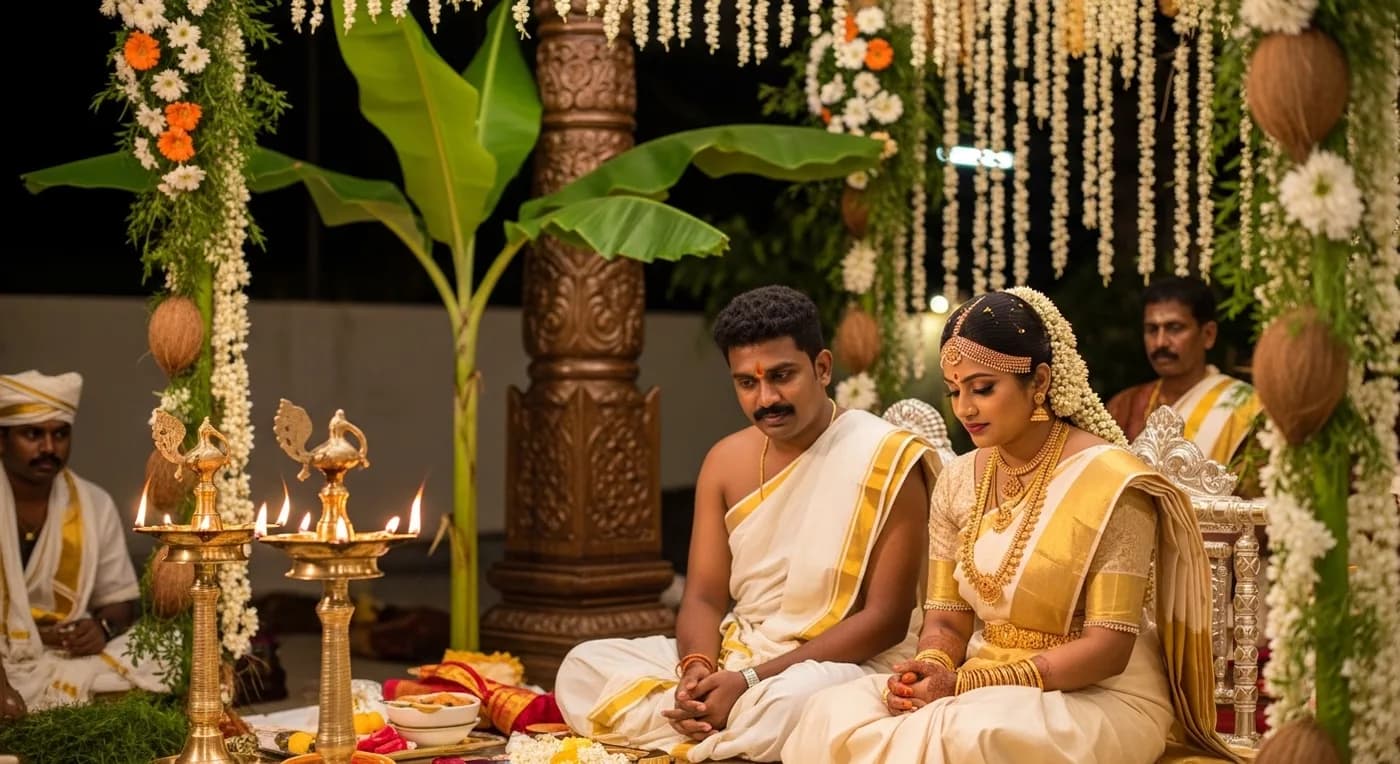
Kerala Nair Wedding: Complete Guide to Rituals, Checklist & Costs in 2026
Average Wedding Cost in India (2026): City-by-City Breakdown

Best Season for South India Destination Weddings: Month-by-Month Western Ghats Guide
Still planning?
Get quotes from India's best vendors
Tell us what you're planning and we'll match you with verified photographers, venues, decorators, and more.
Get free quotes