
Kerala Wedding Mehndi Guide: Mailanchi Designs, Trends & Planning for 2026
Bridal mehndi in Kerala costs ₹5,000–₹35,000 in 2026. Your complete guide to mailanchi traditions, design trends, artist pricing, and stain care tips.

Cultural Heritage Writer
Sujata Iyer is a cultural heritage writer specializing in the rich tapestry of South Indian wedding traditions.
On this page
Bridal mehndi in Kerala costs ₹5,000–₹35,000 depending on artist and complexity — basic designs start at ₹5,000–₹8,000, premium artists charge ₹20,000–₹35,000. Apply 24–48 hours before the ceremony for full colour development. The Mailanchi Kalyanam in Malabar Muslim weddings is the emotional centrepiece, with Oppana dance running from sunset past midnight.
Quick Answer
Quick answer: Bridal mehndi (mailanchi) in Kerala costs ₹5,000–₹35,000 based on artist and design complexity. Apply 24–48 hours before the ceremony — mehndi darkens over 48 hours after paste removal. Book a premium artist 3–4 months ahead during October–February wedding season. Use only natural henna; avoid "black henna" which contains harmful PPD chemicals.
Mehndi is one of those rare elements of a Kerala wedding that carries equal weight in ritual significance, aesthetic beauty, and sheer communal joy. In an Indian wedding industry valued at ₹10.79 lakh crore and projected to reach ₹24 lakh crore by 2030, pre-wedding rituals like mehndi have become increasingly elaborate celebrations in their own right. Across the state — from the Mailanchi ceremonies of Malabar to the pre-wedding celebrations in Thrissur and Ernakulam — henna has woven itself into the fabric of every community's wedding tradition. Having spent over fifteen years documenting and advising on Kerala weddings, I can say confidently that no other pre-wedding ritual generates quite the same atmosphere: the intimacy, the laughter, the songs, the gentle artistry unfolding on the bride's hands while the world around her celebrates.
This guide covers everything you need to know about mehndi in the context of a Kerala wedding in 2026 — the cultural traditions that shape each community's approach, the design styles trending this season, practical guidance on organising a mehndi function, how to choose and book an artist, and the science behind getting that deep, rich stain in Kerala's tropical humidity.
The Mailanchi Tradition Across Kerala's Communities
The word mailanchi is the Malayalam name for the henna plant (Lawsonia inermis), and in Kerala, it refers not just to the paste or the designs but to the entire ceremony built around its application. What makes Kerala distinctive is that mehndi is not the exclusive domain of any single community — it has deep roots across Hindu, Muslim, and Christian wedding traditions, each with its own flavour and significance.
Hindu Mylanchi: Auspicious Adornment
In traditional Hindu Kerala weddings, mehndi — often called mylanchi in the southern districts — is applied as part of the bride's pre-wedding preparation. Historically, the application was simple: crushed henna leaves ground into a paste at home and applied in basic patterns on the palms and feet. The emphasis was on the auspiciousness of the plant itself rather than elaborate artistry.
In the Nair and Ezhava communities across Thrissur, Palakkad, and Ernakulam, mehndi application has traditionally been a quieter, family-only affair — the bride's mother, aunts, and sisters gathering to apply henna the day before the muhurtham. There was no separate event or ceremony; it was simply part of the preparation process, alongside the oil bath and floral adornment.
That has changed dramatically over the past decade. With CAIT reporting 4.6 million weddings and ₹6.5 lakh crore in spending during the November-December 2025 season alone, the scale of pre-wedding celebrations has grown nationally — and Kerala is no exception. In 2026, Hindu brides across Kerala are embracing mehndi as a full pre-wedding event, often combining it with a sangeet or music night. The designs have grown far more elaborate, and the occasion has become an important moment for the bride's closest circle to bond before the wedding day.
Tip
Muslim Mailanchi Kalyanam: The Heart of Malabar Celebrations
For the Malabar Muslim community across Kozhikode, Malappuram, Kannur, and Kasaragod, the Mailanchi ceremony is not an optional addition — it is the emotional centrepiece of the entire wedding celebration. The Mailanchi Kalyanam (literally "henna wedding") is held the evening before the Nikah, and in many families, it is the event that guests remember most vividly.
The bride is seated on a decorated platform or ornate chair, surrounded by female relatives and friends who perform the Oppana dance — a rhythmic, clapping celebration unique to the Malabar Muslim tradition. While the Oppana unfolds, professional mehndi artists work on the bride's hands and feet, creating dense, intricate patterns that can take three to five hours for full coverage.
The Mailanchi night in Malabar is a sensory event. Jasmine garlands frame the bride's seating area. Sulaimani chai and pazham pori circulate through the crowd. The songs — traditional Mappilapattu — carry lyrics that have been passed through generations, celebrating love, beauty, and blessings for the married life ahead. In Malappuram and Kozhikode, the Mailanchi night routinely runs past midnight, with the bride's mehndi left to set through the early morning hours. For complete bridal attire and styling advice, see our Kerala Muslim Bridal Look Guide.
Christian Adaptations: A Growing Trend
Mehndi was not traditionally part of Kerala Christian wedding customs. However, over the past decade — particularly among Syrian Catholic and Jacobite families in Kottayam, Idukki, and parts of Ernakulam — bridal mehndi has become increasingly popular. Christian brides typically incorporate mehndi into a pre-wedding gathering, often a combined hen party and mehndi afternoon held two to three days before the church ceremony.
The approach is generally more restrained than Hindu or Muslim traditions. Designs tend to be lighter and more minimal — elegant vine patterns on one or both palms, sometimes incorporating a cross or floral motifs that complement the white bridal gown. What is notable is how naturally mehndi has integrated into Kerala Christian celebrations, blending with the existing culture of pre-wedding family gatherings that are common in the central Travancore belt.
Mehndi Design Styles: Traditional, Regional & 2026 Trends
Choosing a mehndi style is one of the most personal decisions a Kerala bride makes. The right design reflects your personality, complements your wedding attire, and photographs beautifully. Here is a breakdown of the major styles and what is trending in 2026.
Traditional Kerala Motifs
Kerala-specific mehndi motifs draw from the state's cultural and natural imagery. Expect to see:
- Nilavilakku (brass oil lamp): The most iconic Kerala motif, often placed at the centre of the palm
- Coconut palms and fronds: Reflecting the landscape that defines Kerala
- Jasmine chains (malli): Delicate floral chains that mirror the garlands used in wedding decoration
- Elephants: Particularly popular in Hindu bridal mehndi, referencing the caparisoned elephants of temple festivals in Thrissur and Guruvayur
- Banana leaf and sadya motifs: A playful nod to the wedding feast
- Kathakali and temple architecture: Intricate figurative work for brides who want a distinctly Keralite statement
These motifs work best when integrated into a broader design rather than used in isolation. A skilled Kerala mehndi artist will weave two or three of these elements into a cohesive pattern that covers the full hand.
Rajasthani (Marwari) Style
The Rajasthani style is characterised by extremely fine, dense work with thin lines, intricate jaali (net) patterns, and elaborate figurative scenes — bridal processions, peacocks, palaces, and portraits of the couple. This style demands a highly skilled artist and typically takes four to six hours for full bridal coverage.
In Kerala, Rajasthani-style mehndi peaked in popularity around 2022-2023. It remains a strong choice, particularly among brides in Ernakulam and Thiruvananthapuram who want maximum visual impact in their wedding photography. However, the extremely dense coverage can sometimes feel heavy in Kerala's climate — both visually and physically, as the thick paste takes longer to dry in humid conditions.
Arabic Style
Arabic mehndi is defined by bold, flowing patterns with generous negative space. The designs feature thick outlines, large floral motifs, leaves, and vines that cascade naturally across the hand and forearm. The beauty of Arabic mehndi lies in its balance — the contrast between filled patterns and bare skin creates a striking visual effect.
This style is the most popular choice among Malabar Muslim brides, reflecting the region's deep historical connections to the Arab world. In Kozhikode and Kannur, Arabic mehndi with personalised elements — mosque domes, crescent moons, the couple's initials in Arabic calligraphy — is the dominant bridal choice in 2026.
Fusion and Contemporary: The 2026 Trend
The biggest trend in Kerala bridal mehndi for 2026 is fusion — combining elements from multiple traditions into a cohesive, personalised design. Here is what we are seeing across the state this season:
- Kerala-Arabic fusion: Arabic flowing patterns with Kerala motifs (nilavilakku, elephants) integrated as focal points. This is the single most requested style in Kochi and Kozhikode in 2026.
- Minimalist bridal: Thin-line work covering only the palms and fingertips, leaving the back of the hands bare. Popular among Christian brides and couples having destination weddings in Munnar or Wayanad.
- Portrait mehndi: Miniature portraits of the couple, their pets, or significant locations woven into the palm design. Technically demanding but stunning in photographs.
- Geometric and mandala-forward: Clean geometric patterns with mandala centrepieces, blending Indian and Middle Eastern aesthetics. Growing in popularity among younger brides in Thiruvananthapuram.
- Negative space storytelling: Using empty space strategically to create patterns — the design is defined as much by what is left bare as by what is filled. This requires exceptional artistic skill and works beautifully in close-up photography.
Tip
Bridal Mehndi vs. Guest Mehndi
Bridal Coverage
A full bridal mehndi in Kerala typically covers:
- Both palms and backs of hands: Dense, detailed work up to the wrists
- Forearms: Extending to the elbows (full coverage) or mid-forearm (half coverage)
- Feet: Tops of feet and soles, extending to the ankles
- Application time: 3-6 hours depending on complexity
The bride's mehndi is always the most elaborate. In Malabar Muslim weddings, full coverage from fingertips to elbows on both arms is standard. Hindu brides in Kerala increasingly opt for full coverage as well, though half-arm designs remain popular for brides who want a lighter, more modern look.
Guest Mehndi
Guest mehndi is an important part of the celebration — it makes attendees feel included and creates wonderful group photo opportunities. Typical guest designs:
- Single palm: Simple floral or vine pattern, 10-15 minutes per person
- One finger or ring finger accent: Minimal, trendy, takes 5 minutes
- Both palms (simple): For close friends and bridesmaids, 20-30 minutes
For a mehndi function with 30-50 guests wanting designs, you will need 2-3 additional mehndi artists beyond the bridal artist. Plan for the guest artists to start working when the event begins, while the bridal artist focuses exclusively on the bride.
Guest mehndi pricing in Kerala (2026):
- Simple single-hand designs: ₹200 – ₹500 per person
- Detailed single-hand designs: ₹500 – ₹800 per person
- Both hands (moderate detail): ₹800 – ₹1,500 per person
Planning Your Mehndi Function
Whether you call it a Mailanchi night, mehndi evening, or henna party, organising a dedicated mehndi event requires thoughtful planning. Here is a practical framework built from real Kerala wedding timelines.
Venue and Setup
The mehndi function works beautifully in intimate settings. Ideal options:
- Home courtyard or terrace: The most traditional choice, particularly in Malabar. Families in Kozhikode and Malappuram often erect a pandal in the courtyard with jasmine strings and warm lighting.
- Rented hall or community space: For larger guest lists (100+), a hall near the bride's home allows more space for Oppana performances, guest seating, and separate mehndi stations.
- Hotel banquet space: For destination weddings in Kochi, Munnar, or Kumarakom, hotel event spaces offer convenience and coordination with the wedding venue.
- Outdoor garden setting: Resorts in Wayanad and Thekkady offer beautiful garden spaces that work well for daytime mehndi functions.
Setup essentials:
- Comfortable, elevated seating for the bride (she will be seated for 3-5 hours)
- Cushioned floor seating or chairs for guests getting mehndi
- Good lighting — natural light during daytime events, warm artificial lighting for evening
- A dedicated area for the mehndi artists with adequate ventilation
- Charging stations (guests will want to photograph everything)
- Background music system for Oppana or playlist
Timing
For evening Mailanchi (Malabar Muslim tradition): Start after Maghrib prayer (around 6:30 PM in Kerala). The bride's mehndi application begins immediately. Oppana performances run from 7:30 PM onwards. Light snacks served throughout, with dinner at 9:00-9:30 PM. The event typically winds down by midnight, though the bride's mehndi may need another hour to complete.
For afternoon/daytime mehndi (Hindu and Christian celebrations): Start at 2:00-3:00 PM. The bride's mehndi application begins first. Guest mehndi stations open simultaneously. Tea and snacks served at 4:00 PM. The event wraps by 7:00-8:00 PM, giving the bride a full evening and night for the henna to develop colour.
Important
Food and Refreshments
Mehndi functions call for food that can be eaten without cutlery issues (since many guests will have wet henna on their hands). Smart choices:
- Sulaimani chai and fresh lime soda: The classic Malabar mehndi pairing
- Finger foods: Pazham pori, unniyappam, cutlets, mini samosas
- Chaat station: Pani puri and bhel puri served by attendants
- Main meal: If serving dinner, opt for a buffet with serving staff. Biryani with raita is the standard at Malabar Mailanchi nights.
- Desserts: Individual portions — pudding cups, cake slices, or traditional payasam in small glasses
Entertainment Beyond Mehndi
While mehndi application is the centrepiece, the event needs energy:
- Oppana performance: Essential for Muslim weddings, increasingly popular at Hindu celebrations too
- Music playlist: Curate a mix of Mappila songs, Malayalam film music, and the couple's favourites
- Games: Mehndi-themed games like "find the groom's name hidden in the bride's design" or henna trivia
- Photo booth: Set up a simple backdrop with props for group photos. Hands-focused photography stations work well.
- Live music: A small acoustic set adds warmth without overwhelming the intimate atmosphere
Looking for Makeup Artists?
Tell us what you need and get quotes from verified makeup artists
Choosing a Mehndi Artist in Kerala
What to Look For
Selecting the right mehndi artist is critical. Here is what matters most:
- Portfolio depth: Review at least 20-30 completed bridal designs, not just selected highlights. Look for consistency in line quality, symmetry, and spacing.
- Style match: Ensure the artist's natural style aligns with what you want. An artist who specialises in Rajasthani fine work may not deliver the best Arabic bold patterns, and vice versa.
- Kerala wedding experience: An artist who has worked Kerala weddings understands the humidity factor, the typical ceremony timeline, and the cultural context of different community celebrations.
- Healed colour photos: Ask to see photos of healed mehndi (48-72 hours after application), not just fresh paste photos. The true test of quality is the final stain colour and clarity.
- Reviews and references: Speak to at least two recent brides who used the artist. Ask specifically about punctuality, speed, and how the colour turned out.
Note
Pricing methodology: Mehndi artist rates in this guide are based on itsmy.wedding vendor data and market surveys across Kochi, Kozhikode, Thrissur, and Thiruvananthapuram (2025–2026). Ranges cover local artists to premium travelling artists.
Pricing in Kerala (2026)
Bridal mehndi pricing varies significantly based on artist reputation, design complexity, and location:
Budget tier:
₹5,000 – ₹8,000Basic to moderate bridal designs, hands and feet, local artists. Suitable for simpler designs or when budget is a priority. Available in all districts.
Mid-range tier:
₹10,000 – ₹18,000Detailed bridal mehndi with full hand and feet coverage, established artists with strong portfolios. This is the sweet spot for most Kerala brides — excellent quality without premium pricing. Artists in Kochi, Kozhikode, and Thrissur fall heavily in this range.
Premium tier:
₹20,000 – ₹35,000Top-tier artists with national-level portfolios, Instagram followings, and experience with celebrity or destination weddings. Full bridal coverage with portrait work, 3D effects, or hyper-detailed fusion designs. These artists typically travel from Kochi, Bangalore, or Mumbai.
Tip
Questions to Ask Before Booking
- What brand or type of henna do you use? (Natural henna only — avoid chemical-based pastes)
- How many hours will full bridal mehndi take?
- Do you bring your own seating setup and lighting?
- What is the cancellation and rescheduling policy?
- Do you provide guest mehndi artists as part of the package, or do I need to arrange separately?
- Can you do a trial on one hand 2-3 weeks before the wedding?
Natural vs. Chemical Henna: What Every Kerala Bride Must Know
This is non-negotiable advice: use only natural henna for your bridal mehndi. The distinction matters more than most brides realise.
Natural Henna
Made from dried, powdered leaves of the Lawsonia inermis plant, mixed with lemon juice, sugar, and essential oils (eucalyptus, tea tree, or lavender). Natural henna:
- Produces a deep reddish-brown to burgundy stain
- Takes 6-12 hours to develop full colour
- Is completely safe for skin (barring rare plant allergies)
- The paste appears dark green to brown when fresh
Chemical "Black Henna"
Chemical henna contains para-phenylenediamine (PPD) — an industrial dye that produces an instant black colour. This is dangerous:
- Can cause severe allergic reactions, blistering, and chemical burns
- May leave permanent scarring
- Reactions can appear hours or even days after application
- Is banned for direct skin application in many countries
Important
How to Verify
Ask your artist to apply a small test patch on your inner wrist 2-3 weeks before the wedding. Natural henna will stain orange initially and deepen to brown-red over two days. If the stain is immediately dark or appears black, the product contains chemicals. A reputable artist will never hesitate to do a patch test.
Getting a Darker Stain in Kerala's Humid Climate
Kerala's tropical humidity is actually an advantage for mehndi colour development — moisture helps the dye molecule (lawsone) bond with the skin's keratin. However, getting the deepest possible stain requires technique. Here is the protocol that experienced Kerala mehndi artists recommend:
Before Application
- Exfoliate hands and feet gently 24 hours before mehndi application. Remove dead skin cells so the dye penetrates fresh skin.
- Avoid lotions and oils on the hands for at least 12 hours before application. Oils create a barrier that prevents the henna from absorbing.
- Ensure hands are clean and completely dry before the artist begins.
During Application
- Keep still. Movement causes smudging. Have everything you need within reach — water, phone, snacks — so you do not have to move.
- Stay warm. Warmth accelerates the dye release process. In Kerala's climate, this is rarely an issue, but avoid sitting directly under air conditioning or fans during application.
After Application: The Critical Window
This is where most brides lose colour depth:
- Let the paste dry naturally for 30-45 minutes. Do not touch or press anything against it.
- Apply lemon-sugar sealant. Mix equal parts lemon juice and sugar, dab gently over the dried paste with a cotton ball. This seals the paste, prevents flaking, and keeps it moist against the skin for continued dye release.
- Keep the paste on for 6-8 hours minimum. Overnight is ideal. The longer the paste stays on the skin, the deeper the stain.
- Wrap loosely with tissue paper and a breathable cloth if sleeping with mehndi on. Avoid plastic wrap — it traps too much moisture and can cause smudging.
- Scrape off the dried paste — never wash it off with water. Use a butter knife or the edge of a card to gently flake off the dried henna.
- Apply a thin layer of natural balm (coconut oil, eucalyptus balm, or Vicks VapoRub — yes, many Kerala artists swear by it) immediately after scraping off the paste. The warmth helps the stain oxidise and darken.
- Avoid water for 24 hours after removing the paste. Water halts the oxidation process that deepens the colour. This means no hand washing, no wudu (for Muslim brides, complete ablutions before the mehndi night), and no contact with water-based products.
Tip
The 48-Hour Rule
Mehndi continues to darken for 48 hours after paste removal through oxidation. The initial colour will be bright orange — do not panic. By the morning of the wedding (if applied 24-36 hours prior), it will have deepened to a rich reddish-brown or burgundy. This is why timing your mehndi application correctly is so important.
Photography Tips for Mehndi Shots
Mehndi provides some of the most visually striking content in your wedding album. Here is how to make the most of it:
During the Function
- Candid moments: The best mehndi function photos are candid — the bride laughing during Oppana, close friends comparing their designs, the artist's hands at work. Brief your photographer to focus on these moments rather than posed shots.
- Process shots: Time-lapse or sequential shots of the design being built are compelling album content.
- Group hands: A circle of decorated hands from the bride and her closest friends makes a beautiful image.
The Bridal Mehndi Portrait Session
Schedule a 20-30 minute mehndi photography session the day after the function, when the colour has developed:
- Natural light is essential — shoot near a window or outdoors in soft morning light
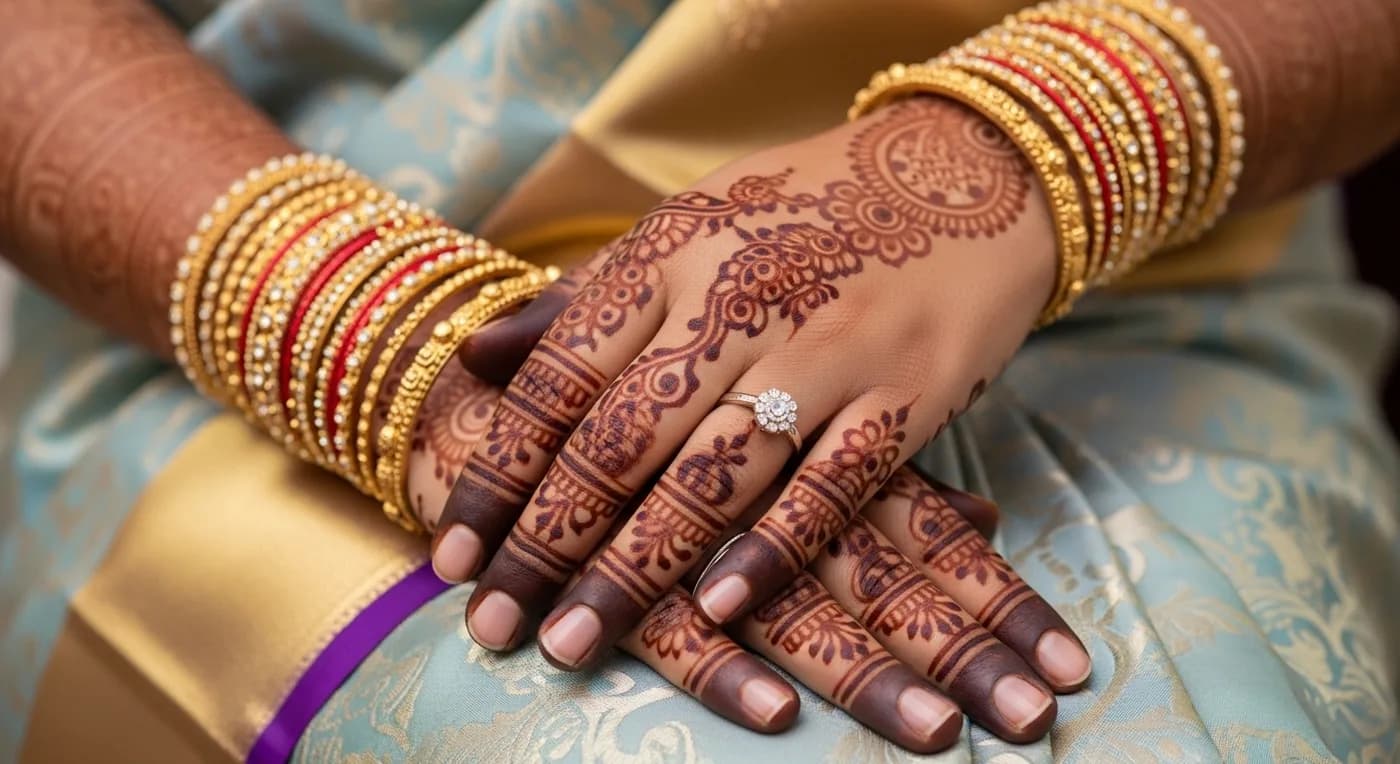
- Hand positions: Photograph hands in natural poses — holding flowers, resting on fabric, framing the face, holding jewellery
- Detail shots: Macro close-ups of the most intricate sections of the design
- With the wedding outfit: A few shots of mehndi-adorned hands against the wedding saree or lehenga fabric
- Ring shots: The engagement ring or wedding ring against the mehndi pattern is a classic must-have
Tip
DIY Mehndi vs. Professional: Making the Right Choice
When DIY Works
- Guest mehndi at small gatherings: If your mehndi function has fewer than 15 guests, a talented friend or family member with store-bought henna cones can handle simple designs.
- Practice sessions: Many brides enjoy applying basic mehndi on friends in the weeks leading up to the wedding as a bonding activity.
- Touch-ups: Having a few natural henna cones on hand for minor touch-ups on the wedding morning is practical.
When You Need a Professional
- Bridal mehndi — always. No exceptions. Your bridal mehndi will be photographed hundreds of times and will be visible in nearly every close-up shot. This is not the place to save money.
- Guest mehndi for 20+ people. Speed and consistency matter when multiple people are waiting. Professional guest artists can complete a simple design in 8-12 minutes per person.
- Intricate or fusion designs. Portrait work, 3D shading, Kerala-Arabic fusion, and any design requiring precise symmetry demands professional skill.
Cost comparison for a typical Kerala mehndi function (50 guests + bride):
- DIY (cones only): ₹2,000 – ₹4,000 for materials
- Professional bridal artist + 2 guest artists: ₹15,000 – ₹30,000 for the full function
The professional route costs more, but the difference in the final result — both in the quality of the designs and the smoothness of the event — is dramatic. According to a WedMeGood survey of 2,000+ couples, bridal beauty services — including mehndi — are among the top areas where couples feel professional investment pays off. Every bride I have worked with who chose the professional route has told me the investment was worth it.
Looking for Makeup Artists?
Tell us what you need and get quotes from verified makeup artists
Organising a Mehndi Function: Complete Checklist
Here is a practical timeline for planning your mehndi event:
3-4 months before:
- Decide on the format (evening Mailanchi, afternoon mehndi party, combined sangeet-mehndi)
- Book the bridal mehndi artist
- Finalise the venue or confirm home setup plans
6-8 weeks before:
- Book guest mehndi artists (2-3 depending on guest count)
- Confirm the design style with your bridal artist — share reference images and discuss personalisation
- Arrange catering or home cooking plan
- Book Oppana troupe or entertainment (if applicable)
- Order decorations — fairy lights, jasmine, cushions, fabrics for the seating area
2-3 weeks before:
- Schedule a trial session with the bridal artist (one hand)
- Confirm headcount for guest mehndi and food
- Arrange the photography plan with your wedding photographer
- Prepare a playlist or coordinate with the music arrangement
Day before the function:
- Set up the venue — seating, lighting, mehndi stations, food area
- Confirm arrival times with all artists
- Prepare the bride's seating area with comfort in mind (cushions, side table, phone charger, water)
Day of:
- Bride exfoliates and avoids lotions from morning
- Artists arrive 30-60 minutes before the event to set up
- Bridal mehndi begins as soon as the event opens
- Guest mehndi runs in parallel at separate stations
- Enjoy the celebration
Common Questions About Kerala Wedding Mehndi
Are mailanchi and mehndi the same thing in Kerala weddings?
Mailanchi is the Malayalam word for henna — both the plant (Lawsonia inermis) and the ceremony built around its application. In Kerala, mailanchi and mehndi are used interchangeably, though mailanchi is more common in Malabar Muslim and traditional Hindu contexts while mehndi is widely understood across all communities. The Hindu term mylanchi (used in southern districts like Thiruvananthapuram and Kollam) is a slight variant of the same word. Regardless of terminology, the practice traces back centuries across every Kerala community, with each tradition developing its own ceremonial flavour — Hindu Mylanchi as a family preparation, Malabar Muslim Mailanchi Kalyanam as a grand celebration, and Christian adaptations as pre-wedding gatherings.
How much should I budget for a bridal mehndi artist in Kerala?
Bridal mehndi costs fall into three clear tiers. Budget artists charge ₹5,000-₹8,000 for basic-to-moderate bridal designs covering hands and feet — these are typically local or salon-based artists working in all districts. Mid-range artists at ₹10,000-₹18,000 deliver detailed Arabic, Rajasthani, or fusion designs with full hand and feet coverage — this is the sweet spot for most Kerala brides, with strong artists concentrated in Kochi, Kozhikode, and Thrissur. Premium artists at ₹20,000-₹35,000 bring national-level portfolios, Instagram followings, and experience with hyper-detailed or portrait-style work. Guest mehndi is typically ₹200-₹800 per person depending on complexity.
How do I actually get a darker mehndi stain in Kerala's humidity?
Kerala's humidity helps mehndi colour development because moisture enables the dye molecule (lawsone) to bond with skin keratin — but technique matters enormously. Exfoliate hands and feet 24 hours before application and avoid oils or lotions for 12+ hours. After application, let the paste dry naturally for 30-45 minutes, then dab on a lemon-sugar sealant to keep it moist against the skin. Leave the paste on for 6-8 hours minimum; overnight is ideal. Scrape off dried paste — never wash with water. Apply a thin layer of eucalyptus balm or Vicks immediately after removal, then avoid water entirely for 24 hours while oxidation deepens the colour.
Do Christian brides in Kerala actually apply mehndi now?
Yes — mehndi has become increasingly popular among Christian brides in Kerala, particularly in Kottayam, Ernakulam, and Thrissur, though it is not a traditional Christian ritual. Many incorporate mehndi into their pre-wedding celebrations or hen parties held 2-3 days before the church ceremony. Designs tend to be lighter and more minimal than Hindu or Muslim bridal mehndi — typically elegant vine patterns on one or both palms, sometimes incorporating a cross or floral motifs that complement the white bridal saree or gown. The trend is strongest among Syrian Catholic and Jacobite families, where mehndi has naturally blended into existing pre-wedding family gathering culture.
When exactly should bridal mehndi be applied before the ceremony?
Apply bridal mehndi 24-48 hours before the wedding ceremony. This timing allows the colour to develop fully (mehndi darkens over 48 hours after paste removal via oxidation) and gives the bride adequate rest time before the wedding day. For Muslim weddings, mehndi is applied during the Mailanchi night, typically 1-2 days before the Nikah. Hindu brides often schedule a dedicated Mylanchi afternoon 2-3 days before the muhurtham. Never schedule mehndi application on the same day as the ceremony — rushing results in orange-toned mehndi instead of the deep burgundy that photographs beautifully in bridal portraits.
Final Thoughts
Mehndi is more than decoration — in every Kerala community, it is a moment of pause before the whirlwind of the wedding day. It is the evening when the bride's closest people gather around her, when songs are sung and stories are told, when the slow, meditative art of henna anchors everyone in the present moment. Whether you are planning a grand Malabar Mailanchi with three hundred guests and a professional Oppana troupe, or an intimate afternoon mehndi on a Kottayam terrace with your ten closest friends, the essence remains the same: love made visible on the skin, fading slowly over the weeks that follow as your new life together begins.
Plan it well, choose your artist carefully, respect the traditions that speak to your family, and give the henna the time it needs to bloom. The colour will take care of itself.
Looking for Makeup Artists?
Tell us what you need and get quotes from verified makeup artists
Tip
Planning a traditional wedding? Our AI Wedding Checklist generates a personalised timeline that includes all the rituals and ceremonies for your specific tradition. Estimate your full budget with the Cost Calculator.
Topics
Kerala mehndi designmailanchibridal henna Keralamehndi function planningKerala wedding traditionsmehndi artist Keralahenna designs 2026mailanchi kalyanamExplore more
Frequently Asked Questions
1What is the difference between mailanchi and mehndi in Kerala weddings?
2How much does a bridal mehndi artist charge in Kerala in 2026?
3How can I get a darker mehndi stain in Kerala's humid weather?
4Do Christian brides in Kerala apply mehndi?
5When should I apply bridal mehndi before the wedding ceremony?
Continue reading
Related Articles
Pre-Wedding Rituals Kerala: Nischayam & Mehendi
Kerala Wedding Traditions Explained: Rituals, Meaning & Modern Adaptations
Malabar Muslim Nikah: ₹15-35L Rituals, Vendors & Costs (2026)
Best Season for South India Destination Weddings: Month-by-Month Western Ghats Guide
Destination Wedding Cost in South India 2026: 5-Tier Budget Guide
Destination Wedding in South India: Complete 2026 Planning Guide
Still planning?
Get quotes from India's best vendors
Tell us what you're planning and we'll match you with verified photographers, venues, decorators, and more.
Get free quotes