
Malabar Muslim Nikah: ₹15-35L Rituals, Vendors & Costs (2026)
Malabar Muslim wedding costs ₹15-35 lakhs for 500-800 guests. Full Oppana, Mailanchi, walima feast rituals — with real vendor pricing for Kerala Mappila kalyanam in Kozhikode, Malappuram, and Kannur.

Kerala Wedding Traditions Writer
Fathima Zahra is a traditions writer who specializes in Muslim and Mappila wedding customs of Kerala.
On this page
A Malabar Muslim wedding with 500–800 guests costs ₹15–35 lakh, spanning 2–3 days across Mailanchi night, Nikah, and Walima feast. The Walima is the largest expense — Thalassery biryani and Malabar cuisine runs ₹800–₹1,500 per plate. Oppana troupes for the Mailanchi night cost ₹15,000–₹40,000; premium Kozhikode celebrations can reach ₹40–50 lakh.
Quick Answer
Quick answer: A Malabar Muslim nikah follows 7 key rituals: Mailanchi (henna night), Oppana (clap dance), Nikah ceremony, Mahr exchange, Walima feast, Sadya, and Reception. Total cost: ₹15-35 lakh for 500-1,500 guests in North Kerala.
Few weddings anywhere in India carry the sensory richness, communal warmth, and sheer culinary ambition of a Malabar Muslim wedding. In an Indian wedding industry valued at ₹10.79 lakh crore, Malabar celebrations stand out for their legendary hospitality. Spanning the northern Kerala districts of Kozhikode (Calicut), Malappuram, Kannur, and Kasaragod, the Malabar region has cultivated a wedding tradition that is unmistakable — rooted in centuries of Islamic faith, shaped by Arab maritime heritage, and expressed through legendary feasts, the rhythmic clapping of Oppana, and a hospitality so generous it borders on the extravagant.
When you step into a Malabar wedding hall, you step into a world where the aroma of Thalassery biryani drifts through every corridor, where gold adorns the bride in layers that tell the story of generations, and where entire neighbourhoods come together not as guests but as family.
Whether you are a couple from a Malabar family planning your own Nikah, a partner marrying into the community for the first time, or a vendor seeking to understand the customs and expectations of Malabar wedding clients, this guide covers everything you need to know. For the complete North Kerala planning picture — venues, costs, and vendor selection across all communities — see our Malabar wedding planning guide. We walk through every event from the Mailanchi night to the Walima feast, break down realistic 2026 costs across budget tiers, explore how weddings differ between Kozhikode, Malappuram, Kannur, and Kasaragod, and offer a practical planning timeline built from real vendor availability in the current season. Having witnessed and documented hundreds of Malabar weddings across these districts, we can say with confidence: no other wedding tradition in Kerala demands — and rewards — this level of planning.
The Pre-Wedding: Mailanchi Night
The Mailanchi (henna ceremony) is the emotional heart of the Malabar wedding experience. Held the evening before the Nikah, typically at the bride's home or a rented hall, this is where the celebration truly ignites. The word Mailanchi comes from the Malayalam name for henna, and while the night revolves around the application of mehndi on the bride's hands and feet, the event is far more than cosmetic — it is a deeply communal ritual of joy, blessing, and sisterhood that sets the emotional tone for the days ahead.
Setting the Scene
The bride's family transforms their home or venue into a space of warmth and beauty. In Kozhikode and Malappuram, families often erect a pandal (temporary canopy) in the courtyard, lined with jasmine strings and lit with warm golden lighting from brass lamps and fairy lights. Floral arrangements — typically roses, jasmine, and marigold in white and gold tones — frame the seating area. The bride is seated on a decorated peetham (raised platform) or an ornate chair at the centre of the hall, dressed in her finest for the evening — often a heavily embroidered churidar or sharara in green, pink, or gold reserved specifically for this occasion.
The atmosphere is intimate yet electric. Tea and snacks flow continuously — pazham pori (banana fritters), unniyappam (sweet rice balls), and the ever-present Sulaimani chai circulate among guests throughout the evening. A light dinner is typically served midway through the night, though many families now serve a full meal to accommodate guests who travel from distant taluks.
The Oppana Dance
The defining tradition of the Mailanchi night is the Oppana — a celebratory dance form unique to the Malabar Muslim community that has no true parallel anywhere else in India. This is not a performance watched from a distance; it is an immersive, participatory celebration. Women from the bride's family and community gather in a circle around the seated bride, clapping rhythmically and singing traditional Oppana songs (Mappilapattu) that celebrate love, beauty, and the blessings of married life. The songs are in the Mappila dialect, carrying lyrics passed down through generations — each family adding their own favourites to the repertoire.
The movements are graceful yet energetic: rhythmic clapping that builds in intensity, swaying bodies, gentle hand gestures that frame the bride like a living portrait. Traditionally performed exclusively by women, mixed-gender Oppana performances have become increasingly common at modern celebrations in urban Kozhikode and Kannur, though many families in Malappuram and Ponnani maintain the all-women tradition.
In 2026, the Oppana scene has evolved considerably. While amateur family performances remain the emotional highlight, many families also engage professional troupes who bring polished choreography, superior vocal quality, and modern sound equipment. The best troupes in the region understand the balance — they amplify the tradition rather than replace it, blending classical Mappilapattu melodies with contemporary fusion arrangements while preserving the essential clapping rhythm that makes Oppana what it is.
Tip
Oppana Booking Tip: Professional Oppana troupes in Kozhikode and Malappuram typically charge between ₹15,000 and ₹40,000 for a 2-hour performance (based on itsmy.wedding vendor data, 2025-2026). Book at least 3 months ahead during wedding season (November-February) as the best troupes fill up fast.
Mehndi Application
While the Oppana unfolds around her, professional mehndi artists work on the bride's intricate henna designs. Malabar mehndi traditionally favours dense, detailed patterns covering both hands up to the elbows and feet up to the ankles. Arabic-style flowing patterns are more common here than the Rajasthani jaali style, reflecting the region's deep historical connections to the Arab world. In 2026, brides across Thalassery, Tirur, and Kozhikode are increasingly requesting personalised motifs — mosque domes, crescent moons, the couple's initials in Arabic calligraphy, and even miniature portraits woven into the design.
Close friends and female relatives also have mehndi applied, transforming the evening into a communal bonding experience. Bridal mehndi takes 3-5 hours for full coverage, while guest designs are simpler, typically covering only one hand. The night generally runs from Maghrib (sunset prayer) until well past midnight, with the bride's mehndi left to set through the early hours for maximum colour depth.
The Nikah Ceremony
The Nikah is the religious solemnization of the marriage — the most sacred moment in the entire celebration. Unlike the elaborate, multi-hour ceremonies found in some traditions, the Malabar Nikah is characterised by its spiritual focus and relative brevity. The ceremony itself typically lasts 30 to 60 minutes, though the surrounding events and hospitality extend the occasion considerably.
Venue: Mosque or Bride's Home
In Malabar, the Nikah is conducted either at the local mosque (Juma Masjid or Palli) or at the bride's home. The choice depends on family tradition and regional custom. In Malappuram district, mosque ceremonies are more prevalent, with the bride's family hosting the pre- and post-Nikah events at home. In Kozhikode city, home-based Nikahs with the Qazi travelling to the venue have become equally popular, especially when families wish to accommodate a larger gathering of female relatives who may be more comfortable in a private setting. Some families in Kannur and Kasaragod prefer the mosque for the ceremony and then move to a separate convention centre or auditorium for the reception.
The Ceremony Itself
The Nikah is presided over by a Qazi (Islamic judge or scholar), who is often the chief Qazi of the local mosque or a respected religious scholar known to the family. The ceremony follows the essential Islamic requirements with the solemnity they deserve:
-
Khutbah (Sermon) — The Qazi delivers a short sermon on the sanctity of marriage in Islam, drawing from the Quran and Hadith. This sets the spiritual tone and reminds the gathering of the responsibilities and blessings of the marital bond.
-
Mahr Declaration — The Mahr (bridal gift from the groom to the bride) is formally announced. In Malabar tradition, the Mahr is the bride's absolute right — discussed and agreed upon by both families well before the wedding day. It may consist of cash, gold, property, or any valuable mutually decided. In 2026, Mahr values in the Malabar region typically range from ₹1 lakh to ₹10 lakhs, though the amount varies significantly by family circumstances and community expectations.
-
Ijab and Qubool (Proposal and Acceptance) — The bride's Wali (guardian, usually her father or closest male relative) proposes the marriage on her behalf, and the groom accepts with a clear "Qubool hai" (I accept), spoken three times. Two adult Muslim male witnesses must be present to validate the contract.
-
Nikah-Nama (Marriage Contract) — The marriage contract is signed by the groom, the bride's Wali, and the witnesses. This document records the Mahr, any conditions agreed upon, and serves as the Islamic marriage certificate.
-
Dua and Blessings — The Qazi concludes with prayers for the couple's happiness and prosperity. Dates and itthar (sweets, often dates and pathiri) are distributed to all present as a gesture of celebration.
Legal Registration
Families should ensure the Nikah is also registered under applicable marriage laws. In Kerala, this is completed through the local Mahall committee or the municipal office. Many Qazis assist with the paperwork, but it remains the family's responsibility to confirm that legal registration is completed promptly after the ceremony.
Looking for Venues in Kozhikode?
Tell us what you need and get quotes from verified venues
Note
Pricing methodology: Cost figures in this guide are based on itsmy.wedding vendor data and caterer quotes from Kozhikode, Malappuram, Kannur, and Kasaragod (2025–2026). Per-plate costs and venue ranges reflect typical market rates; premium celebrations may exceed stated maximums.
The Walima / Salkaram
The Walima (also called Salkaram in local parlance) is the grand reception feast that follows the Nikah. If there is one element that has made Malabar Muslim weddings famous across Kerala and beyond, it is the sheer scale and quality of the Walima. This is where the family's hospitality is on full display — and in Malabar culture, a family's reputation rests significantly on how well they feed their guests.
Scale and Guest Count
A Malabar Walima routinely hosts 500 to 1,000 guests — well above the national average of 300-350 guests per wedding, according to a WedMeGood survey of Indian couples. In prominent families across Kozhikode and Malappuram, counts of 1,500 to 2,000 are not unusual. The entire extended family, the neighbourhood, business associates, mosque community, and acquaintances from across the district are invited. In many Malabar families, not inviting someone is considered a social slight, so guest lists tend to be generous — and catering must typically account for 10-15% additional walk-ins.
Venue Types
The choice of venue depends on the scale:
- Convention centres and auditoriums — The most popular choice in Kozhikode city and Malappuram town. Major convention centres along the Kozhikode bypass and Malappuram's growing event hall corridor accommodate 800-2,000 guests with full kitchen facilities, climate control, and parking.
- Open-air grounds with pandal — Common in semi-urban and rural areas of Malappuram, Ponnani, Tirur, and Kasaragod. Families rent open land and construct elaborate temporary structures with professional event companies managing the setup.
- Hotel ballrooms — Premium hotels in Kozhikode (particularly along the beach road and NH-66 corridor) offer all-inclusive packages. These are increasingly popular for smaller, curated celebrations of 300-500 guests.
Customs During the Walima
- Couple's entrance — The newlyweds arrive to applause, sometimes with a duff (traditional drum) procession. Stage seating is arranged for the couple to receive blessings and greetings from every guest.
- Separate seating — While mixed seating is becoming more common in urban Kozhikode, many traditional families maintain separate dining areas for men and women. The serving and menu remain identical across both sections.
- Gift-giving (Hanthakashu) — Guests present cash gifts in envelopes to the couple or their families. This is a significant tradition — close relatives often gift gold ornaments or substantial cash amounts. A receipt register is meticulously maintained to record every gift, as the family will reciprocate at future weddings.
- Speeches and Dua — Senior family members and the Qazi or a respected scholar offer brief speeches and prayers. Formal speech-giving is kept shorter than in Western-style receptions.
Malabar Wedding Cuisine
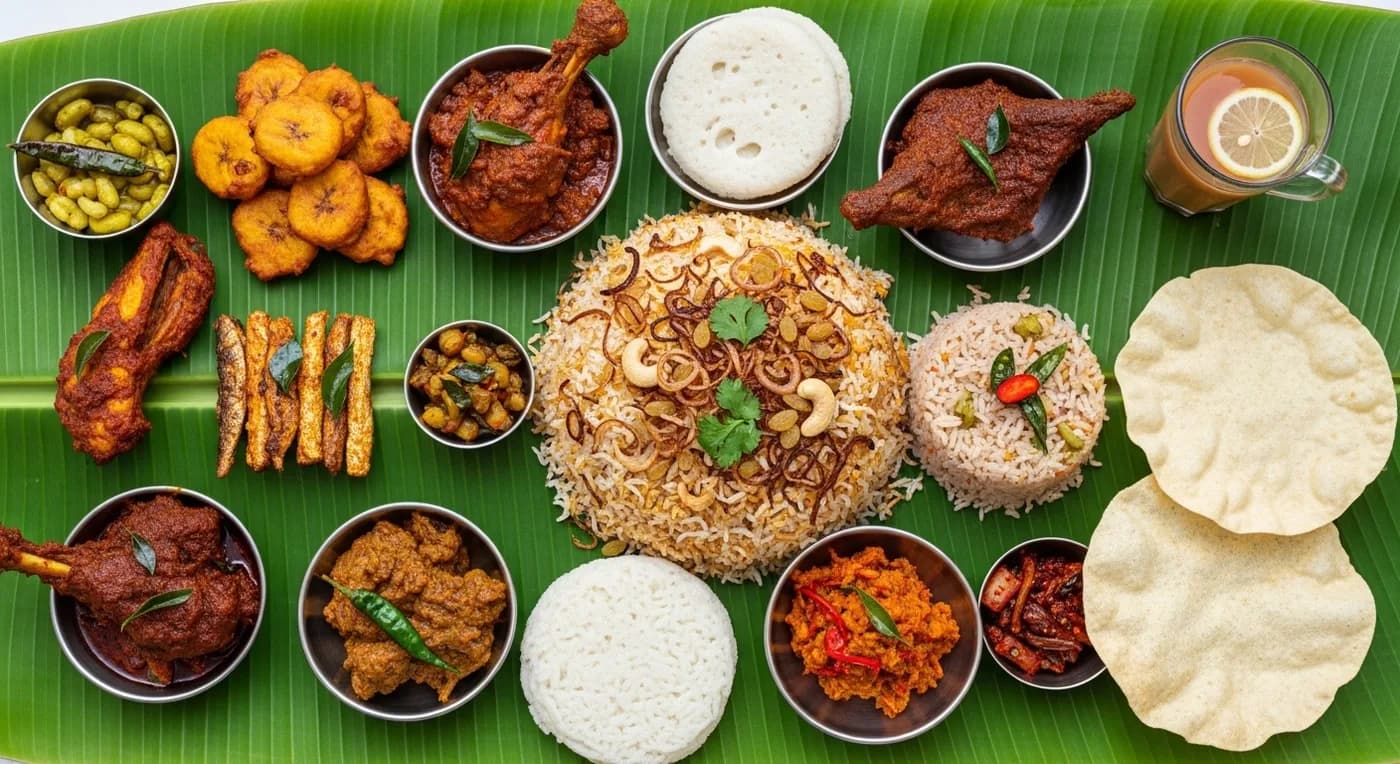
If there is a single element that defines a Malabar Muslim wedding in the public imagination — across Kerala and increasingly across India — it is the food. The culinary tradition of Malabar weddings is arguably the most ambitious, varied, and technically demanding of any wedding culture in southern India. Families take immense pride in the quality, quantity, and presentation of the feast. A typical wedding menu includes 15 to 25 dishes per sitting, the preparation often begins a full day before the event, and the cooking itself is a spectacle that draws curious visitors to the kitchen.
This section deserves particular attention because, in Malabar culture, the food is not merely part of the wedding — in many ways, it is the wedding. Guests will talk about the biryani for years. Caterers build reputations that span decades. And many families book their caterer before they book the venue.
Note
The Malabar Standard: A Malabar wedding feast typically includes 15-25 dishes per sitting. The quality of the biryani alone can make or break the wedding's reputation in the community — many families book their caterer before the venue.
Thalassery Biryani — The Undisputed Star
No Malabar wedding is complete without Thalassery Biryani (also called Malabar Biryani), and no dish at the wedding table carries more weight. This is the preparation that guests judge first, discuss most, and remember longest.
What makes Thalassery Biryani fundamentally different from Hyderabadi or Lucknowi biryanis is the rice. Thalassery biryani uses Kaima or Jeerakasala rice — a short-grained, fragrant variety that absorbs flavour beautifully without becoming mushy. This is emphatically not basmati; the grains are shorter, rounder, and carry a distinctive nutty aroma that is the signature of the dish.
The meat — chicken or mutton, sometimes both at larger weddings — is cooked separately in a rich masala with fried onions, cashews, raisins, whole spices (cardamom, cinnamon, cloves, bay leaf, star anise), and generous amounts of ghee. The par-cooked rice is layered over the spiced meat, sealed with dough or a tight lid, and slow-cooked (dum) until every grain is infused with flavour. The result is lighter and more aromatic than its Hyderabadi cousin, with distinct, separate grains and a depth of flavour that rewards each mouthful.
At a wedding, biryani preparation is a community spectacle. Professional biryani masters — often hereditary specialists from Thalassery, Mahe, or the old quarters of Kozhikode — are hired to cook for hundreds. A single wedding might require 200-500 kg of Kaima rice and corresponding quantities of meat, cooked in massive chembu (copper vessels) over wood fires that burn through the night. The aroma carries across neighbourhoods, and it is not uncommon for neighbours to send their children to the kitchen for an early taste.
Pathiri — The Malabar Flatbread
Pathiri is a thin, soft rice-flour flatbread unique to Malabar cuisine and inseparable from the wedding feast. Unlike wheat-based rotis or parottas, pathiri is made from finely ground rice flour mixed with water and a touch of oil, rolled impossibly thin, and cooked on a flat griddle. The result is delicate, slightly chewy, and the perfect vehicle for the rich curries it accompanies.
At weddings, pathiri appears in several varieties:
- Plain Pathiri — The classic, paper-thin round served with curries.
- Mutta Pathiri — Egg-enriched pathiri with a slightly richer texture and golden colour.
- Nei Pathiri — Ghee-brushed pathiri, layered and flaky, served as a standalone treat.
- Irachi Pathiri — Stuffed pathiri with a spiced meat filling, essentially a Malabar meat pie that is a labour of love to produce in quantity.
Making pathiri in large quantities for a wedding requires dedicated, skilled hands. Many catering teams bring a separate pathiri squad — experienced women who can roll and cook hundreds of perfectly round, uniformly thin pathiris in the hours before service.
Neychoru (Ghee Rice)
Neychoru is fragrant basmati rice cooked with generous amounts of ghee, whole spices (cinnamon, cardamom, cloves, bay leaf), fried onions, and sometimes saffron. It serves as the base for several gravies and sits alongside the biryani at the wedding table — offering a milder, ghee-rich alternative for guests who want to appreciate the curries on their own terms.
Meat Preparations
The variety of meat dishes at a Malabar wedding is extraordinary, and the menu is deliberately constructed to offer contrasting textures and flavour profiles:
- Chicken Roast (Kozhi Porichathu) — Marinated pieces deep-fried to a golden crisp, then finished in a thick onion-tomato masala with curry leaves and Malabar spices. The exterior shatters, the interior stays juicy.
- Mutton Curry (Erachi Curry) — Slow-cooked mutton in a rich coconut-based gravy, aromatic with fennel and black pepper. This is the traditional accompaniment to pathiri, and many families consider this pairing the soul of the feast.
- Chicken Curry — A lighter, coconut-milk-based curry that balances the richer preparations.
- Mutton Fry (Erachi Ularthiyathu) — Dry-fried mutton pieces with shallots, curry leaves, ginger, and coarse-ground Malabar spices. Every table fights over the last pieces.
- Beef preparations — In many Malabar families, particularly in Malappuram and Kozhikode, a beef dish is essential. Beef Ularthiyathu (dry-roasted beef) or Beef Curry with raw banana chips is a crowd favourite.
Fish Preparations (Coastal Weddings)
In coastal areas — Kozhikode city, Thalassery, Kannur, Ponnani, and Kasaragod — fish takes a prominent place on the menu alongside the meat dishes:
- Meen Curry (Fish Curry) — A sour, tangy curry made with kudampuli (Malabar tamarind) or raw mango, typically featuring seer fish or kingfish.
- Meen Porichathu (Fish Fry) — Marinated in a vibrant red chilli-turmeric-garlic paste and shallow-fried until crisp. Neymeen (seer fish) and Ayakkoora (king fish) are the preferred choices for their firm, flavourful flesh.
Desserts and the Sweet Finale
The dessert spread at a Malabar wedding is extensive and includes several preparations rarely found outside the community:
- Muttamala and Pinjanathappam — The signature Malabar wedding dessert pairing. Muttamala consists of delicate egg-yolk threads drizzled in sugar syrup, served atop Pinjanathappam, a steamed egg pudding that is mild, custardy, and subtly flavoured with cardamom. Together, they are unmistakably Malabar.
- Firni — A chilled rice-flour pudding set in earthen bowls, flavoured with cardamom and topped with slivered almonds and pistachios.
- Halwa varieties — Ghee-rich halwa in several forms: Karachi halwa (translucent and chewy), wheat halwa, and seasonal fruit halwa.
- Fruit salad with ice cream — A modern addition that has become nearly universal, offering a cool, light contrast to the rich main course.
- Sulaimani — Sweet, spiced black tea with a hint of lime, served as the traditional digestif. Not technically a dessert, but the essential full stop to the Malabar wedding meal. No guest leaves without their glass of Sulaimani.
Serving Traditions
Traditional Malabar weddings serve the feast on banana leaves in a seated format, with guests eating in batches called panthi. Each batch of 150-200 guests is served simultaneously — the choreography of servers moving through the hall, ladling rice, curry, and biryani onto leaves in precise order, is a spectacle in itself. The panthi system allows families to serve 800-1,000 guests in 3-4 rotations over a 3-hour window.
Buffet-style service has become increasingly common at convention centre weddings, particularly in urban Kozhikode and Malappuram. Many families opt for a hybrid approach — seated service for biryani and the main course (preserving the traditional experience), with desserts, beverages, and starters available at buffet stations.
| Dish Category | Typical Items | Estimated Per-Plate Contribution (₹) |
|---|---|---|
| Biryani (Chicken or Mutton) | Thalassery-style with accompaniments | 250-400 |
| Pathiri + Curries | 2-3 varieties with mutton/chicken curry | 150-250 |
| Neychoru + Gravy | Ghee rice with chicken/mutton roast | 150-200 |
| Starters/Sides | Cutlets, samosa, pappadam, pickle | 100-150 |
| Desserts | Muttamala, Firni, fruit salad, halwa | 100-200 |
| Beverages | Sulaimani, juices, water | 50-100 |
| Total Per Plate | 800-1,500 |
Looking for Caterings in Kozhikode?
Tell us what you need and get quotes from verified caterings
Bridal Attire and Jewellery
The Nikah Look
For the Nikah ceremony, the traditional Malabar bride wears rich red and gold — a heavily embroidered Lehenga, Sharara, or Anarkali paired with a matching dupatta. Gold dominates the colour palette, and the Malabar bridal jewellery set is one of the most elaborate in all of Kerala. A traditional set includes:
- Manga Mala — A long necklace with mango-shaped gold pendants, often the visual centrepiece of the ensemble. Families pass these down through generations.
- Palakka Mala — A necklace studded with green palakka stones set in gold — distinctly Kerala and instantly recognisable.
- Pathakkam — A large, ornate pendant worn on a chain or layered with other necklaces.
- Jimikki — Traditional gold jhumka earrings, often in the Kozhikode style with intricate filigree work that catches light with every movement.
- Bangles and Aravanki — Gold bangles (sometimes 20-30 worn at once) and an aravanki (armlet) on the upper arm.
- Nethichutti and Maang Tikka — Forehead ornaments that frame the bride's face and complete the traditional silhouette.
Malabar families traditionally invest heavily in bridal gold — sets weighing 150 to 400 grams (or more) are common, according to WeddingWire India research. The gold serves a dual purpose: it is both personal adornment and a financial asset gifted to the bride, belonging entirely to her.
The Reception Look (2026 Trends)
For the Walima reception, 2026 brides in the Malabar region are increasingly experimenting with contemporary styles while keeping the traditional look reserved for the religious ceremony:
- Pastel-coloured Shararas in mint, lavender, or blush pink with heavy sequin or zardozi work
- Embellished silk Kaftans with Swarovski or pearl detailing — a nod to the region's longstanding Gulf connections
- Contemporary Lehengas in non-traditional colours (sage green, champagne, dusty rose) with modern draping
- Designer Sarees with heavy blouse work for brides who prefer a Kerala touch at the reception
This two-look approach — traditional for Nikah, contemporary for Walima — has become the dominant pattern in Kozhikode and Malappuram, giving brides the freedom to honour tradition and express personal style in a single celebration.
Groom's Attire
The Malabar groom traditionally wears a Jubba (long tunic) in white or cream with gold embroidery, paired with a mundu or tailored trousers for the Nikah. For the Walima reception, Sherwanis in richer colours (navy, maroon, black) with matching pagdi or topi are the standard. In 2026, modern Indo-Western options — Nehru jackets with tailored trousers, or bandhgala suits — are gaining traction among younger grooms, particularly in Kozhikode city. Designer Sherwanis from Kozhikode's tailoring houses on S.M. Street and Mittai Theruvu remain in high demand for those who prefer the classic look.
₹1,00,000 – ₹5,00,000Decor and Venue Traditions
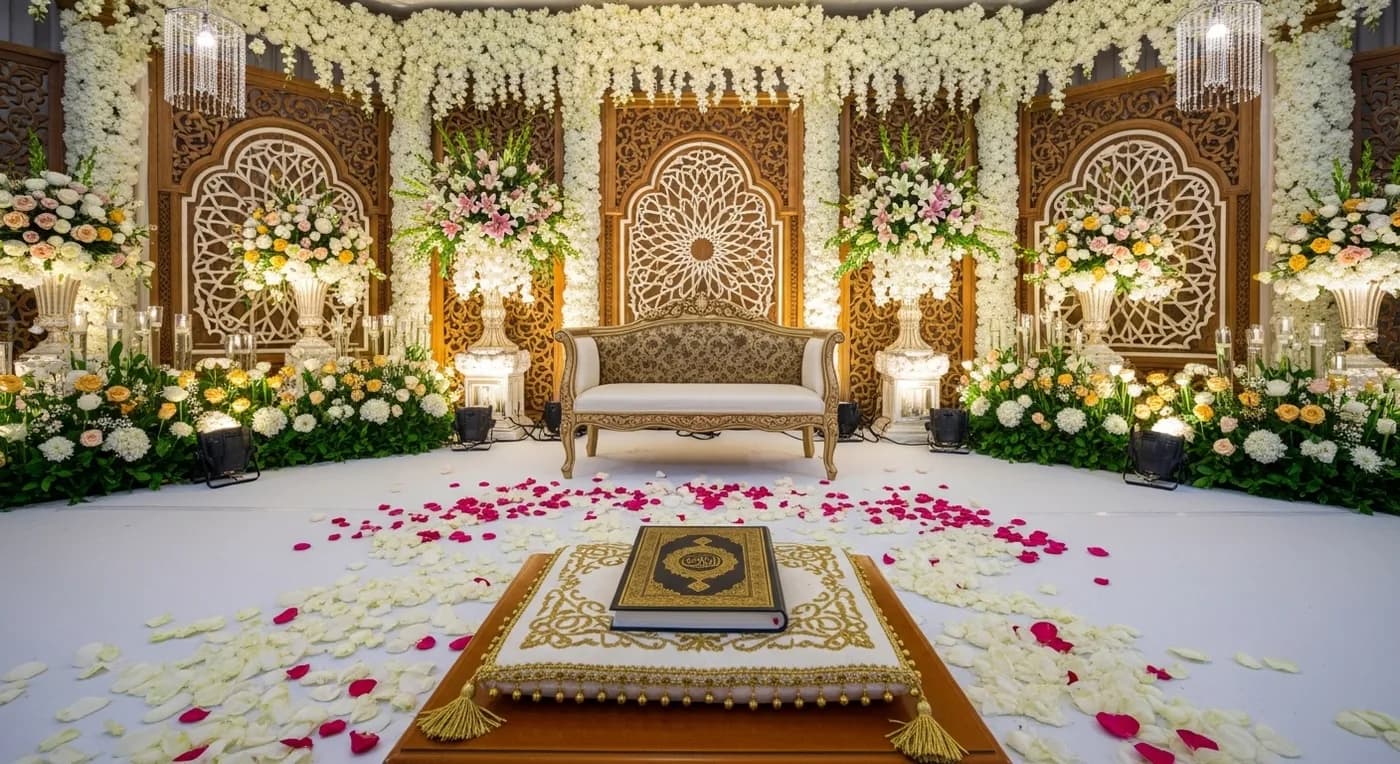
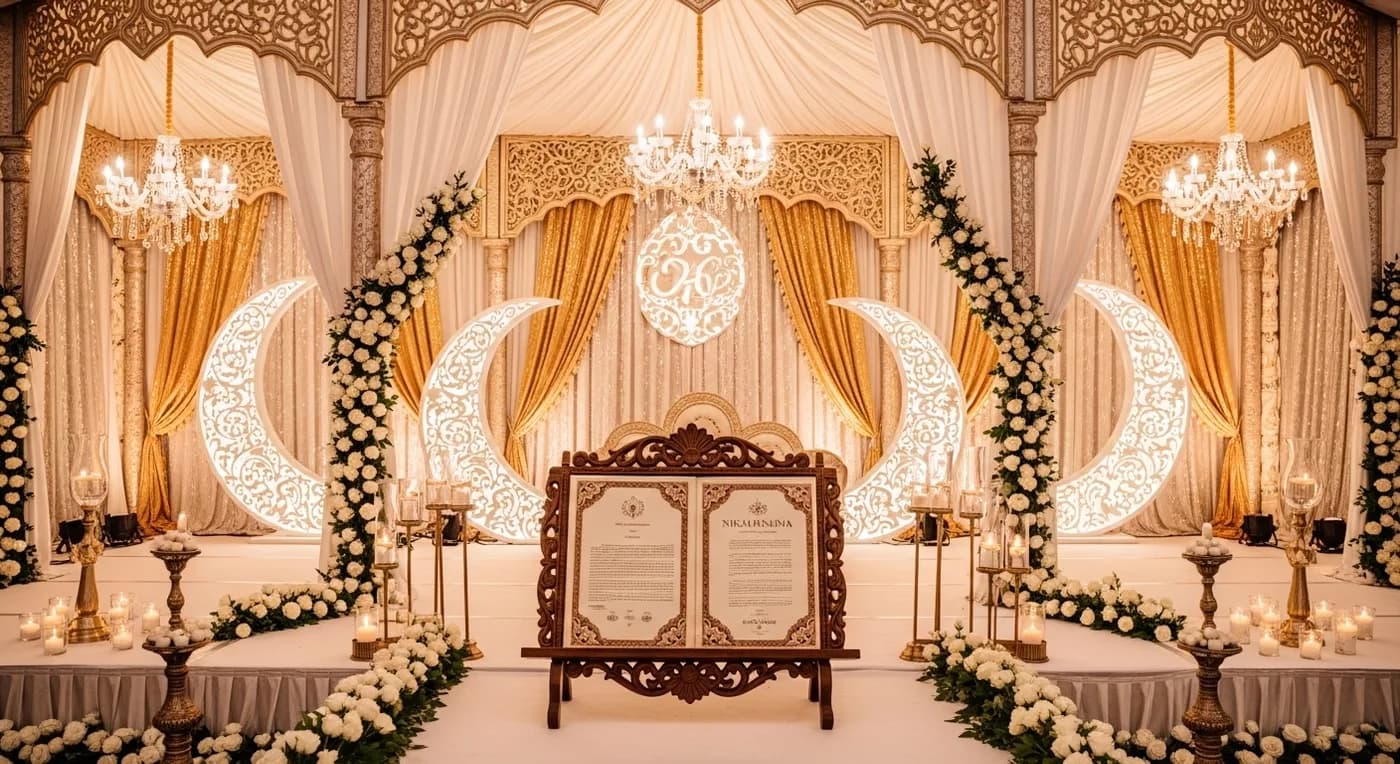
Malabar Muslim wedding decor tends toward the opulent. Compared to the minimalist brass-and-white aesthetic common in many Kerala Hindu weddings, Malabar celebrations embrace rich colours, elaborate floral installations, and dramatic lighting. The stage design is the focal point — this is where the couple sits to receive guests, and families invest significantly in making it a visual centrepiece worthy of the occasion.
Stage Design Trends in 2026
- Massive floral walls — Installations using hundreds of kilograms of roses, carnations, and orchids arranged in gradients of white, pink, or gold. Some families incorporate jasmine (malli) curtains as a nod to Kerala tradition.
- LED and projection mapping — Programmable LED panels behind the stage, displaying the couple's names, Islamic calligraphy, or geometric patterns. Full projection mapping is emerging at premium celebrations in Kozhikode.
- Crystal and mirror elements — Chandeliers, crystal curtains, and mirror-topped stages that multiply the light and create a sense of infinite depth. This aesthetic is particularly popular in Kozhikode's top wedding venues.
- Themed colour palettes — Coordinated colour schemes spanning stage, table settings, entrance arches, chair covers, and lighting. White-and-gold and blush-and-gold are the most requested 2026 palettes, though deep jewel tones (emerald, sapphire) are making a strong showing at premium events.
Entrance and Pellikuthuru Setup
The entrance corridor to the wedding hall receives almost as much attention as the stage itself. Elaborate arches, hanging florals, LED pathways, and name boards welcome guests and set the tone before they even enter the main hall. The Pellikuthuru (bridal preparation area) is also designed with care — a private, beautifully decorated space where the bride is prepared and where close family gathers before the couple's entrance.
Lighting and Sound
Professional lighting is essential, particularly for evening celebrations. The transition from the warm, intimate glow of the Mailanchi to the dramatic spotlighting and colour washes of the Walima stage must be carefully planned. Sound systems must handle both the Oppana's acoustic singing and the amplified entertainment during the reception — experienced wedding DJs and sound engineers in the Malabar region understand how to manage this transition respectfully, keeping volume and energy appropriate to each moment.
Looking for Decorators in Malappuram?
Tell us what you need and get quotes from verified decorators
Photography and Documentation
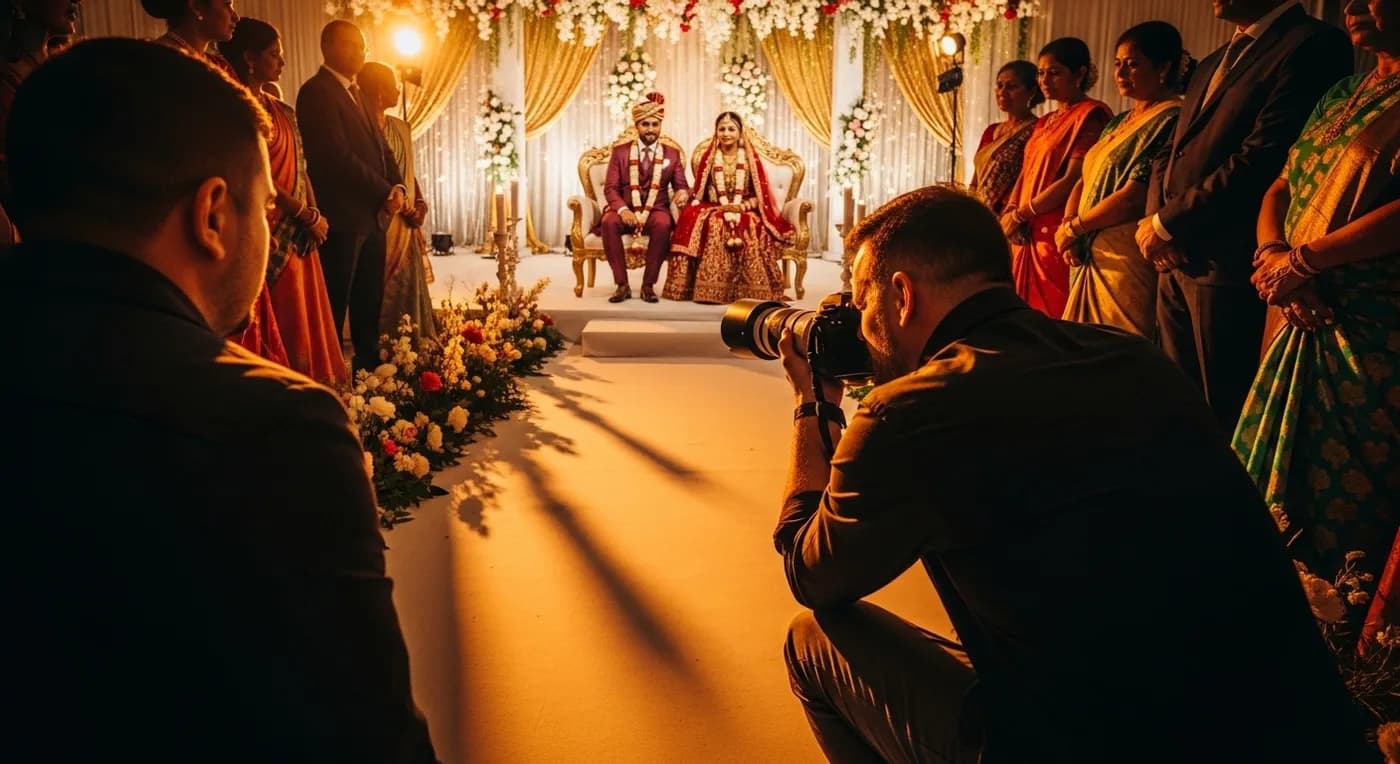
Photography at a Malabar Muslim wedding requires cultural sensitivity, technical skill, and careful advance planning. Different families have varying comfort levels with photography, and the best photographers in the region understand these nuances instinctively — they have grown up in the culture and know when to step forward and when to stay back.
Cultural Sensitivity Guidelines
- During the Nikah — Some families prefer minimal or no photography inside the mosque during the actual ceremony. Others welcome full coverage. Always confirm with the family well in advance. If photography is permitted, a single discreet photographer (no flash, no movement through the gathering) is generally more appropriate than a full crew.
- Women's sections — At events with separate seating, photography in the women's section should ideally be handled by a female photographer or conducted only with explicit permission from the family. Many families hire a dedicated female photographer for exactly this purpose.
- Modesty in framing — Experienced Malabar wedding photographers understand how to capture beautiful, candid moments while respecting the modesty preferences of guests who wear hijab or niqab. This is a non-negotiable skill for anyone working Malabar weddings.
Key Moments to Capture
Despite the need for sensitivity, Malabar weddings offer extraordinary photographic opportunities that a skilled team should never miss:
- Mailanchi preparations — The bride getting ready, mehndi application close-ups, the venue transformation from ordinary to extraordinary
- Oppana performance — The rhythmic clapping, the bride's expressions as she watches, the energy of the circle seen from above
- Nikah signing — The formal moment of signing the Nikah-nama (if photography is permitted), the exchange of glances, the Qazi's blessing
- Bridal entry at the Walima — The couple's grand entrance to the reception hall, the reaction of the crowd
- Feast preparation — The behind-the-scenes spectacle of biryani being prepared in massive copper vessels over wood fires
- Family portraits — Formal group photographs with both families, a keepsake that gains value with every passing year
- Couple portraits — Usually photographed between the Nikah and Walima, or during a pre-wedding shoot at locations like Kozhikode Beach, Kappad, Beypore, or the hill stations of Wayanad
Night Photography for Mailanchi
The Mailanchi ceremony presents specific challenges for photographers: it takes place in the evening under mixed lighting — warm fairy lights, fluorescent overheads, candlelight, and LED strips all competing for dominance. The best Malabar wedding photographers bring portable LED panels and know how to work with the existing warm tones rather than fighting them. The resulting images — golden, intimate, alive with motion — are often the most emotionally powerful photographs in the entire wedding album.
Full Cost Breakdown for a Malabar Muslim Wedding
The following table provides a realistic 2026 cost breakdown for a Malabar Muslim wedding with approximately 600 guests (based on itsmy.wedding vendor data, 2025-2026). All figures are in Indian Rupees (Lakhs).
| Category | Budget (15-20L) | Mid-Range (20-35L) | Premium (35-50L) |
|---|---|---|---|
| Venue / Hall (Nikah + Walima) | 1.5-2.5L | 3-5L | 5-8L |
| Catering / Walima Feast | 5-8L | 8-14L | 14-22L |
| Bridal Outfit + Jewellery | 2-4L | 4-8L | 8-12L |
| Groom's Attire | 0.3-0.5L | 0.5-1.5L | 1.5-3L |
| Decor + Stage + Flowers | 1.5-2L | 2.5-4L | 4-7L |
| Photography + Videography | 0.75-1.5L | 1.5-3L | 3-5L |
| Mehendi / Henna Artists | 0.15-0.3L | 0.3-0.75L | 0.75-1.5L |
| Oppana Troupe | 0.15-0.4L | 0.4-0.8L | 0.8-1.5L |
| Music / Entertainment / DJ | 0.3-0.5L | 0.5-1.5L | 1.5-2.5L |
| Invitations (Print + Digital) | 0.25-0.5L | 0.5-1L | 1-1.5L |
| Transport + Guest Accommodation | 0.5-1L | 1-2L | 2-3L |
| Miscellaneous (Gifts, Tips, Contingency) | 1-1.5L | 1.5-2.5L | 2.5-4L |
| Total Estimated | 15-20L | 20-35L | 35-50L+ |
Notice that catering alone typically accounts for 35-45% of the total budget in most Malabar weddings (based on itsmy.wedding vendor data, 2025-2026). This is not accidental — it reflects the community's deep cultural investment in hospitality. When budgeting, finalise your menu and per-plate cost first. This single decision determines the overall scale of your celebration. Get itemised quotes from at least three caterers, conduct a tasting session with each, and compare not just price but quality of rice, meat sourcing, and the experience of the biryani master they assign to your event.
Regional Variations Across Malabar
While the core rituals remain consistent across the Malabar region, each district has developed its own character and customs over generations. Understanding these differences matters — whether you are planning your own wedding or serving as a vendor working across districts.
Kozhikode (Calicut)
Kozhikode is the cultural capital of Malabar Muslim weddings. The city's wealthy merchant families — with deep roots in the spice trade and Gulf business — have historically set the standard for wedding celebrations. Kozhikode weddings tend to be the most elaborate and highest-budget in the region. The food tradition here is the strongest and most scrutinised: Kozhikode's biryani masters and caterers are considered the gold standard, and families in Malappuram, Kannur, and even Kasaragod regularly hire Kozhikode-based caterers for their events. The city also has the highest concentration of premium wedding venues — from beach-facing convention centres to refurbished heritage properties in the old city near Valiyangadi.
Malappuram
Malappuram district hosts the highest volume of Muslim weddings in Kerala, and celebrations here are deeply traditional and community-driven. Weddings tend to be larger in guest count — 700-1,500 is the common range, according to industry estimates — with strong emphasis on community participation. The local Mahall (mosque committee) plays a more active coordination role, and extended Oppana sessions featuring family performers (not just professional troupes) are a hallmark. Budget-wise, Malappuram families achieve remarkable scale at moderate costs thanks to community kitchens (panthi systems managed by neighbourhood volunteers), bulk ingredient sourcing through family networks, and the tradition of relatives contributing labour for cooking and setup. Towns like Tirur, Ponnani, and Perinthalmanna each have distinct micro-traditions within the broader Malappuram style.
Kannur
Kannur brings a unique cultural flavour to Malabar Muslim weddings. The district's proximity to the Theyyam tradition — a spectacular ritual art form performed during the October-April season at sacred groves across northern Kerala — creates a rich cultural backdrop. While Theyyam is rooted in Hindu practice, its artistic sensibility is part of Kannur's broader cultural landscape, and Kannur Muslim weddings often feature slightly more theatrical staging, bolder colour choices in decor, and a general comfort with dramatic visual presentation. The cuisine in Kannur leans more heavily toward seafood, with fish preparations taking a more prominent role compared to the meat-heavy menus further south in Malappuram.
Note
Regional Note: Kannur weddings during the Theyyam season (November-April) sometimes reflect the broader cultural influence of this ancient ritual art form in their visual aesthetics — bolder staging and more theatrical presentation — though the traditions themselves remain distinct.
Kasaragod
Kerala's northernmost district, Kasaragod, brings Tulu and Kannada cultural influences into the Malabar wedding tradition. Weddings here may feature slight variations in cuisine — more coconut-based preparations, the influence of Mangalorean coastal cooking, and the occasional appearance of Kasaragod-specific dishes like Patrode (colocasia leaf rolls) at pre-wedding meals. The scale tends to be more moderate than Kozhikode or Malappuram, with a stronger emphasis on intimate family ceremonies and a quieter, more understated aesthetic that reflects the district's multilingual, multicultural character.
Planning Timeline for a Malabar Muslim Wedding
Malabar weddings require careful advance planning. The best vendors — especially caterers and Oppana troupes — book up quickly during the peak November-March season, and late planning leads to compromises that families regret. Here is a realistic timeline built from current 2026 vendor availability patterns.
| Timeline | Task |
|---|---|
| 10-12 months before | Fix the wedding date in consultation with family, community elders, and Qazi. Book the venue for both Nikah and Walima. Begin preliminary discussions about Mahr. |
| 8-10 months before | Book the caterer — this is critical. Top Malabar caterers are booked 6-8 months ahead for peak season dates. Conduct initial tastings. Begin bride's gold jewellery shopping (gold prices fluctuate, so early purchase can save significantly). |
| 6-8 months before | Shortlist and book photographer/videographer. Begin bride's outfit shopping — designer pieces require 3-4 months for stitching. Start groom's Sherwani or Jubba tailoring. |
| 4-6 months before | Book decor vendor and finalise stage design concept. Hire Oppana troupe and entertainment. Confirm the Nikah venue (mosque or home) and coordinate with the Qazi. Start guest list compilation and family discussions on logistics. |
| 3-4 months before | Finalise and print invitations or design digital invitations. Book mehndi artists (top artists in Kozhikode are booked 2-3 months ahead). Arrange guest accommodation for outstation relatives. |
| 1-2 months before | Menu tasting with caterer — finalise exact dishes and per-plate count. Confirm all vendor bookings with advance payments. Trial bridal makeup and hair. Begin distributing invitations. Coordinate Mahr arrangement. |
| 1-2 weeks before | Submit final guest count to caterer and venue. Coordinate vendor arrival times and event-day schedule. Prepare the Hanthakashu (gift) register. Brief family coordinators on logistics for each event. |
| Day before (Mailanchi) | Venue setup for henna night. Mehndi artist arrives early afternoon for bridal application. Oppana troupe sound check. Bride's preparation begins. |
| Wedding day | Nikah ceremony (morning or early afternoon), followed by Walima feast (lunch or dinner depending on family tradition). |
Important
Peak Season Alert: The November-February wedding season in Kozhikode and Malappuram typically sees venue prices spike 30-40% (based on itsmy.wedding vendor data, 2025-2026). CAIT data shows 4.6 million weddings and ₹6.5 lakh crore in spending during the November-December 2025 season, and Malabar's share of this volume is substantial. Convention centres on the Kozhikode-Malappuram highway book out 10-12 months ahead for premium Saturday dates.
Common Questions About Malabar Muslim Nikah
What are the main events in a Malabar Muslim wedding?
A Malabar Muslim wedding typically spans 2-3 days and includes four main events, each with its own customs, dress code, and scale. The Mailanchi (henna night with Oppana) is held the evening before the wedding and is the most festive, emotionally intimate event — women gather around the bride, singing and clapping while professional mehndi artists work. The Nikah ceremony is the religious solemnization, held at the mosque or bride's home, presided over by the Qazi with the signing of the Nikah-nama. The Walima / Salkaram is the grand reception feast — the largest event by guest count and budget, centred on the legendary Malabar cuisine. Finally, the Grihapravesham marks the bride's arrival at the groom's home, where she is welcomed by the groom's family with prayers and sweets. Families often engage different vendors and create different setups for each event.
What is the Oppana ceremony?
Oppana is a traditional celebratory dance form unique to the Malabar Muslim community, performed during the Mailanchi (henna) ceremony on the eve of the wedding. Women from the bride's family and community gather in a circle around the seated bride, clapping rhythmically and singing traditional Mappilapattu songs that celebrate love, beauty, and the blessings of married life. The songs are in the Mappila dialect, carrying lyrics that have been passed down through generations. The bride sits decorated and adorned at the centre while the performers create a warm, joyful atmosphere that builds in energy as the evening progresses. In 2026, professional Oppana troupes are widely available across Kozhikode, Malappuram, and Kannur, offering performances that range from purely traditional to tasteful fusion arrangements — always preserving the essential clapping rhythm and communal spirit that defines the art form.
How much does a Malabar Muslim wedding cost?
A traditional Malabar Muslim wedding with 500-800 guests typically costs between 15 and 35 lakhs in 2026. The Walima feast is consistently the single largest expense, accounting for 35-45% of the total budget — Malabar cuisine, with Thalassery biryani, multiple pathiri varieties, extensive meat preparations, and elaborate desserts, runs 800-1,500 per plate depending on menu complexity and caterer reputation. Bridal attire and jewellery is the second-largest line item, particularly given the Malabar tradition of investing heavily in gold. Premium celebrations in Kozhikode city, featuring top-tier venues, renowned caterers, and designer decor, regularly reach 40-50 lakhs. Families in Malappuram often achieve impressive scale at lower costs through community participation and neighbourhood-based food preparation.
What food is served at a Malabar wedding?
Malabar wedding cuisine is legendary in Kerala for both its quantity and quality. The undisputed centrepiece is Thalassery Biryani, made with fragrant Kaima rice (not basmati), layered with spiced meat, fried onions, cashews, and raisins. Alongside the biryani, guests are served Pathiri (soft rice flatbread in multiple varieties) with rich mutton and chicken curries, Neychoru (ghee rice) with roast preparations, and an array of meat dishes including chicken roast, mutton curry, mutton fry, and often beef preparations. In coastal areas like Thalassery and Kannur, fish curry and fish fry feature prominently. The dessert course includes Muttamala (egg-yolk threads in sugar syrup), Pinjanathappam (steamed egg pudding), Firni (rice pudding), halwa varieties, and fruit salad with ice cream. The meal concludes with Sulaimani, a sweet spiced black tea that serves as a digestif. A typical Malabar wedding menu includes 15-25 individual dishes, and the cooking often begins a full day before the event.
What does a Malabar bride wear?
For the Nikah ceremony, the traditional Malabar bride wears a heavily embroidered outfit in red and gold — a Lehenga, Sharara, or Anarkali — paired with a matching dupatta and an extensive gold jewellery set. The jewellery typically includes a Manga Mala (mango-pendant necklace), Palakka Mala (green-stone necklace), Pathakkam (large pendant), Jimikki (jhumka earrings), gold bangles, and forehead ornaments. Bridal gold sets in Malabar frequently weigh 150-400 grams, representing both adornment and a significant financial asset belonging entirely to the bride. For the Walima reception in 2026, brides are increasingly choosing contemporary styles — pastel Shararas in mint or lavender, embellished silk Kaftans with Swarovski detailing, or designer Lehengas in non-traditional colours — allowing them to honour tradition during the religious ceremony while expressing personal style at the reception.
Further Reading
For complete planning logistics — budgets, venues, catering, and vendor selection — see our Muslim Wedding Kerala: The Complete Planning Guide.
Explore more Kerala wedding guides on itsmy.wedding:
- Muslim Wedding Kerala Planning Guide — Budgets, venues, catering, and a month-by-month planning timeline.
- Muslim Wedding Cost in Kerala — Full line-item budget breakdown across 3 tiers.
- Kerala Muslim Wedding Checklist — Month-by-month planning checklist with Muslim-specific tasks.
- Complete Guide to Kerala Wedding Traditions — A comprehensive overview of wedding traditions across all Kerala communities.
- How to Plan a Kerala Wedding — Step-by-step planning guide covering timelines, budgets, and vendor selection.
- Kerala Wedding Budget Guide — Detailed cost breakdowns and budgeting strategies for Kerala weddings of all sizes.
Tip
Planning a traditional wedding? Our AI Wedding Checklist generates a personalised timeline that includes all the rituals and ceremonies for your specific tradition. Estimate your full budget with the Cost Calculator.
Topics
Malabar Muslim weddingKerala nikah guideOppana ceremonyMailanchi nightKozhikode weddingMuslim wedding Kerala ritualsExplore more
Frequently Asked Questions
1What are the main events in a Malabar Muslim wedding?
2What is the Oppana ceremony?
3How much does a Malabar Muslim wedding cost?
4What food is served at a Malabar wedding?
5What does a Malabar bride wear?
6What is the dress code for a Malabar Muslim wedding?
7What are the main rituals in a Malabar Muslim wedding?
Continue reading
Related Articles
Muslim Wedding Catering in Kerala: Malabar Menu, Costs & Planning for 2026
Muslim Wedding Photography Kerala: Costs & Booking 2026
Hyderabadi Muslim Wedding (Nikah): Traditions, Customs & Planning Guide
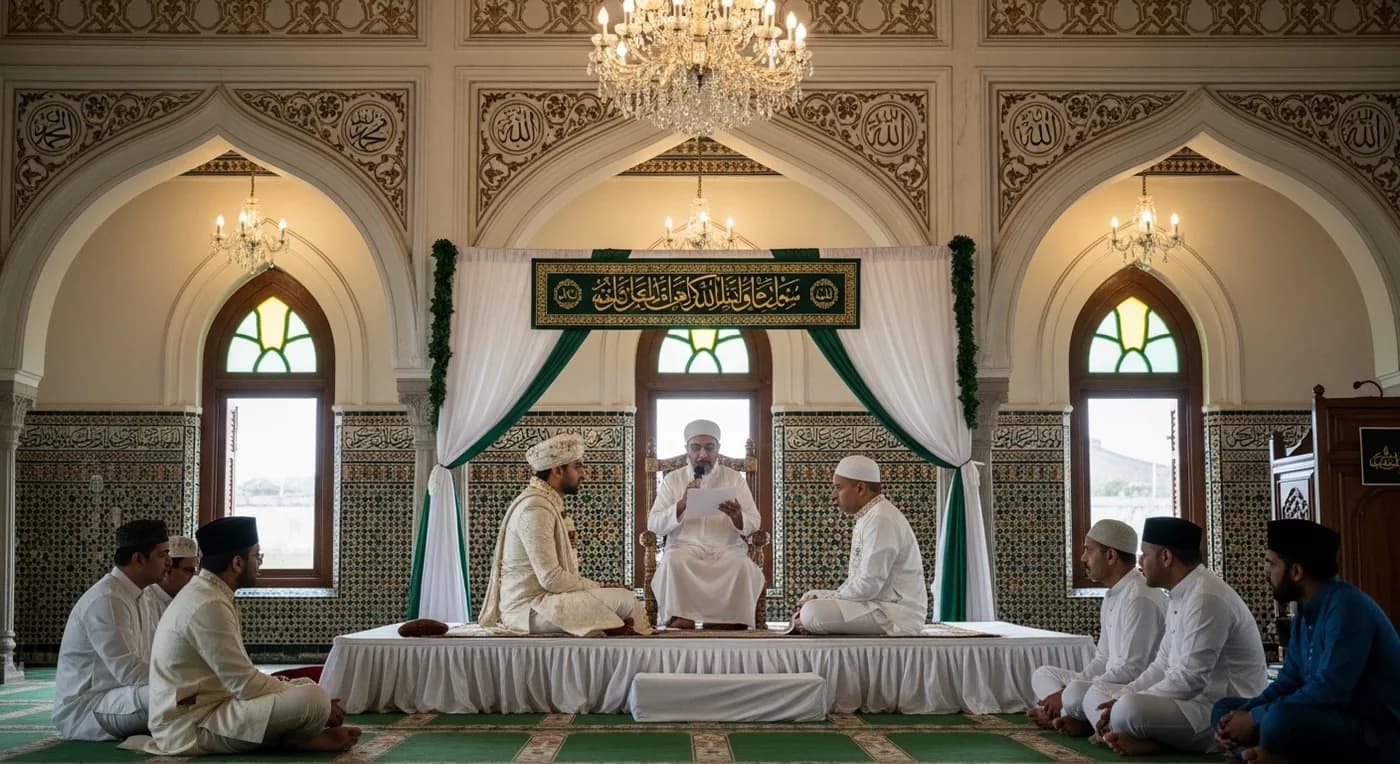
Muslim Wedding in Karnataka: Nikah Traditions in Bangalore
Muslim Wedding Cost in Kerala: Full Budget Breakdown for 2026
Kerala Muslim Wedding Checklist: Month-by-Month Planning Timeline for 2026
Still planning?
Get quotes from India's best vendors
Tell us what you're planning and we'll match you with verified photographers, venues, decorators, and more.
Get free quotes