
Hyderabadi Muslim Wedding (Nikah): Traditions, Customs & Planning Guide
Complete guide to Hyderabadi Muslim wedding traditions: Nikah ceremony, Mehendi, Walima feast, Khada Dupatta bridal attire, and modern planning tips for 2026.

On this page
A Hyderabadi Muslim wedding spans 3-5 days of celebrations blending Islamic tradition with four centuries of Deccani culture — from the intimate Nikah ceremony to the grand Walima feast. The Khada Dupatta bridal attire and Hyderabadi Dum Biryani banquet make these celebrations among the most distinctive in India. Here's every tradition explained.
Quick Answer
Quick answer: A Hyderabadi Muslim wedding spans 3-5 days of celebrations blending Islamic tradition with four centuries of Deccani culture — from the intimate Nikah ceremony to the grand Walima feast. The Khada Dupatta bridal attire and Hyderabadi Dum Biryani banquet make these celebrations among the most distinctive in India. Here's every tradition explained.
Note
Pricing methodology: Cost ranges in this guide are based on vendor pricing data from the itsmy.wedding marketplace and published industry reports, collected in Q4 2025 – Q1 2026.
Hyderabadi Muslim weddings are unlike any other in India. They carry the grace of Deccani Urdu culture, the formality of Islamic tradition, and a culinary heritage centred on what many consider the finest biryani in the world. These celebrations form a vital part of India's ₹10.79 lakh crore wedding industry, shaped by the Nizam dynasty's centuries of patronage and the city's unique position as a crossroads of North Indian Mughal and South Indian Deccani cultures.
Whether you're a Hyderabadi family planning a traditional Nikah or an inter-faith couple incorporating Muslim customs into your celebration, this guide covers every tradition, its meaning, and practical planning considerations.
What Are the Pre-Wedding Celebrations?
Hyderabadi Muslim weddings don't begin with the Nikah — several days of celebration build up to the main ceremony.
Mangni (Engagement)
The Mangni is the formal engagement ceremony, typically held at the bride's home or a family gathering space. The groom's family brings gifts for the bride — traditionally including the Joda (a complete set of clothes, jewellery, and cosmetics) and fruits, dry fruits, and sweets. Rings are exchanged between the couple, and the families agree on the wedding date.
In modern Hyderabad, the Mangni is often a larger celebration — hosted at a banquet hall or restaurant with extended family and friends. Some families combine the Mangni with a separate ring ceremony (Nishaan), while others keep them distinct.
Mehendi Ceremony
The Mehendi ceremony is one of the most vibrant pre-wedding events. The bride's hands and feet are adorned with intricate henna designs — Hyderabadi mehendi is known for its detailed patterns, often featuring floral motifs, paisleys, and geometric designs that are distinctly Deccani in style.
The Mehendi night is a women-centric celebration with music, dancing, and food. In traditional Hyderabadi families, the Mehendi ki Raat features qawwali performances and Deccani folk songs. Modern celebrations often add a DJ and choreographed dance performances, blending tradition with contemporary entertainment.
Tip
Haldi (Manjha)
The Manjha — Hyderabad's version of the Haldi ceremony — involves applying a paste of turmeric, sandalwood, and rosewater to the bride's and groom's skin. It's a purification ritual believed to give the skin a golden glow for the wedding day. The Manjha is held separately at the bride's and groom's homes, usually the day before the Nikah.
In Hyderabadi families, the Manjha paste is prepared by married women of the family — their involvement is considered auspicious. The ceremony is intimate, usually limited to close family, and accompanied by traditional songs.
How Does the Nikah Ceremony Work?
The Nikah is the Islamic marriage contract — a sacred and legally binding ceremony that follows specific requirements under Islamic law.
Choosing the Venue
The Nikah can be performed anywhere — at a mosque, at the bride's home, at a banquet hall, or at the wedding venue. In Hyderabad, many families hold the Nikah at a mosque or at home and then host the reception (Walima) at a larger venue. The Mecca Masjid, Jama Masjid, and Spanish Mosque are among the most prestigious Nikah venues in the city.
For families who prefer a single-venue celebration, many of Hyderabad's hotels and banquet halls have dedicated spaces for the Nikah ceremony, separate from the reception area.
The Qazi and Witnesses
The Nikah is conducted by a Qazi (Islamic judge or scholar) who oversees the legal and religious requirements. Two male witnesses (or one male and two female witnesses) must be present from each side. The Qazi verifies the consent of both the bride and groom — this is a fundamental requirement under Islamic law.
Mehr (Bridal Gift)
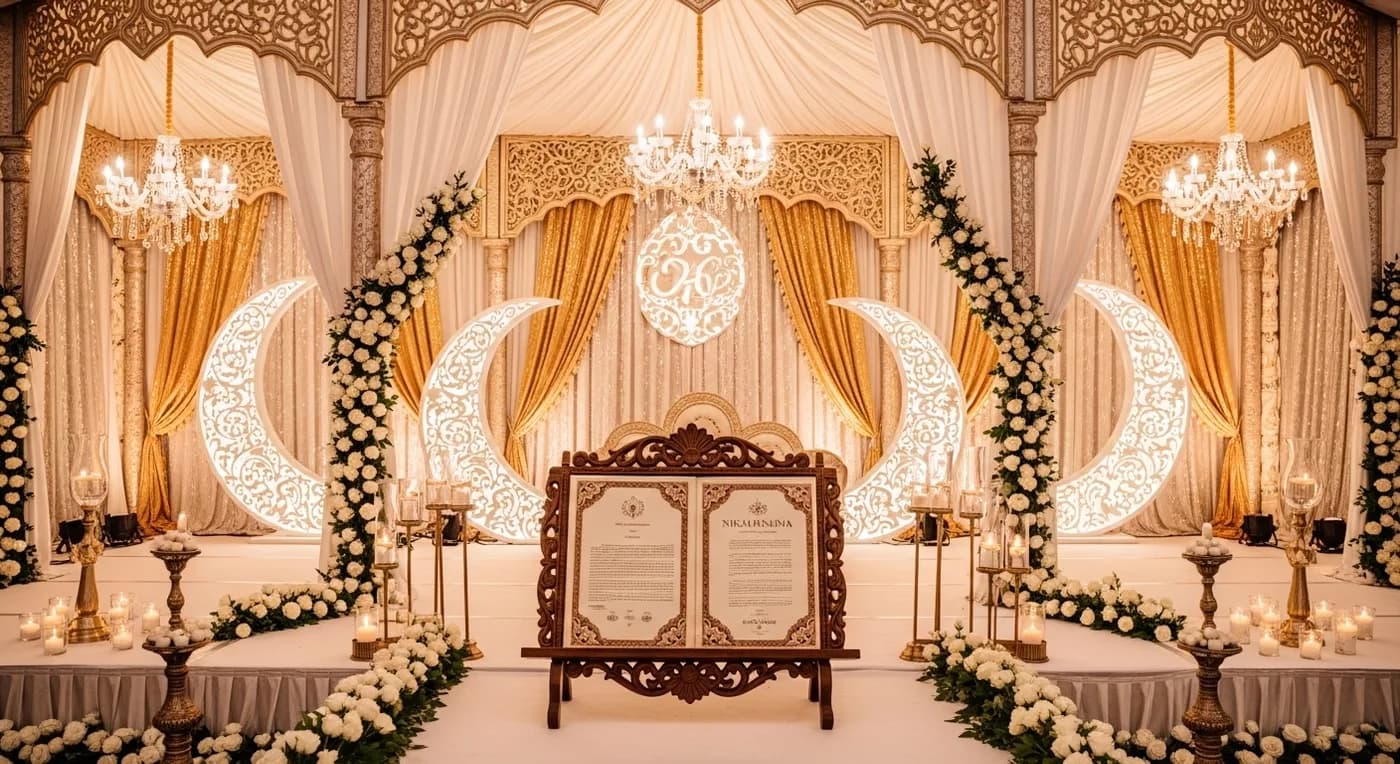
The Mehr is the mandatory gift from the groom to the bride. It can be a financial amount, property, gold, or any valuable asset — the specifics are discussed and agreed upon by both families before the Nikah. The Mehr is the bride's absolute right and is recorded in the Nikahnama (marriage contract).
In Hyderabad, Mehr amounts vary significantly based on family tradition, socioeconomic status, and community norms. Some families follow a symbolic Mehr (a nominal amount representing the tradition), while others set substantial amounts. The key is that both parties agree willingly.
Khutba and Ijab-o-Qubool
The Qazi begins the Nikah ceremony with the Khutba — a sermon on the importance of marriage in Islam, the rights and responsibilities of husband and wife, and Quranic verses related to matrimony.
This is followed by the Ijab-o-Qubool — the formal proposal and acceptance. The Qazi asks the groom (in the presence of witnesses) if he accepts the bride in marriage for the agreed Mehr. The groom responds with "Qubool hai" (I accept) — this is repeated three times. The same process is followed with the bride.
Nikahnama (Marriage Contract)
The Nikahnama is the written marriage contract signed by the bride, the groom, the Qazi, and the witnesses. It records the terms of the Mehr, any conditions agreed upon by both parties, and the formal acknowledgment of the marriage. The Nikahnama serves as the primary legal document of the marriage and should be registered with the Sub-Registrar's office for legal validity in India.
Note
What Are the Post-Nikah Traditions?
Jilwa (Unveiling)
The Jilwa is a beautiful Hyderabadi tradition where the bride is formally unveiled to the groom after the Nikah. The bride, escorted by female relatives, is brought to the groom for the first time as his wife. Female family members hold a decorated cloth or dupatta around the bride, which is lowered to reveal her in full bridal attire. It's a moment of genuine emotion and anticipation.
Arsi Mushaf (Mirror Ceremony)
The Arsi Mushaf is one of the most iconic Hyderabadi wedding traditions. A mirror is placed between the bride and groom with a Quran resting above it. The couple sees each other's reflection in the mirror for the first time after the Nikah. It's intimate, symbolic, and one of the most photographed moments of a Hyderabadi Muslim wedding.
The tradition represents the beginning of the couple's life together — seeing each other through the lens of the Quran (faith) that connects them. It's unique to the Deccani Muslim tradition and not widely practised outside Hyderabad.
Joota Chupai (Shoe Hiding)
Similar to the North Indian tradition, Joota Chupai is a playful ritual where the bride's sisters and female cousins steal the groom's shoes during the Nikah. The groom must negotiate a ransom — usually cash or gifts — to get them back. It's lighthearted, funny, and a welcome moment of levity amid the formal proceedings.
What Is the Walima and What Food Is Served?
The Walima Tradition
The Walima is the grand reception feast hosted by the groom's family, traditionally held the day after the Nikah. In Hyderabad, the Walima is the largest and most lavish event in the wedding calendar — this is where the families display their hospitality, and the food is the centrepiece.
The Hyderabadi Walima Menu
A Hyderabadi Walima without biryani isn't a Walima at all. The menu typically includes:
Centrepiece:
- Hyderabadi Dum Biryani — Slow-cooked basmati rice layered with marinated meat (mutton or chicken), saffron, fried onions, and whole spices. This is the dish guests judge the entire wedding by.
Starters and sides:
- Shami Kebab — Minced mutton patties with chana dal and spices
- Seekh Kebab — Spiced minced meat grilled on skewers
- Mirchi ka Salan — Green chillies in a tangy peanut-sesame gravy (the essential biryani accompaniment)
- Baghare Baingan — Stuffed aubergine in a rich, nutty gravy
- Paya — Slow-cooked trotters curry, a Hyderabadi delicacy
Desserts:
- Double ka Meetha — Deep-fried bread soaked in saffron-infused milk and topped with dry fruits
- Qubani ka Meetha — Stewed apricots with cream, the signature Hyderabadi dessert
- Phirni — Rice pudding set in earthen pots
Per-plate catering costs for a Walima in Hyderabad range from ₹800 for a simple biryani-focused menu to ₹2,500 or more for a full multi-course spread with live counters and premium desserts. With CAIT estimating 4.6 million weddings and ₹6.5 lakh crore in spending during the Nov-Dec 2025 season alone, catering remains the single largest line item for most celebrations.
Looking for Caterings in Hyderabad?
Tell us what you need and get quotes from verified caterings
What Does the Bride Wear? The Khada Dupatta
The Khada Dupatta is the Hyderabadi bride's signature — a distinctive two-layered ensemble that's unique to the Deccan region and one of the most recognisable bridal looks in India.
The ensemble consists of:
- A kurta (tunic) worn underneath
- A churidar (fitted trousers)
- The dupatta itself — a large, heavily embroidered piece of fabric draped over the head and wrapped around the body in a specific layered style
The draping is an art — it takes 20-30 minutes and is usually done by experienced female relatives or a professional dresser. The traditional colours are gold, green, ivory, or white, with heavy zardozi (gold thread) and kundan embroidery.
Where to shop in Hyderabad:
- Laad Bazaar (near Charminar) — The traditional hub for bridal jewellery and Khada Dupatta fabrics
- Begum Bazaar — Wholesale fabrics and accessories
- Banjara Hills boutiques — Designer Khada Dupattas with contemporary styling
Jewellery for a Hyderabadi Muslim bride typically includes a jhoomar (forehead ornament), passa (side headpiece), heavy jhumkas (earrings), a choker necklace, and stacked bangles. Hyderabadi pearls — the city's signature gemstone — feature prominently. Telangana's growing luxury retail sector ensures a wide selection of bridal jewellery across all price points in the city.
Tip
How Should You Plan the Wedding Timeline?
Here's a suggested timeline for a Hyderabadi Muslim wedding spanning 4 days:
| Day | Event | Venue | Key Notes |
|---|---|---|---|
| Day 1 | Mehendi ki Raat | Bride's home or hall | Women-centric, 4-6 hours, qawwali or DJ |
| Day 2 | Manjha (Haldi) | Bride's and groom's homes | Intimate, family only, 2 hours each |
| Day 3 | Nikah + Jilwa + Arsi Mushaf | Mosque or venue | Core ceremony, 2-3 hours |
| Day 4 | Walima | Banquet hall or hotel | Grand reception, 4-5 hours |
Some families compress this to 3 days by combining Mehendi and Manjha, while others extend it to 5-6 days with additional events like a Sangeet night and a Chauthee (the bride's visit to her parents' home 4 days after the Nikah).
Looking for Decorators in Hyderabad?
Tell us what you need and get quotes from verified decorators
For complete planning details including venues and budgets, see our Hyderabad wedding planning guide. For budget-specific guidance, check our Hyderabad wedding budget breakdown.
Tip
Start planning your wedding — generate a personalised checklist with our AI Wedding Checklist, estimate your budget with the Cost Calculator, or create a beautiful digital invitation.
Topics
hyderabadi muslim weddingnikah ceremony hyderabadhyderabadi wedding traditionsdeccani muslim weddingwalima feast hyderabadExplore more
Frequently Asked Questions
1What is the order of events in a Hyderabadi Muslim wedding?
2What is the Khada Dupatta worn by Hyderabadi brides?
3What is Mehr in a Hyderabadi Nikah?
4What food is served at a Hyderabadi Walima?
5How much does a Hyderabadi Muslim wedding cost?
Continue reading
Related Articles
How to Plan a Hyderabad Wedding: The Complete 2026 Guide
Hyderabad Wedding Traditions: Telugu, Muslim & Multi-Faith Customs Explained
Telugu Wedding Rituals Explained: From Pellikuthuru to Talambralu
Best Season for South India Destination Weddings: Month-by-Month Western Ghats Guide
Destination Wedding Cost in South India 2026: 5-Tier Budget Guide
Destination Wedding in South India: Complete 2026 Planning Guide
Still planning?
Get quotes from India's best vendors
Tell us what you're planning and we'll match you with verified photographers, venues, decorators, and more.
Get free quotes