
Muslim Wedding Catering in Kerala: Malabar Menu, Costs & Planning for 2026
Plan your Kerala Muslim wedding feast — traditional Malabar menu breakdowns, per-plate costs, caterer selection tips, and logistics for serving 500-1000+ guests at your Walima.

Kerala Wedding Traditions Writer
Fathima Zahra is a traditions writer who specializes in Muslim and Mappila wedding customs of Kerala.
On this page
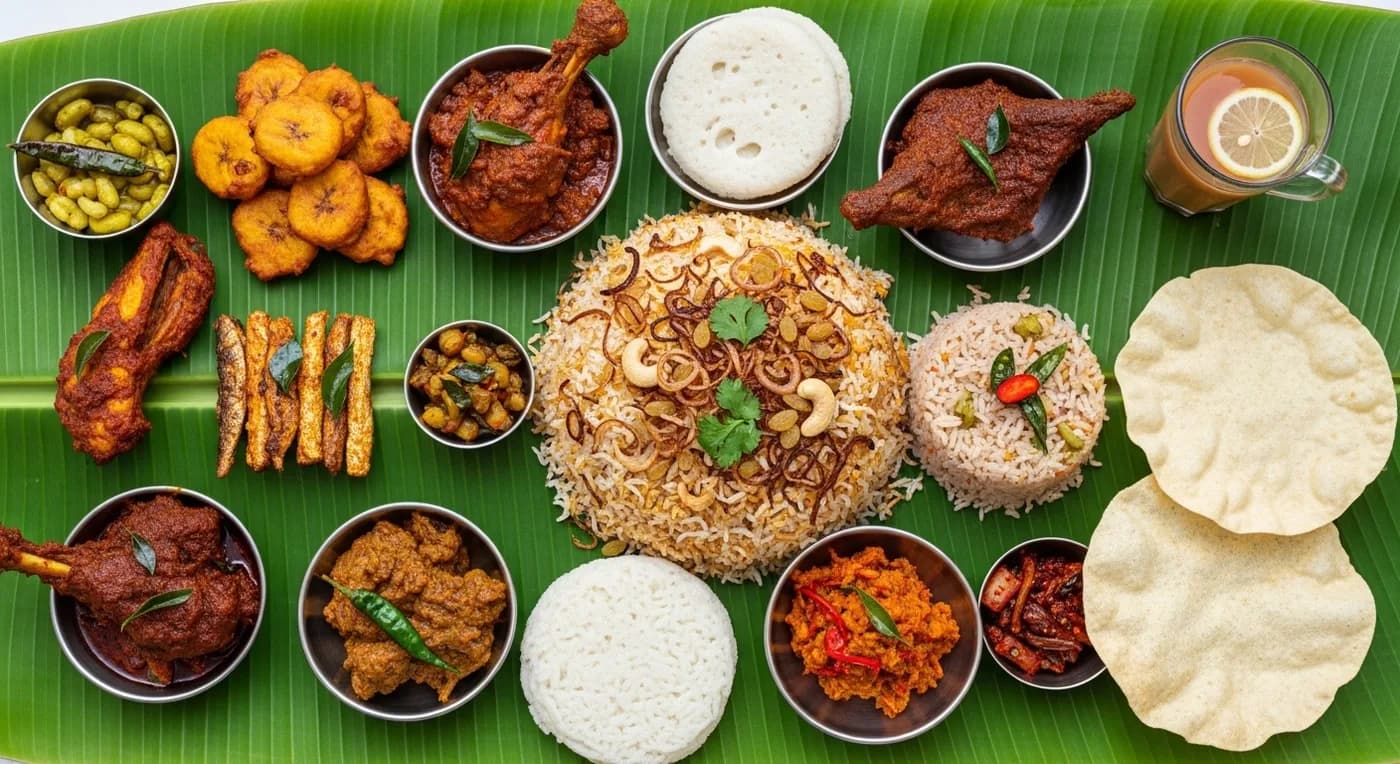
Malabar wedding feast catering costs ₹800–1,500 per plate in 2026, with a standard menu of Thalassery biryani, pathiri, 3–4 meat dishes, and desserts running ₹900–1,200 per plate. For a 600-guest Walima, expect to spend ₹5.4–9 lakh on catering alone — 35–45% of your total wedding budget. Premium menus with seafood, live counters, and expanded dessert stations push toward ₹1,200–1,500 per plate.
Quick Answer
Quick answer: Budget ₹900–1,200/plate for a standard Malabar feast (Thalassery biryani, pathiri, 3–4 meat dishes, desserts). Premium menus reach ₹1,500/plate. Book the best Kozhikode and Malappuram caterers 6–8 months ahead — they fill peak-season calendars faster than venues.
Note
Pricing methodology: Per-plate figures in this guide are based on direct quotes from caterers across Kozhikode, Malappuram, Kannur, and Kochi, collected in Q1 2026. Actual rates vary by menu complexity, guest count, travel distance, and peak-season demand. Use these as planning benchmarks. Request itemised quotes from at least three caterers before finalising.
In every Malabar Muslim wedding, the feast is not merely a meal — it is the event itself. Guests will forgive an unremarkable stage design. They will overlook an awkward DJ. But serve mediocre biryani, and your family will hear about it for years. In a culture where hospitality is honour, where the aroma of Thalassery biryani rising from massive copper vessels signals that a celebration is truly underway, getting the food right is the single most consequential planning decision you will make.
This guide covers everything you need to plan the catering for a Kerala Muslim wedding: the full traditional menu breakdown, per-plate costs across budget tiers and regions, how to select and evaluate a caterer, modern additions that complement tradition, and the logistics of serving 500 to 1,000 guests without chaos. For the complete planning picture, read our Muslim Wedding Kerala Planning Guide. For ceremony rituals and Oppana traditions, see the Malabar Muslim Nikah Guide. For a broader look at Malabar feast traditions across all communities — including the Hindu Sadya in North Kerala — see our Malabar Wedding Food Guide.
Why Does Food Define the Malabar Wedding Experience?
Malabar families routinely allocate 35–45% of their total wedding budget to catering — the highest proportion of any Kerala community. In most Indian wedding traditions, food is important. In Malabar Muslim culture, food is sacred infrastructure. The quality and abundance of the Walima feast directly reflects the family's standing, generosity, and respect for their guests. This is not subtle — it is openly discussed, carefully evaluated, and long remembered.
There are practical reasons for this emphasis. The Indian wedding industry stands at ₹10.79 lakh crore, and within Kerala's share of that figure, Malabar families consistently allocate a larger percentage to catering than any other community. Where a typical Kerala Hindu wedding might spend 25–30% of the budget on food (primarily sadya), Malabar Muslim weddings routinely channel 35–45% into the feast. The reason is straightforward: the menu is more complex, the dishes are more labour-intensive, the ingredient quality expectations are higher, and the guest counts are larger.
In conversations with Kozhikode caterers this season, I have confirmed that many Malabar families book their caterer before they book the venue. This is not an exaggeration — it is standard practice in Kozhikode, Malappuram, and Kannur. The best biryani masters and established catering houses are booked 6–8 months ahead for peak season dates between November and February. Your caterer shapes your budget, your venue requirements (kitchen capacity matters enormously), and ultimately, what your guests remember about the day.
Note
The Malabar Priority Order: Most families in Kozhikode and Malappuram follow this booking sequence — caterer first, then venue, then photographer. The caterer determines the per-plate budget, which in turn determines how many guests you can afford to host at your chosen quality level.
What Does a Traditional Malabar Wedding Menu Include?
A full Malabar wedding feast spans 15–25 dishes across rice, bread, meat, seafood, dessert, and beverage categories — each with a defined purpose in the dining experience. Having coordinated weddings across Malabar for over a decade, I can confirm that the menu structure has remained remarkably consistent even as presentation styles evolve. A full Malabar wedding feast includes 15–25 dishes served across multiple categories. Every dish has a purpose — rice dishes form the base, breads add variety, meat preparations deliver richness, and desserts close the experience. Here is each category in detail.
Rice Dishes: The Foundation
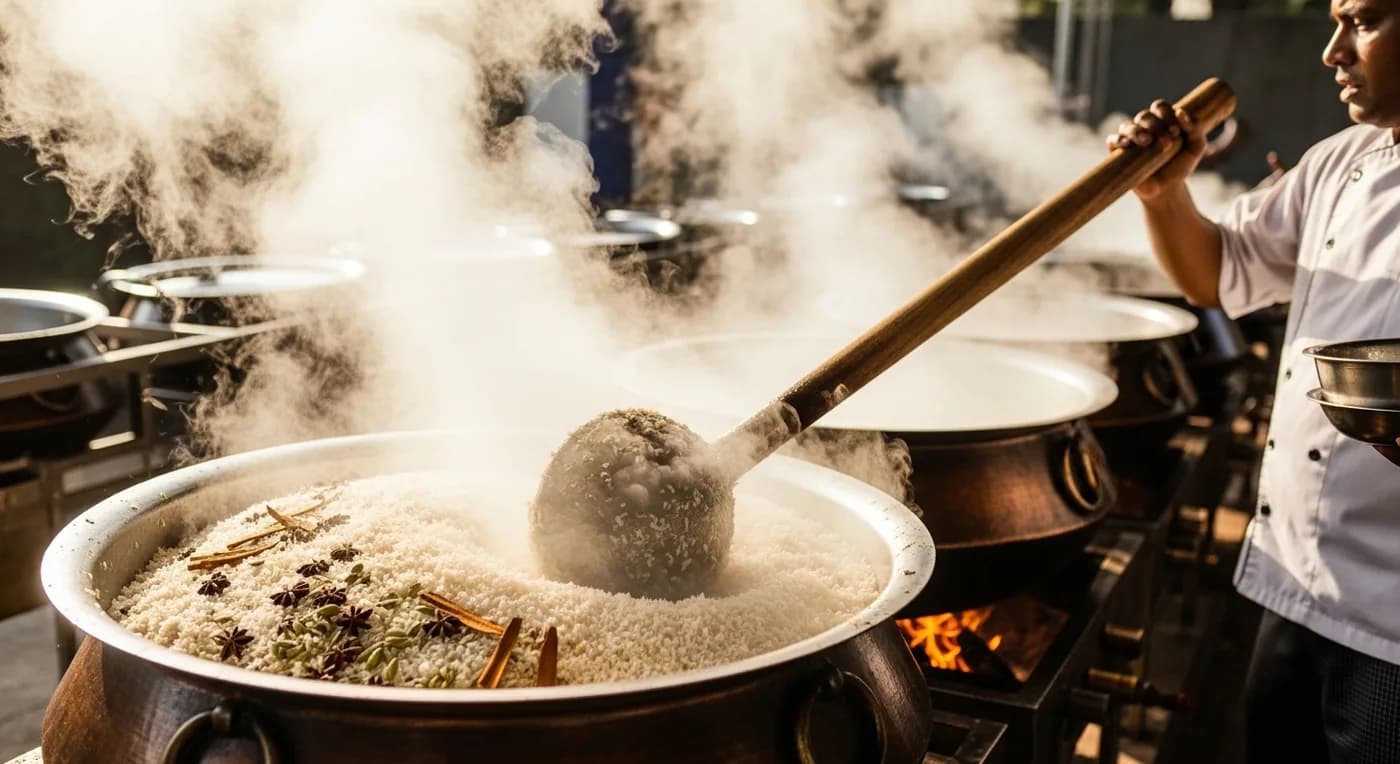
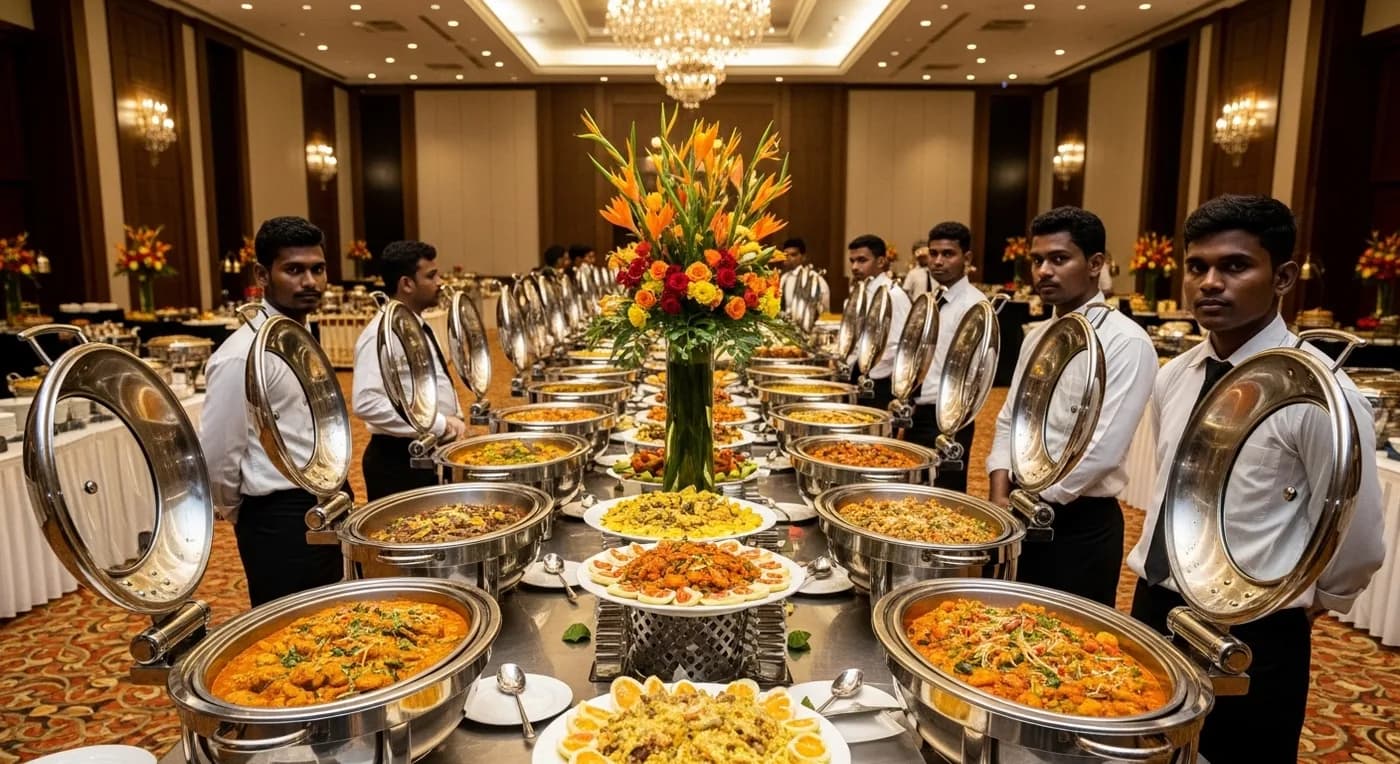
Thalassery Biryani is the undisputed star of every Malabar wedding table and the single dish guests judge most critically. What sets it apart from Hyderabadi or Lucknowi biryanis is the rice — Thalassery biryani uses Kaima or Jeerakasala rice, a short-grained, fragrant variety with a nutty aroma that absorbs spice beautifully without becoming mushy. This is emphatically not basmati. The meat (chicken, mutton, or both at larger weddings) is cooked separately in a rich masala with fried onions, cashews, raisins, and whole spices — cardamom, cinnamon, cloves, bay leaf, star anise — before being layered with par-cooked rice and slow-cooked under a sealed lid (dum). The result is lighter and more aromatic than its Hyderabadi cousin, with each grain distinctly flavoured.
At a wedding serving 600 guests, a biryani master may prepare 200–400 kg of Kaima rice in massive chembu (copper vessels) over wood fires that burn through the night. The preparation itself is a spectacle that draws neighbours and curious visitors to the kitchen.
Kozhikode Biryani — a subtle regional variation found at weddings in and around Calicut — uses a slightly different spice ratio, with more fennel and less star anise, producing a milder but deeply aromatic flavour. Some families in Kozhikode serve both Thalassery and Kozhikode biryani to offer contrast.
Neychoru (Ghee Rice) is fragrant basmati rice cooked with generous amounts of ghee, whole spices (cinnamon, cardamom, cloves, bay leaf), fried onions, and sometimes saffron. It sits alongside the biryani as a milder, ghee-rich alternative that lets guests appreciate the curries and roasts on their own terms. Nearly every Malabar wedding menu includes neychoru — it is the base for multiple gravies and a palate cleanser between the more intensely spiced dishes.
Breads: Pathiri and Beyond
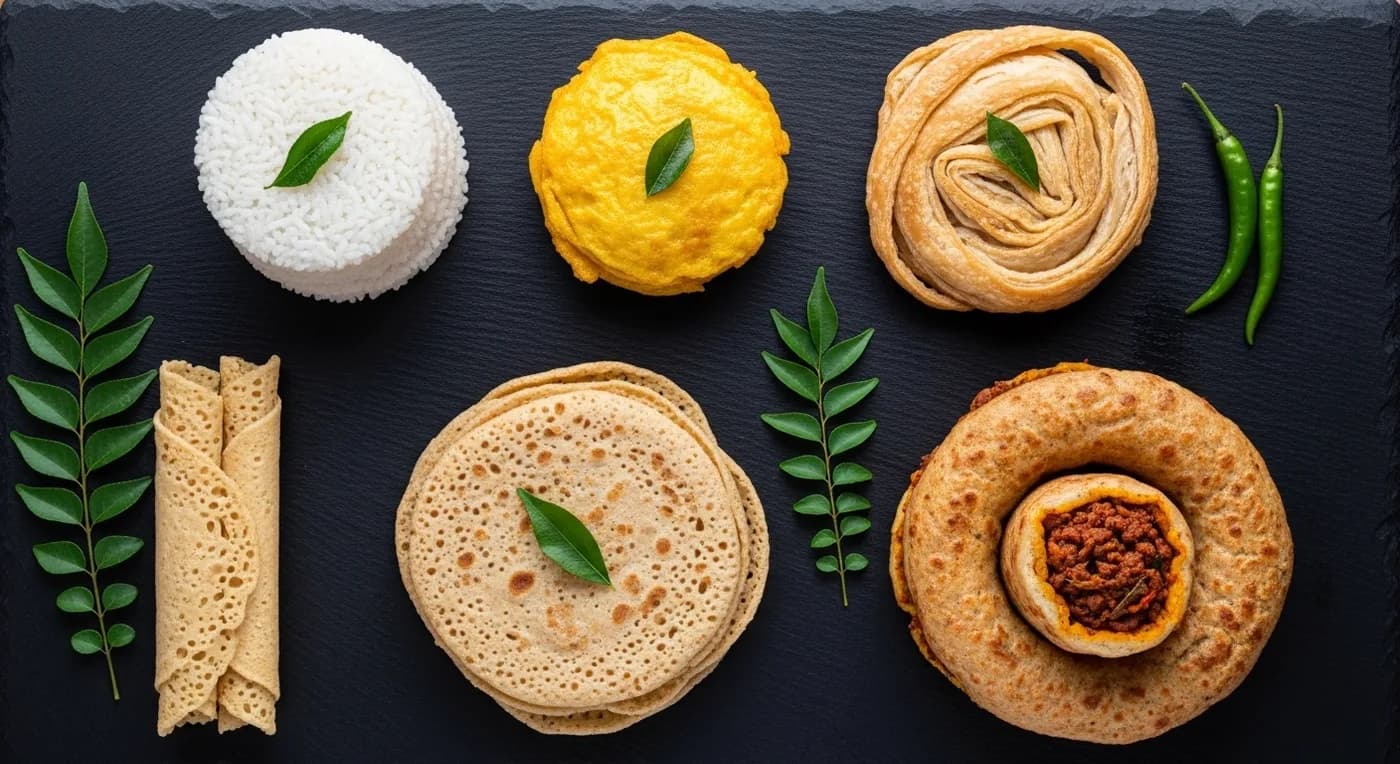
Pathiri is the signature Malabar flatbread — thin, soft, made from finely ground rice flour, and unlike anything in the wheat-based North Indian bread tradition. At weddings, pathiri appears in several varieties, and each requires dedicated skill to produce in large quantities:
- Plain Pathiri — Paper-thin rice flatbread, the classic accompaniment to mutton curry. The defining pairing of the Malabar feast.
- Mutta Pathiri (Egg Pathiri) — Enriched with egg for a richer texture and golden colour. Slightly thicker, slightly more indulgent.
- Nei Pathiri (Ghee Pathiri) — Brushed with ghee, layered and flaky. Often served as a standalone item rather than a curry vehicle.
- Irachi Pathiri (Stuffed Meat Pathiri) — Rice flour encasing a spiced minced meat filling. A labour-intensive preparation that marks a premium menu — essentially a Malabar meat pie.
- Porotta — Flaky, layered wheat flatbread. Not traditionally Malabar but now standard at most wedding menus, particularly popular with younger guests who pair it with chicken roast.
Tip
Pathiri Staffing: Making pathiri in large quantities requires a dedicated pathiri squad — experienced cooks who can roll and cook hundreds of perfectly round, uniformly thin pathiris in the hours before service. When evaluating caterers, ask specifically about their pathiri preparation team. A caterer who outsources this or uses machine-made pathiri will deliver a noticeably inferior product.
Meat Preparations: The Heart of the Feast
The variety and quality of meat dishes at a Malabar wedding is where the caterer truly earns their fee. The menu is deliberately constructed to offer contrasting textures and flavour profiles:
- Chicken Roast (Kozhi Porichathu) — Deep-fried chicken finished in a thick onion-tomato masala with curry leaves and Malabar spices. The exterior shatters, the interior stays juicy. The most universally loved dish at the table.
- Mutton Curry (Erachi Curry) — Slow-cooked mutton in a rich coconut-based gravy, aromatic with fennel and black pepper. This is the traditional companion to pathiri — many families consider this pairing the soul of the entire feast.
- Chicken Curry — A lighter, coconut-milk-based curry that balances the richer preparations. Often mildly spiced to suit all palates.
- Mutton Fry (Erachi Ularthiyathu) — Dry-fried mutton with shallots, curry leaves, ginger, and coarse-ground spices. Intensely flavoured, almost chewy, and universally fought over. Every table runs out of this first.
- Beef Preparations — In Malappuram, Kozhikode, and much of North Malabar, a beef dish is considered essential. Beef Ularthiyathu (dry-roasted beef with coconut slivers) or Beef Curry served with raw banana chips is a crowd favourite. Coastal families in Thalassery and Kannur sometimes substitute with a beef pepper fry.
A standard menu includes 3–4 meat dishes. Premium menus extend to 5–6, often adding a lamb shank preparation or a bone-in mutton roast that functions as a centrepiece.
Seafood: The Coastal Distinction
In coastal areas — Kozhikode city, Thalassery, Kannur, Ponnani, and Kasaragod — fish takes a prominent place alongside the meat dishes, adding a dimension that inland menus lack:
- Meen Curry (Fish Curry) — A sour, tangy gravy made with kudampuli (Malabar tamarind), typically featuring seer fish (neymeen) or kingfish. The acidity cuts through the richness of the biryani beautifully.
- Meen Porichathu (Fish Fry) — Marinated in a vibrant red chilli-turmeric-garlic paste and shallow-fried until crisp. Seer fish and kingfish are preferred for their firm, flavourful flesh.
- Prawn Preparations — At premium coastal weddings, prawn curry or prawn fry appears as an additional item. Fresh tiger prawns from Kozhikode or Kannur, when in season, elevate a menu from excellent to memorable.
However, adding seafood to the menu increases the per-plate cost by ₹100–250 depending on the variety and freshness of fish sourced.
Sides and Accompaniments
Every Malabar wedding table includes a supporting cast of sides that round out the meal:
- Pappadam — Crisp lentil wafers, always served fresh-fried.
- Pickle (Achar) — Mango pickle, lime pickle, or a mixed vegetable pickle. Often homemade by the family.
- Raita — Yoghurt with cucumber and onion, offering cool relief between spiced dishes.
- Cutlets and Samosas — Served as starters or alongside the main spread. Meat cutlets with a breadcrumb exterior are universal at Malabar weddings.
- Salad — Simple onion-cucumber-tomato salad with a squeeze of lime. Modest but essential.
Desserts: The Sweet Finale
The dessert spread at a Malabar wedding is extensive and includes several preparations rarely found outside the community:
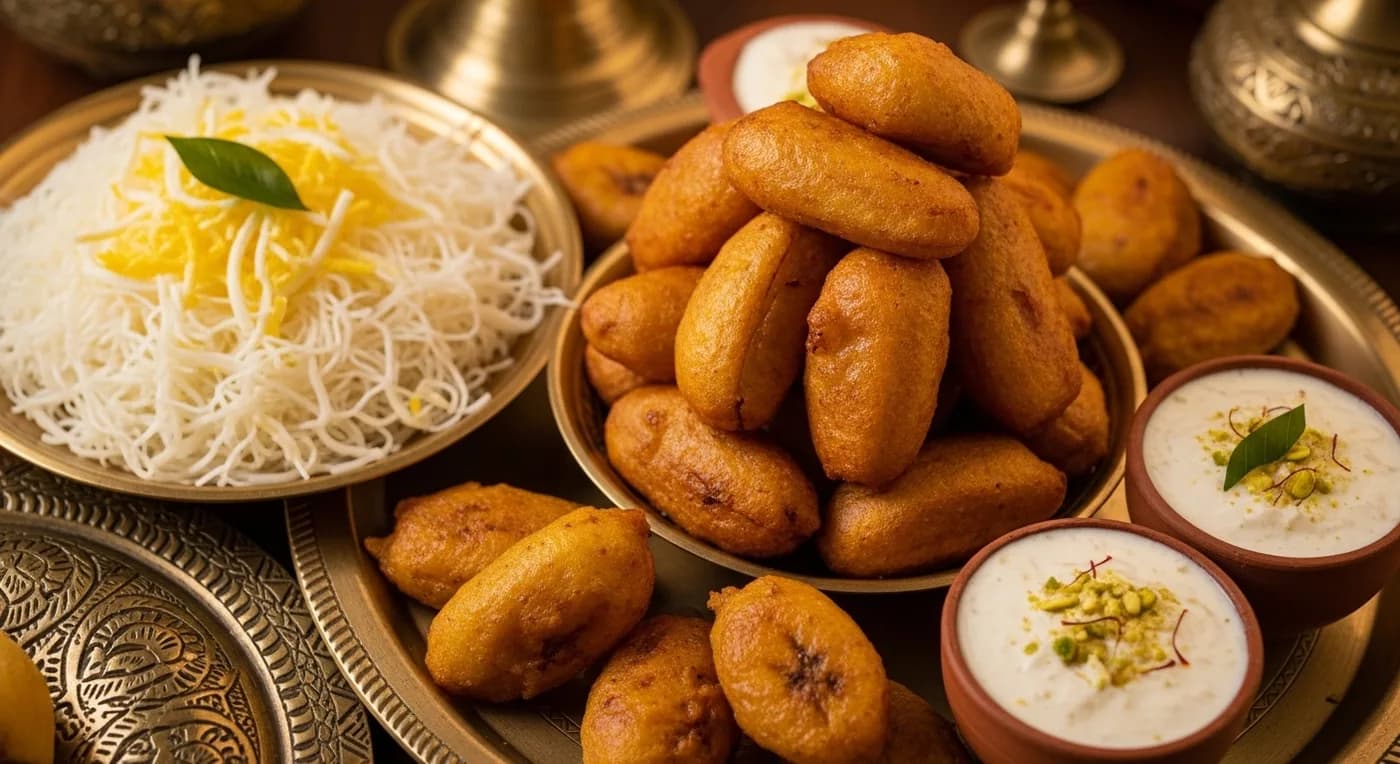
- Muttamala and Pinjanathappam — The signature Malabar wedding dessert pairing. Muttamala consists of delicate egg-yolk threads drizzled in sugar syrup, served atop Pinjanathappam, a steamed egg pudding with subtle cardamom flavour. Together, they are unmistakably Malabar — and many guests judge a wedding's authenticity by the quality of this single item.
- Unnakkaya — Ripe banana stuffed with a sweet mixture of cashews, raisins, and sugar, coated in a rice flour batter and deep-fried. Rich, fragrant, and deeply traditional.
- Pazham Nirachathu (Stuffed Banana) — Similar to Unnakkaya but with variations in filling and presentation. A Malabar speciality that appears almost exclusively at weddings and festivals.
- Firni — Chilled rice-flour pudding set in earthen bowls, flavoured with cardamom and topped with slivered almonds and pistachios.
- Halwa Varieties — Ghee-rich halwa in several forms: Karachi halwa (translucent and chewy), wheat halwa, and seasonal fruit halwa.
- Fruit Salad with Ice Cream — A modern addition that has become nearly universal, offering a cool, light contrast to the rich main course.
Beverages: From Welcome to Farewell
- Welcome Drinks — Rose sherbet, fruit punch, or fresh lime soda served as guests arrive. Increasingly, families offer a dedicated welcome drink station with 3–4 options.
- Fruit Juices — Mango, pineapple, and mixed fruit juices served throughout the meal.
- Water — Chilled water, often served in traditional copper tumblers at premium weddings.
- Sulaimani Chai — Sweet, spiced black tea with a hint of lime, served as the traditional digestif. No guest leaves a Malabar wedding without their glass of Sulaimani. This is the full stop to the meal — warm, fragrant, and final. Its absence would be noticed and remarked upon.
How Are Modern Additions Reshaping the Malabar Wedding Menu?
Live shawarma counters, dessert bars, and mocktail stations are gaining traction — but should never consume more than 15–20% of your catering budget. While the traditional core remains non-negotiable at most Malabar weddings, 2026 has brought a wave of modern additions that complement rather than replace the classics. Families across Kozhikode, Ernakulam, and Thrissur are increasingly incorporating these elements:
Live Counters
- Live Biryani Station — Biryani served from a copper vessel by the chef, allowing guests to request specific portions (more gravy, extra fried onions, a bone piece). Theatrical and practical.
- Shawarma Counter — Arguably the most popular modern addition at Malabar weddings. A dedicated counter with chicken and mutton shawarma, often styled with a vertical rotisserie for visual impact. Guest traffic at this counter frequently rivals the main serving line.
- Grill Station — Tandoori chicken, seekh kebabs, and grilled fish served fresh off the grill. Particularly popular at outdoor or semi-outdoor venues.
Dessert Stations
- Ice Cream Bar — Multiple flavours with toppings, cones, and cups. Replaces the traditional single-flavour fruit salad with ice cream at premium weddings.
- Halwa and Mithai Counter — An expanded selection beyond the traditional 2–3 varieties, sometimes including North Indian sweets like gulab jamun, jalebi, and rabdi alongside Malabar classics.
- Live Crepe or Waffle Station — A contemporary addition gaining traction at high-budget urban weddings in Kochi and Kozhikode.
Welcome Drink Bars
- Mocktail Station — Freshly prepared non-alcoholic cocktails with fruit garnishes. Positioned near the entrance for immediate guest engagement.
- Fresh Juice Bar — Pressed juices, coconut water, and traditional sherbet options.
Important
Balance is Everything: Modern additions should complement the traditional menu, not compete with it. If your shawarma counter draws more traffic than the biryani service, something has gone wrong in proportioning. Allocate no more than 15–20% of your catering budget to live counters and modern stations. The biryani, pathiri, and meat preparations must remain the centrepiece.
What Does Each Menu Tier Cost Per Plate in 2026?
Standard menus run ₹800–1,000 per plate, premium menus ₹1,000–1,200, and luxury menus ₹1,200–1,500 — but regional location can shift these numbers by 15–25%. Catering costs vary meaningfully by menu complexity and geography. The following table provides realistic 2026 pricing for a 600-guest Malabar wedding feast.
| Menu Tier | Dishes | Per Plate | Total (600 guests) | Best For |
|---|---|---|---|---|
| Standard | 15–18 items: biryani, neychoru, 2 pathiri types, 3 meat dishes, 3 sides, 3 desserts, Sulaimani | ₹800–1,000 | ₹4.8–6L | Budget-conscious families, community-managed cooking |
| Premium | 18–22 items: biryani, neychoru, 3 pathiri types, 4–5 meat dishes, fish curry, 4 sides, 4–5 desserts, live counter, Sulaimani | ₹1,000–1,200 | ₹6–7.2L | Most Malabar weddings, professional caterers |
| Luxury | 22–25+ items: dual biryani, neychoru, 4 pathiri types, 5–6 meat dishes, 2 seafood items, expanded sides, dessert station, shawarma counter, welcome drinks, Sulaimani | ₹1,200–1,500 | ₹7.2–9L | Premium celebrations in Kozhikode, Kochi |
Regional Price Variations
| Region | Price Adjustment | Notes |
|---|---|---|
| Kozhikode city | Baseline | The gold standard for Malabar catering. Highest concentration of established caterers. |
| Malappuram | 5–10% below Kozhikode | Higher volume, competitive pricing. Community kitchens can reduce costs further. |
| Kannur / Thalassery | Comparable to Kozhikode | Seafood-heavy menus may cost slightly more during monsoon when fish prices spike. |
| Kasaragod | 10–15% below Kozhikode | Smaller-scale operations, fewer premium caterers. Some families hire from Kozhikode. |
| Kochi / Ernakulam | 10–20% above Kozhikode | Fewer specialised Malabar caterers locally. Travel charges from North Kerala add ₹20,000–50,000. |
| Thrissur | 5–15% above Kozhikode | Growing demand for Malabar catering, limited local supply. Most hire from Kozhikode or Malappuram. |
| Trivandrum | 15–25% above Kozhikode | Very few local Malabar caterers. Almost all authentic catering requires North Kerala teams with full travel setup. |
Note
The Travel Premium: Families in Kochi, Thrissur, and Trivandrum who want authentic Malabar catering should budget an additional ₹20,000–50,000 for caterer travel, accommodation, and equipment transport. This covers the team's transit, temporary cooking setup, and the logistics of sourcing Kaima rice and specific spices that may not be locally available in the same quality.
Looking for Caterings in Kozhikode?
Tell us what you need and get quotes from verified caterings
What Vegetarian and Multi-Cuisine Options Suit a Mixed Guest List?
For weddings with 15–20%+ vegetarian guests, a dedicated vegetarian station with separate utensils costs ₹150–300 per vegetarian guest and prevents any cross-contamination concerns. Malabar wedding feasts are fundamentally meat-centric, but modern guest lists increasingly include vegetarian guests, guests from other communities, and international attendees. Planning for dietary diversity without compromising the core Malabar experience requires thought:
Standard Vegetarian Additions
Most Malabar caterers include 3–4 vegetarian sides as standard — avial, thoran, sambar, and a dal preparation. For weddings with a significant vegetarian contingent (more than 15–20% of guests), consider expanding:
- Vegetarian Biryani or Ghee Rice — A dedicated vegetable biryani using the same Kaima rice and spice profile, or a ghee rice with paneer, lets vegetarian guests participate in the central dish of the feast.
- Avial — Mixed vegetables in a coconut-yoghurt gravy. A Kerala classic that bridges communities.
- Olan — White pumpkin and cowpeas in coconut milk. Mild, elegant, and distinctly Kerala.
- Thoran — Dry stir-fried vegetables with grated coconut. Multiple varieties (beans, cabbage, carrot) add colour and nutrition.
- Sambar and Rasam — Traditional lentil-based preparations that are universally loved.
- Paneer Preparation — Paneer butter masala or kadai paneer for guests accustomed to North Indian vegetarian cuisine.
Dedicated Vegetarian Station
For weddings expecting a large vegetarian contingent — common when the guest list includes the couple's professional network or friends from non-Muslim communities — a dedicated vegetarian station with separate serving utensils is the most respectful approach. This costs an additional ₹150–300 per vegetarian guest and eliminates any concern about cross-contamination for strict vegetarian or Jain guests.
Multi-Cuisine Elements
Meanwhile, some families add a small multi-cuisine section alongside the Malabar core — a Chinese counter (Gobi Manchurian, fried rice, noodles), a chaat station, or a pasta counter. These typically serve 10–15% of the total guest count and add ₹50,000–1,50,000 to the overall budget depending on the variety offered.
How Do You Select the Right Caterer for a Malabar Wedding?
The caterer you choose shapes your budget, your venue requirements, and ultimately what 700 guests remember about the day. Choosing the right caterer is the most consequential vendor decision in your wedding planning process. Here is a structured approach:
The Tasting Process
Never book a caterer without a tasting session. Additionally, verify that your caterer holds a valid FSSAI food licence — mandatory for any commercial catering operation serving more than 100 guests under the Food Safety and Standards Act, 2006. Most established Malabar caterers offer a dedicated tasting for serious enquiries, typically for ₹3,000–8,000 (often adjusted against your final invoice). Here is how to approach it:
- Shortlist 3–4 caterers based on referrals from recently married families in your community. Word of mouth is the most reliable signal in this market.
- Schedule tastings at least 4–6 months before the wedding. During peak season, popular caterers may limit tasting availability.
- Taste the biryani first. This is the defining dish. Evaluate the rice (Kaima, not basmati), the meat quality, the spice balance, and the dum technique. If the biryani fails, move to the next caterer.
- Evaluate pathiri quality. Taste the plain pathiri — it should be thin, soft, and not rubbery. Machine-made pathiri is immediately detectable and unacceptable at a Malabar wedding.
- Try the mutton curry. This is the second most scrutinised dish. Check the coconut gravy consistency, the tenderness of the meat, and the fennel-pepper balance.
- Sample desserts. Muttamala should be delicate, not chewy. Unnakkaya should be freshly fried, not reheated.
Questions to Ask Every Caterer
- How many wedding events of 500+ guests have you handled in the past 12 months?
- Who is the biryani master assigned to our event? (The individual matters — experienced caterers have named specialists.)
- Where do you source Kaima rice? (Quality varies significantly by supplier.)
- Do you bring your own cooking equipment, or do you rely on the venue kitchen?
- How large is your pathiri preparation team?
- What is your serving staff ratio per 200 guests?
- How do you handle batch rotations for 600+ guests?
- What is included in the per-plate price, and what carries additional charges? (Starters, welcome drinks, and live counters are often quoted separately.)
- What is your cancellation and date-change policy?
- Do you provide separate vegetarian preparation with dedicated utensils?
Red Flags
- No tasting offered. Any caterer unwilling to let you taste before booking is not confident in their food.
- Vague staffing commitments. "We will bring enough staff" is not an answer. You need specific numbers.
- Generic biryani. If the tasting biryani uses basmati rice instead of Kaima, the caterer does not specialise in Malabar cuisine.
- No named biryani master. At this scale, the individual cooking the biryani matters. Generic rotation staffing produces inconsistent results.
- Unusually low pricing. A per-plate quote significantly below ₹800 for a full Malabar menu in 2026 suggests compromises on ingredient quality — particularly meat sourcing and rice grade.
Looking for Caterings in Malappuram?
Tell us what you need and get quotes from verified caterings
How Do You Serve 500–1,000 Guests Without Chaos?
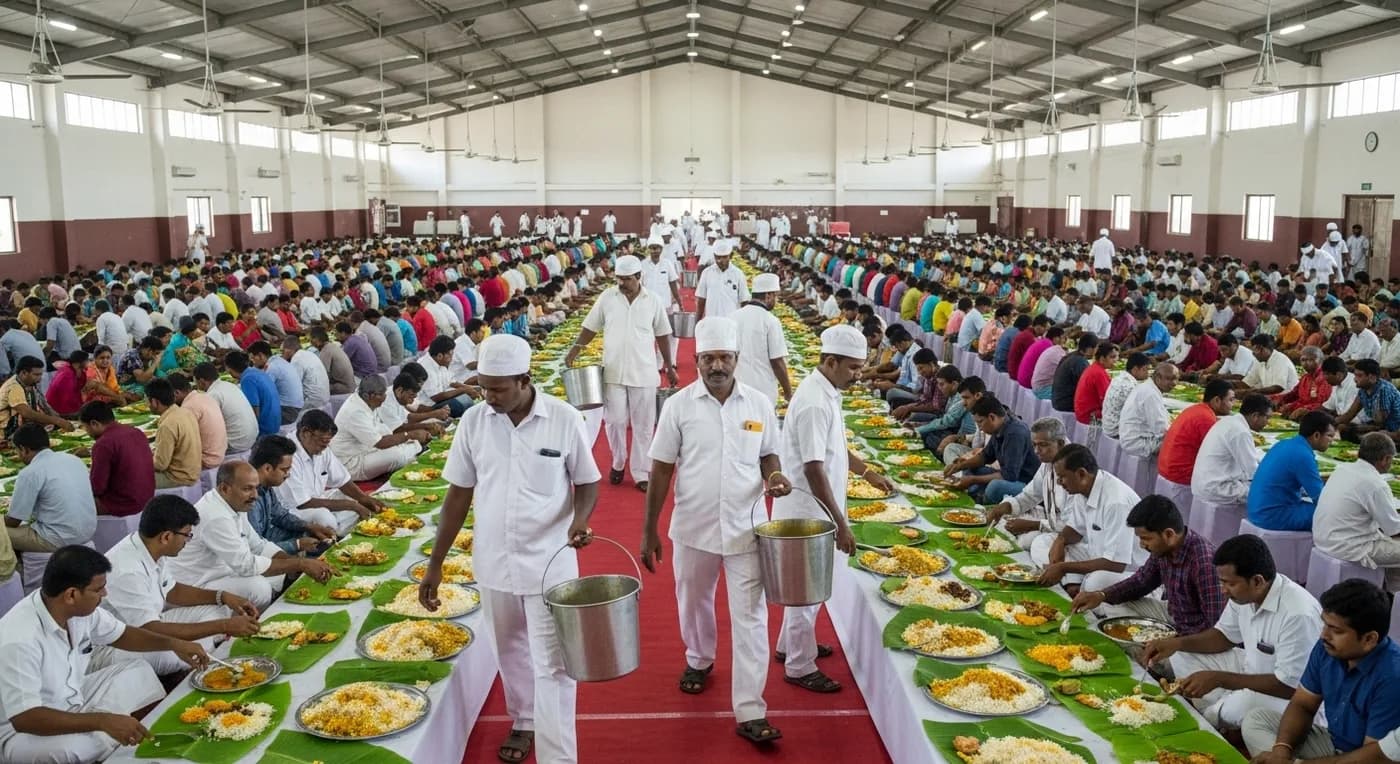
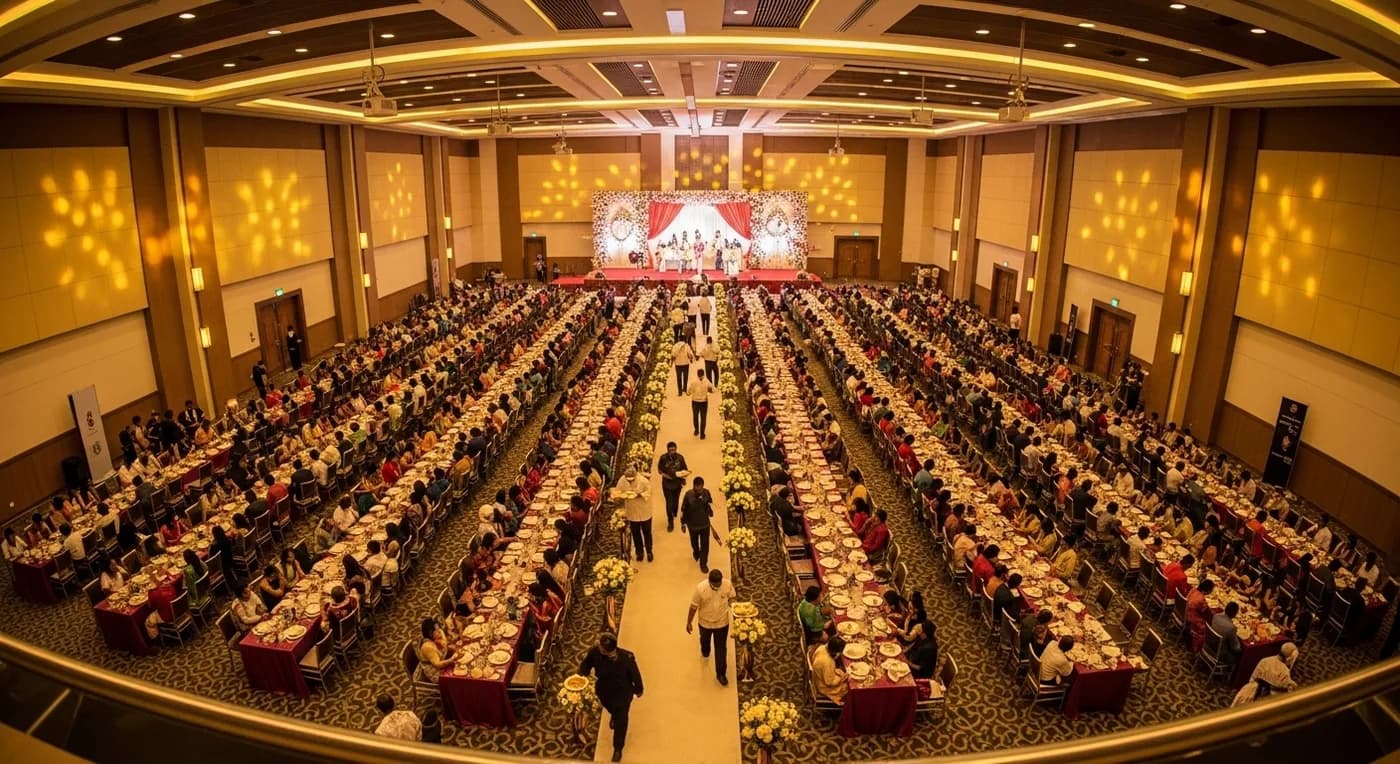
The traditional Malabar panthi (batch rotation) system seats 150–250 guests per rotation, completing a 600-guest Walima in 3–4 batches over 2–3 hours. The logistics of serving a Malabar feast to 500–1,000 guests is a discipline in itself. Even the finest food becomes a source of frustration if the serving operation breaks down. Here is how experienced caterers and families manage it.
The Batch Rotation System (Panthi)
The traditional Malabar panthi (batch) system is the most efficient way to serve large gatherings:
- Batch size: 150–250 guests per rotation, depending on seating capacity.
- Rotations: 3–4 batches for a 600-guest event, 4–5 for 800–1,000 guests.
- Time per batch: 20–30 minutes from seating to completion. Malabar guests eat efficiently — this is not a leisurely dining experience but a communal, purposeful meal.
- Transition time: 10–15 minutes between batches for clearing, resetting banana leaves or plates, and resetting the serving line.
- Total serving window: 2–3 hours for most Malabar weddings.
Staffing Requirements
The serving staff ratio directly determines guest experience:
| Guest Count | Serving Staff | Kitchen Staff | Service Managers |
|---|---|---|---|
| 300–500 | 25–35 | 15–20 | 1–2 |
| 500–700 | 35–50 | 20–30 | 2–3 |
| 700–1,000 | 50–70 | 30–40 | 3–4 |
| 1,000+ | 70+ | 40+ | 4+ |
These numbers include servers, clearing staff, drink service, and counter attendants. The service managers are critical — they coordinate batch timing, manage the queue, and ensure that every batch receives the same quality and quantity of food.
Serving Format Decisions
Banana Leaf (Traditional Seated): The most authentic Malabar experience. Guests sit in rows, and servers move through the hall placing dishes on individual banana leaves in a specific order. This requires the most staff but delivers the most controlled, traditional experience. Best for families with strong community volunteer networks.
Buffet Lines: More common at convention centre weddings in urban Kozhikode, Kochi, and Malappuram town. Multiple parallel buffet lines (minimum 2 for 500 guests, 3–4 for 800+) reduce wait times. The biryani is typically served by staff from behind the counter to control portions and ensure even distribution.
Hybrid: The increasingly popular choice — biryani and the main course served seated (panthi style), with starters, desserts, and live counters available at buffet stations. This preserves the traditional feast experience while offering modern variety.
Flow Management Tips
- Stagger arrival times. Mention specific arrival windows on the invitation for different guest groups — family at 12:00, community guests from 12:30, general guests from 1:00. This naturally distributes the crowd across batches.
- Position the welcome drink station near the entrance, away from the dining hall. This creates a natural holding area while the current batch finishes.
- Designate family coordinators for each batch. In the Malabar Kalyana Samithi (wedding committee) tradition, 4–6 family members should be assigned exclusively to dining hall management — guiding guests to seats, signalling when a batch is ready, and ensuring smooth transitions.
- Brief the venue on timing. The convention centre or hall staff needs to know your batch schedule. Coordinate air conditioning, lighting transitions, and parking management with the dining timeline.
- Plan the Sulaimani service separately. Sulaimani chai should be served at a dedicated station outside the main dining area, allowing guests who have finished eating to collect their tea without blocking the exit flow.
Tip
The 10% Buffer Rule: Always confirm your caterer's per-plate count at 10–15% above your confirmed guest list. Malabar weddings consistently see walk-in guests — neighbours, extended community members, and acquaintances who attend without formal invitation. Running out of biryani is a social catastrophe that no amount of planning can recover from. For more strategies on managing large guest lists, see our Kerala Muslim Wedding Guest Management guide.
How Should You Structure Your Total Catering Budget?
For a 600-guest Walima, plan ₹5.5–14 lakh depending on your menu tier — and do not forget the Mailanchi dinner, welcome drinks, and service overtime. Here is a complete catering budget framework for a Malabar Muslim wedding, covering the Walima feast as the primary catering event. Some families also cater a lighter meal for the Mailanchi night and a simple lunch for close family on the Nikah day — factor those in if applicable.
| Budget Component | Standard (600 guests) | Premium (600 guests) | Luxury (600 guests) |
|---|---|---|---|
| Main feast (per plate x guests) | ₹4.8–6L | ₹6–7.2L | ₹7.2–9L |
| Live counters (shawarma, grill) | — | ₹40,000–80,000 | ₹80,000–1.5L |
| Welcome drinks station | ₹15,000–25,000 | ₹25,000–50,000 | ₹50,000–1L |
| Dessert station upgrade | — | ₹30,000–60,000 | ₹60,000–1.2L |
| Mailanchi night (light dinner, 200 guests) | ₹40,000–60,000 | ₹60,000–1L | ₹1–1.5L |
| Caterer travel (if out-of-district) | — | ₹20,000–35,000 | ₹35,000–50,000 |
| Service staff overtime (if event extends) | ₹10,000–20,000 | ₹15,000–30,000 | ₹25,000–50,000 |
| Total Catering Budget | ₹5.5–7L | ₹7.5–10L | ₹10–14L |
For a comprehensive cost breakdown covering all wedding expenses, see our Muslim Wedding Cost Kerala guide. To evaluate venues with adequate kitchen facilities for your caterer's requirements, read our venue guide.
Common Questions About Muslim Wedding Catering in Kerala
How much does Muslim wedding catering cost per plate in Kerala?
Expect ₹800–1,500 per plate depending on menu complexity and your caterer's standing. A professional caterer serving the standard 18–20 dish spread with Kaima rice biryani lands at ₹900–1,200 per plate in most Malabar districts. For a 600-guest Walima, that translates to ₹5.4–7.2 lakh before add-ons like live counters and welcome drinks. Community-managed cooking in Malappuram can drop rates to ₹600–800 per plate.
What dishes are served at a Malabar Muslim wedding?
The centrepiece is always Thalassery biryani made with Kaima rice — never basmati. Alongside sit multiple pathiri varieties, neychoru with roast preparations, and 3–5 meat dishes including chicken roast, mutton curry, and beef ularthiyathu. Specifically, coastal weddings add fish curry and prawn preparations. Desserts feature the signature Muttamala-Pinjanathappam pairing, Unnakkaya, and Firni, with Sulaimani chai closing every meal.
How do you serve food to 500–1,000 guests at a Muslim wedding?
The panthi batch rotation system seats 150–250 guests per round, with each batch eating in 20–30 minutes. A 600-guest Walima runs 3–4 rotations over 2–3 hours. You need 35–50 serving staff and 2–3 service managers for 500–700 guests. For example, staggering arrival times and positioning a welcome drink station near the entrance creates a natural holding area between batches.
Should I hire a Kozhikode caterer for my wedding in Kochi?
The quality difference is genuine — Kozhikode and Thalassery caterers bring superior Kaima rice sources, named biryani masters, and deep experience with 500+ guest feasts. However, factor in ₹20,000–50,000 for travel, accommodation, and equipment transport. Confirm the caterer has handled off-site events at your venue's scale before, and ask for references from recent out-of-district events.
What vegetarian options work at a Malabar wedding feast?
Standard Malabar menus include 3–4 vegetarian sides — avial, thoran, sambar, and dal. For weddings with over 15% vegetarian guests, add a dedicated vegetarian biryani station with separate utensils at ₹150–300 per vegetarian guest. Additionally, a sadya-style banana leaf option works well as a parallel track for Hindu and Jain guests who prefer the familiar format.
Further Reading
Explore more guides in our Muslim wedding planning series:
- Muslim Wedding Kerala Planning Guide — The complete planning playbook covering budgets, venues, vendors, and timelines.
- Malabar Muslim Nikah Guide — Nikah rituals, Oppana traditions, Mailanchi customs, and bridal styling.
- Muslim Wedding Cost Kerala — Full cost breakdown across every category for 2026.
- Muslim Wedding Venues Kerala — Venue selection, capacity planning, and kitchen requirements for large-scale feasts.
- Kerala Muslim Wedding Guest Management — Strategies for managing 500–1,000+ guest lists with the Kalyana Samithi system.
- Kerala Wedding Catering: Sadya vs Buffet — How Malabar catering compares to traditional sadya and multi-cuisine formats.
Tip
Planning your Malabar wedding feast? Use our Cost Calculator to estimate your total catering budget based on guest count and menu tier. Browse verified caterers in your district to start your shortlist, and generate a personalised planning timeline with our AI Wedding Checklist.
Topics
Muslim wedding catering KeralaMalabar wedding foodThalassery biryani weddingMuslim wedding menu KeralaWalima feast planningExplore more
Frequently Asked Questions
1How much does Muslim wedding catering cost per plate in Kerala?
2What dishes are served at a Malabar Muslim wedding?
3How do you serve food to 500-1000 guests at a Muslim wedding?
4Should I hire a Kozhikode caterer for my wedding in Kochi?
5What vegetarian options work at a Malabar wedding feast?
Continue reading
Related Articles
Kerala Muslim Wedding: Managing 500+ Guests
Muslim Wedding Cost in Kerala: Full Budget Breakdown for 2026
Muslim Wedding Venues Kerala: Best Halls & Pricing 2026
Best Season for South India Destination Weddings: Month-by-Month Western Ghats Guide
Destination Wedding Cost in South India 2026: 5-Tier Budget Guide
Destination Wedding in South India: Complete 2026 Planning Guide
Still planning?
Get quotes from India's best vendors
Tell us what you're planning and we'll match you with verified photographers, venues, decorators, and more.
Get free quotes