
Muslim Wedding in Karnataka: Nikah Traditions in Bangalore
Muslim wedding guide for Karnataka — Deccani-influenced Nikah ceremony, Meher traditions, Mehndi nights, and Walima feast customs in Bangalore in 2026.

On this page
Karnataka Muslim weddings combine the Islamic Nikah contract with distinctive Deccani influences — Urdu-Kannada bilingual traditions, a biryani-centric feast from the Hyderabad-Bijapur corridor, and Mehndi nights blending South and North Indian elements. Key ceremonies are Mangni (engagement), Mehndi night, the Nikah itself, and the Walima feast hosted by the groom's family the following day.
Quick Answer
Quick answer: Karnataka Muslim weddings combine the Islamic Nikah contract with distinctive Deccani influences — Urdu-Kannada bilingual traditions, a biryani-centric feast from the Hyderabad-Bijapur corridor, and Mehndi nights blending South and North Indian elements. Key ceremonies are Mangni (engagement), Mehndi night, the Nikah itself, and the Walima feast hosted by the groom's family the following day.
Note
Pricing methodology: Cost ranges in this guide are based on vendor pricing data from the itsmy.wedding marketplace and published industry reports, collected in Q4 2025 – Q1 2026.
With Karnataka ranking among India's top states by GDP and Bangalore's cosmopolitan Muslim community growing rapidly, the city has become a major market for premium Islamic wedding celebrations. The Karnataka State Board of Auqaf (Wakf Board) oversees many of the community institutions that play a role in Muslim weddings across the state. The All India Muslim Personal Law Board provides guidance on Nikah practices and family law that shapes how weddings are conducted in Karnataka and beyond. Muslim weddings in Karnataka blend the universal principles of Islamic marriage — the Nikah contract, the Meher (mandatory bridal gift), and the Walima (reception feast) — with the distinctive Deccani cultural influences that define the region's Muslim community. The result is a celebration that is different from both the Lucknowi grandeur of North Indian Muslim weddings and the Mappila traditions of Kerala, carrying its own Urdu-Kannada bilingual character, a biryani-centric feast drawn from the Hyderabad-Bijapur corridor, and a growing contemporary wedding culture in Bangalore's expanding Muslim middle class.
Whether your family's roots are in the Deccani traditions of North Karnataka, the Nawayath community of the coastal belt, or Bangalore's cosmopolitan Muslim neighbourhoods, this guide covers every element of planning a Muslim wedding in Karnataka — from the Mehndi night to the Nikah, the Walima, and the practicalities of venues, catering, and budget. For a comprehensive overview of all wedding traditions in the city, see our Bangalore wedding planning guide.
What Are the Pre-Wedding Celebrations?
How Does the Mangni (Engagement) Work?
The Mangni is the formal agreement between two families — in Bangalore's Muslim community, it has evolved from a simple family meeting into a more celebratory event. The Mangni (engagement) marks the beginning of the wedding journey. In Karnataka's Muslim community, the Mangni typically takes place at the bride's home or at a family gathering. Rings are exchanged, prayers are offered, and the families share sweets and refreshments. An elder — often a respected uncle or community leader — facilitates the introduction and discussion between the families. Modern Mangni celebrations increasingly feature printed or digital invitations sent well in advance, reflecting the growing formality of the event.
In Bangalore's Muslim community, the Mangni has evolved from a simple family meeting into a more celebratory event, sometimes held at a restaurant or small function hall with a modest guest list. However, its core function remains a formal declaration of intent — a commitment by both families to the marriage.
What Makes the Mehndi Night Special?
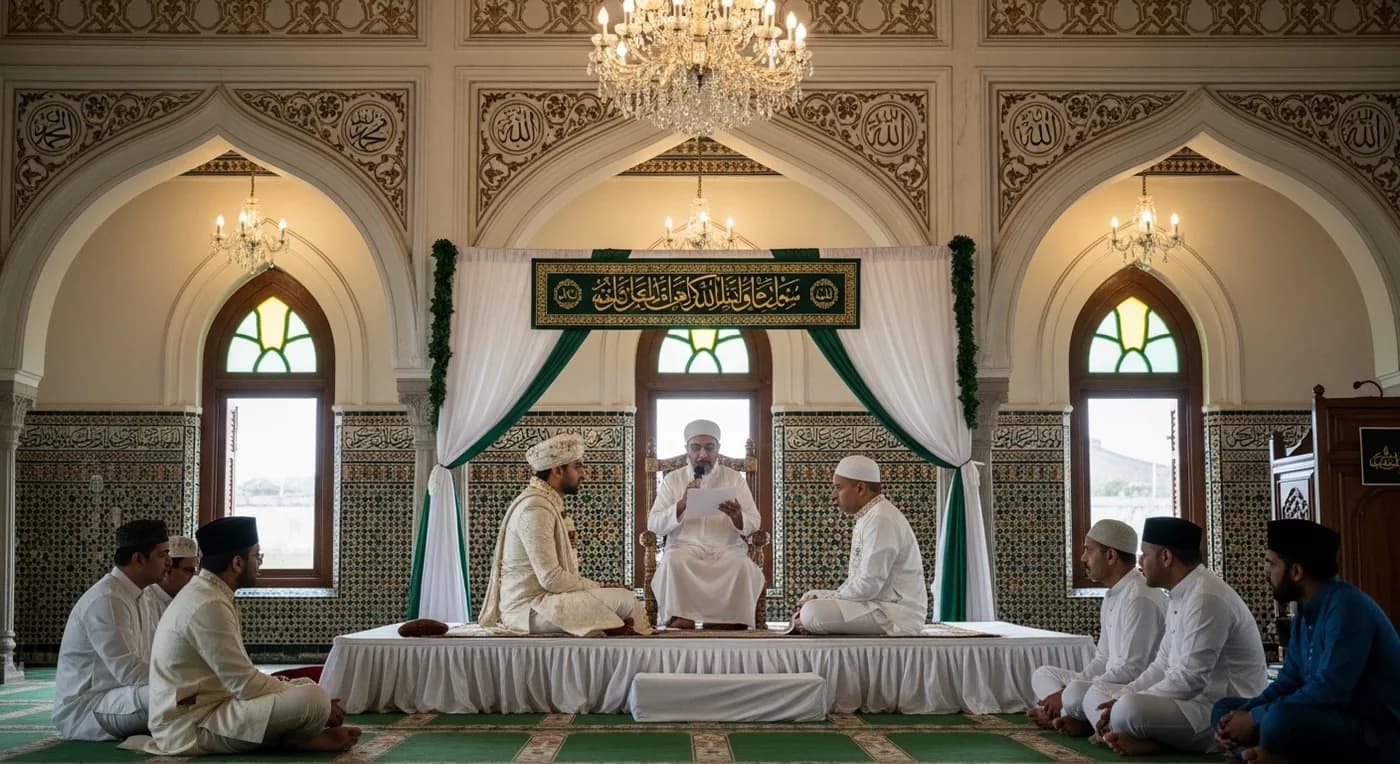
The Mehndi night has become a major event in its own right among Bangalore's Muslim families — themed decor, professional photography, and elaborate food spreads now rival the Walima in scale. The Mehndi (henna) night is one of the most vibrant pre-wedding events. Held one to three days before the Nikah, typically at the bride's home or a rented venue, the Mehndi celebration is the bride's evening — an occasion for the women of the family and close friends to gather, apply elaborate henna designs, sing, dance, and celebrate.
Karnataka's Mehndi nights carry a distinctive flavour. The music blends Bollywood hits with Deccani folk songs — qawwali and ghazal performances are common, and many families hire professional singers for the occasion. Our wedding entertainment cost guide for Bangalore covers pricing for live performers, DJs, and full Mehndi-night production. Having coordinated Mehndi nights at venues in Frazer Town and RT Nagar, I find the Deccani qawwali tradition gives these celebrations an energy that is unmistakably Bangalorean. The henna artists apply intricate designs that can take three to four hours, with the groom's name traditionally hidden within the pattern for him to find later.
Tip
For example, the Mehndi night has increasingly become a major event in its own right among Bangalore's Muslim families. Themed decor, professional photography, coordinated outfits for the bridal party, and elaborate food spreads have transformed it from an intimate family gathering into a full-scale celebration.
Do Karnataka Muslim Families Hold the Haldi / Ubtan?
Some Karnataka Muslim families hold an Ubtan ceremony — a turmeric-and-sandalwood application reflecting centuries of cultural cross-pollination between the state's Muslim and Hindu communities. The application of turmeric paste (and sometimes sandalwood) to the bride and groom at their respective homes is more common in families that have been established in Karnataka for generations.
How Does the Nikah Ceremony Proceed?
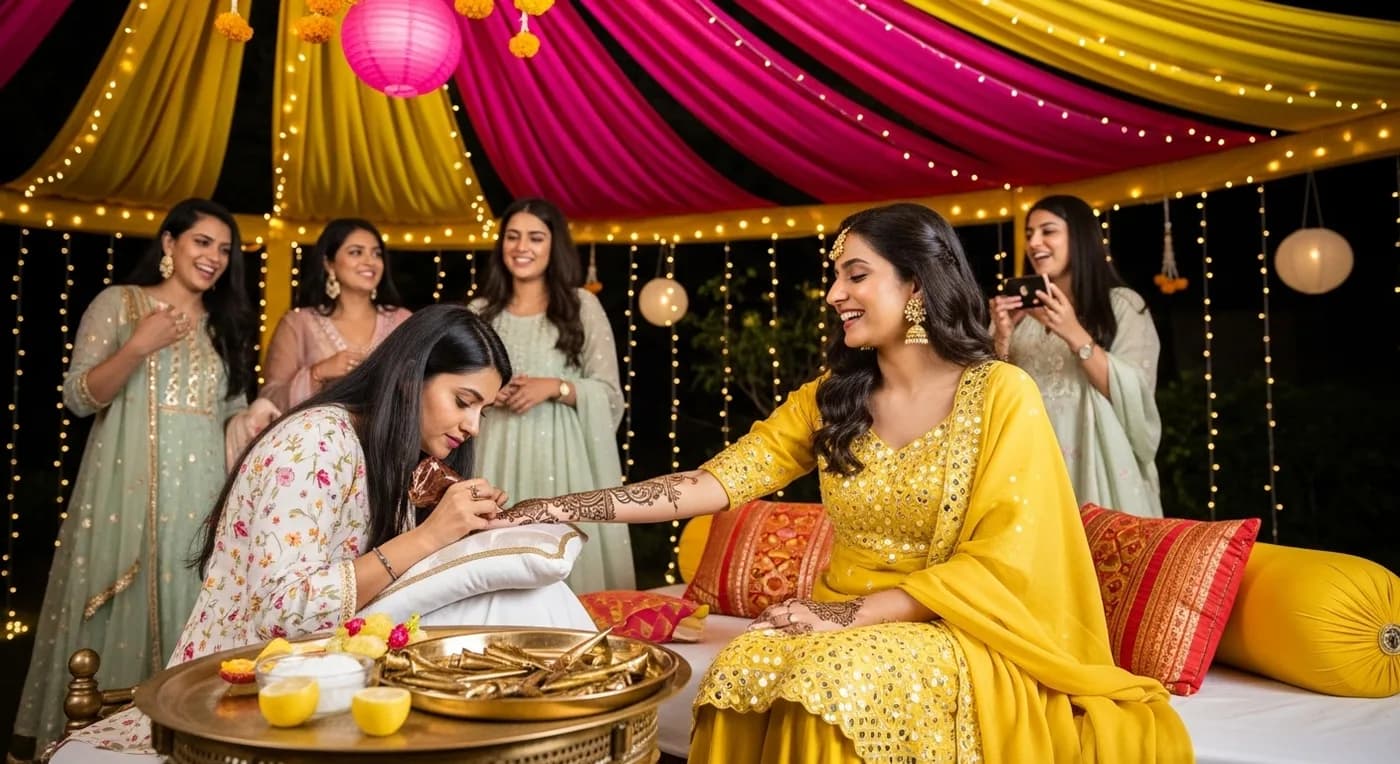
The Nikah is the Islamic marriage contract — the spiritual and legal heart of the wedding — and it can be completed in as little as 30 minutes while carrying profound significance.
Where Is the Nikah Typically Held?
The venue choice often depends on family tradition and guest count — mosque ceremonies carry the deepest spiritual resonance, while function hall setups offer more logistical flexibility. Speaking with Qazis in Bangalore, I find that families who hold the Nikah at a mosque and then move to a separate reception venue often describe it as the most spiritually meaningful approach. In Bangalore, many families conduct the Nikah at a mosque — particularly Jama Masjid in Shivajinagar, the Masjid-e-Khadria in Frazer Town, or the mosques along Mosque Road and Commercial Street — and then host the reception at a separate venue. Others set up a dedicated Nikah stage within the function hall, with the ceremony and celebration in one location.
The stage is typically decorated with flowers, fabric draping, and lighting. White, gold, and green are the most common colour schemes, and calligraphic verses from the Quran may adorn the backdrop. For detailed pricing on stage setup, floral arrangements, and lighting design, see our wedding decor cost guide for Bangalore.
What Is the Qazi's Role?
The Qazi verifies identities, confirms consent, ensures the Meher is agreed upon, and guides the couple through the sacred contract — all within the framework of Islamic jurisprudence. A Qazi (Islamic judge or scholar) officiates the Nikah. Under the Muslim Personal Law (Shariat) Application Act, the Nikah is both a religious ceremony and a legally recognised contract. From Nikah ceremonies I have attended in Shivajinagar, I can say that the Qazi's role goes beyond the legal formalities — they set the spiritual tone for the entire marriage. The Qazi verifies the identities of the bride and groom, confirms the consent of both parties, and ensures the Meher has been agreed upon. They recite verses from the Quran, deliver a brief sermon on the rights and responsibilities of marriage in Islam, and guide the couple through the contract.
How Is the Meher Decided?
The Meher in Bangalore's Muslim community typically includes both an immediate portion (gold jewellery) and a deferred cash amount, with the total varying from modest symbolic figures to several lakhs. The Meher (also spelled Mahr) is a mandatory gift from the groom to the bride, stipulated in the Nikah contract. It is the bride's exclusive right under Islamic law and cannot be waived by anyone on her behalf. In Bangalore's Muslim community, the Meher typically comprises two components: Meher-e-Muajjal (the immediate portion, given at the time of the Nikah — usually gold jewellery) and Meher-e-Muwajjal (the deferred portion, a cash amount promised for the future). The amount is discussed and agreed upon between the families before the ceremony day, and during the Nikah itself it is publicly announced before the assembled witnesses — the community bears witness to the groom's commitment, and the Qazi records it in the Nikah-nama.
Note
How Does the Ijab-e-Qubool (Offer and Acceptance) Work?
The groom responds "Qubool hai" three times in the presence of witnesses — this triple acceptance is the defining moment that seals the Nikah. This is the spiritual and legal climax of the ceremony. The Qazi asks the groom whether he accepts the bride as his wife, with the agreed Meher. The groom responds "Qubool hai" (I accept) — spoken three times. Two male witnesses (or one male and two female witnesses) attest to the acceptance. The bride's consent is confirmed separately — she may be present at the same stage or in a separate room, with her wakeel (representative) conveying her acceptance.
In modern Bangalore Nikah ceremonies, particularly among younger couples, the bride is increasingly present on the stage alongside the groom, and the Qubool is exchanged in each other's presence. This is a contemporary adaptation that many families welcome.
Signing the Nikah-nama
The Nikah-nama is both the religious record and the legal document of the marriage under Muslim Personal Law. The Nikah-nama (marriage contract) is signed by the bride, groom, and witnesses. This document is the legal record of the marriage under Muslim Personal Law and includes the Meher details, the names of witnesses, and the conditions agreed upon. The Qazi retains a copy, and the couple and their families receive theirs. Couples can also register the marriage through the Karnataka Kavivaha Mitra portal for additional legal documentation.
Dua (Prayers)
The ceremony concludes with collective Dua — prayers for the couple's happiness, prosperity, and faithfulness. The Qazi leads the prayer, and the assembled guests raise their hands in supplication. Dates and sweets are distributed — a Sunnah (prophetic tradition) that marks the conclusion of the Nikah.
What Is the Walima and What Should You Expect?
The Walima is a Sunnah practice — the Prophet Muhammad specifically encouraged it — making it a religious duty for the groom's family to host a meal and invite the community. The Walima is the reception feast, traditionally hosted by the groom's family on the day after the Nikah.
What Makes the Karnataka Walima Feast Distinctive?
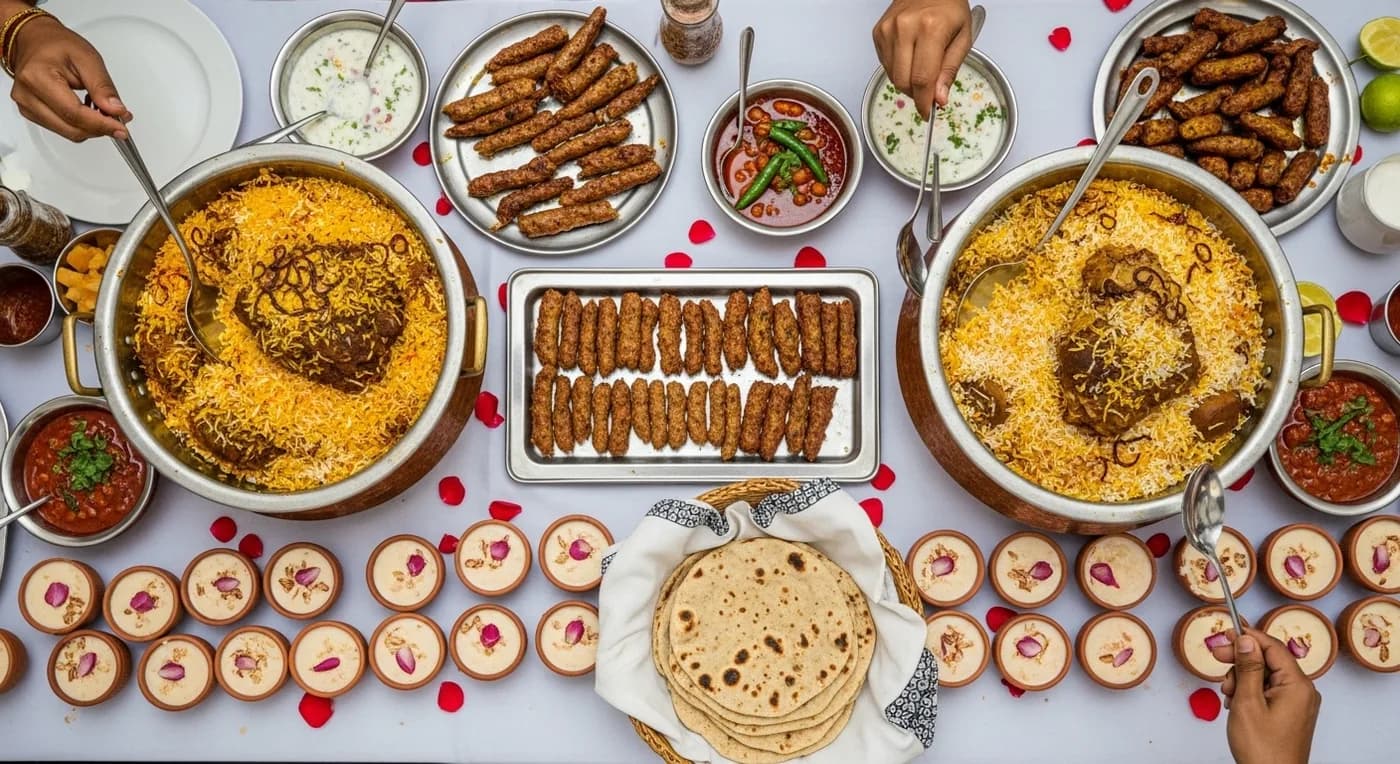
The centrepiece is Deccani-style dum biryani — richer, more intensely spiced, and heavier on saffron than its Lucknowi counterpart — and specialist Muslim caterers in Bangalore guard their family recipes closely. From the Walima receptions I have attended in Frazer Town and Shivajinagar, the biryani quality is the single metric by which guests judge the entire celebration. Reputable caterers in this belt hold FSSAI food safety licences and display their registration prominently. The Bruhat Bengaluru Mahanagara Palike (BBMP) also requires food business operators catering large events to comply with local health and trade licensing — something established caterers in the Shivajinagar-Frazer Town belt handle as a matter of course.
Deccani biryani is a dum preparation — layered rice and meat (mutton or chicken) slow-cooked in a sealed pot until the flavours merge. In Bangalore, specialist Muslim caterers maintain closely guarded biryani recipes that have been in their families for generations. Caterers in Shivajinagar tell me that the most common complaint from families is not about the quantity but about whether the biryani matches the standard their guests remember from other weddings in the community.
Beyond biryani, the Walima spread typically includes Haleem (a slow-cooked wheat and meat porridge, especially popular during the monsoon months), Shami kebabs, Seekh kebabs, Korma (rich, creamy meat curry), Rumali roti (paper-thin bread), and Phirni or Sheer Khurma for dessert. The food is abundant — generosity in feeding guests is a core Islamic wedding value.
However, guest counts at Karnataka Muslim Walimas are substantial. While the national average wedding hosts approximately 330 guests, Muslim celebrations in Karnataka regularly exceed this — three hundred to eight hundred guests is a common range, and large families in areas like Shivajinagar may host a thousand or more. The sheer scale of the feast requires experienced caterers who can manage volume without sacrificing quality.
What Do the Bride and Groom Wear?
The Bride
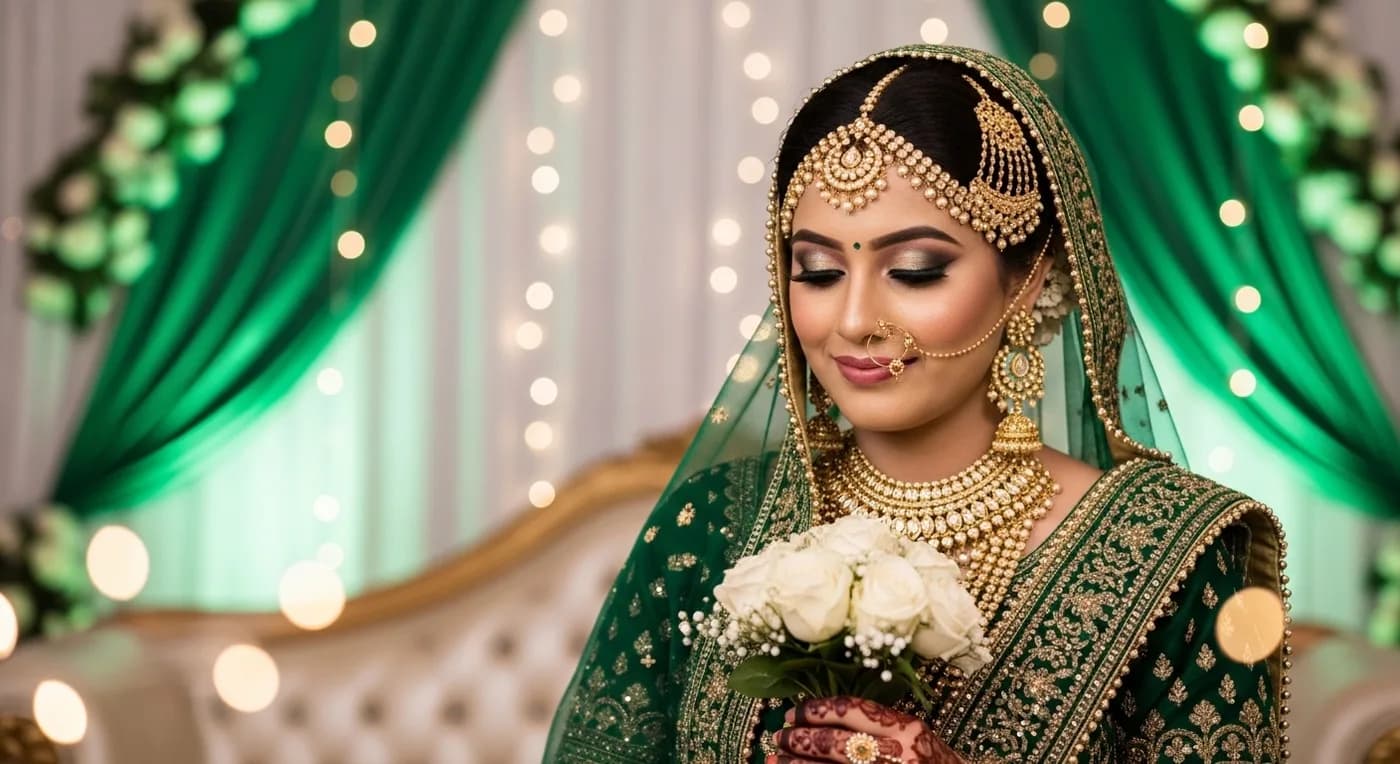
The Karnataka Muslim bride's attire draws from both Deccani and broader Indian Muslim fashion traditions — lehengas in deep red, maroon, or emerald green with heavy embroidery are the most common choice. The diversity of options reflects the community's rich cultural layers. The most common choice is a lehenga (skirt, blouse, and dupatta set) in rich colours — red, maroon, deep pink, or emerald green — with heavy embroidery, zardozi work, or mirror-work. Some brides opt for a sharara (wide-legged trousers with a tunic) or an anarkali (flowing, floor-length dress) for a more traditional silhouette.
The dupatta is essential — draped over the head during the Nikah ceremony, it serves both as a mark of modesty and as a stunning visual frame for bridal photographs. Gold jewellery is elaborate: jhumkas (chandelier earrings), maang tikka (forehead ornament), nath (nose ring with chain), haath phool (hand ornament), and multiple bangles.
South Indian influence is visible in some Karnataka Muslim bridal looks — brides from families long established in the state may incorporate elements of South Indian jewellery or drape a silk saree for the Walima reception, blending regional identity with Islamic tradition.
The Groom
The sherwani remains the dominant choice for Karnataka Muslim grooms, though contemporary Bangalore grooms increasingly experiment with pastels, navy, and black. The groom wears a sherwani — a long, fitted coat with embroidery — paired with a churidar (fitted trousers) and a topi (cap) or pagri (turban). White and cream sherwanis are traditional choices, though contemporary Bangalore grooms increasingly opt for pastels, navy, or even black. The groom's look is completed with a sehra (veil of flowers or beaded strings worn over the face) during the procession, and a dupatta draped over the shoulders.
How Should You Plan a Muslim Wedding in Bangalore?
What Are the Best Venue Options?
Bangalore offers a diverse range of venues suited to Muslim weddings — from historic function halls in Shivajinagar to five-star hotel ballrooms. The couples I advise in Bangalore typically choose their venue based on the Walima guest count, since that is almost always the largest event. Here are the main categories:
Historic function halls in Shivajinagar and Frazer Town. These neighbourhoods are the heart of Bangalore's Muslim community and host dozens of well-equipped function halls — Hamid Function Hall, Al-Ameen Function Hall, and several others along Tannery Road and Commercial Street. These venues are purpose-built for large community celebrations, with kitchen facilities that accommodate the scale of Walima catering. The Karnataka Minorities Development Corporation has also invested in community infrastructure in these areas, which benefits the local wedding ecosystem.
₹50,000 – ₹2,00,000Commercial banquet halls. Venues across the city — in Koramangala, Jayanagar, Whitefield, and Electronic City — offer modern amenities, ample parking, and flexibility for both the Nikah and Walima in a single space.
₹2,00,000 – ₹6,00,000Hotel venues. For premium celebrations, five-star hotels like the Taj West End, ITC Windsor, Sheraton Grand, and Le Meridien offer ballrooms with capacities of 300 to 1,000 guests. These are particularly popular for the Walima reception, while the Nikah itself may be held at a mosque.
₹5,00,000 – ₹15,00,000Looking for Venues in Bangalore?
Tell us what you need and get quotes from verified venues
How Do You Choose the Right Caterer?
Choosing the right caterer is paramount for a Muslim wedding — the biryani is the dish by which guests will judge the entire celebration. The biryani must be exceptional — it is the dish by which guests will judge the entire celebration. Bangalore has a thriving ecosystem of Muslim caterers who specialise in Deccani cuisine, many of them based in the Shivajinagar-Frazer Town belt. Book a tasting well in advance, and specify the exact biryani style you prefer (Hyderabadi dum, Deccani, or Malabar — each has a distinct character).
For a Walima serving 300-500 guests with a full Deccani spread (biryani, kebabs, korma, breads, desserts), budget approximately (see our wedding catering cost guide for a broader comparison across cuisine types):
₹1,50,000 – ₹4,00,000Looking for Caterings in Bangalore?
Tell us what you need and get quotes from verified caterings
What Does a Muslim Wedding in Bangalore Typically Cost?
A Muslim wedding in Bangalore ranges from ₹3 lakhs for a budget celebration to ₹50 lakhs for a premium five-star experience. India's wedding industry is valued at ₹10.79 lakh crore, with 4.6 million weddings during peak season driving intense competition for venues and caterers. Couples should also be aware that marriage registration in Karnataka is available through the Kavivaha Mitra portal — while Muslim marriages are governed by personal law, registration provides additional legal documentation. A Muslim wedding in Bangalore — inclusive of the Mehndi night, Nikah ceremony, Walima, photography, and decor — typically falls within these ranges:
- Budget-conscious (community hall, 200-400 guests): ₹3,00,000 – ₹8,00,000
- Mid-range (commercial banquet hall, 400-700 guests): ₹8,00,000 – ₹20,00,000
- Premium (5-star hotel, 500-1000 guests): ₹20,00,000 – ₹50,00,000
How Large Are Guest Lists Typically?
Muslim weddings in Karnataka tend to have large guest lists — 300 to 800 is the typical range for a Bangalore celebration, with families in Shivajinagar sometimes exceeding 1,000. The Islamic emphasis on community — inviting neighbours, colleagues, and extended family — means that trimming the guest list is culturally difficult. Plan your venue and catering accordingly.
Tip
Common Questions About Muslim Weddings in Karnataka
Do both the bride and groom need to be present at the same location during the Nikah?
Not necessarily. Traditionally, the bride may be in a separate room with her wakeel (representative) who conveys her acceptance to the Qazi. However, in modern Bangalore Nikah ceremonies, particularly among younger couples, both the bride and groom are increasingly present on the same stage. The choice is entirely the family's — both formats are Islamically valid, and Bangalore Qazis are comfortable officiating either arrangement.
How long does the entire Nikah ceremony take?
The Nikah itself — the Qazi's sermon, the Ijab-e-Qubool exchange, signing the Nikah-nama, and concluding Dua — can be completed in 30 to 45 minutes. However, the full event including guest arrival, photography, and post-ceremony congratulations typically spans two to three hours. This compact format is one reason many families choose to hold the Nikah and Walima on separate days, keeping each event focused and unhurried.
Can a Muslim wedding in Karnataka include elements from the partner's non-Muslim traditions?
Interfaith weddings are becoming more common in cosmopolitan Bangalore. Many families hold the Nikah as a standalone Islamic ceremony and then incorporate elements from the partner's tradition — a garland exchange, a reception with mixed cultural elements, or a separate ceremony for the other family. The key is that the Nikah itself follows Islamic requirements (Meher, consent, witnesses, Qazi officiation). Consult your Qazi early in the planning process to understand what can be accommodated within the Islamic framework.
What is the dress code for guests at a Karnataka Muslim wedding?
There is no strict dress code, but guests typically dress formally. Women often wear sarees, salwar kameez, or lehengas — modest attire is appreciated, especially during the Nikah at a mosque. Men wear sherwanis, kurta-pyjamas, or formal suits. For mosque-based Nikah ceremonies, women should carry a dupatta or scarf to cover their head during prayers, and all guests should be prepared to remove shoes before entering the prayer hall.
Is photography allowed during the Nikah ceremony?
Yes, photography is generally permitted and expected at Bangalore Muslim weddings — families invest significantly in capturing the Nikah moment. For what professional wedding photography costs in the city, see our Bangalore photography pricing guide. However, if the ceremony is held inside a mosque, check with the mosque administration beforehand, as some have restrictions on flash photography or videography during prayers. Professional photographers experienced with Muslim weddings in Bangalore know to be discreet during the Dua and Qubool exchange, capturing the moments without disrupting the solemnity.
A Muslim wedding in Karnataka is a celebration where faith meets culture — where the universality of Islamic marriage principles is expressed through the specific textures of Deccani cuisine, Urdu-Kannada bilingual conversation, and a community character that is unmistakably Bangalorean. The Nikah's solemn beauty, the Mehndi's joyful colour, and the Walima's generous abundance together create a celebration that honours both God and community. For venue options across the city, explore our guide to the best wedding venues in Bangalore, and for budget planning, see our Bangalore wedding budget guide.
Tip
Start planning your wedding — generate a personalised checklist with our AI Wedding Checklist, estimate your budget with the Cost Calculator, or create a beautiful digital invitation.
Topics
muslim wedding bangalorenikah in bangalorekarnataka muslim weddingdeccani wedding traditionsislamic wedding customs karnatakaExplore more
Frequently Asked Questions
1How are Muslim weddings in Karnataka different from North Indian ones?
2What is Meher in a Bangalore Muslim wedding?
3What are the main ceremonies in a Karnataka Muslim wedding?
4Where are Muslim weddings held in Bangalore?
Continue reading
Related Articles
Bangalore Wedding Planning: ₹5-60L Costs & Venues (2026)
Bangalore Wedding Budget: Realistic 2026 Cost Breakdown
Best Wedding Venues in Bangalore: Complete 2026 Guide
Best Season for South India Destination Weddings: Month-by-Month Western Ghats Guide
Destination Wedding Cost in South India 2026: 5-Tier Budget Guide
Destination Wedding in South India: Complete 2026 Planning Guide
Still planning?
Get quotes from India's best vendors
Tell us what you're planning and we'll match you with verified photographers, venues, decorators, and more.
Get free quotes