
Kerala Wedding Food Menu Ideas: Beyond the Traditional Sadya
Explore Kerala wedding food menu ideas from classic sadya to live stations, Mappila feasts, and late-night street food — with per-plate costs for every style.

Wedding Finance Advisor
Arjun Das is a wedding finance advisor who helps couples across Kerala plan celebrations that match their vision without breaking the bank.
On this page
Kerala wedding catering ranges from ₹600–₹1,800 per plate for a traditional sadya to ₹1,200–₹2,500 for a non-veg buffet. For 500 guests with a morning sadya and evening buffet, budget ₹7–10 lakh total. The most popular 2026 format pairs a vegetarian sadya at the ceremony with a non-veg buffet or Mappila feast at the reception.
Quick Answer
Food is the one thing your guests will remember long after the garlands have wilted and the photo albums have been shelved. Ask anyone about a Kerala wedding they attended years ago, and the conversation will inevitably turn to the food — how many payasams were served, whether the biriyani had the right amount of ghee, if the sambar was salty or perfect. In Kerala, wedding food is not just sustenance or even hospitality. It is reputation. It is how families are measured. And it is, without exaggeration, the single most discussed element of any wedding in the state.
With CAIT estimating that 4.6 million weddings generated ₹6.5 lakh crore in spending during the November-December 2025 season alone, the scale of India's wedding catering market is staggering. That cultural weight means the pressure on couples and their families to get the food right is enormous. But here is the good news: the Kerala wedding food landscape in 2026 is wider and more creative than it has ever been. You are no longer limited to choosing between a traditional sadya and a generic North Indian buffet. India's wedding industry is valued at ₹10.79 lakh crore and projected to reach ₹24 lakh crore by 2030 according to IBEF, and catering is consistently the single largest line item. Today, couples across Kochi, Thrissur, Kozhikode, and Trivandrum are building menus that honour tradition while embracing new influences — live stations, global cuisines, curated dessert rooms, and late-night comfort food that keeps the celebration going well past midnight. This guide walks you through every major food format available for Kerala weddings, with real per-plate costs and practical planning advice drawn from current market rates.
For a detailed breakdown of sadya pricing tiers and caterer selection, our Kerala Wedding Sadya & Catering Cost guide goes deeper into the numbers. If you are building your full budget, the Kerala Wedding Budget Guide puts catering in context alongside every other expense category.
The Classic Kerala Sadya: Elevating Tradition
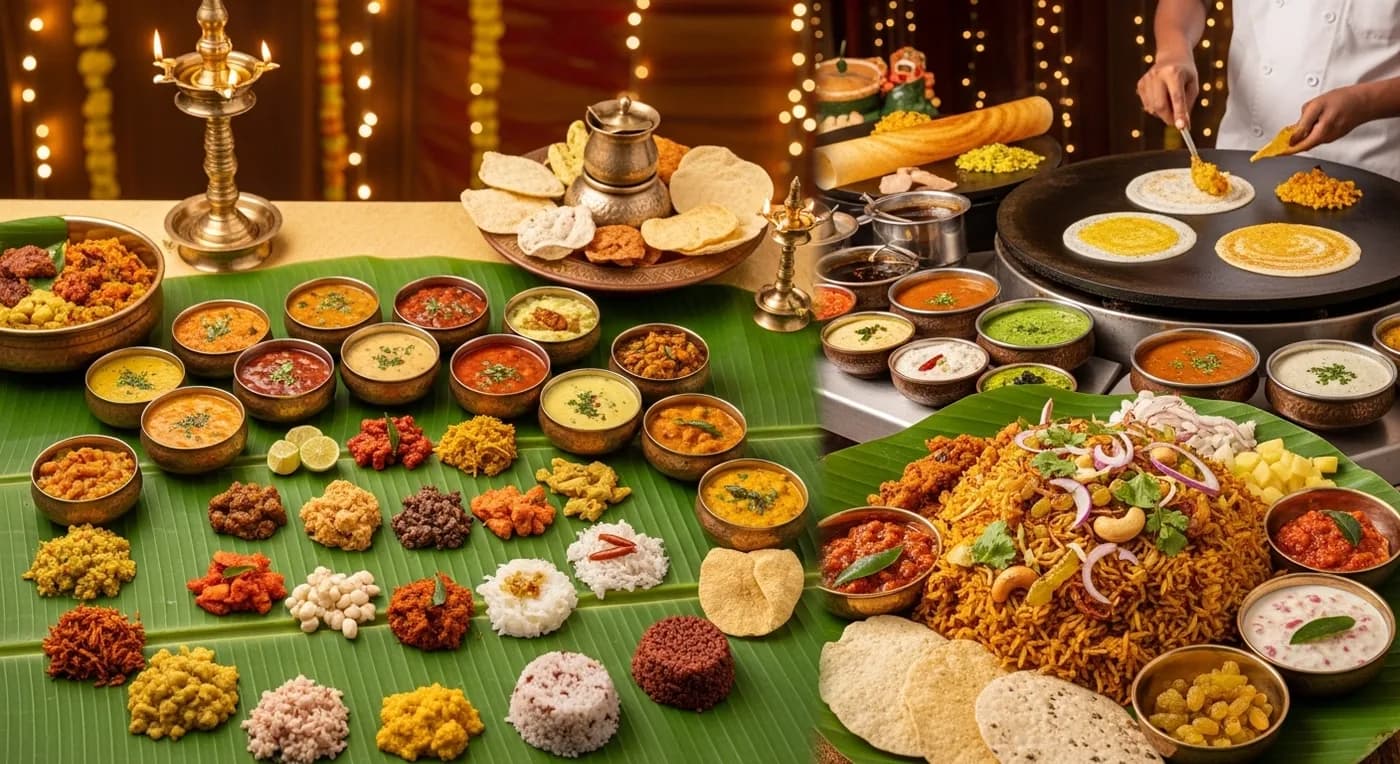
The traditional Kerala sadya remains the default and most culturally respected food format for the morning wedding ceremony across Hindu, Christian, and many Muslim families. Served on a fresh banana leaf, the sadya is a fully vegetarian meal of 20 to 32 items, served in a specific arrangement and sequence that has been refined over generations.
Note
A standard wedding sadya in 2026 costs 800 to 1,000 per plate for a 24 to 26-item meal with three payasam varieties and trained servers. This is the tier where most families land — guests leave satisfied, the elders nod approvingly, and nobody whispers about corners being cut.
But the sadya can be elevated without fundamentally changing what it is. Here is how thoughtful families in 2026 are raising the bar:
Expand the Payasam Counter
The payasam selection is the most visible marker of sadya quality. A standard wedding sadya includes two or three varieties — palada pradhaman, parippu pradhaman, and semiya payasam are the usual trio. Expanding to five or seven varieties transforms the meal from respectable to memorable. Add chakka pradhaman (jackfruit), ada pradhaman, gothambu payasam (broken wheat in jaggery syrup), and kadala pradhaman (Bengal gram). The cost of adding two extra payasam varieties is typically 60 to 100 rupees per plate — a modest investment for an outsized impression.
Source Heirloom Ingredients
The gourmet sadya tier — 1,400 to 1,800 per plate — has gained traction among families in Ernakulam and Trivandrum who want the traditional format but with exceptional ingredient quality. This means Palakkadan matta rice, Wayanadan pepper, cold-pressed coconut oil from specific farms, and jaggery sourced from Thrissur. The difference in taste is real and noticeable, especially in the parippu, sambar, and rasam where ingredient quality has nowhere to hide.
Themed Banana Leaf Presentation
Some premium caterers now offer artistic banana leaf presentations — gold-bordered leaves, coordinated placement of flowers alongside the meal, and even personalised place cards in traditional Kerala script. These touches cost 20 to 50 rupees per setting and add visual elegance to photographs without altering the food itself.
Tip
Non-Vegetarian Add-Ons: The Hybrid Approach
A growing number of Kerala families, particularly in central Kerala districts like Ernakulam and Kottayam, are adopting a hybrid approach — serving the traditional vegetarian sadya on the banana leaf while offering non-vegetarian items on a separate plate alongside. This lets families honour the vegetarian tradition while acknowledging that many guests prefer non-veg options.
₹200 – ₹500The non-veg supplement typically costs 200 to 500 rupees per plate on top of the sadya rate. Common additions include:
- Fish curry (meen curry) — The most popular add-on across Kerala. A well-made fish curry with coconut milk and kudampuli (Malabar tamarind) is a natural companion to rice and sadya sides. Karimeen (pearl spot) preparations command a premium but are considered the gold standard.
- Chicken curry — Kerala-style chicken curry with thick coconut gravy. A safe, universally liked addition that adds protein to the meal without overwhelming the sadya.
- Chicken fry — Dry preparation, usually served as a side piece. Popular especially at Christian and Muslim-influenced weddings.
- Mutton curry — Less common as a sadya accompaniment but seen at premium celebrations, particularly in Malabar-influenced menus in Thrissur and northern Ernakulam.
The logistics matter here. Non-veg items are served on a separate stainless steel plate placed beside the banana leaf, not on the leaf itself. Your caterer needs to know the expected non-veg uptake — typically 40 to 60 percent of guests opt for the non-veg supplement (based on itsmy.wedding catering data) — and staff the serving line accordingly.
Multi-Cuisine Buffet: The Reception Standard
For evening receptions, the multi-cuisine buffet has become the default format across most Kerala cities. It offers variety, accommodates different dietary preferences, and creates a relaxed, social eating experience that suits the reception atmosphere better than a seated sadya.
₹1,200 – ₹2,500A standard non-veg multi-cuisine buffet in 2026 runs 1,200 to 2,500 per plate depending on the protein choices and number of counters. Here is what a well-constructed wedding buffet typically includes:
Kerala Counter
This is the anchor — the section that grounds the buffet in local identity. Expect Kerala fish curry, avial, thoran, appam or pathiri with stew, and often a small sadya-style selection for guests who prefer the traditional format. Karimeen (pearl spot) preparations, prawn masala, and Malabar-style chicken curry are premium additions that elevate this counter.
North Indian Counter
Paneer butter masala, dal makhani, naan and roti from a tandoor, chicken tikka, and butter chicken are the staples. This counter exists primarily for out-of-state guests and younger attendees who grew up on a more pan-Indian palate. It is expected at any wedding with more than 200 guests.
Continental and Asian Options
Pasta stations, fried rice, manchurian, and occasionally a soup counter round out the spread. These are supporting players rather than stars — most guests at a Kerala wedding treat them as additional variety rather than primary choices.
The Biriyani Counter
Biriyani deserves its own mention because at a Kerala wedding reception, it is often the single most consumed item. Kochi-style dum biriyani with chicken or mutton, served from large copper vessels, draws the longest queues at any buffet. Some families offer both a Thalassery-style biriyani (distinct Malabar preparation with khaima rice) and a Hyderabadi-style dum biriyani to cover both flavour profiles.
Looking for Caterings in Kochi?
Tell us what you need and get quotes from verified caterings
Live Stations and Interactive Food Experiences
Live food stations have moved from luxury novelty to mainstream expectation at Kerala wedding receptions, particularly in Kochi, Trivandrum, and Thrissur. They add theatre, reduce waste (since items are made to order), and give guests a reason to move around the reception space rather than cluster at a single buffet line.
₹300 – ₹800Live stations are typically priced as add-ons to the base buffet rate, adding 300 to 800 rupees per plate depending on the number and type of stations. Here are the most popular options in 2026:
Biriyani Counter
A chef prepares biriyani in real time from large dum vessels, portioning out servings with the precision and showmanship that makes the dish feel special. The aroma alone draws guests across the hall. A dedicated biriyani counter with two varieties (chicken and mutton) adds 150 to 250 rupees per plate.
Dosa Station
A live dosa counter — featuring paper dosa, masala dosa, rava dosa, and sometimes egg dosa — is a crowd-pleaser that appeals across age groups. The visual theatre of a skilled dosa maker working a large griddle is part of the experience. Cost: 100 to 200 per plate as an add-on.
Pasta and Pizza Counter
A chef preparing fresh pasta with choice of sauces, or wood-fired mini pizzas, appeals strongly to younger guests and children. This is one of the most common live stations at Kochi weddings and has spread to Thrissur and Trivandrum. Cost: 150 to 300 per plate.
Dessert Bar
An interactive dessert station — featuring made-to-order waffles, crepes, liquid nitrogen ice cream, chocolate fountains, or build-your-own sundaes — has become the Instagram moment at many 2026 Kerala receptions. This is where couples express their personality: some opt for a traditional Indian mithai counter, others go for a French patisserie spread. Cost: 200 to 400 per plate.
Tandoor and Grill Counter
Live kebab and tikka preparation on a charcoal grill or tandoor, with meats and vegetables cooked to order. The smoky aroma and visual appeal make this a strong draw. Some caterers offer a shawarma or Lebanese grill station as an alternative. Cost: 200 to 350 per plate.
Tip
The Mappila Wedding Feast: Biriyani at the Centre
Mappila Muslim weddings across Kozhikode, Malappuram, Kannur, and Kasaragod follow a distinct culinary tradition that deserves its own section. The Mappila feast — often served as the Walima (reception meal) — is legendary in its scale, variety, and unapologetic richness. If you have attended one, you know that the word "feast" is not a figure of speech.
₹1,000 – ₹1,800The centrepiece is biriyani — but not just any biriyani. Thalassery biriyani, made with small-grained khaima rice, ghee-roasted cashews and raisins, and slow-cooked meat layered in copper vessels, is the star. In Kozhikode and Malappuram, the biriyani is the single dish by which a wedding is judged. Families will travel across districts for a caterer whose biriyani has the right layering, the right moisture, and the right balance of spice. For a detailed exploration of Mappila wedding traditions and customs, our Malabar Muslim Nikah Guide covers the full celebration.
What a Mappila Wedding Menu Includes
A typical Mappila wedding feast in 2026 includes 15 to 25 dishes:
- Thalassery Biriyani — chicken or mutton, always the star
- Neychoru — ghee rice served alongside curries
- Pathiri — thin rice flour flatbreads, the Malabar equivalent of chapati
- Chicken curry — two or three preparations (roast, gravy, and sometimes a Kozhikode-style green masala)
- Mutton curry — slow-cooked with fennel, star anise, and thick coconut gravy
- Fish fry — usually seer fish (choora) or king fish (ayakoora) in Malabar masala
- Prawn curry or fry — at premium celebrations
- Ari pathiri with stew — rice pancakes with a mild vegetable or egg stew
- Mutta mala and mutta surka — egg desserts unique to Malabar, strands of sweet egg yolk that melt on the tongue
- Sulaimani — the aromatic, lemon-spiked black tea that closes every Malabar meal
The per-plate cost for a full Mappila feast runs 1,000 to 1,800 depending on the protein selections and the scale of the menu. For a 500-guest Walima, total food costs typically fall between 5 and 9 lakhs. Kozhikode and Malappuram have the deepest pool of specialist Mappila caterers, many of whom operate exclusively within the community and book out months in advance during wedding season.
Looking for Caterings in Kozhikode?
Tell us what you need and get quotes from verified caterings
Christian Wedding Reception Menu
Kerala Christian weddings — whether Syrian Catholic, Marthomite, CSI, or Latin Catholic — have their own distinct food culture, particularly at the reception. The ceremony is typically held in church, and the reception that follows is the main culinary event. Christian wedding menus in Kerala tend to be non-veg forward, drawing on the community's strong culinary tradition of meat and seafood preparation.
₹1,200 – ₹2,200The Typical Christian Wedding Spread
- Appam with chicken or mutton stew — The signature Kerala Christian combination. The lacy-edged appam with a mild, coconut-milk-based stew is served at almost every Syrian Christian wedding reception in Kottayam, Ernakulam, and Pathanamthitta.
- Duck roast (tharavu roast) — A distinctly central-Kerala Christian preparation, duck slow-roasted with thick masala. Found more commonly at weddings in Kottayam, Pala, and Changanassery.
- Beef fry and beef curry — At Latin Catholic and some Syrian Christian weddings, beef preparations are prominent. Beef fry (ularthiyathu) with thin-sliced coconut pieces is a specialty.
- Fish molee — A mild, turmeric-yellow coconut milk fish curry that is gentler than the typical Kerala fish curry. Pairs beautifully with appam.
- Kerala porotta with chicken curry — The flaky, layered parotta with a thick chicken gravy is the soul-food option at many receptions.
- Fruit cake and wine cake — Traditional at Syrian Christian celebrations, these dense, fruit-studded cakes are served as part of the dessert spread or as a take-home favour.
Many Christian families in 2026 blend this traditional core with continental touches — a soup course, a salad bar, grilled fish, and pasta — reflecting the community's cosmopolitan influence from historical connections with European missionaries and trade. The per-plate cost for a Christian wedding reception buffet runs 1,200 to 2,200, sitting in the mid-to-upper range of Kerala wedding catering.
Dessert Ideas: From Payasam to Patisserie
The dessert course at a Kerala wedding has expanded beyond payasam into a full experience. While traditional payasam remains non-negotiable at most celebrations, the reception dessert counter has become a canvas for creativity.
Traditional Payasam Varieties
Every Kerala wedding includes payasam. The question is how many varieties and how they are served. Here is a quick reference:
| Payasam | Key Ingredient | Cost Impact | Notes |
|---|---|---|---|
| Palada pradhaman | Rice flakes in jaggery-coconut milk | Standard | The one everyone expects |
| Parippu pradhaman | Moong dal in jaggery-coconut milk | Standard | Rich, dense, universally loved |
| Semiya payasam | Vermicelli in milk | Standard | Lighter option, popular with children |
| Ada pradhaman | Rice ada in jaggery-coconut milk | Standard-Premium | Thrissur favourite, excellent texture |
| Pal payasam | Rice in sweetened milk | Standard-Premium | Subtle, elegant |
| Gothambu payasam | Broken wheat in jaggery | Premium | Earthy, distinctive flavour |
| Chakka pradhaman | Jackfruit in jaggery-coconut milk | Premium | Seasonal, bold flavour — served March-June |
| Kadala pradhaman | Bengal gram in jaggery-coconut milk | Premium | Nutty, hearty |
Modern Dessert Additions
Beyond payasam, reception dessert counters now commonly include:
- Cake display — A tiered wedding cake for the cutting ceremony, plus sheet cakes or cupcakes for guests. Fondant custom cakes in Kochi start at 3,000 to 8,000 depending on size and design.
- Ice cream counter — Branded ice cream stations (Naturals, Amul) or artisanal gelato from local makers. Budget 80 to 150 per head.
- Indian mithai spread — Gulab jamun, rasgulla, jalebi, and barfi arranged on tiered displays. Popular at multi-community weddings where guests span different cultural backgrounds.
- Chocolate fountain — Strawberries, marshmallows, and fruit kebabs dipped in flowing chocolate. Photogenic and popular with children. Rental plus supplies: 8,000 to 15,000 for the event.
- Kulfi counter — Malai, pista, mango, and paan kulfi served from a decorated cart. A charming, affordable addition at 60 to 100 per serving.
Note
Late-Night Food: Keeping the Celebration Going
The most memorable Kerala weddings do not end when the buffet closes. Late-night food — served between 10 PM and midnight, after the formal reception dinner — has become a defining feature of celebrations in Kochi, Thrissur, and Kozhikode. This is informal, comfort-driven food that signals to guests that the party is not over and that the family's hospitality extends beyond the main meal.
₹100 – ₹250Late-night food is typically charged as a flat add-on by the caterer, running 100 to 250 per head depending on the options chosen. Here are the most popular formats:
Kanji Station
Rice porridge (kanji) served with pickle, pappadam, and simple accompaniments is the most traditional late-night option. It is gentle on the stomach after a heavy reception dinner, deeply comforting, and unmistakably Kerala. A kanji station for 300 guests costs approximately 15,000 to 25,000.
Chai and Snack Counter
Sulaimani chai (Malabar-style lemon tea), masala chai, and coffee served alongside pazham pori (banana fritters), uzhunnu vada, and egg puffs. This is the social fuel of the late-night conversation — guests linger, families bond, and the chai keeps flowing. Budget 80 to 120 per head.
Street Food Stalls
A mini food street setup within the reception venue, featuring stalls serving dosa, egg dosa, shawarma, frankie rolls, chaat, and pani puri. This format works brilliantly at outdoor receptions and resort weddings where there is space to create a festival atmosphere. Each stall costs 8,000 to 15,000 for the evening, and three to four stalls create a convincing food street.
Biriyani Midnight Counter
At Malabar weddings and some Kochi celebrations, a midnight biriyani counter — serving fresh pots of chicken biriyani — has become a beloved tradition. It is the ultimate gesture of abundance. Guests who thought they could not eat another bite find themselves in line with a plate, unable to resist. Budget 200 to 300 per plate for the midnight round.
Planning Your Wedding Food Budget
Putting all these options together, here is a realistic total catering budget framework for different wedding sizes and food strategies in 2026:
| Strategy | 200 Guests | 500 Guests | 800 Guests |
|---|---|---|---|
| Sadya only (morning ceremony) | 1.6 - 2.0 lakhs | 4.0 - 5.0 lakhs | 6.4 - 8.0 lakhs |
| Sadya AM + Non-veg buffet PM | 3.0 - 4.5 lakhs | 7.5 - 11 lakhs | 12 - 18 lakhs |
| Sadya AM + Buffet + Live stations PM | 3.5 - 5.5 lakhs | 9 - 14 lakhs | 14 - 22 lakhs |
| Mappila feast (single event) | 2.0 - 3.6 lakhs | 5.0 - 9.0 lakhs | 8.0 - 14 lakhs |
| Premium multi-event (sadya + buffet + late night) | 4.0 - 7.0 lakhs | 10 - 17 lakhs | 16 - 27 lakhs |
These figures include food, service staff, and basic equipment but exclude GST (5-18% depending on caterer type), venue kitchen access fees, and beverages. Add 10 to 15 percent to any estimate for these hidden costs. Our cost calculator can help you build a personalised estimate based on your specific guest count and food preferences.
Important
Choosing the Right Caterer
The food format matters, but the caterer matters more. A brilliant menu on paper means nothing if the caterer cannot execute it consistently for your guest count. Here are the key considerations:
Match caterer to format. WedMeGood's survey of 2,000+ couples consistently ranks food as the most remembered element of any wedding — which means your caterer choice directly impacts your celebration's legacy. If you want a traditional sadya, hire a specialist sadya caterer — particularly in Thrissur and Palakkad, where generations-deep expertise exists. If you want a multi-cuisine buffet, look for caterers with hotel or restaurant backgrounds. Do not ask a sadya specialist to do a Continental pasta station, and do not ask a hotel caterer to run a 700-guest banana leaf sadya.
Insist on a tasting. Any caterer handling a wedding of 200 or more guests should offer a complimentary tasting. Use this session to evaluate not just flavour but temperature management, presentation, and the serving team's coordination.
Get everything in writing. The full menu with individual dish names, per-plate rate, total headcount, service staff count, setup and cleanup responsibilities, payment schedule, and cancellation terms must be in a signed agreement. Verbal quotes lead to disputes — this is the single most common source of wedding-day stress related to catering.
If you are deciding between a traditional banana leaf sadya and a modern buffet, our sadya vs buffet comparison guide lays out the cost and experience tradeoffs clearly. For vendor-specific recommendations, see our best wedding caterers in Kerala guide. Start your search for the right catering partner through our caterer directory, where you can filter by location, cuisine type, and budget range. For venue-specific recommendations, explore wedding venues in Kochi and venues in Thrissur — many venues have preferred caterer lists that simplify the selection process.
Looking for Caterings?
Tell us what you need and get quotes from verified caterings
Common Questions About Kerala Wedding Food Menu Ideas
What are the most popular food options at a Kerala wedding?
The traditional sadya on banana leaf remains the most common option for the morning ceremony, costing 600 to 1,800 per plate depending on the tier. For evening receptions, multi-cuisine buffets with Kerala, North Indian, and Continental options are the standard format at 1,200 to 2,500 per plate. Live food stations — biriyani counters, dosa stations, tandoor grills, and dessert bars — have become mainstream additions that add theatre and variety. Mappila biriyani feasts are the default at Muslim weddings across Malabar. The trend in 2026 is toward layered menus: traditional in the morning, creative in the evening, and informal late-night food to close out the celebration.
How much does wedding catering cost in Kerala in 2026?
A standard sadya costs 800 to 1,000 per plate. Non-veg buffets run 1,200 to 2,500 per plate. Live station add-ons cost 300 to 800 per plate extra. A Mappila feast with biriyani and multiple non-veg dishes runs 1,000 to 1,800 per plate. For a 500-guest wedding with a morning sadya and evening buffet, budget 7 to 11 lakhs for catering alone before GST and extras. Premium celebrations with live stations, a dessert room, and late-night food can push the total to 14 to 17 lakhs for the same guest count. Use our cost calculator for a personalised estimate.
Can I serve both sadya and non-veg at a Kerala wedding?
Absolutely, and this is increasingly common. The hybrid approach serves the traditional vegetarian sadya on the banana leaf while offering non-vegetarian items — fish curry, chicken, or mutton — on a separate plate alongside. This satisfies tradition-minded family members while giving non-veg-preferring guests what they want. The non-veg supplement adds 200 to 500 rupees per plate. Alternatively, many couples serve a purely vegetarian sadya for the morning ceremony and a full non-veg buffet for the evening reception, which is the most popular dual-format approach in Kerala.
What food is served at a Mappila Muslim wedding in Kerala?
Mappila wedding feasts centre on Thalassery or Kozhikode-style biriyani as the undisputed star, accompanied by pathiri (rice flatbreads), neychoru (ghee rice), multiple chicken and mutton curries, fish fry, prawn preparations at premium events, and the unique Malabar desserts mutta mala and mutta surka. A full Mappila feast includes 15 to 25 dishes and costs 1,000 to 1,800 per plate. The meal closes with sulaimani chai. The scale of food at a Malabar wedding is a point of family pride, and the biriyani quality is the single metric by which the celebration is judged in the community.
What are good late-night food options for a Kerala wedding?
The most popular late-night option is a kanji (rice porridge) station with pickle and pappadam, costing about 15,000 to 25,000 for 300 guests. Sulaimani chai and snack counters — with pazham pori, vada, and egg puffs — are social favourites at 80 to 120 per head. Street food stalls serving dosa, shawarma, and chaat create a festive atmosphere at outdoor venues. Midnight biriyani counters have become a Malabar tradition that is spreading across Kerala. Budget 100 to 250 per head for late-night food as an add-on to your main catering contract.
Further Reading
For a deep dive into sadya-specific pricing by district and tier, read our Kerala Wedding Sadya & Catering Cost guide. If you are still shaping your overall wedding budget, the Kerala Wedding Budget Guide puts catering costs alongside every other expense category. And for couples planning a step-by-step timeline that includes food logistics, our How to Plan a Kerala Wedding guide covers the full planning process from engagement to reception.
Topics
kerala wedding food menu ideaskerala wedding menuwedding catering Keralakerala sadya menumappila wedding feastwedding buffet Keralakerala wedding dessertslive food stations weddingExplore more
Frequently Asked Questions
1What are the most popular food options at a Kerala wedding?
2How much does wedding catering cost in Kerala in 2026?
3Can I serve both sadya and non-veg at a Kerala wedding?
4What food is served at a Mappila Muslim wedding in Kerala?
5What are good late-night food options for a Kerala wedding?
Continue reading
Related Articles
Kerala Wedding Sadhya & Catering Cost: 2026 Pricing Guide

Kerala Wedding Budget Guide: 2026 Cost Breakdown
Malabar Muslim Nikah: ₹15-35L Rituals, Vendors & Costs (2026)
Best Season for South India Destination Weddings: Month-by-Month Western Ghats Guide
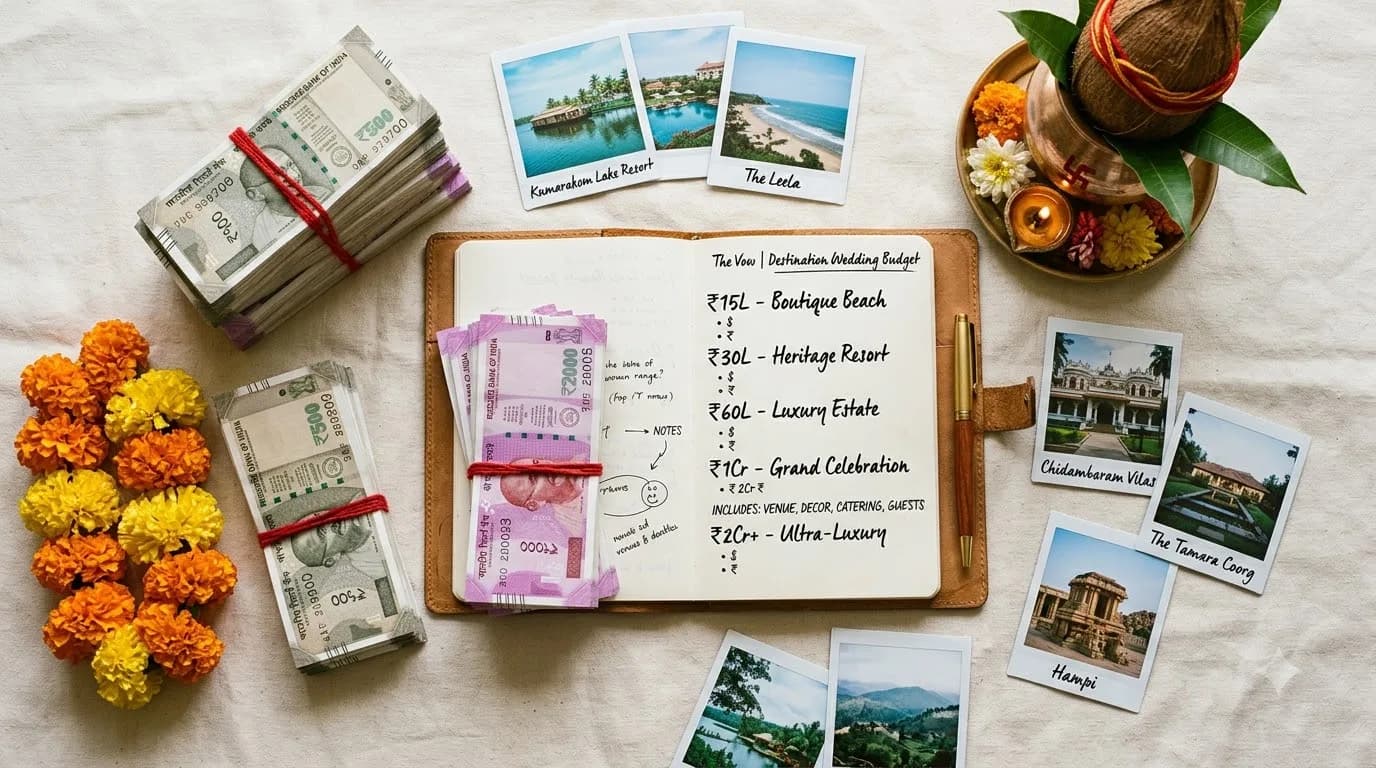
Destination Wedding Cost in South India 2026: 5-Tier Budget Guide
Destination Wedding in South India: Complete 2026 Planning Guide
Still planning?
Get quotes from India's best vendors
Tell us what you're planning and we'll match you with verified photographers, venues, decorators, and more.
Get free quotes