
Best Wedding Caterers in Kerala (2026): From Traditional Sadya to Modern Fusion
Kerala wedding catering runs ₹350-₹2,000+ per plate in 2026. Compare 5 caterer types — sadya, buffet, halal, and live stations — with pricing and booking tips.

Wedding Finance Advisor
Arjun Das is a wedding finance advisor who helps couples across Kerala plan celebrations that match their vision without breaking the bank.
On this page
Kerala wedding catering costs ₹350–900 per plate for traditional sadya and ₹600–1,500 for multi-cuisine buffets, with Kochi pricing running 15–25% above the state average. Five caterer types operate across Kerala — sadya specialists, multi-cuisine buffets, halal caterers, live stations, and pure veg setups. A full sadya with 22–30 dishes requires at least 8–10 servers per 100 guests.
Quick Answer
Quick answer: Kerala wedding catering costs ₹350–900 per plate for traditional sadya and ₹600–1,500 for multi-cuisine buffets, with Kochi pricing running 15–25% above the state average. Five caterer types operate across Kerala — sadya specialists, multi-cuisine buffets, halal caterers, live stations, and pure veg setups. A full sadya with 22–30 dishes requires at least 8–10 servers per 100 guests.
Note
Pricing methodology: Cost ranges in this guide are based on vendor pricing data from the itsmy.wedding marketplace and published industry reports, collected in Q4 2025 – Q1 2026.
Finding the right caterer is the single most consequential vendor decision you will make for your Kerala wedding. With India's wedding industry valued at ₹10.79 lakh crore and CAIT estimating 4.6 million weddings during the Nov-Dec 2025 season alone, the catering market is intensely competitive. The venue can be stunning, the decor can be breathtaking, and the photography can be world-class — but if the food disappoints, that is what guests will remember. Ask anyone about a Kerala wedding they attended five years ago and they might not recall the colour of the stage backdrop, but they will tell you with precision whether the sambar was good, how many payasams were served, and whether the parippu had enough ghee. Food is the centrepiece of every Kerala celebration, and the caterer you choose determines whether your wedding is remembered fondly or with a polite but unmistakable silence.
This guide is not a ranked list of specific caterers — vendor reputations shift, staff changes, and quality can vary from one event to the next. Instead, this is a practical framework for understanding the five main types of wedding caterers operating in Kerala in 2026, what each type does best, what they charge, what to ask them, and how to evaluate whether they are right for your celebration. Whether you are planning a 200-guest intimate ceremony in Alappuzha or a 1,000-person celebration in Thrissur, the information here is drawn from current market realities across the state.
Type 1: Traditional Sadya Specialists
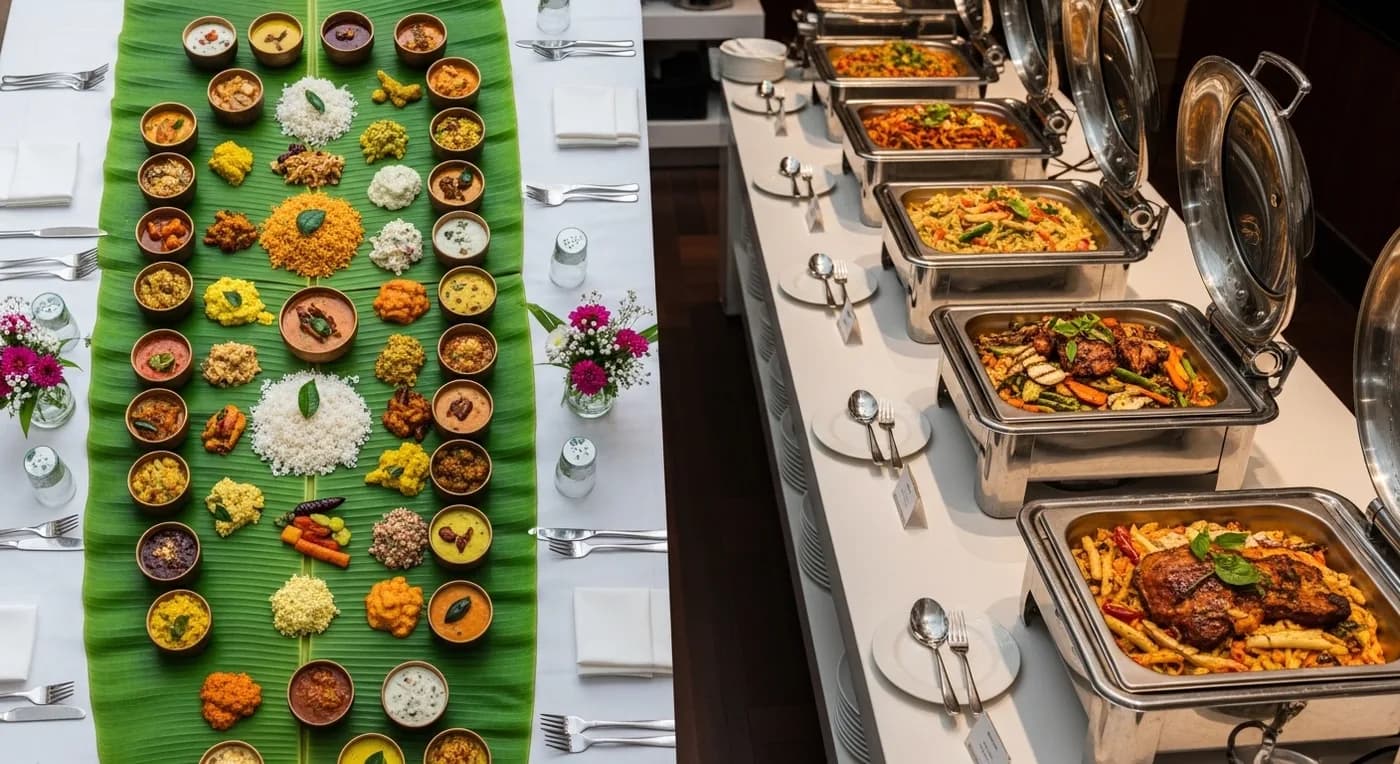
Traditional sadya specialists focus exclusively on the full banana-leaf wedding sadya, handling 100 to 200 weddings per year with dedicated portable kitchens, optimised supply chains, and trained serving crews. They typically operate without a restaurant base, working exclusively on-site at wedding venues. Their kitchens are portable, their supply chains are optimised for specific ingredients (Palakkadan matta rice, Wayanadan pepper, fresh banana leaves from known farms), and their serving crews have been trained to coordinate the precise rounds that define a proper sadya.
₹350 – ₹900What They Do Best
A specialist sadya caterer delivers the full 22-to-30-item banana-leaf meal with military-level coordination. The serving sequence — parippu with ghee first, then sambar, then rasam, then pulissery, with payasam last — follows tradition without shortcuts. The crew operates in synchronised rounds, ensuring every guest at every seat receives each dish in the correct order and at the right temperature. At a well-run specialist sadya, 500 guests can be fed in 45 minutes with no one waiting and no dish running short.
Pricing Breakdown
| Tier | Per Plate (INR) | Dish Count | Payasam Varieties |
|---|---|---|---|
| Basic | 350 - 500 | 18-20 items | 2 |
| Standard | 500 - 700 | 22-24 items | 3 |
| Premium | 700 - 900 | 26-30 items | 5-7 |
Thrissur and Palakkad have the deepest pool of dedicated sadya specialists. Many of these operators have been in the business for two or three generations, and their reputations are built entirely on wedding-to-wedding word of mouth. In Kochi and Trivandrum, specialist sadya caterers exist but are fewer — the market there tilts more toward multi-cuisine operators who include sadya as one of several offerings.
What to Ask a Sadya Specialist
- What is your exact dish count, and can I see the full list? A vague answer like "standard sadya items" is a red flag. You want each dish named.
- How many serving staff do you deploy per 100 guests? The minimum for a coordinated sadya is 8-10 servers per 100 diners.
- Do you source your own banana leaves, or is that my responsibility? During peak season (November-January), leaf sourcing becomes a real logistical challenge.
- What is your minimum guest guarantee? Most specialists require a minimum — typically 200 guests — below which they will not take the booking.
- Can I attend a live event you are catering before I book? The best way to evaluate a sadya caterer is to see them work at someone else's wedding.
Tip
Looking for Caterings?
Tell us what you need and get quotes from verified caterings
Type 2: Multi-Cuisine Buffet Caterers
Multi-cuisine buffet caterers handle both vegetarian and non-vegetarian spreads for wedding receptions, operating across 4 to 6 cuisines with per-plate rates of ₹600 to ₹1,500. They work across multiple cuisines — South Indian, North Indian, Chinese, Continental, Mughlai, and sometimes Thai or Lebanese — and operate with chafing dish setups, buffet counters, and dedicated service staff. Most hotel-affiliated caterers and large independent caterers in Kerala fall into this category.
₹600 – ₹1,500What They Do Best
Buffet caterers excel at variety and volume. A good buffet spread offers 15 to 25 dishes across multiple cuisine categories, giving guests the freedom to choose what appeals to them. This format is ideal for evening receptions where the crowd is diverse — younger guests want pasta and stir-fry stations, elders want familiar South Indian dishes, and out-of-state guests want options they recognise. The buffet also runs for a longer service window (90-120 minutes versus the 40-minute sadya), which suits the social, mingling nature of a reception.
Pricing Breakdown
| Tier | Per Plate (INR) | Cuisine Range | Proteins Included |
|---|---|---|---|
| Veg Buffet | 600 - 1,000 | 3-4 cuisines | None |
| Non-Veg Standard | 1,000 - 1,300 | 4-5 cuisines | Chicken, fish |
| Non-Veg Premium | 1,300 - 1,500 | 5-6 cuisines | Chicken, fish, mutton, prawns |
The per-plate rate for a buffet is driven primarily by the protein selection. Chicken and fish are the baseline; adding mutton pushes the rate up by 150-250 per plate, and prawns or crab add another 100-200. A simple chicken-and-fish buffet at 1,000 per plate is fundamentally different from a spread featuring mutton biriyani, prawn masala, and crab malabar at 1,500.
Red Flags to Watch For
- Vague menu descriptions. "Assorted non-veg items" is not a menu — you need specific dish names and quantities.
- No tasting offered. Any reputable buffet caterer bidding on a 200+ guest event should offer a tasting. If they refuse, they are hiding something.
- Chafing dish condition. Ask to see their equipment. Dented, discoloured chafing dishes signal poor maintenance across the operation.
- Understaffing the buffet line. Each counter station needs at least one dedicated server. If they deploy three people for a ten-station buffet, you will have chaos and cold food.
For couples planning their reception at a hotel venue in Kochi or Trivandrum, check whether the venue mandates their in-house caterer. Many hotels do, and their per-plate rates are typically 20-40% higher than independent caterers — but you avoid corkage fees and logistics headaches. Weigh the total cost, not just the per-plate number. Our Kerala wedding budget guide covers how catering fits into your overall spending plan.
Looking for Caterings in Kochi?
Tell us what you need and get quotes from verified caterings
Type 3: Live Station and Contemporary Caterers
Live station catering is the premium tier of Kerala's wedding market, costing ₹800 to ₹2,000 per plate with interactive counters where food is prepared to order in front of guests. Live station caterers bring a theatrical, interactive element to the reception — dosa stations where batter is poured to order, tandoor counters with freshly pulled naan, pasta bars with made-to-order sauces, shawarma stations, ice cream sundae setups, and even sushi counters at ultra-premium events. The food is prepared in front of guests, which eliminates waste (items are cooked to order) and adds genuine entertainment value to the evening.
₹800 – ₹2,000What They Do Best
Live stations transform a wedding reception from a meal into an experience. Guests interact with chefs, choose their ingredients, and watch their food being prepared. This format works exceptionally well for receptions with 200-400 guests where the couple wants a curated, upscale feel. It is also the most photography-friendly catering format — the visual appeal of live cooking translates beautifully into candid reception photos.
Pricing Breakdown
| Format | Per Plate (INR) | What's Included |
|---|---|---|
| Buffet + 2 live stations | 800 - 1,200 | Standard buffet with 2 interactive counters |
| Buffet + 4-5 live stations | 1,200 - 1,600 | Expanded buffet with multiple live counters |
| Full live station format | 1,500 - 2,000+ | Minimal buffet, majority live prep stations |
Live station costs are typically charged as add-ons to the base buffet rate. Each station adds 150-300 per plate depending on the cuisine and ingredients. A dosa station is the most affordable add-on (150-200 per plate); a sushi or fresh seafood grill station sits at the top (250-400 per plate).
Note
Choosing the Right Stations
Not every live station adds equal value. Here are the five most popular choices at Kerala wedding receptions in 2026, ranked by guest satisfaction:
- Dosa and appam station — A guaranteed crowd-pleaser. Fresh dosa batter, multiple chutneys, and variants (masala, cheese, Mysore) appeal across every age group.
- Tandoor counter — Naan, roti, paneer tikka, and chicken tikka prepared in a portable clay oven. The aroma alone draws guests.
- Pasta bar — Surprisingly popular at Kerala weddings. Guests choose their pasta, sauce, and toppings. Works well for younger guests and children.
- Ice cream and dessert station — Gelato scoops, waffle cones, chocolate fondue, or a sundae bar. Best placed near the exit so guests end on a sweet note.
- Chaat and street food counter — Pani puri, bhel puri, pav bhaji. Adds an informal, fun energy that counterbalances the formality of the main buffet.
Type 4: Halal and Muslim Wedding Caterers
Kerala's Malabar region — Kozhikode, Malappuram, Kannur, and Kasaragod — has a deep and sophisticated tradition of wedding catering built around halal practices and the distinctive Malabar culinary tradition. Muslim wedding caterers in this region are not simply halal-certified versions of standard caterers; they represent a separate culinary tradition with its own specialities, serving customs, and guest expectations.
₹800 – ₹1,600What They Specialise In
The centrepiece of a Malabar Muslim wedding feast is the biriyani — specifically, the Kozhikode-style or Thalassery-style biriyani that uses jeerakasala rice (kaima rice), slow-cooked meat, and a distinctive masala blend that varies by family and caterer. Alongside the biriyani, expect pathiri (rice flatbreads), neychoru (ghee rice), a selection of non-vegetarian curries (chicken, mutton, and often fish), and Malabar-specific desserts.
Many Malabar wedding caterers also offer a hybrid format that is increasingly popular — a vegetarian sadya for one meal (respecting the broader community of guests) with a non-vegetarian Malabar spread for the walima. This hybrid approach is standard at Muslim weddings in Ernakulam and Thrissur where the guest list includes a mix of communities.
Pricing Breakdown
| Format | Per Plate (INR) | What's Included |
|---|---|---|
| Biriyani-focused meal | 800 - 1,100 | Biriyani, 2 curries, pathiri, dessert |
| Full Malabar spread | 1,100 - 1,400 | Biriyani, neychoru, 4-5 curries, pathiri, 3 desserts |
| Premium walima feast | 1,400 - 1,600 | Extended menu with mutton, prawns, multiple rice preparations |
What to Ask
- Is your meat sourcing fully halal-certified? Verify the certification, not just the claim.
- Do you provide separate kitchen setups for veg and non-veg? At mixed-community events, this is essential.
- Can you accommodate a hybrid sadya-plus-biriyani format? Many caterers do both, but confirm their sadya quality is not just an afterthought.
- What is your copper vessel (uruli) rental situation? Traditional Malabar serving in large copper vessels is a visual and cultural statement, but these are heavy, expensive items. Confirm whether rentals are included or charged separately.
For couples planning a Muslim wedding in Kerala, our Malabar nikah guide covers the complete ceremony and reception planning process, including catering coordination.
Tip
Type 5: Pure Vegetarian Caterers
For temple weddings, Brahmin ceremonies, and families that observe strictly vegetarian traditions, a dedicated vegetarian caterer is not a preference — it is a requirement. These caterers maintain entirely vegetarian kitchens (no non-veg is prepared in the same space, ever), use separate equipment, and often follow additional purity protocols that matter deeply to the families hiring them.
₹350 – ₹1,200What They Specialise In
Pure vegetarian caterers in Kerala range from sadya specialists (covered in Type 1) to operators offering full vegetarian buffets spanning North Indian, South Indian, and Continental cuisines. The best vegetarian caterers in Palakkad and Thrissur deliver sadya that rivals any non-specialist, because the sadya is inherently vegetarian and these operators have spent decades perfecting it.
For vegetarian buffets at receptions, expect paneer preparations (3-4 varieties), mushroom and gobi dishes, elaborate rice stations (lemon rice, tomato rice, pulao, jeera rice), live dosa and chaat counters, and extensive dessert spreads. Vegetarian buffets run 600-1,200 per plate depending on the variety and presentation level.
Important Considerations
- Confirm no cross-contamination. Ask whether the caterer operates a dedicated vegetarian kitchen or whether they also cater non-veg events using the same equipment. For strictly observant families, only the former is acceptable.
- Palakkad caterers for authenticity. If a traditional Brahmin-style sadya is what you need, Palakkad district has the highest concentration of caterers who specialise in this exact format. They are also the most affordable in the state, running 15-20% below the Kochi average.
- Jain dietary requirements. If you have guests who follow Jain dietary practices (no root vegetables, no onion, no garlic), confirm that your caterer can accommodate this within the vegetarian framework. Most large vegetarian caterers in Kerala can, but it needs to be specified in advance.
The Tasting Session: Your Most Important Pre-Booking Step
Never book a wedding caterer in Kerala without a tasting session. This is the single most effective quality assurance step available to you, and any reputable caterer serving 200+ guest weddings should offer one at no additional cost.
How to Get the Most From a Tasting
Bring the right people. Your tasting panel should include three to five family members with strong opinions about food — typically both sets of parents and one or two trusted relatives. Taste is subjective, and you need consensus, not just your own preference.
Evaluate beyond flavour. Pay attention to temperature (is the sambar served hot?), consistency (is the rice uniform or mixed with broken grains?), freshness (are the chips crisp or stale?), and presentation (is the banana leaf the right size? Are the serving vessels clean?).
Test the payasam last. Payasam is the finale of every sadya and the dish guests judge most harshly. Taste every payasam variety the caterer proposes. The difference between a good palada pradhaman and a great one is enormous, and it is easy to detect at a tasting.
Take notes and photographs. Document every dish, your impressions, and any items that need adjustment. After tasting three caterers in two weeks, your memories will blur. Written notes prevent that.
Use our cost calculator tool to model how different per-plate rates affect your total wedding budget based on your guest count.
Contract Must-Haves
A verbal agreement with a caterer is an invitation for disaster. Every detail of your catering arrangement must be in a written contract signed by both parties. Here is what the document must include:
The Non-Negotiables
- Complete menu with dish names and counts. Not "standard sadya" — every individual dish listed by name.
- Per-plate rate and total guest count. With a clear statement of the minimum guarantee (the number of plates you will pay for even if fewer guests attend).
- Service staff headcount. Specified as a ratio per 100 guests.
- Start time, batch sizes, and service window. For sadya, specify panthi sizes and gaps between batches. For buffets, specify the service window duration.
- Banana leaf sourcing responsibility. Who provides them, and what happens if the supplier fails.
- GST rate. Confirm whether 5% or 18% applies (independent caterers typically charge 5%; hotel-based caterers with AC facilities charge 18%).
- Payment schedule. Typically 25% at booking, 50% one week before, and 25% on the day or within three days after.
- Overtime charges. What happens if the ceremony runs late and the meal starts beyond the agreed time.
- Cleanup terms. Who clears banana leaves, washes vessels, and handles waste disposal.
- Cancellation and rescheduling policy. What percentage is refundable if you cancel 90, 60, or 30 days before the event.
Important
Dietary Accommodations: Planning for Every Guest
Kerala wedding guest lists routinely include attendees with diabetes, gluten sensitivities, and children's dietary preferences — accommodating all three requires advance menu coordination with your caterer. Here is how to handle the most common dietary requirements at a Kerala wedding.
Diabetes-Friendly Options
A significant percentage of Kerala wedding guests — particularly among the older generation — manage diabetes. Work with your caterer to ensure at least one low-glycemic rice option (red rice or brown rice alongside white), that payasam is available in a sugar-free variant, and that the menu includes adequate vegetable-forward dishes with minimal added sugar.
Gluten-Free Guests
Traditional sadya is naturally gluten-free — rice, coconut, and vegetables form the base of every dish. The risk comes from buffet items where wheat-based roti, naan, and pasta are served alongside everything else. If you have guests with celiac disease, ask your caterer to label all buffet items clearly and to keep gluten-free options physically separated.
Children's Preferences
If your guest list includes a significant number of children (common at large Kerala weddings), consider adding a simple children's counter with familiar items — fried rice, french fries, chicken nuggets, ice cream. This costs 200-400 per child but prevents the chaos of children refusing unfamiliar dishes and parents scrambling for alternatives.
Seasonal Considerations and Booking Timeline
Kerala's wedding season has distinct peaks and valleys that directly affect caterer availability, pricing, and food quality.
Peak season (November to February): This is when 60-70% of Kerala weddings happen — part of the national surge that saw ₹6.5 lakh crore spent across 4.6 million weddings in just two months, according to CAIT. Caterer calendars fill months in advance. Ingredient prices spike because demand outstrips supply — fresh banana leaves, high-quality jaggery, and specific rice varieties all become more expensive. Book your caterer 4-6 months ahead during this window. Our wedding checklist maps this timeline against your other vendor bookings.
Shoulder season (March to May and September to October): Wedding activity is moderate. Caterers are more available, often more flexible on pricing, and ingredient sourcing is less pressured. This is the sweet spot for couples who want premium caterer access without peak-season pricing.
Monsoon season (June to August): Very few weddings happen during Kerala's monsoon, which means caterers are highly available and may offer discounts of 10-15% on per-plate rates. The trade-off is logistical — outdoor catering setups are risky, and transportation of equipment and ingredients is more challenging during heavy rain. If you are planning a monsoon wedding, indoor venue catering is essential.
Seven Money-Saving Strategies That Actually Work
1. Serve Sadya for the Ceremony, Light Buffet for the Reception
This is the most proven cost-saving strategy in Kerala weddings. The morning sadya at 700 per plate honours tradition and satisfies elders. The evening reception gets a lighter buffet at 800-1,000 per plate instead of a full premium spread. For 500 guests, this combined approach saves 1.5-3 lakhs compared to non-veg buffets for both events.
2. Optimise Your Guest Count Before Anything Else
Every 100 guests you remove saves 70,000-1,50,000 on catering alone. Do one honest pass through the guest list with your family before finalising numbers. A 400-guest wedding with exceptional food creates a better impression than a 600-guest wedding where the budget was stretched thin.
3. Book Early and Lock Your Rate
Caterers in Thrissur and Kochi routinely increase prices by 5-10% between January and June for the upcoming wedding season. An early commitment with a written rate lock prevents you from absorbing that increase. The deeper your lead time, the more leverage you have.
4. Negotiate Payasam Separately
If you want five payasam varieties but the rest of your requirements fit the standard tier, do not upgrade the entire package. Ask the caterer to add extra payasam varieties as line items to the standard menu. Adding two extra payasams costs 60-100 per plate — far less than moving up a full tier.
5. Hire Two Specialists Instead of One Generalist
For weddings with both a morning sadya and an evening non-veg reception, consider hiring a dedicated sadya caterer for the morning and a separate buffet caterer for the evening. Each specialist does what they do best, and the combined cost is often comparable to a single generalist who does both formats adequately but neither brilliantly.
6. Source Banana Leaves and Beverages Independently
If your family has access to banana farms (common in rural Kerala), source leaves yourself and save 5,000-10,000. Similarly, buy beverages wholesale — water, juices, and soft drinks — rather than paying the caterer's marked-up rate. Tea and coffee service from a family-managed setup costs a fraction of the caterer's beverage surcharge.
7. Choose a Weekday or Off-Peak Date
Caterers charge 10-20% premiums on peak muhurtham Saturdays and Sundays in November-January. A Thursday or Friday wedding, or a date in February-March, gets you the same caterer at a lower rate with better availability and more flexibility on customisation.
Our budget guide provides a complete framework for allocating your wedding budget across all categories, with catering typically accounting for 25-35% of total spend. For Kochi-specific pricing context, the average wedding cost in Kochi guide covers neighbourhood-level variations.
Venue and Caterer Coordination
Your choice of venue directly affects your catering options and costs. Before you book either one, understand how they interact.
In-house catering mandates. Many hotel venues in Kochi and Trivandrum require you to use their in-house caterer. This eliminates choice but simplifies logistics. Hotel catering rates are typically 20-40% above market rates for equivalent quality.
Corkage and kitchen access fees. If your venue allows outside caterers, they may charge a corkage fee (25,000-1,50,000) or a kitchen access fee (10,000-50,000) for use of their infrastructure. Factor this into your total catering cost comparison.
Auditorium and convention centre flexibility. Most standalone auditoriums and convention centres in Thrissur, Kozhikode, and Alappuzha allow outside caterers with no restrictions, giving you full freedom to hire your preferred operator.
For couples still choosing between venue types, our best wedding venues in Kerala guide covers how catering policies vary across different venue categories.
Looking for Caterings in Thrissur?
Tell us what you need and get quotes from verified caterings
Common Questions About Best Wedding Caterers in Kerala
Who are the best wedding caterers in Kerala for a traditional sadya?
The best sadya caterers are specialists who focus exclusively on banana-leaf meals and handle 100 or more weddings per year. Thrissur and Palakkad have the highest concentration of dedicated sadya caterers, many of whom have been in the business for two or three generations. Look for operators whose entire business model revolves around the wedding sadya — their supply chains, serving crews, and quality control processes are built specifically for this format. Ask for a tasting session, check their experience with your guest count, and request references from three recent weddings of similar scale. The best way to find an excellent specialist is word-of-mouth within your community — ask recently married families in your district for recommendations.
How much does wedding catering cost per plate in Kerala in 2026?
Traditional sadya costs 350 to 900 per plate depending on the tier (dish count and payasam varieties). Multi-cuisine non-veg buffets run 600 to 1,500 per plate based on protein selection and cuisine range. Live station and premium formats range from 800 to 2,000 or more per plate. Halal Malabar spreads cost 800 to 1,600. Pricing varies meaningfully by district — Kochi (Ernakulam) is 15 to 25 percent above the state average, Thrissur sits at the moderate centre, and Palakkad consistently offers the most affordable rates at 15 to 20 percent below average. For a 500-guest wedding using the popular sadya-morning plus light-buffet-evening strategy, total catering costs typically land between 5 and 8 lakhs including service charges, GST, and beverages.
What should I look for in a Kerala wedding caterer contract?
A proper catering contract should specify the complete menu with every dish named individually, the per-plate rate, total guest count with a minimum guarantee clause, service staff headcount stated as a ratio per 100 guests, banana leaf sourcing responsibility, applicable GST rate (5% for independent caterers, 18% for hotel-based operations), a detailed payment schedule, overtime charges if the ceremony runs late, cleanup and waste disposal terms, and a clear cancellation and rescheduling policy. Get all of this in writing before paying any advance. Verbal agreements are the number one source of catering disputes in Kerala weddings.
Are there good halal wedding caterers in Kerala?
Absolutely. Kerala's Malabar region has one of the most sophisticated halal wedding catering ecosystems in South India. Kozhikode, Malappuram, and Kannur are the heartland, with caterers who specialise in Thalassery-style biriyani, pathiri, neychoru, and elaborate non-vegetarian spreads that follow strict halal sourcing and preparation standards. Many of these caterers also offer hybrid formats combining a vegetarian sadya with halal non-veg additions for events where the guest list spans multiple communities. Per-plate rates for halal multi-cuisine catering range from 800 to 1,600 depending on the menu scope. Book early during wedding season — the best Malabar caterers are in very high demand.
Should I choose a specialist caterer or a multi-cuisine one for my Kerala wedding?
It depends on your menu plan. If your priority is a flawless traditional sadya, a specialist sadya caterer will outperform any multi-cuisine operator because their entire operation is optimised for that single format. If you need both a morning sadya and an evening buffet, you have two options: hire two specialists (one for each meal) or choose a large-scale caterer with demonstrated expertise in both formats. The two-specialist approach often delivers better quality at a comparable or slightly lower combined cost, but it requires more coordination. The one thing to avoid is hiring a generalist who treats sadya as a secondary offering — the quality gap between a specialist and a generalist on the banana-leaf meal is consistently noticeable.
Further Reading
- Kerala Sadhya & Catering Cost Guide — Detailed per-plate pricing breakdown by district and tier
- Kerala Wedding Budget Guide — Complete budget planning across every wedding category
- Best Wedding Venues in Kerala — Venue selection with catering policy details
- How to Plan a Kerala Wedding — Step-by-step planning guide including vendor booking timeline
Use our quote request form to get personalised caterer recommendations based on your guest count, location, and budget.
Looking for Caterings?
Tell us what you need and get quotes from verified caterings
Topics
best wedding caterers KeralaKerala wedding cateringsadya caterer Keralawedding buffet Keralahalal wedding catererlive station catering Keralawedding food Kerala 2026Explore more
Frequently Asked Questions
1Who are the best wedding caterers in Kerala for a traditional sadya?
2How much does wedding catering cost per plate in Kerala in 2026?
3What should I look for in a Kerala wedding caterer contract?
4Are there good halal wedding caterers in Kerala?
5Should I choose a specialist caterer or a multi-cuisine one for my Kerala wedding?
Continue reading
Related Articles
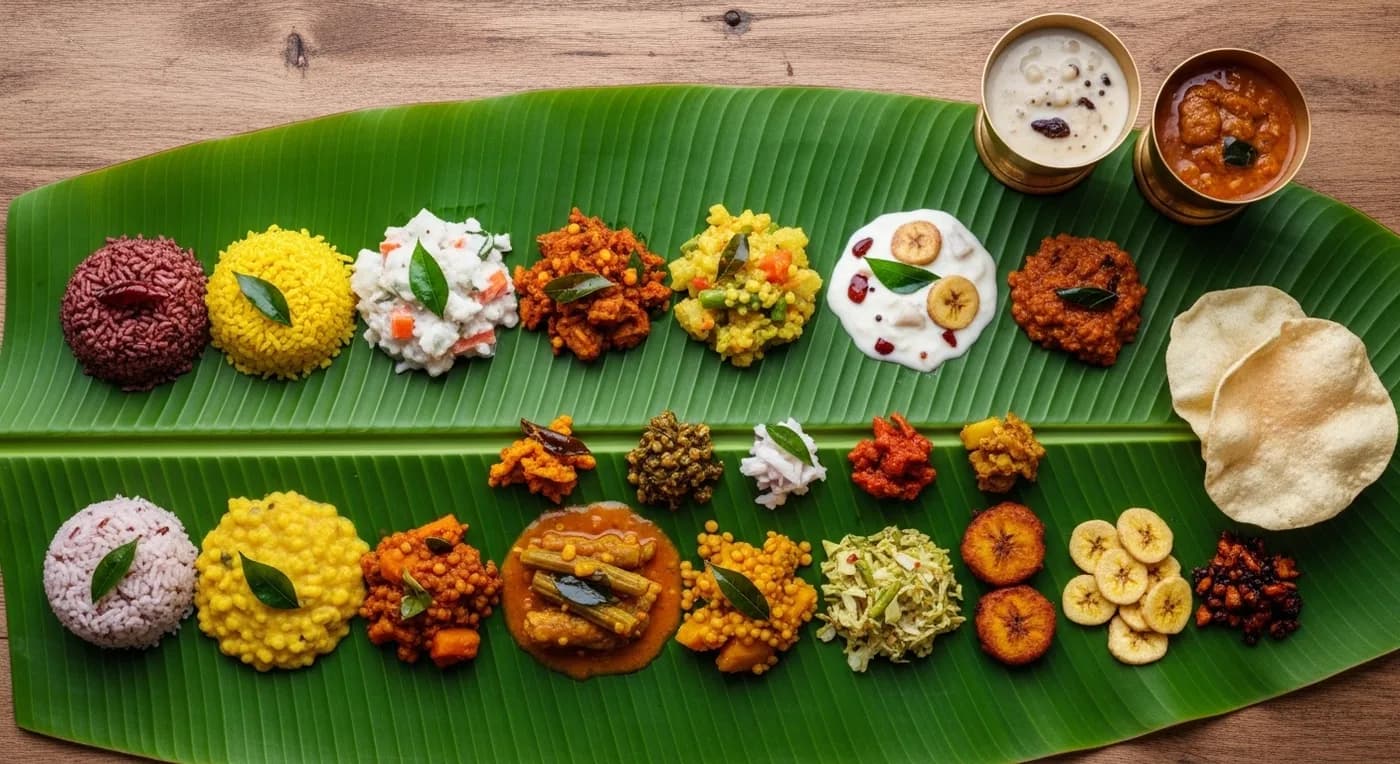
Kerala Wedding Sadhya & Catering Cost: 2026 Pricing Guide

Kerala Wedding Budget Guide: 2026 Cost Breakdown
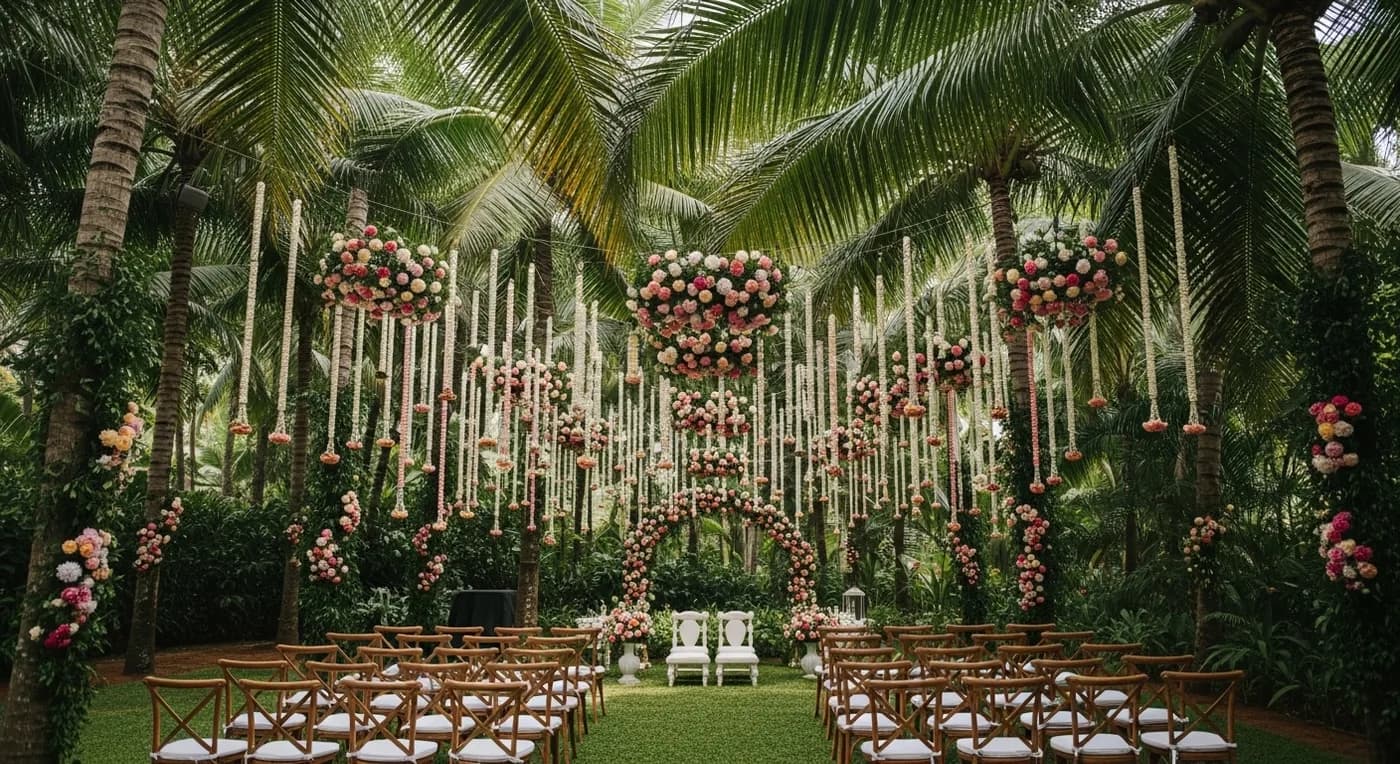
Best Wedding Venues Kerala: ₹50K-₹25L With Prices (2026)
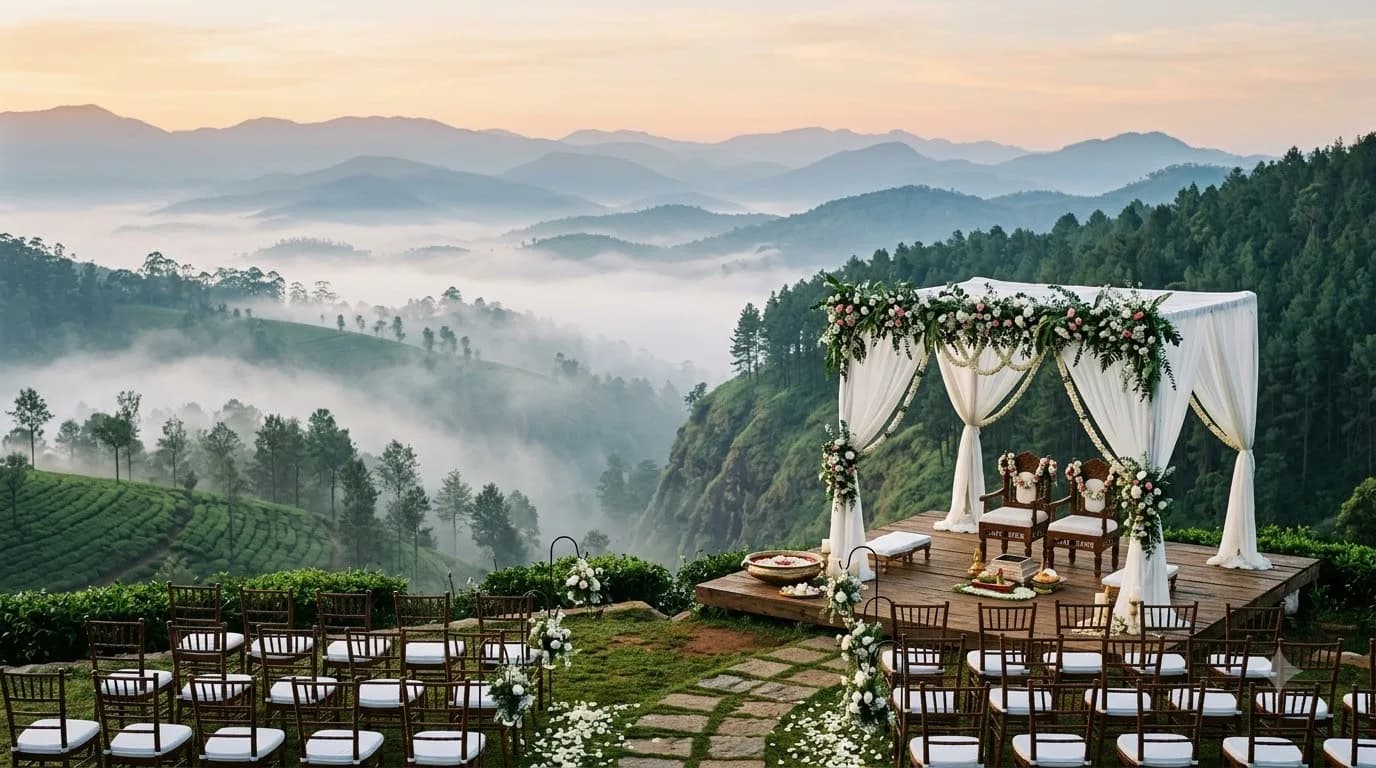
Best Season for South India Destination Weddings: Month-by-Month Western Ghats Guide
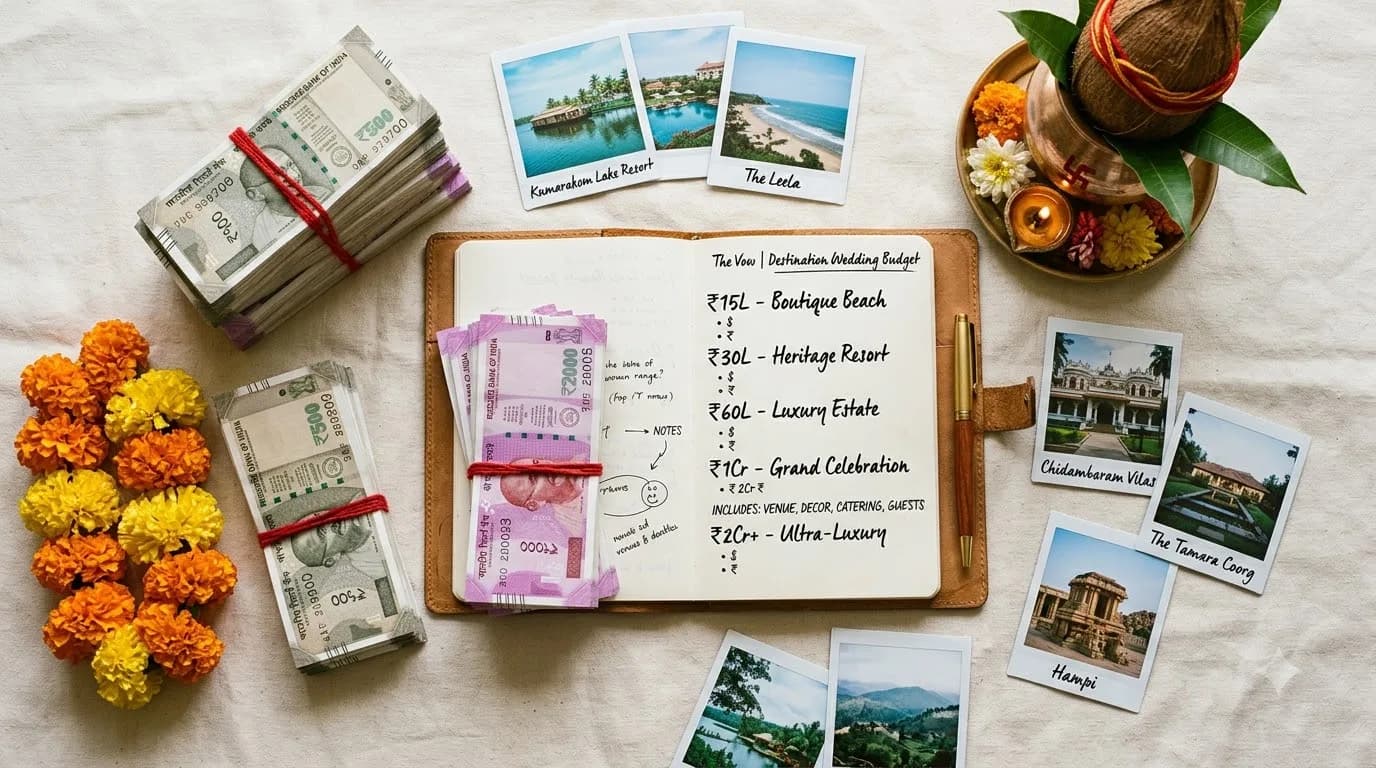
Destination Wedding Cost in South India 2026: 5-Tier Budget Guide
Destination Wedding in South India: Complete 2026 Planning Guide
Still planning?
Get quotes from India's best vendors
Tell us what you're planning and we'll match you with verified photographers, venues, decorators, and more.
Get free quotes