
Kerala Wedding Catering: Sadya vs Buffet Cost Guide (2026)
Kerala wedding catering costs ₹400–800 per plate for sadya vs ₹700–1,500 for buffet. Compare all 3 formats with detailed 2026 pricing for 500+ guests.

Wedding Finance Advisor
Arjun Das is a wedding finance advisor who helps couples across Kerala plan celebrations that match their vision without breaking the bank.
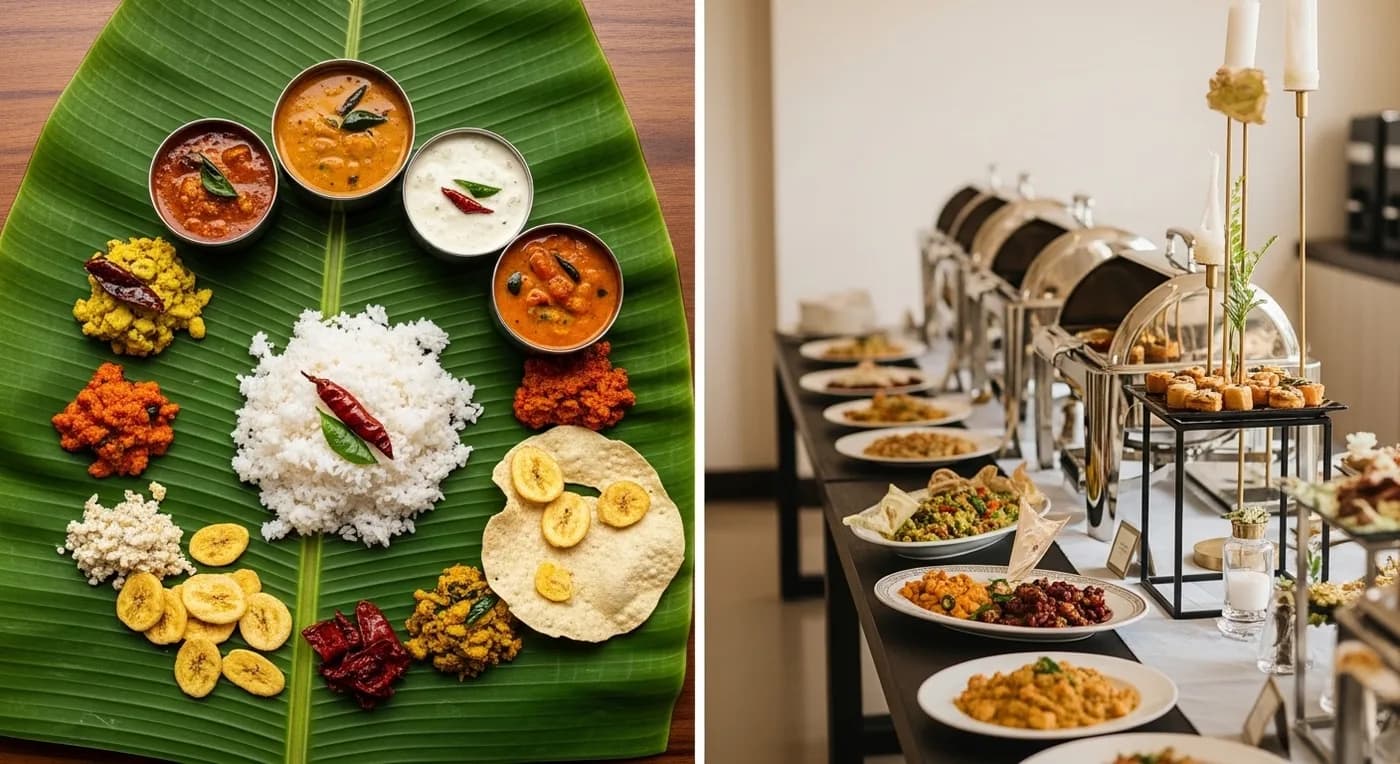
On this page
Kerala wedding catering costs ₹400–800 per plate for traditional sadya, ₹700–1,500 for buffet, and ₹1,500–3,000+ for multi-cuisine. Sadya is the most cost-effective for large guest lists (500+) and deeply traditional. Buffet offers variety and lower waste. The growing trend is a hybrid approach: sadya for the ceremony, buffet for the reception — budget 30–40% more than single-format.
Quick Answer
Quick answer: Kerala wedding catering ranges from ₹400–800/plate for sadya to ₹700–1,500 for buffet and ₹1,500–3,500+ for multi-cuisine. For 500 guests, sadya costs ₹2–6 lakh; buffet ₹3.5–7.5 lakh; multi-cuisine ₹7.5–17.5 lakh. The hybrid approach — sadya for the ceremony meal, buffet for the evening reception — is the fastest-growing format and costs 30–40% more than single-format.
Note
Pricing methodology: Cost ranges in this guide are based on vendor pricing data from the itsmy.wedding marketplace and published industry reports, collected in Q4 2025 – Q1 2026.
No part of a Kerala wedding is judged as relentlessly as the food. Guests who struggle to recall the decor colour or the wedding music will remember with perfect clarity whether the sambar was well-made, how many payasams were served, whether the rasam had the right sourness, and whether the buffet line moved without chaos. In a state where hospitality is a form of cultural identity, the meal you serve is a statement about who you are as a family.
It is also, without exception, the largest single expense in most Kerala wedding budgets — or very close to it. With India's wedding industry valued at ₹10.79 lakh crore and projected to reach ₹24 lakh crore by 2030, catering regularly accounts for 25 to 35 percent of the total wedding spend (based on itsmy.wedding budget data). A WedMeGood survey of 2,000+ couples found that food and beverage is consistently the single largest line item in Indian wedding budgets. For a 500-guest wedding in Ernakulam or Thrissur, this translates to 5 to 15 lakhs depending on format, tier, and whether you are catering one event or two. The decision you make about catering format — traditional sadya, modern buffet, multi-cuisine, or some combination — shapes not just your budget but your guest experience, your logistics, your venue requirements, and the cultural tone of the entire celebration.
This guide exists to make that decision as clear as possible. It covers all three primary catering formats used at Kerala weddings, what each costs in 2026 across different guest count brackets, the practical logistics of each, their cultural fit, and how to choose the right caterer to execute your vision. For context on how catering fits into your overall wedding spend, start with the Kerala Wedding Budget Guide. For detailed sadya-specific pricing by district and dish tier, our Kerala Wedding Sadya & Catering Cost guide goes deeper on the numbers.
Quick Comparison: Sadya vs Buffet vs Multi-Cuisine
Before diving into the detail, here is how the three main formats stack up across the factors that matter most to families planning a Kerala wedding.
| Factor | Traditional Sadya | Modern Buffet | Multi-Cuisine / Plated |
|---|---|---|---|
| Per-plate cost (2026) | ₹400–1,200 | ₹700–1,500 | ₹1,500–3,500+ |
| Total for 500 guests | ₹2–6 lakhs | ₹3.5–7.5 lakhs | ₹7.5–17.5 lakhs |
| Cultural fit | Strongest — deepest tradition | Moderate — widely accepted | Lowest — more suited to reception |
| Guest experience | Seated, communal, structured | Self-serve, flexible, casual | Elegant, personalised, slower |
| Logistics complexity | High (batch serving, leaf sourcing) | Moderate (equipment, line management) | Highest (service staff, kitchen needs) |
| Dietary accommodation | Vegetarian only by default | Easily customised | Maximum flexibility |
| Food waste | Moderate (fixed portions) | Low (self-serve portions) | Low (to-order or plated) |
| Serving time for 500 guests | 90–120 min (multiple batches) | 60–90 min (open line) | 120–180 min (plated) |
| Best for | Morning ceremony, large guest lists | Evening reception, 200–600 guests | Intimate weddings, elite receptions |
| Setup requirement | Banana leaves, serving crew | Chafing dishes, counters, equipment | Full kitchen access, service staff |
This table is a starting point. The right choice depends on your guest profile, venue, cultural community, time of day, and how you want your wedding to feel. The sections below explore each format in the depth that decision deserves.
The Traditional Sadya: Kerala's Gold Standard
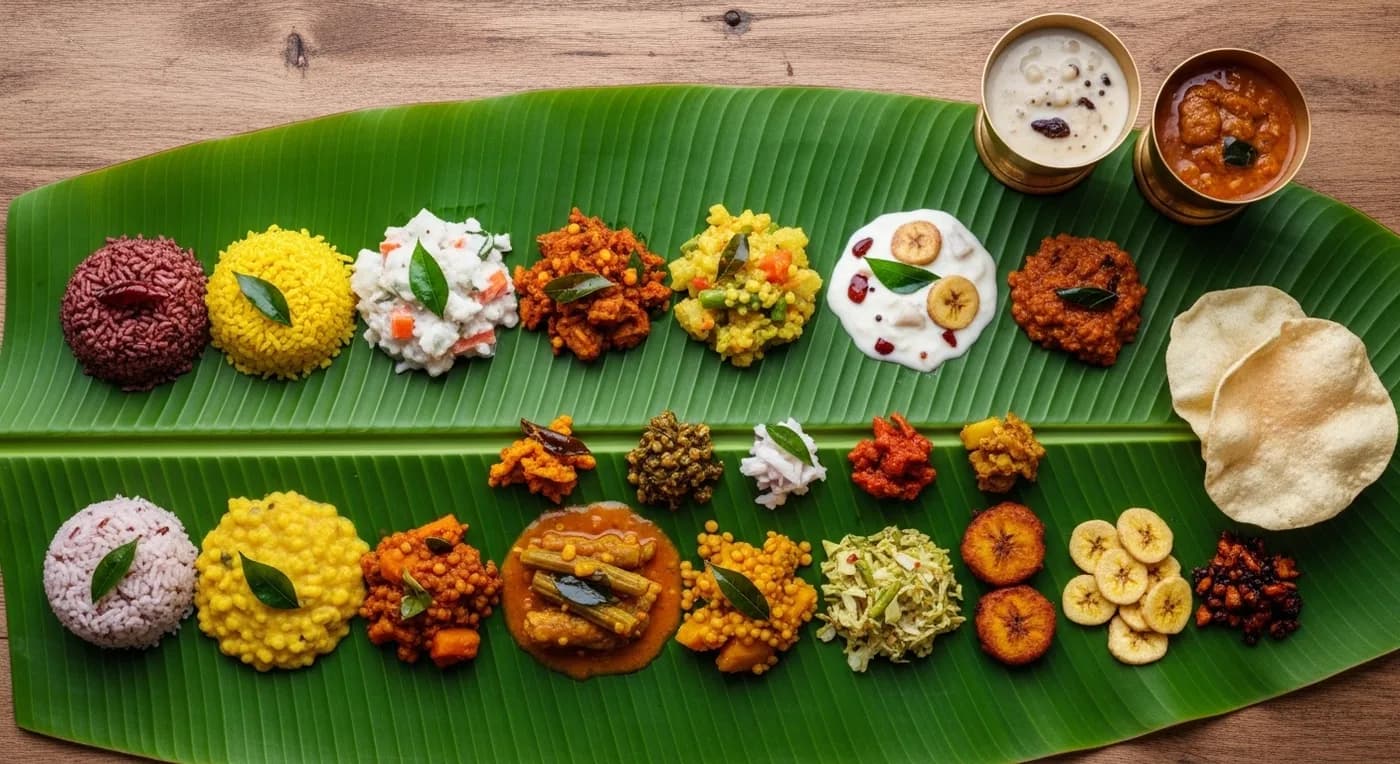
The sadya is not merely a meal. It is a ritual, a sequence, a cultural performance that has been refined across centuries of Kerala's civilisational history. Served on a fresh banana leaf with the stem end pointing to the left of the diner, the sadya unfolds in a specific order — salt and pickle first, then the vegetable preparations, then rice with parippu and ghee, followed by sambar, rasam, pulissery, and finally the payasam that marks the meal's conclusion. No part of this sequence is arbitrary. Each step is designed to balance flavours, aid digestion, and create a satisfying arc from the first taste to the last.
What a Full Wedding Sadya Includes
A standard Kerala wedding sadya contains 20 to 24 items. A premium sadya expands this to 26 to 30 or more. Here is the complete list of items a well-executed wedding sadya should contain, organised by their position on the leaf:
Upper left (accompaniments and savouries):
- Upperi — salted banana chips, deep-fried in coconut oil
- Sharkkara varatti — jaggery-coated banana chips, sweet and crunchy
- Papadam — two pieces, placed horizontally above the serving area
Left side (curd-based and mild preparations):
- Pachadi — sweet-sour curd preparation with pineapple or cucumber
- Kichadi — curd-based preparation with mustard and ground coconut, distinct from pachadi
- Olan — ash gourd and cowpeas in thin coconut milk, finished with coconut oil and curry leaves
- Kalan — raw banana and yam in thick curd-coconut gravy
Centre and right (main vegetable preparations):
- Aviyal — mixed vegetables in thick coconut-curd sauce, the centrepiece of the sadya
- Erissery — pumpkin and Bengal gram in roasted coconut preparation
- Thoran — dry-fried vegetables with grated coconut (cabbage, beans, or green banana)
- Mezhukkupuratti — vegetables stir-fried in coconut oil with minimal spice
- Kaalan curry — raw banana in black pepper and curd gravy
Rice and gravies (served progressively):
- Matta rice or par-boiled rice — served in two or three rounds
- Parippu — dal, served with ghee as the opening course
- Sambar — served with the second round of rice
- Rasam — lighter and more pungent, served with the third round
- Pulissery — a mild curd curry to settle the palate
Pickles and finishing touches:
- Inji puli — ginger in tamarind-jaggery sauce (non-negotiable)
- Naranga achaar — lime pickle
- Mango pickle (when in season)
- Ghee — ladled generously alongside parippu
Payasam (the grand finale):
- Palada pradhaman — rice flakes in jaggery and coconut milk
- Parippu pradhaman — moong dal in jaggery and coconut milk
- Semiya payasam — vermicelli in sweetened milk (standard third variety)
- Premium additions: ada pradhaman, chakka pradhaman, gothambu payasam, kadala pradhaman, pal payasam
Fruit:
- Small nendran banana, placed at the top right of the leaf
Sadya Cost Tiers in 2026
₹400 – ₹1,200| Tier | Per Plate | Dish Count | Payasams | What You Get |
|---|---|---|---|---|
| Entry | ₹400–600 | 18–20 items | 2 | Core sadya items, basic serving, minimal staff |
| Standard | ₹600–800 | 22–24 items | 2–3 | Full traditional spread, coordinated serving rounds |
| Premium | ₹800–1,000 | 24–26 items | 3–5 | Elevated ingredients, trained serving crew, team lead |
| Gourmet | ₹1,000–1,200 | 26–30+ items | 5–7 | Organic/heirloom sourcing, custom presentations |
The standard tier — at ₹600 to ₹800 per plate — is where most Kerala families land and where value is highest. This is the sadya that elders will consider "done properly." The gourmet tier is growing in urban Kochi and Trivandrum, particularly among NRI families who want the tradition but with exceptional execution.
Why Sadya Works for Large Weddings
Sadya's fundamental advantage for large Kerala weddings is efficiency of scale. It is the most cost-effective way to feed 500 or 1,000 guests a satisfying, culturally appropriate meal. The serving system — trained staff moving in coordinated rounds down the rows of seated guests — is specifically designed for mass hospitality. A well-organised sadya can seat and serve 200 guests in 40 to 50 minutes per batch, according to experienced sadya caterers,, meaning a 600-guest list can be fed in three batches across 2.5 hours without any guest feeling rushed.
The banana leaf serving format also keeps food waste low. Portions are controlled by the serving staff, and the sequential nature of the meal ensures guests do not load up on one item and ignore others. The vegetarian-only composition means there are no complex dietary allergies to manage beyond gluten and nut sensitivities, which are easily accommodated.
The strongest argument for sadya, however, is cultural. At a Kerala Hindu wedding, serving a proper banana leaf sadya is not optional — it is expected. At Christian and many Muslim weddings, it is the norm for the morning ceremony. Guests of the older generation will judge the wedding by the sadya's quality more than by any other element. A caterer who makes the sambar correctly, serves the payasam hot, and runs clean serving rounds earns your family respect that no buffet spread can replicate.
Tip
Looking for Caterings?
Tell us what you need and get quotes from verified caterings
Sadya Logistics: What You Need to Plan
Serving a sadya for a large wedding requires logistical precision that many families underestimate. The banana leaves must arrive fresh on the morning of the wedding — during peak season (November to January), leaf shortages are common, and confirming that your caterer handles leaf sourcing in writing is essential. You need a minimum of 8 to 10 trained servers per 100 guests for seated serving. The venue needs a floor layout that allows serving staff to move freely down rows without bottlenecks.
Sadya is served in batches, called "panthi" in Kerala. Confirm the planned batch size with your caterer, the gap between batches, and how they coordinate with the wedding ceremony timeline to ensure the ceremony concludes before the first batch is seated. The most common sadya disruption is a ceremony running 30 to 45 minutes late while 200 guests stand waiting. Your wedding coordinator and caterer must communicate directly on timing.
The Modern Buffet: Flexibility and Variety
Buffet formats became increasingly popular at Kerala wedding receptions from the early 2010s. With WeddingWire India reporting a national average of 330 guests per wedding, the buffet's flexibility and self-serve efficiency have made it the default expectation at evening events across Kochi, Trivandrum, Thrissur, and Kozhikode. It replaced the traditional sit-down reception dinner because it serves the social nature of the reception better — guests move freely, conversation flows more naturally, and the relaxed pacing suits an evening of mingling and dancing rather than the focused, seated experience of a morning ceremony.
What a Wedding Buffet Includes
A well-constructed Kerala wedding buffet in 2026 typically contains:
Kerala counter (the anchor): Kerala fish curry, avial, thoran, appam with stew, and a small sadya-style selection for guests who prefer traditional items. Karimeen pollichathu or prawn masala as premium additions.
Non-vegetarian proteins: Two chicken preparations (typically a Kerala-style curry and a drier preparation like chicken fry or roast), one or two fish preparations, and at the premium end, mutton or prawn. Biriyani — dum-style with chicken or mutton — is almost always the star of the buffet and draws the longest queues.
North Indian counter: Paneer butter masala, dal makhani, naan or roti from a live tandoor, and butter chicken. This counter exists for out-of-state guests and younger attendees with pan-Indian palates.
Rice and breads: Fried rice, plain rice, Kerala porotta, and chapati alongside the various curries.
Salad and soup: A simple salad counter and one soup option — typically a clear chicken soup or a cream of vegetable — round out the meal as lighter alternatives.
Dessert counter: Minimum two options: payasam (palada pradhaman is standard) and something modern — gulab jamun, ice cream, or a wedding cake for the cutting ceremony.
Buffet Cost Tiers in 2026
₹700 – ₹1,500| Format | Per Plate | What's Included | Best For |
|---|---|---|---|
| Vegetarian buffet | ₹700–1,000 | South + North Indian veg, desserts | Purely vegetarian families |
| Standard non-veg buffet | ₹1,000–1,300 | Kerala + NI counters, 1–2 proteins | Most Kerala receptions |
| Premium non-veg buffet | ₹1,300–1,500 | Multiple proteins, live stations, expanded desserts | Urban celebrations, 200–600 guests |
The per-plate cost gap between sadya and buffet — roughly ₹300 to ₹700 per plate at comparable quality levels — is real. However, caterers report that buffet waste is typically 15 to 25 percent lower than sadya because guests self-select portions. For smaller weddings under 300 guests, this waste saving narrows the effective cost difference. For weddings over 500, the buffet's higher per-plate cost is more significant in absolute terms.
Buffet Pros
Dietary accommodation is straightforward. A buffet can easily label vegetarian, non-vegetarian, and vegan options, and can include a separate Jain preparation if required. Managing allergies in a buffet context is far simpler than in a seated sadya where the serving staff must track individual guest requirements across a crowded hall.
Guest experience at receptions. Buffet eating is social. Guests form organic groups at the counter, reconnect with distant relatives, and move at their own pace. The reception atmosphere — louder, more festive, with music and dancing — pairs naturally with the flexibility a buffet provides. A seated sadya at a reception can feel too formal for the mood the evening is trying to create.
Easier guest count flexibility. Adding or reducing 30 guests the week before the wedding is manageable with a buffet — the caterer adjusts quantities. With a batch-served sadya, every addition creates logistical ripples across the panthi arrangement.
Buffet Cons
Higher cost per plate. This is the primary disadvantage. A buffet requires more diverse ingredients, chafing dish equipment, counter infrastructure, and a longer service window — all of which cost more than the banana leaf and serving crew setup of a sadya.
Service staff requirements are different, not lower. A common misconception is that buffets need less staff. A 500-guest wedding buffet needs counter staff to replenish dishes, manage queues, serve from live stations, and handle the dessert counter. While the ratio per 100 guests is lower (5 to 6 versus 8 to 10 for sadya, per caterer staffing guidelines), the total staff number for a large event is comparable.
Equipment dependency. Chafing dishes, Sterno fuel, buffet tables, serving utensils, and sneeze guards must all be available and functioning. At outdoor venues or heritage properties without proper kitchen infrastructure, this creates logistics challenges that a simple banana leaf sadya largely avoids.
Multi-Cuisine and Plated Service: When to Consider It
Multi-cuisine catering — a step beyond the standard buffet — incorporates multiple culinary traditions (Kerala, North Indian, Continental, East Asian, and sometimes Middle Eastern) into a single event, often with live cooking stations for multiple formats. Plated service takes this further, with a structured course menu served to guests at their seats by dedicated service staff.
₹1,500 – ₹3,500This format is not the norm for Kerala weddings, but it has a specific and growing role: intimate weddings under 200 guests where the couple wants a restaurant-quality dining experience; elite receptions at five-star hotels in Kochi or Thiruvananthapuram where the venue's culinary team is part of the proposition; destination weddings at luxury resorts in Munnar or Kumarakom where the setting calls for a more refined dining experience; and NRI weddings where guests from multiple countries expect international food options.
What Multi-Cuisine Catering Typically Includes
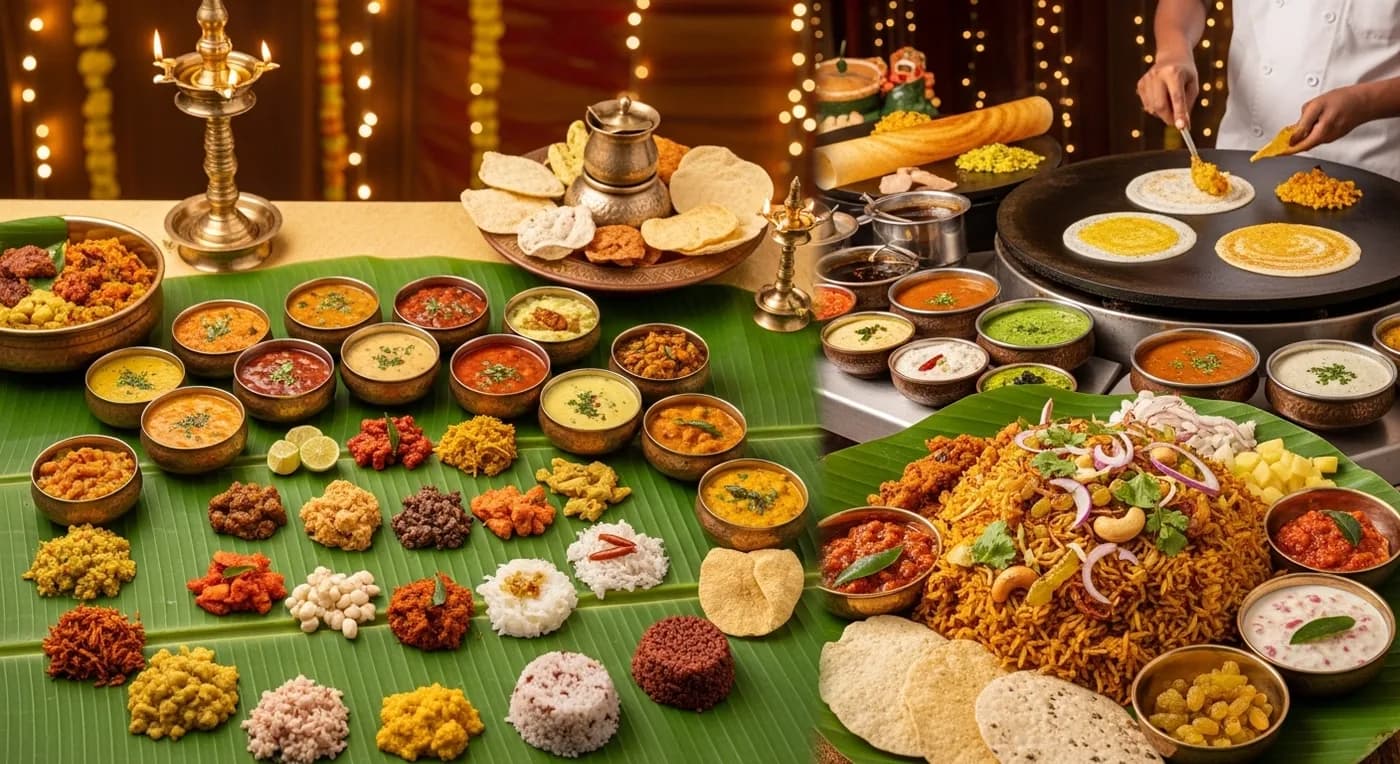
At the premium end in 2026, a multi-cuisine wedding spread might encompass a live dosa and appam station alongside a pasta bar, a tandoor counter serving seekh kebabs and paneer tikka, a Kerala seafood counter with karimeen and prawn preparations, a Continental station with carved meats or grilled fish, a global dessert room with French patisserie alongside traditional payasam, and a cocktail counter with mocktails and fresh juices. This level of variety creates genuine excitement at receptions and photographs beautifully, but it requires a venue with substantial kitchen infrastructure, a caterer with wide culinary range, and a service team large enough to staff multiple simultaneous stations.
Venue Requirements
Not all venues can support multi-cuisine catering. Hotels with full in-house kitchens and banquet experience — the Taj, Marriott, Crowne Plaza, and equivalent properties in Kochi and Trivandrum — are naturally suited to this format. Convention halls and auditoriums in Thrissur, Palakkad, and smaller cities typically lack the kitchen infrastructure for complex multi-cuisine execution. For outdoor venues at resorts or heritage properties, the caterer must bring portable kitchen equipment, which adds 20 to 30 percent to the base cost.
Note
Cost Reality Check
At ₹1,500 to ₹3,500 per plate, a multi-cuisine or plated reception for 500 guests costs ₹7.5 to ₹17.5 lakhs on catering alone before GST, beverages, and service charges. For most Kerala families, this represents a significant premium over a sadya-plus-buffet approach for the same guest count. The question is whether the elevated experience justifies the cost difference. For intimate weddings under 150 guests, the per-plate premium is more manageable (₹2.25 to ₹5.25 lakhs total) and the elevated experience per guest is more palpable. At 500 guests, the incremental cost difference can fund a honeymoon.
Looking for Caterings in Kochi?
Tell us what you need and get quotes from verified caterings
The Hybrid Approach: Sadya Morning, Buffet Evening
The most practical and increasingly popular catering strategy for Kerala weddings in 2026 is neither pure sadya nor pure buffet — it is a deliberate combination of both, matched to the natural rhythm of the wedding day.
The morning ceremony — typically a Hindu religious event, a church wedding, or a Nikah — is accompanied by a traditional sadya served on banana leaves. This honours cultural expectations, satisfies the older generation of guests who constitute the majority of the morning attendance, and keeps catering costs reasonable because sadya per-plate rates are significantly lower than buffet rates. The evening reception — a more relaxed, social event with music, dancing, and a younger guest mix — gets the buffet treatment: multiple cuisines, live stations, a dessert counter, and the flexibility that a longer, social evening demands.
Why the Hybrid Works
Different events have different guest profiles. Morning ceremony attendance skews toward older relatives and community members. Evening reception attendance is broader — friends, colleagues, and younger guests are more likely to attend. The food format should match the crowd. A seated sadya is perfect for elders; a self-serve buffet suits a mixed, younger group.
The meal timing is naturally different. A morning sadya at 11 AM to 1 PM is a full, satisfying meal. An evening reception starting at 7 PM calls for different food — something guests can eat while socialising, in smaller portions, with variety. The buffet format is simply better suited to the evening occasion.
Cost efficiency. The morning sadya at ₹600 to ₹800 per plate covers the largest crowd (100% of guests are typically present for the ceremony). The evening reception usually draws 60 to 70 percent of the ceremony guest count — people who cannot stay for the full day, guests who have other commitments. Running a buffet for a smaller evening crowd is more manageable than feeding the full wedding list.
Cost Modelling for the Hybrid Approach
For a 500-guest wedding (assuming 60% of guests attend the evening reception, so 300 evening guests):
- Morning sadya for 500 guests at ₹750 per plate: ₹3,75,000
- Evening buffet for 300 guests at ₹1,200 per plate: ₹3,60,000
- Total hybrid catering: ₹7,35,000
Compare this to:
- Sadya only for 500 guests: ₹3,75,000
- Buffet only for 500 guests: ₹6,00,000
- Multi-cuisine for 500 guests: ₹9,00,000–₹17,50,000
The hybrid approach costs 30 to 40 percent more than sadya-only (the most economical option) but delivers a meaningfully richer overall guest experience. It costs significantly less than buffet-only or multi-cuisine while maintaining cultural authenticity at the ceremony. For most Kerala couples in 2026 planning a 300 to 700-guest wedding, the hybrid is the right answer.
Logistics of Running Two Formats
The hybrid approach requires coordination that single-format catering does not. Your caterer must ideally be able to execute both formats, or you need two separate caterers with clear division of responsibilities, shared venue kitchen access, and a coordinator who manages the handoff between morning and evening service. Some Kerala caterers specialise in one format only — a sadya specialist may not have the equipment or range for a quality buffet. Confirm before signing contracts whether your caterer can competently execute both, or whether you need to engage a second operator for the evening.
Important
Cost Calculator: How Catering Scales with Guest Count
Here is a comprehensive view of total catering cost across five guest count brackets for each format, using 2026 mid-range per-plate rates. Evening reception counts assume 65% attendance for the hybrid model.
| Guest Count | Sadya Only (₹750/plate) | Standard Buffet (₹1,200/plate) | Hybrid: Sadya + Buffet | Multi-Cuisine (₹2,000/plate) |
|---|---|---|---|---|
| 200 guests | ₹1,50,000 | ₹2,40,000 | ₹2,18,000 | ₹4,00,000 |
| 300 guests | ₹2,25,000 | ₹3,60,000 | ₹3,10,000 | ₹6,00,000 |
| 500 guests | ₹3,75,000 | ₹6,00,000 | ₹5,10,000 | ₹10,00,000 |
| 700 guests | ₹5,25,000 | ₹8,40,000 | ₹7,20,000 | ₹14,00,000 |
| 1,000 guests | ₹7,50,000 | ₹12,00,000 | ₹10,20,000 | ₹20,00,000 |
Hybrid calculation method: Sadya for full guest count at ₹750/plate + evening buffet for 65% of guest count at ₹1,200/plate.
Important: These figures cover food and service staff only. Add 10 to 15 percent for GST (5% for independent caterers, 18% for hotel-based operations), plus banana leaf sourcing (₹5,000 to ₹15,000 for sadya events), beverage costs (₹40 to ₹80 per head), and any live station add-ons (₹300 to ₹800 per plate extra). For a 500-guest hybrid wedding, the all-in catering cost including GST and extras typically falls between ₹6 and ₹8 lakhs.
To see how this fits into your overall wedding budget, use the budget planning tool which lets you allocate catering costs alongside every other expense category and adjust numbers in real time as you finalise your plan. For ideas on how to build out your menu within each format, the Kerala Wedding Food Menu Ideas guide provides detailed options across every catering style.
How to Choose the Right Caterer
The most beautifully designed menu is worthless if the caterer cannot execute it for your guest count on the day. Kerala weddings have seen enough catering disasters — sadyas that ran out of payasam by the third batch, buffets where the biriyani was served cold, caterers who arrived 90 minutes late — that choosing a caterer deserves the same rigour you apply to choosing a photographer.
Tasting Sessions Are Non-Negotiable
Any caterer handling a wedding of 200 or more guests should offer a complimentary tasting session. This is standard practice across reputable operators in Kochi, Thrissur, Kozhikode, and Trivandrum. During the tasting, evaluate more than flavour — check the sambar temperature (it should arrive hot), the consistency of the rice (not mushy or undercooked), the payasam texture, and the presentation of the serving arrangement. Bring two or three family members whose opinions you trust, because taste preferences vary and consensus matters.
If a caterer charges for a tasting or refuses to offer one for a large booking, treat this as a warning signal. Confident caterers who do good work want you to experience their food before committing.
References and Recent Weddings
Ask for the contact details of three families for whom the caterer has handled weddings in the past six months at a similar guest count. Call these references and ask specifically: Did the caterer arrive on time? Did any dish run short during later servings or batches? Was the payasam consistent in the final rounds or diluted? Did the crew clean up promptly and completely? References are more useful than portfolios for food — you cannot taste a photograph.
Also ask whether the caterer has experience with your specific venue. Caterers who have worked at your hall or resort before know the kitchen setup, loading dock logistics, and the venue coordinator's expectations. This familiarity prevents surprises on the day.
Contract Essentials
Get everything in writing before paying any advance. A proper catering contract should specify: the full menu with individual dish names and count, per-plate rate and total guest count, service staff headcount, serving timeline and batch sizes (for sadya), setup and breakdown times, banana leaf sourcing responsibility (if applicable), beverage inclusions and exclusions, GST rate and applicable percentage, payment schedule with advance amount and balance due date, cancellation and refund terms, and what happens if the guest count changes by more than 10 percent.
Tip
If you are looking for vetted caterer recommendations across Kerala's major wedding cities, our best wedding caterers in Kerala guide profiles top operators by district and specialty. For a comprehensive checklist of questions to ask before signing with any catering vendor — covering contract terms, staff ratios, contingency plans, and red flags — read our Questions to Ask Wedding Vendors in Kerala guide.
FSSAI Licensing and Food Safety
Verify that your caterer holds a valid FSSAI licence before signing any contract. This is a mandatory requirement for all commercial food operators in India, and any serious caterer in Kochi, Thrissur, Kozhikode, or Trivandrum will have one. Beyond compliance, it signals that the operator takes hygiene and food safety seriously. Ask whether they carry event liability insurance — increasingly common among premium caterers in urban Kerala — which provides coverage if any guest experiences food-related illness.
Matching Caterer to Format
Specialist caterers outperform generalists in their specific format. In Thrissur and Palakkad, there are sadya caterers who have been doing nothing else for three generations — their supply chains, crew training, and serving systems are optimised for this one format at scale, and they simply cannot be matched by a multi-cuisine operator who treats sadya as one service among many. Conversely, a hotel banquet kitchen with a culinary team that does multi-cuisine events weekly will run a smoother Continental-and-Asian live station spread than a traditional sadya caterer stretched outside their expertise.
Match the caterer's core competency to the format you need. If you are running the hybrid approach with two formats, engage two specialists — or one versatile operator who can genuinely demonstrate strong execution in both formats through references and tastings. Do not assume a caterer can do everything well just because they claim to.
Catering is the one element of your Kerala wedding that guests will form a clear, lasting opinion about before they even reach the car park. Getting it right — the right format for your ceremony, the right tier for your budget, the right caterer for your venue and guest count — is worth the time this research takes. The choice between sadya, buffet, and multi-cuisine is not a matter of one being better than the others: it is a matter of which format serves your specific wedding, your guests, your cultural context, and your budget with the most integrity. Make that choice clearly, put the right caterer in place to deliver it, and the food at your wedding will be what people are still talking about years later.
For a complete picture of where catering fits in your total wedding spend, the Kerala Wedding Budget Guide covers every expense category with realistic 2026 numbers across multiple budget tiers. And if you are still exploring what a full sadya menu should look like before meeting caterers, our Kerala Wedding Food Menu Ideas guide gives you the vocabulary to evaluate proposals with confidence.
Common Questions About Kerala Wedding Catering
How much does sadya cost per plate at a Kerala wedding in 2026?
Traditional sadya costs ₹400 to ₹800 per plate depending on the number of dishes (typically 20 to 28 items), quality of ingredients, and whether the caterer uses organic or premium rice varieties. A standard 22 to 24-item sadya with two to three payasams and a trained serving crew costs ₹600 to ₹800 per plate at most venues across Kerala. Gourmet or premium sadya with heirloom rice varieties like Palakkadan matta, five or more payasam types, and organic ingredient sourcing can reach ₹800 to ₹1,200 per plate. District-level variation is significant: Palakkad is 15 to 20 percent cheaper than the state average; Kochi is 15 to 25 percent more expensive.
Is buffet catering more expensive than sadya?
Yes. Buffet catering costs ₹700 to ₹1,500 per plate for a standard spread and ₹1,500 to ₹3,000 or more for premium multi-cuisine options. While the buffet per-plate cost is higher, portion waste is typically 15 to 25 percent lower because guests serve themselves, which partially offsets the per-plate premium. For weddings over 500 guests, the total cost gap between sadya and buffet is substantial — often ₹2 to ₹4 lakhs. For intimate weddings under 200 guests, the gap narrows enough that the choice becomes more about experience than pure budget.
Can I serve both sadya and buffet at my Kerala wedding?
Yes, and this is the most popular approach for modern Kerala weddings with both a morning ceremony and an evening reception. The hybrid model serves sadya at the ceremony (most cost-effective, culturally appropriate for the morning context) and a buffet at the reception (better suited to the social, evening atmosphere). Budget an additional 30 to 40 percent over sadya-only catering costs, but significantly less than buffet-only for the full guest list. For a 500-guest wedding, the hybrid typically costs ₹5 to ₹8 lakhs all-in versus ₹3.75 to ₹5 lakhs for sadya-only and ₹6 to ₹10 lakhs for buffet-only.
How many items should a Kerala wedding sadya have?
A standard Kerala wedding sadya has 20 to 24 items served on a banana leaf, including rice, sambar, rasam, pulissery, aviyal, thoran, olan, pachadi, kichadi, kalan, erissery, inji puli, pickle varieties, papadam, banana chips, sharkkara varatti, ghee, and two to three payasams. Premium sadyas extend to 26 to 30 items with additional curries, more payasam varieties (five to seven), and seasonal specialties. When evaluating caterer proposals, count the individual dish names listed — a "26-item sadya" that lists papadam and banana as two of those items is not the same as one where both are included beyond the core 24-item count. Ask caterers to list every item explicitly.
Topics
Kerala wedding cateringsadya vs buffet weddingKerala wedding foodwedding catering cost Keralasadya cost per platemulti-cuisine wedding KeralaExplore more
Frequently Asked Questions
1How much does sadya cost per plate at a Kerala wedding in 2026?
2Is buffet catering more expensive than sadya?
3Can I serve both sadya and buffet at my Kerala wedding?
4How many items should a Kerala wedding sadya have?
Continue reading
Related Articles

Kerala Wedding Budget Guide: 2026 Cost Breakdown
Kerala Wedding Sadhya & Catering Cost: 2026 Pricing Guide
Kerala Wedding Food Menu Ideas: Beyond the Traditional Sadya
Best Season for South India Destination Weddings: Month-by-Month Western Ghats Guide
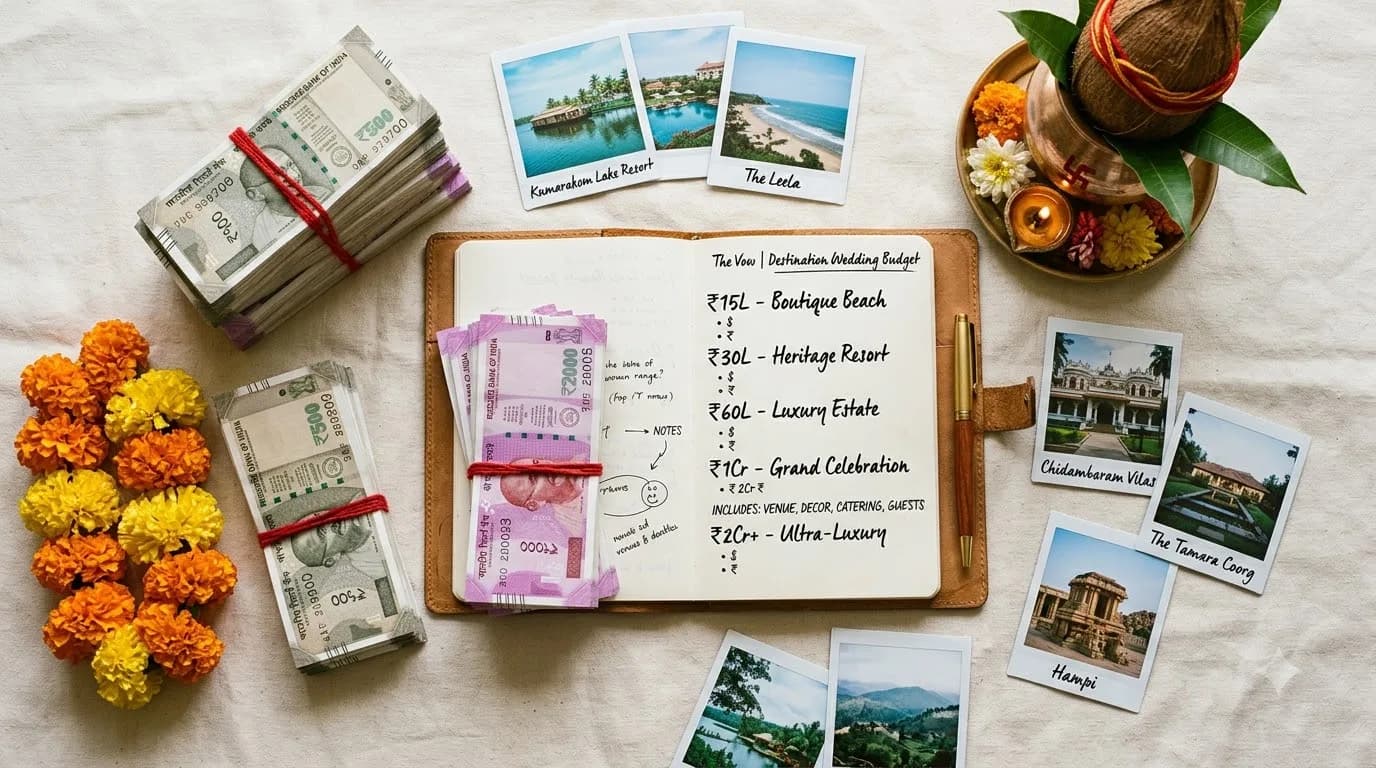
Destination Wedding Cost in South India 2026: 5-Tier Budget Guide
Destination Wedding in South India: Complete 2026 Planning Guide
Still planning?
Get quotes from India's best vendors
Tell us what you're planning and we'll match you with verified photographers, venues, decorators, and more.
Get free quotes