
Kerala Wedding by Religion: Hindu, Christian & Muslim
Comprehensive guide to planning Kerala weddings across Hindu, Christian, and Muslim traditions — rituals, costs, timelines, and venue selection for each community.

Senior Wedding Planner
Priya Nair is a senior wedding planner based in Kochi with over eight years of experience coordinating Hindu, Christian, and destination weddings across Kerala.
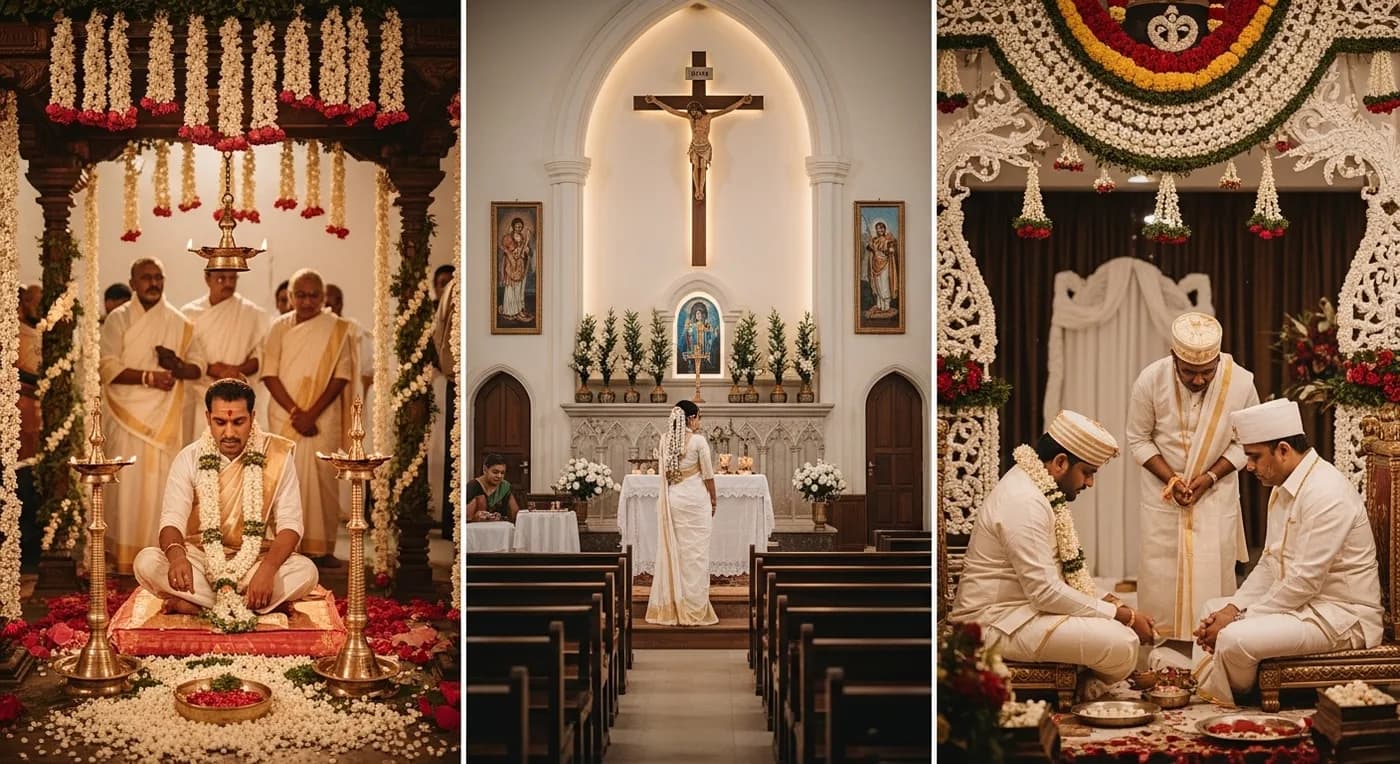
On this page
Kerala's three major wedding traditions — Hindu, Christian, and Muslim — each require distinct planning approaches, from ceremony rituals and venue selection to catering and guest management. Hindu weddings centre on the muhurtham and sadya, Christian ceremonies on the church and reception, and Muslim weddings on the Nikah and walima. This guide covers the complete planning framework for each.
Quick Answer
Quick answer: Kerala's three major wedding traditions — Hindu, Christian, and Muslim — each require distinct planning approaches, from ceremony rituals and venue selection to catering and guest management. Hindu weddings centre on the muhurtham and sadya, Christian ceremonies on the church and reception, and Muslim weddings on the Nikah and walima. This guide covers the complete planning framework for each.
Kerala is one of the few states in India where three major religions coexist in near-equal cultural prominence. According to the 2011 Census of India, Hindus constitute 54.73% of the population, Muslims 26.56%, and Christians 18.38%. In an Indian wedding industry valued at over 10.79 lakh crore, each community has shaped a wedding tradition that is unmistakably Malayali yet profoundly distinct in ritual, scale, and planning requirements.
This pillar guide covers rituals, costs, timelines, venue logic, and seasonal considerations for every major religious wedding in Kerala. For a broader view of shared cultural motifs, see our Kerala wedding traditions pillar page. For a complete hour-by-hour ceremony timeline across all three communities, see our Kerala wedding ceremony sequence.
Understanding Kerala's Wedding Landscape
Kerala's wedding market is shaped by three religious communities that each bring distinct spending patterns, seasonal preferences, and logistical requirements to the planning process. Understanding these macro differences before diving into community-specific details saves months of misdirected effort.
Religious Demographics and Wedding Volume
Kerala's population of approximately 3.46 crore (Census 2011) produces an estimated 3.5 to 4 lakh weddings annually. Hindu weddings account for the largest share by volume, but Muslim and Christian weddings often match or exceed Hindu celebrations in per-event spending — particularly in Kozhikode and Malappuram (Muslim-majority) and Kottayam and Ernakulam (significant Christian populations). Research from the Centre for Policy Studies shows Muslim families now account for a growing share of wedding-related spending in northern Kerala.
Season and Calendar Differences
The three communities follow fundamentally different calendars for scheduling weddings, which directly impacts vendor availability and venue pricing across the state.
- Hindu weddings are governed by the Panchangam and astrological muhurtham dates. Peak months fall in Medam (April-May) and Thulam (October-November) in the Malayalam calendar. The months of Karkidakam (July-August) and Mithunam (June-July) are generally avoided. Our muhurtham dates guide for 2026-2027 lists every auspicious date.
- Christian weddings are not bound by astrological timing but follow the liturgical calendar. Weddings are popular from October through February. The 40-day Lent period (February-April) is strictly avoided by most denominations, and Advent (December) is discouraged by some parishes.
- Muslim weddings follow the Islamic Hijri calendar. The month of Ramadan is universally avoided, while Shawwal (the month immediately after Ramadan) is considered especially auspicious for Nikah ceremonies, following the Prophetic tradition.
Tip
Cost Overview by Community
While individual wedding budgets vary enormously, the broad cost profiles differ by religion due to structural factors like venue type, catering style, and guest count norms. According to data from Kerala wedding planners and industry sources:
| Factor | Hindu | Christian | Muslim |
|---|---|---|---|
| Typical total cost | 10-25 lakhs | 12-30 lakhs | 8-20 lakhs |
| Guest count | 400-600 | 400-700 | 500-800 |
| Ceremony duration | 1-2 hours | 45 min-1.5 hours | 30-45 minutes |
| Largest expense | Sadya catering | Hotel reception | Walima feast |
| Peak season | Medam, Thulam | Oct-Feb (avoid Lent) | Post-Ramadan |
For a detailed breakdown of wedding costs across Kerala, see our Kerala wedding budget guide.
Kerala Hindu Wedding: Planning Overview
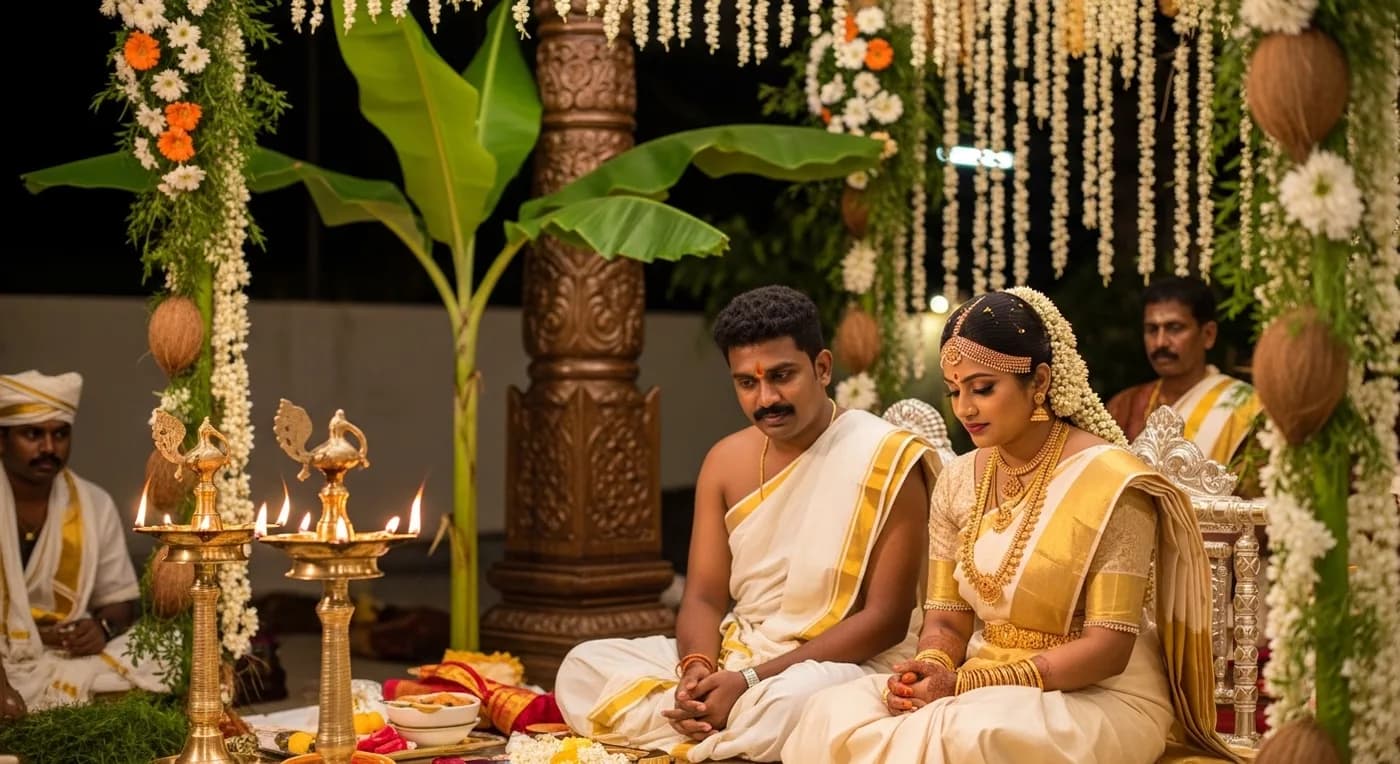
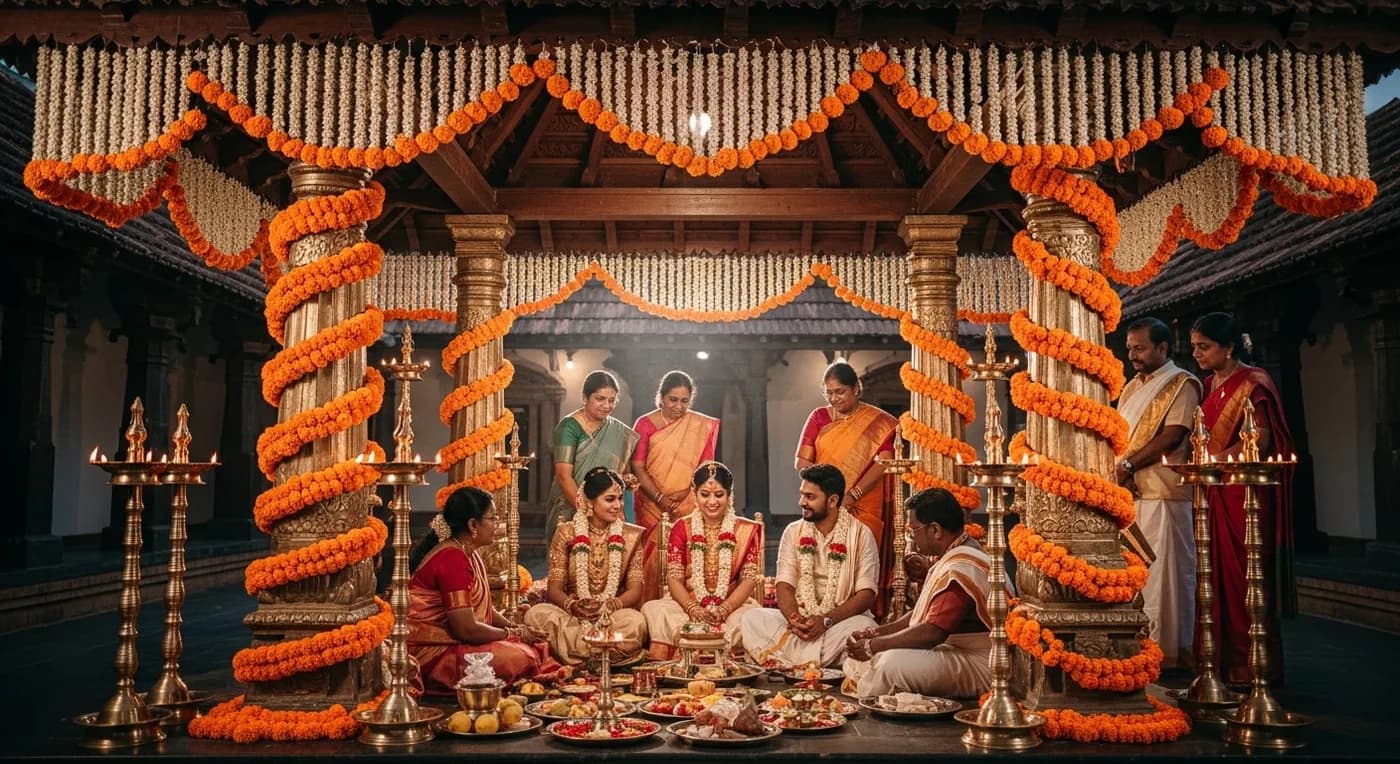
Hindu weddings in Kerala are structured around the muhurtham — an astrologically exact moment that determines every other planning decision, from venue booking to catering timing. The ceremony itself is elegant in its restraint compared to North Indian Hindu weddings, with white-and-gold attire, brass oil lamps, and a banana-leaf sadya forming the visual and cultural signature.
Key Rituals
The core Hindu wedding ceremony in Kerala follows a sequence refined over centuries. Each ritual has specific spatial, temporal, and material requirements that impact planning.
Nischayam (Engagement) marks the formal confirmation of the marriage. Both families meet to exchange rings and announce the wedding date. In 2026, many families hold the Nischayam at auditoriums with 100-200 guests, treating it as a standalone event.
Muhurtham (Auspicious Time) is the non-negotiable anchor of the entire wedding. A jyothishi (astrologer) examines both horoscopes and the Panchangam to identify the precise auspicious window — sometimes as narrow as 15-20 minutes. Temple venues enforce muhurtham slots strictly, and delays carry genuine social consequence.
Thalikettu (Tying the Sacred Thread) is the defining ritual. At the exact muhurtham, the groom ties the thali (mangalsutra) around the bride's neck on the decorated mandapam. The WeddingWire India guide to Kerala Hindu weddings notes that this single act constitutes the legal and spiritual solemnisation of the marriage. In Namboodiri weddings, the bride's father performs the thalikettu; in Nair and Ezhava traditions, the groom does.
Pudamuri (Gifting the Wedding Sari) follows the thalikettu. The groom presents the bride with a traditional kasavu sari — the iconic white-and-gold Kerala wedding garment. This symbolises the groom's commitment to the bride and is among the most photographed moments of any Kerala Hindu wedding.
Sadya (Wedding Feast) is the cultural centrepiece. Served on banana leaf with over 20 dishes including rice, sambar, avial, olan, thoran, pachadi, erissery, and multiple varieties of payasam, the sadya is how guests judge the wedding. According to Kerala catering services data, a traditional vegetarian ela sadya starts at 170-250 rupees per head, while non-vegetarian options range from 300-350 rupees per head — making catering for 400-600 guests the single largest budget line.
Sub-Community Differences
Kerala's Hindu community is not monolithic. The three largest sub-communities each bring distinct customs to the wedding mandapam.
Nair weddings are known for elegant simplicity — completed within an hour, with thalikettu and pudamuri as the primary rituals and no fire ceremony (homam). The Nair tradition reflects the community's historically matrilineal structure. Concentrated in Thrissur, Palakkad, Ernakulam, and Thiruvananthapuram. For a full walkthrough, see our upcoming Nair wedding guide.
Namboodiri (Brahmin) weddings, called Veli, follow full Vedic rites and are the most elaborate Hindu ceremonies in Kerala. The thali has two banyan-leaf-shaped gold pendants signifying Dwija (twice-born) status. The ceremony includes homam (fire rituals), Saptapadi (seven steps), and extensive Vedic chanting by multiple priests, extending to 2-3 hours.
Ezhava weddings are the shortest — a one-day affair reformed by Sree Narayana Guru, who introduced the formal vivaham ceremony. The Ezhava tradition has distinctive features: the mandapam must include a photo of Sree Narayana Guru, and bride and groom stand facing each other during thalikettu rather than sitting side by side.
Note
Typical Timeline and Costs
A standard Kerala Hindu wedding follows this timeline:
- 6-12 months before: Muhurtham selection, venue booking, engagement (Nischayam)
- 3-6 months before: Catering finalisation, photographer booking, invitation design
- 1-3 months before: Attire selection, jewellery, mandapam decoration planning
- 1-2 days before: Mehendi ceremony (increasingly popular), venue setup
- Wedding day: Muhurtham ceremony (morning), sadya (lunch), reception (evening, optional)
Total costs for a mid-range Hindu wedding with 500 guests in 2026: catering at 3-5 lakhs, venue at 1-3 lakhs, photography at 1.5-3 lakhs, decoration at 1-2 lakhs, attire and jewellery at 1-3 lakhs, and miscellaneous at 1-2 lakhs. The total ranges from 10 to 25 lakhs, with Kochi and Thrissur commanding premium pricing. See our guide on how to plan a Kerala wedding for a step-by-step timeline.
Kerala Christian Wedding: Planning Overview
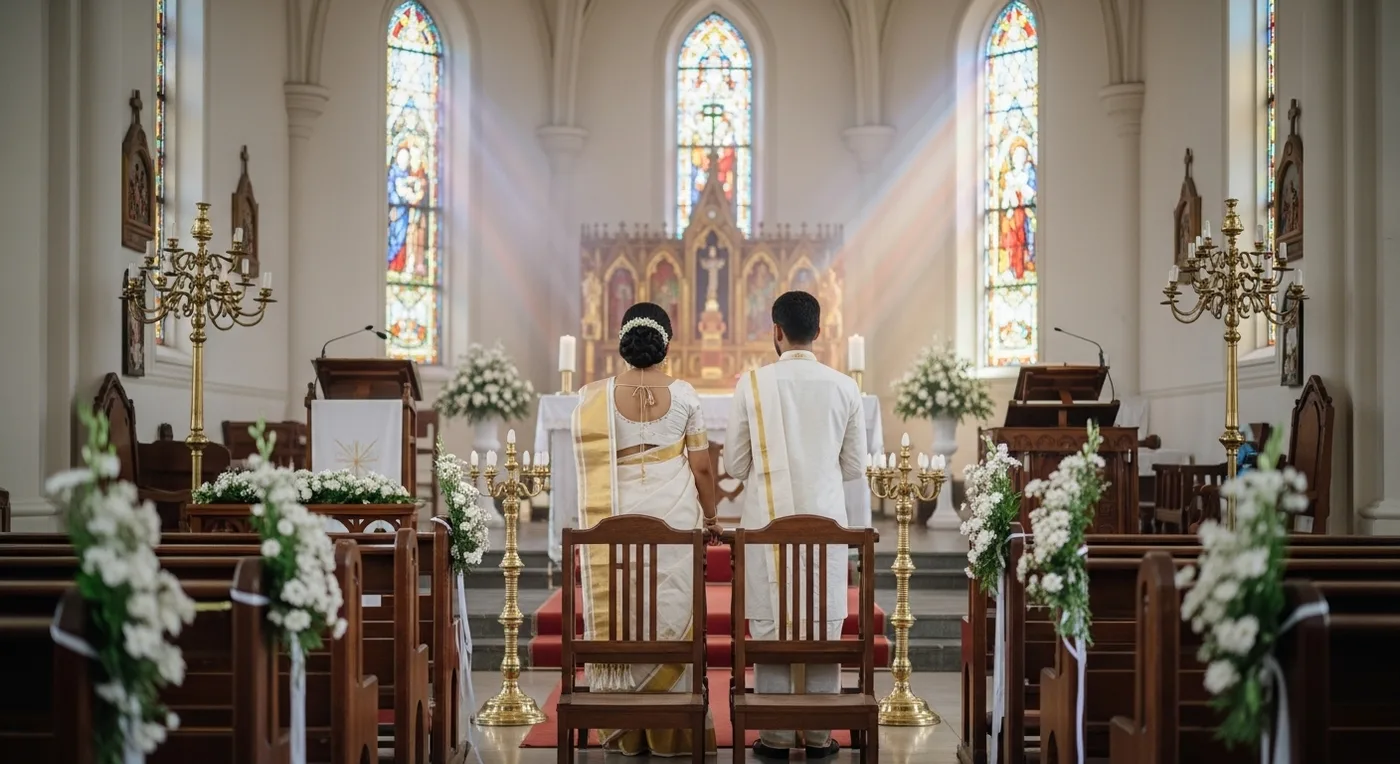
Kerala Christian weddings are defined by a two-part structure — the church ceremony and the reception — with costs weighted heavily toward the reception venue and catering. The church ceremony carries deep liturgical significance that varies dramatically across the five major denominations, while the reception has evolved into an elaborate celebration that often rivals North Indian wedding receptions in scale and expense.
Key Rituals
The Kerala Christian wedding spans two days in most traditions, with distinct events that each require separate planning.
Madhuram Veppu (Sweetening Ceremony) takes place the evening before the wedding at the bride's home. Family members prepare a mixture of jaggery, banana, and sweets that the bride and groom feed each other, symbolising the sweetness they will bring to married life. This intimate gathering of 50-100 close family members sets the emotional tone.
Church Ceremony is the spiritual heart of the wedding. The WeddingWire India guide describes a structured sequence: bridal procession, prayers, Scripture readings, homily, exchange of consent, ring blessing, and the Minnukettu (tying of the wedding pendant). The Minnu — a gold pendant on a thread made from seven strands of the Manthrakodi — is the Christian equivalent of the Hindu thali, symbolising one strand each for the bride, groom, their parents, and the Church. In Syrian Catholic and Orthodox traditions, a full Holy Mass extends the ceremony to 1-1.5 hours.
Manthrakodi (Wedding Saree) is presented by the groom during the ceremony. Traditionally a gold-bordered red or white saree draped over the bride's head during the blessing, the Manthrakodi is one of the most visually striking moments in any Kerala wedding. Premium Kanchipuram silk versions cost 50,000 to 2 lakhs.
Reception follows the church ceremony at a hotel, convention centre, or parish hall. This is where the bulk of the budget goes — multi-course meals, professional entertainment, and formal cake-cutting ceremonies.
For a comprehensive ritual-by-ritual walkthrough, see our Kerala Christian wedding rituals guide.
Denomination Differences
Kerala's Christian community spans five major denominations, each with distinct liturgical practices that directly affect wedding planning. Our Christian wedding rituals guide covers each denomination in depth.
Syrian Catholic (Syro-Malabar) weddings, concentrated in Kottayam, Ernakulam, and Thrissur, follow an Eastern Syriac liturgy with ancient Chaldean chants and a full Qurbana. Church bookings under the Archdiocese of Changanassery require 6-12 months advance reservation.
Malankara Orthodox and Jacobite weddings feature the dramatic Crowning ceremony (Muhurtham Kuthal) — ornate crowns placed on both bride and groom. These are the longest Christian ceremonies, often exceeding 90 minutes. Concentrated in Kottayam, Pathanamthitta, and Thiruvalla.
Knanaya weddings are the most ritual-rich. The Knanaya procedure includes four distinct ceremonies: Othukalyanam (engagement with betel leaf exchange), Mylanchi Idal (henna, exclusive to Knanaya), Chantham Chartal (groom's ceremonial shave), and the wedding. These require separate venue arrangements. For planning details, see our upcoming Syrian Christian wedding planning guide.
Latin Catholic weddings from Thiruvananthapuram to Fort Kochi follow the Roman Rite — a Nuptial Mass with readings, homily, and nuptial blessing — enriched with Malayali touches in cuisine, attire, and celebration scale.
Tip
Typical Timeline and Costs
A standard Kerala Christian wedding follows this planning arc:
- 8-12 months before: Church booking, reception venue reservation, priest consultation
- 4-8 months before: Catering selection, photographer, invitation design, choir/music booking
- 2-4 months before: Attire (bridal gown or saree, Manthrakodi), jewellery, cake ordering
- 1 week before: Madhuram Veppu arrangements, rehearsal at church
- Wedding day: Church ceremony (morning or afternoon), reception (evening)
Church fees are modest (5,000-25,000 rupees), but hotel reception venues drive costs higher — 1.5-5 lakhs for venue hire alone, with catering at 900-1,500 rupees per plate versus 170-350 for a traditional sadya. A mid-range Christian wedding with 500 guests in 2026 totals 12-30 lakhs, with premium celebrations in Kochi and Kottayam reaching 40 lakhs.
Kerala Muslim Wedding: Planning Overview
Muslim weddings in Kerala are centred on the Nikah — a religiously binding contract completed in 30-45 minutes — but the surrounding celebrations, particularly the Walima feast and Mailanchi night, create a multi-day experience renowned for its warmth and culinary grandeur. The Malabar Muslim tradition of northern Kerala has produced a wedding culture that is distinct from Muslim celebrations anywhere else in India. For the complete planning guide covering budgets, venues, catering, and timelines, see our Muslim Wedding Kerala: The Complete Planning Guide.
Key Rituals
The Kerala Muslim wedding unfolds across 2-3 days, with each event carrying specific logistical and financial requirements.
Mailanchi (Henna Night) is the emotional heart of the Malabar wedding. Held the evening before the Nikah at the bride's home or a rented hall, this celebration centres on the application of henna on the bride's hands and feet. The defining tradition is the Oppana — a participatory dance form unique to Malabar Muslims where women gather in a circle around the seated bride, singing traditional Mappilapattu songs and clapping rhythmically. Professional Oppana troupes in 2026 charge 15,000-40,000 rupees. For the complete Mailanchi and Oppana experience, see our Malabar Muslim Nikah guide.
Nikah (Marriage Contract) is the religious solemnisation, officiated by a Qazi (Islamic judge) at the mosque or the bride's home. The ceremony is structured around the Ijab (proposal) and Qubool (acceptance), witnessed by two male witnesses from each side. The Mahr — a mandatory payment from the groom to the bride as a commitment of respect — is agreed upon before the ceremony and can take the form of money, gold, or property. The amount varies by family but typically ranges from 1 to 10 lakhs in Kerala. The Nikah itself is the shortest major religious wedding ceremony in Kerala, often completed in 30-45 minutes.
Walima (Wedding Feast) is the grand reception hosted by the groom's family. In Malabar tradition, the Walima is where the family's reputation is publicly demonstrated through the scale and quality of the feast. Malabar wedding cuisine centres on Thalassery Biryani, Pathiri with various curries, Neychoru, multiple chicken and mutton preparations, and an elaborate dessert spread. Most menus feature 15-25 dishes, and catering costs run 800-1,500 rupees per plate for authentic Malabar cuisine.
Veettil Koodal and Salkaaram mark the final events. Veettil Koodal is the tradition where the bride's family prepares a large feast marking the bride's formal entry into the groom's household. Salkaaram is the final reception, completing the wedding celebration cycle.
Malabar Muslim Traditions
The Malabar region — spanning Kozhikode, Malappuram, Kannur, and Kasaragod — has cultivated a wedding tradition shaped by centuries of Arab maritime trade and Islamic faith. Several features distinguish Malabar Muslim weddings from Muslim celebrations in other parts of India.
Culinary identity is paramount. Thalassery Biryani — distinctly different from Hyderabadi or Lucknowi biryani in its use of kaima rice — is the centrepiece. The catering budget typically exceeds all other combined expenses. Our Malabar Muslim Nikah guide covers Walima planning in detail.
Gold and jewellery play a significant cultural role. Malabar brides traditionally wear multiple layers of gold. The Malabar Gold brand itself emerged from this regional tradition of gold craftsmanship and demand.
Community participation is broader than in Hindu or Christian weddings. The entire neighbourhood contributes to feast preparation, decoration, and celebration. Guest counts of 500-800 are standard, with premium celebrations exceeding 1,000.
Note
Typical Timeline and Costs
A standard Malabar Muslim wedding follows this planning arc:
- 6-10 months before: Qazi consultation, venue booking, Mahr negotiation between families
- 3-6 months before: Catering finalisation (critical for Malabar cuisine specialists), photographer, gold and jewellery selection
- 1-3 months before: Bride's attire, Oppana troupe booking, invitation design
- 1-2 days before: Mailanchi night, venue decoration
- Wedding day: Nikah ceremony (typically morning), Walima feast (afternoon/evening)
A mid-range Malabar Muslim wedding with 500-800 guests costs 8-20 lakhs, with the Walima consuming 40-50% of the budget. Premium celebrations in Kozhikode and Malappuram reach 35-50 lakhs. The Nikah itself is modest — Qazi fees and mosque arrangements cost 5,000-15,000 rupees — but the surrounding celebrations carry substantial costs.
Cost Comparison Across Religions
Catering is the single largest expense across all three communities, but the type of cuisine, service style, and guest count norms create dramatically different budget profiles. The table below compares key cost categories based on 2026 pricing from Kerala wedding planners and catering services.
| Cost Category | Hindu (500 guests) | Christian (500 guests) | Muslim (600 guests) |
|---|---|---|---|
| Venue | 1-3 lakhs (temple/auditorium) | 2-5 lakhs (hotel/convention centre) | 1-2.5 lakhs (hall/community centre) |
| Catering | 3-5 lakhs (sadya at 170-350/plate) | 5-8 lakhs (buffet at 900-1,500/plate) | 5-9 lakhs (Malabar cuisine at 800-1,500/plate) |
| Decoration | 1-2 lakhs (mandapam, flowers) | 1.5-3 lakhs (church + reception) | 1-2 lakhs (stage, hall) |
| Photography | 1.5-3 lakhs | 1.5-3 lakhs | 1.5-3 lakhs |
| Attire + Jewellery | 1-3 lakhs | 1.5-4 lakhs | 2-5 lakhs (heavy gold tradition) |
| Ceremony costs | 10,000-30,000 (priest, rituals) | 5,000-25,000 (church fees) | 5,000-15,000 (Qazi, Mahr separate) |
| Entertainment | 30,000-1 lakh (nadaswaram, music) | 50,000-2 lakhs (band, DJ, choir) | 15,000-40,000 (Oppana troupe) |
| Estimated total | 10-25 lakhs | 12-30 lakhs | 8-20 lakhs |
The Hindu-Christian cost gap is driven by catering: sadya at 170-350 rupees per plate versus hotel buffets at 900-1,500 — a 4-5x multiplier that compounds across 500+ guests. Muslim weddings feature the highest per-plate expense for authentic Malabar cuisine but save through community-assisted preparation, where neighbours contribute labour for cooking and setup. For detailed budget planning, see our Kerala wedding budget guide.
Venue Selection by Religion
Your religion determines not just where the ceremony happens but fundamentally shapes the reception venue decision — a choice that typically accounts for 15-25% of the total wedding budget. Each community has distinct venue conventions driven by religious requirements, cultural expectations, and practical logistics.
Hindu Venues: Temple Halls and Auditoriums
Hindu weddings are traditionally held in temple mandapams or community halls. Guruvayur Temple is the most sought-after temple venue, with bookings requiring 6-12 months. Other popular temples include Thiruvambadi, Vadakkunnathan (Thrissur), and Aranmula Parthasarathy. Temple weddings enforce strict dress codes, muhurtham timing, and photography restrictions. Community auditoriums offer more flexibility at 50,000-3 lakhs.
Christian Venues: Church + Reception Hall
Christian weddings require two venues: the church for the ceremony and a separate reception hall. Popular parishes in Kottayam, Pala, and Ernakulam book 6-12 months out. The reception is almost always at a hotel or convention centre. Hotels like Le Meridien Kochi and Taj Gateway offer packages at 3-8 lakhs for 500 guests. Convention centres like Adlux in Angamaly provide higher capacity at lower per-head rates.
Muslim Venues: Mosques and Community Halls
The Nikah takes place at the local mosque or bride's home — both carrying minimal costs. The Walima is held at community halls or convention centres in Kozhikode, Malappuram, and Kannur. Venues in northern Kerala are more affordable than Christian hotel venues but must accommodate 600-1,000 guests.
Neutral Venues for All Communities
Destination and resort venues that work across traditions are a growing trend. Backwater resorts in Alappuzha, hill stations in Munnar, and beach venues along the Malabar coast charge 5-15 lakhs but provide a single location for ceremony and reception.
Tip
Inter-Faith Weddings in Kerala
Inter-faith marriages in Kerala are legally straightforward under the Special Marriage Act, 1954, and the state shows higher social acceptance than the national average — but planning a ceremony that honours both traditions requires deliberate structural decisions.
Legal Framework
The Special Marriage Act, 1954 provides a secular legal path for inter-faith couples. Neither partner needs to convert. Couples give 30 days written notice to the Marriage Officer, after which the marriage is solemnised in a civil ceremony with three witnesses.
Social Landscape
While Pew Research Center data shows less than 1% of all Indian marriages cross religious lines, Kerala's history of religious coexistence and higher literacy rates correlate with greater openness to inter-community unions.
Planning an Inter-Faith Ceremony
Common approaches for blending traditions in Kerala include:
- Sequential ceremonies: Two separate religious ceremonies on consecutive days or the same day — a temple wedding followed by a church blessing, or a civil ceremony followed by a Nikah.
- Blended ceremony: A single ceremony incorporating elements from both traditions — lighting the nilavilakku (shared across communities) alongside Christian prayers, or including a Mahr alongside a thalikettu.
- Civil ceremony + cultural reception: Legal formalities under the Special Marriage Act followed by a reception featuring both communities — a sadya alongside Malabar biryani, for example.
Neutral venues — hotels, resorts, and destination properties — are strongly preferred because they carry no religious associations. Beach and backwater venues in Alappuzha and Kumarakom are particularly popular.
Note
Choosing the Right Planning Tools
Each religious tradition introduces unique planning tasks that generic wedding checklists miss entirely — from muhurtham slot coordination to Qazi booking to church availability windows. Using tools designed for Kerala's multi-faith wedding landscape eliminates the blind spots.
Our AI wedding checklist tool generates a personalised planning timeline based on your wedding date, budget, and religious tradition. A Hindu checklist includes muhurtham selection and mandapam tasks; a Christian checklist replaces those with church booking and choir arrangements; a Muslim checklist adds Qazi coordination and Oppana troupe booking.
The cost calculator includes community-specific budget templates with the correct proportional allocations for each tradition. Vendor requirements also vary — Hindu weddings need nadaswaram musicians, Christian weddings need church-approved photographers and Syriac-trained choirs, and Muslim weddings need Malabar cuisine specialists. Browse vendors on itsmy.wedding filtered by the services your tradition requires.
Build your wedding checklist
A planning timeline shaped around your date, your events, and your family.
What to Plan Next
This guide provides the structural framework for understanding how Kerala's three major religious traditions shape wedding planning. For deep dives into specific communities, explore these dedicated guides:
- Hindu traditions: Kerala wedding traditions explained covers shared cultural motifs across communities, and our upcoming Nair wedding guide covers the largest Hindu sub-community in detail.
- Christian traditions: Our Christian wedding rituals guide walks through every denomination's ceremony step by step, and the upcoming Syrian Christian wedding planning guide focuses on the largest Christian sub-community.
- Muslim traditions: The Malabar Muslim Nikah guide is the definitive resource for northern Kerala Muslim wedding planning.
- Dates and timing: Our muhurtham dates guide for 2026-2027 covers Hindu auspicious dates, and we note Christian and Muslim calendar considerations in each community guide.
- Budget planning: The Kerala wedding budget guide provides detailed cost breakdowns across all price tiers.
Start your personalised planning at /plan/checklist — select your religious tradition, enter your wedding date, and receive a checklist built specifically for your ceremony.
Topics
Kerala wedding by religionHindu wedding KeralaChristian wedding KeralaMuslim wedding KeralaNair weddingSyrian Christian weddingMalabar Muslim weddingExplore more
Frequently Asked Questions
1How do Kerala Hindu, Christian, and Muslim weddings differ in cost?
2Which religion has the longest wedding ceremony in Kerala?
3Can I have an inter-faith wedding in Kerala?
4What are the peak wedding seasons for different religions in Kerala?
5Do I need separate planning checklists for different religious weddings in Kerala?
Continue reading
Related Articles
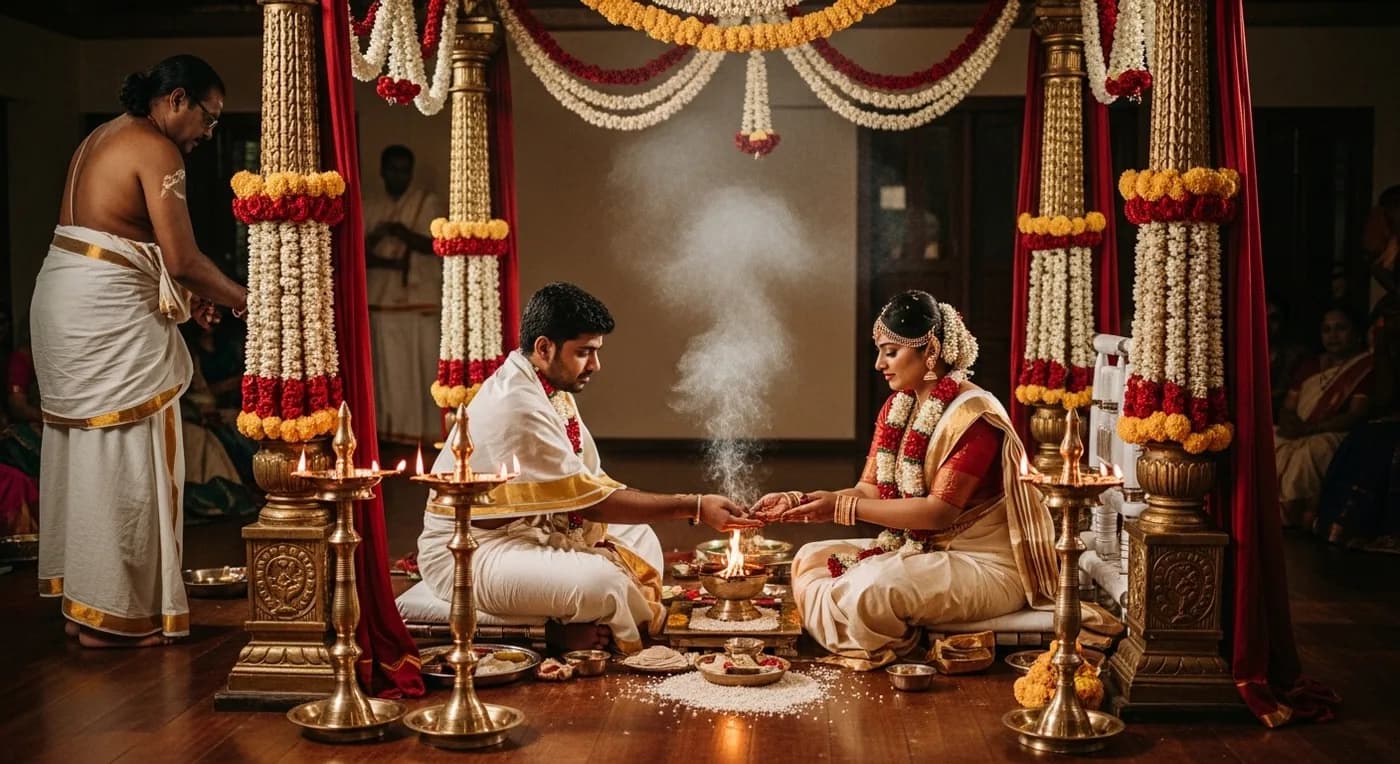
Kerala Wedding Traditions Explained: Rituals, Meaning & Modern Adaptations
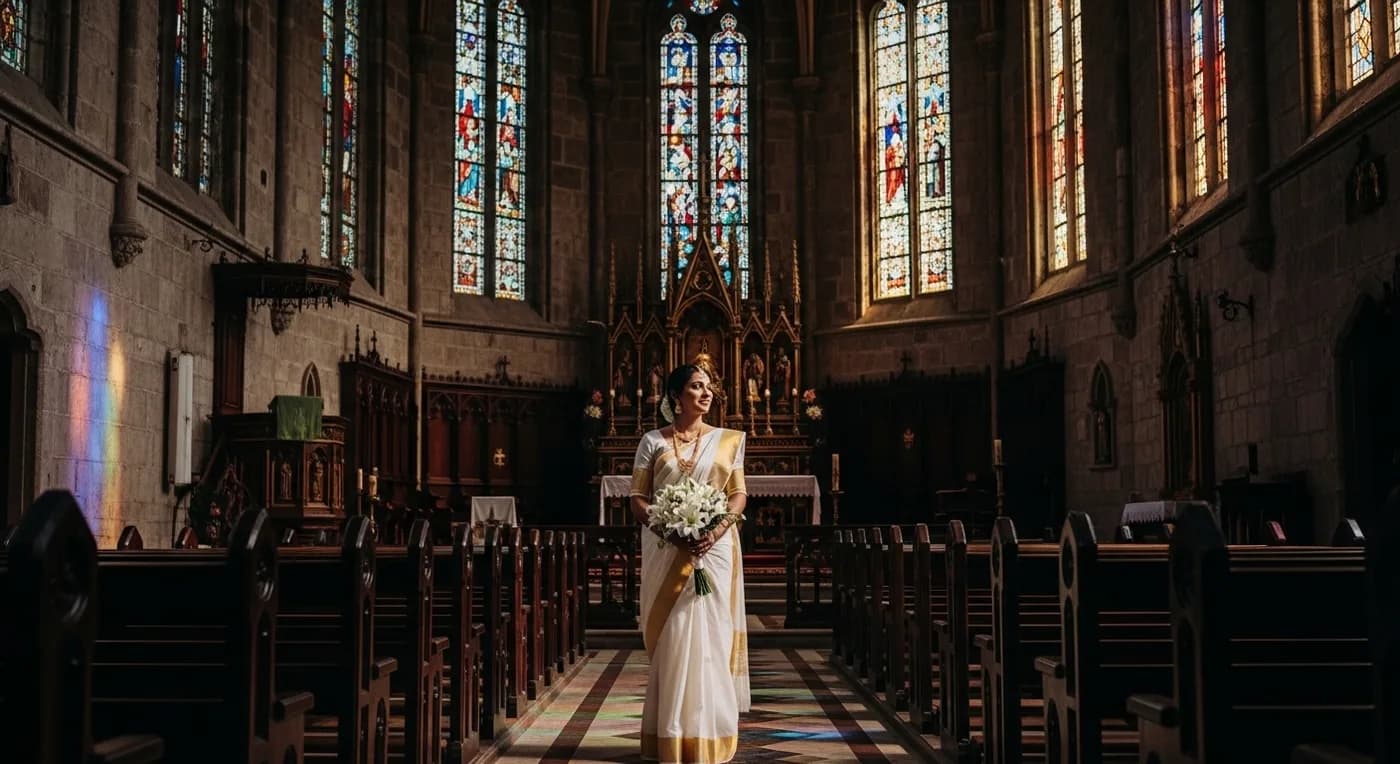
Kerala Christian Wedding Traditions: A Complete Guide to Rituals and Customs
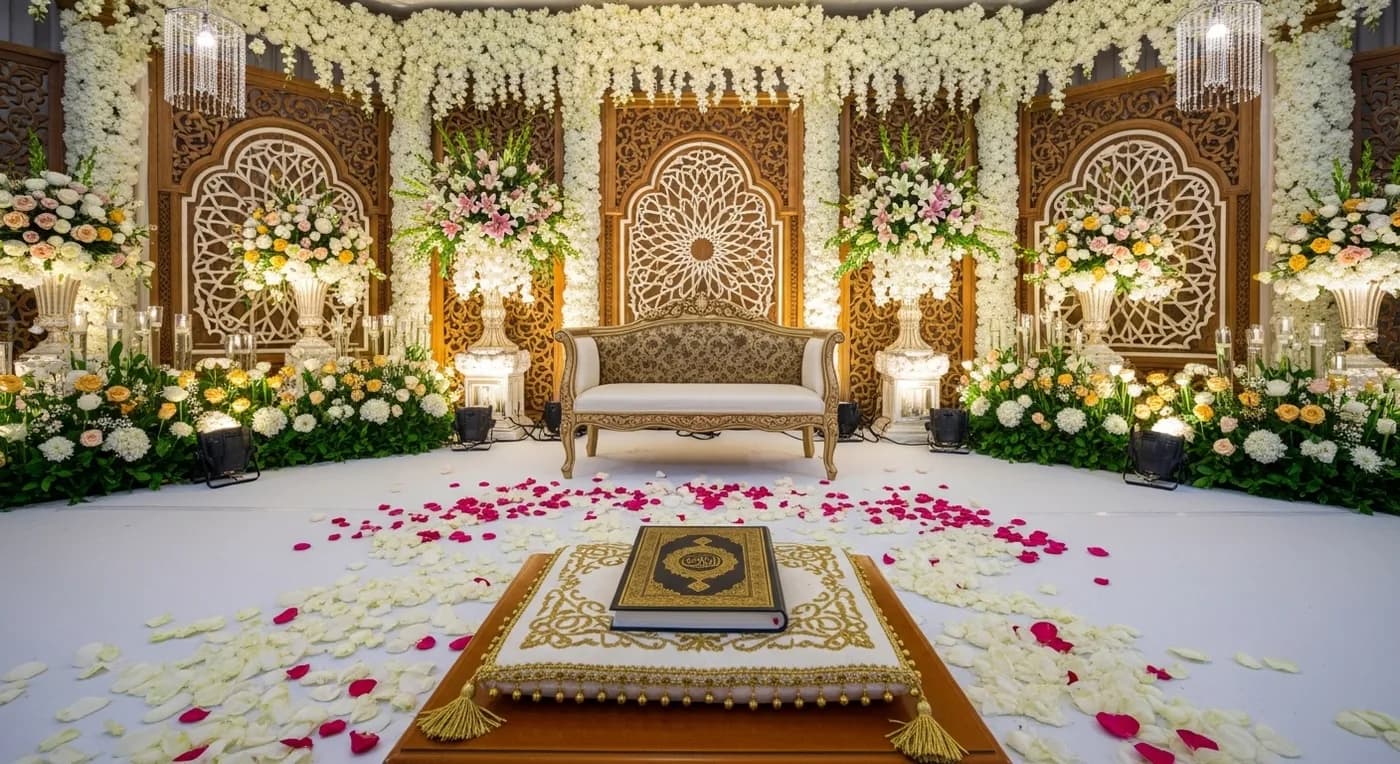
Malabar Muslim Nikah: ₹15-35L Rituals, Vendors & Costs (2026)
Kerala Nair Wedding: Complete Guide to Rituals, Checklist & Costs in 2026
Syrian Christian Wedding in Kerala: Planning Guide, Costs & Timeline for 2026
How to Plan a Kerala Wedding: The Complete 2026 Guide
Still planning?
Get quotes from India's best vendors
Tell us what you're planning and we'll match you with verified photographers, venues, decorators, and more.
Get free quotes