
Kerala Nair Wedding: Complete Guide to Rituals, Checklist & Costs in 2026
Everything you need to plan a Kerala Nair wedding — traditional rituals, modern adaptations, month-by-month checklist, and detailed cost breakdown for 2026.

Senior Wedding Planner
Priya Nair is a senior wedding planner based in Kochi with over eight years of experience coordinating Hindu, Christian, and destination weddings across Kerala.
On this page
A Kerala Nair wedding centres on the Thalikettu and Pudamuri ceremonies, typically held at a temple or decorated mandapam during an auspicious muhurtham. Mid-range Nair weddings for 400–500 guests cost ₹12–18 lakhs in 2026. The ceremony itself takes 1–1.5 hours, followed by a traditional Sadya feast on banana leaves.
Quick Answer
Quick answer: A Kerala Nair wedding centres on the Thalikettu and Pudamuri ceremonies, typically held at a temple or decorated mandapam during an auspicious muhurtham. Mid-range Nair weddings for 400–500 guests cost ₹12–18 lakhs in 2026. The ceremony itself takes 1–1.5 hours, followed by a traditional Sadya feast on banana leaves.
Note
Pricing methodology: Cost ranges in this guide are based on vendor pricing data from the itsmy.wedding marketplace and published industry reports, collected in Q4 2025 – Q1 2026.
If you have attended a Kerala Hindu wedding, there is a strong chance it was a Nair wedding. The Nair community — one of the largest and most prominent Hindu communities in Kerala — has shaped the popular image of what a Malayali wedding looks like: the bride in pristine white and gold, the groom in a crisp mundu, the brief but emotionally charged Thalikettu at the muhurtham, and a banana-leaf Sadya that guests will talk about for months. In an Indian wedding industry valued at ₹10.79 lakh crore, Nair weddings stand out for their elegant simplicity — ceremonies that are deeply meaningful yet refreshingly free of excessive ritual.
But beneath that apparent simplicity lies a rich cultural heritage rooted in the matrilineal tharavad system, community-specific customs, and a set of rituals that have evolved significantly over the past century. Whether you are a Nair couple planning your own wedding, a partner marrying into the community, or a vendor looking to serve Nair families with cultural sensitivity, this guide covers every ritual, cost, and planning consideration you need for 2026.
The Nair Wedding Tradition: What Makes It Unique
The Nair community's wedding traditions are distinct from those of other Hindu communities in Kerala — Namboodiris, Ezhavas, and Viswakarmas each follow different ceremonial patterns. Understanding what sets the Nair wedding apart helps you plan with cultural precision.
The Tharavad Legacy
Historically, Nairs followed a matrilineal joint family system called the tharavad. Property passed through the mother's line, and the eldest woman in the household held significant domestic authority. The traditional Nair marriage was sambandham — a visiting relationship rather than a cohabitation arrangement. Children belonged to the mother's tharavad, and the maternal uncle (karanavar) was the family head. This system was formally replaced after the Nair Act of 1925 and the Hindu Marriage Act of 1955, but its cultural echoes remain. Nair weddings today still honour the bride's family with particular prominence, and maternal uncles continue to play ceremonial roles that other communities assign to the father alone.
How Nair Weddings Differ from Other Kerala Hindu Ceremonies
The differences are worth noting for couples and vendors planning across communities:
- Compared to Namboodiri weddings: Namboodiri ceremonies are elaborate Vedic affairs lasting several hours, with extensive homam (fire rituals), Saptapadi (seven steps around the sacred fire), and Sanskrit mantras chanted throughout. Nair weddings have no homam requirement and are significantly shorter — the core ceremony wraps up in under an hour in many cases.
- Compared to Ezhava weddings: Ezhava ceremonies share some structural similarities with Nair weddings — both include the Thalikettu and Pudamuri — but Ezhava families often conduct their ceremonies at Sree Narayana temples and community halls, with rituals that reflect the community's reformist spiritual tradition under Sree Narayana Guru's teachings.
- The brevity factor: A traditional Nair wedding ceremony is one of the shortest among Kerala Hindu communities. The entire mandapam ritual — from the couple's arrival to the Pudamuri — can be completed in 30 to 60 minutes. This brevity is not a lack of significance; it reflects the community's cultural emphasis on substance over spectacle.
Note
Historical note: The Pudamuri (gifting of the wedding saree) was historically the primary Nair wedding ritual. The Thalikettu — tying the mangalsutra — was formally adopted into Nair wedding practice only after the mid-20th century, influenced by broader Hindu and Tamil customs. Many older Nair family members still consider the Pudamuri the most emotionally significant moment.
Pre-Wedding Rituals
Horoscope Matching and Muhurtham Selection
The Nair wedding timeline begins with jathakam porutham — horoscope matching. Both families consult an astrologer (jyothishi) who compares the couple's horoscopes across ten compatibility factors (dashaporutham). Once compatibility is confirmed, the astrologer selects the most auspicious muhurtham — the exact date and time for the Thalikettu ceremony. This is non-negotiable for most Nair families; the entire wedding schedule is built around this precise moment.
Popular wedding months in the Malayalam calendar are Medam (April–May), Edavam (May–June), and Thulam (October–November). The months of Karkidakam (July–August) and Dhanu (December–January) are generally avoided. For the full list of auspicious dates, see our muhurtham dates guide for Kerala 2026–2027.
Tip
Planning tip: Share the muhurtham time with your photographer and videographer at least two weeks before the wedding. The Thalikettu happens at a precise moment — sometimes as early as 6:30 AM — and your team needs to be in position well before that window.
Nischayam (Engagement Ceremony)
The Nischayam — meaning "confirmation" or "promise" — is the formal engagement ceremony, typically held 2 to 6 months before the wedding. It traditionally takes place at the bride's home, though many families now use temple halls or hotel banquet rooms to accommodate larger gatherings.
The ceremony centres on the exchange of rings (mothiram maatal) between the couple. Elders from both families formally announce the confirmed wedding date and exchange gifts, including bridal ornaments from the groom's family. Compared horoscopes are exchanged, and the families share a festive meal — often a smaller Sadya on banana leaves. The Nischayam functions as the public declaration that both families have agreed to the union.
In 2026, many Nair families combine the Nischayam with a more elaborate engagement celebration — professional photography, curated decor, and a reception-style gathering that gives both families a chance to socialise before the wedding day itself. Budget ₹50,000 to ₹2 lakhs depending on scale. For detailed guidance, see our engagement ceremony planning guide.
Aashirvadam (Pre-Nuptial Blessing)
The Aashirvadam takes place the day before or the morning of the wedding, separately at both the bride's and groom's homes. Close relatives and family elders gather to bless the couple for a prosperous married life. This is a small, intimate gathering — not a public event — and it carries deep emotional weight. The bride and groom touch the feet of each elder to receive their blessing, and in many tharavad families, the maternal uncle's blessing is considered especially significant.
Wedding Day Rituals: Step by Step
The Nair wedding day follows a clear sequence. For a full walkthrough of Kerala Hindu wedding rituals across communities, see our step-by-step Kerala wedding ceremony guide.
1. Dakshina Kodukkal (Seeking Blessings)
The wedding day begins at home. Both the bride and the groom, in their respective houses, perform Dakshina Kodukkal — they approach each elder in the family, offer a dakshina (a betel leaf, ripe areca nut, and a coin), and touch their feet to receive blessings. This ritual affirms the family's collective presence in the marriage and honours the generations that came before. It is a private, unhurried moment — often the most emotionally grounding part of the entire day.
2. Arrival at the Mandapam
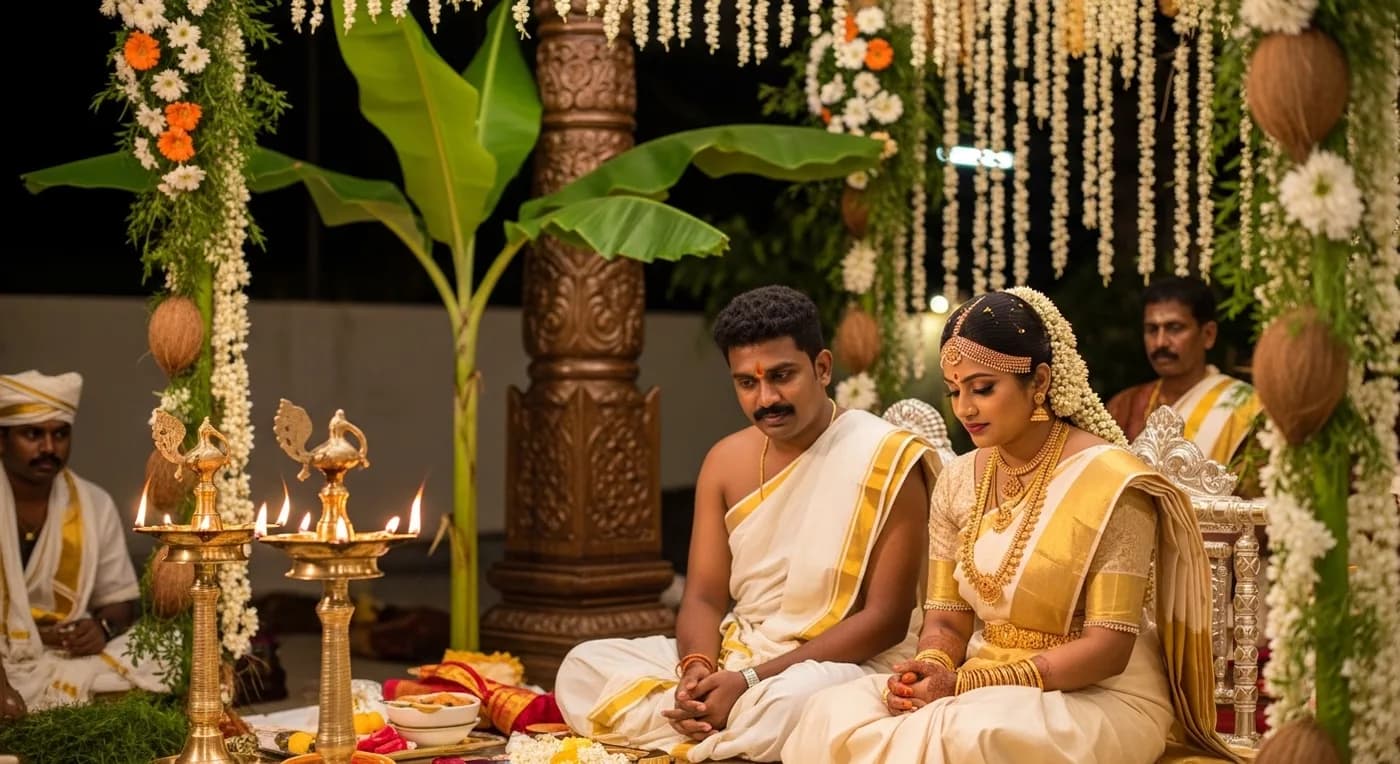
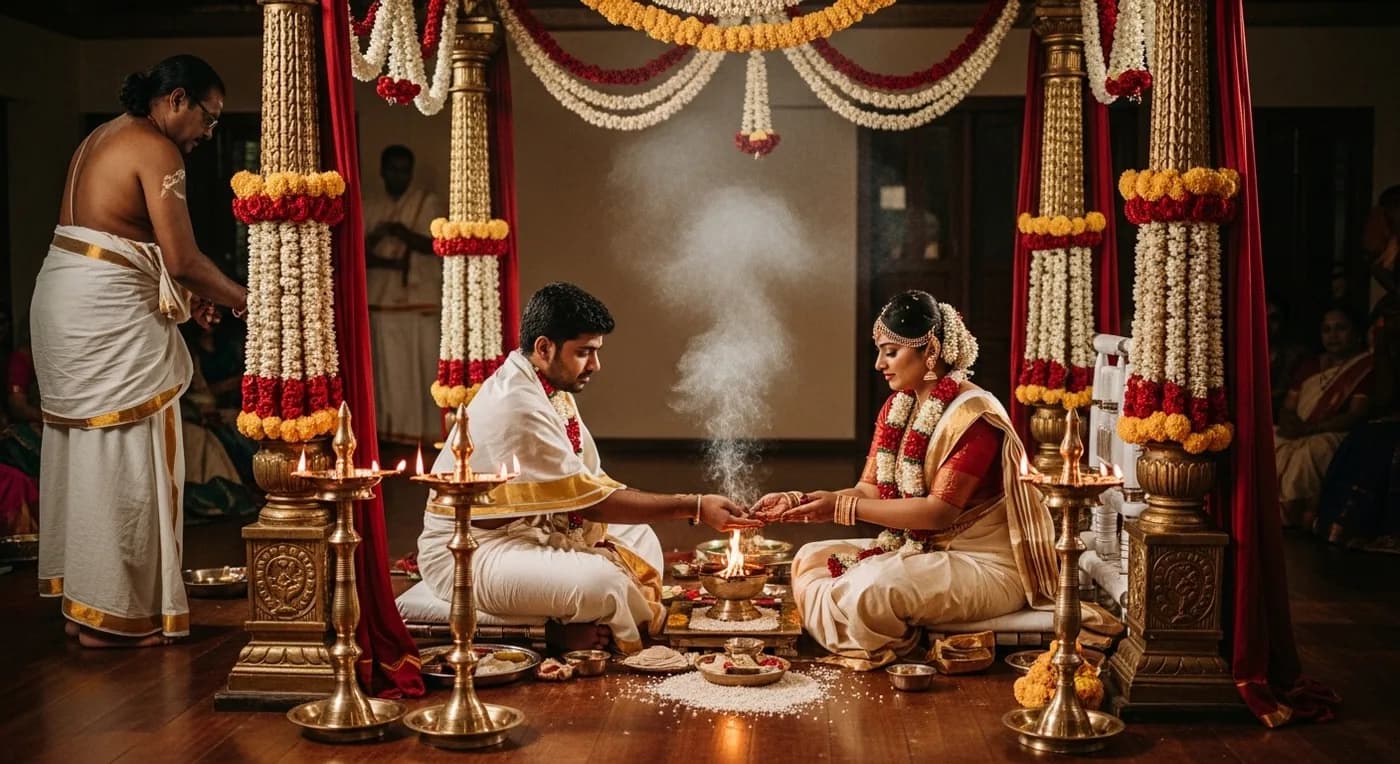
The groom arrives at the temple or wedding venue and is received ceremoniously. In temple weddings, a brief Ganapathi Homam (prayer to Lord Ganesha to remove obstacles) may be performed before the couple takes their seats on the mandapam — a raised platform decorated with jasmine garlands, banana stalks, coconut fronds, and brass nilavilakku oil lamps. The bride sits to the left of the groom on a wooden plank or decorated seat.
3. Kanyadaanam (Giving Away the Bride)
While not historically part of the Nair tradition — it was adopted from broader Hindu practice — Kanyadaanam is now performed at most Nair weddings. The bride's father places her right hand into the groom's right hand, symbolising his trust and the formal transfer of responsibility. A priest recites mantras during this moment. In some progressive Nair families, both parents participate in the Kanyadaanam together, reflecting the community's matrilineal roots.
4. Thalikettu (Tying the Mangalsutra)
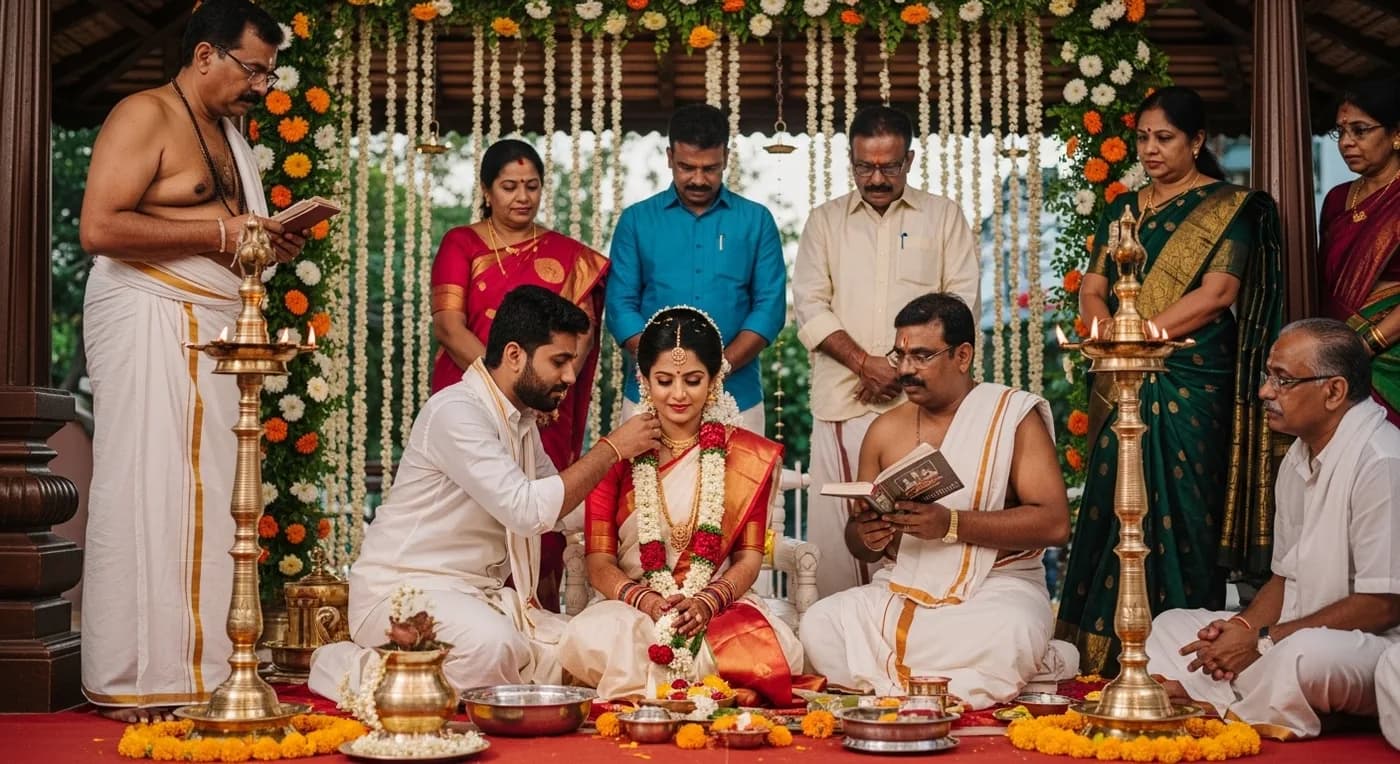
The Thalikettu is the defining moment of the wedding — timed to the exact muhurtham second. The priest signals when the auspicious moment arrives. The groom's father hands the thali (mangalsutra, a gold pendant on a sacred thread) to the groom, who ties it around the bride's neck with three knots. Musicians play the nadaswaram (traditional wind instrument) and thavil (drum), and guests shower the couple with rice and flower petals. The three knots represent commitment in thought, word, and deed.
This is the moment your photographer absolutely must capture — brief, sacred, and unrepeatable. The entire Thalikettu takes under two minutes.
5. Mala Maattal (Exchange of Garlands)
Immediately following the Thalikettu, the couple exchanges floral garlands (mala maattal). This symbolises mutual acceptance and respect. In some families, a playful moment follows — relatives lift the bride and groom to see who can garland the other first, adding a burst of laughter to the solemnity. Jasmine and rose garlands are most common; the garlands should be fresh and well-constructed for photographs.
6. Pudamuri (Gifting the Wedding Saree)
The Pudamuri is the emotional heart of a Nair wedding — historically the original wedding ritual before the Thalikettu was adopted. The groom presents his bride with a traditional kasavu saree (white or cream with a gold border) on a decorated platter, along with a blouse piece. This gift signifies his commitment to providing for her and formally accepting her as his life partner. Many families treat this as the most photographed moment of the ceremony.
Tip
For the groom: Choose the Pudamuri saree carefully — this is one gift the bride will treasure for life. A handwoven Balaramapuram or Kuthampully kasavu saree with a wide kasavu (gold) border is the traditional choice. Budget ₹3,000–₹15,000 for a quality piece.
7. Sadya (The Wedding Feast)
No Nair wedding is complete without the Sadya — a vegetarian feast served on banana leaves. A full Sadya includes 24 to 28 dishes: rice, sambar, rasam, avial, olan, thoran, pachadi, erissery, kootu curry, multiple pickles (upperi, naranga, manga), pappadam, banana chips, and the crowning glory — payasam (typically palada pradhaman, parippu pradhaman, and semiya payasam).
The quality of the Sadya is how most guests will judge the wedding. A reputable caterer serving 400–500 guests at ₹250–₹400 per plate delivers a traditional experience that honours the occasion. For a deep dive into costs and menu planning, see our Kerala Sadya catering costs guide.
Looking for Caterings?
Tell us what you need and get quotes from verified caterings
Modern Adaptations
Nair weddings in 2026 honour tradition while embracing contemporary touches that reflect the couple's personality.
The Evening Reception
Most Nair families now host a separate evening reception — a trend that has become standard over the past decade. While the morning ceremony follows traditional rituals, the reception is the couple's space for personal expression: designer lighting, curated stage decor, a DJ or live band, and a multi-cuisine dinner buffet alongside (or sometimes replacing) the traditional Sadya. Budget ₹2–5 lakhs for a mid-range reception for 300–500 guests.
Photography and Videography
Candid wedding photography has become essential. Most Kerala wedding photographers offer combined photo and video packages starting at ₹1 lakh for basic coverage, with premium packages (drone shots, same-day edits, cinematic highlight reels, custom albums) running ₹1.5–3 lakhs. Pre-wedding shoots in scenic Kerala locations — Munnar tea gardens, Fort Kochi streets, Alappuzha backwaters — are now standard for Nair couples, typically costing ₹15,000–₹40,000 separately. For pricing details, see our Kerala wedding photography cost guide.
Destination and Boutique Weddings
A growing number of Nair families, particularly those in Kochi, Thiruvananthapuram, and the diaspora, are opting for destination weddings at Kerala's backwater resorts, hill station properties in Munnar or Wayanad, and heritage hotels in Fort Kochi. These intimate celebrations (50–150 guests) trade the community-scale Sadya for a curated multi-day experience. Costs range from ₹15–40 lakhs depending on location and guest count. See our destination wedding cost guide for Kerala for detailed planning, or compare hill-station options across South India in our Munnar vs Wayanad vs Kodaikanal vs Ooty hill-station wedding comparison. For NRI Nair families flying in from the Gulf, the Wayanad destination wedding guide and Kodaikanal destination wedding guide cover venue capacity for 80–150-guest Nair celebrations specifically.
Attire Trends
The Nair bride's classic look remains rooted in tradition: the cream or off-white kasavu saree with a wide gold border, paired with layers of traditional gold jewellery — netti chutti (forehead ornament), manga mala and palakka mala (necklaces), kasumala (coin necklace), oddiyanam (waist belt), and vala (bangles). The groom wears a white mundu with gold border and angavastram (shoulder cloth). For the reception, brides often change into a coloured silk saree, Kanjeevaram, or contemporary designer outfit, while grooms may switch to a sherwani or bandhgala suit. For a full comparison, see our groom attire guide: mundu vs sherwani.
Nair Wedding Checklist
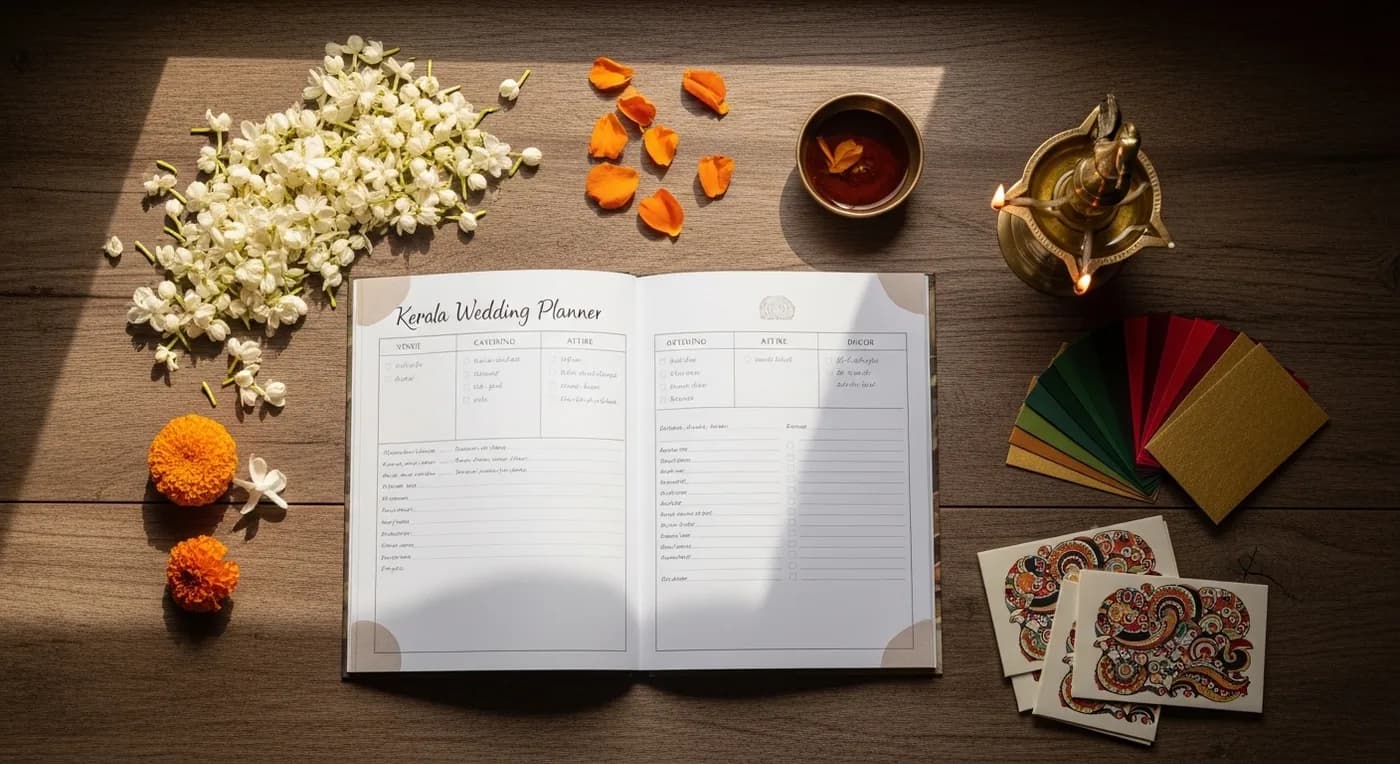
This condensed checklist covers the key milestones. For a fully personalised, date-adjusted version, use our AI wedding checklist tool.
12–9 Months Before
- Finalise horoscope matching and muhurtham with the family astrologer
- Book the wedding venue (temple, auditorium, or hotel)
- Set and agree on budget with both families
- Book photographer and videographer
6–4 Months Before
- Conduct the Nischayam (engagement ceremony)
- Book caterer for Sadya and reception dinner
- Book decorator for mandapam and venue
- Order wedding invitations
- Begin bridal jewellery selection and purchase
3–2 Months Before
- Bride's bridal saree and trousseau shopping
- Groom's attire selection (mundu, reception outfit)
- Book makeup artist and hairstylist
- Finalise Sadya menu with caterer
- Arrange guest accommodation if needed
1 Month Before
- Confirm all vendor bookings in writing
- Distribute invitations (physical and digital)
- Plan the reception programme (if hosting separately)
- Select the Pudamuri saree
1 Week Before
- Final coordination meeting with all vendors
- Confirm muhurtham timing with priest
- Prepare dakshina materials (betel leaves, areca nuts, coins)
- Trial makeup session for the bride
Wedding Day
- Dakshina Kodukkal at home (morning)
- Arrive at venue 1–2 hours before muhurtham
- Ceremony: Kanyadaanam, Thalikettu, Mala Maattal, Pudamuri
- Sadya feast
- Photo sessions
- Evening reception (if applicable)
For the full interactive checklist, visit our wedding checklist tool.
Cost Breakdown for a Nair Wedding in 2026
Costs vary significantly based on guest count, venue type, and city. Here is a realistic breakdown across three tiers for a Nair wedding in Kerala. For a personalised estimate, try our cost calculator.
| Category | Budget (₹) | Mid-Range (₹) | Premium (₹) |
|---|---|---|---|
| Venue (temple/auditorium/hotel) | 50,000–1,00,000 | 1,50,000–3,00,000 | 4,00,000–8,00,000 |
| Catering (Sadya + reception, 400–500 guests) | 1,50,000–2,50,000 | 3,00,000–5,00,000 | 6,00,000–10,00,000 |
| Photography & Videography | 50,000–1,00,000 | 1,50,000–2,50,000 | 3,00,000–5,00,000 |
| Decoration (mandapam + stage) | 40,000–80,000 | 1,00,000–2,00,000 | 2,50,000–5,00,000 |
| Bridal Attire & Jewellery | 1,00,000–2,00,000 | 3,00,000–5,00,000 | 6,00,000–12,00,000 |
| Groom's Attire | 10,000–25,000 | 30,000–60,000 | 75,000–1,50,000 |
| Makeup & Styling | 15,000–25,000 | 30,000–60,000 | 75,000–1,50,000 |
| Music & Entertainment | 15,000–30,000 | 40,000–80,000 | 1,00,000–2,50,000 |
| Invitations (print + digital) | 10,000–20,000 | 25,000–50,000 | 60,000–1,50,000 |
| Miscellaneous (transport, gifts, priest) | 30,000–50,000 | 50,000–1,00,000 | 1,00,000–2,00,000 |
| Total | ₹8–12 lakhs | ₹12–18 lakhs | ₹25–45 lakhs |
Note
Jewellery note: Bridal gold jewellery is the single most variable cost in a Nair wedding. With gold prices in 2026 averaging ₹7,500–₹8,000 per gram, a traditional bridal set (150–300 grams) can range from ₹11 lakhs to ₹24 lakhs. Many families use heirloom pieces or rent jewellery for the ceremony to manage this cost. The figures above reflect jewellery purchase on a modest scale; heirloom and rental options bring costs down significantly.
For a full budget planning framework, see our Kerala wedding budget guide.
Choosing Your Venue: Temple vs Auditorium vs Hotel
The venue question is one of the first decisions Nair families face. Each option carries distinct advantages and trade-offs.
| Factor | Temple | Auditorium / Kalyana Mandapam | Hotel / Resort |
|---|---|---|---|
| Cost | ₹5,000–₹50,000 | ₹50,000–₹3,00,000 | ₹2,00,000–₹8,00,000 |
| Capacity | 100–300 guests | 300–1,000 guests | 100–600 guests |
| Atmosphere | Sacred, traditional, spiritual | Flexible, spacious, functional | Luxurious, all-inclusive |
| Catering | External caterers only | External or in-house options | In-house catering (often mandatory) |
| Photography | Restrictions may apply inside sanctum | Full freedom | Full freedom |
| AC / Weather | Usually open-air | AC halls available | Fully climate-controlled |
| Parking | Often limited | Usually adequate | Valet available at premium venues |
| Best for | Traditional families, intimate ceremonies | Large guest lists, budget-conscious | Luxury celebrations, combined ceremony + reception |
Temple Weddings
Temples like Guruvayur, Sree Poornathrayeesa (Tripunithura), Sree Padmanabhaswamy (Thiruvananthapuram), Vadakkunnathan (Thrissur), and family kshethrams remain the first choice for traditionally-minded Nair families. The spiritual atmosphere is unmatched. However, temple weddings come with constraints: strict time slots, photography limitations near the sanctum, limited seating for elderly guests, and no AC. Book 6–12 months ahead for popular temples. For a complete breakdown, see our Guruvayur temple wedding guide.
Auditoriums and Kalyana Mandapams
The most practical choice for Nair weddings with 400+ guests. Convention centres and kalyana mandapams across Kochi, Thrissur, Kozhikode, and Thiruvananthapuram offer AC halls, ample parking, catering facilities, and flexible scheduling. Prices range from ₹50,000 to ₹3 lakhs depending on the city and season. Many families conduct the ceremony at a nearby temple in the morning and then host the Sadya and reception at the auditorium.
Hotels and Resorts
Premium hotel weddings are growing among urban Nair families, particularly in Kochi and Thiruvananthapuram. The advantage is convenience — venue, catering, accommodation, and decor are handled under one roof. The trade-off is cost (hotel catering minimums often start at ₹1,000–₹1,500 per plate) and a more generic setting that may lack the cultural warmth of a temple or decorated mandapam.
Looking for Venues?
Tell us what you need and get quotes from verified venues
Grihapravesham: The Bride Enters Her New Home
After the wedding ceremony and feast, the final ritual of the day is the Grihapravesham (also called kudivep) — the bride's formal entry into the groom's home. At an auspicious moment, the groom brings his bride to his family home, accompanied by close relatives. The bride holds a traditional brass nilavilakku lamp in her hands and steps into the house with her right foot first. The house is illuminated with oil lamps, creating a warm, welcoming glow. Her in-laws receive her with gifts — clothes, jewellery, and household items — formally welcoming her into the family.
This quiet ritual, usually witnessed only by immediate family, is one of the most intimate and emotionally resonant moments of the entire wedding journey.
Start Planning Your Nair Wedding
Planning a Kerala Nair wedding is about honouring a tradition that values elegance, family, and meaningful simplicity. Whether you are drawn to a sunrise Thalikettu at a family temple or a grand celebration at a Kochi convention centre, the key is starting early and building your vendor team with care.
Ready to begin?
- Create your personalised wedding checklist — tailored to your wedding date and style
- Estimate your budget — with category-by-category breakdowns for Kerala
- Design your wedding invitations — digital and print options
- Browse Kerala wedding venues — temples, auditoriums, hotels, and resorts
For more on Kerala wedding traditions across communities, explore our Kerala wedding traditions guide and step-by-step ceremony walkthrough.
Looking for Wedding Planners?
Tell us what you need and get quotes from verified wedding planners
Topics
Nair wedding KeralaNair wedding ritualsKerala Nair wedding traditionsNair wedding checklistNair wedding costExplore more
Frequently Asked Questions
1What are the main rituals in a Kerala Nair wedding?
2How much does a Nair wedding cost in Kerala in 2026?
3What does a Nair bride wear?
4How long does a Nair wedding ceremony last?
5Do Nair weddings need a specific muhurtham?
Continue reading
Related Articles
Kerala Wedding Traditions Explained: Rituals, Meaning & Modern Adaptations
Steps in a Traditional Kerala Wedding: Rituals and Practical Notes
Kerala Wedding Checklist: Complete Printable Planner for 2026
Kerala Wedding Budget Guide: 2026 Cost Breakdown
Kerala Wedding by Religion: Hindu, Christian & Muslim
Best Season for South India Destination Weddings: Month-by-Month Western Ghats Guide
Still planning?
Get quotes from India's best vendors
Tell us what you're planning and we'll match you with verified photographers, venues, decorators, and more.
Get free quotes