
Monsoon Wedding Kerala: Rainy-Season Planning Guide
Plan a dreamy monsoon wedding in Kerala with expert tips on venues, decor, photography, and cost savings. Your complete rainy-season wedding guide for 2026.

Senior Wedding Planner
Priya Nair is a senior wedding planner based in Kochi with over eight years of experience coordinating Hindu, Christian, and destination weddings across Kerala.
On this page
A monsoon Kerala wedding saves 20–30% versus peak season — a ₹15 lakh December wedding costs ₹10–12 lakh in the rainy months. June–August brings the heaviest rainfall; September is the smart compromise with decreasing rain and lush green backdrops. Top vendors become available on 2–3 months' notice instead of 6–8 months during peak season.
Quick Answer
Monsoon-season weddings (June–September) typically save 20–30% on venue and vendor costs versus peak-season rates — a ₹15 lakh December wedding comes in at ₹10–12 lakh during the rainy months (based on itsmy.wedding marketplace data). September is the sweet spot: off-season pricing with greatly reduced rain risk. Always confirm a fully indoor backup space in writing before booking any monsoon venue.
Note
Pricing methodology: Cost ranges in this guide are based on vendor pricing data from the itsmy.wedding marketplace and published industry reports, collected in Q4 2025 – Q1 2026.
There is a quiet magic to a monsoon wedding in Kerala that peak-season celebrations rarely capture. The air carries the scent of wet earth and jasmine. The landscape transforms into an impossibly vivid canvas of green — paddy fields glowing emerald, coconut palms swaying against silver-grey skies, and water cascading through the Western Ghats with a drama that no decorator could replicate. It is no coincidence that Kerala attracted 2.3 crore tourists in 2024 — the state's natural beauty, amplified during the monsoon, is genuinely world-class.
After fifteen years of coordinating weddings across Kerala, I can tell you this with certainty: some of the most breathtaking celebrations I have witnessed took place between June and September, when most couples assume the rain makes a wedding impossible. That assumption is not just outdated — it is costing couples lakhs in unnecessarily inflated peak-season pricing.
This guide will walk you through everything you need to know about planning a monsoon wedding in Kerala — from month-by-month rainfall patterns and venue strategy to bridal attire, photography techniques, and the very real cost advantages that make rainy-season weddings one of the smartest decisions you can make in 2026.
Why Monsoon Weddings Are Rising in Popularity
The monsoon wedding trend in Kerala has been building steadily over the past five years, and 2026 is shaping up to be the year it truly goes mainstream. Several factors are driving this shift.
Cost savings are substantial. During the peak November-December season alone, CAIT estimates 4.6 million weddings generate ₹6.5 lakh crore in spending — demand that inflates vendor pricing nationwide. With venues, photographers, decorators, and caterers competing for a smaller pool of clients during the off-season, couples routinely save 20 to 30 percent on their total wedding budget. For a celebration that might cost 15 to 20 lakhs in December, the same quality and scale during monsoon months can come in at 10 to 14 lakhs.
₹10,00,000 – ₹14,00,000Vendor availability is dramatically better. During peak season, the best photographers in Kochi or Thrissur are booked six to eight months in advance. During monsoon months, you can often secure top-tier talent with just two to three months of lead time. This alone is a game-changer for couples who get engaged and want to marry within the same year.
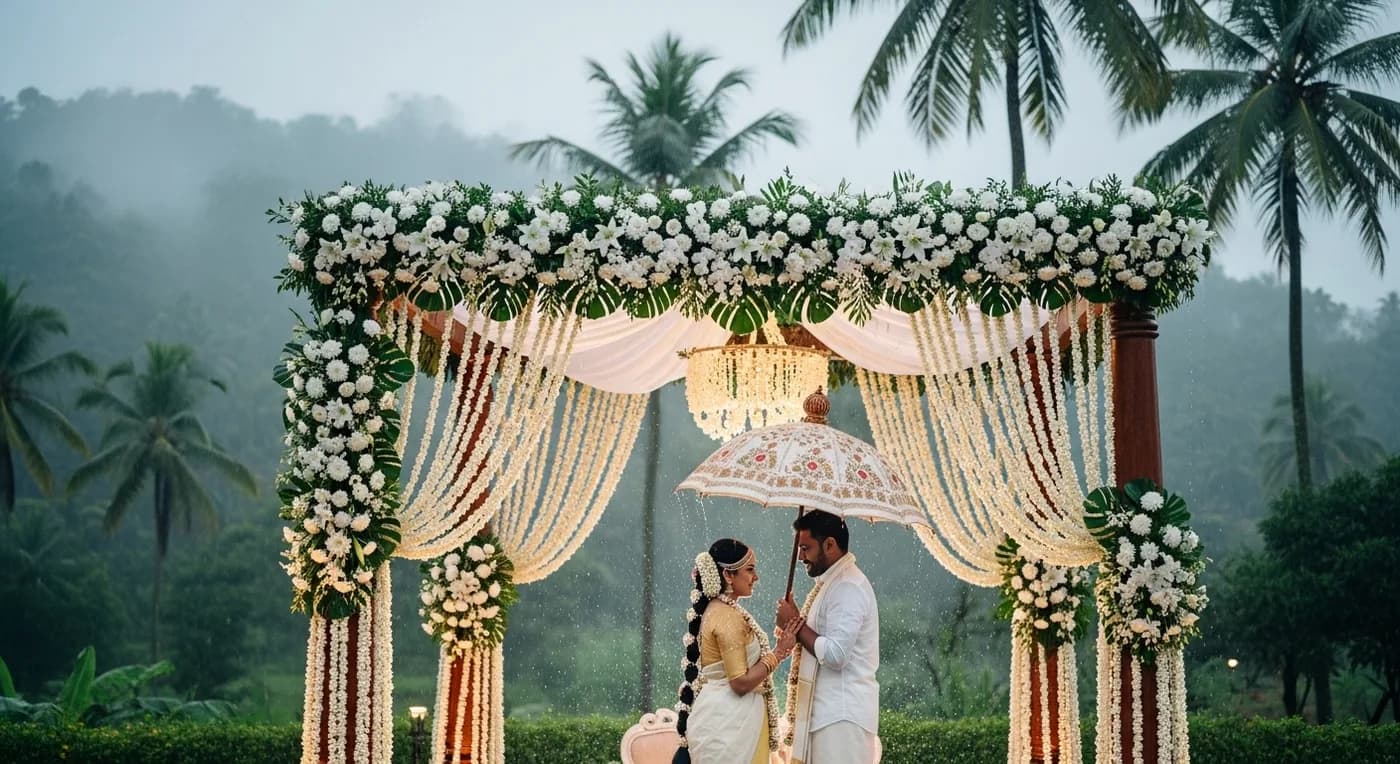
The aesthetic is unmatched. Kerala during the monsoon is arguably the most photogenic version of itself. The soft, diffused light that overcast skies produce is what portrait photographers call "nature's softbox" — it eliminates harsh shadows and creates an even, flattering glow on skin. Couple that with the saturated greens and dramatic cloud formations, and you have a visual backdrop that no amount of decor spending during summer can replicate.
Intimate celebrations feel more natural. The monsoon naturally encourages smaller, cosier gatherings. If you have been wanting to keep your guest list under 200 but face family pressure to go bigger, the rainy season provides a graceful reason to opt for an intimate affair.
Month-by-Month Monsoon Rainfall Guide for Kerala
Not all monsoon months are created equal. Understanding the rainfall pattern across Kerala's districts will help you pick the right month and location for your wedding.
June: The Grand Arrival
The southwest monsoon typically arrives in Kerala between June 1 and June 5, making landfall along the Thiruvananthapuram coast before sweeping northward, according to India Meteorological Department data. Rainfall in June averages 600 to 700 mm across the state, with the heaviest downpours in Wayanad, Idukki, and the coastal belt of Kozhikode.
Wedding viability: Moderate to challenging. The early weeks of June often see continuous heavy rain. If you choose June, aim for the last week when the initial intensity subsides, and select a venue in the drier southern plains around Kottayam or Pathanamthitta.
July: Peak Monsoon
July is the wettest month in Kerala, with average rainfall exceeding 700 mm in most districts. The Western Ghats receive particularly intense precipitation, and districts like Idukki and Wayanad may experience landslide warnings.
Wedding viability: Challenging but not impossible. Fully indoor venues in urban centres like Ernakulam (Kochi) and Thrissur are your safest bet. Avoid hill stations and flood-prone areas entirely.
Important
August: The Settling Phase
Rainfall begins to moderate in August, averaging 400 to 500 mm. The rain becomes more intermittent rather than continuous — you will often get bright, clear mornings followed by afternoon showers. Districts in central Kerala like Thrissur, Palakkad, and Ernakulam tend to be drier than the northern and hill regions.
Wedding viability: Good. August offers the monsoon aesthetic with more predictable weather windows. Morning ceremonies followed by afternoon receptions work particularly well.
September: The Sweet Spot
September is the transition month as the southwest monsoon retreats. Rainfall drops to 200 to 300 mm, and dry spells of two to three consecutive days become common. The landscape remains lush and green from months of rain, but the intensity has passed.
Wedding viability: Excellent. September is arguably the best month for a monsoon wedding in Kerala. You get the visual benefits of the rainy season — verdant scenery, pleasant temperatures, cooler evenings — with significantly reduced rain risk. Venue and vendor pricing still reflects off-season rates.
Tip
Venue Selection: The Most Critical Decision
Your venue choice will make or break a monsoon wedding. This is not the time for an open-air lawn-only venue, no matter how beautiful it looks in photos taken during January.
What to Look For
Indoor-outdoor hybrid spaces are non-negotiable. For a detailed comparison of the pros and cons of each setting, see our outdoor vs indoor wedding in Kerala guide. The ideal monsoon wedding venue in Kerala offers a beautiful covered or indoor ceremony area with the option to open up to outdoor spaces during dry spells. Convention centres attached to resorts, heritage properties with wide verandahs and inner courtyards, and hotels with ballrooms that open onto covered terraces are all excellent options.
Covered walkways and transitions. Your guests should be able to move from the parking area to the ceremony space to the dining hall without getting drenched. This sounds obvious, but you would be surprised how many otherwise lovely venues fail this basic test during the monsoon.
Proper drainage and elevation. Visit the venue during the rainy season before booking. A venue that looks pristine in February might have waterlogged lawns and flooded parking in July. Check that the property sits on elevated ground with functioning drainage systems.
Generator backup. Power outages during monsoon storms are a reality in Kerala, particularly outside major cities. Confirm that the venue has a high-capacity generator that can handle the full lighting, sound, and kitchen load.
Top Venue Types by District
Ernakulam (Kochi): The urban infrastructure makes Kochi one of the safest choices for monsoon weddings. Hotel ballrooms in Fort Kochi, convention centres in Edappally and Kakkanad, and the heritage properties along the backwaters of Vypin and Maradu offer reliable covered spaces with strong logistics support.
Thrissur: Known as Kerala's cultural capital, Thrissur offers stunning auditoriums attached to temples and cultural centres. The convention halls along the Thrissur-Kochi highway are modern, well-maintained, and significantly cheaper during monsoon months.
Alappuzha: If you dream of a backwater wedding, monsoon is when Alappuzha looks most dramatic. Several resorts along the Vembanad Lake offer covered floating pavilions and indoor lakeside halls. The houseboats are not recommended during heavy rain, but shoreline properties with covered decks are magnificent.
Thiruvananthapuram: The capital city offers excellent hotel infrastructure and some of the state's best-maintained convention centres. Kovalam resorts often have deep monsoon discounts — a property that charges 3 lakhs for a December wedding might offer the same package for 1.8 to 2 lakhs in August.
Kozhikode: North Kerala's monsoon intensity is higher, but Kozhikode city itself has excellent covered venues. The heritage properties in the Kappad and Beypore areas, with their traditional Kerala architecture featuring sloped roofs and wide verandahs, are naturally designed for rain.
Looking for Venues?
Tell us what you need and get quotes from verified venues
Decor That Thrives in Humidity
Standard wedding decor strategies fall apart in monsoon humidity. Delicate paper flowers wilt. Fabric draping sags with moisture. Electronic fairy lights become safety hazards in wet conditions. A smart monsoon wedding decorator works with the season rather than against it.
Florals That Love the Rain
Kerala is blessed with tropical flowers that are at their most abundant during the monsoon. Anthuriums, orchids, heliconias, lotus blooms, and bird of paradise — all of these are in peak season between June and September, which means lower costs and fresher arrangements.
₹50,000 – ₹2,00,000Jasmine, the quintessential Kerala wedding flower, is abundantly available during the monsoon and significantly cheaper than during peak season. A jasmine-and-brass-lamp centrepiece that costs 1,500 rupees per table in December might cost just 800 to 900 rupees during the monsoon.
Tip
Materials That Work
- Brass and copper: Traditional Kerala brass lamps, urlis (wide-mouthed vessels), and copper accents are completely unaffected by humidity and gain a beautiful patina in moist air.
- Fresh greenery over fabric: Minimize fabric draping in open or semi-covered areas. Use banana fibre garlands, fresh leaf torans, and flower walls instead.
- Waterproof lighting: LED candles, submersible pool lights in urlis, and properly weatherproofed fairy lights designed for outdoor use.
- Bamboo and cane structures: Lightweight, strong, and naturally resistant to moisture. Bamboo mandapams with floral accents are both eco-friendly and stunning.
Colours That Complement the Monsoon
The monsoon palette is silver, grey, deep green, and occasional bursts of golden sunlight. Your decor should complement rather than fight this. Deep golds, burnt oranges, rich burgundies, and classic whites stand out beautifully against green-and-grey backgrounds. Avoid pastels — they tend to look washed out under overcast skies.
Photography: Turning Rain Into Drama
A skilled photographer does not merely cope with monsoon conditions — they actively leverage them to create images that would be impossible during dry months. Rain-soaked wedding photography in Kerala has become a genre unto itself, with some of the most shared and awarded wedding images coming from monsoon celebrations.
What Makes Monsoon Photography Special
Soft, even lighting. The overcast sky acts as a massive diffuser, eliminating the harsh shadows and squinting that plague noon ceremonies in April and May. Your guests will look naturally radiant without heavy lighting setups.
Reflections everywhere. Wet surfaces — marble floors, garden paths, vehicle rooftops, puddles — create natural reflections that add depth and artistry to composition. A couple walking through a rain-kissed garden, their reflection mirrored in a puddle below, is the kind of image that defines a wedding album.
Dramatic skies. The cloud formations during Kerala's monsoon are theatrical. A single break in the clouds creating a shaft of golden light during the ceremony? That photograph will hang on your wall for decades.
Rain itself as a prop. Couple portraits under a shared umbrella, rain falling like silver curtains in the background captured with a slow shutter, the groom sheltering the bride as they dash between covered areas — these are moments of genuine emotion that posed peak-season photos rarely capture.
Choosing Your Photographer
Not every photographer is comfortable or experienced with monsoon conditions. When interviewing photographers for a monsoon wedding, ask specifically to see rain-weather portfolios. A photographer who primarily shoots in controlled environments may struggle with the rapid light changes and moisture challenges of the rainy season.
Look for photographers who carry weather-sealed camera bodies, have backup equipment, and can demonstrate experience with off-camera flash in wet conditions. They should be proactive about scouting covered areas for formal portraits and creative about using the rain rather than hiding from it.
Tip
Looking for Photographers?
Tell us what you need and get quotes from verified photographers
Guest Comfort: The Details That Matter
Your guests will remember two things about your monsoon wedding — how beautiful it looked and how comfortable they felt. Nail the logistics, and the rain becomes part of the charm rather than a source of complaint.
Transport and Arrival
- Valet parking or covered drop-off. Ensure guests can exit their vehicles under cover. If the venue does not have a portico, set up a temporary covered walkway from the parking area.
- Shuttle service for distant accommodation. If guests are staying at hotels away from the venue, arrange mini-bus shuttles so they do not have to navigate wet roads in unfamiliar areas.
- Clear signage. Wet conditions and reduced visibility make navigation harder. Place well-lit, weather-resistant directional signs from the main road to the venue entrance.
At the Venue
- Umbrellas as welcome gifts. Station branded or colour-coordinated umbrellas at the entrance for guests who need to move between buildings. This doubles as a thoughtful wedding favour.
- Foot-drying stations. Place absorbent mats, shoe racks, and towel stations at every entrance. Guests in silk sarees and mundus will appreciate not having to worry about wet, slippery floors.
- Temperature management. Monsoon air in Kerala is warm and humid. Ensure the indoor spaces have functioning air conditioning, and place pedestal fans in semi-covered areas. Overheated, humid indoor spaces will make guests miserable faster than a bit of rain.
- Footwear-friendly flooring. If any walking paths are on natural ground, lay down anti-slip mats or temporary wooden decking. Wet grass and mud are the enemies of wedding footwear.
Important
Bridal Attire and Styling for Humidity
The Kerala monsoon's humidity levels regularly exceed 85 percent, which affects everything from fabric draping to makeup longevity. Smart fabric and styling choices are essential.
Fabric Selection
Best choices: Tissue silk, organza, lightweight georgette, and cotton-silk blends. These fabrics breathe well, resist moisture absorption, and maintain their structure in humid conditions. The traditional Kerala kasavu saree in fine cotton or tissue is actually ideal for monsoon weddings — it is lightweight, elegant, and drapes beautifully even in high humidity.
Avoid: Heavy Kanjeevaram silk, velvet, and heavily embroidered fabrics. These absorb moisture, become uncomfortably warm, and their weight increases noticeably in humid conditions. If you absolutely want a Kanjeevaram for the ceremony, change into something lighter for the reception.
Makeup That Lasts
- Use a silicone-based primer to create a moisture barrier before foundation.
- Opt for waterproof formulations for foundation, eyeliner, and mascara.
- Set everything with a long-wear setting spray — ask your makeup artist to apply two coats.
- Choose cream-based blush over powder, as powder products can cake in humidity.
- Keep blotting papers and a compact mirror with the bridal party for quick touch-ups.
Hairstyling
Humidity is the enemy of loose curls and blow-dried styles. Within an hour, carefully styled waves can deflate into limp strands. Instead:
- Structured updos like the traditional Kerala bun adorned with jasmine and gold accessories hold beautifully in humidity.
- Braided styles — fishtail braids, Dutch braids, or the classic South Indian plait with fresh flowers — are both moisture-resistant and culturally appropriate.
- Use anti-humidity hair products and strong-hold hairspray. Apply a frizz-control serum before styling begins.
Catering Considerations for the Monsoon
Kerala's wedding feast — the sadhya — is traditionally served on banana leaves on the floor. During the monsoon, catering requires some thoughtful adjustments.
Menu Adjustments
The monsoon naturally lends itself to warm, comforting food. Lean into this:
- Hot items take priority. Increase the proportion of hot dishes over cold ones. Freshly fried banana chips, hot parippu vada, steaming payasam, and warm ada pradhaman resonate better with guests during cool, rainy weather than chilled desserts.
- Soup and beverage stations. Add a hot soup counter and a chai or sulaimani (Kerala-style black tea with spices) station. These are inexpensive additions that dramatically improve guest experience on a rainy evening.
- Reduce cold salads and raw preparations. Monsoon humidity increases food safety risks for items served at room temperature. Stick to cooked preparations and keep cold items properly chilled.
Serving Logistics
- Covered serving areas are mandatory. Even a brief rain shower can ruin an exposed buffet. Ensure all food service points are under permanent cover, not just pop-up tents that can leak.
- Elevated banana leaf dining. If you want the traditional floor-seated sadhya, ensure the dining area has a solid roof and proper flooring — not a tent over grass. Table-seated sadhya on raised banana leaves is an excellent compromise that protects both food and guests from ground-level moisture.
- Staggered serving times. Monsoon traffic delays are real. Plan for guests arriving in waves rather than all at once, and coordinate with your caterer to serve in batches to keep food hot and fresh.
The cost per plate for a traditional sadhya during monsoon months typically ranges from 800 to 1,500 rupees, compared to 1,000 to 1,800 rupees during peak season — another area where your off-season timing pays off.
The Cost Advantage: A Detailed Breakdown
Let us get specific about the financial benefits of a monsoon wedding in Kerala. These are not theoretical numbers — they reflect real market rates from vendor conversations across Kochi, Thrissur, Kozhikode, and Thiruvananthapuram.
| Category | Peak Season (Dec-Feb) | Monsoon (Jun-Sep) | Savings |
|---|---|---|---|
| Venue (300 guests) | 3,00,000 - 5,00,000 | 2,00,000 - 3,50,000 | 25-30% |
| Photography + Video | 1,50,000 - 3,00,000 | 1,00,000 - 2,20,000 | 25-30% |
| Decor + Florals | 1,50,000 - 3,00,000 | 1,00,000 - 2,00,000 | 20-35% |
| Catering (per plate) | 1,000 - 1,800 | 800 - 1,500 | 15-20% |
| Guest Accommodation | 3,000 - 6,000/night | 1,500 - 3,500/night | 40-50% |
| Makeup Artist | 25,000 - 60,000 | 18,000 - 45,000 | 20-25% |
The accommodation savings alone can be staggering. A resort room in Kumarakom that costs 6,000 rupees per night in December is often available for 2,500 to 3,000 rupees during the monsoon. If you are hosting 50 rooms of guests for two nights, that is a saving of 3 to 4 lakhs on accommodation alone.
Tip
Building Your Backup Plan
Every monsoon wedding needs a Plan B. Not because something will definitely go wrong, but because having a solid backup eliminates stress and lets you enjoy the day.
The Three-Layer Backup Strategy
Layer 1: Venue flexibility. Your contract with the venue should explicitly include the option to move between indoor and outdoor spaces at no additional charge. Get this in writing. Some venues charge a "rearrangement fee" for last-minute indoor shifts — negotiate this out before signing.
Layer 2: Timeline flexibility. Build 30 to 45 minutes of buffer into your wedding day timeline. If it is raining during the scheduled outdoor couple portraits, you can wait for a break without the entire schedule collapsing. Kerala's monsoon rain often comes in intense bursts followed by clear periods — patience is usually rewarded.
Layer 3: Communication plan. Designate one person — your wedding coordinator or a trusted family member — as the weather monitor. Their job is to check radar forecasts on the morning of the wedding and coordinate any necessary shifts with the venue, decorator, and photographer so you do not have to think about it.
What to Include in Your Emergency Kit
- Extra umbrellas (at least 20 for a 300-guest wedding)
- Towels at every entrance
- Waterproof covers for the sound and DJ equipment
- A portable steamer for last-minute fabric wrinkles caused by humidity
- Anti-slip floor mats for transition areas
- Waterproof pouches for guests' phones and purses during outdoor moments
Lessons From Real Monsoon Weddings
Over the years, the couples who have embraced monsoon weddings rather than merely enduring them are the ones who created the most memorable celebrations.
One couple in Alappuzha chose an August date specifically because they wanted the backwaters at their most dramatic. They planned the ceremony under a beautifully decorated covered pavilion by the lake, and when a brief rain shower passed through during the reception, their photographer captured the entire bridal party dancing in the rain — an image that became a viral sensation on social media and brought them more joy than any carefully posed peak-season portrait could have.
Another couple in Thrissur leveraged their September wedding timing to book a premium auditorium at nearly half the peak-season rate. They redirected the savings into an elaborate sadhya with 26 dishes and a live chenda melam performance that their guests still talk about years later.
The common thread? These couples did not apologise for the rain. They planned for it, communicated confidently with their guests, and treated the monsoon as a feature of their celebration rather than a flaw.
Your Monsoon Wedding Planning Checklist
To bring everything together, here is a condensed action plan aligned with the comprehensive Kerala wedding checklist:
Six months before:
- Finalise the date and book your venue (confirm indoor-outdoor flexibility in writing)
- Book photographer, videographer, and makeup artist
- Begin outfit shopping — allow time for alterations
Three months before:
- Confirm catering menu with monsoon-specific adjustments
- Finalise decor plan with humidity-resistant materials
- Arrange guest accommodation and transport logistics
- Send save-the-dates with a cheerful note about embracing the monsoon
One month before:
- Visit the venue during rain to confirm drainage and logistics
- Finalise emergency kit and backup plan details
- Confirm generator backup and covered transition paths at the venue
- Brief your wedding party on the timeline and any weather-dependent changes
One week before:
- Check extended weather forecast and brief all vendors
- Confirm shuttle and transport arrangements
- Prepare welcome bags with umbrellas and comfort items for guests
Make the Rain Part of Your Story
A monsoon wedding in Kerala is not a compromise — it is a choice. It is choosing dramatic skies over predictable sunshine. It is choosing lush, vibrant venues at a fraction of peak-season cost. It is choosing the intimacy of a celebration where every guest who shows up truly wants to be there, rain or shine.
The couples who plan monsoon weddings with confidence, creativity, and thorough preparation do not just save money — they create celebrations with a character and atmosphere that January weddings simply cannot replicate.
Kerala in the monsoon is God's Own Country at its most alive. There is no more fitting backdrop for the beginning of a new life together.
Looking for Venues?
Tell us what you need and get quotes from verified venues
Common Questions About Monsoon Weddings in Kerala
Is a monsoon wedding in Kerala actually a good idea?
Absolutely, and increasingly couples are choosing the rainy season for three concrete reasons. Monsoon weddings save 20-30% on venues and vendors across every category — a ₹15 lakh December wedding executes at ₹10-12 lakh between June and September. The aesthetic is unmatched: saturated green landscapes, dramatic cloud formations, soft diffused light that portrait photographers call "nature's softbox," and the atmospheric intimacy that only rainy seasons create. Vendor availability is dramatically better too — top photographers in Kochi or Thrissur who are booked 6-8 months ahead in peak season are often available with just 2-3 months lead time during monsoon.
Which months have the heaviest Kerala rainfall?
Kerala experiences two distinct monsoon seasons. The southwest monsoon from June to August brings the heaviest rainfall, with July being the wettest month — averaging 400-700 mm across different districts. The northeast monsoon from October to November brings lighter, intermittent showers that rarely disrupt well-planned indoor weddings. September is the crucial transition month with decreasing rainfall, making it the smartest choice for couples wanting monsoon aesthetics and pricing with dramatically reduced rain risk. The Western Ghats districts (Wayanad, Idukki, parts of Palakkad) consistently receive more rainfall than coastal plains — factor location into your monsoon date calculation.
How much can couples actually save with a monsoon wedding?
Real savings land between 20-30% on total wedding budget compared to peak-season rates. Venue rates drop 25-30% during monsoon months. Photography and videography packages run 25-30% cheaper. Decor and florals come in 20-35% lower because local tropical flowers are at peak abundance. Catering drops 15-20% per plate. The biggest savings often come from guest accommodation: a Kumarakom resort room that costs ₹6,000 per night in December can run ₹2,500-₹3,000 in August. For a 50-room, two-night wedding, that's ₹3-4 lakhs saved on accommodation alone. Many vendors also throw in added value — extra coverage hours, included pre-wedding shoots, or upgraded packages at standard rates.
What venue format actually works for a monsoon Kerala wedding?
Choose venues offering both covered and open-air spaces. Convention centres, indoor banquet halls with attached lawns, heritage properties with verandahs and inner courtyards, and resort ballrooms with covered terraces are all strong choices. The best monsoon wedding venues have covered walkways between parking and event spaces, proper drainage, functioning generator backup, and the flexibility to shift between indoor and outdoor setups within 30 minutes. Visit the venue during actual rain before booking — a property that looks pristine in February might have waterlogged lawns in July. Get the indoor-outdoor flexibility confirmed in writing at no additional charge.
How do I keep bridal attire and makeup intact in monsoon humidity?
Humidity levels regularly exceed 85% during Kerala monsoon, which requires specific product strategies. Choose lightweight fabrics like tissue silk or organza over heavy Kanjeevaram silk — they breathe well, resist moisture absorption, and maintain structure in humid conditions. The traditional kasavu saree in fine cotton is actually ideal for monsoon weddings. For makeup, use silicone-based primers to create moisture barriers, waterproof formulations for foundation and eye products, and ask your MUA to apply setting spray in two thin coats. Choose structured hairstyles like the traditional Kerala bun with jasmine, or fishtail and Dutch braids that hold well in humidity — loose curls deflate within an hour in Kerala's monsoon air.
Tip
Plan smarter with free tools — generate a personalised timeline with our AI Wedding Checklist, estimate costs with the Wedding Cost Calculator, or create a stunning digital invitation in minutes.
Topics
monsoon wedding Keralarainy season weddingkerala wedding planningmonsoon wedding venuesbudget wedding Keralawedding photography rainkerala wedding tipsoff-season weddingExplore more
Frequently Asked Questions
1Is it a good idea to have a monsoon wedding in Kerala?
2Which months have the heaviest rainfall in Kerala?
3How much can I save with a monsoon wedding in Kerala compared to peak season?
4What kind of venue is best for a monsoon wedding in Kerala?
5How do I protect my bridal attire and makeup from monsoon humidity in Kerala?
Continue reading
Related Articles
How to Plan a Kerala Wedding: The Complete 2026 Guide
Kerala Wedding Checklist: Complete Printable Planner for 2026
Best Wedding Venues Kerala: ₹50K-₹25L With Prices (2026)
Kerala Wedding Budget Guide: 2026 Cost Breakdown
Budget Wedding in Kerala: Complete Plans for ₹5 Lakh, ₹10 Lakh & ₹15 Lakh
Best Season for South India Destination Weddings: Month-by-Month Western Ghats Guide
Still planning?
Get quotes from India's best vendors
Tell us what you're planning and we'll match you with verified photographers, venues, decorators, and more.
Get free quotes