
Wedding Planning App vs Spreadsheet vs Physical Planner: Which Is Right for You?
Compare wedding planning apps, spreadsheets, and physical planners — features, pros and cons, and which approach works best for your wedding size and style.

Senior Wedding Planner
Priya Nair is a senior wedding planner based in Kochi with over eight years of experience coordinating Hindu, Christian, and destination weddings across Kerala.
On this page
For Indian weddings with 300+ guests, a dedicated planning app outperforms spreadsheets and planners with built-in checklists, budget tracking, vendor search, and RSVP management. Spreadsheets give maximum flexibility for detail-oriented couples with smaller weddings. Physical planners work best as supplements, not primary tools. Most couples benefit from a free planning app as their foundation.
Quick Answer
Wedding planning app vs spreadsheet vs physical planner: use a dedicated app when your guest list exceeds 200 or you have multiple events — it provides automated reminders, multi-user access, and pre-built Indian wedding structures that would take hours to replicate in a spreadsheet. Spreadsheets suit smaller, simpler weddings or couples who need custom data analysis. Physical planners work best as creative supplements. For most Indian weddings, the hybrid approach wins: app as command centre, spreadsheet for edge-case analysis, physical planner as a keepsake.
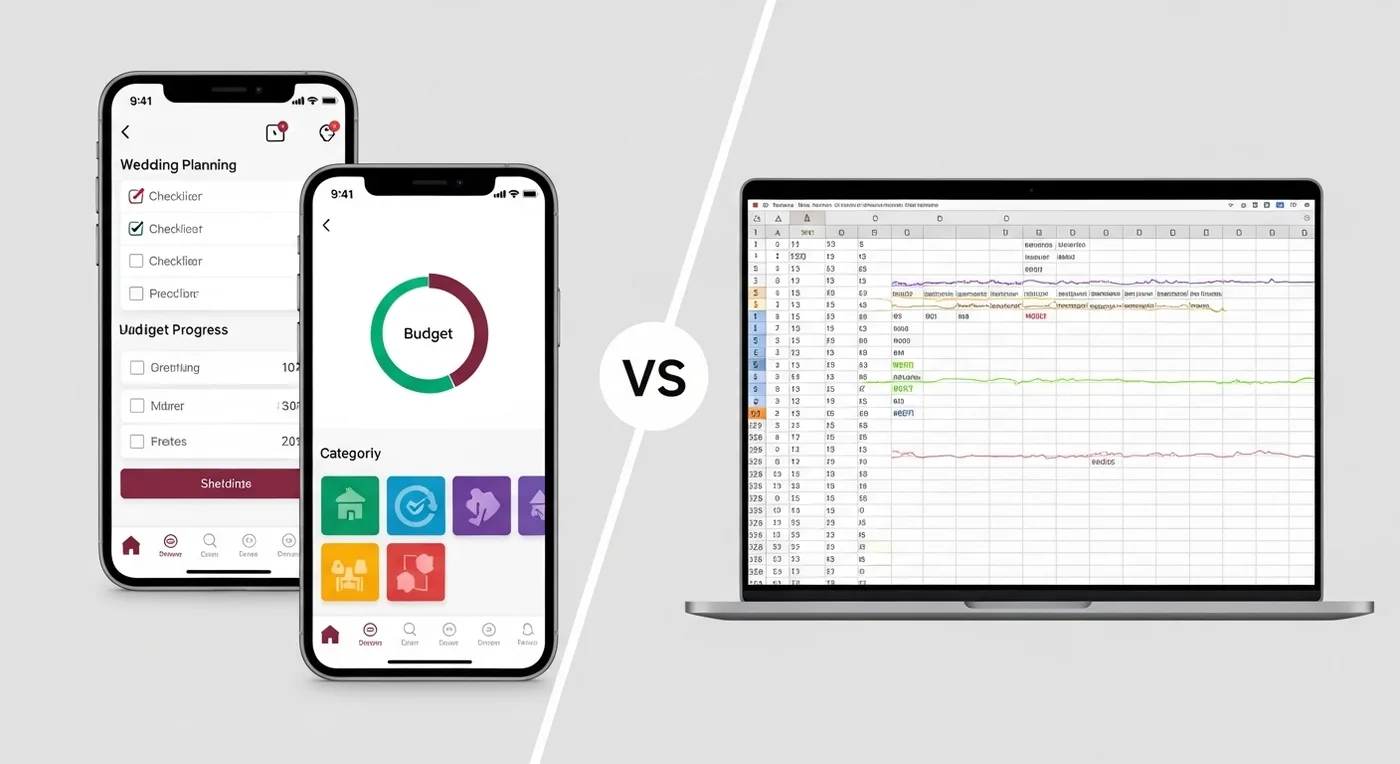
Every couple approaches wedding planning differently. Some download an app the day the ring goes on. Others open a fresh Google Sheet and start building formulas. A few reach for a hardcover wedding planner and start writing. Each approach has genuine strengths — and real limitations.
With 85% of couples now relying on digital platforms to plan their weddings and 36% actively using AI tools during the process, the planning tool landscape has shifted dramatically. Yet spreadsheets remain popular, and physical planners still have advocates. This guide compares all three approaches — features, flexibility, collaboration, and fit for Indian weddings — so you can choose the method that matches your celebration.
The Three Approaches to Wedding Planning
Before diving into the comparison, here is what each approach actually involves.
Wedding Planning Apps
Dedicated platforms — like itsmy.wedding, WedMeGood, and WeddingWire India — that provide structured tools for checklists, budget tracking, vendor discovery, guest lists, and invitations. The global wedding planning app market was valued at $1.2 billion in 2024 and is projected to reach $3.5 billion by 2033, reflecting how quickly couples are moving toward purpose-built tools.
Spreadsheets
Google Sheets or Excel workbooks where couples build their own tracking systems from scratch. Maximum flexibility — you control every column, formula, and filter — but manual setup is required for every feature an app provides out of the box.
Physical Planners
Hardcover or spiral-bound wedding planner books with pre-printed sections for budgets, vendor contacts, timelines, and notes. They range from simple notebooks to elaborately designed planners with month-by-month guides and pocket folders for swatches.
Feature-by-Feature Comparison
This table compares the three approaches across the features that matter most for Indian weddings. The differences are significant.
| Feature | Planning App | Spreadsheet | Physical Planner |
|---|---|---|---|
| Checklist with timeline | Pre-built, adapts to your date | Manual setup required | Pre-printed but static |
| Budget tracking | Auto-calculates, visual charts | Custom formulas needed | Manual calculations only |
| Vendor search | Integrated directory with filters | No vendor integration | No vendor integration |
| RSVP management | Digital tracking, auto-tallying | Manual entry and formulas | Manual tally on paper |
| E-invites | Built-in templates and sending | Not available | Not available |
| Guest list management | Sortable, filterable, exportable | Filterable with manual setup | Handwritten, hard to sort |
| Collaboration | Multi-user with role permissions | Shared editing (version conflicts) | One copy, no sharing |
| Reminders and alerts | Automated push notifications | No native reminders | No reminders |
| Mobile access | Native app, always available | Functional but clunky on mobile | Must carry the book |
| AI features | Personalised plans, smart suggestions | None | None |
| Offline access | Limited (varies by app) | Requires pre-download | Always available |
| Cost | Free to freemium | Free | ₹500 - ₹3,000 one-time |
| Learning curve | Low — guided interface | Medium — formula knowledge helps | Low — just write |
| Data backup | Cloud-synced automatically | Cloud-synced (Google Sheets) | No backup — if lost, it is gone |
Note
When a Planning App Is the Best Choice
A dedicated wedding planning app is the strongest option for the majority of Indian weddings. Here is when it becomes not just helpful, but essential.
Large Guest Lists
Indian weddings average 300-500 guests, with North Indian celebrations frequently exceeding 800. Managing RSVPs, meal preferences, and accommodation for this volume requires searchable, sortable, real-time data. A spreadsheet can handle 200 names. At 500, it becomes unwieldy. Apps like itsmy.wedding let you filter guests by event, by family side, and by meal preference — operations that would require nested formulas and multiple tabs in a spreadsheet.
Multiple Events and Ceremonies
A Kerala Hindu wedding might span a muhurtham ceremony, reception, and sadya lunch. A North Indian celebration could include mehendi, sangeet, haldi, ceremony, and reception across four days. Planning apps handle multi-event structures natively — you assign vendors and guests to specific events, track budgets per event, and generate separate checklists. In a spreadsheet, you would need to build this architecture from scratch and rebuild it every time plans change.
Remote Coordination and Time Savings
When the bride is in Bangalore, the groom is in Dubai, and both sets of parents are in Kerala, a shared planning app becomes the single source of truth. Changes sync instantly, and everyone sees the same data. Spreadsheets offer shared editing too, but version conflicts and accidental formula overwrites are common when multiple family members edit simultaneously.
The average couple spends six hours per week on wedding planning. Apps reduce that time by eliminating setup work — a budget tracker in a spreadsheet takes 2-3 hours to configure properly, while an app gives you the same functionality the moment you sign up.
Tip
Build your wedding checklist
A planning timeline shaped around your date, your events, and your family.
When a Spreadsheet Makes Sense
Spreadsheets are not obsolete for wedding planning. They excel in specific situations where their flexibility outweighs their setup cost.
Smaller, Simpler Weddings
For intimate weddings with under 100 guests and a single ceremony plus reception, a Google Sheet handles the workload comfortably. The guest list fits on one screen, the vendor count is manageable, and the moving parts stay within what a simple checklist can track.
Data-Savvy Couples
If you or your partner work in finance or analytics, you already know how to build pivot tables, conditional formatting, and automated calculations. For these couples, a spreadsheet is the most natural tool — you can build exactly the tracking system your brain expects.
Custom Workflows and Full Data Ownership
Some couples want to track things no app has anticipated — inter-family expense splits using a ratio model, per-event cost comparisons across venue quotes, or specific gifting traditions. Spreadsheets accommodate any data structure you can imagine. Everything lives in your Google or Microsoft account with no dependency on a third-party platform.
Note
When a Physical Planner Works Best
Physical planners occupy a different space in the planning process. They are rarely sufficient as a primary tool for Indian weddings, but they serve purposes that digital tools cannot replicate.
Brainstorming and Inspiration
When you are sitting with your mother discussing colour palettes, flipping through fabric swatches, or sketching a rough mandap layout, a physical notebook is more natural than a screen. Magazine clippings, fabric samples, handwritten notes from your grandmother about family traditions — these artefacts belong in a physical book. Many couples create planners that double as keepsakes of the planning journey.
Offline Reliability and Vendor Meetings
A physical planner works in a temple with no signal, during a power cut, and on a flight with no Wi-Fi. It never needs charging and never crashes. Walking into a venue visit with a planner and pen lets you sketch room layouts, jot immediate impressions, and file business cards directly into pocket folders — more focused than scrolling through phone notes.
Tip
The Hybrid Approach: Best of All Three
Here is the approach that works for most couples, and the one that experienced wedding planners recommend: use all three, but assign each tool a clear role.
App: The Command Centre
Your planning app handles everything that needs to be accurate, up-to-date, and accessible to multiple people. This includes your checklist and timeline, budget tracking, guest list, vendor communication, and e-invite management. The app is the single source of truth. If there is a conflict between what your planner says and what the app says, the app wins.
Spreadsheet: The Custom Analyst
Use a spreadsheet for tracking that no app supports. This might include a comparison matrix for three competing venues, a detailed breakdown of inter-family expense sharing, per-guest cost modelling for different catering options, or a custom seating chart algorithm. The spreadsheet handles edge cases and custom analysis that fall outside an app's pre-built features.
Physical Planner: The Creative Journal
Your planner holds everything emotional and tactile. Colour palette explorations. Fabric swatches. Handwritten notes from conversations with your grandmother about family traditions. Rough sketches of what you imagine the mandap looking like. Magazine clippings and printed Instagram screenshots of outfits you love. It is a keepsake as much as a tool.
This three-layer approach gives you structure (app), flexibility (spreadsheet), and soul (planner) — without any one tool carrying a burden it was not designed for.
Decision Framework: Choose by Wedding Size
Still unsure? Use your guest count and event structure as the deciding factor.
Under 100 Guests, Single Event
A spreadsheet or physical planner is sufficient. The coordination complexity is manageable with simple tools. A single ceremony with a reception, 5-8 vendors, and a contained guest list does not require the overhead of a dedicated app.
Recommended approach: Google Sheet for budget and guest list. Physical planner for creative planning. Optionally, explore a free planning app for its checklist — even for small weddings, the timeline reminders are valuable.
100 to 300 Guests, Two to Three Events
An app is strongly recommended. At this scale, you are managing multiple vendor contracts, a guest list that needs filtering by event, a budget with 10+ categories, and coordination across family members. Manual methods start consuming more time than planning itself.
Recommended approach: Planning app as primary tool. Spreadsheet for any custom tracking (venue comparisons, family budget splits). Physical planner for inspiration and brainstorming.
300 to 500+ Guests, Multi-Day Celebration
An app is essential. The India wedding services market is projected to reach $228 billion by 2030, driven partly by the complexity of large-scale celebrations. At 400 guests and four events, you are managing 15-20 vendor relationships, a catering operation that rivals a restaurant launch, accommodation logistics for out-of-town guests, and transportation coordination. No spreadsheet can handle this without becoming a full-time job.
Recommended approach: Planning app for all logistics, coordination, and tracking. AI-generated checklist for a personalised timeline. Budget tracker for real-time spending visibility. Spreadsheet only for highly specific analysis. Physical planner as a personal keepsake.
Note
Common Mistakes When Choosing a Planning Method
Starting With the Wrong Tool
Couples who begin with a spreadsheet and later realise they need an app face the pain of migrating data — re-entering guest names, rebuilding budget categories, and transferring vendor contacts. Starting with an app and exporting to a spreadsheet later is far easier than the reverse.
Using Too Many Apps
Most couples combine two to three tools, which is reasonable. Five or six tools, each handling one narrow function, creates its own chaos. Notifications from six different apps, data scattered across platforms, and no single view of your full wedding status. Pick one primary app and supplement as needed.
Ignoring the Family Factor
Indian weddings are family affairs. Your mother, future mother-in-law, siblings, and possibly aunts and uncles will all be involved in planning. A physical planner that only you can access, or a spreadsheet with formulas that only you understand, creates bottlenecks. A shared app with simple interfaces ensures that anyone involved can check the guest count, see the budget status, or confirm a vendor booking.
Treating the Physical Planner as the Source of Truth
A physical planner cannot sync, cannot be backed up, and cannot be accessed by anyone who is not holding it. If you write a vendor's revised quote in your planner but forget to update it in your app, your budget calculations will be wrong. Always enter financial data and deadline changes in your digital system first, then note them in your physical planner if you wish.
Getting Started
The best time to choose your planning method is the week you get engaged. The second-best time is now.
If your wedding has more than 200 guests or multiple events, start with a planning app. Our free AI-powered checklist generates a personalised timeline based on your wedding date, location, and ceremony type — the same tasks that would take hours to research and organise in a spreadsheet, ready in under a minute.
From there, explore the tools that support each stage of planning:
- Checklist and timeline — your personalised task list, adapted to your wedding
- Budget tracker — real-time spending with pre-configured Indian wedding categories
- Guest list manager — filter by event, side, and meal preference
- E-invite creator — design and send digital invitations
- Vendor directory — search and shortlist vendors by category and location
For deeper guidance on each planning tool, explore our complete guide to wedding planning tools in 2026, learn how to use a wedding checklist effectively, or see our step-by-step wedding guest list management guide.
Whatever method you choose, the goal is the same: less time managing logistics, more time enjoying the celebration you are creating.
Topics
wedding planning appwedding spreadsheetwedding planner bookwedding planning comparisonbest way to plan weddingExplore more
Frequently Asked Questions
1Should I use a wedding planning app or a spreadsheet?
2Are wedding planning apps worth it?
3What are the disadvantages of using a spreadsheet for wedding planning?
4Can I use a physical wedding planner book alongside an app?
Continue reading
Related Articles
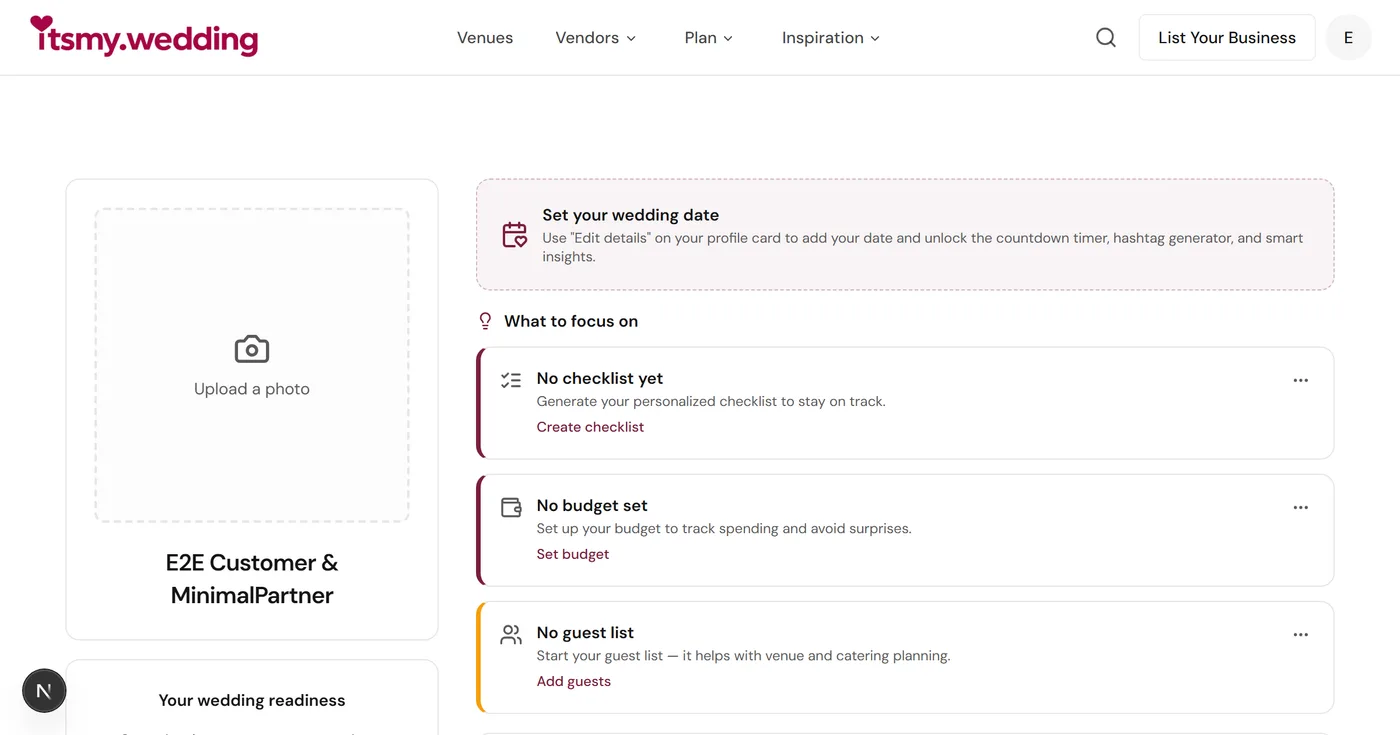
Best Free Wedding Planning Tools in 2026: The Complete Guide
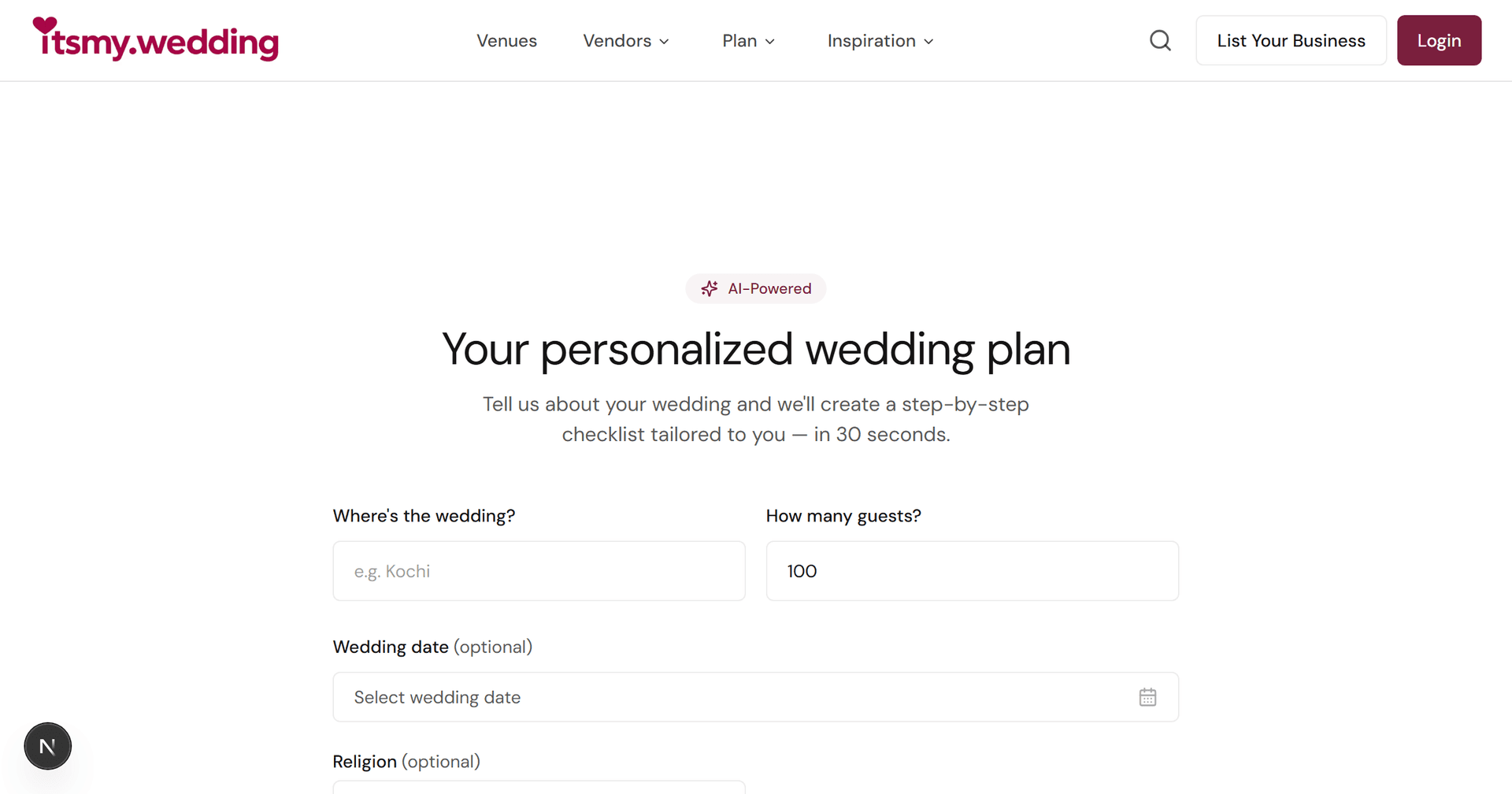
AI Wedding Checklist vs Generic Templates: Which Is Better for Your Wedding?
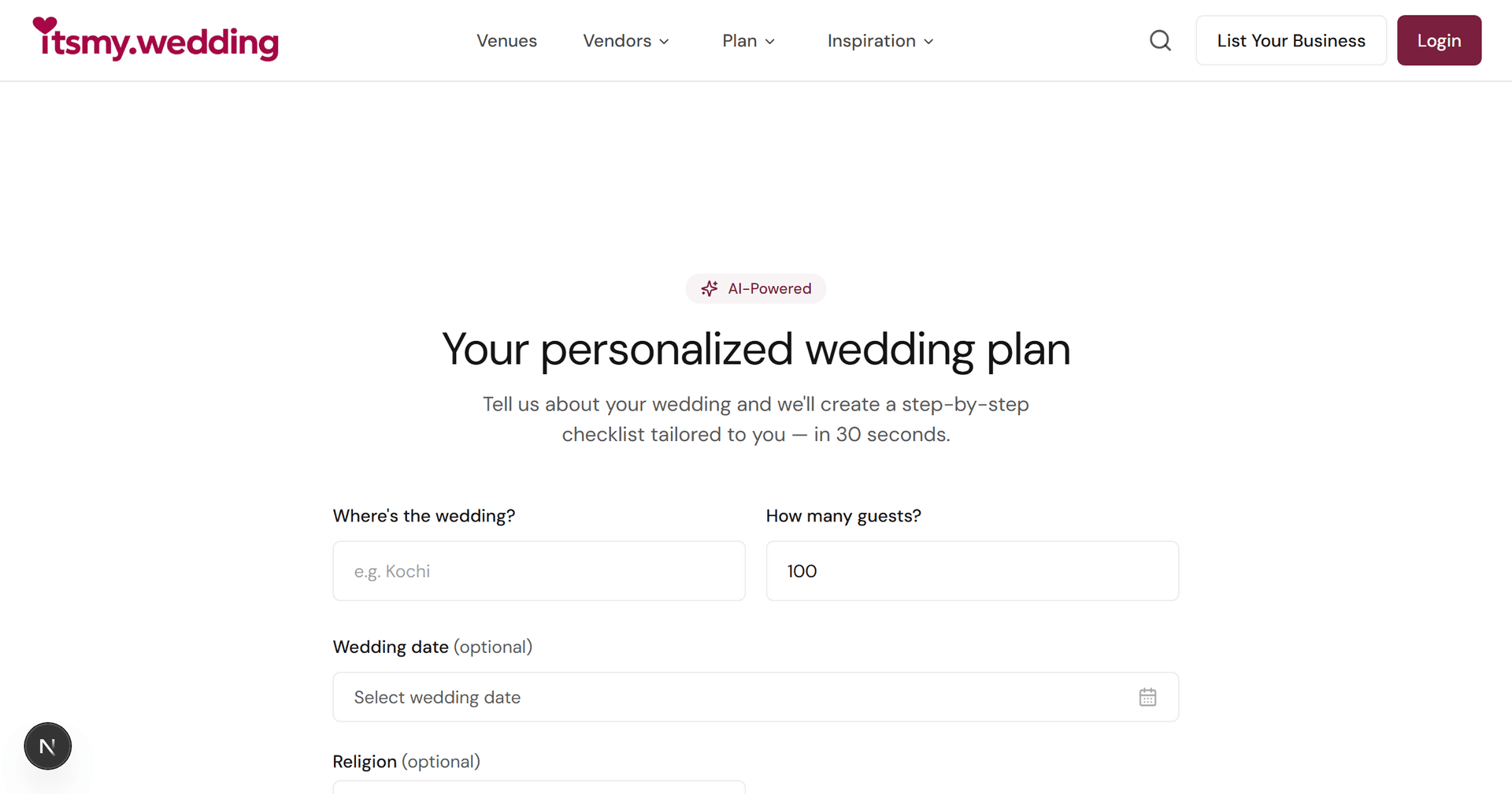
How to Use a Wedding Checklist: Step-by-Step Guide to Stress-Free Planning
How to Track Your Wedding Budget Without a Spreadsheet
Kerala Wedding Checklist: Complete Printable Planner for 2026

Best Season for South India Destination Weddings: Month-by-Month Western Ghats Guide
Still planning?
Get quotes from India's best vendors
Tell us what you're planning and we'll match you with verified photographers, venues, decorators, and more.
Get free quotes