
AI Wedding Checklist vs Generic Templates: Which Is Better for Your Wedding?
Compare AI-generated wedding checklists with generic Pinterest templates — personalisation, accuracy, and how AI adapts to your date, religion, location, and venue type.

Senior Wedding Planner
Priya Nair is a senior wedding planner based in Kochi with over eight years of experience coordinating Hindu, Christian, and destination weddings across Kerala.
On this page
AI wedding checklists outperform generic templates by adapting to your specific wedding — date, location, religion, venue type, and guest count. A Thrissur temple wedding needs muhurtham booking and sadya planning; a Kochi resort wedding needs outdoor backup plans and accommodation blocks. AI handles these differences automatically, while a Pinterest template gives everyone the same 50 tasks.
Quick Answer
AI vs generic wedding checklists: an AI checklist takes your wedding date, location, religion, and venue type and generates a phased plan with only the tasks that apply to your celebration — including region-specific items like muhurtham booking and sadya planning that Pinterest templates miss entirely. Generic templates are faster to start with but require hours of manual filtering. For Kerala weddings with 200+ guests, the AI approach saves meaningful planning time and reduces the risk of missed tasks.
Kerala weddings involve multi-day events, religious rituals, and family expectations that no generic checklist was designed for. With 52% of couples reporting that wedding planning is stressful and 36% of engaged couples now actively using AI tools to plan their weddings — nearly double the rate from just one year ago — the question is no longer whether to use technology, but which approach actually reduces the stress.
This guide compares AI-generated wedding checklists with generic templates across every dimension that matters: personalisation, accuracy, cultural relevance, and real-world usefulness for Indian couples.
The Problem With One-Size-Fits-All Wedding Checklists
Most wedding checklists available online — on Pinterest, wedding blogs, and printable PDF sites — are designed for a Western audience. They assume one ceremony, one reception, 100 to 200 guests, and planning norms that simply do not apply to Indian weddings.
For Kerala couples, this creates real problems. A generic checklist will remind you to "choose your DJ" but will never mention booking a muhurtham with your astrologer. It will suggest "order the cake" but skip sadya menu planning entirely. And it will lay out a timeline built for a Saturday afternoon ceremony — not a 5 AM temple muhurtham followed by an evening reception.
According to The Knot's 2026 Real Weddings Study, nearly 90% of all wedding planning now happens online, with 85% of couples relying on digital platforms or apps. The wedding planning app market is projected to reach $5.2 billion by 2035, yet most of these digital tools still serve Western defaults. The result? Missed tasks, last-minute panic, and couples scrambling to fill gaps that a culturally aware checklist would have caught months earlier.
Note
How AI Wedding Checklists Work
An AI wedding checklist is not a static document with checkboxes. It is a system that takes your inputs and generates a plan tailored to your exact situation. Here is how the process typically works.
What You Provide
You answer a short set of questions — usually five to seven — covering the essentials:
- Wedding date — determines the entire countdown timeline
- Location — triggers region-specific tasks (permits, venue rules, weather planning)
- Religion and ceremony type — adds the correct rituals and removes irrelevant ones
- Venue type — temple, resort, home, backwater, or beach each need different logistics
- Guest count — scales catering, seating, transport, and accommodation tasks
- Budget range — prioritises vendor bookings and flags cost-sensitive decisions early
What the AI Generates
Based on those inputs, the AI produces a structured, time-phased checklist that accounts for your specific context. A couple planning a Hindu temple wedding in Thrissur with 500 guests gets a fundamentally different list than a couple planning a Christian church ceremony in Kottayam with 150 guests.
The AI also adjusts timelines dynamically. If your wedding is eight months away, you get a relaxed schedule. If it is four months away, the AI compresses the early-stage tasks and flags urgent bookings immediately.
Tip
Feature Comparison: AI vs Generic
Here is how AI checklists stack up against the three most common generic alternatives.
| Feature | AI Checklist | Pinterest Template | Spreadsheet | Planner Book |
|---|---|---|---|---|
| Personalised to your wedding | Yes — adapts to date, religion, location, venue | No — identical for every couple | Manual — you customise it yourself | No — pre-printed generic tasks |
| Timeline accuracy | Dynamic — based on your actual wedding date | Static — assumes 12-month timeline | Manual — requires constant updates | Static — fixed monthly sections |
| Regional tasks | Auto-included — sadya, muhurtham, permits | Missing — Western defaults only | Only if you know to add them | Missing |
| Religion-specific items | Yes — Hindu, Christian, Muslim, Sikh rituals | Rarely — most assume non-denominational | Only if you research and add them | Occasionally — varies by book |
| Real-time updates | Yes — adjusts as you check items off | No — print once, done | Partially — if you maintain it | No |
| Cost | Free to low-cost | Free | Free | ₹500 to ₹2,000 |
| Time to set up | Under 2 minutes | 10 to 30 minutes of searching | 2 to 5 hours of customisation | None — but limited |
The core advantage of AI is not that it has more tasks — it is that it has the right tasks for your wedding.
What an AI Checklist Gets Right That Templates Miss
Religion-Specific Tasks
A Hindu temple wedding requires muhurtham confirmation, priest booking, thali purchase, and nilavilakku arrangement. A Christian ceremony needs church booking, choir coordination, and banns announcement. A Muslim nikah requires qazi confirmation, mehr discussion, and walima planning.
Generic templates include none of these. At best, they offer a single line item — "book officiant" — that collapses dozens of religion-specific tasks into one vague reminder. An AI checklist trained on Indian wedding traditions generates the full ritual sequence for your chosen ceremony type.
Location-Specific Tasks
A backwater wedding in Alappuzha requires houseboat booking, water transport coordination, and monsoon contingency planning. A resort wedding in Munnar needs hillside logistics, fog-delay buffers, and accommodation blocks. A temple wedding in Guruvayur has specific photography restrictions and dress code requirements.
These are not edge cases — they are standard planning tasks that every couple at these venues needs. An AI checklist adds them automatically based on your location input.
Timeline Adaptation
According to wedding planning experts, one of the biggest mistakes couples make is assuming they have more time than they actually do. Popular venues and photographers book 12 to 18 months in advance, and delays compound quickly when you start late.
A generic template gives you a fixed 12-month countdown regardless of when you start. An AI checklist adapts. If you begin planning with only six months left, it immediately flags which vendors need urgent booking, which tasks can be parallelised, and which elements you may need to simplify.
For a detailed month-by-month breakdown, see our Kerala wedding timeline.
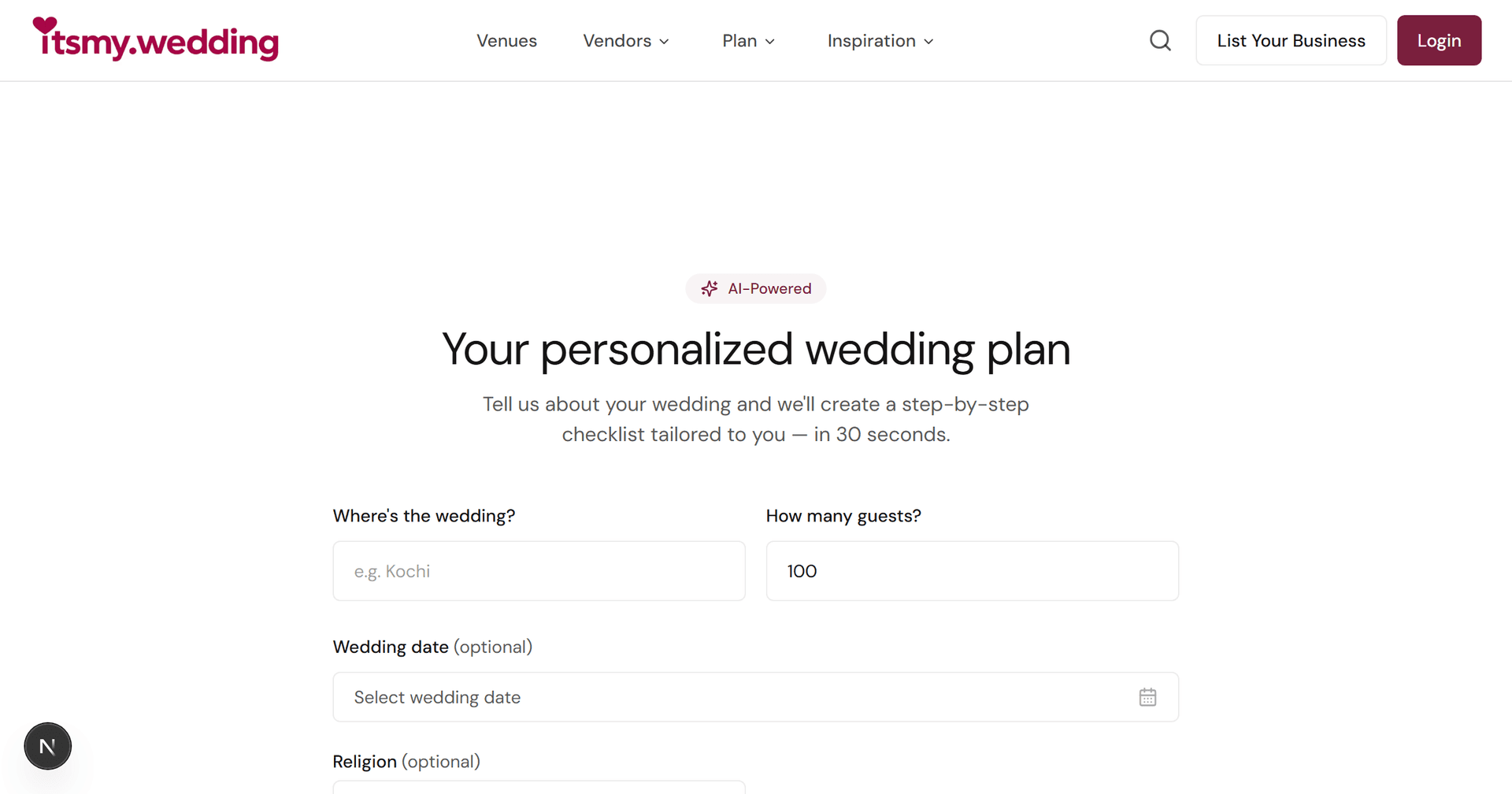
Try It: How itsmy.wedding's AI Checklist Works
Our free AI checklist tool generates a personalised wedding plan in three steps:
- Tell us about your wedding — date, location, religion, venue type, and guest count
- Get your checklist — the AI generates a phased plan with tasks grouped by timeline
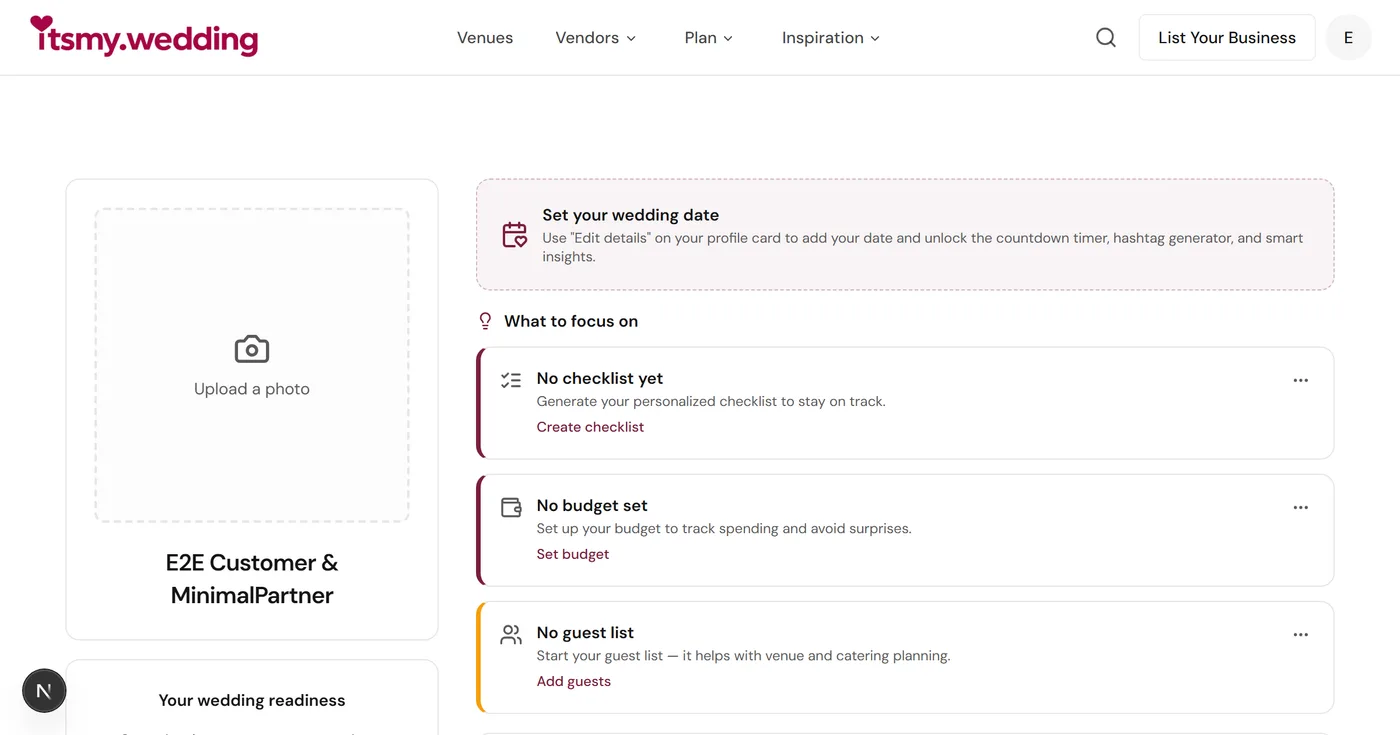
- Track your progress — check items off and the dashboard updates your completion status
The basic version requires no account. For the full experience — including vendor recommendations linked to each task, budget tracking, and shared access with family members — sign in at itsmy.wedding/plan/checklist.
The tool is purpose-built for Indian weddings, with particular depth for Kerala ceremonies. It understands the difference between a Thrissur Pooram-season venue crunch and an off-season Wayanad celebration, and it plans accordingly.
Tip
Build your wedding checklist
A planning timeline shaped around your date, your events, and your family.
Real Examples: Same Couple, Different Checklist
To show why personalisation matters, here is what an AI checklist generates for three different Kerala wedding scenarios — all for the same couple getting married in November 2026.
Example 1: Thrissur Temple Wedding (400 Guests)
Key tasks a generic checklist would miss:
- Book muhurtham slot at the temple 8+ months ahead
- Confirm elephant booking for the groom's procession (if desired)
- Arrange sadya catering with banana leaf service for 400
- Coordinate mandapam decoration within temple restrictions
- Plan guest parking at temple grounds — space is limited during peak season
- Book accommodation within 5 km of the temple for outstation family
Example 2: Kochi Resort Wedding (250 Guests)
Key tasks a generic checklist would miss:
- Block 40+ hotel rooms for guest accommodation
- Arrange outdoor ceremony backup plan for unexpected rain
- Confirm bar licence and beverage service for evening reception
- Book DJ and sound system with venue-specific noise curfew compliance
- Coordinate pool-area safety measures if children are attending
- Arrange airport transfers from Cochin International for travelling guests
Example 3: Alappuzha Backwater Wedding (150 Guests)
Key tasks a generic checklist would miss:
- Book kettuvallam (houseboat) fleet for guest transport and photo sessions
- Arrange water transport logistics from Alappuzha boat jetty to venue
- Confirm monsoon backup plan — especially critical for June to September weddings
- Coordinate with local fishermen's association for waterway access
- Plan humidity-resistant makeup and outfit choices
- Arrange generator backup — waterside venues often have limited power supply
Each of these scenarios generates a checklist that is 30 to 40% different from the others (based on itsmy.wedding data across venue types). A single generic template cannot capture any of this variation. For more on planning at these specific locations, see our guides on backwater weddings and how to plan a wedding in Thrissur.
Note
When a Generic Checklist Is Enough
AI checklists are not necessary for every wedding. A generic template works well when:
- Guest count is under 50 — fewer logistics mean fewer venue-specific and scale-specific tasks
- You are eloping or having a courthouse ceremony — the planning scope is small enough that a simple list covers it
- Your format is deliberately simple — a home ceremony with family-cooked food and no external vendors
- You already have a wedding planner — a professional coordinator brings their own planning system
For anything beyond these scenarios — and particularly for multi-event Indian weddings with 200+ guests, religious rituals, and multiple vendor categories — an AI checklist saves real time and catches tasks you would not think to add yourself.
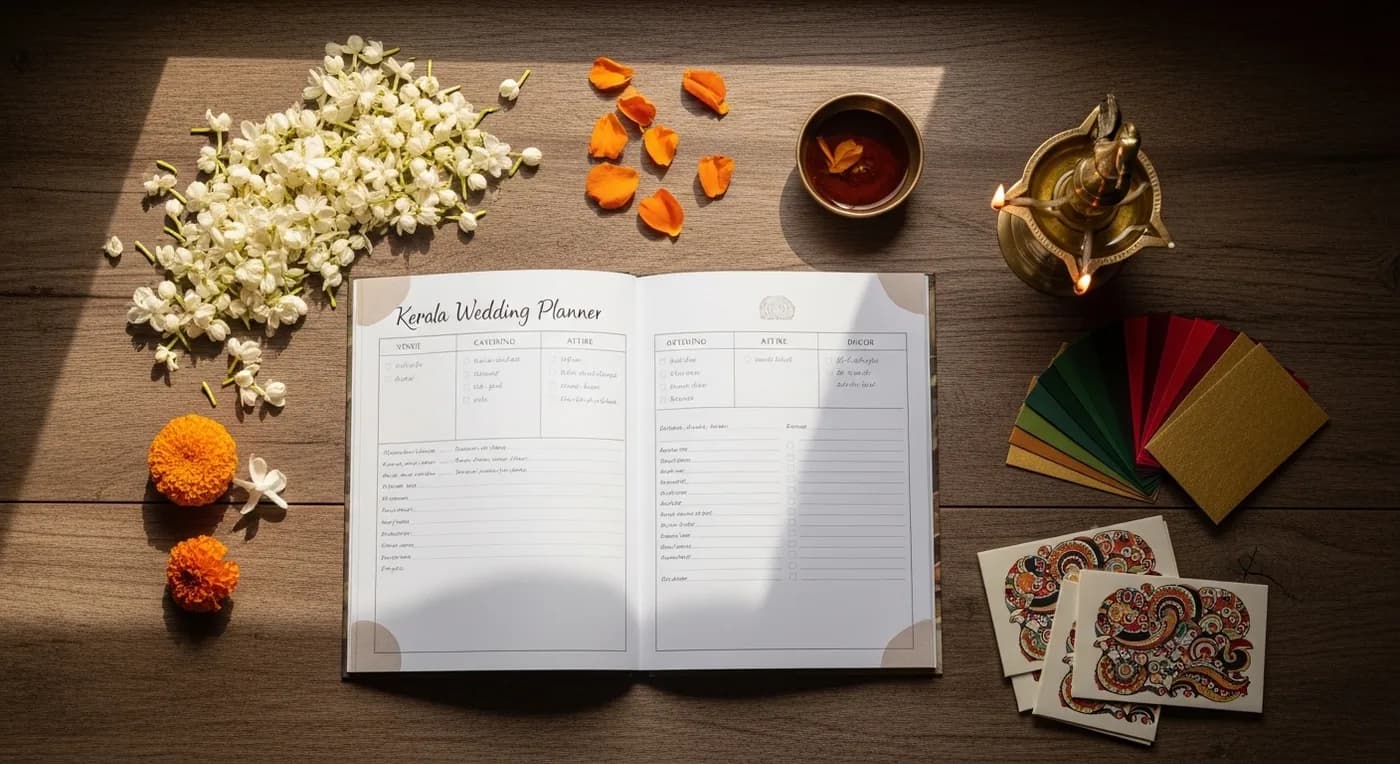
If you want a comprehensive manual checklist designed specifically for Kerala weddings, our Kerala wedding checklist is a strong starting point. For the full planning walkthrough, read our complete Kerala wedding planning guide. And for a comparison of all available digital tools, see our roundup of the best wedding planning tools for 2026.
Common Questions About AI Wedding Checklist vs Generic Templates
How does an AI checklist actually learn what your wedding needs?
The AI doesn't "learn" in a personalised sense — it uses a structured decision tree trained on thousands of Indian wedding templates. When you input your date, religion, venue type, and city, the system matches those inputs against task libraries specific to each combination. A Kochi resort wedding in November triggers a different library than a Thrissur temple wedding in May. The resulting checklist is generated in under 60 seconds and covers 80-120 tasks calibrated to your exact scenario, compared to 50 generic tasks on a Pinterest template.
Do I need to pay to use a quality AI wedding checklist?
No. Free AI checklist tools — including the one at itsmy.wedding/plan/checklist — generate a personalised plan with no account required for the basic version. Paid features typically add vendor recommendations linked to each task, shared family access, real-time budget integration, and WhatsApp progress nudges. A hired wedding planner would charge ₹1-5 lakhs for equivalent customisation, and even premium planning apps cost ₹500-₹2,000 yearly. For Indian couples, free AI checklists deliver 80-90% of the value paid tools offer.
Will an AI checklist understand Kerala-specific rituals?
The best AI checklists are trained on regional ritual data. For Kerala weddings specifically, the checklist generates muhurtham confirmation with the family astrologer, sadya menu planning with the caterer, mandapam decoration within temple restrictions, kasavu saree shopping with a 2-month lead, and chenda melam booking for the groom's procession. A Thrissur temple wedding produces different tasks than a Kochi resort wedding within the same state — AI systems handle this variation automatically, whereas generic templates collapse all Hindu ceremonies into a single "book officiant" line.
What happens if I start planning with only 4 months left?
This is where AI checklists shine most dramatically. A static Pinterest template gives you the same 12-month countdown regardless of when you begin, leaving you to figure out which tasks are urgent. An AI checklist recalculates the timeline based on your actual wedding date. If you have four months, it compresses early-stage tasks, flags which vendors need immediate booking (typically photographers and venues), identifies which elements can be parallelised, and recommends simplifications where compression isn't possible. This alone saves couples 20-40 hours of manual replanning.
How often should I regenerate or update the checklist?
Regenerate once if your wedding details change substantially — a venue switch from temple to resort, a date shift of more than two weeks, or a significant guest count change (100 to 300, for example). Otherwise, the checklist should be treated as a living document: check tasks off as you complete them, add custom items specific to your family traditions, and review the remaining list monthly. Good AI tools let you export the list to Google Sheets or share it via WhatsApp so extended family members planning alongside you stay in sync.
Next Steps
The fastest way to see the difference is to try it yourself. Generate your free AI wedding checklist in under 60 seconds and compare it against whatever template you have been using. For couples deep into planning, our Kerala wedding timeline pairs well with the AI checklist as a month-by-month reference.
Topics
AI wedding checklistpersonalised wedding checklistwedding planning AIwedding checklist comparisonsmart wedding plannerExplore more
Frequently Asked Questions
1What is an AI wedding checklist?
2Are AI wedding checklists free?
3How is an AI checklist different from a Pinterest wedding checklist?
4Can an AI checklist handle Indian wedding traditions?
Continue reading
Related Articles
Kerala Wedding Checklist: Complete Printable Planner for 2026
How to Plan a Kerala Wedding: The Complete 2026 Guide
Best Free Wedding Planning Tools in 2026: The Complete Guide
Kerala Wedding Timeline: Month-by-Month Planning Schedule for 2026

Best Season for South India Destination Weddings: Month-by-Month Western Ghats Guide
Destination Wedding Cost in South India 2026: 5-Tier Budget Guide
Still planning?
Get quotes from India's best vendors
Tell us what you're planning and we'll match you with verified photographers, venues, decorators, and more.
Get free quotes