
Wedding Guest List: RSVP, Seating & Logistics
Manage your 300-500 guest Indian wedding — guest list organisation, digital RSVP tracking, seating arrangements, dietary tracking, and day-of logistics.

Senior Wedding Planner
Priya Nair is a senior wedding planner based in Kochi with over eight years of experience coordinating Hindu, Christian, and destination weddings across Kerala.
On this page
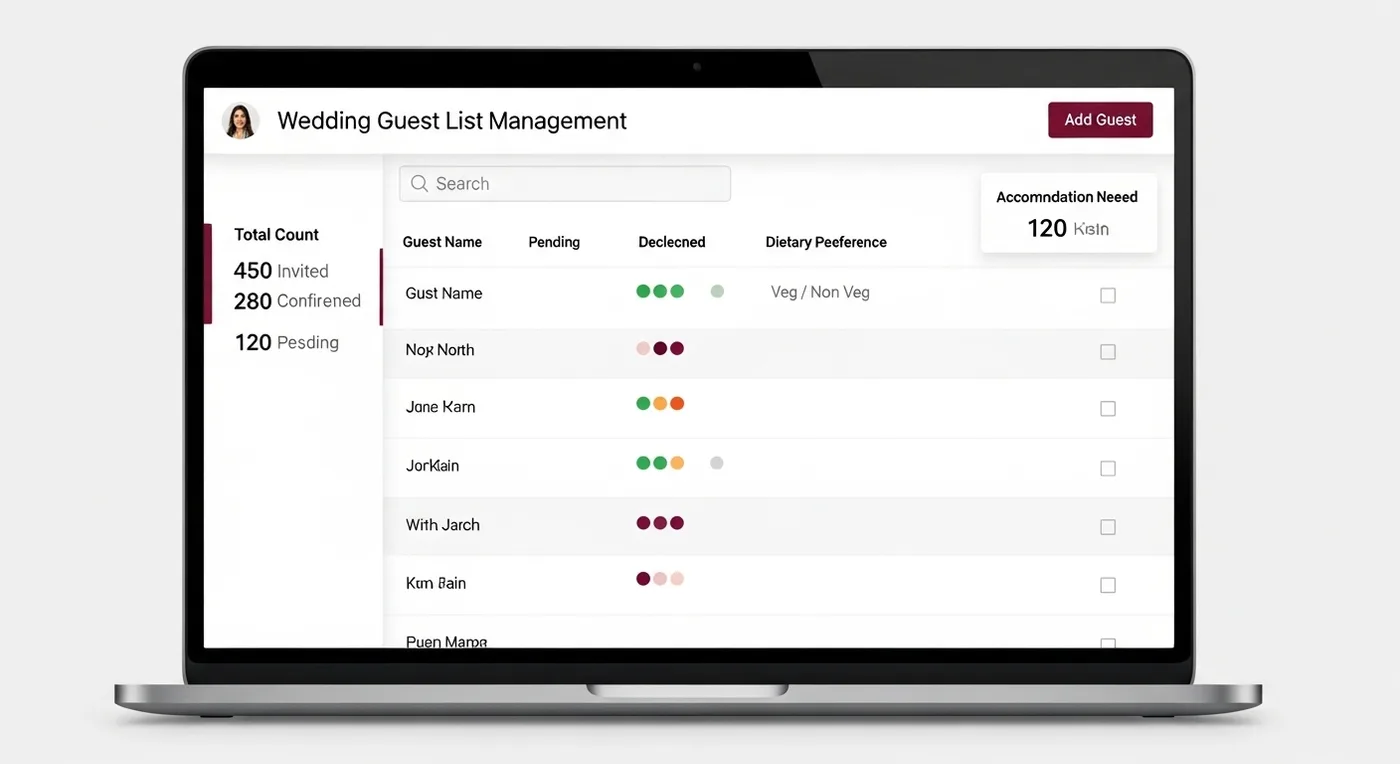
Managing a 300-500 guest Indian wedding requires more than a spreadsheet — you need RSVP tracking, dietary preference collection, seating assignments, and accommodation logistics in one place. Only 30-40% of Indian wedding guests formally RSVP, so follow-up systems and buffer planning are essential. Use a digital guest list manager to track everything from invitation status to day-of check-in.
Quick Answer
How to manage a large Indian wedding guest list: structure your list by family side and category from day one, assign every guest to the specific events they are invited to, and plan catering for 80–90% attendance regardless of RSVP rate. Send invitations 4–6 weeks out, follow up with non-responders via personal WhatsApp two weeks before, and lock the final headcount with your caterer 7–10 days before the wedding. A digital guest list tool handles multi-event tracking and dietary aggregation at a scale where spreadsheets break down.
The Indian wedding industry generates an estimated ₹6.5 lakh crore in annual spending, with the average wedding hosting 330 guests according to WeddingWire India — and Kerala weddings routinely exceeding 400 to 800. Behind every one of those celebrations is a guest list that someone had to build, manage, and track across weeks of invitations, follow-ups, dietary questions, accommodation requests, and last-minute additions from relatives you forgot existed. Guest list management is the connective tissue of wedding planning. It touches your venue capacity, your catering budget, your seating layout, and your day-of coordination. Get it right, and every other decision downstream becomes cleaner. Get it wrong, and you discover the gap at the worst possible moment — when the caterer asks for a final headcount and your list is scattered across three WhatsApp groups, a shared Google Sheet with conflicting edits, and a handwritten diary your mother-in-law maintains independently.
This guide covers the full lifecycle of guest list management for Indian weddings: structuring your list from the start, tracking RSVPs in a culture where formal responses are rare, collecting dietary preferences at scale, building seating arrangements that respect family dynamics, coordinating accommodation for outstation guests, and managing check-in on the wedding day. If you are planning in Kerala specifically, pair this with our guest logistics and accommodation guide for region-specific transport, hotel block-booking, and welcome kit details.
Why Indian Wedding Guest Lists Are Uniquely Challenging
Indian wedding guest management is a fundamentally different problem from its Western counterpart. Understanding why helps you build systems that actually work instead of borrowing frameworks designed for 120-person seated dinners in Connecticut.
Note
How we compiled these figures: Guest count ranges and per-guest cost estimates are based on itsmy.wedding vendor data from Kerala and South Indian weddings, cross-referenced with WeddingWire India and WedMeGood industry reports. Catering cost impacts reflect typical sadya and buffet pricing as of 2026.
Scale
The average Indian wedding hosts 300 to 500 guests. Kerala Hindu weddings typically range from 400 to 600 guests, Kerala Christian weddings can reach 500 to 1,000, and North Indian weddings regularly exceed 800. WedMeGood's 2025-2026 report found that the average wedding budget has climbed to ₹39.5 lakhs — and guest count is the single largest cost driver, with each additional 100 guests adding ₹2-5 lakhs in catering, seating, and logistics.
Family Politics
In Western weddings, the couple typically controls the guest list. In Indian weddings, the guest list is a family project — and often a contested one. Both sets of parents have their own lists. Grandparents add names. Uncles insist that their colleague's son must be invited because "they invited us." The guest list becomes a mirror of family relationships, social obligations, and community standing. Managing this diplomatically requires a structured system, not a casual conversation.
Low Formal RSVP Rates
Here is the reality that breaks most Western guest management advice: RSVPify data shows that 83% of invited guests RSVP "yes" in Western weddings, with formal response rates above 80%. In Indian weddings, expect only 30-40% of guests to formally respond to an RSVP request — even a digital one. The remaining guests will simply show up, or not, based on personal circumstances. This is not rudeness; it is a cultural norm where wedding invitations are understood as open and response is communicated informally through family networks.
Multi-Event Tracking
Indian weddings are not a single event. A typical celebration includes mehendi, sangeet, haldi, the main ceremony, and reception — sometimes across multiple venues over 2-5 days. Not every guest attends every event. Your guest list needs to track per-event attendance, not just a single yes-or-no RSVP. The ceremony might have 400 guests. The reception might have 600. The mehendi might be 80. One flat list cannot accommodate this complexity.
Note
The cost of getting guest count wrong: Overestimating by 100 guests means ₹1-3 lakhs in wasted catering. Underestimating by 100 guests means running out of food — the single most embarrassing outcome for any Indian host family. Accurate guest tracking pays for itself many times over.
Setting Up Your Guest List
A well-structured guest list is not just a list of names. It is a database that feeds every downstream decision — from how many plates your caterer prepares to which hotel rooms you block-book. Start with the right structure and you will avoid rebuilding it later.
Guest Categories
Divide your guest list into clear categories from day one. This structure helps you manage additions, set boundaries, and communicate clearly with both families.
| Category | Description | Typical % of List |
|---|---|---|
| Immediate family | Parents, siblings, grandparents, and their spouses | 5-8% |
| Extended family | Uncles, aunts, cousins, their families | 25-35% |
| Family friends | Parents' social circle, neighbours, community elders | 20-30% |
| Couple's friends | Personal friends of the bride and groom | 10-15% |
| Professional contacts | Colleagues, business associates, mentors | 5-10% |
| Community / obligatory | Religious leaders, community members, reciprocal invites | 5-15% |
Assign a "must invite," "should invite," and "nice to invite" priority to each guest. When the list inevitably exceeds your venue capacity, you will know exactly where to make cuts — and where you cannot.
Essential Tracking Fields
Every guest entry in your guest list manager should capture these data points. Setting up tracking fields at the start saves you from chasing information weeks before the wedding.
- Full name — as it should appear on the invitation
- Side — bride's family, groom's family, or mutual
- Category — from the table above
- Contact — phone number and WhatsApp number (often the same in India)
- Plus-ones / family members — number of additional guests included in this invitation
- Invitation status — not yet sent, sent, delivered, opened (for digital invites)
- RSVP status — awaiting, confirmed attending, declined, no response
- Events attending — which specific events (mehendi, ceremony, reception, etc.)
- Dietary preference — vegetarian, non-vegetarian, Jain, vegan, specific allergies
- Accommodation needed — local, needs hotel, staying with family, needs airport transfer
- Table / seating assignment — filled in closer to the event
- Notes — relationship context, special requirements, mobility needs
Tip
Avoid the shared spreadsheet trap. When three family members edit the same Google Sheet simultaneously — adding names, correcting phone numbers, marking RSVPs — version conflicts are inevitable. A dedicated guest list tool with role-based access lets each family coordinator manage their section without overwriting others.
The Family List Consolidation Process
Start by giving each set of parents a blank template with the categories above and a target number. "We have capacity for 450 guests total. Please provide your list of up to 200." Set a deadline — typically 3-4 months before the wedding. Collect all lists, merge them into a single master list, remove duplicates (common when both families know the same people), and resolve conflicts together. This conversation is easier with data in front of everyone than with vague verbal estimates.
Organise your guest list
Manage guests across every event, from mehendi to reception, with both families.
Sending Invitations and Tracking RSVPs
Once your guest list is structured, the next challenge is getting invitations out and tracking who is actually coming. In Indian weddings, this process has its own rhythm — and it does not look like the neat RSVP-by-date model of Western weddings.
Digital vs Paper Invitation Tracking
Most Indian weddings in 2026 use a combination of both. Physical printed invitations are still expected for close family and elders — they carry cultural weight and are often hand-delivered. Digital invitations via WhatsApp are increasingly the primary method for the broader guest list, with 83.2% of couples now using digital wedding planning platforms for research and coordination.
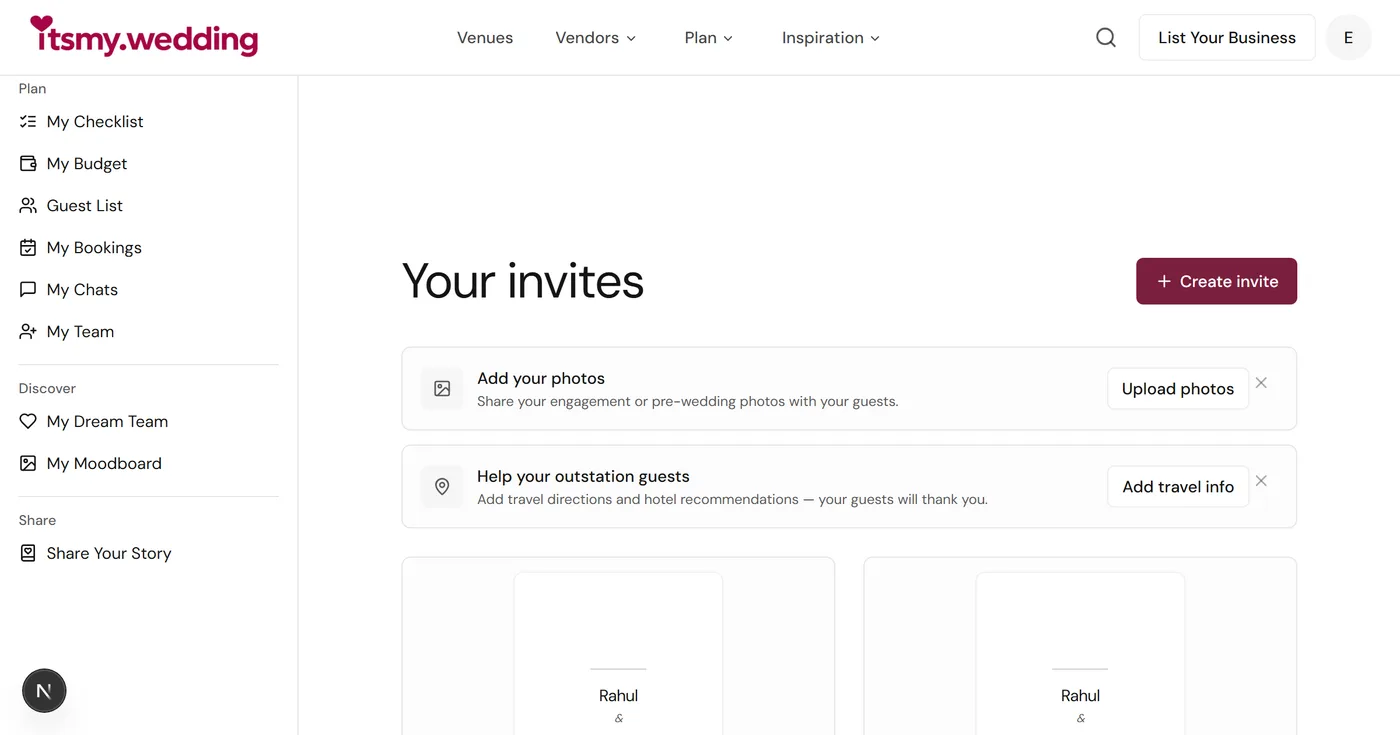
The advantage of digital invitations is tracking. When you send a digital e-invite, you can see who has opened it, who has clicked through, and who has responded. Paper invitations give you no such visibility. For a detailed walkthrough of creating and sending digital invitations, read our Kerala wedding e-invite guide.
| Method | Tracking Capability | Best For | Limitation |
|---|---|---|---|
| Physical card (hand-delivered) | None — must track separately | Close family, elders, VIPs | No delivery confirmation, expensive at scale |
| Physical card (posted) | Minimal — delivery receipt only | Outstation elders | Slow, no open/RSVP tracking |
| WhatsApp digital invite | High — delivered, read, responded | Broad guest list | May feel informal to older generation |
| Email with RSVP link | High — open rate, click rate, RSVP | Tech-savvy guests, NRI guests | Low open rates compared to WhatsApp in India |
| Wedding website with RSVP | Full — per-guest tracking | All guests (shared via WhatsApp or card) | Requires guests to visit a URL |
The most effective approach: send physical cards to the top 50-80 guests (parents' close circle, elders, VIPs) and digital invitations to everyone else. Use your guest list tool to track both channels in one place.
WhatsApp RSVP Follow-Up Strategy
In India, WhatsApp is the primary communication channel — not email, not postal mail. Your RSVP follow-up strategy should centre on WhatsApp. Here is a timeline that works.
6 weeks before: Send save-the-date messages to all guests via WhatsApp. Include the date, city, and a line about the formal invitation following soon.
4 weeks before: Send the digital invitation with an embedded RSVP link. Include a personal message — not a broadcast-style mass message. Personalisation dramatically improves response rates.
2 weeks before: Send a gentle follow-up to non-responders. Frame it as a logistics question: "We are finalising seating and catering — could you confirm if you and your family will be joining us?" This gives people a reason to respond beyond social obligation.
1 week before: Final follow-up via personal call or message to the remaining non-responders, especially those whose attendance affects your catering count significantly (large families, outstation guests who need accommodation).
Tip
The personal touch matters. A broadcast message to 400 people feels like spam. A personal WhatsApp message — "Anitha aunty, we would love to have you and Suresh uncle at the ceremony on the 15th. Could you let us know if you will be joining?" — gets a response. Assign family members to follow up with their respective circles.
Handling Non-Responders
Even with diligent follow-up, a significant portion of your guest list will never formally RSVP. Here is how to plan around this reality.
For catering planning, assume 80-90% of invited guests will attend. Industry data suggests that decline rates increase for guests who must travel — expect 25-40% decline rates from outstation invitees versus 10-15% from local guests. Build a 5-10% buffer on top of your estimated attendance for unexpected additions — the cousin who brings an extra family member, the colleague who shows up with their spouse unannounced.
For seating planning, design your layout for your confirmed count plus 10%. Have a designated overflow area — extra tables that can be set up quickly if attendance exceeds your estimate.
Collect RSVPs on WhatsApp
Guests reply in a tap, and your counts update per event automatically.
Managing Dietary Preferences at Scale
Dietary management at an Indian wedding is not a simple vegetarian-or-not checkbox. The diversity of dietary requirements across Indian communities makes this one of the most operationally important fields in your guest list.
Dietary Categories to Track
Your RSVP form or guest list should capture these categories at minimum:
- Vegetarian — the most common preference, especially at South Indian and Jain-community weddings
- Non-vegetarian — includes all meat types; some guests eat chicken and fish but not red meat
- Jain vegetarian — no root vegetables (onion, garlic, potato, carrot), no food prepared after sunset
- Vegan — no dairy, no ghee, no honey — increasingly common among younger urban guests
- Eggetarian — vegetarian plus eggs, common in Kerala and Bengal
- Specific allergies — nuts, gluten, shellfish, lactose intolerance
Sharing Counts with Your Caterer
Your caterer needs final dietary counts 7-10 days before the wedding. Export this data directly from your guest list manager grouped by dietary category. For a 400-guest Kerala wedding, a typical split might be:
| Dietary Preference | Estimated % | Count (of 400) |
|---|---|---|
| Vegetarian | 35-45% | 140-180 |
| Non-vegetarian | 40-50% | 160-200 |
| Jain vegetarian | 2-5% | 8-20 |
| Vegan | 1-3% | 4-12 |
| Specific allergies | 2-4% | 8-16 |
For sadya-style serving (traditional Kerala banana-leaf meal), designate separate serving rows for vegetarian and non-vegetarian guests. For buffet-format receptions, ensure vegetarian and non-vegetarian stations are clearly labelled and physically separated — not just by signage, but by placement. Read our Kerala wedding catering guide for detailed menu planning and per-plate cost breakdowns.
Note
Jain dietary needs require advance coordination. Jain vegetarian food cannot be prepared with onion, garlic, or root vegetables — ingredients that are fundamental to most Indian cooking. Your caterer needs specific advance notice to source separate ingredients and dedicate separate cooking vessels. Do not assume your caterer knows Jain requirements; confirm explicitly.
Seating Arrangements for Indian Weddings
Seating at an Indian wedding is not just a logistical exercise — it is a social one. Where people sit communicates respect, hierarchy, and relationship. Getting it right avoids awkwardness. Getting it wrong creates stories that families retell for decades.
Family Hierarchy and Stage Proximity
The seats closest to the stage or mandap are reserved for immediate family — parents, grandparents, and siblings of the couple. The next ring outward goes to close extended family — parents' siblings and their families. This hierarchy is culturally expected and deviating from it without explanation will be noticed.
Practical Seating Principles
Group by relationship, not alphabetically. Seat people with others they know and are comfortable with. A table of strangers produces awkward silence. A table of cousins who have not seen each other in two years produces laughter and warmth.
Separate known conflicts. Every family has them. The uncle who is not speaking to his brother. The cousins with a property dispute. Seat them on opposite sides of the venue. Your guest list tool's notes field is where you flag these situations.
Create mixed-generation tables strategically. While most tables should group by age and relationship, a few mixed tables — where younger cousins sit with approachable elders — can create beautiful cross-generational conversations.
VIP and elder seating. Reserve chairs with armrests and extra legroom for elderly guests. Place them near exits for easy access and away from speakers. If your wedding includes floor seating for the ceremony, provide chair-and-table alternatives for elders who cannot sit on the floor comfortably.
Outstation guest clustering. Guests who have travelled from the same city or region should be seated together. They already know each other, and shared travel experiences give them natural conversation starters.
Seating Layout Tips
For a 400-guest reception with round tables seating 8-10 each, you need approximately 40-50 tables. Number them and create a physical chart that maps table numbers to guest names. Share this chart with your ushers on the wedding day. Post a large printed seating chart at the venue entrance so guests can find their table without asking. Your guest list tool can generate this chart directly from your seating assignments.
Accommodation and Travel Logistics
For any Indian wedding with outstation guests — which is virtually every Indian wedding — your guest list doubles as your accommodation planning tool. The same data that tells you who is attending also tells you who needs a hotel room, who needs an airport pickup, and who needs transport between venues.
Identifying Accommodation Needs
When you set up your guest list, the "accommodation needed" field should capture whether each guest is local, staying with family, needs a hotel recommendation, or needs you to book on their behalf. For a 400-guest wedding, typically 30-50% of guests are outstation and need some level of accommodation support.
Export this filtered list from your guest list manager and use it to determine how many hotel rooms to block-book. For a detailed guide to hotel block-booking strategies, negotiating group rates, and managing tiered accommodation options, read our guest logistics and accommodation guide.
Transport Coordination
For multi-venue weddings — temple ceremony in the morning, reception hall in the evening — your guest list data tells you exactly how many people need shuttle transport between venues. Group guests by pickup location (hotel clusters, family homes, railway station) and arrange transport accordingly.
Tip
Create a guest logistics WhatsApp group. Add outstation guests to a dedicated WhatsApp group 2 weeks before the wedding. Share hotel details, venue addresses with Google Maps links, transport schedules, and emergency contact numbers. Update it in real time on the wedding day for any schedule changes. This single step eliminates 80% of "where do I go?" phone calls on the day.
NRI and Overseas Guest Support
Overseas guests — whether Gulf-based NRIs returning for a Kerala wedding or family from the US and UK — need additional support. Include a timezone-friendly response option in your RSVP (they may be reading your WhatsApp invitation at 3 AM their time). Offer to coordinate their airport pickup. Share a brief orientation document covering local weather, dress code for each event, and any cultural context they may need. Track their arrival and departure dates in your guest list so you can plan transfers accurately.
Day-of Guest Management
Your guest list does its final and most important job on the wedding day itself. A well-managed check-in process ensures you know who has arrived, your caterer gets live headcount updates, and no guest feels lost or unwelcome.
Check-In Process
Station 2-3 coordinators at the venue entrance with a digital or printed guest list. As guests arrive, mark them as checked in. This serves three purposes: your caterer gets a running headcount for food replenishment, you have a record of who actually attended (useful for thank-you notes later), and you can identify VIP guests who need to be escorted to their seats.
For weddings over 300 guests, a digital check-in system — even as simple as a tablet with your guest list open — is faster and more accurate than flipping through printed pages.
Welcome Kit Distribution
If you are providing welcome kits for outstation guests, your guest list tells you exactly how many to prepare and for whom. Tag guests who should receive kits in your guest list tool, and have the kits ready at either the hotel front desk (pre-distributed) or the venue check-in table.
Point-of-Contact Assignments
Assign specific family members as points of contact for different guest groups. Your mother's brother handles her side of the family. A trusted friend manages the college friend group. A cousin coordinates with outstation guests from Bangalore. Map these assignments in your guest list notes so every group of guests has someone they can call when they cannot find parking or need directions to the reception venue.
Real-Time Headcount for Catering
Share a live attendance number with your caterer at three points during the event: when 50% of expected guests have arrived, when 75% have arrived, and 30 minutes before serving begins. This allows the catering team to adjust quantities — adding extra rice, preparing additional servings of popular dishes, or holding back on items that are running ahead of consumption.
Tools for Guest List Management
The right tool transforms guest list management from a stressful chore into a structured process. Here is how the options compare for Indian weddings.
Spreadsheets (Google Sheets / Excel)
Pros: Free, familiar, infinitely customisable. Cons: No built-in RSVP tracking, no automated reminders, version conflicts when shared with multiple family editors, no seating chart visualisation, manual dietary aggregation. Best for: Weddings under 150 guests where one person manages the list.
Generic Wedding Planning Apps
Pros: Purpose-built features for guest management, RSVP tracking, and seating charts. Cons: Most are designed for Western weddings with 100-200 guests. They assume a single event, single venue, and formal RSVP culture. They break down at Indian wedding scale and complexity. Best for: Intimate or destination Indian weddings with under 200 guests.
Indian Wedding-Specific Tools
Pros: Built for multi-event tracking, large guest counts, WhatsApp integration, dietary preference collection across Indian categories (Jain, eggetarian), and family-based invitation management. Cons: Newer category with fewer established options. Best for: Traditional Indian weddings with 200+ guests and multiple events.
The itsmy.wedding Guest List Manager
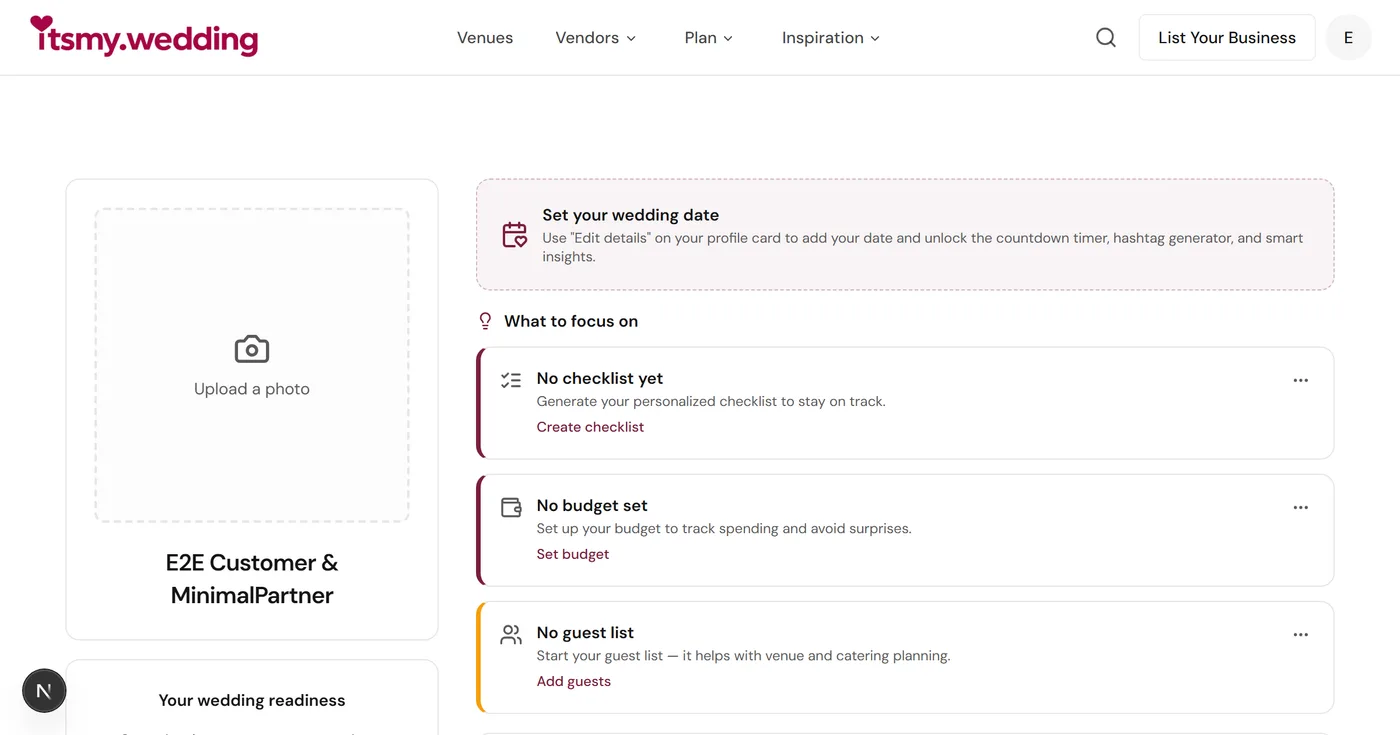
Our guest list manager is built specifically for Indian weddings. Track guests across multiple events, collect dietary preferences with Indian-specific categories, manage seating assignments with visual charts, export catering counts by dietary group, and coordinate accommodation needs — all from one dashboard. It integrates with your AI wedding checklist so guest list milestones appear at the right time in your planning timeline.
Guest list management is not glamorous work. Nobody posts their RSVP tracking system on Instagram. But it is the operational backbone that determines whether your wedding runs smoothly or descends into preventable chaos. Start your list early, structure it properly, use the right tool for the scale of your celebration, and follow up persistently on RSVPs — even when it feels like shouting into the void. The families who plan their guest logistics well are the ones whose weddings feel effortless. Not because they did less work, but because they did the work early enough that it was invisible by the wedding day.
For the full planning timeline that puts guest list milestones in context with every other wedding task, start with our Indian wedding checklist. For Kerala-specific planning, our how to plan a Kerala wedding guide covers region-specific considerations. And for the broader toolkit — budget calculators, vendor search, and AI-powered planning — explore our best wedding planning tools for 2026.
Topics
wedding guest list managementwedding RSVP trackingIndian wedding guest listwedding seating planwedding guest logisticsExplore more
Frequently Asked Questions
1What is the average guest count for an Indian wedding?
2How do I handle guests who don't RSVP?
3Should I use a digital guest list tool or a spreadsheet?
4How do I manage dietary preferences for a large Indian wedding?
5When should I finalise my guest list?
Continue reading
Related Articles
How to Plan a Kerala Wedding: The Complete 2026 Guide
Best Free Wedding Planning Tools in 2026: The Complete Guide
Kerala Wedding E-Invite Guide: Templates, Wording & Tools for 2026
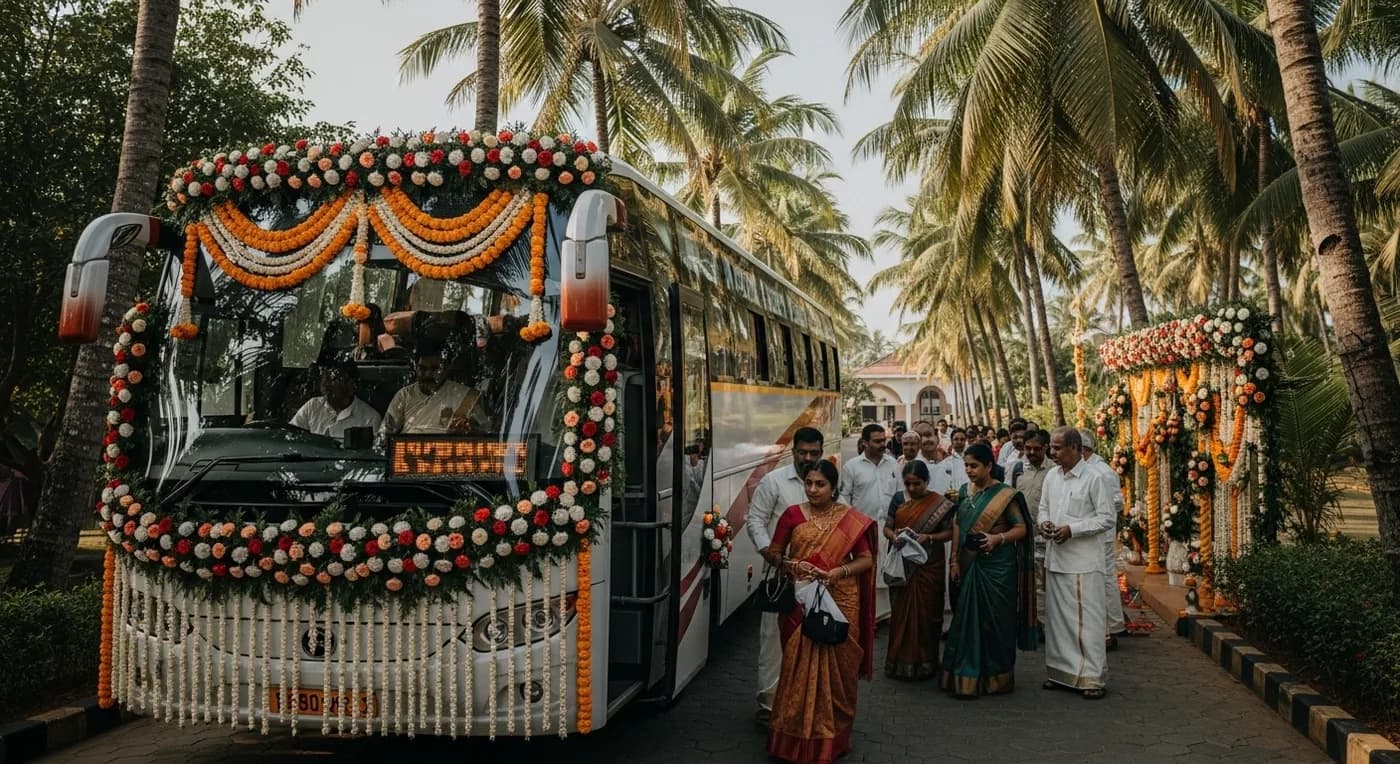
Kerala Wedding Guest Logistics: Accommodation, Transport, and Hospitality Guide
Kerala Wedding Checklist: Complete Printable Planner for 2026
Best Season for South India Destination Weddings: Month-by-Month Western Ghats Guide
Still planning?
Get quotes from India's best vendors
Tell us what you're planning and we'll match you with verified photographers, venues, decorators, and more.
Get free quotes