
How to Use a Wedding Checklist: Step-by-Step Guide to Stress-Free Planning
Learn how to use a wedding checklist effectively — prioritise tasks, set deadlines, delegate to family, and track progress from 12 months out to the wedding day.

Senior Wedding Planner
Priya Nair is a senior wedding planner based in Kochi with over eight years of experience coordinating Hindu, Christian, and destination weddings across Kerala.
On this page
A wedding checklist works best when you break it into monthly phases, assign each task a deadline and owner, and review progress weekly. Start 10-12 months out with venue and vendor booking, then narrow focus as the date approaches. Digital checklists with reminders and sharing features outperform paper — try our free AI checklist to generate a personalised timeline.
Quick Answer
How to use a wedding checklist effectively: generate a personalised plan based on your date and location, assign every task an owner and an internal deadline 1–2 weeks before the real one, and review progress in a 15-minute weekly check-in. Digital tools with automated reminders outperform paper for most couples — start with the free AI checklist, share it with your partner and key family members, and update it as decisions evolve.
Getting engaged is exhilarating. Then the reality of planning a wedding lands. According to The Knot's Real Weddings Study, 71% of couples did not feel prepared for the sheer number of decisions involved, and 52% describe the planning process as stressful. The problem is rarely a lack of enthusiasm — it is a lack of structure. A wedding involves over 150 distinct decisions across vendors, budgets, family logistics, and legal paperwork. Without a system to sequence those decisions, each one becomes a source of friction between you, your partner, and your families.
This guide does not give you another list of tasks. Our Indian wedding checklist timeline already covers every task month by month. Instead, this guide teaches you how to use a checklist effectively — how to set it up, assign ownership, build in deadlines, and keep it current so nothing falls through the cracks.
Why Every Couple Needs a Wedding Checklist
The data on unstructured wedding planning is sobering. A CNBC report citing Zola's survey data found that 74% of couples exceed their wedding budget, with 20% overspending by more than $10,000. The Knot places average budget overruns at $7,000. These overruns rarely stem from lavish taste — they come from missed deadlines that eliminate negotiating leverage, duplicate bookings that waste deposits, and last-minute rushes that command premium pricing.
The Stress Cascade Without Structure
Wedding planning stress does not stay contained. Zola's First Look Report 2025 found that for 43% of couples, planning strains their relationship to the point where 8% contemplate calling the wedding off entirely, and another 16% consider postponing. Budget management is the single largest stressor, with 60% of couples identifying it as their primary source of anxiety.
The psychological research supports what wedding planners have observed for decades. A systematic review of 107 studies published in Frontiers in Education found that structured time management lowered anxiety with a correlation of r = -0.36, a meaningful effect size. The study confirmed that planning, goal-setting, and task organisation were the specific strategies most beneficial for reducing stress and improving performance.
Note
What a Checklist Actually Prevents
The most common planning failures are not dramatic catastrophes — they are quiet oversights that compound. The Knot's list of 60 common wedding mistakes identifies patterns that a checklist directly prevents:
- Booking out of sequence. Couples book a decorator before confirming the venue layout, then discover the mandap does not fit. A checklist enforces the correct order: venue first, then decor.
- Missing vendor deadlines. Catering contracts often show a subtotal as "[number] ++" — plus tax, plus service charges — adding 20-30% to the quoted figure. A checklist prompts you to ask about hidden fees at the inquiry stage, not after signing.
- No contingency planning. Assuming it will not rain during an outdoor ceremony is the most reliably punished optimism in wedding planning. A checklist includes weather backup as a non-negotiable line item.
- Forgetting legal paperwork. Marriage registration requires advance notice in many Indian states, and couples frequently discover this weeks before the ceremony when it is nearly too late.
Step 1: Generate Your Personalised Checklist
A generic checklist downloaded from the internet is better than nothing, but it cannot account for your specific wedding date, location, guest count, or cultural tradition. A Hindu ceremony in Kerala during November peak season has a fundamentally different task sequence than a Christian wedding in Bangalore during August.
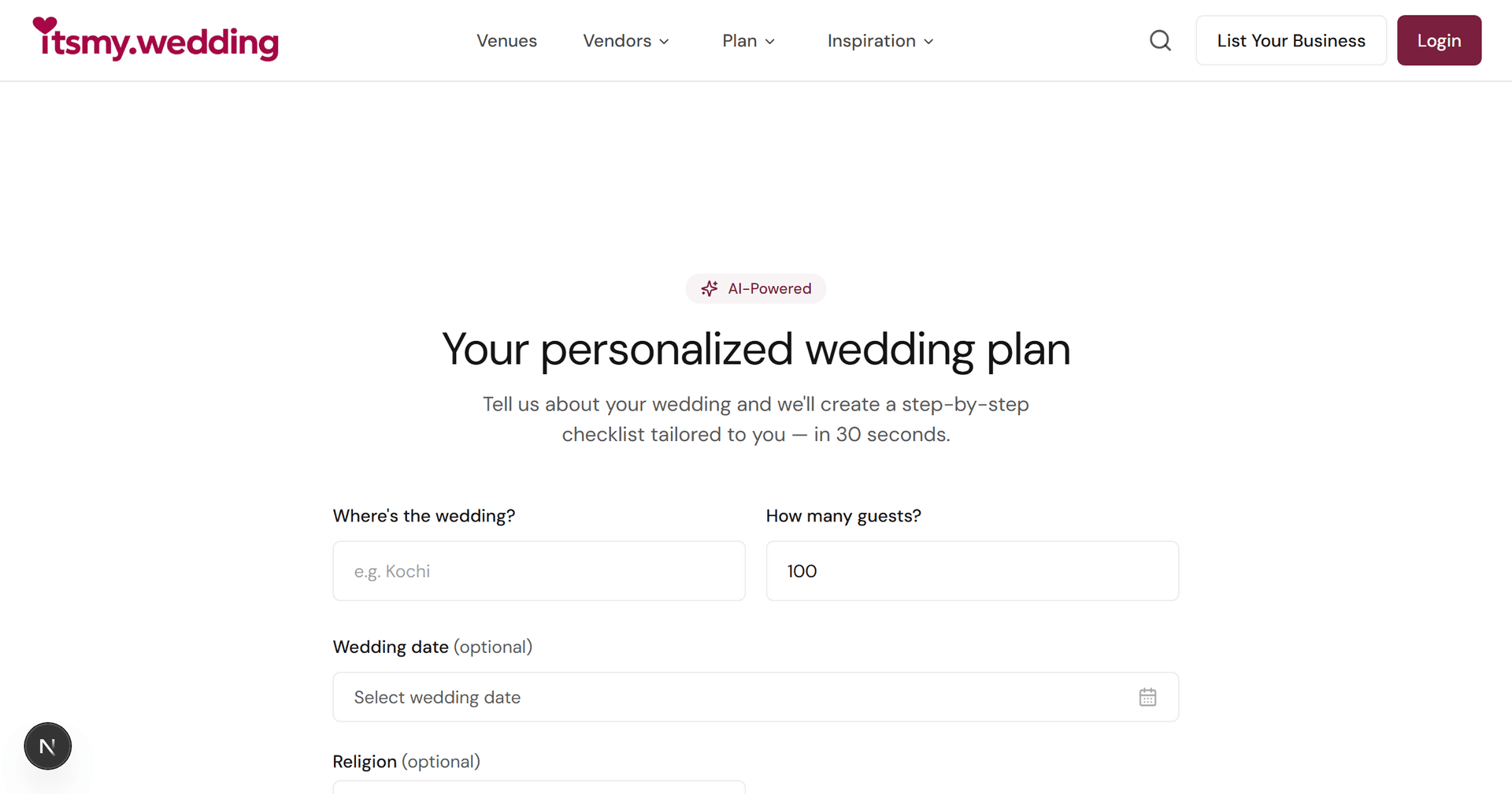
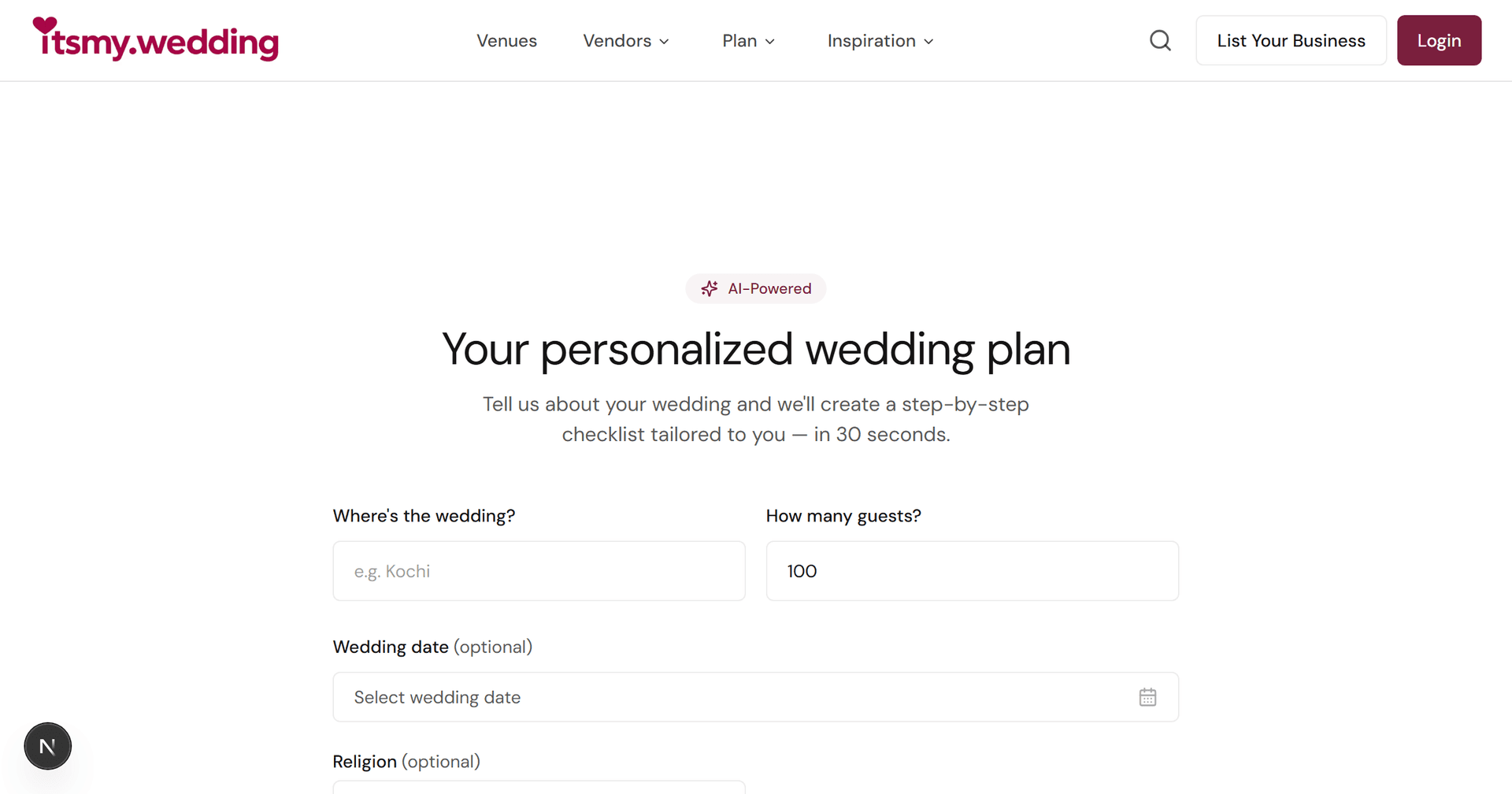
Open the AI Checklist tool on itsmy.wedding and enter three pieces of information:
- Your wedding date — the tool calculates how many months you have and adjusts the timeline accordingly
- Your location — regional tasks appear automatically (temple slot booking for Kerala, church counselling sessions for Christian weddings, qazi coordination for Muslim ceremonies)
- Your wedding style — intimate, traditional, destination, or grand celebration — each generates a different task density
The AI analyses your inputs and produces a personalised, month-by-month checklist with tasks already sequenced in the correct dependency order. If your wedding is eight months away instead of twelve, it compresses the early phases and flags high-urgency bookings that need immediate attention.
Tip
Why Personalisation Matters
The Wedding Planner Institute reports that the average couple's planning timeline falls between 10 and 16 months, but this varies dramatically by season and region. During peak wedding season in India (November through February), popular venues and photographers book 12-18 months in advance. A generic "12-month checklist" that suggests booking your photographer at the 10-month mark is already too late for a February wedding.
Roughly 30% of couples now use AI-powered tools for budgets, timelines, and vendor matching — a number that has grown steadily as digital planning platforms mature. For a deeper comparison of AI-generated versus template-based checklists, read our AI wedding checklist vs templates analysis.
Step 2: Organise Tasks by Timeline
Once you have your checklist, the next step is understanding the rhythm of wedding planning. Not every month carries equal weight. The early months are about locking in capacity-constrained resources; the middle months handle creative and logistical decisions; the final weeks focus on confirmation and coordination.
12-10 Months Out: Foundation Phase
This is the structural phase. Every decision here shapes what follows. The three non-negotiable bookings in this window are venue, photographer, and caterer — the vendors with the least availability and the longest lead times.
- Set your total budget with family contributions agreed in writing
- Select your wedding date (consult your Indian wedding checklist timeline for date selection guidance)
- Book your venue and pay the advance
- Book your photographer and videographer
- Use the Cost Calculator to model scenarios for different guest counts
9-6 Months Out: Vendor Phase
With the big three locked, this phase fills in the remaining vendor slots and begins creative decisions.
- Book caterer and schedule a tasting
- Book decorator, mehendi artist, and entertainment
- Begin shopping for wedding attire (bridal outfits need 6-9 months for custom work)
- Send save-the-dates or create a wedding website
- Start your guest list — our planning hub keeps the list synced with invitations
5-3 Months Out: Detail Phase
The pace quickens here. Creative decisions become concrete logistics.
- Finalise guest list and send invitations
- Confirm all vendor contracts and payment schedules
- Plan ceremony and reception flow with your decorator
- Arrange accommodation and transport for outstation guests
- Schedule hair and makeup trials
2 Months to 1 Week Out: Confirmation Phase
This phase is about tightening every loose end.
- Confirm final headcount with caterer and venue
- Create a detailed day-of timeline and distribute to all vendors
- Arrange vendor meals for the wedding day (a task couples forget until it becomes a problem)
- Confirm transport, parking, and guest logistics
- Prepare emergency kit (sewing supplies, painkillers, safety pins, phone chargers)
Final Week and Day-Of
- Reconfirm every vendor with a phone call — not a message
- Distribute final payments and tips
- Delegate day-of coordination to a family member or planner
- Brief your bridal party on the timeline
Note
Step 3: Assign Tasks to Your Wedding Team
A checklist with 150 tasks and one person doing all of them is not a system — it is a recipe for burnout. The WeddingWire India Newly Wed Survey found that only 27% of couples hire a professional wedding planner. The remaining 73% manage planning themselves, which means the workload must be distributed across a team.
Build Your Planning Team
Every task on your checklist should have a name next to it. Here is a practical delegation framework:
You and your partner handle decisions that define the wedding's identity — venue selection, photographer style, overall aesthetic, budget allocation. These require joint agreement and cannot be outsourced.
Parents and in-laws take ownership of guest list management for their respective sides, religious ceremony coordination (pandit, priest, or qazi arrangements), and family attire shopping. These are tasks where their networks and cultural knowledge exceed yours.
Siblings or close friends manage logistics: accommodation bookings for guests, welcome bags, transport coordination, and day-of errands. These tasks are effort-intensive but do not require high-stakes decisions.
Your wedding planner or coordinator (if you hire one) owns vendor follow-ups, timeline creation, and day-of execution. Their value is not in making decisions for you — it is in executing the decisions you have already made.
Tip
Use a Shared Digital Checklist
A checklist that only one person can see is half as useful. The AI Checklist on itsmy.wedding allows you to share your checklist with family members so everyone sees the same task list, knows who owns what, and can mark items complete. When your mother-in-law confirms the temple booking, you see the update immediately instead of discovering it through a phone call three weeks later.
Step 4: Set Deadlines and Reminders
Every task needs two dates: the real deadline and your internal deadline. The gap between them is your buffer — and it will save you more than once.
The Two-Deadline System
Internal deadline: Set this 1-2 weeks before the actual deadline. This is the date you aim for and the date that appears on your checklist reminders.
Actual deadline: The date after which the task creates a cascading problem. A caterer's final headcount deadline, a venue's payment due date, or the last day to submit marriage registration paperwork.
The buffer exists because wedding planning involves other people — vendors who are slow to respond, family members who need time to decide, and tailors who underestimate turnaround times. When a task slips past the internal deadline, you still have time before it becomes a crisis.
Set Up Automated Reminders
Digital checklists outperform paper specifically because of reminders. According to the Frontiers in Education study, structured time management with built-in reminders measurably reduces anxiety and improves task completion. Set reminders for:
- One week before the internal deadline — a nudge to start the task
- On the internal deadline — a prompt to complete or escalate
- Two days before the actual deadline — an urgent alert if the task is still open
The planning dashboard on itsmy.wedding sends these reminders automatically based on your task deadlines. You do not need to set up calendar entries manually for 150 tasks.
Step 5: Review and Update Weekly
A checklist that is not reviewed regularly becomes decoration. The single habit that separates couples who feel in control from those who feel overwhelmed is a weekly 15-minute check-in.
The Weekly Check-In
Block 15 minutes every Sunday evening — or whatever day works for both of you. This is not a planning session. It is a status review with three questions:
- What was completed this week? Mark items done. Celebrate small wins — they matter for morale during a months-long project.
- What is due in the next two weeks? These are your active priorities. If any task needs input from someone outside your household, reach out to them during this check-in, not later.
- Has anything changed? Guest count shifts, vendor availability changes, budget adjustments — update the checklist immediately so it reflects reality, not the original plan.
Tip
Adjust Without Guilt
Your checklist is a living document, not a contract. Tasks will shift. Deadlines will move. New tasks will appear that you did not anticipate (like discovering your venue requires a fire safety certificate for indoor pyrotechnics). The goal is not to execute the original plan perfectly — it is to always know where you stand and what needs attention next.
The Personality and Individual Differences study referenced by Mental Health Center found that individuals who practised effective time management — which includes adapting plans when circumstances change — had lower perceived stress and anxiety than those who rigidly adhered to initial plans and felt guilty when they deviated.
Common Checklist Mistakes to Avoid
Even with a checklist in hand, couples fall into predictable traps. These are the mistakes we see most frequently.
Starting Too Late
Lightner Museum's wedding planning guide and multiple industry surveys confirm that the sweet spot for beginning to plan is 10-16 months before the wedding. Starting at 6 months is manageable but limits your choices. Starting at 3 months means you are reacting rather than planning — and paying premium rates for whatever availability remains. If your wedding is in peak season, add 2-3 months to every benchmark.
No Delegation
Trying to manage every task personally is the fastest path to burnout and relationship strain. The Zola First Look Report found that 43% of couples experience significant relationship strain during planning. Delegation is not about giving up control — it is about sustainable execution. Assign, trust, and verify during your weekly check-in.
Ignoring Vendor Deadlines
Vendor deadlines are not suggestions. A final headcount submitted three days late means your caterer has already ordered food for the wrong number. A late payment forfeits your booking at some venues during peak season. Your checklist should track every vendor deadline as a hard date with reminders set two weeks and one week in advance.
No Contingency Buffer
Every budget should include a 10% contingency fund. Every timeline should include buffer days between vendor deadlines and your action items. The Knot's budget data shows that hidden costs — service charges, overtime fees, last-minute additions — typically add 9-15% to initial vendor quotes. Without a buffer, every unexpected cost becomes a crisis.
Treating the Checklist as Static
A checklist created in month one and never updated is a historical document, not a planning tool. Update it weekly. Add tasks that emerge. Remove tasks that are no longer relevant. Your checklist should always reflect the current state of your planning, not a snapshot from when you started.
Digital vs Paper: Which Checklist Format Works Best
The format debate is simpler than it seems. Both work; digital works better for most couples.
Digital Checklists
Strengths: Sync across devices so both partners see the same list. Send automated reminders. Allow shared access for family members. Track completion percentages. Integrate with other planning tools (budget tracker, guest list, vendor contacts). AI-powered versions adapt to your specific wedding parameters.
Best for: Couples who plan collaboratively, families spread across cities, weddings with large guest lists (300+), and anyone who wants automated reminders instead of manually checking a notebook.
64% of couples already use digital platforms like The Knot, WeddingWire, and Zola for planning — the infrastructure for digital checklists is already part of how modern weddings get planned.
Paper Checklists
Strengths: Tactile satisfaction of physically crossing off items. No screen fatigue. Work without internet access. Some people simply think better on paper.
Best for: Couples who prefer a single planning notebook, weddings with shorter timelines (under 4 months) and fewer moving parts, and as a backup reference to complement a digital primary list.
The Practical Answer
Use digital as your primary system and paper as your backup. Print a monthly summary from your digital checklist and stick it on the fridge. This gives you the automation and sharing benefits of digital with the visual reminder of paper. For a detailed feature comparison of AI-generated checklists versus static templates, read our AI wedding checklist vs templates guide.
Your Next Step
If you have read this far, you understand the system. Now implement it.
- Generate your checklist. Open the AI Checklist tool, enter your wedding date, location, and style, and get a personalised timeline in under two minutes.
- Assign owners. Go through the first three months of tasks and put a name next to each one. Share the checklist with your partner and key family members.
- Set your first weekly check-in. Pick a day, set a 15-minute recurring reminder, and commit to it.
The difference between couples who enjoy their planning journey and those who endure it is rarely budget or taste — it is whether they have a system. A checklist is that system. Start yours now.
For Kerala-specific planning, our Kerala wedding checklist covers everything from temple muhurtham bookings to sadya tastings. For a broader planning overview, the how to plan a Kerala wedding guide provides strategic context. And for a full inventory of digital planning tools available in 2026, see our best wedding planning tools roundup.
Build your wedding checklist
A planning timeline shaped around your date, your events, and your family.
Common Questions About How to Use a Wedding Checklist
When should I start using a wedding checklist?
Start your checklist as soon as you get engaged, ideally 10-12 months before the wedding date. For peak-season weddings in India (November through February), starting earlier gives you first pick of venues and vendors. Even if your wedding is 6 months away, a checklist immediately brings order to planning by surfacing which tasks should have been completed already and what needs urgent attention. Generate your personalised timeline with our AI Checklist tool.
Should I use a digital checklist or a paper one?
Digital checklists are more practical for most couples — they sync across devices, send reminders, and can be shared with family members who are helping with planning. AI-powered checklists like the one on itsmy.wedding adapt to your specific wedding date, location, and style, adding relevant tasks automatically. Paper checklists work well as a tactile backup or for couples who prefer pen-and-paper planning. Read our AI vs template checklist comparison for a full breakdown.
How do I handle tasks that depend on other people?
Assign each task a responsible person — your partner, parents, siblings, or wedding planner. Set internal deadlines 1-2 weeks before the actual deadline to create a buffer for delayed responses. Use a shared checklist so everyone can see progress and pending items. During your weekly 15-minute check-in, flag any task that is blocked by someone else and follow up immediately rather than waiting.
What if I feel overwhelmed by the number of tasks?
Focus only on the current month's tasks — ignore everything further out. Break large tasks (like "plan the reception") into smaller, actionable steps (like "get three caterer quotes" and "confirm reception venue capacity"). An AI checklist automatically prioritises by deadline, so you always know what needs attention first. Delegate non-critical tasks to family members and trust them to execute. The weekly review habit described in this guide keeps the big picture manageable without requiring you to hold every detail in your head.
Further Reading
- Indian Wedding Checklist Timeline — The complete 12-month task-by-task checklist for Indian weddings
- Kerala Wedding Checklist — Region-specific planning guide for Kerala weddings
- How to Plan a Kerala Wedding — Strategic planning guide from engagement to reception
- AI Wedding Checklist vs Templates — Feature comparison of AI-generated and static checklists
- Best Wedding Planning Tools 2026 — Comprehensive roundup of digital planning platforms
Start your personalised wedding checklist now — generate yours free on itsmy.wedding.
Topics
how to use wedding checklistwedding planning checklist guidewedding task managementwedding planning tipswedding checklist tutorialExplore more
Frequently Asked Questions
1When should I start using a wedding checklist?
2Should I use a digital checklist or a paper one?
3How do I handle tasks that depend on other people?
4What if I feel overwhelmed by the number of tasks?
Continue reading
Related Articles
Kerala Wedding Checklist: Complete Printable Planner for 2026
How to Plan a Kerala Wedding: The Complete 2026 Guide
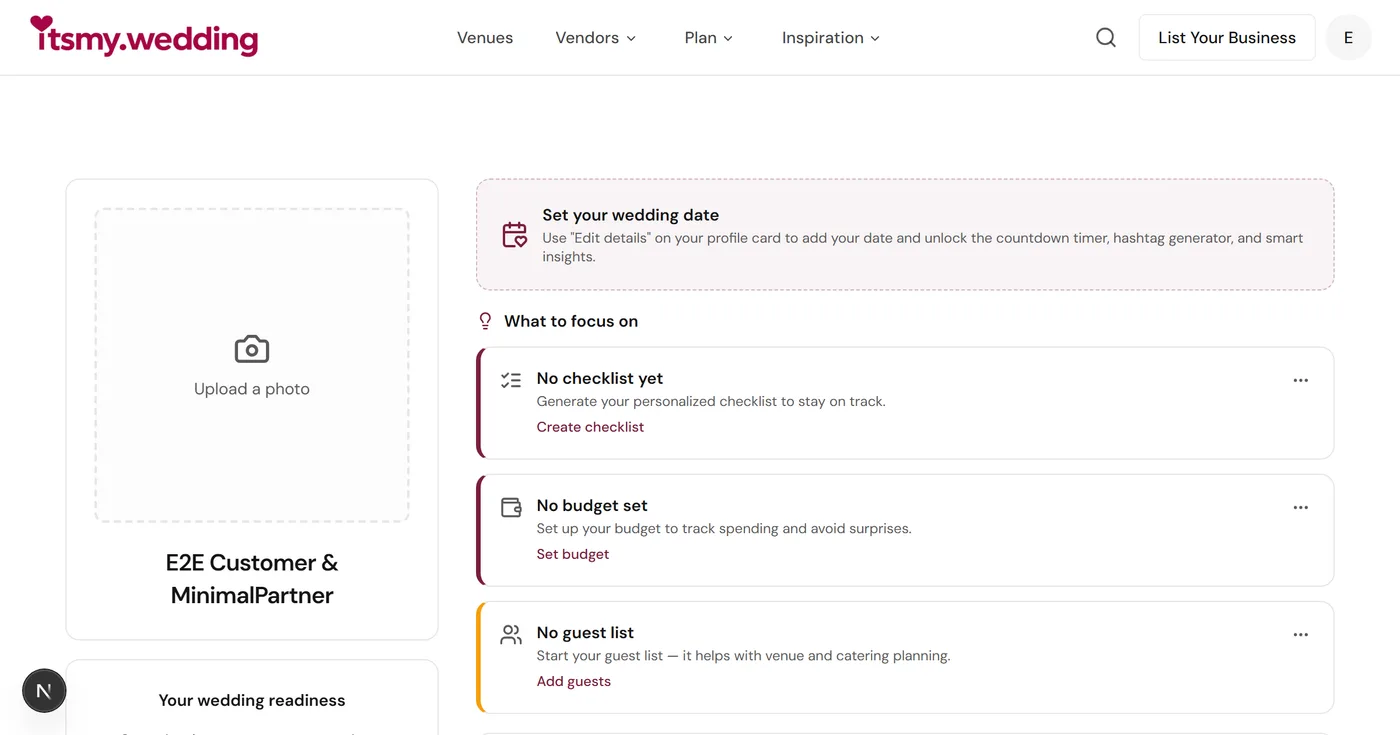
Best Free Wedding Planning Tools in 2026: The Complete Guide
AI Wedding Checklist vs Generic Templates: Which Is Better for Your Wedding?
Indian Wedding Checklist: The 12-Month Planning Timeline

Best Season for South India Destination Weddings: Month-by-Month Western Ghats Guide
Still planning?
Get quotes from India's best vendors
Tell us what you're planning and we'll match you with verified photographers, venues, decorators, and more.
Get free quotes