
Kerala Muslim Wedding: Managing 500+ Guests
Plan for 500–1,000+ guests at your Kerala Muslim wedding — batch serving across 3–5 rotations, Kalyana Samithi coordination, parking for 250 vehicles, and day-of timelines that keep every guest fed and welcomed.

Kerala Wedding Traditions Writer
Fathima Zahra is a traditions writer who specializes in Muslim and Mappila wedding customs of Kerala.
On this page
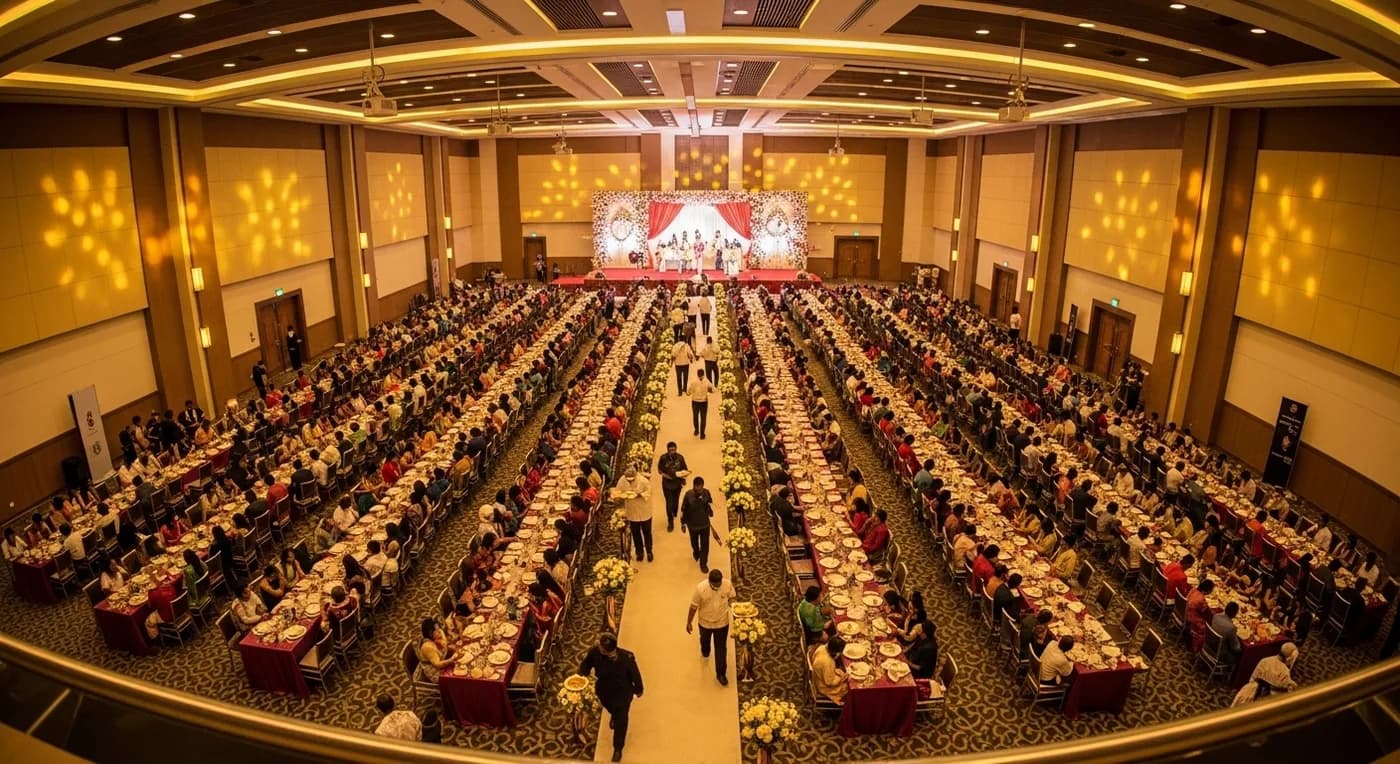
A Kerala Muslim wedding with 700 guests requires 3–5 dining batches of 200–250 guests each, a Kalyana Samithi of 15–30 coordinators, parking for 150–250 vehicles, and a day-of timeline that runs from 6 AM setup to 5 PM cleanup. The difference between a smoothly run celebration and logistical chaos comes down to one thing: a plan built for scale.
Quick Answer
Quick answer: Kerala Muslim weddings typically host 500–1,500 guests — 2–3x the national average. Feed them with 3–5 batch rotations of 200–300 each. Assign a 15–30 person Kalyana Samithi in dedicated sub-teams: catering, reception, transport, logistics, and finance. Plan parking for 150–250 vehicles and add a 15–20% buffer for walk-in guests.
Note
Pricing methodology: Cost estimates for parking operations, generator rental, and planner fees in this guide reflect 2026 market rates based on itsmy.wedding planning data from Kozhikode and Malappuram. Actual figures vary by vendor, event scale, and district. Use as planning benchmarks only.
Why Kerala Muslim Weddings Are Beautifully Large
A Malabar Muslim wedding is not a private affair — it is a community celebration. When a family in Malappuram or Kozhikode announces a wedding, they open their doors to an entire social world: extended family spanning three generations and five districts, the Mahall (mosque community) that has shared every milestone, the neighbourhood that watched the bride or groom grow up, professional networks, and Gulf diaspora relatives who fly home carrying blessings and expectations in equal measure.
This scale is not a logistical burden to minimise. It is a cultural inheritance to honour and manage well. Where the national average Indian wedding hosts approximately 330 guests, a typical Malabar celebration serves 500 to 1,000 — and families in Tirur, Ponnani, and Perinthalmanna routinely welcome 1,200 to 1,500. The challenge is building a framework that allows every guest to feel welcomed and fed without the family losing sleep.
For Nikah rituals, Oppana traditions, and Malabar cuisine details, read our Malabar Muslim Nikah Guide. For the complete planning overview, start with the Muslim Wedding Kerala Planning Guide. This post focuses exclusively on large-scale guest logistics.
How Should You Plan a Guest List for 500+ People?
Expect your final headcount to exceed the initial estimate by 15–20% — walk-in guests are not exceptions in Malabar culture, they are the norm. The guest list for a Kerala Muslim wedding is a negotiation across families, communities, and social obligations. The largest wedding I helped coordinate in Malappuram had 1,200 guests — and the family had initially estimated 700. Specifically, the gap between "who we plan to invite" and "who actually attends" is wider in Malabar than anywhere else in Kerala. Build yours outward from the centre:
- Immediate family — Parents, siblings, grandparents and spouses from both sides. Non-negotiable.
- Extended family — Uncles, aunts, first through third cousins, their spouses and children. In Malabar families, this circle alone can reach 150–300 people.
- Mahall and community — The mosque committee, neighbourhood families, community elders. In Malappuram especially, the Mahall list carries weight — excluding a family that invited you to their weddings creates lasting friction.
- Professional and business networks — Business associates, Gulf connections, colleagues.
- Friends — The couple's friends, parents' friends, family friends spanning decades.
Tip
The 15-20% Buffer Rule: Whatever your final invited count, add 15-20% for walk-in guests. In Malabar culture, walk-ins are expected and welcomed. A family inviting 700 should plan catering, seating, and parking for 800-840.
The Shared Spreadsheet
A shared Google Sheet is the most effective tool for managing a large guest list:
| Column | Purpose |
|---|---|
| Guest name | Full name for invitation printing |
| Family/group | Group related guests (e.g., "Rasheed uncle's family — 6") |
| Relation | Bride's side / Groom's side / Community / Professional |
| Invite status | Not yet / Sent / Confirmed / Declined |
| Guest count | Number in this party (including children) |
| Transport needs | Own vehicle / Outstation — needs accommodation / Gulf — needs airport transfer |
| Notes | VIP, elderly, wheelchair access, dietary needs |
Share this with both families and the Kalyana Samithi. Assign one person per side to maintain it — updating weekly from four months out, then daily in the final two weeks.
With your guest list taking shape and numbers becoming real, the next challenge is reaching every family on that list in a way that honours the Malabar tradition of personal invitation. A spreadsheet with 800 names is useless if the invitations do not go out on time, through the right channels, and with the right information.
How Do You Manage Invitations for a Large Malabar Wedding?
Physical cards remain the primary medium in Malappuram, Kozhikode, and Kannur, where hand-delivered invitations carry cultural weight. Order 15-20% more than your guest count to cover last-minute additions. Begin distribution 4-6 weeks before the wedding for local guests, 6-8 weeks for outstation families. Assign hand-delivery by area to Kalyana Samithi members — one person per neighbourhood or taluk.
WhatsApp and digital invitations supplement but do not replace physical cards. Use digital channels for venue Google Maps links, schedule updates, parking instructions, and accommodation coordination with outstation guests.
Note
RSVP Reality: Formal RSVPs are not part of Malabar wedding culture. Instead, Kalyana Samithi members in each area informally confirm attendance through conversations. For Gulf diaspora families — in Dubai, Abu Dhabi, Doha, Muscat, and Jeddah — send invitations 8-10 weeks ahead so they can book flights. A direct WhatsApp message asking about travel plans works better than a formal RSVP.
With your guest list set and invitations sent, the next challenge is the one that defines Malabar hospitality — how you feed everyone. A beautifully decorated hall and a perfectly timed Nikah mean little if 700 guests experience cold biryani or a 45-minute wait between batches. The dining logistics are where celebrations succeed or stumble, and the system that makes it work has been refined across generations of large-scale Malabar weddings.
How Does Batch Serving Work at a 700-Guest Walima Feast?
A 700-guest Walima requires 35–45 serving staff per rotation, 2–3 parallel buffet lines, and a Flow Manager who controls entry and exit like clockwork. This section separates a well-run Malabar wedding from a chaotic one. Batch serving is the proven system for feeding hundreds of guests a hot, multi-course Malabar meal. However, the mechanics of rotating 700 people through a dining hall in under three hours require military-grade coordination that most families underestimate. For menu selection and per-plate costs, see our Muslim Wedding Catering Guide. Here we cover the flow logistics.
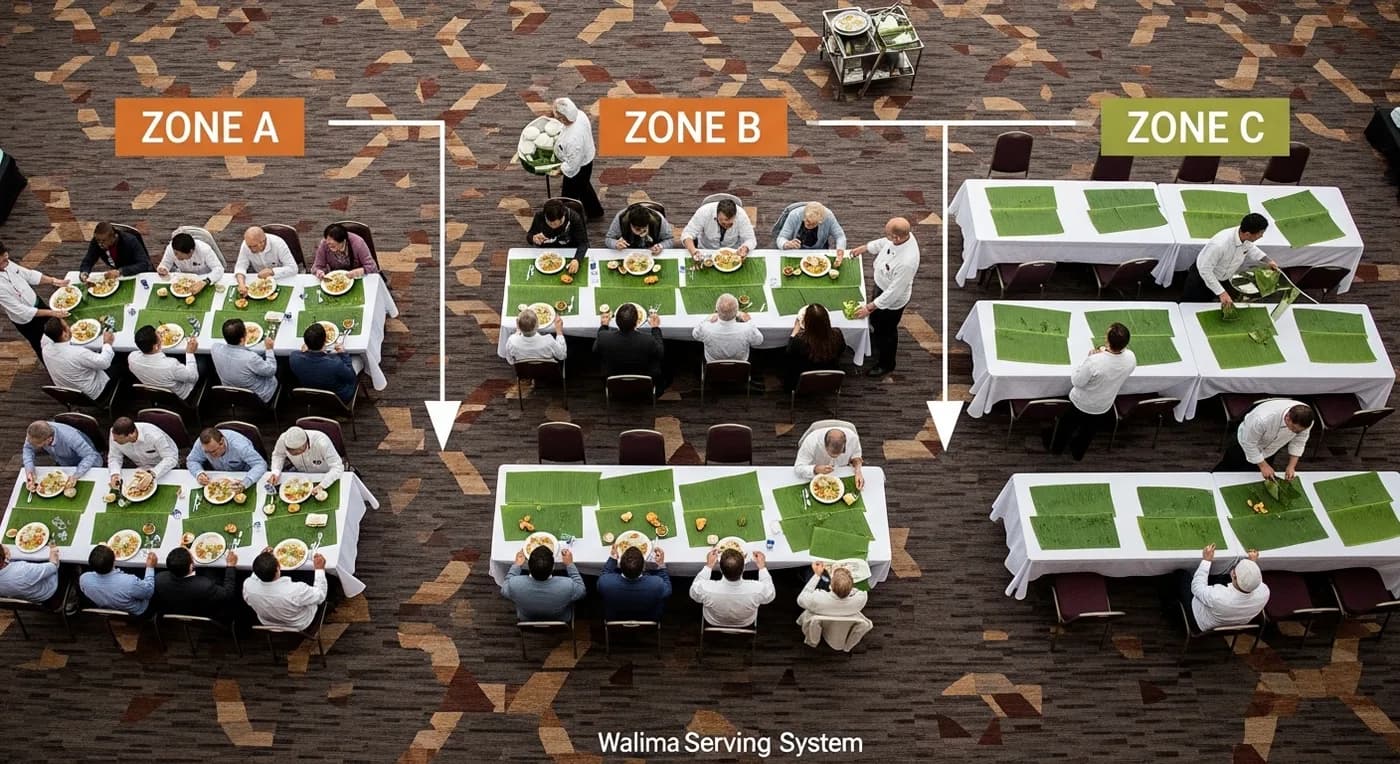
Batch Timing Strategy (700 Guests)
Consider your venue's seating capacity as the starting constraint — most Malabar convention centres seat 200–300 per rotation. The key here is timing: each batch gets 20–30 minutes at the table, while the next group socialises and greets the couple in the reception area.
| Batch | Time | Guests | Priority |
|---|---|---|---|
| Batch 1 | 12:30–1:00 PM | 200 | VIPs, elderly, Mahall elders, out-of-town guests |
| Batch 2 | 1:00–1:30 PM | 200 | Extended family, close community |
| Batch 3 | 1:30–2:00 PM | 200 | General guests, professional network, friends |
| Batch 4 | 2:00–2:30 PM | 100-150 | Remaining guests, late arrivals, walk-ins |
For 1,000+ guests, add a fifth batch or increase batch size to 250 with additional serving lines.
Serving Lines and Staff
One approach that works consistently is running 2–3 parallel serving lines, each mirroring the complete menu — biryani, pathiri and curries, neychoru, meat preparations, desserts, and Sulaimani. A dedicated Flow Manager at the dining entrance controls rotation: guests enter from one side, exit from the other, and a cleaning crew of 6–8 resets seats within 3–5 minutes between batches. A common mistake is allowing guests to self-select their dining time, which creates unpredictable surges that overwhelm the kitchen and leave later batches waiting. Specifically, the reset crew should pre-set banana leaves or plates for the next batch while the current one is still eating — this overlap cuts transition time from 10 minutes to under 5. Meanwhile, a volunteer stationed at the reception area announces the next batch verbally and via the venue PA system, preventing the bottleneck that occurs when guests self-select their dining time. For large-scale events, WeddingWire India reports that professional flow management reduces total dining time by 25-30% compared to informal coordination.
| Role | Staff Needed (per 200-guest batch) |
|---|---|
| Serving staff (per line, 2-3 lines) | 20-25 |
| Kitchen support | 5-8 |
| Cleaning and resetting | 6-8 |
| Flow Manager | 1 |
| Water and beverage service | 3-4 |
| Total | 35-45 |
Important
The Biryani Timing Rule: Thalassery biryani must be served hot. Coordinate with your caterer to time each batch's dum so it finishes 10 minutes before that batch is seated. Cold biryani at a Malabar wedding is an unrecoverable failure.
Looking for Caterings in Kozhikode?
Tell us what you need and get quotes from verified caterings
The dining system handles guests once they are inside the hall — but getting 700 people and their vehicles to the venue without gridlock is an equally critical logistics puzzle. One common mistake is treating parking as an afterthought, only to discover on the morning of the wedding that the venue's advertised capacity does not account for the narrow access road or the generator truck blocking half the lot.
How Do You Handle Parking and Transport for 500+ Wedding Guests?
If guests circle the venue for 20 minutes looking for parking, they arrive frustrated regardless of how beautiful the stage looks. A 700-guest wedding means 150–250 vehicles converging on your venue within a two-hour window. Kalyana Samithi volunteers I have worked with in Kozhikode recommend treating parking as a first-impression issue — if guests circle for 20 minutes looking for a spot, they arrive frustrated regardless of how beautiful the stage looks.
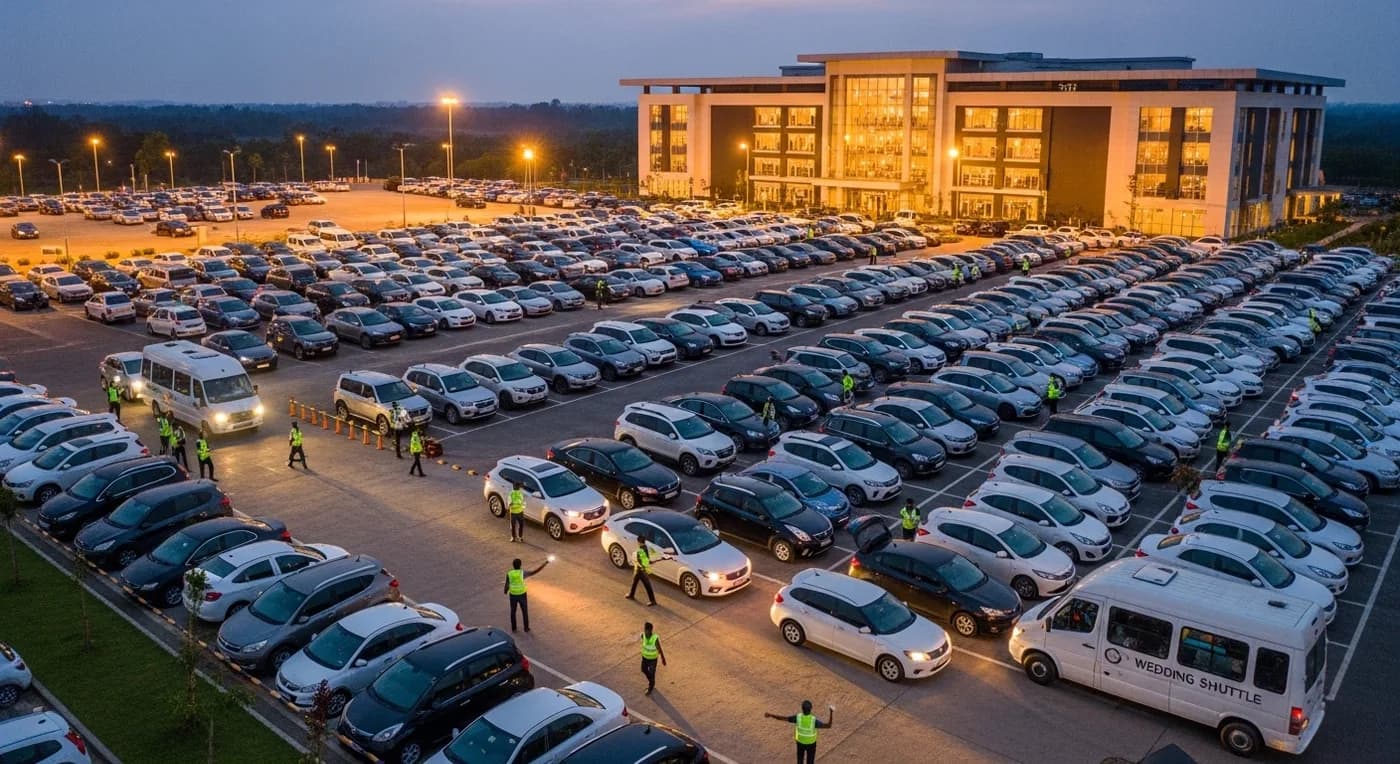
| Guest Count | Expected Vehicles | Parking Needed (with buffer) |
|---|---|---|
| 500 | 100-150 | 160-180 spaces |
| 700 | 150-200 | 220-240 spaces |
| 1,000 | 200-300 | 320-350 spaces |
Your parking plan in four steps:
- Primary lot — Confirm the venue's actual parking capacity. Many advertised numbers include blocked or unusable spaces.
- Overflow lot — Secure a secondary area within 500 metres. Open grounds, school compounds, or adjacent commercial properties work well. In Kozhikode, convention centres along the bypass often have arrangements with nearby plots.
- Hire 4-6 parking attendants — Two for primary, two for overflow, two roving to prevent double-parking and keep the entrance clear.
- Shuttle for overflow — If the secondary lot is more than 300 metres away, run a continuous shuttle (two autorickshaws or a Tempo Traveller looping every 5-10 minutes). Budget for the full parking operation — attendants, signage, and shuttle rental — at approximately ₹3,000 – ₹5,000 per event for a well-organized shuttle and valet setup.
Elderly and VIP Access
Every large Malabar wedding has guests aged 70+ whose comfort is non-negotiable. Create a designated drop-off point at the entrance, reserve Batch 1 seating for elderly guests, maintain 20-30 table-and-chair seats if the venue uses floor-level banana leaf service, and set up a quiet resting room with water and a volunteer attendant. Check wheelchair ramp access personally — many older convention centres in Malappuram lack this.
For Gulf diaspora families arriving from Dubai, Sharjah, Abu Dhabi, or Doha, coordinate airport transfers through Calicut International Airport (Karipur) and pre-book accommodation at three tiers: budget (₹1,500-3,000/night), mid-range (₹3,000-6,000), and premium (₹6,000-15,000). Block-book rooms 4-6 months ahead for wedding-season dates in Kozhikode or Malappuram.
The Kalyana Samithi: Your Wedding Operations Team
A well-structured Kalyana Samithi of 15–30 members replaces what would otherwise require a professional event management team costing ₹2–5 lakh. The Kalyana Samithi is the engine that makes large-scale Malabar weddings possible. This volunteer committee has coordinated celebrations across Kozhikode, Malappuram, Kannur, and Kasaragod for generations.
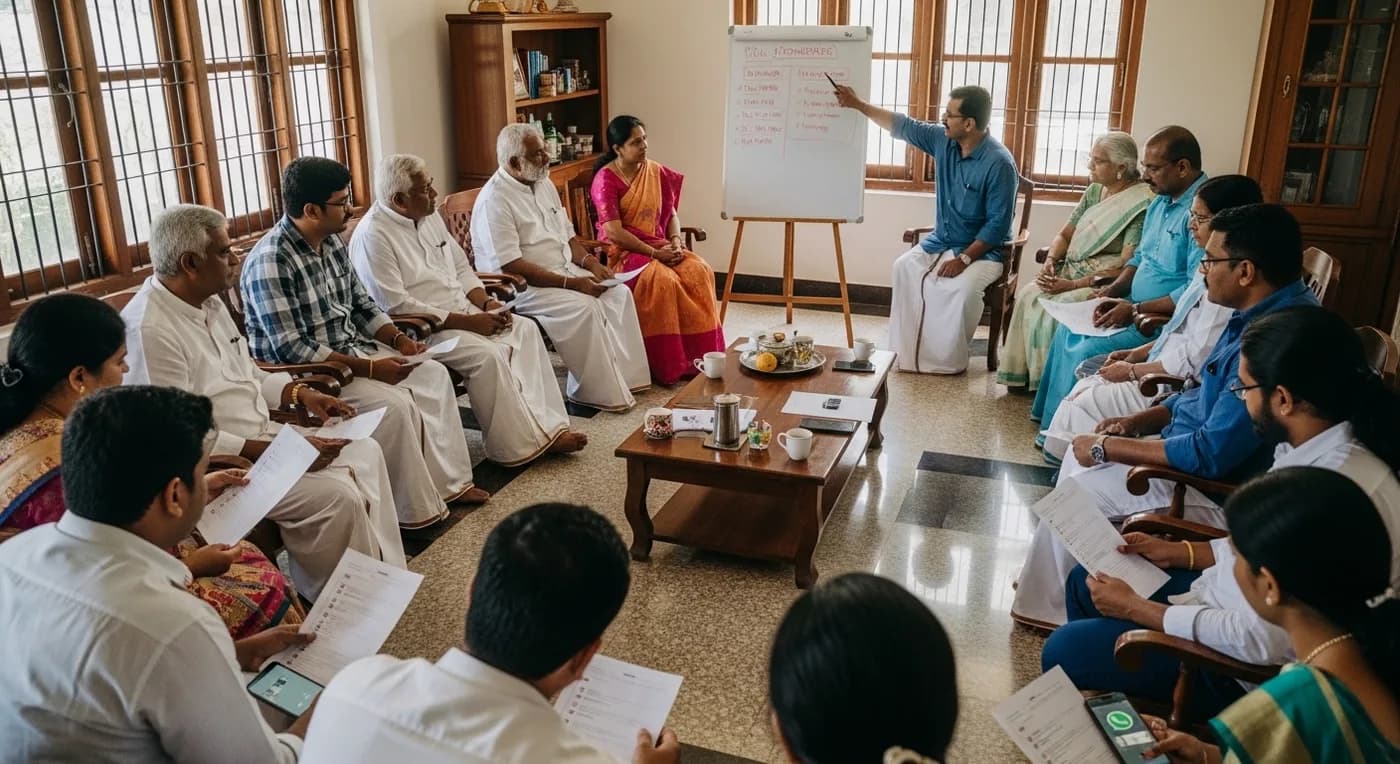
Sub-Team Structure (15-30 Members)
| Sub-Team | Members | Responsibilities |
|---|---|---|
| Head Coordinator | 1-2 | Timeline management, vendor liaison, emergency decisions |
| Venue and Logistics | 3-4 | Setup/teardown, power, signage, generator, furniture |
| Catering and Serving | 3-4 | Kitchen coordination, batch timing, serving line management |
| Guest Reception | 3-4 | Entrance welcome, couple's greeting queue, VIP identification |
| Transport and Parking | 2-3 | Parking attendants, shuttles, airport transfers |
| Finance and Gifts | 2-3 | Hanthakashu register, vendor payments, petty cash |
Modern Coordination Layer
Supplement the traditional committee with a main WhatsApp group (day-of schedule and emergency contacts pinned), sub-team groups for operational details, and a shared Google Sheet with tabs for budget, guest RSVP status, vendor contacts, and task assignments. The itsmy.wedding AI Checklist generates Muslim-wedding-specific task timelines that generic checklists miss.
When You Need a Professional Planner
The Kalyana Samithi works when the family has a large, local, experienced network. Supplement with a professional planner when the family is returning from the Gulf without local connections, the couple is based in Kochi, Thrissur, or Bangalore and the wedding is in Malappuram, the guest count exceeds 1,000, or the family simply wants to enjoy the celebration rather than manage it. The planner handles vendor coordination and day-of logistics; the Samithi maintains community relationships no outsider can replicate. Additionally, professional wedding planners in Kerala typically charge ₹50,000 – ₹5,00,000 depending on the scale and level of involvement — from day-of coordination only to full-service planning across all events.
Looking for Wedding Planners in Kozhikode?
Tell us what you need and get quotes from verified wedding planners
What Does a Day-of Coordination Timeline Look Like?
Printed run sheets reduce coordination errors by over 40% compared to digital-only distribution, according to event management research. Print this schedule. Distribute to every Kalyana Samithi member. Pin it in the WhatsApp group the night before. According to EventMB's large-event management research, printed run sheets reduce coordination errors by over 40% compared to digital-only distribution — especially when teams are handling multiple tasks simultaneously.
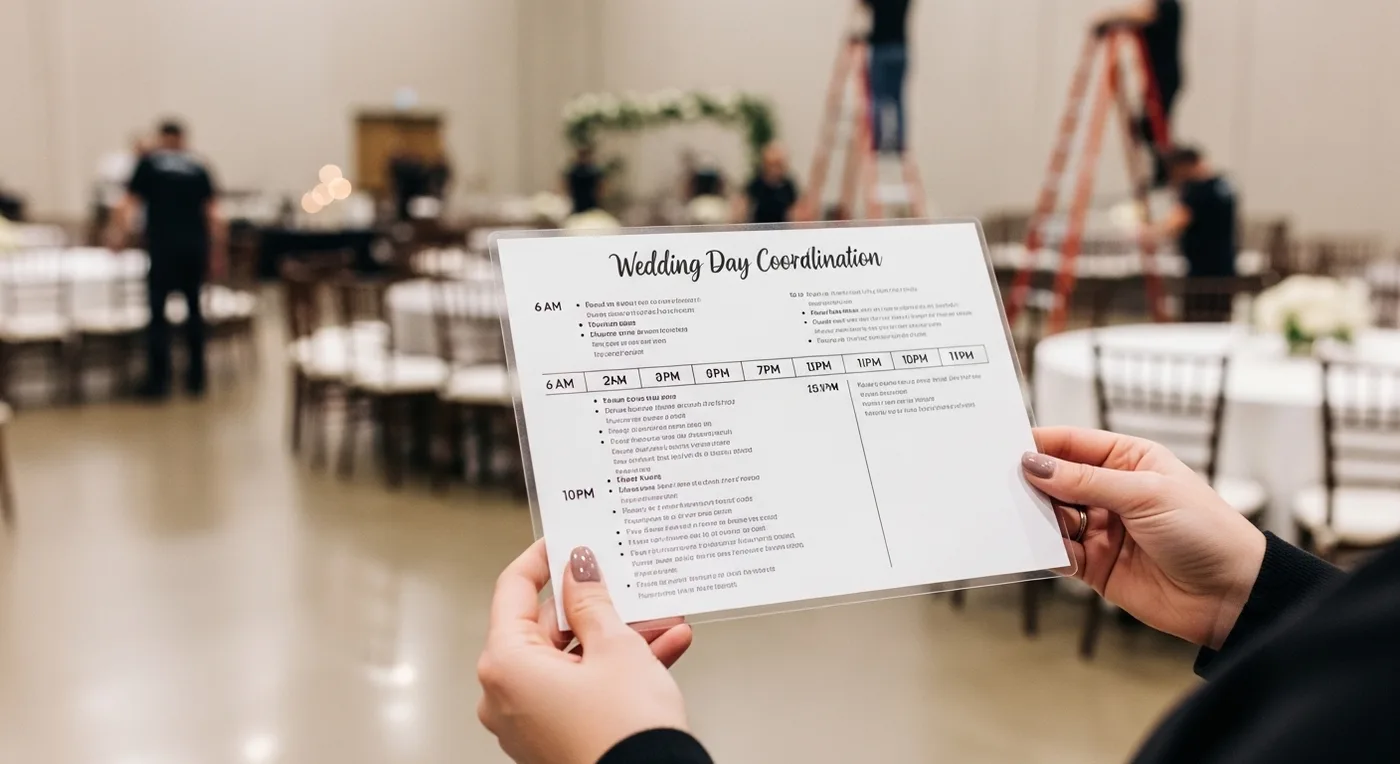
| Time | Activity | Responsible |
|---|---|---|
| 6:00 AM | Venue opens. Setup verification — stage, sound, dining area, signage, parking markers | Venue & Logistics |
| 7:00 AM | Caterer arrives, begins kitchen setup. Verify ingredient delivery, serving line layout | Catering team |
| 7:30 AM | Decorator finalises stage, entrance arch. Photographer arrives for detail shots | Venue & Logistics |
| 8:00 AM | Parking attendants take positions. Overflow shuttle test run. Road signage check | Transport team |
| 8:30 AM | Guest reception team at entrance. Welcome drinks station stocked | Reception team |
| 9:00 AM | Guest arrival begins. VIPs and elderly directed to reserved seating | Reception team |
| 9:30–10:30 AM | Nikah ceremony. Mahr presented, Ijab-Qubool exchanged, Nikah-nama signed | Head Coordinator |
| 10:30–11:00 AM | Post-Nikah sweets. Couple transitions to Walima venue. Family photos | Head Coordinator |
| 11:00 AM | Couple arrives at Walima stage. Guest greeting line opens | Reception team |
| 11:30 AM | Kitchen status check — biryani dum timing confirmed for Batch 1 | Catering team |
| 12:30 PM | Batch 1 begins. 200 guests seated, biryani served hot | Catering team |
| 1:00–2:30 PM | Batches 2-4 rotate through dining. 30-minute cycles | Flow Manager |
| 3:00 PM | Family photographs. Gift register finalised and secured | Finance team |
| 4:00–5:00 PM | Vendor breakdown. Venue inspection. Leftover food distributed | Head Coordinator |
Tip
Print the Timeline: On the day, people reach for paper faster than phones — especially when their hands are busy coordinating a 700-person event. Give every sub-team lead a physical copy with their responsibilities highlighted.
What Emergency Plans Should You Have in Place?
Every large-scale wedding encounters at least one unplanned disruption — the families that recover smoothly are the ones who planned for it. No 700-guest event runs without surprises. For example, at a 900-guest celebration I helped coordinate near Tirur, the generator failed 20 minutes before Batch 1 — we had a backup unit on standby that saved the biryani service. Plan for the common ones:
Weather — For open-air pandal weddings in Malappuram and Kannur, confirm waterproof roofing, keep 20-30 umbrellas at the entrance, and identify a nearby indoor backup venue.
Guest count surprises — Your 15-20% buffer absorbs extra walk-ins. Keep 30-40 folding chairs backstage. If fewer guests arrive, consolidate into fewer batches and distribute leftover food to staff or local charities.
Vendor failures — Keep one backup contact per critical vendor category. The Head Coordinator carries ₹10,000-20,000 in emergency cash. Route all vendor communication through a single Kalyana Samithi liaison.
Power failures — Verify the venue's generator is full-capacity (kitchen, lighting, and sound — not partial). If the venue lacks backup, rent a 25KVA unit independently at approximately ₹8,000 – ₹15,000 for a full-day rental. The Kerala State Electricity Board recommends confirming your venue's sanctioned load before planning heavy electrical installations like stage lighting and industrial kitchen equipment.
Fire safety compliance — For any gathering exceeding 200 guests, Kerala Fire and Rescue Service requires a fire-safety certificate. Verify the venue holds a valid certificate, emergency exits are unobstructed, and fire extinguishers are accessible near kitchen and stage areas. The Kerala Police advisory on large public gatherings additionally recommends informing the local station for events exceeding 500 guests, particularly when road closures or traffic diversions may be needed near the venue — a common scenario for Malappuram convention centres on narrow feeder roads.
Common Questions About Kerala Muslim Weddings
How many guests attend a typical Kerala Muslim wedding?
Mid-range Kerala Muslim weddings host 500-800 guests. In Malappuram, where Mahall-driven invitations are broadest, counts regularly reach 1,000-1,500. Always add a 15-20% buffer above your invited count — walk-in guests are culturally expected and must be fed with the same hospitality as formally invited guests.
How does a Kalyana Samithi work?
A Kalyana Samithi is a volunteer committee of 15-30 family members and community elders divided into sub-teams: Head Coordinator, Venue and Logistics, Catering, Guest Reception, Transport, and Finance. In 2026, effective committees supplement traditional coordination with WhatsApp groups and shared Google Sheets for real-time task management.
How do you serve food to 1,000 guests at a Muslim wedding?
Batch serving: 3-5 rotations of 200-300 guests over 2.5-3.5 hours. Each batch gets 20-30 minutes, with 2-3 parallel serving lines staffed by 35-45 people per rotation. A Flow Manager controls one-directional entry and exit. Time the biryani dum fresh for each batch.
How do I manage parking for a large Kerala wedding?
Expect 150-250 vehicles for 500+ guests. Confirm venue parking capacity, book overflow within 500 metres, hire 4-6 attendants, and run a shuttle for remote lots. Many Kozhikode convention centres include parking coordination in their packages.
How do I handle the guest list for a Kerala Muslim wedding?
Build outward through five circles (immediate family, extended family, Mahall/community, professional network, friends) using a shared Google Sheet with both families and the Kalyana Samithi maintaining it. Begin four months ahead. Always include a 15-20% walk-in buffer.
Further Reading
- Muslim Wedding Kerala Planning Guide — Complete planning overview for 2026.
- Malabar Muslim Nikah Guide — Traditions, rituals, Oppana, and the full ceremonial guide.
- Muslim Wedding Venues in Kerala — Venue options by district for 500-1,500 guests.
- Muslim Wedding Catering in Kerala — The Malabar feast, per-plate costs, and caterer selection.
Tip
Ready to start planning? Our AI Wedding Checklist generates a personalised timeline with Muslim-wedding-specific tasks — Kalyana Samithi formation, caterer booking windows, Qazi coordination, and Oppana scheduling. Estimate your full budget with the Cost Calculator.
Topics
large wedding guest management KeralaMuslim wedding guest listwedding coordination KeralaKalyana Samithi1000 guest wedding planningExplore more
Frequently Asked Questions
1How many guests attend a typical Kerala Muslim wedding?
2How does a Kalyana Samithi work?
3How do you serve food to 1000 guests at a Muslim wedding?
4How do I manage parking for a large Kerala wedding?
5How do I handle the guest list for a Kerala Muslim wedding?
Continue reading
Related Articles
Muslim Wedding Venues Kerala: Best Halls & Pricing 2026
Muslim Wedding Catering in Kerala: Malabar Menu, Costs & Planning for 2026
Kerala Muslim Wedding Checklist: Month-by-Month Planning Timeline for 2026
Best Season for South India Destination Weddings: Month-by-Month Western Ghats Guide
Destination Wedding Cost in South India 2026: 5-Tier Budget Guide
Destination Wedding in South India: Complete 2026 Planning Guide
Still planning?
Get quotes from India's best vendors
Tell us what you're planning and we'll match you with verified photographers, venues, decorators, and more.
Get free quotes