
Malabar Wedding Food: Thalassery Biryani, Pathiri & Feast Traditions
Malabar wedding food guide — Thalassery biryani, pathiri varieties, Mappila feast structure, North Kerala sadya, catering costs, and how to choose the right caterer in 2026.

Kerala Wedding Traditions Writer
Fathima Zahra is a traditions writer who specializes in Muslim and Mappila wedding customs of Kerala.

On this page
Malabar wedding food costs ₹300–1,500 per plate in 2026 — from ₹350–600 for a North Kerala Hindu sadya to ₹800–1,500 for a full Mappila feast with Thalassery biryani, pathiri, multiple meat dishes, and desserts. For a 600-guest wedding in Kozhikode, catering alone runs ₹4.8–9 lakh, consuming 35–45% of the total budget.
Quick Answer
Quick answer: Malabar wedding food costs ₹300–1,500 per plate in 2026 — from ₹350–600 for a North Kerala Hindu sadya to ₹800–1,500 for a full Mappila feast with Thalassery biryani, pathiri, multiple meat dishes, and desserts. For a 600-guest wedding in Kozhikode, catering alone runs ₹4.8–9 lakh, consuming 35–45% of the total budget.
Note
Pricing methodology: Cost ranges in this guide are based on vendor pricing data from the itsmy.wedding marketplace and published industry reports, collected in Q4 2025 – Q1 2026.
I grew up in a house in Kozhikode where the kitchen was the centre of everything. The smell of biryani rising from copper vessels at a neighbour's wedding — that was the signal that something worth attending was happening. In Malabar, the food is not a side element of the wedding. It is the wedding. Guests will forgive a slightly late start, an overcrowded hall, a sound system that crackles. They will not forgive mediocre biryani. Not in this region. Not ever.
This guide covers the full landscape of Malabar wedding food — the Mappila feast in all its layered glory, the Thalassery biryani that anchors it, every variety of pathiri your caterer should master, the North Kerala Hindu sadya and how it differs from the south, what each menu tier costs in 2026, and how to choose a caterer who will do justice to the single most important element of your celebration. For the complete planning picture — venues, budgets, timelines — start with our Malabar wedding planning guide. For Muslim ceremony traditions specifically, see the Malabar Muslim Nikah guide.
What Makes Malabar Wedding Food Different?
In most of Kerala, food is important at a wedding. In Malabar, it is the single most consequential decision you will make. The distinction is not subtle. Families in Kozhikode, Malappuram, Kannur, and Kasaragod routinely allocate 35–45% of their total wedding budget to catering — the highest proportion of any region in the state. Compare that to 25–30% in Thiruvananthapuram or Kochi, and you begin to understand the scale of the difference.
This food-first culture has deep roots. Malabar sits at the crossroads of centuries of Arab, Persian, and European trading influences that shaped a cuisine unlike anything else in Kerala. The Mappila community, in particular, developed a culinary tradition that blended Middle Eastern spice knowledge with Kerala's coconut-rich cooking techniques — producing dishes like Thalassery biryani, pathiri, and Muttamala that exist nowhere else in India in quite the same form. Ummi Abdullah, one of the foremost authorities on Mappila cuisine, has documented how this food tradition evolved through the spice trade routes that made Kozhikode one of the ancient world's great commercial centres.
The practical effect is straightforward: in Malabar, the caterer is typically booked before the venue. This is not an exaggeration — it is standard practice confirmed by caterers I speak with every season across Kozhikode and Malappuram. The best biryani masters and established catering houses are booked 6–8 months ahead for peak season dates between November and February. Your caterer determines your per-plate budget, which shapes how many guests you can afford to host, which in turn determines your venue choice.
There is also a social dimension. In communities across Kozhikode and Malappuram, a family's wedding food is openly discussed, evaluated, and remembered for years. The biryani at a wedding becomes part of the family's reputation. I have heard relatives compare biryani across weddings held a decade apart. This is the cultural context you are operating in — and it is why getting the food right matters more here than anywhere else in Kerala.
Note
The Malabar Booking Priority: Most families in Kozhikode and Malappuram follow this vendor booking order — caterer first, then venue, then photographer. The caterer sets the per-plate budget, which determines your guest count ceiling at your chosen quality level. See our Kozhikode wedding guide for specific caterer recommendations by district.
What Does a Mappila Wedding Feast Include?
A full Mappila wedding feast spans 15–25 dishes served across two distinct courses — pathiri and curries first, then biryani with accompaniments — and closes with desserts and Sulaimani chai. This structure has remained remarkably consistent across generations, even as individual dishes evolve. Having attended and coordinated hundreds of Malabar weddings across every district from Kasaragod to Wayanad, I can walk you through each stage of the feast exactly as your guests will experience it.
First Course: Pathiri and Curries
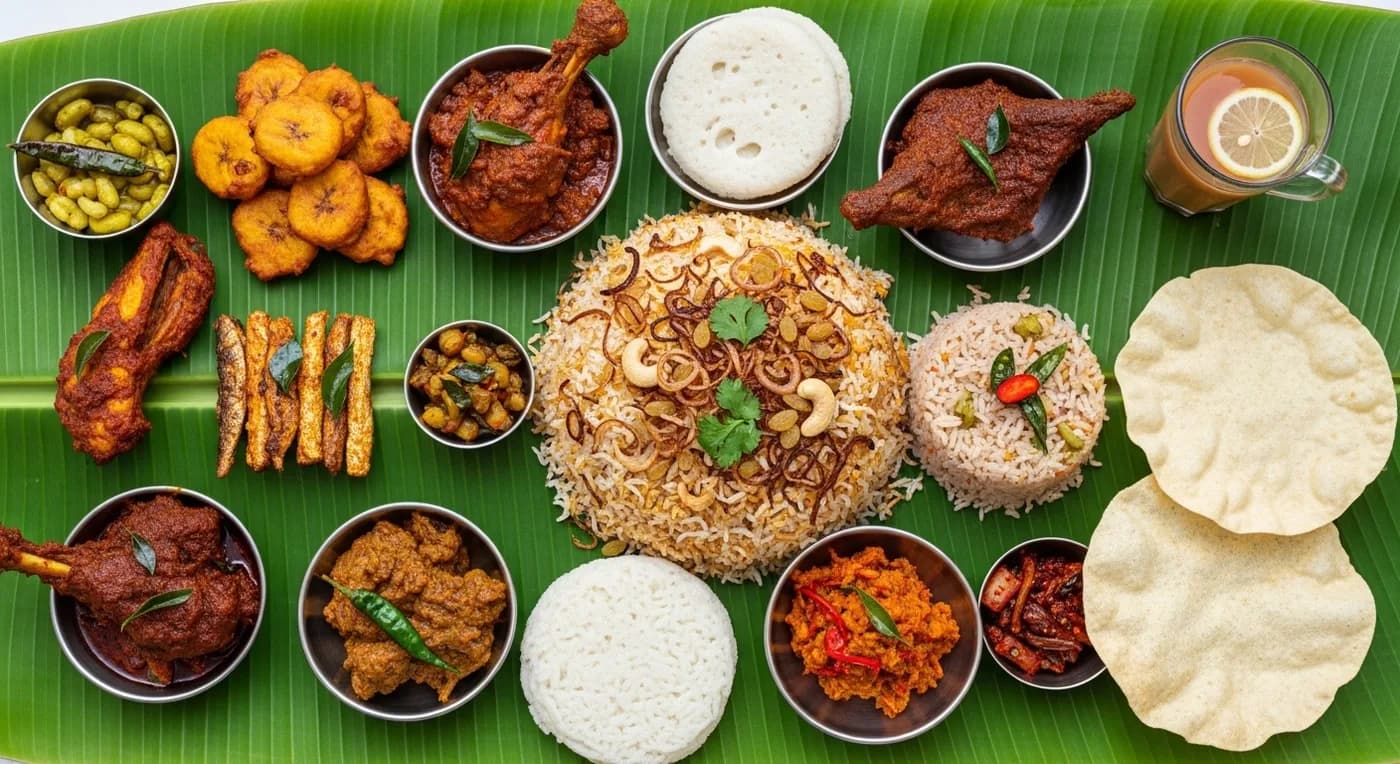
The meal begins with pathiri — the signature rice flour flatbreads of Malabar — served alongside an array of meat curries. This is not an appetiser. It is a full, substantial opening course that establishes the meal's tone.
Guests receive a banana leaf or plate with 2–3 types of pathiri. Alongside, the serving staff circulate with:
- Mutton curry (Erachi Curry) — Slow-cooked in coconut gravy with fennel and black pepper. This is the traditional companion to plain pathiri — many families consider this pairing the soul of the entire feast.
- Chicken curry — A lighter, coconut-milk-based preparation that balances the richer mutton.
- Chicken roast (Kozhi Porichathu) — Deep-fried chicken finished in a thick onion-tomato masala. The most universally loved dish at the table.
- Beef preparations — In Malappuram, Kozhikode, and much of North Malabar, a beef dish is considered essential. Beef Ularthiyathu (dry-roasted with coconut slivers) or Beef Curry with raw banana chips is a crowd favourite.
- Mutton fry (Erachi Ularthiyathu) — Dry-fried mutton with shallots, curry leaves, and coarse-ground spices. Every table runs out of this first.
In coastal areas — Kozhikode city, Thalassery, Kannur, Ponnani — fish curry (sour, tangy, made with kudampuli) and fish fry (marinated in chilli-turmeric paste, shallow-fried) join the lineup.
Second Course: The Biryani
After the pathiri course clears, the star arrives. Thalassery biryani is served from massive copper vessels, accompanied by:
- Raita — Yoghurt with cucumber, onion, and sometimes fried pakoras.
- Onion salad — Simple, sharp, essential.
- Pickle — Mango or lime, often homemade by the family.
- Neychoru (Ghee rice) — Fragrant basmati cooked with ghee and whole spices, offered as a milder alternative for guests who want to appreciate the curries without the biryani's spice intensity.

Desserts: The Sweet Finale
The dessert course features several preparations that are uniquely Malabar:
- Muttamala and Pinjanathappam — The signature pairing. Muttamala consists of delicate egg-yolk threads drizzled in sugar syrup, served atop Pinjanathappam, a steamed egg pudding with cardamom. Many guests judge a wedding's authenticity by this single item.
- Unnakkaya — Ripe banana stuffed with cashews, raisins, and sugar, coated in rice flour batter and deep-fried. Rich, fragrant, and deeply traditional.
- Chatti pathiri — Kerala's answer to lasagne: layers of spiced meat between egg-dipped pancakes, baked until golden. At some weddings, a sweet version with custard replaces the meat filling.
- Firni — Chilled rice-flour pudding in earthen bowls, topped with slivered almonds and pistachios. The Arab influence is unmistakable.
- Halwa varieties — Ghee-rich Karachi halwa, wheat halwa, and seasonal fruit halwa.
The Closing Ritual: Sulaimani Chai
Sulaimani — sweet, spiced black tea with a hint of lime — is the full stop to every Malabar wedding meal. No guest leaves without their glass. Its absence would be noticed and talked about. Sulaimani is not optional. It is the host's final gesture of hospitality — warm, fragrant, and decisive.

Batch Dining: How 600 Guests Eat in Two Hours
The traditional panthi (batch rotation) system is how Malabar families serve 500–1,500 guests without chaos:
- 200–300 guests per rotation, seated simultaneously.
- 20–25 minutes per rotation — Malabar guests eat with purpose, not leisure.
- 3–4 rotations for a 600-guest wedding, 5–6 for 1,000+ guests.
- 10–15 minutes between batches for clearing and resetting.
- A dedicated service manager coordinates flow, calling each batch by family section or seating block.
This system requires 15–20 serving staff per 200 guests. Experienced Malabar caterers run this seamlessly — it is the one area where you should never compromise on staffing numbers.
Tip
Ask About the Service Manager: The person coordinating batch rotations is as important as the biryani master. At tastings, ask the caterer who manages their floor operations and how many events of 500+ guests that individual has handled. A weak service manager turns a great menu into a frustrating experience.
Why Is Thalassery Biryani the Heart of the Feast?
Thalassery biryani is the single dish that defines a Malabar wedding — and the only Kerala biryani made with Kaima (Jeerakasala) rice instead of basmati. Understanding what makes it special helps you evaluate caterers and set the right expectations.
The Rice: Kaima, Not Basmati
The defining difference is the rice. Thalassery biryani uses Kaima rice — also called Jeerakasala — a short-grained, fragrant variety with a nutty aroma. Each grain is smaller and rounder than basmati, and it absorbs spice beautifully without becoming mushy. This is emphatically not basmati. If a caterer serves you biryani with long-grained basmati rice and calls it Thalassery biryani, they are not a Malabar specialist. Walk away.
The Cooking Method
The meat — chicken, mutton, or both at larger weddings — is cooked separately in a rich masala with fried onions, cashews, raisins, and whole spices: cardamom, cinnamon, cloves, bay leaf, star anise. The par-cooked rice is then layered over the meat and slow-cooked under a sealed lid using the dum technique. At a wedding serving 600 guests, a biryani master may prepare 200–400 kg of Kaima rice in massive chembu (copper vessels) over wood fires that burn through the night.
The result is lighter and more aromatic than Hyderabadi biryani — each grain distinctly flavoured, the meat tender, the spice balanced rather than overwhelming. CurlyTales has documented how the technique traces back to the Arab traders who brought rice-and-meat layering traditions to Kozhikode's port centuries ago, where local cooks adapted it with Kerala's indigenous spices and coconut.
The Kozhikode Variation
There is a subtle regional variation worth knowing. Kozhikode biryani — found at weddings in and around Calicut — uses a slightly different spice ratio, with more fennel and less star anise, producing a milder but deeply aromatic flavour. Some families in Kozhikode serve both Thalassery and Kozhikode biryani to offer contrast. If your guest list includes discerning food enthusiasts, a dual-biryani menu is a premium move that will be noticed and appreciated.

Note
The Biryani Test: When tasting a caterer's biryani, check three things: (1) the rice must be Kaima, not basmati — the grains are visibly shorter and rounder; (2) each grain should be separate, not clumped; (3) the meat should be tender enough to fall off the bone. If all three pass, you have found a serious Malabar caterer.
Looking for Caterings in Kozhikode?
Tell us what you need and get quotes from verified caterings
What Are the Pathiri Varieties Your Caterer Should Master?
Pathiri — the signature rice flour flatbread of Malabar — appears in at least five distinct varieties at a full wedding feast, and the quality of each reveals the caterer's skill. Making pathiri at wedding scale is one of the most labour-intensive tasks in Malabar catering. It requires a dedicated team of experienced cooks who can roll and cook hundreds of perfectly uniform flatbreads in the hours before service. Here is each variety and what to expect.
Plain Pathiri
The foundation. Paper-thin rice flour flatbread, cooked on a hot griddle until soft with faint brown spots. The defining companion to mutton curry — this is the pairing that anchors the first course. A well-made plain pathiri should be thin enough to see light through, soft enough to fold without cracking, and never rubbery.
Mutta Pathiri (Egg Pathiri)
Plain pathiri enriched with egg for a richer texture and golden colour. Slightly thicker, slightly more indulgent. The egg adds a subtle richness that makes this variety a favourite with younger guests.
Nei Pathiri (Ghee Pathiri)
Brushed with ghee, layered and flaky. Nei pathiri is often served as a standalone item — the ghee flavour is robust enough that it does not need a curry accompaniment, though it pairs beautifully with chicken roast. At premium weddings, nei pathiri is served hot, straight from the griddle, with the ghee still glistening.
Irachi Pathiri (Stuffed Meat Pathiri)
Rice flour encasing a spiced minced meat filling — essentially a Malabar meat pie. This is the most labour-intensive pathiri variety and its presence on a menu signals a premium caterer. Making irachi pathiri for 600 guests requires a dedicated preparation team working several hours before the event.
Chatti Pathiri: Kerala's Layered Masterpiece
Chatti pathiri deserves special mention because it occupies a unique space — part bread, part dessert, part architectural achievement. Thin pancakes are layered with spiced minced meat (or, in the sweet version, custard and dry fruits), dipped in egg, and baked in a chatti (flat-bottomed vessel). The result resembles a lasagne — golden on top, moist within, each layer distinct. At weddings, chatti pathiri is often served during the dessert course in the sweet version, or as a special item between courses in the savoury version.

Important
Machine-Made Pathiri Is Unacceptable: Some caterers cut costs by using machine-made pathiri. The difference is immediately obvious — machine pathiri is uniformly thick, rubbery in texture, and lacks the delicate irregularity that marks hand-made preparation. At a Malabar wedding, where every guest has eaten hand-made pathiri since childhood, this shortcut will be noticed and judged. When evaluating caterers, ask specifically about their pathiri preparation team and insist on hand-made.
How Does the North Kerala Hindu Sadya Differ from South Kerala?
The Hindu wedding sadya in North Kerala — served across Kozhikode, Kannur, Kasaragod, and Wayanad — carries distinct regional characteristics that separate it from the Thiruvananthapuram or Kottayam tradition most people associate with Kerala sadya.
A North Kerala sadya still follows the traditional 20–25 dish banana leaf format — rice, sambar, rasam, avial, thoran, olan, pachadi, kichadi, payasam, and the full sequence. But the regional differences are meaningful:
More Coconut, Everywhere
North Kerala cooking uses coconut more generously and in more forms. Preparations have thicker coconut milk gravies. Coconut paste appears more frequently as a base. Coconut oil is used with a heavier hand. For a South Kerala native eating at a Kozhikode wedding sadya, the first thing they notice is the richer, more coconut-forward flavour profile across nearly every dish.
Coastal Influence in Kozhikode and Kannur
In coastal districts, the sadya tradition accommodates the region's seafood heritage. While a strict traditional sadya is vegetarian, North Kerala wedding sadyas — particularly at Nair and Thiyya community weddings in Kozhikode and Kannur — sometimes include a non-vegetarian course served after the leaf meal. Fish curry, prawn preparation, or a meat dish may follow the sadya as a supplementary course, a practice less common in Palakkad or Kottayam weddings.
Distinct Preparations
- Kootu curry in North Kerala uses a more robust coconut paste base, with raw banana and black chickpeas as primary ingredients — different from the sweeter, lighter kootu curry found in Thrissur.
- Erissery (pumpkin and Bengal gram) tends to be drier and more intensely coconut-flavoured in the north.
- Payasam selection often includes parippu pradhaman and palada pradhaman, but North Kerala weddings may add a locally specific godhambu (wheat) payasam or a jackfruit-based variation during season.
Sadya Cost in North Kerala
| Tier | Dishes | Per Plate | Total (500 Guests) |
|---|---|---|---|
| Standard | 20–22 items | ₹350 – ₹450 | ₹1,75,000 – ₹2,25,000 |
| Premium | 24–26 items | ₹450 – ₹600 | ₹2,25,000 – ₹3,00,000 |
| Grand | 26–30 items with 3+ payasams | ₹600 – ₹800 | ₹3,00,000 – ₹4,00,000 |
The sadya vs buffet comparison covers format trade-offs in detail if you are deciding between sadya and a modern buffet for a Hindu wedding in North Kerala.
How Much Does Malabar Wedding Catering Cost in 2026?
Malabar wedding catering ranges from ₹300 – ₹1,500 per plate depending on menu type, tier, and district — with the Mappila feast commanding the highest budgets and Hindu sadya offering the most affordable option. Here is the complete cost picture for 2026.
Mappila Feast: Cost by Menu Tier
| Menu Tier | Dishes | Per Plate | Total (600 Guests) | Best For |
|---|---|---|---|---|
| Standard | 15–18 items: biryani, neychoru, 2 pathiri types, 3 meat dishes, 3 sides, 3 desserts, Sulaimani | ₹800 – ₹1,000 | ₹4,80,000 – ₹6,00,000 | Budget-conscious families, community-managed cooking |
| Premium | 18–22 items: biryani, neychoru, 3 pathiri types, 4–5 meat dishes, fish curry, 4 sides, 4–5 desserts, Sulaimani | ₹1,000 – ₹1,200 | ₹6,00,000 – ₹7,20,000 | Most Malabar weddings, professional caterers |
| Luxury | 22–25+ items: dual biryani, neychoru, 4 pathiri types, 5–6 meat dishes, 2 seafood items, dessert station, shawarma counter, welcome drinks, Sulaimani | ₹1,200 – ₹1,500 | ₹7,20,000 – ₹9,00,000 | Premium celebrations in Kozhikode, destination weddings |
Hindu Sadya: Cost by Tier
| Tier | Per Plate | Total (500 Guests) |
|---|---|---|
| Standard (20–22 items) | ₹350 – ₹450 | ₹1,75,000 – ₹2,25,000 |
| Premium (24–26 items) | ₹450 – ₹600 | ₹2,25,000 – ₹3,00,000 |
Regional Price Variations
Location significantly affects catering costs across Malabar. Here is how each district compares:
| District | Price Adjustment | Notes |
|---|---|---|
| Kozhikode city | Baseline | The gold standard. Highest concentration of established Malabar caterers. |
| Malappuram | 5–10% below Kozhikode | Intense caterer competition from high wedding volume. Community kitchens can reduce costs further. |
| Kannur / Thalassery | Comparable to Kozhikode | Seafood-heavy menus cost slightly more during monsoon when fish prices spike. |
| Kasaragod | 10–15% below Kozhikode | Smaller-scale operations. Many families hire caterers from Kozhikode for quality assurance. |
| Wayanad | 5–10% above Kozhikode | Limited local options for large-scale catering. Most families bring caterers from Kozhikode or Kannur. Transport adds ₹15,000–30,000. |
What Drives the Cost Up?
Several factors push catering costs above the baseline:
- Seafood additions — Fish and prawn preparations add ₹100 – ₹250 per plate, depending on variety and freshness.
- Live counters — A shawarma counter, grill station, or live biryani station adds ₹50,000 – ₹1,50,000 to the total bill.
- Dual biryani — Serving both Thalassery and Kozhikode biryani requires additional rice, spices, and a second preparation setup.
- Dessert stations — Expanding beyond the standard 3–4 desserts to a full dessert bar with 8–10 items adds ₹30,000 – ₹80,000.
- Travel charges — Hiring a Kozhikode caterer for a wedding in Kochi or Trivandrum adds ₹20,000 – ₹50,000 for travel, accommodation, and equipment transport.
For a detailed breakdown of how catering fits into your full Malabar wedding budget, see the Malabar wedding planning guide. For Muslim-specific catering logistics including managing 1,000+ guests, the Muslim wedding catering guide covers the operational details.
Looking for Caterings in Malappuram?
Tell us what you need and get quotes from verified caterings
How Do You Choose the Right Malabar Caterer?
The caterer you select determines 35–45% of your budget, the quality of the dish your family will be remembered by, and the logistical feasibility of your entire event. Having worked with dozens of caterers across every Malabar district, here is the structured approach I recommend.
The Tasting Protocol
Never book a Malabar caterer without a dedicated tasting. Most established catering houses offer this for ₹3,000 – ₹8,000 — usually adjusted against your final invoice. Here is how to approach it.
Step 1: Shortlist 3–4 caterers from community referrals. In Malabar, word of mouth remains the most reliable signal. Ask recently married families in your community whose biryani they remember. Those names are your shortlist.
Step 2: Taste the biryani first. This is the defining evaluation. Check:
- The rice must be Kaima (short-grained, nutty), not basmati.
- Each grain should be separate, not clumped.
- The meat should be tender enough to fall off the bone.
- The spice balance should be aromatic, not overwhelming.
Step 3: Evaluate the pathiri. Plain pathiri must be thin, soft, and not rubbery. Hold it up — you should see some light through it. If it is thick or chewy, the caterer is either using machine preparation or lacks skilled pathiri makers.
Step 4: Try the mutton curry. This is the second most scrutinised dish. Check the coconut gravy consistency, meat tenderness, and the fennel-pepper balance that marks authentic Malabar preparation.
Step 5: Sample desserts. Muttamala should be delicate, not chewy. Unnakkaya should be freshly fried, not reheated. Chatti pathiri should have distinct layers.
Critical Questions for Every Caterer
Ask every caterer these questions before booking:
- How many wedding events of 500+ guests have you handled in the past 12 months?
- Who is the biryani master assigned to our event? (The individual matters — experienced caterers have named specialists.)
- Where do you source Kaima rice? (Quality varies significantly by supplier.)
- How large is your pathiri preparation team? How many pathiris can they produce per hour?
- Do you bring your own cooking equipment, or rely on the venue kitchen?
- What is your serving staff ratio per 200 guests?
- How do you handle batch rotations for 600+ guests?
- What is included in the per-plate price, and what is quoted separately? (Starters, welcome drinks, and live counters are frequently additional.)
- Do you hold a valid FSSAI food licence? (Mandatory for any commercial caterer serving 100+ guests.)
- What is your cancellation and date-change policy?
Red Flags to Watch For
- No tasting offered — Any caterer unwilling to let you taste is not confident in their food.
- Basmati in the biryani — If the tasting biryani uses basmati instead of Kaima, this is not a Malabar specialist.
- Vague staffing numbers — "We will bring enough staff" is not an answer. You need specific ratios.
- No named biryani master — At this scale, the individual cooking the biryani matters. Generic rotation staffing produces inconsistent results.
- Unusually low pricing — A per-plate quote significantly below ₹800 – ₹800 for a full Malabar feast in 2026 suggests compromises on ingredient quality.
Tip
The 50-Question Framework: For a comprehensive vendor evaluation checklist that works for caterers and every other wedding vendor, use our 50 questions to ask wedding vendors in Kerala. Adapt the food-specific questions to Malabar's unique priorities: biryani rice sourcing, pathiri team credentials, and batch rotation experience.
What Modern Additions Work at a Malabar Wedding?
Live shawarma counters, dessert bars, and mocktail stations are gaining traction across Kozhikode and Kannur — but should never consume more than 15–20% of your catering budget. The traditional Mappila feast core is non-negotiable at most Malabar weddings. But 2026 has brought modern additions that complement the classics without competing with them.
Live Counters That Work
- Shawarma counter — The most popular modern addition. A dedicated station with chicken and mutton shawarma, often with a vertical rotisserie for visual impact. Guest traffic here frequently rivals the main serving line.
- Live biryani station — Biryani served directly from the copper vessel by the chef, allowing guests to request specific portions. Theatrical and practical.
- Grill station — Tandoori chicken, seekh kebabs, and grilled fish served fresh. Particularly popular at outdoor and semi-outdoor venues in Kannur and Kasaragod.
Dessert Expansions
- Ice cream bar — Multiple flavours with toppings, replacing the traditional single-option fruit salad with ice cream.
- Expanded halwa and mithai counter — North Indian sweets like gulab jamun and jalebi alongside Malabar classics.
- Live crepe or waffle station — A contemporary addition gaining traction at high-budget urban weddings in Kozhikode city.
What to Skip
Skip anything that competes directly with the traditional menu. A pasta counter or a sushi station at a Malabar wedding reads as tone-deaf rather than cosmopolitan. The shawarma counter works because it shares flavour DNA with Mappila cuisine. A live dosa counter works because it complements without competing. Anything that pulls attention away from the biryani and pathiri is a misallocation of budget.
For more on how modern additions integrate into a Muslim wedding catering plan, including specific budget allocations for each type of live counter, see our detailed catering guide.
Planning Your Malabar Wedding Menu: A Timeline
Start catering planning 8–10 months before the wedding — and remember, in Malabar, the caterer often comes before the venue.
| Timeline | Action |
|---|---|
| 8–10 months before | Shortlist caterers from community referrals. Contact top 4–5 to check date availability. |
| 6–8 months before | Schedule tasting sessions. Evaluate biryani, pathiri, and mutton curry quality. |
| 5–6 months before | Finalize caterer and sign contract. Lock in per-plate rate, menu composition, and staffing commitments. |
| 3–4 months before | Confirm guest count estimate. Discuss batch rotation logistics and venue kitchen requirements with caterer. |
| 1 month before | Final guest count confirmation. Finalize menu additions (live counters, dessert stations). Confirm Kaima rice sourcing. |
| 1 week before | Final coordination call: timing, setup requirements, serving staff deployment, Sulaimani preparation schedule. |
If you are building a complete wedding plan around this timeline, the Malabar wedding planning guide provides the full month-by-month schedule including venue, photography, and decoration alongside catering. For Kerala-specific food menu ideas beyond the traditional format, see our Kerala wedding food menu ideas guide.
Common Questions About Malabar Wedding Food
What is the cost of Malabar wedding food per plate in 2026?
Malabar wedding catering costs ₹300 – ₹1,500 per plate in 2026 depending on menu type. A Hindu sadya runs ₹350 – ₹600 per plate. A standard Mappila feast with Thalassery biryani, pathiri, and 3–4 meat dishes costs ₹800 – ₹1,200 per plate. Premium menus with seafood and dessert stations reach ₹1,200 – ₹1,500 per plate.
What makes Thalassery biryani different from other biryanis?
Thalassery biryani uses Kaima (Jeerakasala) rice — a short-grained, fragrant variety — instead of basmati. It is slow-cooked over wood fires in copper vessels using the dum method. The rice stays separate yet absorbs spice beautifully, producing a lighter, more aromatic result than Hyderabadi or Lucknowi biryanis.
What dishes are served at a Mappila wedding feast?
A full Mappila feast includes 15–25 dishes across two courses: pathiri with meat curries first, then Thalassery biryani with accompaniments. The standard spread includes 3–5 pathiri varieties, chicken roast, mutton curry, mutton fry, beef preparations, neychoru, raita, pickle, Muttamala, Pinjanathappam, Unnakkaya, and Sulaimani chai.
What are the different types of pathiri at a Malabar wedding?
The main varieties are: plain pathiri (thin rice flour flatbread), mutta pathiri (egg-enriched), nei pathiri (ghee-brushed and flaky), irachi pathiri (stuffed with spiced minced meat), and chatti pathiri — a layered baked dish with spiced meat between egg-dipped pancakes. Each requires dedicated hand-preparation at wedding scale.
How is North Kerala sadya different from South Kerala sadya?
North Kerala sadya uses more coconut across preparations, features thicker coconut milk gravies, and in coastal Kozhikode and Kannur, may include non-vegetarian dishes served after the traditional vegetarian leaf meal. Kootu curry and erissery have distinct regional variations, and payasam selections often include locally specific wheat or jackfruit-based versions.
Should I book the caterer before the venue for a Malabar wedding?
Yes. In Kozhikode and Malappuram, this is standard practice. The best biryani masters are booked 6–8 months ahead for peak season. Your caterer determines your per-plate budget, which shapes your guest count ceiling and venue kitchen requirements. See the Malabar wedding planning guide for the full booking timeline.
How do I choose the right caterer for a Malabar wedding?
Shortlist 3–4 caterers from community referrals, schedule tasting sessions (₹3,000 – ₹8,000, often adjusted against your invoice), and evaluate biryani first. The rice must be Kaima, not basmati. Test pathiri for thinness and softness. Ask about the biryani master by name, their pathiri team size, and serving staff ratios.
Can I get authentic Malabar wedding food for a wedding in South Kerala?
Yes. Many families in Kochi, Thrissur, and Trivandrum hire North Malabar caterers from Kozhikode or Thalassery. Budget an additional ₹20,000 – ₹50,000 for travel, accommodation, and equipment transport. Confirm the caterer has handled off-site large-scale events and can source quality Kaima rice at the destination.
Planning your Malabar wedding? Start with the complete Malabar wedding planning guide for venues, budgets, and timelines — then use this food guide to lock in the most important decision of all. For Muslim wedding ceremony details, the Malabar Muslim Nikah guide covers the rituals.
Topics
Malabar wedding foodThalassery biryani weddingpathiri varietiesMappila wedding feastMalabar sadyawedding catering KozhikodeMalabar cuisine wedding menuExplore more
Frequently Asked Questions
1What is the cost of Malabar wedding food per plate in 2026?
2What makes Thalassery biryani different from other biryanis?
3What dishes are served at a Mappila wedding feast?
4What are the different types of pathiri at a Malabar wedding?
5How is North Kerala sadya different from South Kerala sadya?
6Should I book the caterer before the venue for a Malabar wedding?
7How do I choose the right caterer for a Malabar wedding?
8Can I get authentic Malabar wedding food for a wedding in South Kerala?
Continue reading
Related Articles

How to Plan a Malabar Wedding: North Kerala's Complete 2026 Guide
Muslim Wedding Catering in Kerala: Malabar Menu, Costs & Planning for 2026

Wedding Halls in Kozhikode with Price (2026) | Capacity & Rates
Best Season for South India Destination Weddings: Month-by-Month Western Ghats Guide
Destination Wedding Cost in South India 2026: 5-Tier Budget Guide
Destination Wedding in South India: Complete 2026 Planning Guide
Still planning?
Get quotes from India's best vendors
Tell us what you're planning and we'll match you with verified photographers, venues, decorators, and more.
Get free quotes