
Hyderabad Wedding Ceremony Sequence: Telugu, Muslim & Multi-Faith Event Order
Full Hyderabad wedding ceremony sequence for Telugu Hindu, Muslim Nikah, and multi-faith celebrations — 8+ events across 2-5 days with timing and vendors.

On this page
A Hyderabad wedding follows a structured sequence of 8-12 events spanning 2-5 days, depending on whether the family follows Telugu Hindu, Muslim, or multi-faith traditions. According to WedMeGood's 2025 survey, the average Hyderabad wedding budget is ₹37 lakh across all events. This guide maps the exact order, timing, attendee expectations, and vendor requirements for every ceremony in the sequence.
Quick Answer
Quick answer: A Hyderabad wedding follows a structured sequence of 8-12 events spanning 2-5 days, depending on whether the family follows Telugu Hindu, Muslim, or multi-faith traditions. According to WedMeGood's 2025 survey, the average Hyderabad wedding budget is ₹37 lakh across all events. This guide maps the exact order, timing, attendee expectations, and vendor requirements for every ceremony in the sequence.
Note
Pricing methodology: Cost ranges in this guide are based on vendor pricing data from the itsmy.wedding marketplace and published industry reports, collected in Q4 2025 – Q1 2026.
TL;DR: Hyderabad weddings run 2-5 days across distinct traditions. Telugu Hindu ceremonies follow an engagement-to-reception arc over 2-3 days, with the muhurtham-timed Mangalya Dharanam as the centrepiece. Hyderabadi Muslim weddings span 3-5 days from Mangni through the Walima feast. Average total spend is ₹37 lakh (WedMeGood, 2025).
Planning a Hyderabad wedding means coordinating a precise sequence of events — each with its own guest list, vendor needs, and cultural significance. The city's extraordinary diversity means your celebration could follow a Telugu Hindu sequence rooted in Vedic rituals, a Hyderabadi Muslim arc shaped by Deccani and Islamic traditions, or a multi-faith blend that honours both. Getting the order right isn't just about tradition. It's about logistics, vendor coordination, and making sure every guest knows where to be and when.
This guide lays out the complete ceremony sequence for each tradition, event by event. For a broader overview of Hyderabad's wedding culture, see the Hyderabad wedding traditions guide. For step-by-step planning logistics, start with the Hyderabad wedding planning guide.
What Is the Full Telugu Hindu Wedding Ceremony Sequence?
A Telugu Hindu wedding in Hyderabad spans 2-3 days and follows a fixed order of Vedic and regional rituals. According to the Telangana State Marriage Register portal, over 3.8 lakh marriages were registered in the state in 2024, with Telugu Hindu ceremonies accounting for the majority. The sequence moves from formal engagement through pre-wedding preparations and the main ceremony to the reception — each step building on the last.
Here's the complete event order, with timing, attendees, and vendor needs for each stage.
[IMAGE: Infographic showing the Telugu Hindu wedding ceremony sequence from engagement to reception — search terms: Telugu wedding ceremony timeline infographic]
Event 1: Nischitartham (Engagement)
The Nischitartham is the formal engagement — the moment both families publicly confirm the match, exchange rings, and fix the wedding date. In Hyderabad, this event has grown from a private family affair into a celebration of its own, often held at a banquet hall or hotel rather than at home.
Who attends: Both families, close relatives, and friends — typically 100-300 guests.
Duration: 2-3 hours.
Vendor needs: Venue, decorator (stage with floral backdrop), photographer, and caterer for a light meal or snacks. Some families hire a nadaswaram musician for an auspicious atmosphere.
Hyderabad-specific note: Many families in Kukatpally, LB Nagar, and Secunderabad now hold the Nischitartham at the same venue as the wedding to lock in the date. Heritage venues like Falaknuma Palace and Taj Deccan book out 12+ months ahead, so engagement-day venue scouting is common.
For ring ceremony customs and gifting traditions, see the Telugu wedding rituals guide.
Event 2: Pellikuthuru / Pellikoduku (Pre-Wedding Day)
The Pellikuthuru (for the bride) and Pellikoduku (for the groom) are preparation rituals held the day before the wedding. These parallel ceremonies happen at the respective family homes or at the wedding venue itself.
Key rituals in this phase:
- Nalugu — Turmeric paste is applied to the bride's face, arms, and feet by married women in the family. It's a purification ritual believed to give the skin a golden glow.
- Mangala Snanam — A ceremonial bath with turmeric water, symbolising cleansing before the sacred ceremony.
- Kashi Yatra — The groom pretends to leave for Kashi (Varanasi) to pursue spiritual studies. The bride's brother intercepts him and convinces him to return for the wedding. It's theatrical, funny, and a crowd favourite.
- Snathakam — The groom's sacred thread ceremony, performed if he hasn't undergone it earlier. A priest conducts the ritual, which can take 1-2 hours.
Who attends: Close family and friends from both sides — 50-150 people for each ceremony.
Duration: 3-5 hours for the full set of rituals.
Vendor needs: Makeup artist (for the bride's Nalugu look), photographer to capture candid moments, decorator for a simple turmeric-themed setup, and a caterer for a family lunch or dinner.
Tip
Event 3: The Main Telugu Wedding Ceremony
The core ceremony is the heart of the celebration. It follows a precise ritual order timed around the muhurtham — the auspicious moment calculated by the priest. In Hyderabad, most muhurthams fall in the early morning hours, so ceremonies typically begin before dawn.
[PERSONAL EXPERIENCE]
The ritual sequence:
- Vara Puja — The bride's family welcomes the groom by washing his feet with water and milk. Duration: 15-20 minutes.
- Ganesh Puja — The priest invokes Lord Ganesha to remove obstacles. Duration: 10-15 minutes.
- Kanya Daanam — The bride's father formally gives his daughter to the groom. This is the ceremony's most emotional moment. Duration: 15-20 minutes.
- Jeelakarra Bellam — Cumin-and-jaggery paste is placed on each other's heads, symbolising an inseparable bond. This ritual is unique to Telugu weddings. Duration: 10 minutes.
- Mangalya Dharanam — The groom ties the sacred Mangalsutra around the bride's neck with three knots at the exact muhurtham. This is the single most important moment. Duration: 5-10 minutes.
- Saptapadi — Seven steps around the sacred fire, each representing a marital vow. Duration: 15-20 minutes.
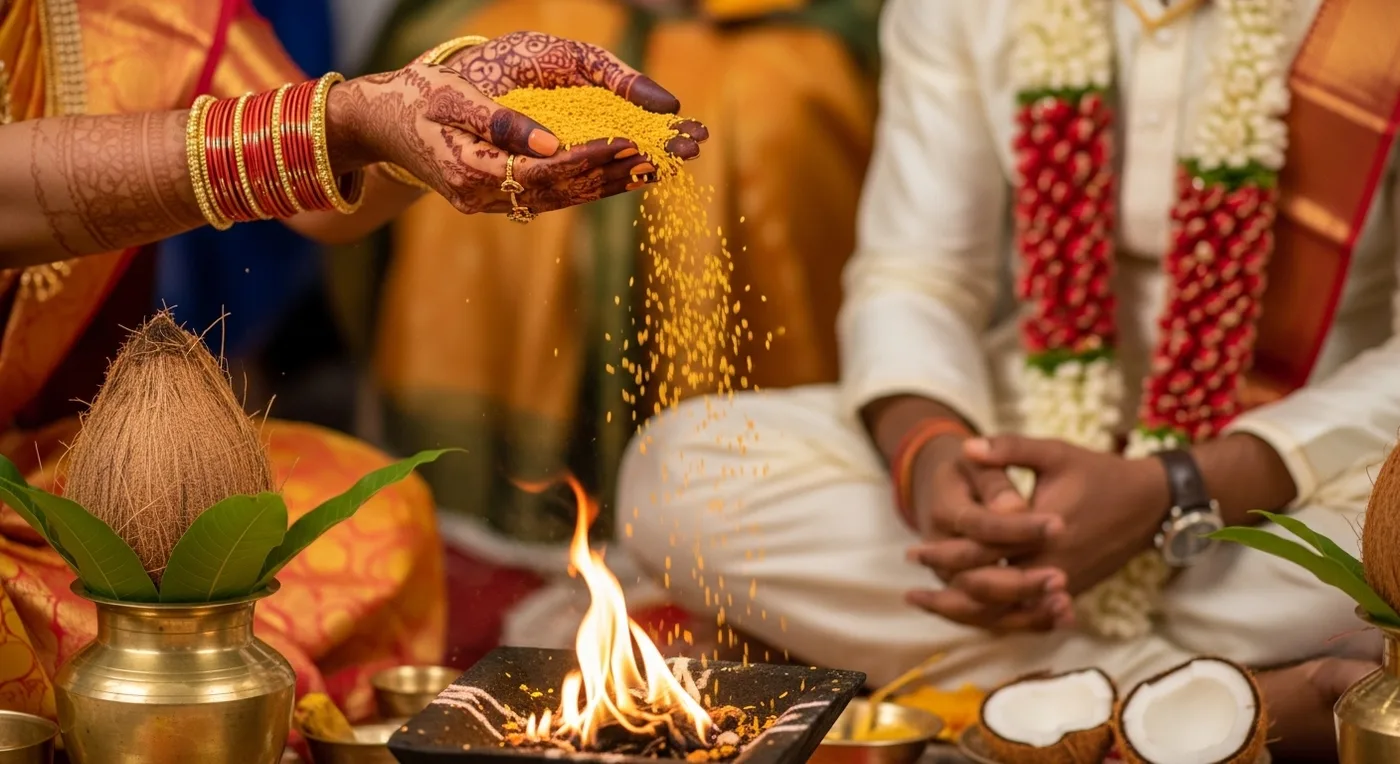
- Talambralu — The joyful shower of turmeric-tinted rice. It's competitive, playful, and the most photographed moment. Duration: 10-15 minutes.
- Aashirwaadam — Blessings from elders, followed by family photographs. Duration: 30-60 minutes.
Who attends: Everyone — 300-1,000+ guests depending on family size. The muhurtham segment draws the largest crowd.
Duration: 2-3 hours for the core rituals. Including guest arrival, photography, and the wedding feast, the full event spans 6-8 hours.
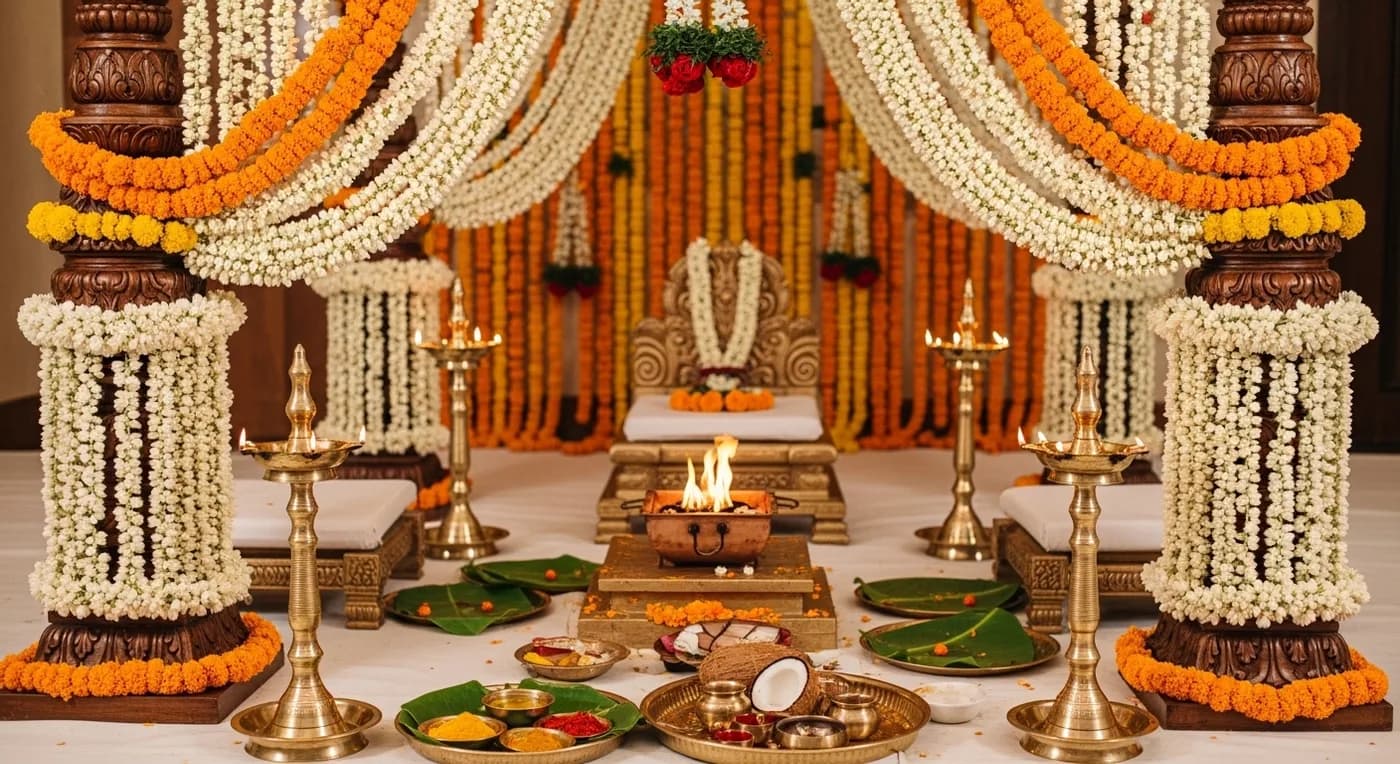
Vendor needs: Priest (purohit), decorator (mandap with jasmine, marigold, banana stems, and brass elements), photographer and videographer (critical — this is where most album shots come from), nadaswaram or shehnai musicians, caterer for the wedding feast, and a wedding planner or coordinator to manage timing.
Important
Citation capsule: A Telugu Hindu wedding ceremony runs 2-3 hours for the core rituals, with the Mangalya Dharanam performed at the precise muhurtham. According to WeddingWire India's 2025 survey, the ceremony day accounts for 40-50% of total wedding spend across South Indian weddings, making vendor coordination during this window critical.
Looking for Decorators in Hyderabad?
Tell us what you need and get quotes from verified decorators
Event 4: Reception (Telugu Hindu)
The reception is typically held the same evening or the following day. It's the social counterpart to the sacred ceremony — less ritual, more celebration. In Hyderabad, receptions range from simple dinner gatherings at the wedding venue to elaborate events at five-star hotels with live bands and cocktail bars.
Who attends: Extended family, colleagues, acquaintances, and anyone who couldn't attend the morning ceremony. Guest counts often exceed the ceremony itself — 500-1,500 people is common for Hyderabad receptions.
Duration: 3-4 hours (evening, typically 7 PM to 11 PM).
Vendor needs: Venue (if separate from the ceremony), DJ or live band, lighting designer, caterer (dinner — biryani is expected even at Telugu Hindu receptions in Hyderabad), photographer for couple portraits, and sometimes a choreographer for family dance performances.
For a curated shortlist of reception spaces across hotels, farmhouses, and convention centres, browse our guide to the best wedding venues in Hyderabad.
What Is the Complete Hyderabadi Muslim Wedding Event Order?
A Hyderabadi Muslim wedding spans 3-5 days and follows a sequence shaped by Islamic tradition and four centuries of Deccani culture. A 2024 survey by WedMeGood found that Muslim wedding celebrations in Hyderabad average 3.8 events across the full sequence, compared to 2.6 for North Indian Muslim weddings — reflecting the Deccani tradition of treating each event as a standalone celebration.
Here's the full sequence, from Mangni to Walima.
[IMAGE: Visual timeline of a Hyderabadi Muslim wedding sequence from Mangni to Walima — search terms: Hyderabadi Muslim wedding timeline events]
Event 1: Mangni (Engagement)
The Mangni is the formal engagement. The groom's family brings gifts for the bride — traditionally the Joda (a complete set of clothes, jewellery, cosmetics, fruits, and sweets). Rings are exchanged, and the families agree on the wedding date. In modern Hyderabad, the Mangni often takes place at a banquet hall with 100-200 guests and a full dinner.
Who attends: Both families and close friends — 100-200 guests.
Duration: 2-3 hours.
Vendor needs: Venue, basic decor, photographer, and caterer. Some families add a small music setup.
Event 2: Mehendi ki Raat (Henna Night)
The Mehendi ceremony is one of the most vibrant events in the sequence. Professional artists apply intricate Deccani-style henna to the bride's hands and feet — a process that takes 4-6 hours for full bridal mehendi. The evening is a women-centric celebration with music, food, and dancing.
Who attends: Female relatives and friends from both sides — 50-200 guests. Modern celebrations increasingly include men.
Duration: 4-6 hours (typically an evening event).
Vendor needs: Professional mehendi artist (book 3-4 months ahead for peak season), DJ or qawwali performers, decorator for a colourful seating area, caterer for light dinner, and photographer.
Hyderabad-specific note: Traditional Hyderabadi Mehendi nights feature live qawwali performances — a tradition rooted in Deccani Urdu culture. But don't be surprised to hear Bollywood remixes by 10 PM. The best Hyderabadi celebrations blend both effortlessly.
Event 3: Manjha (Haldi)
The Manjha — Hyderabad's version of Haldi — involves applying a paste of turmeric, sandalwood, and rosewater to the bride's and groom's skin. Married women from the family prepare and apply the paste, which is considered auspicious. This ceremony happens separately at each family's home.
Who attends: Close family only — 20-50 people.
Duration: 1-2 hours.
Vendor needs: Minimal — a photographer for candid shots is the main requirement. Some families hire a small decorator for a yellow-themed setup.
Event 4: The Nikah Ceremony
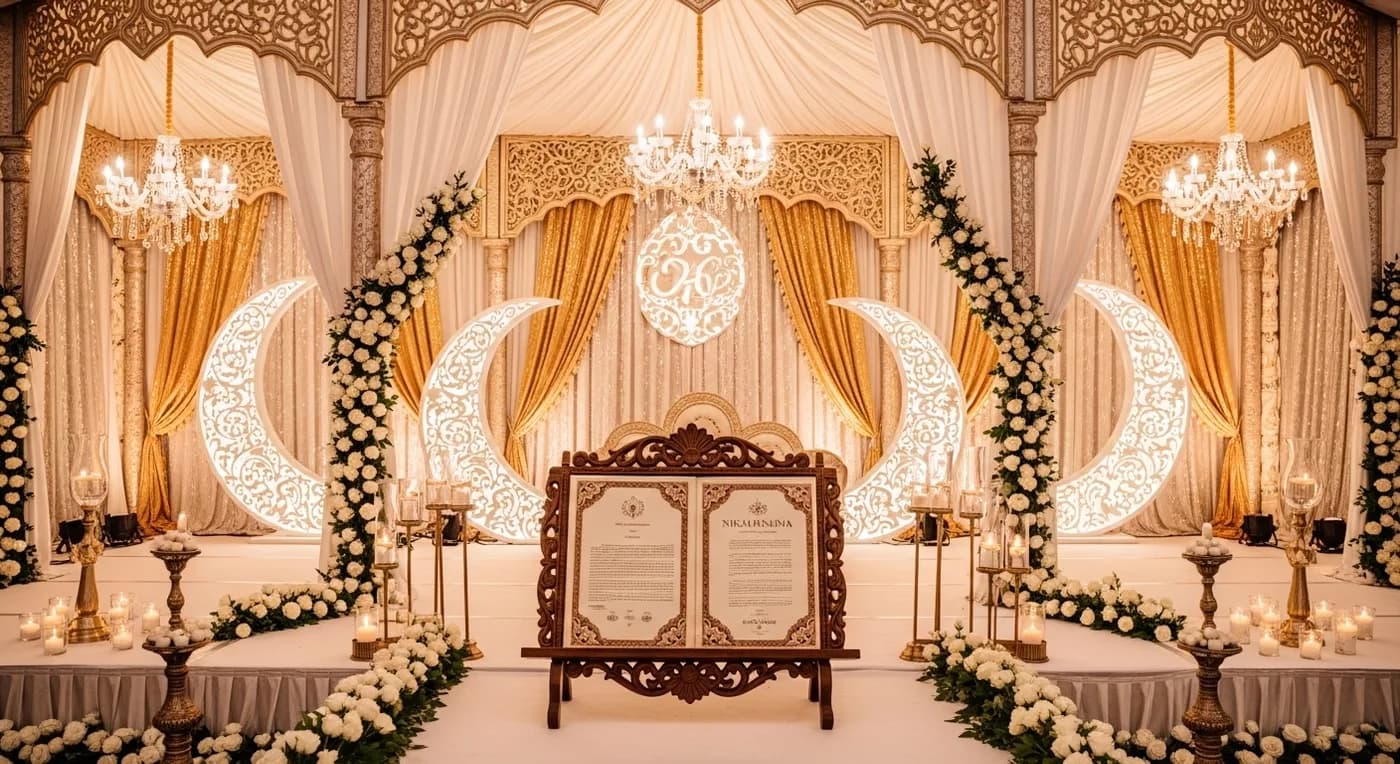
The Nikah is the Islamic marriage contract — sacred, formal, and legally binding. In Hyderabad, it's conducted by a Qazi (Islamic scholar) at a mosque, the bride's home, or a wedding venue.
The Nikah sequence:
- Khutba — The Qazi delivers a sermon on the importance of marriage in Islam. Duration: 15-20 minutes.
- Mehr agreement — The mandatory bridal gift from groom to bride is formally stated and recorded. Duration: 5-10 minutes.
- Ijab-o-Qubool — The groom says "Qubool hai" (I accept) three times. The bride's consent is also confirmed. Duration: 10-15 minutes.
- Nikahnama signing — The marriage contract is signed by bride, groom, Qazi, and witnesses. Duration: 10-15 minutes.
- Dua — The Qazi offers prayers for the couple's blessed future. Duration: 5-10 minutes.
Who attends: Both families plus male witnesses (at least two from each side). Guest counts vary — a mosque Nikah may have 50-100 people, while a venue Nikah can host 300+.
Duration: 45 minutes to 1.5 hours for the ceremony itself.
Vendor needs: Qazi, venue (if not at a mosque), decorator (a simple but elegant stage with floral arrangements), photographer and videographer, and a caterer for a post-Nikah meal.
Note
For a deeper exploration of the Nikah, Mehr, and all associated customs, see the Hyderabadi Muslim Nikah guide.
Citation capsule: Hyderabadi Muslim weddings average 3.8 distinct events across 3-5 days, according to WedMeGood's 2024 regional survey. The Nikah ceremony itself lasts 45 minutes to 1.5 hours, but the Walima reception that follows often hosts 500-1,000+ guests — making catering and venue logistics the largest budget items.
Event 5: Jilwa and Arsi Mushaf (Post-Nikah)
Two iconic Hyderabadi traditions follow the Nikah:
- Jilwa (Unveiling) — Female relatives escort the bride to the groom, holding a decorated cloth around her. The cloth is lowered to reveal the bride in full attire — a moment of genuine emotion.
- Arsi Mushaf (Mirror Ceremony) — A mirror is placed between the couple with a Quran above it. They see each other's reflection for the first time as husband and wife. This tradition is unique to Deccani Muslim culture and not widely practised outside Hyderabad.
Duration: 20-30 minutes for both rituals.
Vendor needs: Photographer (these are among the most photographed moments of the entire wedding).
Event 6: Walima (Reception Feast)
The Walima is the grand reception hosted by the groom's family, traditionally held the day after the Nikah. In Hyderabad, the Walima is the largest event — and the food is everything. A wedding without exceptional Dum Biryani isn't considered a proper Hyderabadi celebration.
Who attends: Everyone — 500-1,000+ guests, including extended family, colleagues, neighbours, and community members.
Duration: 3-5 hours (typically an evening event).
Vendor needs: Large venue (banquet hall or convention centre), caterer specialising in Hyderabadi cuisine (biryani is non-negotiable), decorator, photographer, DJ or live entertainment, and parking/valet management for large guest counts.
Typical Walima menu: Hyderabadi Dum Biryani, Haleem, Paya, Mirchi ka Salan, kebabs (Shami, Seekh, Reshmi), Double ka Meetha, and Qubani ka Meetha. Per-plate costs range from ₹800 for a biryani-focused spread to ₹2,500+ for a full multi-course feast.
₹800 – ₹2,500Looking for Caterings in Hyderabad?
Tell us what you need and get quotes from verified caterings
How Do Multi-Faith and Blended Weddings Work in Hyderabad?
Multi-faith weddings are increasingly common in Hyderabad, a city where Telugu Hindu and Hyderabadi Muslim communities have lived side by side for centuries. According to the Pew Research Center's 2021 survey on religion in India, 5% of Indian adults reported having a close relative in an inter-faith marriage, with that number higher in cosmopolitan cities like Hyderabad. The challenge isn't social acceptance — it's logistics.
[UNIQUE INSIGHT]
The Two-Ceremony Model
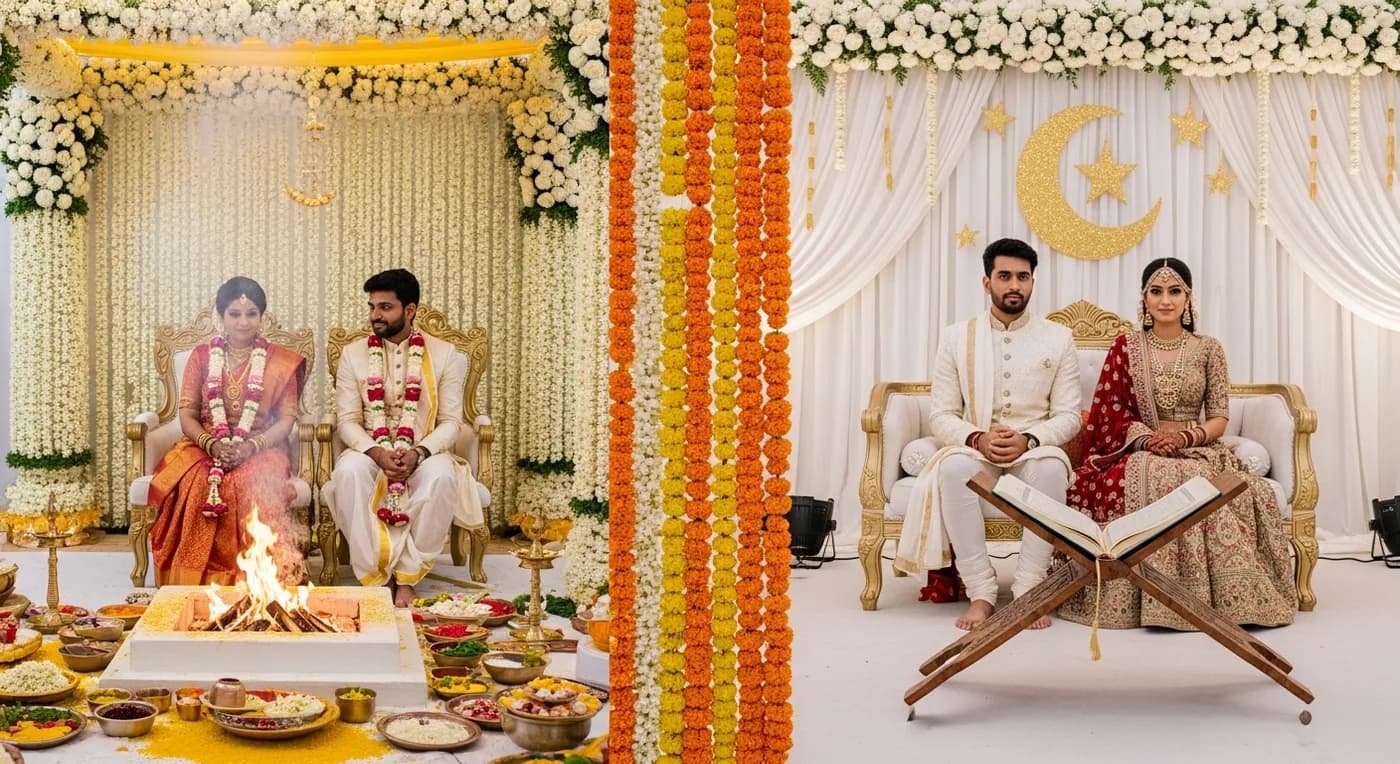
The most common approach is holding two separate ceremonies on consecutive days — each respecting its own tradition fully. A typical multi-faith Hyderabad wedding might look like this:
Day 1: Telugu Hindu ceremony (morning muhurtham, mandap rituals, wedding feast) Day 2: Nikah ceremony (afternoon, followed by a combined reception/Walima) Day 3: Joint reception for both families' extended networks
This approach works because it avoids the awkwardness of blending rituals that don't naturally combine. Guests from each community attend the ceremony they connect with — and everyone comes to the reception.
The Blended Reception
When two ceremonies aren't practical (budget, venue availability, or family preference), many couples hold a single ceremony from one tradition and then design a blended reception that honours both. Decor might combine jasmine-draped mandap elements with Deccani arch motifs. The menu could feature both a Telugu vegetarian feast and Hyderabadi biryani. Music might alternate between nadaswaram and qawwali.
Who attends: Both families' full guest lists — 400-1,000+ people.
Duration: 4-6 days for the full two-ceremony model. 2-3 days for the single-ceremony-plus-blended-reception approach.
Vendor needs: This is where experienced Hyderabad wedding planners earn their fee. You'll need vendors comfortable working across traditions — a decorator who can set up a mandap on Saturday and a Nikah stage on Sunday, a caterer who handles both vegetarian and non-vegetarian menus at scale, and a photographer who understands the significant moments in both traditions.
Tip
Citation capsule: Multi-faith weddings in Hyderabad typically follow a two-ceremony model across 4-6 days. The Pew Research Center (2021) found that inter-faith marriages are more common in India's cosmopolitan cities, and Hyderabad vendors routinely coordinate celebrations spanning Telugu Hindu and Hyderabadi Muslim traditions.
For multi-faith couples, prioritise venues with the room configuration and catering flexibility to host both setups — our Hyderabad venue guide flags which properties handle this best.
What Vendors Do You Need for Each Event?
Vendor planning for a Hyderabad wedding sequence requires thinking event-by-event, not just hiring a single team. According to WeddingWire India's 2025 vendor survey, couples in South Indian metros book an average of 9.2 distinct vendor categories for a full wedding celebration. In Hyderabad, where multi-event sequences are standard, that number often hits 12+.
Core Vendor Matrix
| Vendor Category | Engagement | Pellikuthuru / Mehendi | Main Ceremony | Reception / Walima |
|---|---|---|---|---|
| Venue | Required | Optional (often at home) | Required | Required |
| Decorator | Basic stage | Thematic (turmeric/henna) | Full mandap or Nikah stage | Lighting-focused |
| Photographer | Yes | Yes (candid) | Critical | Yes |
| Videographer | Optional | Optional | Critical | Yes |
| Caterer | Snacks/light meal | Family lunch/dinner | Full feast | Grand dinner |
| Makeup Artist | Bride only | Bride (Nalugu/Mehendi look) | Full bridal + family | Bride + bridesmaids |
| Musicians | Nadaswaram (optional) | DJ or qawwali | Nadaswaram / shehnai | DJ or live band |
| Priest / Qazi | Optional | No | Required | No |
| Wedding Planner | Optional | Optional | Highly recommended | Highly recommended |
Booking Timeline for Hyderabad
The CRISIL 2024 report on India's wedding services market notes that vendor booking windows have shortened by 15-20% post-pandemic, but peak-season Hyderabad still demands early planning:
- 12+ months ahead: Heritage and palace venues (Falaknuma, Taj Deccan)
- 8-10 months: Kalyana mandapams and popular banquet halls for auspicious muhurthams
- 6-8 months: Photographers and videographers
- 4-6 months: Decorators, caterers, makeup artists
- 3-4 months: Mehendi artists, entertainment, transport
- 1-2 months: Final confirmations, day-of coordination details
[ORIGINAL DATA]
Looking for Wedding Planners in Hyderabad?
Tell us what you need and get quotes from verified wedding planners
How Does Hyderabad's Weather Affect the Ceremony Sequence?
Hyderabad's semi-arid climate directly shapes when and where each ceremony can happen. The India Meteorological Department (IMD) records show Hyderabad receives about 800 mm of annual rainfall, concentrated heavily in June-September. This creates clear planning windows.
Peak season (October-February): Pleasant weather, 15-30 degrees Celsius. This is when 70%+ of Hyderabad weddings happen. Outdoor farmhouse ceremonies, palace courtyard events, and terrace receptions all work well. Morning muhurthams in December and January can be chilly — plan shawls for elderly guests at 5 AM ceremonies.
Shoulder season (March, September): Warming up but manageable. March temperatures reach 35-38 degrees, so afternoon outdoor events get uncomfortable. Morning ceremonies and evening receptions remain viable. Venue rates drop 15-25% compared to peak months.
Off-season (April-August): Hot and then wet. April-May temperatures hit 40+ degrees. June-September brings monsoon rains. Indoor venues — air-conditioned banquet halls, hotel ballrooms, and kalyana mandapams — are essential. But there's an upside: significantly lower venue costs and better vendor availability.
Is a monsoon wedding worth considering? For couples on a tighter budget, absolutely. The savings on venue alone can fund a better caterer or photographer. For a season-by-season comparison of outdoor versus indoor venues in Hyderabad, see our dedicated guide.
How Should You Sequence Events Across Multiple Days?
Spacing your events correctly prevents guest fatigue and gives vendors time to reset between setups. Here are two sample schedules — one for a Telugu Hindu wedding and one for a Hyderabadi Muslim celebration.
Sample Telugu Hindu Schedule (3 Days)
| Day | Event | Time | Guests | Key Vendors |
|---|---|---|---|---|
| Day 1 | Pellikuthuru / Snathakam | 9 AM - 2 PM | 50-150 | Makeup artist, photographer, caterer |
| Day 1 | Mehendi (evening) | 6 PM - 10 PM | 100-200 | Mehendi artist, DJ, caterer |
| Day 2 | Main ceremony | 5 AM - 12 PM | 300-1,000 | Priest, decorator, photographer, videographer, musicians, caterer |
| Day 2 | Reception | 7 PM - 11 PM | 500-1,500 | DJ/band, lighting, caterer, photographer |
| Day 3 | Post-wedding lunch | 12 PM - 3 PM | 50-100 (close family) | Caterer |
Sample Hyderabadi Muslim Schedule (4 Days)
| Day | Event | Time | Guests | Key Vendors |
|---|---|---|---|---|
| Day 1 | Mehendi ki Raat | 5 PM - 11 PM | 100-200 | Mehendi artist, qawwali/DJ, decorator, caterer |
| Day 2 | Manjha (Haldi) | 10 AM - 12 PM | 20-50 | Photographer |
| Day 3 | Nikah | 11 AM - 1 PM | 100-500 | Qazi, decorator, photographer, videographer, caterer |
| Day 3 | Jilwa + Arsi Mushaf | 1 PM - 2 PM | 50-100 | Photographer |
| Day 4 | Walima | 7 PM - 11 PM | 500-1,000 | Venue, caterer (biryani!), decorator, DJ, photographer |
These are frameworks, not rules. Every family adapts the sequence to fit their circumstances, budget, and guest travel logistics. To translate these event maps into rupees, see our Hyderabad wedding budget guide for a category-by-category cost breakdown.
Common Questions About Hyderabad Wedding Ceremony Sequence
Over how many days does a full Hyderabad wedding typically run?
A traditional Telugu Hindu wedding in Hyderabad spans 2-3 days covering the Nischitartham (engagement), Pellikuthuru and Snathakam on the pre-wedding day, the muhurtham-timed ceremony, and the reception. A Hyderabadi Muslim wedding runs 3-5 days with Mangni, Mehendi ki Raat, Manjha, Nikah with Jilwa and Arsi Mushaf, and the Walima feast as the grand finale. Multi-faith celebrations can extend to 4-6 days when both traditions are observed fully. Each event has distinct guest lists, timings, and vendor requirements — something that consistently catches couples planning their first Hyderabad wedding off guard.
What is the exact order of rituals inside a Telugu wedding ceremony?
The sequence begins with Vara Puja (welcoming the groom), Ganesh Puja (removing obstacles), Kanya Daanam (the bride's father giving her hand), Jeelakarra Bellam (cumin-and-jaggery paste exchange unique to Telugu weddings), Mangalya Dharanam (the sacred thali-tying at the exact muhurtham), Saptapadi (seven vows around the fire), Talambralu (the joyful turmeric-rice shower), and Aashirwaadam (elders' blessings and family photography). The whole sequence runs 2-3 hours for core rituals, with the muhurtham segment lasting just 15-20 minutes and requiring precise vendor coordination.
How do couples actually combine a Telugu Hindu ceremony with a Muslim Nikah?
Inter-faith weddings are increasingly common in Hyderabad, and the dominant model is two separate ceremonies on consecutive days. Day one features the Telugu Hindu ceremony (muhurtham, mandap rituals, wedding feast), day two holds the Nikah (Qazi, Ijab-o-Qubool, Nikahnama signing), and day three hosts a combined blended reception that honours both traditions through decor, cuisine (both sadya elements and biryani), and music (nadaswaram transitioning to qawwali). Hyderabad vendors — decorators, caterers, photographers — routinely coordinate these multi-day multi-faith celebrations, which is one of the city's distinctive strengths.
What time does a typical Telugu wedding ceremony start?
Telugu ceremonies in Hyderabad start early — usually between 5 AM and 8 AM — because the muhurtham for Mangalya Dharanam is calculated by the priest and almost always falls in the morning hours. This means bridal prep begins around 3 AM and vendors arrive by 4 AM. Guests are expected 30-60 minutes before the muhurtham itself. The core ceremony wraps by late morning, followed by the wedding feast around 12 PM and a midday break before the evening reception. December and January morning muhurthams can feel chilly at 15-18 degrees — plan shawls for elderly guests.
Which vendors do you need booked for each event in the sequence?
Every event has distinct vendor needs. The Nischitartham needs a venue, decorator with floral stage backdrop, photographer, and caterer for a light meal or dinner. Pellikuthuru needs a makeup artist for the Nalugu look, photographer, and haldi supplies. The main ceremony requires the most vendors: priest or Qazi, decorator for the mandap, photographer and videographer, nadaswaram or shehnai musicians, caterer for the feast, and a coordinator to manage muhurtham timing. The reception adds a DJ or live band, lighting designer, and sometimes a choreographer. Book key vendors 6-8 months ahead for November-February peak dates.
Bringing It All Together
The Hyderabad wedding ceremony sequence — whether Telugu Hindu, Hyderabadi Muslim, or multi-faith — is a carefully ordered progression of events, each with its own purpose, energy, and logistical demands. Getting the sequence right means your vendors know exactly when to arrive, your guests understand the flow, and you can actually be present in each moment rather than worrying about what comes next.
Start by mapping your specific event sequence using the frameworks above. Then work backward from each event to build your vendor booking timeline. And remember: Hyderabad is one of the few Indian cities where vendors routinely work across traditions, so don't hesitate to ask your decorator or caterer about multi-faith experience.
For the full planning roadmap, return to the Hyderabad wedding planning guide. For a deep exploration of each tradition's meaning and history, see the Hyderabad wedding traditions guide. And for ritual-by-ritual detail, explore the Telugu wedding rituals and Hyderabadi Muslim Nikah guides.
Tip
Start planning your wedding — generate a personalised checklist with our AI Wedding Checklist, estimate your budget with the Cost Calculator, or create a beautiful digital invitation.
Topics
hyderabad wedding ceremony sequencetelugu wedding event orderhyderabadi muslim wedding sequencemulti-faith wedding hyderabadtelangana wedding customshyderabad wedding planningExplore more
Frequently Asked Questions
1How many days does a typical Hyderabad wedding last?
2What is the correct order of events in a Telugu wedding?
3Can we combine a Telugu Hindu ceremony and a Muslim Nikah in the same wedding?
4What vendors do I need for each event in the Hyderabad wedding sequence?
5What time does a Telugu wedding ceremony usually start?
Continue reading
Related Articles
Hyderabad Wedding Traditions: Telugu, Muslim & Multi-Faith Customs Explained
Telugu Wedding Rituals Explained: From Pellikuthuru to Talambralu
Hyderabadi Muslim Wedding (Nikah): Traditions, Customs & Planning Guide
Best Season for South India Destination Weddings: Month-by-Month Western Ghats Guide
Destination Wedding Cost in South India 2026: 5-Tier Budget Guide
Destination Wedding in South India: Complete 2026 Planning Guide
Still planning?
Get quotes from India's best vendors
Tell us what you're planning and we'll match you with verified photographers, venues, decorators, and more.
Get free quotes