
Eco-Friendly Kerala Weddings: The Complete Sustainability Guide for 2026
Eco-friendly Kerala weddings cost 5-10% less than conventional ones. Green Protocol venues, zero-waste sadya, sustainable decor, and 2026 pricing guide.

Senior Wedding Planner
Priya Nair is a senior wedding planner based in Kochi with over eight years of experience coordinating Hindu, Christian, and destination weddings across Kerala.
On this page
An eco-friendly Kerala wedding can cost 5–10% less than a conventional one, not more. The traditional sadya on banana leaf is inherently zero-waste — biodegradable serving, no cutlery, seasonal local ingredients. Green Protocol-certified venues across all 14 districts now provide composting infrastructure, waste segregation, and modest 5–8% event discounts.
Quick Answer
With India's wedding industry valued at ₹10.79 lakh crore and CAIT estimating 4.6 million weddings in the Nov-Dec 2025 season, the environmental impact of the sector is enormous. Kerala has always understood something the rest of the world is only beginning to grasp: that celebration and environmental stewardship are not opposing forces. This is the land where the sacred grove (kavu) tradition has protected biodiversity for centuries, where the banana leaf sadya turns a wedding feast into a zero-waste masterclass, and where the first state-level Green Protocol was born — not as a marketing exercise, but as a genuine policy commitment. Kerala's cultural DNA is, at its core, ecological. The contemporary eco-wedding movement here is not an imported trend; it is a homecoming.
And 2026 marks a genuine tipping point. Green Protocol certification, once limited to government events in Thrissur and Ernakulam, has expanded to private wedding venues across all fourteen districts. Caterers now routinely offer zero-waste packages. Handloom cooperatives in Balaramapuram and Chendamangalam are reporting record orders from brides who want sustainability without sacrificing tradition. This guide is a comprehensive, practical resource covering every dimension of planning an eco-friendly Kerala wedding — from venue selection and catering to decor, fashion, invitations, gifting, transport, and waste management — with real 2026 pricing, cost comparisons, and actionable checklists. Whether you are planning a 200-person intimate ceremony or a 1,000-guest celebration, every section offers choices that reduce your environmental footprint while honouring the rituals that make a Kerala wedding unforgettable.
Kerala's Green Protocol: What It Means for Weddings
Kerala's Green Protocol, spearheaded by the Suchitwa Mission under the Local Self-Government Department, is the country's most ambitious state-level initiative to eliminate single-use plastic and promote zero-waste practices at public and private events. Originally launched for government functions, the protocol has evolved into a formal certification framework that wedding venues, caterers, and event planners can adopt.
For a wedding to qualify as Green Protocol compliant, it must meet five core requirements. First, zero single-use plastic — no flex banners, plastic plates, plastic-wrapped food, or polythene bags anywhere on the premises. Second, all serving ware must be biodegradable: banana leaves, areca nut plates, and steel or glass reusable alternatives. Third, food waste must be composted on-site or collected by a certified organic waste processor. Fourth, the venue must provide segregated waste bins (organic, recyclable, and residual) with clear signage. Fifth, paper usage must be minimized through digital communication and minimal printed materials.
Note
Green Protocol Basics: Launched by the Kerala government, Green Protocol certification requires: zero single-use plastic, biodegradable serving ware, food waste composting, waste segregation, and reduced paper use. Many temple and community halls in Thrissur, Ernakulam, and Kozhikode now carry this certification.
The certification process is straightforward. Venues apply through their local panchayat or municipal body, undergo an inspection of waste management infrastructure, and receive a Green Protocol compliance certificate that is valid for two years. As of early 2026, certified venues include the Guruvayoor Devaswom convention facilities in Thrissur, multiple KTDC properties across the state, the Bolgatty Palace complex in Ernakulam, Kozhikode's Tagore Centenary Hall, and several modern convention centres in Trivandrum and Palakkad. The list is expanding rapidly — the Suchitwa Mission website maintains an updated registry, and your municipal office can confirm local options.
For couples, choosing a Green Protocol venue is the single most impactful decision you can make. These venues already have the composting infrastructure, waste segregation systems, and vendor partnerships in place. You are not building sustainability from scratch — you are plugging into an existing ecosystem. Many certified venues also offer a modest discount (5-8%) for events that maintain full compliance, as it reduces their cleanup and waste disposal costs.
Zero-Waste Catering: The Sadya Advantage and Beyond
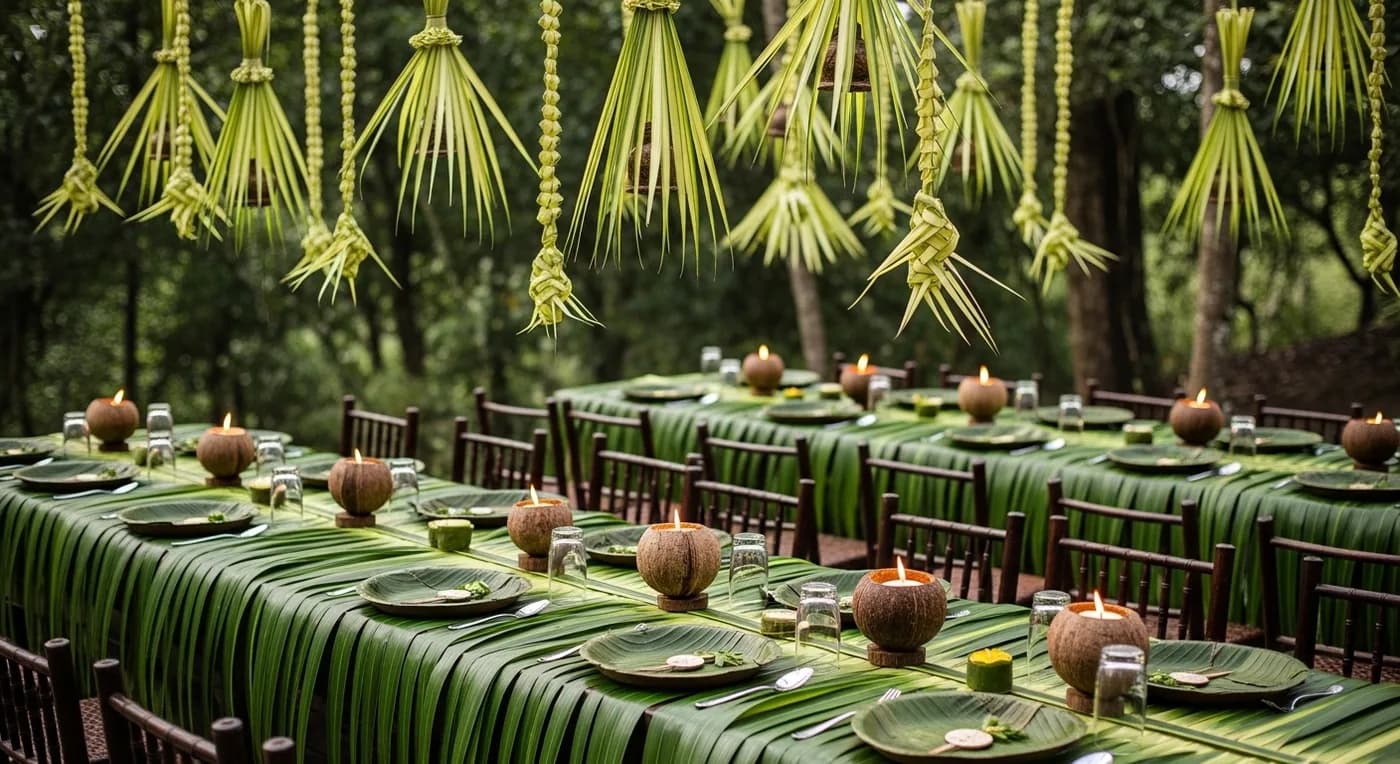
The traditional Kerala sadya is, without exaggeration, one of the most inherently sustainable wedding meals served anywhere on the planet. It arrives on a banana leaf — fully biodegradable, locally sourced, and compostable within weeks. It is eaten by hand, eliminating cutlery waste entirely. The dishes are prepared from seasonal, locally grown ingredients: rice from Palakkad, coconut from every backyard, vegetables from the nearest market, and spices from Idukki's plantations. The entire supply chain is regional, the carbon footprint minimal, and the cultural significance immense.
Tip
The Banana Leaf Advantage: A traditional Kerala sadya on banana leaf is the ultimate eco-friendly wedding meal — completely biodegradable serving, no cutlery needed, seasonal local ingredients, and it costs 30-40% less than a multi-cuisine buffet with disposable plates and cutlery.
For couples who want to offer a multi-cuisine spread alongside the sadya — a common choice for receptions that include non-vegetarian and continental options — the key substitution is areca nut plates and bowls replacing plastic or thermocol. Areca plates are manufactured across Palakkad and Thrissur districts, cost only marginally more than cheap plastic alternatives, and decompose completely within 60 days. Steel tumblers and glasses, rented from the caterer or a local supplier, replace single-use cups.
Note
Per-Plate Cost Comparison
| Item | Conventional Approach | Eco-Friendly Alternative | Cost Difference |
|---|---|---|---|
| Serving plate | Plastic/thermocol plate (Rs 3-5) | Banana leaf (Rs 2-4) or areca plate (Rs 6-8) | -Rs 1 to +Rs 3 |
| Drinking glass | Disposable plastic cup (Rs 2-3) | Steel tumbler rental (Rs 1-2/event) | Saves Rs 1-2 |
| Cutlery | Plastic fork/spoon pack (Rs 3-5) | Hand-eating (sadya) or areca spoon (Rs 4-6) | -Rs 3 to +Rs 1 |
| Food packaging | Plastic wrap and containers | Banana leaf wraps, cloth covers | Saves Rs 2-4 |
| Waste disposal | Mixed waste to landfill (Rs 15-20/kg) | Composting on-site (Rs 5-8/kg) | Saves Rs 10-12/kg |
| Vegetarian sadya per plate | Rs 600-900 | Rs 500-750 | Saves Rs 100-150 |
| Multi-cuisine buffet per plate | Rs 900-1,500 | Rs 1,000-1,500 | +Rs 0-100 |
The critical strategy for zero-waste catering is portion intelligence. Work with your caterer to plan quantities based on confirmed RSVPs, not the traditional "add 20% buffer." Implement a buffet-to-order system where dishes are replenished in smaller batches rather than laid out in excess from the start. For a 400-guest wedding, this approach alone can reduce food waste by 30-40%, based on industry patterns from sustainable catering practitioners.
For surplus food, establish a donation pipeline before the event. Organisations like the Robin Hood Army have active chapters across Ernakulam and Kozhikode. Feeding India operates in most Kerala cities. Your caterer can pack surplus food in compostable containers within 30 minutes of the event ending, and a volunteer team can distribute it to shelters or community kitchens the same evening.
Looking for Caterings in Kochi?
Tell us what you need and get quotes from verified caterings
Sustainable Decor: Beauty Without the Burden
Wedding decor is where the gap between conventional and sustainable approaches is most visually dramatic — and where the cost savings are often largest. The conventional Kerala wedding decor industry has, in recent decades, drifted toward imported flowers, thermocol structures, synthetic fabrics, and single-use installations that generate enormous waste. The sustainable alternative is not a compromise — it is a return to the aesthetic richness that made Kerala weddings legendary.
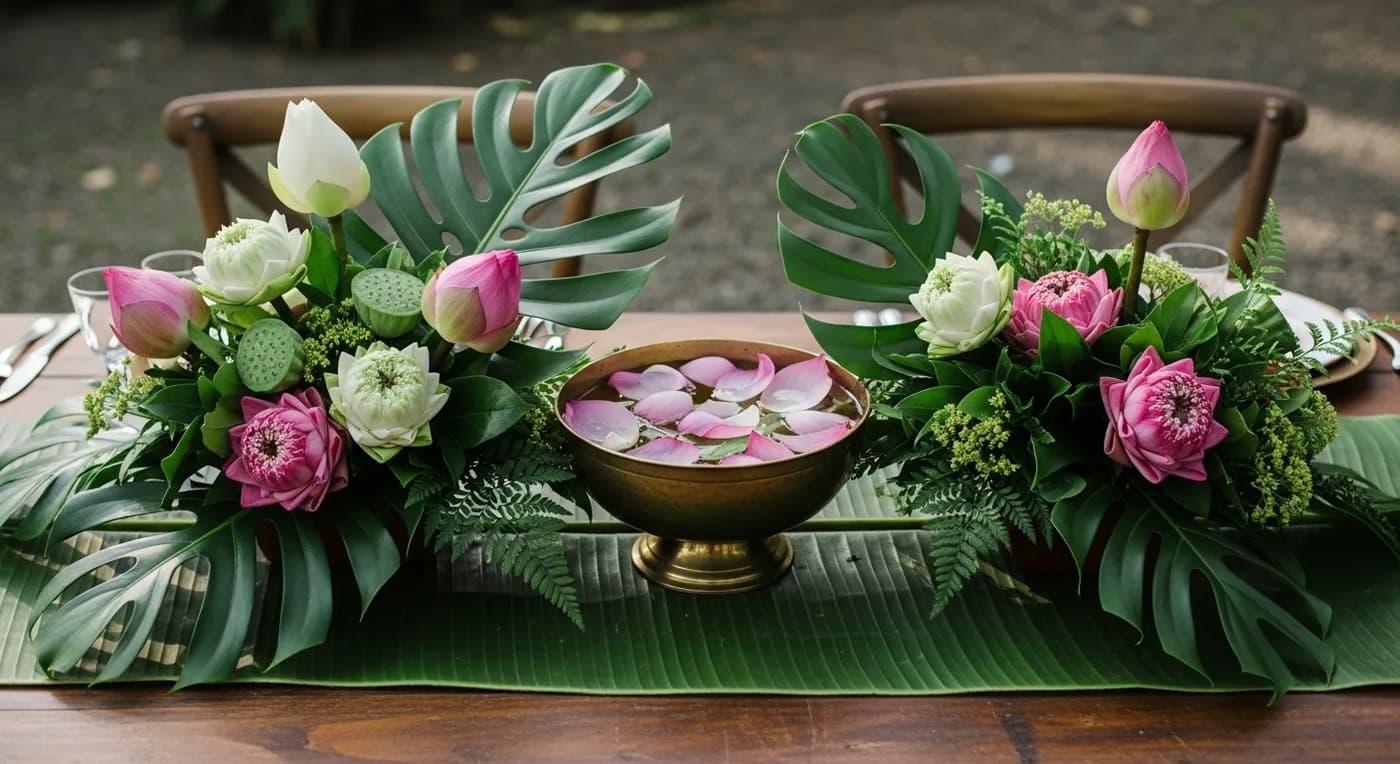
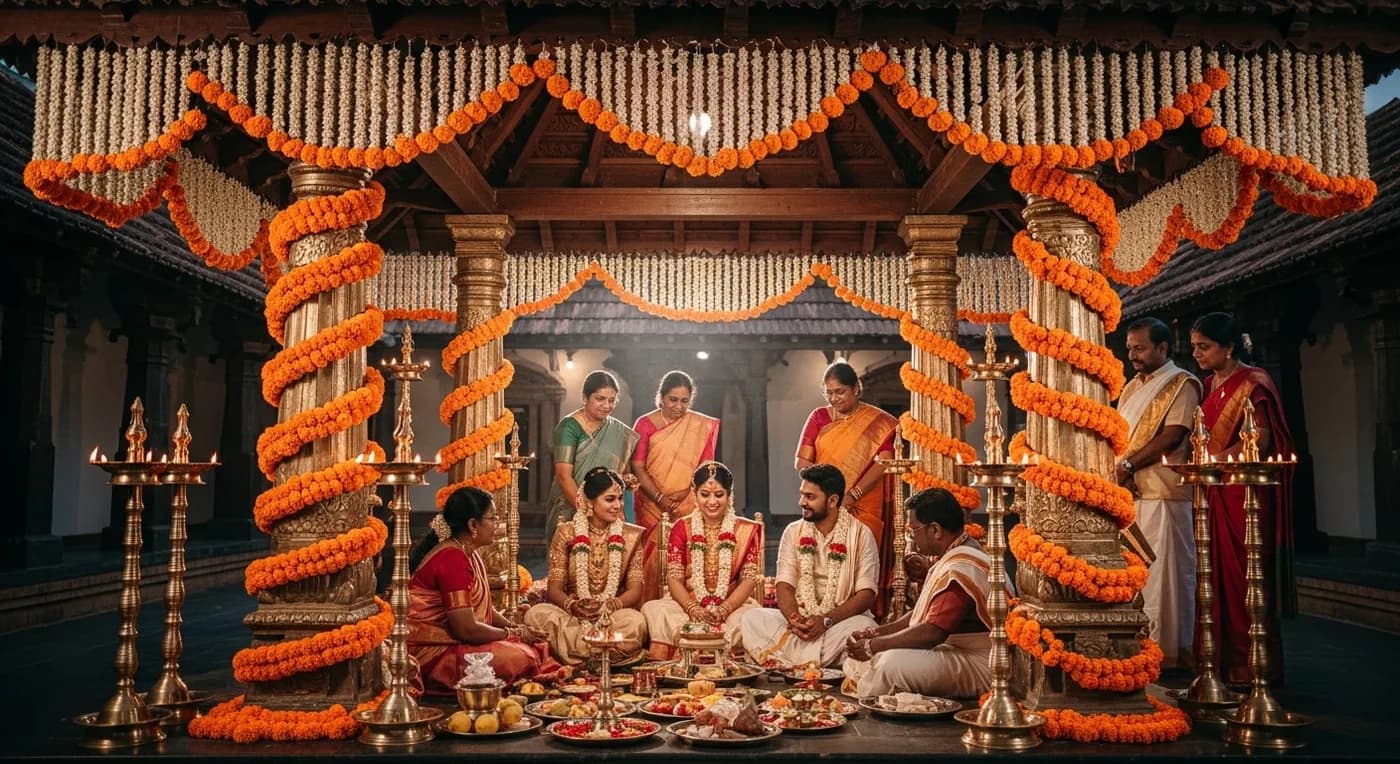
Local flowers vs imported: A conventional wedding decorator might fly in Dutch roses, Thai orchids, and African chrysanthemums. The sustainable choice uses Kerala's extraordinary native floral palette: jasmine (mulla), marigold, lotus, local chrysanthemum, hibiscus, and the iconic golden shower (kanikkonna). These flowers cost 40-60% less, last longer in Kerala's climate (imported flowers wilt fast in humidity), and carry cultural resonance that imported varieties simply cannot match. A mandap draped in jasmine strings and golden shower garlands is not just sustainable — it is quintessentially Kerala.
Potted plants as centrepieces: Instead of cut flower arrangements that go to waste, use small potted plants — money plants, succulents, miniature palms, or flowering herbs — as table centrepieces. Guests take them home as living favours. The cost per centrepiece drops from Rs 500-1,500 (cut flowers) to Rs 100-300 (potted plant), and the waste generated is zero.
Fabric over plastic: Replace synthetic draping and thermocol pillars with reusable fabric. Silk, cotton, or khadi draping in gold and cream tones creates a warmer, more elegant aesthetic than shiny synthetics. These fabrics are rented, not purchased, and return to the decorator's inventory after the event.
Bamboo and cane structures: For mandaps, arches, and entrance installations, bamboo and cane offer structural beauty that steel frames wrapped in thermocol cannot match. Bamboo mandaps have become a signature offering from decorators in Thrissur and Kottayam, and they can be disassembled and reused across multiple events.
LED lighting: Replace conventional incandescent and halogen lighting with LED arrays. The upfront rental cost is comparable, but energy consumption drops by 70-80%, and the reduced heat output means flowers and food stay fresh longer.
Decor Cost Comparison (400-Guest Wedding)
| Decor Element | Conventional Cost | Sustainable Cost | Savings |
|---|---|---|---|
| Flower arrangements (mandap, stage, entrance) | Rs 80,000 - 1,50,000 | Rs 40,000 - 80,000 (local flowers) | Rs 40,000 - 70,000 |
| Table centrepieces (30 tables) | Rs 15,000 - 45,000 (cut flowers) | Rs 3,000 - 9,000 (potted plants) | Rs 12,000 - 36,000 |
| Draping and fabric | Rs 30,000 - 60,000 (synthetic) | Rs 25,000 - 50,000 (cotton/silk rental) | Rs 5,000 - 10,000 |
| Structural elements (mandap, arches) | Rs 40,000 - 80,000 (thermocol/metal) | Rs 30,000 - 60,000 (bamboo/cane) | Rs 10,000 - 20,000 |
| Lighting | Rs 25,000 - 50,000 (mixed) | Rs 20,000 - 45,000 (full LED) | Rs 5,000 - 5,000 |
| Entrance and signage | Rs 10,000 - 25,000 (flex, plastic) | Rs 8,000 - 20,000 (cloth, chalkboard) | Rs 2,000 - 5,000 |
| Total Decor | Rs 2,00,000 - 4,10,000 | Rs 1,26,000 - 2,64,000 | Rs 74,000 - 1,46,000 |
The numbers speak clearly: sustainable decor is not a premium add-on. It is consistently and significantly cheaper than conventional alternatives, while producing a fraction of the waste. The key is working with a decorator who understands local materials and has an inventory of reusable elements.
Looking for Decorators in Thrissur?
Tell us what you need and get quotes from verified decorators
Eco-Friendly Invitations: Digital-First, Paper-Smart
The average Kerala wedding sends 400-800 printed invitation cards, each enclosed in a decorative envelope, often wrapped in additional plastic. The total paper waste is significant, and most cards end up in the bin within a week. The sustainable approach is not to eliminate paper entirely — that would be culturally tone-deaf for a generation of elders who treasure a physical card — but to adopt a digital-first strategy with mindful paper for those who appreciate it.
Digital invitations are the foundation. A well-designed digital card sent via WhatsApp or email reaches guests instantly, allows RSVP tracking, includes venue maps and event schedules, and costs a fraction of printed cards. Platforms offer Kerala-specific templates with traditional motifs — Ashtamangalyam symbols, Nilavilakku imagery, kasavu borders — that feel authentic rather than generic. Budget: Rs 2,000-8,000 for a professionally designed digital suite.
Plantable seed paper cards are the premium eco option for guests who merit a physical invitation — close family, community elders, VIPs. These cards are embedded with seeds (marigold, basil, or wildflower varieties suited to Kerala's climate) and can be planted after the wedding. They cost Rs 40-80 per card, compared to Rs 20-50 for conventional printed cards, but the emotional impact and conversation value far exceed the price difference.
Recycled paper cards printed with soy-based inks offer a middle ground: visually indistinguishable from conventional cards, fully recyclable, and available from multiple printers in Ernakulam and Kozhikode. Budget: Rs 25-60 per card.
A practical split for a 400-guest wedding: 350 digital invitations + 50 seed paper cards for elders and VIPs. Total cost: Rs 5,000-12,000, compared to Rs 15,000-30,000 for fully printed invitations with envelopes.
₹5,000 – ₹30,000Sustainable Fashion: Handloom Heritage Meets Modern Elegance
Kerala is uniquely positioned for sustainable wedding fashion because some of the finest handloom traditions in India are woven right here — literally. The kasavu saree, with its natural cotton or silk base and golden border, is not just a traditional choice; it is a deeply sustainable one. Zero synthetic content, minimal chemical processing, and a supply chain that directly supports artisan families and cooperative economies.
Balaramapuram (Trivandrum district): The epicentre of Kerala's handloom heritage. Balaramapuram weavers produce the classic kasavu mundu and saree using techniques that have remained largely unchanged for centuries. A wedding saree from Balaramapuram ranges from Rs 3,000 for a simple cotton kasavu to Rs 30,000+ for a heavy silk tissue with elaborate zari work. Every purchase here supports a weaving family directly — no middlemen, no factory pollution, no synthetic blends.
Chendamangalam (Ernakulam district): This heritage weaving village, devastated by the 2018 floods and rebuilt through remarkable community resilience, produces distinctive cotton fabrics with subtle colour work. Chendamangalam sarees and mundus are lighter, perfect for Kerala's climate, and carry a GI (Geographical Indication) tag that certifies authenticity. Wedding-appropriate pieces range from Rs 2,500 to Rs 15,000.
Kuthampully (Thrissur district): Known for the veshti and settu mundu with the characteristic kasavu border, Kuthampully weavers specialise in wedding-specific attire. Their silk-cotton blends offer a luxurious drape while keeping the fabric breathable. Prices range from Rs 4,000 to Rs 25,000 for bridal pieces.
Tip
Handloom Heritage: Kerala's Chendamangalam (Ernakulam) and Balaramapuram (Trivandrum) handlooms produce stunning wedding sarees with zero synthetic content. A handloom Kasavu saree costs 3,000-15,000 and directly supports artisan families — fashion that's both sustainable and culturally significant.
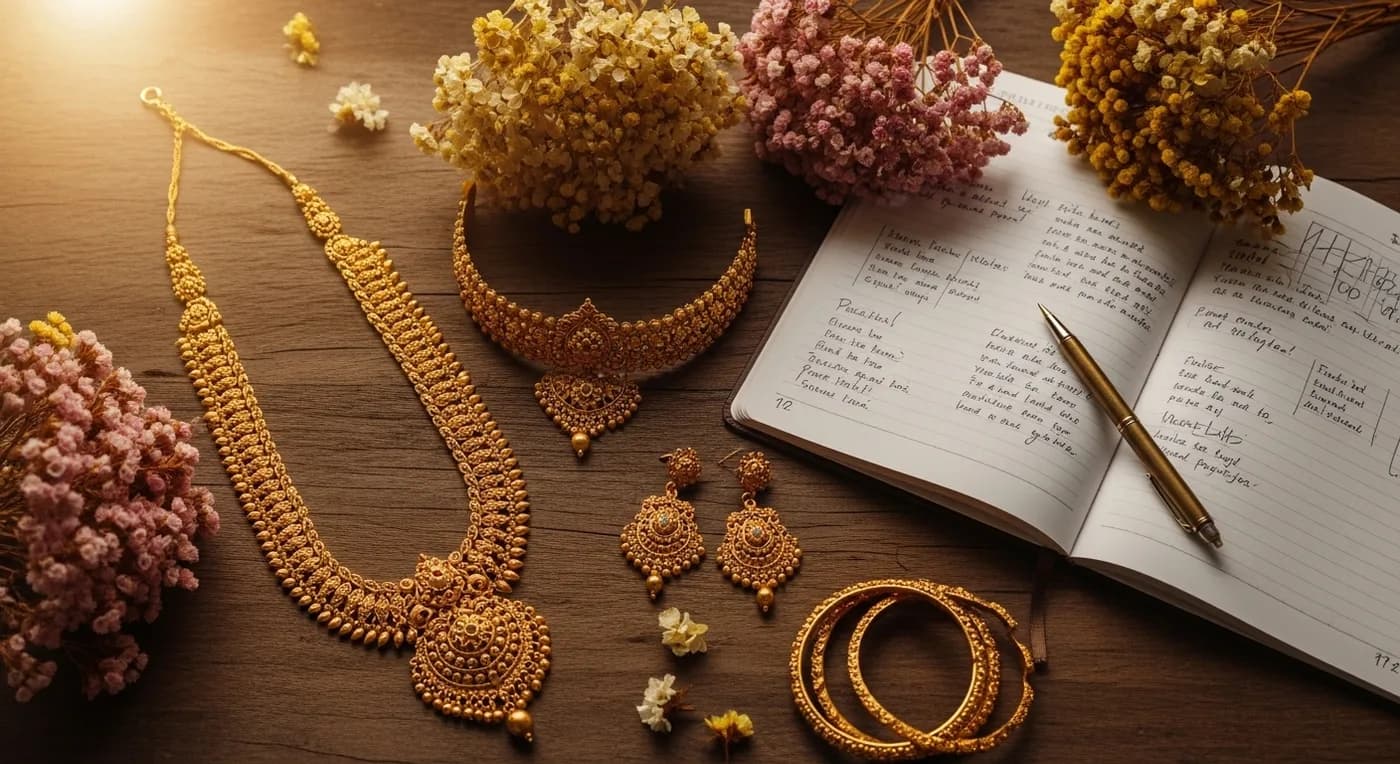
Heirloom jewellery is perhaps the most naturally sustainable choice in any Kerala wedding. The tradition of passing gold ornaments across generations means that most Kerala brides already wear jewellery with zero new mining impact. If new pieces are needed, work with a trusted local jeweller who sources certified recycled gold — increasingly available in Thrissur's jewellery hub.
For grooms, the most sustainable option is renting formal attire for the reception while using family-owned mundus for the ceremony. Several rental services in Ernakulam and Kozhikode offer premium suits and sherwanis for Rs 3,000-10,000, avoiding the environmental cost of manufacturing a garment worn once.
Natural dyes are gaining ground for bridesmaids' attire and coordinated family outfits. Indigo, turmeric, pomegranate, and jackfruit wood produce rich, stable colours on cotton and silk. Small-batch dyers in Palakkad and Kottayam accept custom orders for wedding parties.
₹15,000 – ₹1,00,000Carbon-Neutral Transportation
Guest transportation is an often-overlooked source of wedding carbon emissions. A 400-guest wedding where most guests drive individually can generate 2-4 tonnes of CO2 from travel alone, typically. Strategic planning can cut this by 60-70%, according to industry patterns in sustainable event management.
Venue selection near transport hubs is the most impactful decision. Choosing a venue near a major railway station or bus terminus (such as those in Ernakulam, Thrissur, Kozhikode, or Trivandrum city centres) means guests can use public transport for the bulk of their journey. Many KTDC and convention centre venues are deliberately situated for transport accessibility.
Carpooling coordination is simple with a shared spreadsheet or WhatsApp group. Designate a family member or friend as the "transport coordinator" who maps guest locations and organises shared rides. For a 400-guest wedding, effective carpooling can reduce the number of vehicles from 150+ to 60-80.
Electric vehicle hire for the bridal party and VIP guests is now practical in Kerala's major cities. EV rental services operate in Ernakulam, Trivandrum, and Kozhikode, offering sedans and small buses. A decorated EV for the bridal procession makes a statement about values while costing roughly the same as a conventional luxury car rental (Rs 5,000-15,000 for the day).
Digital concierge for logistics: Create a simple wedding website or WhatsApp broadcast that includes venue maps, parking details, carpooling sign-up, and public transport routes. This eliminates the need for printed direction cards and helps guests make lower-carbon travel choices.
Sustainable Gifting and Favours
The conventional wedding favour — a plastic-wrapped sweet box or a generic decorative item in synthetic packaging — generates enormous waste and rarely brings lasting joy. Sustainable alternatives are more personal, more useful, and often more affordable.
Spice jars from Idukki: Small glass jars of premium cardamom, pepper, or cinnamon sourced directly from Idukki's spice estates. Cost: Rs 80-200 per jar. These are genuinely useful, distinctly Kerala, and support hill farming communities.
Seed packets: Packets of flower or herb seeds with a personalised label — "Plant this, and grow something beautiful like our love." Cost: Rs 20-50 per packet. Lightweight, zero-waste packaging in kraft paper.
Small potted plants: Succulents, money plants, or miniature flowering plants in terracotta pots. Cost: Rs 100-250 per piece. Guests leave with a living memory of the celebration.
Aranmula Kannadi: For VIP guests or close family, the legendary Aranmula metal mirror from Pathanamthitta district is a GI-tagged, handcrafted masterpiece with deep cultural significance. Small sizes start at Rs 300-500, making them feasible as premium favours for a select list.
Handloom pouches: Small cotton or jute pouches woven by local cooperatives, filled with a mix of sweets or dry fruits. The pouch itself becomes reusable — a purse, a storage bag, a keepsake. Cost: Rs 75-150 per pouch with contents.
₹50 – ₹500Full Budget Comparison: Conventional vs Eco-Friendly (400-Guest Wedding)
This is the section that answers the question every couple asks: "Will going green cost us more?" The honest answer, supported by 2026 pricing across Kerala's major wedding markets, is that a well-planned eco-friendly wedding costs 5-10% less than a conventional one.
| Category | Conventional Cost (Rs) | Eco-Friendly Cost (Rs) | Difference |
|---|---|---|---|
| Venue (Green Protocol certified) | 1,50,000 - 4,00,000 | 1,40,000 - 3,80,000 | Saves 5-8% |
| Catering (400 guests, sadya + dinner) | 4,00,000 - 6,00,000 | 3,50,000 - 5,50,000 | Saves Rs 50,000 - 1,00,000 |
| Decor (full venue) | 2,00,000 - 4,10,000 | 1,26,000 - 2,64,000 | Saves Rs 74,000 - 1,46,000 |
| Invitations (400 guests) | 15,000 - 30,000 | 5,000 - 12,000 | Saves Rs 10,000 - 18,000 |
| Bridal attire and jewellery | 50,000 - 2,00,000 | 40,000 - 1,50,000 | Saves Rs 10,000 - 50,000 |
| Groom attire | 20,000 - 60,000 | 15,000 - 40,000 | Saves Rs 5,000 - 20,000 |
| Favours (400 pieces) | 30,000 - 80,000 | 20,000 - 60,000 | Saves Rs 10,000 - 20,000 |
| Transportation | 30,000 - 80,000 | 25,000 - 70,000 | Saves Rs 5,000 - 10,000 |
| Waste management | 10,000 - 20,000 | 8,000 - 15,000 | Saves Rs 2,000 - 5,000 |
| Photography and videography | 80,000 - 2,50,000 | 80,000 - 2,50,000 | No difference |
| Total | Rs 9,85,000 - 21,30,000 | Rs 8,09,000 - 17,91,000 | Saves Rs 1,76,000 - 3,39,000 |
Important
The Hidden Savings: While some individual eco choices cost more (organic catering, handloom fabrics), the overall budget typically comes in 5-10% lower because the biggest savings — banana leaf sadya, local flowers, digital invitations, rental decor — more than offset the premiums.
The data is clear: sustainability is not a luxury surcharge. In a state that IBEF describes as a leader in social development and environmental awareness, the conventional wedding spends more because it relies on imported materials, disposable goods, and inefficient waste practices. The eco-friendly wedding leverages local supply chains, reusable materials, and smarter planning — and the savings compound across every category.
Waste Management Plan
Even the most carefully planned wedding generates some waste. The difference between a conventional and eco-friendly wedding is not zero waste versus some waste — it is managed waste versus unmanaged waste. Here is how to set up a comprehensive waste management system for your event.
Waste segregation stations: Place clearly labelled three-bin stations at every exit and food service area. Green bins for organic waste (food scraps, banana leaves, flower petals). Blue bins for recyclables (glass bottles, paper, steel). Red bins for residual waste (anything that does not fit the other two categories). Your decorator can design bins that match the event aesthetic — painted bamboo containers or fabric-covered bins work well.
On-site composting: If your venue has a composting facility (all Green Protocol certified venues do), organic waste goes directly there. For venues without composting, arrange a pickup with a local organic waste processor. In Ernakulam and Thrissur, several private firms offer event-day composting services for Rs 3,000-8,000, collecting organic waste within hours of the event ending.
Food donation logistics: Contact your chosen food donation partner (Robin Hood Army, Feeding India, or a local church/temple feeding programme) at least two weeks before the event. Provide them with the event date, expected surplus volume, and pickup time. Your caterer should pack surplus food in compostable containers within 30 minutes of the last service. The donation team collects and distributes the same evening.
Flower waste management: Post-event flowers can be composted, donated to temple communities for secondary use, or processed into organic compost by specialised firms. Some vendors in Kottayam and Ernakulam now offer "flower cycling" — collecting wedding flowers and converting them into incense sticks and organic holi colours.
Post-event audit: Assign one responsible family member or wedding planner to photograph the waste segregation results and document the weight of each waste category. This data helps you understand your actual environmental impact and can be shared on social media to inspire others — genuine sustainability is worth celebrating publicly.
Planning Your Eco-Wedding: A 12-Month Checklist
- 12 months before: Choose a Green Protocol certified venue or confirm your venue's willingness to support eco-compliance. Set your sustainability goals and budget.
- 10 months before: Book a caterer with zero-waste experience. Discuss banana leaf sadya, areca plate alternatives, and food donation partnerships.
- 9 months before: Commission handloom bridal and groom attire from Balaramapuram, Chendamangalam, or Kuthampully weavers. Custom orders need 2-3 months for weaving.
- 8 months before: Engage a decorator experienced in sustainable materials. Discuss local flowers, potted plant centrepieces, bamboo structures, and fabric draping.
- 7 months before: Design and distribute digital invitations. Order plantable seed paper cards for the elder/VIP list.
- 6 months before: Finalise wedding favours — place orders with spice estates in Idukki, handloom cooperatives, or local nurseries.
- 4 months before: Set up carpooling coordination. Identify EV rental options for the bridal party. Create a digital concierge page with transport details.
- 3 months before: Confirm waste management arrangements — composting, segregation bins, food donation partner, flower recycling.
- 2 months before: Review all vendor contracts to ensure eco-compliance clauses are included. Confirm LED lighting, reusable serving ware, and plastic-free packaging.
- 1 month before: Conduct a final walkthrough with all vendors at the venue. Test waste segregation stations. Brief the food donation team on logistics.
- 1 week before: Confirm final guest count with caterer for precise portion planning. Prepare digital day-of schedule for all guests and vendors.
- Wedding day: Assign an eco-coordinator (a trusted friend or hired professional) to monitor waste segregation, coordinate food donation pickup, and ensure all vendors maintain compliance throughout the event.
Common Questions About Eco-Friendly Kerala Weddings
Does an eco-friendly wedding cost more than a traditional one?
Not necessarily. Many sustainable choices actually save money — banana leaf plates versus disposable plastic, local flowers versus imported ones, digital invitations versus printed cards. The main areas where eco costs more are organic catering (10-15% premium) and sustainable decor materials. Overall, a Green Protocol wedding can cost 5-10% less than a conventional one. The comprehensive budget comparison in this guide shows potential savings of Rs 1,76,000 to Rs 3,39,000 on a 400-guest wedding — that is not a marginal difference, it is a substantial sum that can be redirected toward your honeymoon, home, or savings.
What is Kerala's Green Protocol for weddings?
Kerala's Green Protocol is a government-backed initiative encouraging zero-waste events. For weddings, it means: no single-use plastic, biodegradable plates and cutlery (banana leaf and areca), food waste composting, segregated waste bins, and minimal paper. Venues with Green Protocol certification provide infrastructure for compliant events. The certification is administered through local panchayats and municipal bodies under the Suchitwa Mission. As of 2026, certified venues are available in all fourteen districts, with the highest concentration in Thrissur, Ernakulam, Kozhikode, and Trivandrum.
How do I manage food waste at a Kerala wedding?
Work with your caterer to plan precise portions based on confirmed guest count — not the traditional "add 20% buffer" approach. Use a buffet-to-order system where dishes are replenished in smaller batches rather than laid out in excess. Partner with organisations like Feeding India or Robin Hood Army for surplus food donation. Compost all organic waste on-site if the venue supports it. For a 400-guest wedding, these strategies can reduce food waste from the typical 15-20% to under 5%.
What are the best eco-friendly decor options for Kerala weddings?
Use local seasonal flowers (jasmine, marigold, lotus, chrysanthemum) instead of imported roses. Choose potted plants as centrepieces that guests take home. Use fabric draping instead of single-use plastic or thermocol. Opt for LED lighting over traditional bulbs. Rent decor elements instead of buying disposable pieces. Bamboo and cane mandap structures are increasingly popular across Thrissur and Kottayam and can be reused across multiple events. The cost savings from these choices can reach Rs 74,000 to Rs 1,46,000 compared to conventional decor.
Can I have a traditional Kerala sadya and still be eco-friendly?
Absolutely — sadya is inherently one of the most eco-friendly wedding meals possible. It is served on biodegradable banana leaves, eaten by hand (no cutlery waste), and uses seasonal local ingredients from Kerala's own farms and markets. The key is managing portions to minimize food waste and composting the banana leaves after the meal. A traditional vegetarian sadya also costs 30-40% less than a multi-cuisine buffet, making it the rare choice that is simultaneously the most traditional, the most sustainable, and the most economical.
Further Reading
Tip
Plan your wedding with free tools — try our AI Wedding Checklist for a personalised timeline, or use the Cost Calculator to estimate your budget.
Topics
eco-friendly wedding Keralasustainable weddingGreen Protocol weddingzero waste wedding Keralaeco wedding decorsustainable catering KeralaExplore more
Frequently Asked Questions
1Does an eco-friendly wedding cost more than a traditional one?
2What is Kerala's Green Protocol for weddings?
3How do I manage food waste at a Kerala wedding?
4What are the best eco-friendly decor options for Kerala weddings?
5Can I have a traditional Kerala sadya and still be eco-friendly?
Continue reading
Related Articles
Sustainable Floral Decor for Kerala Weddings: The 2026 Guide
Kerala Wedding Budget Guide: 2026 Cost Breakdown
How to Plan a Kerala Wedding: The Complete 2026 Guide
Best Wedding Caterers in Kerala (2026): From Traditional Sadya to Modern Fusion
Best Season for South India Destination Weddings: Month-by-Month Western Ghats Guide
Destination Wedding Cost in South India 2026: 5-Tier Budget Guide
Still planning?
Get quotes from India's best vendors
Tell us what you're planning and we'll match you with verified photographers, venues, decorators, and more.
Get free quotes