
Sustainable Floral Decor for Kerala Weddings: The 2026 Guide
Kerala wedding floral decor costs ₹50,000–₹6 lakhs depending on local vs imported blooms. Seasonal calendar, sustainable options, and mandap budget tips.

Wedding Stylist & Beauty Editor
Meera Menon is a wedding stylist and beauty editor with over seven years of experience in the Kerala bridal industry.
On this page
Sustainable Kerala wedding floral decor costs ₹50,000–₹1.5 lakh using local blooms versus ₹3–6 lakh for imported flower setups. Jasmine, marigold, and lotus are the top local choices; booking your florist in September–November (peak bloom) saves 25–40% versus December–February rates. Imported roses cost 3–5 times more than locally grown equivalents.
Quick Answer
Flowers Are the Soul of a Kerala Wedding
Walk into any Kerala wedding venue — from a sprawling Thrissur temple hall to a contemporary Kochi waterfront banquet — and the first thing that hits you is the flowers. The heady sweetness of jasmine hanging in thick curtains from the mandap, the liquid gold of marigold garlands framing every doorway, the quiet dignity of a single lotus floating in a brass uruli. Flowers are not just decoration in Kerala; they are ritual, identity, and emotion distilled into petals. A bride's gajra, the garlands exchanged at the thaali-tying, the floral carpet leading to the stage — each arrangement carries cultural memory that stretches back centuries.
But in 2026, the conversation around wedding flowers has matured. In an Indian wedding industry valued at ₹10.79 lakh crore and projected to reach ₹24 lakh crore by 2030, the environmental footprint of millions of celebrations has become impossible to ignore. Couples across Ernakulam, Trivandrum, Kozhikode, and every district in between are asking sharper questions: Where did these flowers come from? What happens to five hundred kilograms of blooms once the reception ends? Can we create something equally breathtaking without importing roses on a refrigerated flight from Pune or Bangalore? This guide is your comprehensive answer. Over the following sections, we will walk through Kerala's seasonal flower calendar, profile the best local blooms for weddings, compare the true economics of local versus imported flowers, detail foam-free and sustainable arrangement techniques, break down mandap budgets by style, and give you a full-venue floral planning framework. Whether you are planning a modest family ceremony in Palakkad or a grand destination wedding in Idukki's hill country, this is the floral playbook you need.
Kerala's Seasonal Flower Calendar
Timing is one of the most powerful levers you have when it comes to floral costs and quality. The difference between booking your florist during peak bloom versus peak wedding season can easily save you a lakh or more — and give you fresher, more vibrant arrangements in the bargain. Here is the month-by-month picture for Kerala.
| Month | Available Local Flowers | Price Level | Best For |
|---|---|---|---|
| January | Jasmine, Marigold, Rose, Chrysanthemum | High (peak wedding) | Grand mandaps (book early) |
| February | Jasmine, Marigold, Rose, Chrysanthemum, Orchid | High (peak wedding) | Traditional and contemporary styles |
| March | Jasmine, Marigold, Rose (supply thinning) | Moderate-High | Heat-tolerant arrangements |
| April | Marigold, Chrysanthemum, Kanakambaram | Moderate | Foliage-heavy designs |
| May | Marigold, Chrysanthemum, Kanakambaram | Moderate | Minimal and tropical looks |
| June | Limited — monsoon disrupts supply | High (scarcity) | Dried flowers + foliage |
| July | Limited — monsoon peak | High (scarcity) | Indoor-only, potted plants |
| August | Jasmine starts returning, Lotus | Moderate-High | Lotus-centric designs |
| September | Jasmine, Marigold, Lotus, Chrysanthemum | Low (peak bloom) | Budget-friendly grand setups |
| October | Full bloom — all local varieties | Low (best prices) | Any style, maximum variety |
| November | Full bloom — all local varieties | Low-Moderate | Ideal for large-scale decor |
| December | Jasmine, Marigold, Rose, Chrysanthemum | High (peak wedding) | Book months ahead |
Monsoon impact (June-August): IMD monsoon data confirms that Kerala's southwest monsoon, arriving in early June, batters open-air jasmine and marigold fields in Thrissur, Palakkad, and Ernakulam districts. Supply drops sharply, and what does arrive at wholesale markets is often waterlogged, reducing longevity by 30-50%. If your wedding falls during monsoon months, plan for foliage-dominant designs supplemented by hardier flowers like chrysanthemum and kanakambaram, or invest in dried and fabric flower elements that are impervious to humidity.
When to book for best rates: The golden window for locking in floral pricing is September-November. Wholesale markets in Thrissur (Thekkinkkadu Maidan area) and Ernakulam are flush with stock, and florists are less booked than during the December-February rush. If your wedding is in peak season, signing a contract and locking in rates by September can save you 25-40% compared to last-minute December bookings.
Note
Seasonal Planning Rule: If your wedding is during December-February (peak season), finalize your floral decor vendor and lock in pricing by September. During peak season, flower wholesale prices spike 40-60% and the best florists are booked solid.
Note
Local Kerala Flowers Guide
Kerala's tropical climate supports a remarkable diversity of blooms year-round. Here is a detailed profile of each flower you should know when planning your wedding.
Jasmine (Mulla)
The queen of Kerala wedding flowers. No other bloom carries the same cultural weight — a bride's hair adorned with mulla is an image etched into the identity of every Malayali wedding. Jasmine is sourced primarily from Thrissur and Palakkad districts.
- Price: Rs 400-800/kg (local season), Rs 1,200-1,800/kg (off-season or peak wedding demand)
- Availability: Best from September to March; scarce during monsoon
- Fragrance: Intense, sweet — the signature scent of Kerala celebrations
- Usage: Bridal gajra, mandap garland curtains, entrance draping, hair flowers for bridal party
- Longevity: 8-12 hours in Kerala heat if kept hydrated; wilts rapidly beyond 14 hours
- Pro tip: Order 15-20% more than your florist's estimate to account for wilting replacements at long receptions
Marigold (Chethi / Chendumalli)
The workhorse of Indian wedding decor. Marigold delivers extraordinary visual impact per rupee — nothing else gives you that wall of saturated gold and orange at such low cost. It is grown extensively in Palakkad and Thrissur.
- Price: Rs 200-400/kg (in-season), Rs 600-900/kg (peak demand)
- Colour range: Deep orange, golden yellow, pale lemon, bicolour
- Longevity: 18-24 hours — one of the most durable local flowers even in heat
- Usage: Entrance arches, aisle draping, mandap garlands, bulk backdrop coverage, car decoration
- Bulk pricing: For large weddings (100+ kg orders), wholesale rates in Thrissur drop to Rs 150-250/kg in-season
Lotus (Thamara)
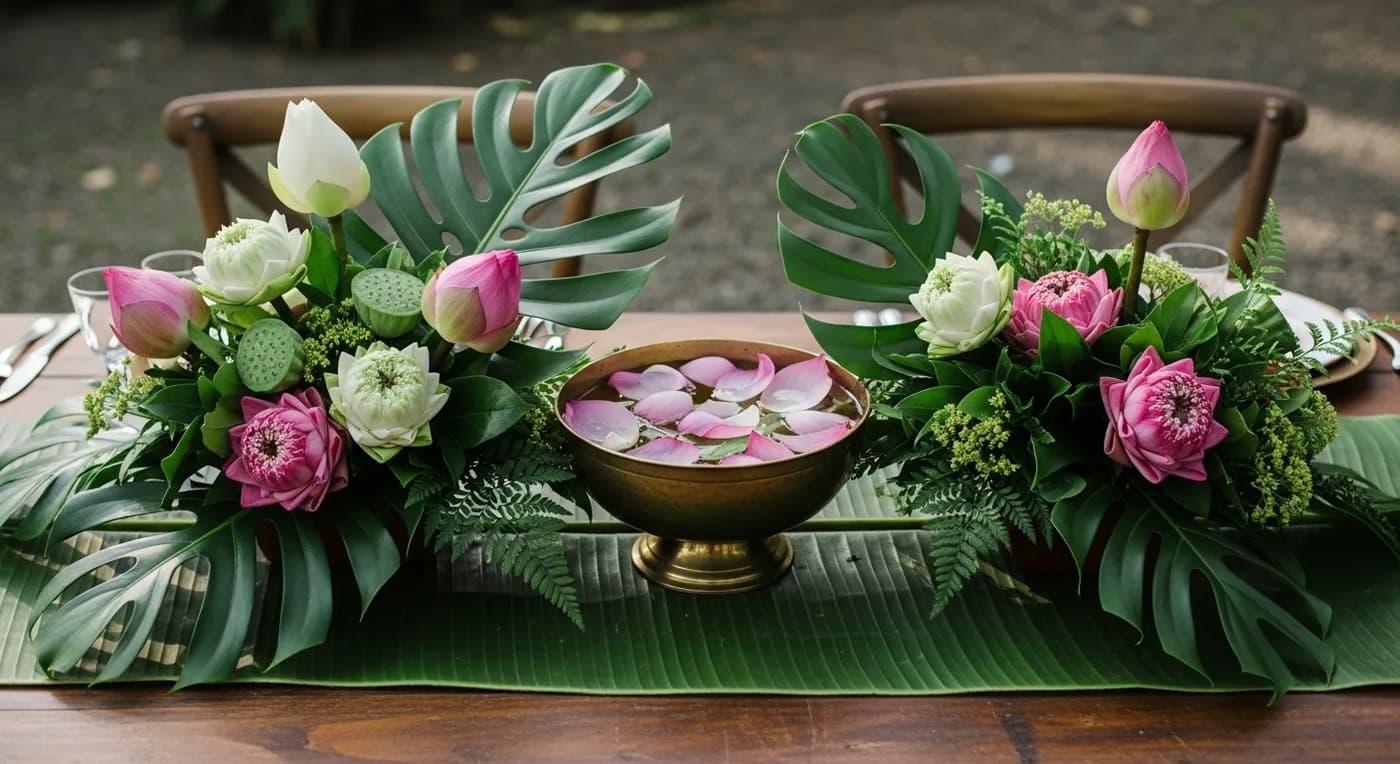
Sacred in Hindu tradition and visually stunning, the lotus commands attention without volume. A single bloom floating in a brass uruli can anchor an entire table arrangement.
- Price: Rs 30-60 per flower (local ponds), Rs 80-120 per flower (cultivated/ordered)
- Sourcing: Local temple ponds, backwater farms in Kottayam and Alappuzha districts
- Handling: Requires careful transport; petals bruise easily. Must be kept in water at all times
- Usage: Uruli centrepieces, floating arrangements, welcome area feature pieces, sacred rituals
- Sustainability note: Wild-harvesting from ponds is not sustainable at scale; work with cultivated lotus farms
Chrysanthemum
The unsung hero of budget-conscious weddings. Chrysanthemums provide massive volume and colour variety for a fraction of the cost of roses or orchids. They are widely grown around Ernakulam and Idukki.
- Price: Rs 200-350/kg (in-season), Rs 500-700/kg (off-season)
- Colour range: White, yellow, pink, purple, rust, bicolour — the widest palette of any local flower
- Longevity: 24-36 hours — the most durable flower on this list
- Heat tolerance: Excellent; holds shape even in direct afternoon sun
- Usage: Backdrop fill, garlands, table centrepieces, mixed arrangements, altar framing
Rose (Locally Grown)
Kerala-grown roses — primarily from Idukki's highland nurseries and parts of the Nilgiris supply chain — are a fraction of the cost of imported varieties while offering genuine beauty.
- Local price: Rs 600-1,000/kg
- Imported price: Rs 2,500-4,500/kg (Pune, Bangalore, or international)
- Key difference: Local roses tend to be slightly smaller with shorter stems. Imported roses offer uniform long stems and specific designer colours (deep burgundy, dusty pink, champagne)
- Usage: Bridal bouquet, mandap accent blooms, stage backdrop focal points, table arrangements
Kanakambaram (Firecracker Flower / Crossandra)
A distinctly South Indian flower that is gaining traction in contemporary wedding design. Its compact, stacked petals and warm coral-orange tone add textural interest that no other flower replicates.
- Price: Rs 300-500/kg — one of the most affordable options
- Availability: Year-round in Kerala, with peak supply March-November
- Usage: Mixed garlands, bridal hair accents, mandap border detailing, petals for floral rangoli
- Unique advantage: Extremely heat-tolerant and holds colour without browning for 18+ hours
Orchids (Locally Grown)
Thrissur and Ernakulam districts are home to a growing number of orchid nurseries producing Dendrobium and Mokara varieties. These locally cultivated orchids cost significantly less than imported Phalaenopsis.
- Price: Rs 800-1,500/kg (local), vs Rs 3,000-5,000/kg (imported Phalaenopsis)
- Availability: Year-round from nurseries; order 2-3 weeks in advance for bulk
- Usage: Contemporary mandap accents, hanging installations, bridal bouquet features
Banana Flower and Palm Fronds
Often overlooked, these structural elements are available for free or near-zero cost from any homestead in Kerala.
- Banana leaves: Natural table runners, backdrop panels, stage skirting. Rs 5-15 per leaf in bulk
- Palm fronds (coconut/areca): Arch framing, aisle markers, ceiling draping. Available at Rs 10-30 per frond or free from property trees
- Banana flower (vazhakoombu): Striking sculptural element for welcome area or mandap pillars
Flower Price Comparison Table
| Flower | Price/kg (Local, In-Season) | Price/kg (Imported/Off-Season) | Longevity (Hours) | Heat Tolerance |
|---|---|---|---|---|
| Jasmine (Mulla) | Rs 400-800 | Rs 1,200-1,800 | 8-12 | Moderate |
| Marigold | Rs 200-400 | Rs 600-900 | 18-24 | High |
| Lotus | Rs 30-60/flower | Rs 80-120/flower | 12-16 | Moderate |
| Chrysanthemum | Rs 200-350 | Rs 500-700 | 24-36 | Excellent |
| Rose (local) | Rs 600-1,000 | Rs 2,500-4,500 (imported) | 10-16 | Low-Moderate |
| Kanakambaram | Rs 300-500 | Rs 600-800 | 18+ | Excellent |
| Orchid (local) | Rs 800-1,500 | Rs 3,000-5,000 (imported) | 24-48 | Good |
Local vs Imported: The Economics
The most consequential financial decision in your floral plan is the ratio of local to imported flowers. Understanding the true cost gap — and why it exists — will help you make intentional choices instead of defaulting to a decorator's standard package.
Why imported flowers cost 3-5x more: Imported roses, hydrangeas, carnations, and Phalaenopsis orchids travel via refrigerated trucks from Pune, Bangalore, or even international sources (Dutch auction flowers via Mumbai). Each step in that cold chain — harvest, refrigeration, packing, transport, cold storage at the local wholesaler, final delivery — adds cost and wastage. By the time an imported rose reaches a Kochi wedding venue, 15-25% of the original shipment has been discarded due to bruising, wilting, or cold chain breaks. You are paying for that waste.
When imported flowers are worth it: Some design concepts genuinely require specific imported varieties. Pastel peony-style arrangements, specific Pantone colour matching (dusty mauve, sage green roses), or ultra-long-stem arrangements for tall vases — these have no local equivalent. If your design concept calls for them, budget accordingly, but limit imported flowers to hero placements where they have the most visual impact.
The 80/20 rule: The most cost-effective approach, recommended by top decorators in Kozhikode, Thrissur, and Trivandrum, is to use 80% local flowers for volume coverage (garlands, backdrop fill, aisle draping, bulk garlands) and reserve 20% of your budget for imported accent flowers at key focal points (bridal bouquet, mandap centrepiece, stage backdrop focal arrangement). This blend gives you the lush abundance of local blooms with the designer touch of curated imports.
| Arrangement Area | All-Local Cost | 80/20 Mix | All-Imported Cost |
|---|---|---|---|
| Mandap (standard) | Rs 50,000-80,000 | Rs 80,000-1,40,000 | Rs 2,00,000-3,50,000 |
| Stage backdrop | Rs 25,000-40,000 | Rs 40,000-70,000 | Rs 1,00,000-1,80,000 |
| Entrance arch | Rs 15,000-25,000 | Rs 25,000-45,000 | Rs 60,000-1,20,000 |
| Table centrepieces (10 tables) | Rs 10,000-20,000 | Rs 20,000-40,000 | Rs 50,000-90,000 |
| Full venue (all areas) | Rs 75,000-1,50,000 | Rs 1,50,000-3,00,000 | Rs 3,50,000-6,00,000 |
Looking for Decorators in Thrissur?
Tell us what you need and get quotes from verified decorators
Sustainable Floral Practices
Sustainability in wedding floral decor is not about doing less — it is about doing things differently. A foam-free, locally sourced floral setup can be every bit as lush and dramatic as a conventional one, often more so, because the design has to be more thoughtful. Here are the techniques that leading Kerala decorators are using in 2026.
Foam-Free Arranging Techniques
Traditional floral foam (sold under the brand name Oasis) is a polyurethane plastic that crumbles into microplastic particles as it degrades — which takes decades. Every block of foam used in a single wedding sends thousands of plastic particles into Kerala's waterways. The alternatives are proven, effective, and increasingly standard.
- Chicken wire frames: Crumpled chicken wire inserted into vessels creates a grid that holds stems securely. Reusable indefinitely, costs Rs 50-100 per arrangement
- Pin frogs (kenzans): Heavy metal disc with brass pins that anchor individual stems. Perfect for uruli arrangements and low bowls. Rs 200-500 per frog, lasts for years
- Water tubes (aqua picks): Small plastic tubes filled with water, attached to individual stems. Essential for garland work and overhead installations where stems cannot reach a water source. Rs 5-10 per tube
- Moss and jute wrapping: For bouquets and hand-tied arrangements, damp moss wrapped in jute replaces foam entirely and keeps stems hydrated for 8-10 hours
Tip
Foam-Free Mandap: Traditional floral foam (Oasis) is non-biodegradable plastic that takes decades to decompose. Ask your decorator about chicken wire frames, reusable pin frogs, or water tube systems instead. Most experienced Kerala decorators now offer foam-free options at no extra charge.
Potted Plant Centrepieces
One of the most elegant sustainable trends gaining ground from Trivandrum to Kozhikode: using potted plants as table centrepieces that double as guest favours. Potted orchids, anthuriums, or money plants in decorative brass or terracotta pots serve as beautiful table anchors during the event and meaningful take-home gifts afterward. Cost per table: Rs 300-800 for the plant and pot, versus Rs 1,500-3,000 for a fresh-cut arrangement that gets discarded.
Dried Flower Elements
Dried flowers are not the dusty, faded arrangements of decades past. Modern drying techniques preserve colour and form beautifully. Dried palms, pampas grass, lunaria (honesty pods), and preserved ferns work brilliantly for ceiling installations, welcome area features, and non-perishable elements that can be set up days in advance — eliminating the morning-of scramble for those areas.
Fabric Flower Ceiling Installations
For grand ceiling draping — where fresh flowers would wilt within hours under venue lighting heat — high-quality fabric flowers are the sustainable and practical choice. A fabric flower ceiling installation costs Rs 30,000-80,000 and can be reused across multiple events, compared to Rs 80,000-2,00,000 for fresh flower ceilings that last a single day. Many decorator studios in Ernakulam and Thrissur maintain inventories of fabric flower panels for rental.
Foliage-Heavy Designs
Kerala has an embarrassment of riches in tropical foliage. Banana leaves, coconut fronds, areca palm, ferns, and philodendron create lush green canopies, backdrops, and structural frames at a fraction of the cost of flowers — often sourced directly from the venue property or nearby homesteads. A foliage-dominant design with strategic flower accents is both strikingly modern and deeply rooted in Kerala's landscape.
Post-Wedding Flower Composting and Donation
A WedMeGood survey of 2,000+ couples found that decor is one of the top budget categories where couples feel the spend-to-impact ratio matters most — making sustainable alternatives that look equally stunning a compelling choice. Progressive couples in 2026 are planning what happens to their flowers after the event. Options include donating usable flowers to local temples (many temples in Thrissur and Palakkad districts accept wedding flower donations), arranging composting pickup through local waste management services, or partnering with organisations that repurpose wedding flowers for hospital and hospice deliveries.
Mandap Floral Budgets
The mandap is the centrepiece of your floral investment. Here is what to expect across four distinct design approaches, all based on 2026 pricing for Kerala venues.
Traditional Kerala Mandap
Jasmine and marigold dominant, with brass uruli accents and banana leaf structural elements. This is the timeless aesthetic — fragrant, golden, unapologetically Malayali. Heavy use of jasmine curtain garlands (minimum 30-50 garlands for a standard mandap), marigold swags framing the canopy, and lotus urul arrangements at the base.
- Primary flowers: Jasmine (60%), Marigold (30%), Lotus and foliage (10%)
- Cost range: Rs 75,000-1,25,000
- Sustainability score: Excellent — nearly 100% local, biodegradable, foam-free by tradition
Contemporary Mandap
Blends local flowers with imported accents for a softer, pastel-leaning aesthetic. Think white roses and baby's breath mixed with jasmine, chrysanthemum in muted tones, and touches of imported lisianthus or spray roses. This style is popular in Kochi and Trivandrum urban venues.
- Primary flowers: Chrysanthemum (30%), Local rose (25%), Jasmine (20%), Imported accents (25%)
- Cost range: Rs 1,50,000-2,50,000
- Sustainability score: Good — majority local with limited imports
Minimal Mandap
Foliage-heavy with statement flower accents. Architectural palm fronds and banana leaf panels form the structure, with curated clusters of orchids, roses, or anthuriums at focal points. Negative space is part of the design. Growing rapidly in popularity for intimate weddings in Idukki, Wayanad, and backwater venues.
- Primary flowers: Foliage (60%), Orchid or rose accents (25%), Kanakambaram or chrysanthemum (15%)
- Cost range: Rs 75,000-1,50,000
- Sustainability score: Excellent — minimal flower usage, high foliage, reusable structural elements
Grand Mandap
Full floral coverage with premium imported flowers forming the dominant visual. This is the no-budget-bar approach — cascading phalaenopsis orchids, hundreds of imported roses in designer colours, hydrangea clouds, and imported greenery (eucalyptus, ruscus). Typically seen in high-budget weddings at premium venues in Kochi, Trivandrum, and destination properties.
- Primary flowers: Imported roses (40%), Orchids (25%), Hydrangea (15%), Local fill (20%)
- Cost range: Rs 3,00,000-5,00,000+
- Sustainability score: Low — heavy import reliance, significant waste, foam often required for complex structures
| Mandap Style | Primary Flowers | Cost Range | Sustainability Score |
|---|---|---|---|
| Traditional Kerala | Jasmine, Marigold, Lotus | Rs 75,000-1,25,000 | Excellent |
| Contemporary | Mixed local + imported accents | Rs 1,50,000-2,50,000 | Good |
| Minimal / Foliage-Heavy | Foliage + statement blooms | Rs 75,000-1,50,000 | Excellent |
| Grand / Full-Import | Imported roses, orchids, hydrangea | Rs 3,00,000-5,00,000+ | Low |
Beyond the Mandap: Full Venue Floral Plan
The mandap gets the most attention, but it typically accounts for only 30-40% of your total floral budget. Here is where the rest goes — and how to allocate wisely.
Entrance and Welcome Arch
The first floral element guests encounter. A well-designed entrance arch sets the tone for the entire event. Options range from a simple marigold-and-banana-leaf toran (Rs 8,000-15,000) to a full floral archway with mixed blooms (Rs 25,000-60,000) to a premium imported flower statement entrance (Rs 80,000-1,50,000).
Aisle and Walkway
Floral aisle markers, petal pathways, or potted plant-lined walkways. Budget Rs 10,000-25,000 for local flower arrangements or Rs 30,000-60,000 for imported flower aisle decor. A cost-effective alternative: loose petals (marigold and rose) scattered along the path with potted plants at intervals.
Stage Backdrop
After the mandap, this is the most photographed area. A lush floral wall backdrop costs Rs 40,000-80,000 in local flowers or Rs 1,00,000-2,50,000 in imported. Consider a mixed approach: foliage base with flower accent clusters that concentrate your budget where cameras point.
Table Centrepieces
For a reception with 15-25 tables, centrepieces add up quickly. Local flower arrangements cost Rs 800-1,500 per table; imported flower centrepieces run Rs 2,500-5,000 per table. Potted plant alternatives cost Rs 300-800 per table and go home with guests.
Ceiling Installations
Overhead floral elements create drama but face heat and gravity challenges. Fresh flower ceilings work only in well-air-conditioned venues and cost Rs 60,000-2,00,000. Fabric flower or dried flower ceiling panels cost Rs 30,000-80,000 and are reusable.
Photo Corners
Dedicated floral backdrops for guest photographs are standard at 2026 Kerala weddings. A single floral photo corner costs Rs 15,000-40,000 depending on size and flower selection.
Car Decoration
The bridal car arrangement is a small but visible expense: Rs 3,000-8,000 for local flowers, Rs 10,000-20,000 for imported. Jasmine and rose combinations remain the most popular choice.
Recommended Budget Allocation
| Area | % of Total Floral Budget |
|---|---|
| Mandap | 30-35% |
| Stage backdrop | 15-20% |
| Entrance and arches | 10-12% |
| Table centrepieces | 8-10% |
| Aisle and walkway | 5-8% |
| Ceiling installations | 8-12% (if applicable) |
| Photo corners | 3-5% |
| Car decoration | 2-3% |
| Backup/replacement stock | 5-10% |
Working with Your Florist or Decorator
The difference between a good floral outcome and a great one often comes down to communication. Here is how to get the most from your decorator relationship.
Sharing reference images: Collect 10-15 reference images, but categorize them — "I love the colour palette in this image," "I love the density of flowers here," "This is the mandap shape I want." Generic Pinterest boards with 200 pins give your florist no clear direction.
Specifying colour palettes, not just flowers: Instead of saying "I want roses," say "I want warm ivory with blush pink accents and deep green foliage." A skilled florist can achieve your colour vision with whatever flowers are available and in season, giving you better value and freshness.
Understanding seasonal substitutions: If your wedding is in July and you want jasmine-heavy decor, your florist may suggest chrysanthemum or fabric jasmine for bulk coverage with small quantities of real jasmine at key focal points. Trust their seasonal knowledge — fighting the calendar only inflates cost and reduces quality.
Getting an itemized quote: This is non-negotiable. A transparent florist will list every flower type, quantity, arrangement location, labour cost, and transport charge separately.
Important
Quote Transparency: Always insist on an itemized floral quote that lists: flower types, quantities, arrangement locations, labour, and transport separately. A lump-sum 'decor package' makes it impossible to evaluate value or make informed substitutions if prices change.
Trial arrangement: For weddings with floral budgets above Rs 1,50,000, request a trial arrangement of the mandap centrepiece or stage focal point. This costs Rs 3,000-8,000 but eliminates guesswork and ensures you and your florist are aligned on density, colour accuracy, and overall feel.
Looking for Decorators in Kochi?
Tell us what you need and get quotes from verified decorators
Heat and Humidity Management
Kerala's tropical climate is the single biggest threat to your floral investment. A Rs 3,00,000 imported rose mandap can look wilted and brown by noon if heat management is not planned. Here is how to protect your arrangements.
Heat Tolerance Rankings
- Excellent (18+ hours): Chrysanthemum, Kanakambaram, Marigold, Dried flowers
- Good (12-18 hours): Jasmine (if hydrated), Lotus (in water), Local orchids
- Moderate (8-12 hours): Local roses, Anthuriums
- Poor (4-8 hours in Kerala heat): Imported roses, Hydrangea, Baby's breath, Lisianthus
The Morning-Of Arrangement Strategy
Never accept a decorator who wants to set up fresh flowers the night before your ceremony. In Kerala's daytime temperatures of 28-35 degrees Celsius with 70-90% humidity, overnight arrangements lose 30-50% of their freshness before guests even arrive.
Tip
The Morning-Of Rule: In Kerala's climate, flowers arranged the night before will wilt by noon. Insist that all arrangements be done the morning of the event (before 10 AM). Keep backup jasmine garlands in insulated cooler boxes for mid-ceremony replacements.
Water Tube Techniques
Individual water tubes (aqua picks) are essential for overhead installations, garland work, and any arrangement where stems are not sitting in a water source. Each tube costs only Rs 5-10 and extends flower life by 4-8 hours. For a full mandap, budget 200-400 water tubes.
Shade and Misting Schedule
If any arrangements are in direct sunlight — entrance arches, car decoration, outdoor aisle markers — assign a helper to mist them with a spray bottle every 30-45 minutes. For the mandap and stage, ensure venue fans or air conditioning are directed away from arrangements (direct air flow accelerates dehydration).
Backup Flower Budget
Budget 10-15% of your floral total as a contingency for mid-event replacements. This is not waste — it is insurance. Keep backup jasmine garlands, marigold strands, and loose blooms in insulated cooler boxes (standard thermocol boxes with ice packs work well) backstage. Your decorator's team should do a freshness check and swap wilted elements at the midway point of your event.
Note
Cooler Box Strategy: Prepare 2-3 thermocol boxes with ice packs before the event. Store backup jasmine garlands, loose rose heads, and marigold strands inside. Station them backstage. A freshness sweep at the halfway point of your event ensures the venue looks as good for the reception as it did for the ceremony.
Full Cost Breakdown by Wedding Scale
Here is the complete picture across four budget tiers, based on 2026 Kerala market rates. All figures are approximate ranges and will vary by venue size, city, and season.
| Area | Budget (Local Only) | Mid-Range (80/20 Mix) | Premium (Mixed Import) | Grand (Import Heavy) |
|---|---|---|---|---|
| Mandap | Rs 50,000-75,000 | Rs 1,00,000-1,50,000 | Rs 2,00,000-3,00,000 | Rs 3,50,000-5,00,000 |
| Entrance arch | Rs 8,000-15,000 | Rs 20,000-35,000 | Rs 40,000-70,000 | Rs 80,000-1,50,000 |
| Stage backdrop | Rs 20,000-35,000 | Rs 40,000-70,000 | Rs 80,000-1,50,000 | Rs 1,50,000-2,50,000 |
| Table centrepieces (15 tables) | Rs 8,000-15,000 | Rs 20,000-40,000 | Rs 40,000-75,000 | Rs 60,000-1,00,000 |
| Aisle/walkway | Rs 5,000-10,000 | Rs 15,000-25,000 | Rs 25,000-50,000 | Rs 40,000-70,000 |
| Ceiling | — | Rs 30,000-50,000 | Rs 60,000-1,20,000 | Rs 1,00,000-2,00,000 |
| Photo corner | Rs 5,000-10,000 | Rs 15,000-25,000 | Rs 25,000-40,000 | Rs 40,000-60,000 |
| Car decoration | Rs 3,000-5,000 | Rs 8,000-12,000 | Rs 12,000-20,000 | Rs 15,000-25,000 |
| Backup stock | Rs 5,000-10,000 | Rs 15,000-25,000 | Rs 25,000-40,000 | Rs 40,000-60,000 |
| Total | Rs 50,000-1,50,000 | Rs 1,50,000-3,00,000 | Rs 3,00,000-5,00,000 | Rs 5,00,000-8,00,000+ |
Common Questions About Sustainable Floral Decor for Kerala Weddings
How much do wedding flowers cost in Kerala?
Floral decor for a Kerala wedding ranges widely based on three primary variables: flower origin, season, and venue scale. A budget wedding using entirely local flowers — jasmine, marigold, chrysanthemum — can achieve beautiful decor for Rs 50,000-1,50,000. A mid-range celebration using the 80/20 local-to-imported mix typically runs Rs 1,50,000-3,00,000. Premium and grand weddings with heavy imported flower usage push into the Rs 3,00,000-6,00,000+ range. The single biggest cost driver is imported vs local flowers, with imported roses and orchids costing 3-5x their local equivalents. Season matters enormously too: peak wedding months (December-February) see wholesale prices spike 40-60% above September-November rates.
Which local Kerala flowers are best for weddings?
Jasmine (Mulla) is the signature Kerala wedding flower, offering unmatched fragrance and cultural resonance for bridal hair, mandap garlands, and entrance draping. Marigold delivers the most visual impact per rupee — vibrant gold and orange tones, exceptional longevity (18-24 hours), and the lowest cost per kilogram. Lotus brings sacred symbolism and dramatic floating arrangements. Chrysanthemum is the budget champion: widest colour range, best heat tolerance, and longest lasting of all local flowers. Kerala-grown roses offer beauty at a third of imported prices. Kanakambaram (firecracker flower) provides unique coral-orange texture and outstanding heat resistance. For structural elements, banana leaves and palm fronds add lush tropical character at negligible cost.
When are flowers cheapest for Kerala weddings?
September through November is the sweet spot. Most local flowers — jasmine, marigold, chrysanthemum, kanakambaram — are in peak bloom, wholesale markets in Thrissur and Ernakulam are fully stocked, and florists have more availability. Prices during this window are 40-60% lower than during December-February, which is peak wedding season with maximum demand. The monsoon months (June-August) are paradoxically expensive due to supply disruption: heavy rains damage crops and reduce market availability. March-May offers moderate pricing but extreme heat shortens flower longevity, meaning you need to budget more for backup stock.
What are sustainable alternatives to fresh flowers?
The sustainable floral toolkit for Kerala weddings in 2026 includes several proven approaches. Potted plant centrepieces — orchids, anthuriums, or money plants in decorative brass or terracotta pots — serve double duty as decor and guest favours. Dried flower arrangements (preserved palms, pampas grass, lunaria) work beautifully for non-perishable installations that can be set up days in advance. Fabric flower panels for ceiling installations are reusable across multiple events and impervious to heat. Foliage-dominant designs using banana leaves, coconut fronds, and ferns create lush backdrops at minimal cost and zero waste. Choosing locally grown seasonal flowers over imported ones reduces your carbon footprint dramatically. And replacing disposable floral foam bases with reusable brass uruli, copper vessels, chicken wire frames, and pin frogs eliminates plastic waste entirely.
How do I keep flowers fresh in Kerala's heat?
Start with the right flower selection: jasmine, marigold, chrysanthemum, and kanakambaram tolerate Kerala's heat far better than imported roses or hydrangea. Insist on morning-of arrangements — never the night before. All setup should be complete before 10 AM. For individual stems in overhead installations or garlands, use water tubes (aqua picks) at Rs 5-10 each to extend life by 4-8 hours. Keep all arrangements in shade until display time. Assign a helper to mist exposed arrangements every 30-45 minutes. Budget 10-15% extra flowers for mid-event replacements and store backups in insulated thermocol boxes with ice packs. Direct venue fans and air conditioning away from arrangements, as air flow accelerates dehydration. For long events (8+ hours), schedule a freshness check and swap at the midway point.
Further Reading
Tip
Plan your wedding with free tools — try our AI Wedding Checklist for a personalised timeline, or use the Cost Calculator to estimate your budget.
Topics
Kerala wedding floral decorsustainable wedding flowerswedding flower cost Keralamandap decoration flowerslocal flowers Kerala weddingeco-friendly wedding decorExplore more
Frequently Asked Questions
1How much do wedding flowers cost in Kerala?
2Which local Kerala flowers are best for weddings?
3When are flowers cheapest for Kerala weddings?
4What are sustainable alternatives to fresh flowers?
5How do I keep flowers fresh in Kerala's heat?
Continue reading
Related Articles
Wedding Decor Cost in Kerala: Flowers, Lights, and Mandapam Pricing
Eco-Friendly Kerala Weddings: The Complete Sustainability Guide for 2026
Kerala Wedding Budget Guide: 2026 Cost Breakdown
Best Wedding Venues Kerala: ₹50K-₹25L With Prices (2026)
Best Season for South India Destination Weddings: Month-by-Month Western Ghats Guide
Destination Wedding Cost in South India 2026: 5-Tier Budget Guide
Still planning?
Get quotes from India's best vendors
Tell us what you're planning and we'll match you with verified photographers, venues, decorators, and more.
Get free quotes