
Kerala Wedding Videography: ₹25K-₹5L Pricing (2026)
Kerala wedding videography costs ₹25,000–₹5 lakh in 2026. Cinematic, documentary, drone, and same-day edit packages explained with mid-range from ₹75,000.

Senior Wedding Planner
Priya Nair is a senior wedding planner based in Kochi with over eight years of experience coordinating Hindu, Christian, and destination weddings across Kerala.
On this page
Kerala wedding videography costs ₹25,000–50,000 for budget packages and ₹2–5 lakh for luxury cinematic productions; mid-range packages at ₹75,000–1.5 lakh offer the best value. Five distinct styles are available — cinematic, documentary, traditional, drone aerial, and same-day edit. Social media teasers are delivered in 5–10 days; full cinematic films take 12–16 weeks.
Quick Answer
Quick answer: Kerala wedding videography pricing: budget ₹25,000–₹50,000 (single camera, basic edit), mid-range ₹75,000–₹1.5 lakh (2-person team, highlight reel), premium ₹1.5–5 lakh (cinematic with drone). Same-day edits screened at the reception cost ₹50,000–₹1.5 lakh extra. Delivery: social teaser in 5–10 days, full film in 12–16 weeks.
Note
Pricing methodology: Cost ranges in this guide are based on vendor pricing data from the itsmy.wedding marketplace and published industry reports, collected in Q4 2025 – Q1 2026.
I have spent fifteen years filming weddings across Kerala — from dawn ceremonies at Guruvayur temple where the light filters through centuries-old architecture, to sunset receptions on Kumarakom's backwater decks where the water doubles every candle flame. In that time, wedding videography has undergone a transformation more dramatic than any other vendor category in the Kerala wedding industry — an industry that is part of India's ₹10.79 lakh crore wedding market, projected to reach ₹24 lakh crore by 2030. What was once a single camera on a tripod recording hours of unedited footage has become a sophisticated craft involving multiple cameras, aerial drones, stabilised gimbals, and narrative storytelling techniques borrowed from cinema.
Yet the gap between exceptional and mediocre wedding videography remains enormous. A great wedding film makes you feel the tremor in your mother's voice during the blessing, the electricity of the chenda melam procession, the quiet intimacy of a stolen glance during the thalikettu. A poor one gives you shaky footage with bad audio set to generic background music. The difference comes down to the filmmaker you choose, the style you select, and the clarity of your planning.
This guide covers everything you need to know about wedding videography in Kerala for 2026 — from understanding the distinct styles available to navigating pricing, evaluating showreels, negotiating contracts, and making the critical decision between combo packages and specialist filmmakers.
The Five Videography Styles You Need to Know
Understanding videography styles is the foundation of every decision that follows. Each style produces a fundamentally different final product, and your preference will determine which filmmakers to shortlist.
1. Cinematic Wedding Films
This is the most sought-after style in Kerala's wedding market in 2026. Cinematic videography treats your wedding as a short film. The filmmaker uses shallow depth of field (the blurred background look), dramatic camera movements on gimbals and sliders, carefully graded color palettes, and narrative editing with voiceovers, vows, or speeches layered over visual sequences. The final product feels like a movie trailer for your love story.
Cinematic films work exceptionally well for visually rich Kerala weddings — the ornate kasavu sarees, elaborate floral mandaps, and the vibrant colours of temple ceremonies provide stunning raw material, and our temple wedding photography in South India reference covers the lighting and ritual coverage cues that translate directly to film. Filmmakers in Kochi and Thrissur have particularly embraced this style, with several studios now producing work that rivals international standards.
The trade-off: cinematic films require more equipment, more crew, and significantly more editing time. Expect higher costs and longer delivery timelines.
2. Documentary Style
Documentary videography captures your wedding as it unfolds, chronologically and authentically. The filmmaker is an observer, not a director. There are no re-enacted moments, no scripted sequences, and minimal intervention. The audio is real — you hear the priest's chants, your grandmother's whispered advice, the chaos of the kitchen preparing the sadya.
This style appeals to couples who value authenticity over polish. It is especially powerful for traditional Kerala Hindu weddings in Palakkad and Thrissur where the rituals themselves carry deep emotional weight and deserve to be preserved intact. Documentary films tend to be longer (20-45 minutes for a ceremony edit) and serve as genuine historical records.
3. Traditional Coverage
Traditional videography is straightforward, continuous event recording — typically from a fixed position or with minimal movement. While it lacks the artistry of cinematic or documentary approaches, it serves an important purpose: complete, unbroken documentation of the ceremony for family members who could not attend.
Many families in Kerala, particularly those with relatives in the Gulf, still request traditional full-ceremony recordings alongside more creative formats. Budget-tier packages are almost always traditional in approach.
4. Drone and Aerial Videography
Drone footage has become a near-essential element for Kerala weddings held at scenic outdoor venues. The aerial perspective transforms a backwater venue in Alappuzha, a hilltop resort in Wayanad, or a beachside ceremony in Kovalam into something genuinely spectacular. Drone shots serve as establishing sequences in the final edit, providing a sense of scale and location that ground-level cameras cannot achieve.
Important
Drone videography requires a DGCA-licensed pilot and prior venue permission. Temples, churches, and venues near airports or military installations have strict no-fly zones. Confirm drone permissions with your venue at least one month before the wedding. An unlicensed drone operator is both a legal risk and a safety hazard.
5. Same-Day Edit (SDE)
A same-day edit is a 3-5 minute cinematic recap of your wedding morning, edited on-site and screened at the evening reception. It is logistically demanding — a dedicated editor works in a makeshift setup at the venue while the wedding is still happening, cutting footage in real time. When executed well, the reception screening becomes one of the most emotional moments of the entire wedding.
SDEs have gained significant popularity across Ernakulam and Thiruvananthapuram — a state that welcomed 2.3 crore tourists in 2024 and whose destination wedding scene is booming — where reception budgets tend to be higher and couples seek a "wow moment" for their guests. However, this format requires a team with proven SDE experience — it is not something to experiment with on your wedding day.
Understanding 2026 Pricing Tiers
Wedding videography pricing in Kerala varies dramatically based on style, crew size, equipment, and deliverables. Here is what each tier looks like in 2026.
Budget Tier
₹25,000 – ₹50,000At this level, you are typically getting a single videographer with a DSLR or mirrorless camera, basic editing, and a full-ceremony recording. The deliverable is usually a complete unedited or lightly edited ceremony video (1-3 hours) and possibly a simple 3-5 minute highlights reel. Audio quality may be limited to on-camera microphone capture. This tier is functional for documentation purposes but should not be expected to deliver cinematic quality.
What is included: Single camera coverage, basic colour correction, ceremony recording, simple highlights video, delivery on hard drive or cloud link.
Mid-Range Tier
₹75,000 – ₹1,50,000The mid-range is where quality takes a significant leap. You get two videographers (one for the ceremony, one for candid moments and B-roll), professional audio recording with lapel microphones, stabilised footage from gimbals, and a properly edited highlight reel of 5-8 minutes — pricing here mirrors the candid photography cost benchmarks for 2026. Many mid-range packages also include a teaser video for social media.
This tier represents the best value for most Kerala weddings. Filmmakers operating at this price point in markets like Kochi, Kozhikode, and Thrissur have invested in professional equipment and developed genuine editing skills. The final product is polished, emotional, and shareable.
What is included: Two-camera coverage, gimbal-stabilised footage, professional audio, 5-8 minute highlight reel, 60-90 second social media teaser, full ceremony edit, raw footage on hard drive.
Looking for Photographers in Kochi?
Tell us what you need and get quotes from verified photographers
Premium Tier
₹1,50,000 – ₹3,00,000Premium packages introduce cinematic production values. Expect a three-person crew (lead filmmaker, second shooter, assistant/drone operator), 4K resolution throughout, drone aerial footage, colour grading that matches a specific visual mood, narrative editing with voiceover integration, and multiple deliverables including a cinematic trailer, extended highlight film, full ceremony coverage, and social media cuts.
Filmmakers at this level in Kochi and Thiruvananthapuram often have backgrounds in commercial filmmaking or cinema — many appear on our top wedding photographers in Kerala shortlist because they offer combined photo and film teams. They bring lighting equipment, multiple audio sources, and spend 40-80 hours in post-production. The result is a wedding film you would genuinely watch again and again.
What is included: Three-camera coverage, 4K resolution, drone footage, cinematic colour grading, 8-15 minute cinematic film, 60-second trailer, full ceremony edit, social media package (3-5 reels), raw footage, same-day teaser (BTS or short clip).
Luxury Tier
₹3,00,000 – ₹5,00,000At the top end, you are commissioning a short film. Luxury packages include pre-wedding shoot videos, a four-to-six-person crew, multi-day coverage (mehendi, haldi, ceremony, reception), cinematic lighting setups, scripted narrative sequences, professional voiceover recording, custom music scoring, and a premiere-ready 15-25 minute wedding film. Some luxury filmmakers also offer a pre-wedding interview session where they record the couple's love story for use as voiceover narration.
This tier is most common for destination weddings in Munnar, Wayanad, and premium Kochi venues where the wedding itself is a multi-day affair and the film budget reflects the overall event scale.
What is included: Everything in Premium, plus multi-day coverage, pre-wedding video, custom music, scripted narrative, cinematic lighting, extended 15-25 minute film, dedicated colourist, premium packaging and delivery.
Tip
Negotiation leverage: Prices quoted above are market rates, but most filmmakers have flexibility in the off-season (June-August in Kerala). Booking 6-8 months in advance and offering a weekday wedding date can earn you 10-15% savings even in the mid-range and premium tiers.
What Should Be Included in Every Package
Regardless of the tier you choose, your videography package should explicitly cover these deliverables. If any are missing from the proposal, ask for them or negotiate their inclusion.
Raw footage. This is your unedited, complete recording. Even if you never watch it, raw footage is irreplaceable source material. Insist on receiving it on a hard drive — cloud-only delivery risks link expiration. Some filmmakers resist sharing raw footage; make this a non-negotiable contract term.
Highlight reel. A 5-10 minute edited film capturing the emotional arc of the day. This is the video you will share with family, post on social media, and rewatch on anniversaries. It should have professional audio, music licensing, and colour grading.
Full ceremony edit. An unbroken or lightly edited recording of the complete ceremony. This serves as the documentary record and matters most to elder family members and relatives who could not attend.
Social media cuts. In 2026, this is no longer optional — it is expected. Your package should include at least 2-3 vertical (9:16) clips optimised for Instagram Reels, YouTube Shorts, and WhatsApp status. These short clips (15-60 seconds) are how most people will actually see your wedding video.
Teaser or trailer. A 60-90 second cinematic teaser delivered within 5-10 days of the wedding. This serves as your announcement piece while the full film is in production.
Why Equipment Matters More Than You Think
You do not need to become a camera expert, but understanding basic equipment indicators helps you separate professional filmmakers from enthusiastic amateurs.
4K resolution is the baseline in 2026. Any filmmaker still shooting in 1080p for a premium wedding is behind the standard. 4K provides sharper detail, better colour information for grading, and the ability to crop or stabilise footage in post without quality loss. Ask what camera bodies they use — Sony FX3/FX6, Canon C70, and Blackmagic Pocket Cinema Camera 6K are current professional standards.
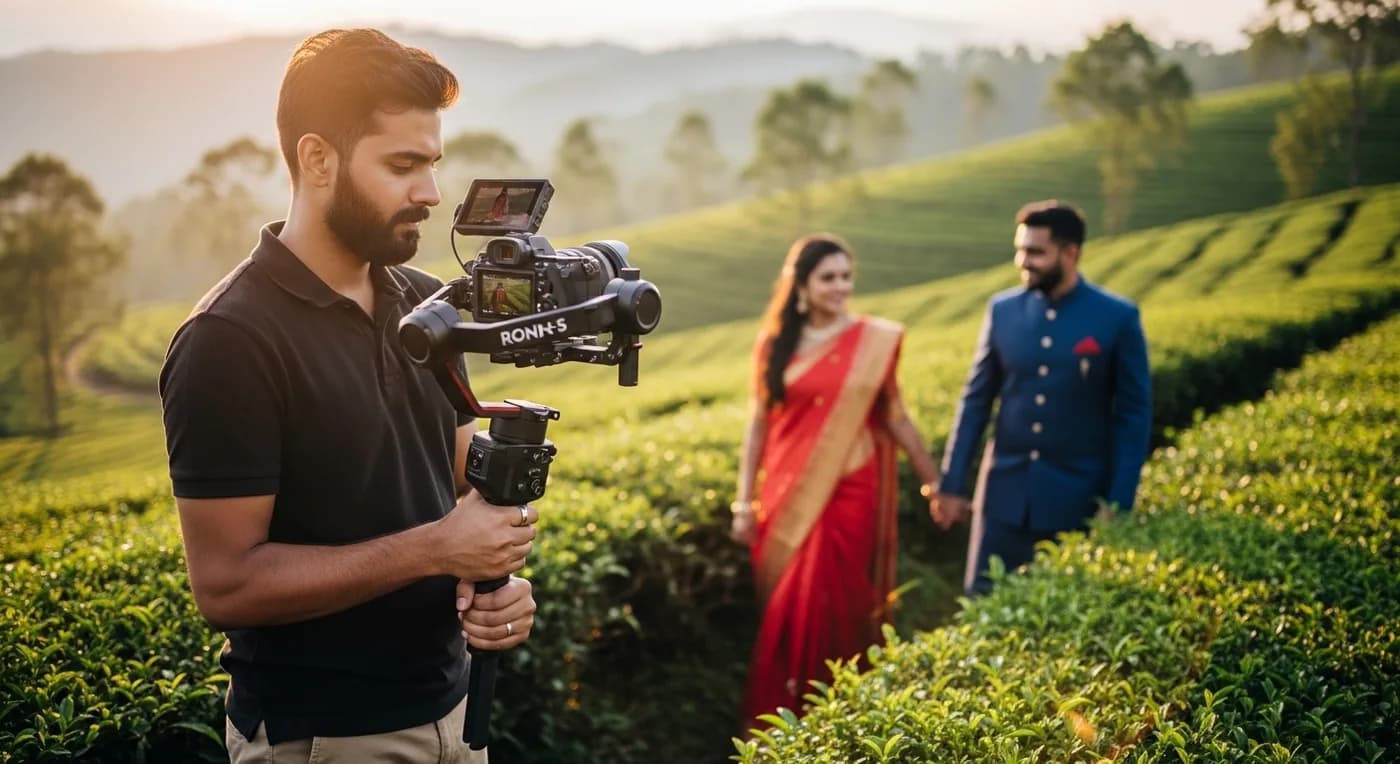
Gimbal stabilisation is essential. Handheld footage has its place in documentary work, but the majority of your wedding video should be smooth and controlled. A three-axis gimbal (DJI RS series, for example) eliminates the shaky, amateur look that ruins otherwise good footage. Watch the filmmaker's showreel specifically for movement quality.
Professional audio equipment matters enormously. Bad audio ruins a wedding video faster than bad image quality. Your filmmaker should use wireless lapel microphones on the couple and officiant, a shotgun microphone on-camera for ambient sound, and ideally a dedicated audio recorder for speeches and vows. If they rely solely on the camera's built-in microphone, walk away.
Drone quality varies widely. A DJI Mini 4 Pro produces acceptable aerial footage. A DJI Mavic 3 Pro or Inspire 3 produces cinematic aerial footage. Ask what drone they fly and whether they hold a DGCA Remote Pilot License.
Tip
The audio test: When watching a filmmaker's showreel, close your eyes for 30 seconds and just listen. Can you hear clear vows, crisp speeches, and well-balanced music? Or is it muffled dialogue drowned by a loud soundtrack? Audio quality reveals a filmmaker's true professionalism more honestly than any visual technique.
How to Evaluate a Showreel
A showreel is a filmmaker's curated best work. Here is how to look past the polish and assess whether they can deliver for your wedding.
Watch at least three complete wedding films, not just the showreel. Showreels cherry-pick the best 30 seconds from 50 weddings. Ask for full highlight reels from 2-3 recent weddings — ideally at venues or in conditions similar to yours. A filmmaker who has shot at the same Thrissur temple or Kochi hotel where your wedding is planned will already know the lighting challenges and best angles.
Assess consistency across different venues and lighting. A skilled filmmaker produces great footage in a dimly lit church in Kottayam and a sun-drenched outdoor ceremony in Alappuzha. If their work only looks good in one type of setting, they may struggle with your specific conditions.
Check the storytelling structure. A highlight reel should have a narrative arc — anticipation, ceremony, celebration, quiet emotional moments. If the edit is just a montage of pretty shots set to music with no emotional throughline, the filmmaker may be technically competent but narratively weak.
Look for real audio integration. The best wedding films weave in actual audio from the day — vows, toasts, a parent's blessing, laughter. If every film in their portfolio is wall-to-wall background music with no real audio, they either lack the equipment to capture it or the editing skill to integrate it.
Pay attention to colour grading consistency. Each film should have a coherent visual tone throughout. If the colour shifts randomly between warm and cool or between saturated and desaturated within the same film, the grading is sloppy.
Contract Essentials: Protect Yourself Before Booking
A verbal agreement is not a contract. Every wedding videography booking should be documented with these specific terms.
Deliverables list with specifications. Every output should be named with format, resolution, approximate duration, and delivery medium. "Highlight reel, 5-8 minutes, 4K MP4, delivered via Google Drive and USB drive" — not just "highlight video."
Delivery timeline with milestones. The contract should specify delivery dates for each item: teaser within 10 days, highlights within 8 weeks, full film within 12 weeks. Include a clause for what happens if the deadline is missed — a common provision is a 10-15% discount per week of delay.
Crew composition. Name the lead filmmaker and confirm they will be present on the day. Studios sometimes send junior team members when the lead is double-booked. Your contract should guarantee the specific team you vetted.
Backup equipment policy. What happens if a camera fails mid-ceremony? Professional filmmakers carry backup camera bodies, lenses, batteries, and memory cards. Ask about their redundancy plan and include it in the contract. The thalikettu cannot be re-shot.
Important
The backup clause is non-negotiable. I have personally witnessed a camera malfunction during a ceremony at a Palakkad venue where the filmmaker had no backup body. The couple lost 40 minutes of irreplaceable footage. Any filmmaker who does not carry a backup camera and duplicate memory cards is not ready for professional wedding work.
Raw footage ownership and retention. The contract should confirm that you receive all raw footage and specify how long the filmmaker retains their copy. A 6-12 month retention period is standard and provides a safety net.
Cancellation and postponement terms. Define refund percentages based on cancellation timing and include a free reschedule clause for genuine emergencies (illness, family bereavement, weather for outdoor weddings).
Usage rights. Most filmmakers will request permission to use clips in their portfolio and social media. This is reasonable and standard, but ensure you have the right to approve any footage they publish. Some couples prefer to restrict usage until after they have shared their own video — negotiate this upfront.
Ten Questions to Ask Before Booking
These questions will separate experienced professionals from those who are not ready for your wedding.
- How many weddings have you filmed in the last 12 months? Look for 15-30. Fewer suggests inexperience; significantly more suggests a volume operation where quality may suffer.
- Can I see three full highlight reels from recent weddings? Not showreel clips — complete films.
- Who exactly will be at my wedding? Get names and confirm the lead filmmaker.
- What is your backup equipment plan? They should describe specific redundancy measures without hesitation.
- How do you handle low-light ceremonies? Kerala temple interiors and evening receptions are challenging. Listen for specific technical responses (fast lenses, external lighting, high-ISO capable cameras).
- What audio equipment do you use? Wireless lapel mics and dedicated recorders are the correct answer.
- What is the exact delivery timeline for each deliverable? Vague answers ("a few months") are a red flag.
- Do you offer a same-day teaser or social media cuts? Essential in 2026.
- Have you worked at my specific venue before? Venue familiarity translates directly to better footage.
- What happens if you fall ill or have an emergency on my wedding day? They should have a named backup filmmaker with comparable skills.
Photo + Video Combo Packages vs. Hiring Separately
This is one of the most debated decisions in Kerala wedding planning, and the right answer depends on your priorities and budget.
Combo Packages: The Case For
Studios that offer both photography and videography under one roof provide several advantages. The team is coordinated — photographers and videographers who work together regularly do not step into each other's shots or compete for the same angle. Logistics are simpler with one point of contact. And pricing is typically 10-20% lower than booking equivalent quality separately.
Combo packages make the most sense in the budget and mid-range tiers, where the cost savings are meaningful and the quality gap between combo studios and specialists is narrow. Several established studios in Kozhikode, Thrissur, and Ernakulam deliver excellent combo packages in the 1,00,000-2,50,000 range.
Hiring Separately: The Case For
If cinematic videography is your top priority, hiring a specialist filmmaker often produces dramatically better results. The best wedding filmmakers in Kerala — the ones whose work genuinely feels like cinema — tend to be video-first specialists, not photography studios that added video as an upsell.
Hiring separately also gives you flexibility to allocate budget asymmetrically. You might choose a mid-range photographer and a premium filmmaker, or vice versa, based on which medium matters more to you.
The coordination challenge is real but manageable. Share both vendors' contact details, schedule a joint planning call 2-3 weeks before the wedding, and establish a simple protocol: the photographer leads during posed sessions, the videographer leads during ceremony coverage, and during candid moments they operate independently in designated zones.
Tip
The 60/40 rule for budget allocation: If you value video over photos (which is increasingly common in 2026), allocate 60% of your combined photo+video budget to videography and 40% to photography. If you value photos more, reverse it. Equal allocation often means both are mid-range when one could be exceptional.
Looking for Photographers in Thrissur?
Tell us what you need and get quotes from verified photographers
Trending Formats: What Couples Want in 2026
The way people consume wedding content has shifted dramatically, and your videography package should reflect how your video will actually be watched.
Instagram Reels and YouTube Shorts (15-60 seconds)
Vertical, punchy, emotionally concentrated. These micro-clips are how 80% of your friends and extended family will first experience your wedding video. The best reels focus on a single moment — the thalikettu with the reaction, the first dance, the bridal entry — with trending audio or your actual wedding audio. Your package should include 3-5 of these, delivered within 7-10 days.
WhatsApp-Friendly Clips
In Kerala's wedding ecosystem, WhatsApp remains the primary sharing platform. A 60-90 second video compressed to under 16MB that looks good on a phone screen is more practically useful than a 4K cinematic masterpiece that cannot be forwarded to your aunt in Dubai. Smart filmmakers now deliver a WhatsApp-optimised version of the teaser alongside the high-resolution file.
YouTube Wedding Trailers (2-3 minutes)
A cinematic trailer with theatrical pacing — title cards, dramatic music builds, slow-motion ceremony moments, and a satisfying emotional climax. This format has exploded in popularity in Kochi and Thiruvananthapuram, with couples creating private YouTube links to share with their full guest list. It serves as the definitive "announcement" video.
The Extended Cinematic Film (10-20 minutes)
This is the format you will watch on your fifth anniversary. It is the complete emotional narrative of your wedding day, edited with cinematic precision but retaining the authentic audio and moments that make it personal. Not everyone will watch the full version, but the people who do — you, your parents, your closest friends — will value it above all other formats.
Making Your Final Decision
Choosing the right wedding videographer comes down to three factors: emotional connection with their existing work, practical confidence in their professionalism, and realistic alignment between your budget and your expectations.
Start by watching films. Browse portfolios from filmmakers who work in your region and at your budget level. When a film makes you feel something — when you get emotional watching strangers' weddings — you have found a candidate worth meeting.
Meet in person or via video call. Discuss your wedding's specific details, your vision, and your non-negotiables. Pay attention to how they listen. A filmmaker who asks thoughtful questions about your story, your family, and your priorities will produce a more personal film than one who immediately jumps into package pricing.
Check references. Ask for contact details of two recent couples and actually call them. Ask about the day-of experience (was the team professional, unobtrusive, punctual?) and the delivery experience (were timelines met, were they responsive to feedback?).
Trust your instinct. If a filmmaker's portfolio is impressive but something about the interaction feels off — they are dismissive of your questions, vague about deliverables, or unwilling to put terms in writing — move on. Kerala has no shortage of talented wedding filmmakers, and you deserve one who treats your wedding with the significance it deserves.
Your wedding video will outlast the flowers, the sadya, and even the venue itself. Fifteen years from now, when you press play, it should transport you back to exactly how that day felt. That is what great wedding videography delivers, and it is worth the time and investment to get it right.
Common Questions About Kerala Wedding Videography
What does wedding videography actually cost in Kerala in 2026?
Wedding videography in Kerala spans ₹25,000-₹50,000 for budget packages with a single videographer and basic editing, ₹75,000-₹1.5 lakhs for mid-range packages with two videographers and a proper cinematic highlight reel, and ₹2-5 lakhs for luxury cinematic productions with multi-day coverage, drone footage, scripted narratives, and custom music scoring. Mid-range packages offer the strongest value for most couples — professional audio, gimbal-stabilised footage, and polished highlight reels at a quality level that translates well across family WhatsApp shares and social media posts. Same-day edits add ₹30,000-₹75,000 to any tier.
Should I prioritise video over photography in my budget?
This is personal, but the 2026 trend is clear: couples increasingly rank video as the more valuable long-term medium. Video captures motion, audio, and emotional build-up in ways that photos cannot — you get to hear your mother's voice during the blessing, the tremor of your partner's vows, the live energy of the chenda melam procession. That said, photography delivers the iconic single frames that get framed on walls and printed in albums. The ideal approach is meaningful investment in both, with a slight budget tilt (60/40) toward whichever medium you personally value more. Equal split often means both are mid-range when one could be exceptional.
What is a same-day edit and is it worth the extra cost?
A same-day edit (SDE) is a 3-5 minute cinematic video of your wedding morning, edited live at the venue and screened at the evening reception. It requires a dedicated editor working in a makeshift setup while the wedding is still happening. It costs an additional ₹30,000-₹75,000 on top of your videography package. SDEs create a powerful emotional moment for reception guests — watching the thali-tying or sadya moments on a big screen hours later is genuinely memorable. But it's only worthwhile if your filmmaker has a proven SDE track record. Ask for examples of 2-3 previous same-day edits before adding this to your package.
How far in advance should I book my videographer?
For peak wedding season (October-February) in Kerala, book 6-9 months in advance. Top-tier filmmakers in Kochi and Thiruvananthapuram are often booked 10-12 months out for auspicious dates. Off-season weddings offer more flexibility, but even then, 3-4 months of advance booking is advisable to secure your preferred filmmaker and allow time for pre-wedding planning sessions. Mid-range filmmakers typically accept bookings 4-6 months out for peak dates. The best filmmakers who produce cinematic work rivaling international standards are often booked further ahead than photographers because video production quality has become a bigger marketing differentiator.
Can I request edits or modifications to the final wedding video?
Most filmmakers include one round of revisions in their contract — typically adjustments to music choice, clip selection, or sequence order. Major re-edits requiring complete style changes or colour-grade overhauls usually incur additional charges of ₹15,000-₹50,000 because they require significant rework. Discuss the revision policy explicitly before signing, and get the number of included revisions documented in writing. The best way to avoid dissatisfaction is thorough pre-production communication: share reference videos you love, discuss your preferred music style and pacing, and align on the narrative approach before a single frame is shot. An hour of upfront alignment prevents days of post-production friction.
Tip
Plan your wedding with free tools — try our AI Wedding Checklist for a personalised timeline, or use the Cost Calculator to estimate your budget.
Looking for Photographers in Thiruvananthapuram?
Tell us what you need and get quotes from verified photographers
Topics
wedding videography Keralacinematic wedding film Keralawedding video cost Keraladrone wedding videographysame-day edit weddingwedding filmmaker Keralawedding highlights reelKerala wedding video packagesExplore more
Frequently Asked Questions
1How much does wedding videography cost in Kerala in 2026?
2Should I hire separate photographers and videographers or book a combo package?
3What is the difference between cinematic and documentary wedding videography?
4How long does it take to receive wedding videos after the event?
5Is drone videography allowed at Kerala wedding venues?
Continue reading
Related Articles
Kerala Wedding Photography Cost: Packages and What to Expect in 2026
Top 15 Wedding Photographers in Kerala (2026): Portfolios, Pricing & Reviews
How to Choose a Wedding Photographer in Kerala: The Complete 2026 Guide
Candid Wedding Photography Cost in Kerala: 2026 Package Guide
Temple Wedding Photography in South India: Rules, Tips & Restrictions by Temple
Best Season for South India Destination Weddings: Month-by-Month Western Ghats Guide
Still planning?
Get quotes from India's best vendors
Tell us what you're planning and we'll match you with verified photographers, venues, decorators, and more.
Get free quotes