
How to Choose a Wedding Photographer in Kerala: The Complete 2026 Guide
Choose the right Kerala wedding photographer — portfolio evaluation, candid vs traditional styles, contracts, pricing tiers, and planning your coverage.

Senior Wedding Planner
Priya Nair is a senior wedding planner based in Kochi with over eight years of experience coordinating Hindu, Christian, and destination weddings across Kerala.
On this page
Budget ₹80,000–1.5 lakh for a quality mid-range photography team in Kerala; premium studios charge ₹2–3.5 lakh and top cinematic teams run ₹3.5–6 lakh for single-day coverage. Kerala-specific challenges include 90-second Thalikettu ceremonies, photography bans inside Guruvayur Temple sanctum, and coastal salt air damaging equipment. Book 6–9 months ahead — Kochi and Trivandrum studios fill peak weekends a year in advance.
Quick Answer
Quick answer: Budget ₹80,000–1.5 lakh for a quality mid-range photography team in Kerala; premium studios charge ₹2–3.5 lakh and top cinematic teams run ₹3.5–6 lakh for single-day coverage. Kerala-specific challenges include 90-second Thalikettu ceremonies, photography bans inside Guruvayur Temple sanctum, and coastal salt air damaging equipment. Book 6–9 months ahead — Kochi and Trivandrum studios fill peak weekends a year in advance.
Note
Pricing methodology: Cost ranges in this guide are based on vendor pricing data from the itsmy.wedding marketplace and published industry reports, collected in Q4 2025 – Q1 2026.
Of every vendor you hire for your wedding, only one produces something you will reach for 25 years later. The caterer feeds your guests for an afternoon. The florist transforms the mandap for a few hours. The photographer creates the permanent record of your family's most emotionally charged day. A missed thalikettu moment, a blown-out portrait under midday sun, or a poorly timed blink during the couple's first look — these are losses with no second chance.
In an industry now worth ₹10.79 lakh crore nationally, couples are spending more on photography than ever before — yet Kerala weddings compound this pressure with challenges found almost nowhere else in India. Ceremonies move fast — a Hindu thalikettu can conclude in under 90 seconds. Temples like Guruvayur prohibit photography inside the sanctum entirely. Coastal venues in Alappuzha and Varkala punish unprotected equipment with salt air and sand. Monsoon-season weddings in Wayanad or Munnar shift from golden light to torrential rain within minutes. This guide walks you through everything — from understanding photography styles and evaluating portfolios to briefing your team, planning the timeline, and negotiating the contract.
Understanding Candid vs Traditional Photography
Candid and traditional photography are complementary approaches, not opposing styles. Most Kerala couples in 2026 prefer a 70/30 blend — roughly 70% candid coverage throughout the day with 30% traditional setups at specific moments.
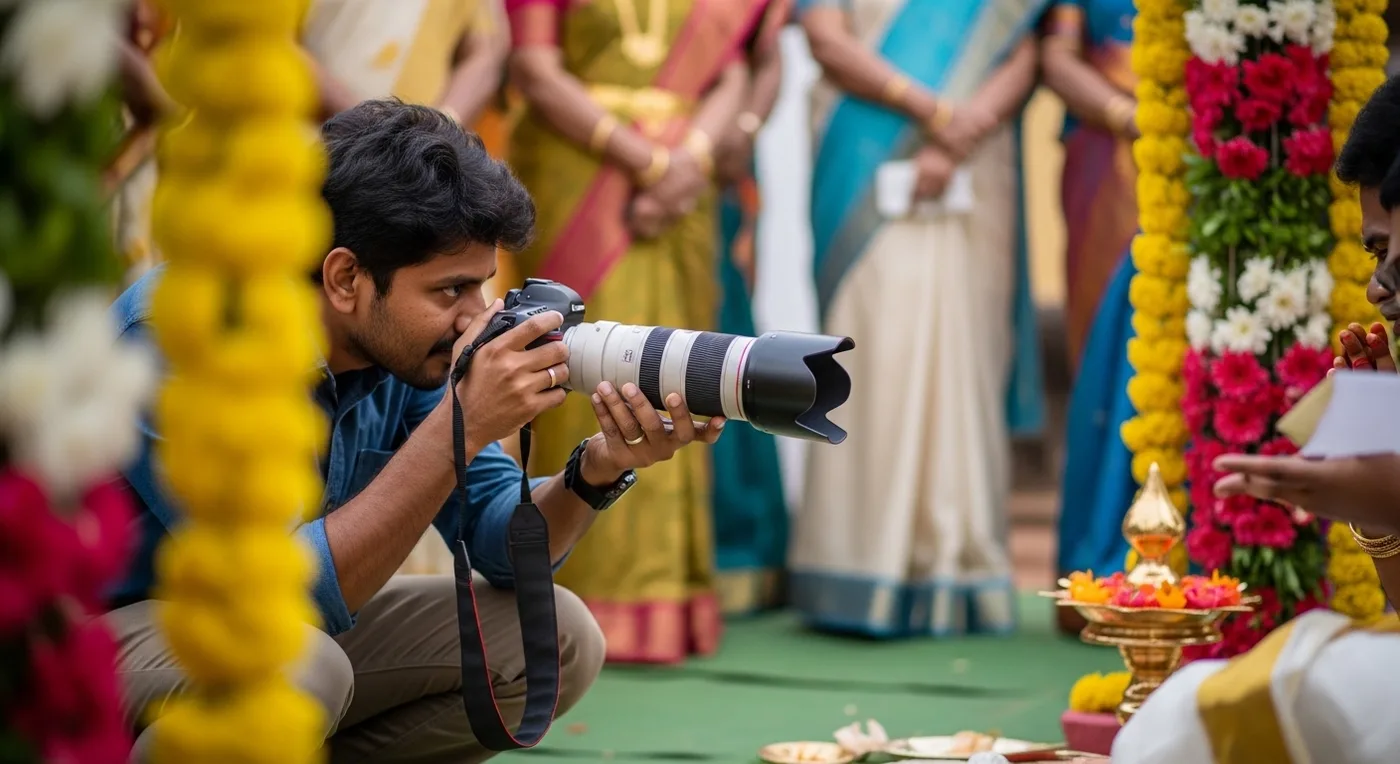
Candid photography is observational. The photographer uses long lenses and situational awareness to capture moments as they unfold naturally. Nobody is asked to look at the camera or repeat an action. It excels at reactions: your father's trembling hand during the mala ceremony, your best friend's open-mouthed laugh on the dance floor.
Traditional photography is directed. The photographer arranges subjects, controls lighting, and composes deliberate frames for family group portraits, formal blessings, and ritual close-ups. It activates for family group shots (a focused 30-45 minute window after the ceremony), formal elder blessings, and specific posed frames.
Certain moments work decisively better in one style. The bride's first mirror look, the groom's arrival procession, children's spontaneous reactions, and the dance floor are inherently candid territory — posing kills their energy. Conversely, the extended family portrait, the formal blessing shot, and post-ceremony group shots demand traditional direction to ensure everyone is included.
What Does Kerala's Photography Market Look Like in 2026?
Kerala supports one of the densest concentrations of professional wedding photographers per capita in India, driven by a cultural emphasis on elaborate weddings and serious investment in visual documentation. With the national average wedding cost reaching ₹29.6 lakh and guest lists averaging 330 people, the demand for professional photography teams has never been higher.
₹50,000 – ₹6,00,000For a curated shortlist of the best studios and freelancers across budget tiers, see our top wedding photographers in Kerala. The market divides into three segments. Studio-based teams — firms clustered in Kochi's Panampilly Nagar and Trivandrum's Kowdiar — operate with in-house editing teams, branded packaging, and multi-photographer rosters. They offer consistency and accountability but start above 1,50,000 for single-day coverage. Freelance photographers have exploded in numbers, many technically skilled shooters who left studios to offer leaner pricing in the 80,000-1,50,000 range. The third segment is the cinematic videography-first studio, which prioritises the wedding film as the primary deliverable and treats photography as complementary.
Geographically, Kochi and Thiruvananthapuram remain the two major hubs, with Kozhikode emerging as a strong third market for Malabar weddings. Price differentials between districts are real: a team charging 2,00,000 for a Kochi wedding may quote 1,60,000 for the same scope in Thrissur or Palakkad. Destination weddings in Munnar, Kumarakom, or Wayanad carry a 15-25% surcharge for travel and logistics.
How Do You Evaluate a Photographer's Portfolio?
A photographer's portfolio is their primary sales tool, curated ruthlessly. Your job is to look past the curation and evaluate their true capability across an entire wedding day.
Ask for complete wedding albums, not curated highlights. Request 3 full galleries from events similar in scale and venue type to yours. This reveals how they perform from quiet morning preparation through chaotic group photos to low-light receptions.
Check consistency across 5 or more weddings. A photographer who delivers beautifully at a Kumarakom resort but poorly at a Thrissur convention centre performs well only under ideal conditions. Look for even quality across varied environments.
Evaluate Kerala-specific competence:
- Temple interiors — Low light, restricted flash, fast rituals. Do their temple shots demonstrate mastery of available-light technique?
- Beach venues — Harsh midday glare, reflective water. Are outdoor portraits well-exposed, or does the background blow out?
- Evening receptions — Mixed artificial light, coloured LED stages. Do skin tones hold up, or does everyone look orange?
Scrutinise skin tone accuracy. Heavy-handed editing that lightens skin uniformly or applies a single colour grade regardless of complexion signals a photographer who applies presets rather than editing with care.
Assess the candid-to-posed ratio. A ratio of roughly 70-30 candid-to-posed is standard for modern Kerala wedding photography. Portfolios dominated by stiffly arranged group shots may not match current expectations.
Check editing style consistency. If the colour palette shifts wildly between weddings, the photographer likely outsources to different editors — not inherently bad, but worth asking about.
Tip
The Album Test: Any photographer can show you 50 stunning images. Ask to see 3 complete wedding albums from start to finish. This reveals their consistency, how they handle difficult moments (crowded ceremonies, poor lighting), and whether every part of your day will be beautifully documented.
What Are Kerala's Unique Photography Challenges?
Kerala's geography, climate, and temple culture create specific challenges that photographers from outside the state often underestimate. Hiring someone with local experience is not a preference — it's a practical necessity.
Temple Restrictions
Guruvayur Sri Krishna Temple — one of the most popular wedding venues in Kerala — strictly prohibits photography inside the sanctum. The thalikettu happens beyond the photography boundary, meaning no direct shots of the tying. Experienced photographers position themselves at the threshold to capture the couple emerging. Other major temples in Thrissur, Palakkad, and Thiruvananthapuram have varying restrictions: some prohibit flash, others restrict access zones, and many forbid drone use.
Important
Temple Photography Reality: Guruvayur temple strictly prohibits photography inside the sanctum. Many other Kerala temples restrict flash photography and drone use. If your ceremony is at a temple, hire a team that has shot there before and knows exactly where to position for the best shots from allowed areas.
Beach and Backwater Conditions
Alappuzha, Varkala, Kovalam, and Marari attract couples seeking dramatic waterfront settings, but salt air corrodes equipment, sand infiltrates lens barrels, and reflective water creates extreme dynamic range challenges. Wind disrupts hair and lightweight fabrics constantly, demanding burst shooting to catch the split-second where everything falls into place. The golden hour along Kerala's west coast arrives between 5:30 and 6:15 PM during peak season — a narrow window that a good photographer will plan around.
Humidity and Monsoon Contingency
Kerala's humidity regularly exceeds 85%. Lenses fog instantly when moving from air-conditioned rooms to outdoor courtyards — a photographer unfamiliar with this will waste 5-10 minutes while your ceremony continues. For monsoon-season weddings, discuss contingency explicitly: covered shooting areas, readiness for dramatic rain portraits, and prior experience shooting through heavy rain.
Multi-Venue Logistics
Many Kerala weddings involve a morning temple ceremony followed by a separate reception — sometimes 90 minutes away. The photography team needs relocation time, equipment reset, and lighting adjustment. Discuss logistics explicitly and build at least 30 minutes of buffer beyond raw travel time into your schedule.
How Should You Brief Your Photography Team?
The photographer briefing is the most consequential planning conversation you will have for your wedding visuals. Do not leave it to a casual phone call. Here is what to share and discuss.
Share a detailed day timeline. Your photographer needs minute-by-minute timing for the ceremony and hour-by-hour overview for everything else. Include venues with addresses, the specific hall for each event, and transitions between locations. If the muhurtham is fixed at 11:17 AM, the team needs to be in position by 10:45 AM.
Create a visual reference board. Assemble 10-15 Pinterest or Instagram references that represent your desired look — choose images shot in conditions similar to yours, not aspirational fantasy from Tuscan villas. Include 2-3 "anti-reference" images showing styles you dislike (heavy filters, overly dark editing).
List priority moments and people. Name the 15-20 moments that must be captured and the specific individuals who matter most. Provide photos of key family members so the photographer can recognise them on the day. Your photographer cannot know that your grandmother is the most important person at the wedding unless you say so.
Share family dynamics. If parents are divorced and should not be in the same frame, the photographer needs to know before the family portrait session. If a grandparent may leave early due to health, flag that.
Discuss venue specifics. Share photos of each space, note lighting conditions, venue restrictions (some temples restrict flash, some churches have designated photographer zones), and the best spots you have noticed.
Schedule a pre-wedding walkthrough 2-3 weeks before the wedding. Walk through the timeline, confirm logistics, and align on communication protocols for the day.
Tip
The Shot List Trick: Create two lists — a 'Must Have' list of 15-20 essential moments, and a 'Nice to Have' list of 10-15 extras. This gives your photographer clear priorities without overwhelming them. Share both lists 2 weeks before the wedding.
Looking for Photographers in Kochi?
Tell us what you need and get quotes from verified photographers
What Does the Photography Day Timeline Look Like?
A well-structured timeline prevents the two most common disasters: rushing through couple portraits because the ceremony ran late, and missing golden hour entirely. Here is an hour-by-hour template for a typical Kerala Hindu wedding with a morning ceremony and evening reception.
| Time | Event | Photography Focus | Lighting Notes |
|---|---|---|---|
| 6:00 - 8:00 AM | Bride getting ready | Mehendi details, saree draping, jewellery close-ups, mother-daughter moments | Soft indoor light; position near windows |
| 7:00 - 8:00 AM | Groom getting ready | Mundu tying, accessories, candid banter with brothers | Indoor light; 45-60 minutes sufficient |
| 8:00 - 8:30 AM | Pre-ceremony portraits | First look, private couple moments before the crowd | Early morning golden light |
| 8:30 - 9:00 AM | Groom's arrival | Chenda Melam procession, family welcome | Outdoor; potentially harsh, backlit shots work well |
| 9:00 - 11:30 AM | Ceremony | Thalikettu, mala exchange, parents' reactions, elder blessings | Temple interiors; often dim, fast lenses required |
| 11:30 AM - 12:15 PM | Family portraits | Group shots by family side, elder portraits | Shaded outdoor or controlled indoor |
| 12:15 - 1:30 PM | Sadya / lunch | Feast candids, banana leaf details, guest interactions | Indoor hall lighting |
| 1:30 - 4:00 PM | Break | Venue detail shots, decor, invitation flat-lay | Midday too harsh for portraits |
| 5:30 - 6:15 PM | Golden hour portraits | Romantic couple session in best natural light | Warm, directional, premium portrait window |
| 6:30 - 9:30 PM | Reception | Grand entrance, cake cutting, toasts, dance floor candids | Mixed artificial lighting |
Important
Golden Hour Alert: Kerala's golden hour varies by season — roughly 5:30-6:15 PM in winter and 6:00-6:45 PM in summer. Plan your couple portraits around this window. If your ceremony runs late, communicate with your photographer so they can adapt.
Budget 2-3 hours for the bride's preparation — this is an emotional narrative arc, not just makeup documentation. For the groom, 1 hour is typical but do not skip it; some of the most authentic candid moments come from groom prep. For couple portraits, block 30-45 minutes during golden hour exclusively — do not let anything encroach on this window.
What Are the Must-Capture Moments at a Kerala Wedding?
Every experienced Kerala wedding photographer has a mental list of moments they never miss. Here is what that list looks like across the day's major phases.
Getting Ready: Bride's hands with fresh mehendi, mother helping drape the saree, jewellery going on piece by piece (jimikki kammal, manga mala), first complete look in the mirror, father seeing his daughter as a bride.
Ceremony: Groom's Chenda Melam arrival (particularly dramatic in Thrissur and Palakkad weddings), the thalikettu from multiple angles, parents' tears during this moment, garland exchange, hand-holding, elder blessings, the couple's expressions when the ceremony ends and relief floods in.
Between Events: The laughter when formality lifts, nervous glances during sadya, children running oblivious through the venue, old friends reuniting. These transitions often produce the most treasured images.
Reception: Grand entrance, first dance (increasingly popular in Ernakulam and Kozhikode), cake cutting, toast reactions, the uncle who dances with abandon, the grandmother pulled onto the floor by grandchildren.
Details: Wedding invitation flat-lay, floral arrangements, sadya food presentation, mandap decor, rings, and any personalised touches.
How Much Does Wedding Photography Cost in Kerala?
The pricing spread is wide, driven primarily by team size, post-production investment, and equipment quality. Here is a breakdown by tier.
₹80,000 – ₹3,50,000| Tier | Team Size | Coverage | Key Deliverables | Price Range (2026) |
|---|---|---|---|---|
| Budget | 1-2 people | 6-8 hours, single day | 300-500 edited photos, highlight reel (2-3 min), digital only | 50,000 - 80,000 |
| Mid-Range | 2-3 people | 8-12 hours, single day | 600-1,000 photos, cinematic highlight (3-5 min), ceremony video, 1 album | 80,000 - 1,50,000 |
| Premium | 3-5 people | Full day or multi-day | 1,000-1,500 photos, cinematic film, drone, same-day edit, 2 albums | 1,50,000 - 3,50,000 |
| Luxury | 5-8 people | Multi-day, multi-venue | 1,500-2,500+ photos, feature-length film, pre-wedding shoot, coffee-table album | 3,50,000 - 6,00,000+ |
What drives cost differences? A mid-range team spends 10 hours on-site but 40-60 hours on culling, colour grading, and retouching. A premium team invests 80-120 hours in post-production. Equipment matters too: a professional full-frame body with glass costs 3-5 lakhs per camera, and a serious team carries three or four bodies plus drones, gimbals, and audio gear.
Hidden costs to watch for:
- Travel and accommodation — adds 5,000-15,000 per day for out-of-city venues
- Album upgrades — additional pages or larger size cost 5,000-20,000 extra
- Overtime — 2,000-5,000 per additional hour
- Expedited delivery — premium for faster-than-standard turnaround
Note
Budget Allocation Rule: Wedding planners across Kerala recommend allocating 12-18% of your total wedding budget to photography and videography combined. On a 15,00,000 budget, that means 1,80,000-2,70,000 — enough for a solid Full Crew package with cinematic video.
How Many Photographers Do You Need?
The right team size depends on your guest count, venue complexity, and whether parallel events require simultaneous coverage.
| Wedding Size | Guests | Photographers | Videographers | Assistants | Total Team |
|---|---|---|---|---|---|
| Intimate | Under 150 | 1 | 1 | 0-1 | 2-3 |
| Standard | 150-400 | 2 | 1 | 1 | 4 |
| Large | 400-700 | 2-3 | 2 | 1-2 | 5-7 |
| Grand | 700+ | 3-4 | 2-3 | 2 | 7-9 |
The Standard tier is the most common Kerala wedding configuration. The second photographer covers parallel events (bride and groom prep), provides a second ceremony angle, and shoots guest reactions. For large Thrissur or Kozhikode weddings with multiple stages and a dedicated sadya area, a third photographer ensures no moment is missed.
Tip
The Second Shooter Difference: The gap between 1 and 2 photographers is the single biggest quality jump in wedding photography. A second photographer captures the groom's reaction while the lead focuses on the bride's entrance, shoots guest reactions during the ceremony, and provides a backup perspective on every critical moment. If your budget is tight, prioritise adding a second photographer over upgrading the album.
What Questions Should You Ask During the Consultation?
Once you have shortlisted 3-5 candidates, the consultation becomes your most important evaluation tool. These questions separate a thorough interview from a superficial one.
- Have you shot at my specific venue before? Venue familiarity — knowing the lighting traps, best portrait locations, and coordinator's preferences — is worth more than almost any other qualification.
- What is your backup plan if you fall ill? The answer should be a specific named photographer. Vague responses are disqualifying.
- How many weddings do you shoot per weekend during peak season? One per day is ideal; two per weekend is the maximum for consistent quality.
- Can I see a complete recent wedding gallery? A confident photographer shares without hesitation. Reluctance is a red flag.
- What happens if equipment fails mid-event? Expect backup bodies, flash units, and dual card slots. The failure should be invisible to you.
- Do you edit in-house or outsource? Neither is wrong, but ask to see work from the specific editor who will handle your files.
- How do you handle large family group photos? Kerala weddings often require formal shots with 20-50 people. A good photographer has a system — designated time, scouted location, confident crowd management.
- What is your turnaround time? Standard in 2026: teaser in 48-72 hours, full gallery in 4-8 weeks, cinematic video in 8-12 weeks.
- Will you personally shoot my wedding? Studios occasionally reassign to junior photographers during peak season. Confirm the lead in writing.
- What is your image backup protocol? Images should be written to dual cards simultaneously and backed up to a separate drive the same evening.
What Should the Contract Include?
Every agreement should be in writing. If someone resists putting terms on paper, they are either disorganised or intentionally keeping commitments vague. Here is what a thorough contract covers.
| Contract Clause | What to Look For | Red Flag |
|---|---|---|
| Team Composition | Named individuals with defined roles (lead, second shooter, videographer) | "We'll send our best available team" — no names |
| Coverage Hours | Specific start/end times, overtime rate per hour | Vague "full day coverage" without defined hours |
| Deliverables | Minimum number of edited photos, video lengths, file formats | "All the best shots" with no minimum specified |
| Delivery Timeline | Teaser in 48-72 hours, gallery in 4-8 weeks, video in 8-12 weeks | No timeline commitment |
| Album Specs | Size, page count, paper type, number of copies, revision rounds | Album promised but specs left vague |
| Backup Equipment | Second camera body minimum, backup flash, dual card slots | Single camera body, no backup plan |
| Raw Files | Clear policy on unedited file access | Ambiguity or refusal to discuss |
| Cancellation Terms | Graduated refund schedule (75% at 90+ days, 50% at 60 days) | No refund under any circumstances |
| Usage Rights | Mutual: they use for portfolio with consent, you print and share freely | Photographer claims exclusive rights |
| Travel Costs | Who covers transport, fuel, hotel for destination weddings | Costs excluded but not discussed until after booking |
Note
Raw Files Clause: Most studios do not provide raw (unedited) files as standard. If having raw files matters to you, negotiate this before signing. Some studios offer them for 10,000-25,000 extra, while others refuse as creative policy.
Looking for Photographers in Trivandrum?
Tell us what you need and get quotes from verified photographers
What About Pre-Wedding Shoots?
Beyond producing images for invitations and social media, the pre-wedding shoot serves as a rehearsal — you build camera comfort, and the photographer learns how you move and interact naturally.
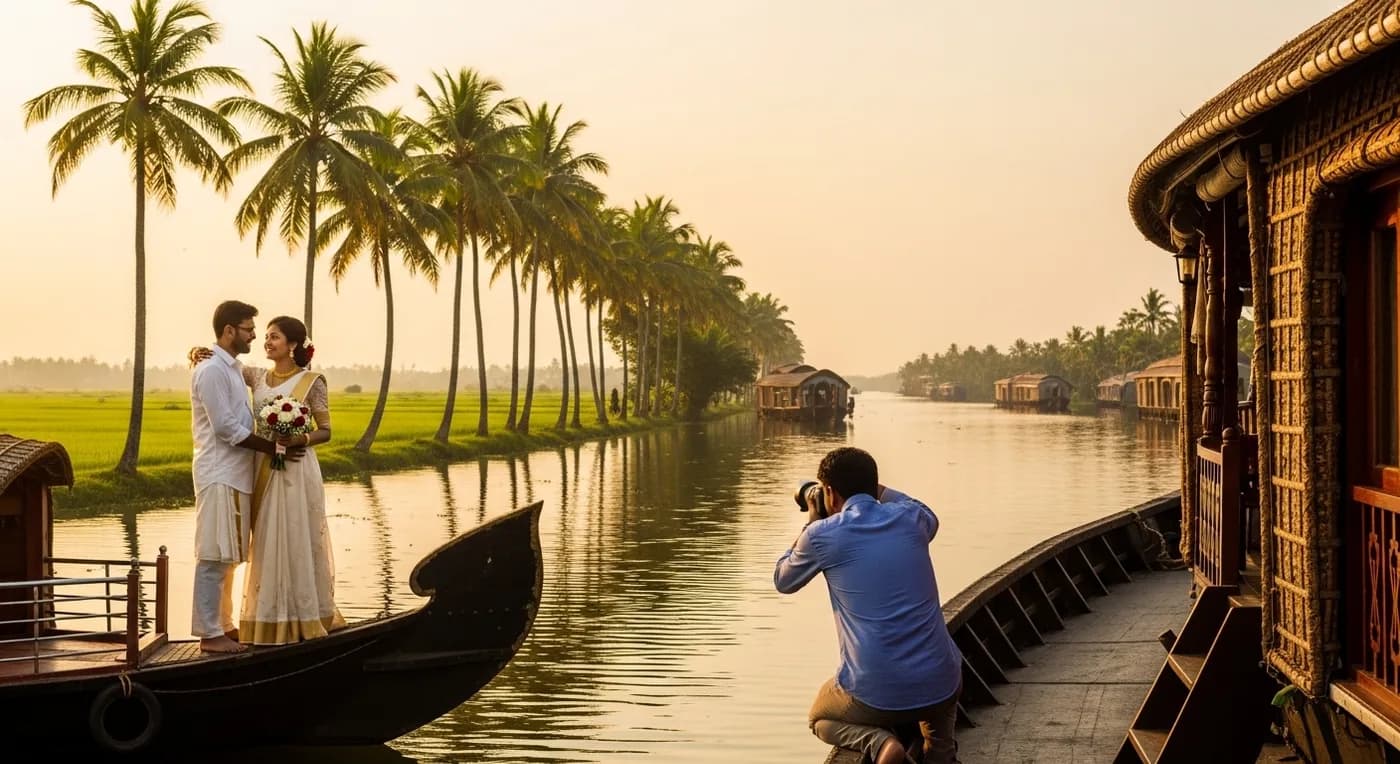
Best locations by region: Fort Kochi streets and Chinese fishing nets (most popular in the state for visual variety within a 2-km radius), Munnar tea gardens and Top Station mist (best September-February), Athirapally waterfalls (shoot before 9 AM to avoid crowds), Alappuzha backwaters and houseboat shoots on a decorated kettuvallam, Varkala's red laterite cliffs over the Arabian Sea, and Wayanad forests around Banasura Sagar and Kuruva Island. For Kochi-specific options with detailed location guides, see our pre-wedding shoot locations in Kochi.
Tip
Location Permits: Popular spots like Athirapally Falls and Fort Kochi heritage sites may require photography permits (500-2,000). Your photographer should handle this, but confirm it's included in their package.
Plan 2-3 outfit changes that coordinate with your backdrop. Rich colours — deep reds, emerald greens, royal blues — photograph well against Kerala's greenery. One traditional outfit (saree and mundu) and one contemporary look gives the album range. Duration runs 4-6 hours for a single location, a full day for multi-location sessions.
₹15,000 – ₹75,000A local shoot with one outfit runs 15,000-25,000. A destination shoot at Munnar or Alappuzha with 2-3 outfits and full-day coverage runs 50,000-75,000. Bundled pre-wedding + wedding packages typically save 15-20%.
What Video Styles Are Available?
Video has become nearly as important as photography for Kerala couples in 2026. Understanding the options helps you choose the right format — and negotiate accurately.
| Style | Duration | Best For | Price Range |
|---|---|---|---|
| Cinematic Highlight | 5-8 minutes | Social sharing, emotional impact, rewatching | 60,000 - 1,50,000 |
| Cinematic Feature | 15-30 minutes | Complete narrative storytelling | 1,00,000 - 2,50,000 |
| Documentary | 20-45 minutes | Authenticity, family interviews | 80,000 - 2,00,000 |
| Highlight Reel | 3-5 minutes | Social media, reception screening | 30,000 - 80,000 |
| Traditional Full-Length | 1-3 hours | Archival record, extended family | 40,000 - 80,000 |
Cinematic film is the most popular format — it tells your wedding day as a narrative using selective footage, background music, and intentional pacing. A 5-minute highlight requires 30-40 hours of post-production from 6-10 hours of raw footage. Documentary style takes a chronological, less-edited approach with natural audio and sometimes family interviews. Traditional video is the full-length ceremony recording — limited rewatchability but valued by older relatives as a complete archival record.
₹50,000 – ₹3,00,000What About Same-Day Edits, Drones, and Other Technology?
Technology has reshaped what is possible at a Kerala wedding in 2026. Not every option is worth the cost, but understanding them helps you decide.
Same-day edits (SDE) are the prestige offering. A dedicated videographer-editor captures morning footage and produces a 3-5 minute cinematic film screened at the evening reception. The emotional payoff is genuine, but only commit if the studio has proven SDE experience — ask to see 3-4 previous examples. Cost: 30,000-75,000 extra.
Drone coverage is now standard at the Premium tier and above. Most valuable for outdoor weddings — backwater venues in Alappuzha, hillside ceremonies in Wayanad, beach setups in Kovalam. DGCA regulations require registered drones and licensed pilots; confirm your studio handles compliance.
AI-enhanced editing has reshaped post-production. AI culling tools sort through 10,000+ raw images in minutes, and AI colour grading maintains consistency across wildly different lighting. Studios using AI workflows deliver social media previews within 3-5 days instead of the previous 7-14 day standard.
Live streaming for overseas family across the Gulf, US, and UK uses dedicated cameras and proper audio feeds. Professional setups run 15,000-35,000.
Instant photo booths with digital sharing (QR-code downloads, GIFs, green-screen backdrops) serve as reception entertainment. Budget 20,000-45,000 for a 3-4 hour setup.
What Album and Delivery Options Should You Choose?
Understanding delivery formats and timelines prevents surprises and helps you negotiate the right package from the start.
Digital gallery: Delivered through Pic-Time, Pixieset, or the studio's portal. Galleries remain active for 6-12 months — download every full-resolution image to your own storage before expiry.
Printed albums:
| Album Type | Pages | Feel | Price Range |
|---|---|---|---|
| Photobook | 40-60 | Magazine-like, lightweight | 8,000 - 15,000 |
| Layflat | 30-50 | Clean spreads, no gutter loss | 15,000 - 25,000 |
| Flush Mount | 30-60 | Premium weight, seamless spreads | 25,000 - 45,000 |
| Coffee Table Book | 50-80 | Archival quality, family heirloom | 40,000 - 60,000 |
Flush mount is the most popular choice in Kerala. Parent albums (smaller duplicates for both families) run 10,000-18,000 each. Canvas prints and wall art of your best portrait range from 5,000-15,000 depending on size.
Delivery timelines: Social media previews in 3-7 days, full gallery in 4-8 weeks, highlight video in 6-10 weeks, cinematic film in 10-14 weeks, physical albums 4-6 weeks after photo selection. Studios using AI-assisted workflows are hitting the faster end of these ranges.
₹15,000 – ₹60,000Red Flags: When Should You Walk Away?
Not every photographer deserves your booking, regardless of how polished their Instagram looks. Watch for these warning signs.
No written contract offered. If someone resists putting terms in writing, they are either disorganised or intentionally keeping commitments vague.
Refusal to show complete albums. Unwillingness to share a full delivered gallery usually means their consistency does not hold across an entire wedding day.
Important
The Instagram Trap: Don't judge a photographer solely by their Instagram feed — those are their absolute best 1% of images, often from multiple weddings and with extensive editing. Judge them by complete albums from real weddings.
Pricing 40%+ below market rate. Common explanations: junior associates instead of the lead, older equipment, outsourced editing, or an overcommitted calendar. Ask specifically who will shoot your wedding.
Overpromising on delivery. Professional culling, grading, and retouching for 800-1,200 images takes 40-80 hours. A promise of 10-day delivery deserves scepticism.
No backup plan. "It has never happened to me" is not a contingency strategy.
Portfolio contains others' work. Reverse-image-search portfolio shots if something feels inconsistent. If they present others' work as their own, every claim is suspect.
Full payment demanded upfront. Standard practice is 25-40% advance, with the remainder split before the wedding and upon delivery.
How Do You Book and Negotiate the Best Deal?
When to Book
The Kerala wedding season peaks November through February — part of a nationwide surge that sees 4.6 million weddings and ₹6.5 lakh crore in spending during the November–December window alone. Top Kochi and Trivandrum studios fill peak-season weekends 9-12 months ahead. Mid-range photographers book out 6-9 months. If your wedding is in peak season, begin searching at least 8 months before your date. Off-peak weddings (April through September) offer more flexibility at 3-5 months.
How to Negotiate
Weekday weddings — most photographers offer 15-20% below weekend rates. Off-season dates — monsoon-season discounts of 15-25% are standard. Multi-event bundling — booking engagement, wedding, and reception together saves on acquisition costs. Album opt-out — if you prefer digital-only delivery, negotiate 10,000-25,000 off in lieu of the physical album.
Tip
Negotiation Leverage: If your wedding is on a weekday, during monsoon season, or you're booking multiple events (engagement + wedding + reception), you have negotiation power. Most photographers offer 15-25% discounts for off-peak dates.
Recommended Payment Schedule
- 25-30% advance at contract signing (secures your date)
- 40-50% second instalment one week before the wedding
- 20-30% final payment upon delivery of complete gallery and video
Common Photography Planning Mistakes to Avoid
Not meeting the photographer before the wedding day. Booking based on an Instagram portfolio and a WhatsApp chat, then meeting the team for the first time on your wedding morning, is a gamble. Studios in Ernakulam and Thrissur increasingly offer complimentary pre-wedding consultations — take them.
Forgetting to flag key people. Every unnamed priority person is a potentially missed moment. Provide photos of the 10-15 most important people along with your shot list.
Over-scheduling with no breathing room. Build 15-20 minute buffers between major events. These gaps become the windows where authentic interactions happen — and where your photographer captures the images you did not know you wanted.
Not planning for weather. Kerala's weather is unpredictable outside the December-February dry window. Discuss rain contingency plans: covered backup locations, clear umbrellas (they photograph beautifully), and acceptance that some of the most dramatic wedding images are shot in the rain.
Choosing based on price alone. Photography is the one wedding expense that compounds in value — every other element is consumed within 24 hours. The mid-range tier (1,00,000-2,00,000 for a team of 2-3 professionals) represents the value sweet spot for most Kerala weddings.
Common Questions About How to Choose a Wedding Photographer in Kerala
How much should I budget for wedding photography in Kerala in 2026?
Budget 80,000-1,50,000 for a quality mid-range team (lead photographer, assistant, videographer) covering a single-day event. This delivers 600-1,000 edited photos, a cinematic highlight reel, ceremony coverage, and one album. Premium studios charge 2,00,000-3,50,000 for larger teams with drone coverage and same-day edits. Top-tier cinematic teams range 3,50,000-6,00,000. Always clarify whether the price includes pre-wedding shoots, albums, and full editing scope — these items can swing a quote by 30,000-80,000.
What should I look for in a wedding photographer's portfolio?
Consistency across multiple complete weddings, not curated highlights. Evaluate handling of Kerala-specific lighting: temple interiors, beach glare, evening receptions with mixed sources. Check the candid-to-posed ratio (70-30 is standard), skin tone accuracy across complexions, editing style consistency between weddings, and venue familiarity — one of the strongest predictors of successful coverage.
What should be in a wedding photography contract?
Team composition by name and role, precise coverage hours with overtime rates, deliverables as minimum numbers (edited photos, video minutes, album pages), delivery timeline with week targets for teasers, full gallery, and video, album specifications, backup equipment protocols, cancellation terms with graduated refund schedule, usage rights for both parties, and travel arrangements for destination weddings.
When should I book my wedding photographer in Kerala?
For peak-season weddings (November-February), book 8-12 months ahead for premium studios, 6-9 months for mid-range. The most sought-after studios fill November and December weekends a full year in advance. Off-season weddings can be booked 3-4 months out. Always confirm with a written contract and 25-30% advance — a verbal confirmation without these is not a booking.
How many photographers do I need for a Kerala wedding?
For a standard 300-500 guest wedding: 1 lead photographer, 1 second shooter, and 1 videographer minimum. The second shooter captures groom preparation while the lead covers the bride, provides a second ceremony angle, and documents guest reactions. For 500+ guests or multi-venue events, add a third photographer. Temple weddings need photographers who know the exact positions available — there is no room for experimentation during ceremonies lasting only minutes.
What is candid wedding photography and how is it different from traditional?
Candid photography captures unscripted, natural moments — emotions, reactions, and spontaneous interactions without posed setups. The photographer operates as an observer using long lenses and anticipation. Traditional photography focuses on formal group shots and staged poses. Most 2026 Kerala weddings use a blend: 70% candid coverage with 30% traditional portraits. The blend works because each style covers what the other cannot — candid captures emotion, while traditional ensures formal group documentation.
How should I brief my wedding photographer?
Share a detailed timeline with locations and timing, a Pinterest board of 10-15 reference images (include 2-3 anti-references showing styles you dislike), your priority moments ranked by importance, family dynamics that could affect groupings or coverage, and venue access details including lighting conditions and restrictions. Meet in person 2-3 weeks before the wedding to walk through everything. This single meeting is the highest-ROI time investment you can make for your wedding photography.
How long does it take to receive wedding photos and videos?
Standard 2026 Kerala timelines: social media previews (50-100 images) within 3-7 days, full edited gallery (500-1,500 images) within 4-8 weeks, highlight video within 6-10 weeks, full cinematic film within 10-14 weeks. Physical albums add 4-6 weeks after photo selection. If timelines are critical, negotiate specific dates into your contract rather than accepting approximate windows.
Further Reading
- Wedding Photography Costs in Kerala — Complete pricing guide with tier-by-tier breakdowns and what you receive at each price point.
- Kerala Wedding Checklist — Full planning checklist with timeline recommendations for every vendor booking.
- 50 Questions to Ask Wedding Vendors — Comprehensive question bank for photographers, venues, caterers, and more.
Looking for Photographers in Kozhikode?
Tell us what you need and get quotes from verified photographers
Tip
Find and compare vendors — browse verified professionals on itsmy.wedding, then use the AI Wedding Checklist to keep your vendor booking timeline on track.
Topics
wedding photographer Keralachoosing wedding photographerKerala wedding photography tipswedding photography contractphotography pricing Keralacandid wedding photographerwedding photography planningpre-wedding shoot KeralaExplore more
Frequently Asked Questions
1How much should I budget for wedding photography in Kerala in 2026?
2What should I look for in a wedding photographer's portfolio?
3What should be in a wedding photography contract?
4When should I book my wedding photographer in Kerala?
5How many photographers do I need for a Kerala wedding?
6What is candid wedding photography and how is it different from traditional?
7How should I brief my wedding photographer?
8How long does it take to receive wedding photos and videos?
Continue reading
Related Articles
Candid Wedding Photography Cost in Kerala: 2026 Package Guide
Kerala Wedding Checklist: Complete Printable Planner for 2026
50 Questions to Ask Wedding Vendors in Kerala Before Booking
Best Season for South India Destination Weddings: Month-by-Month Western Ghats Guide
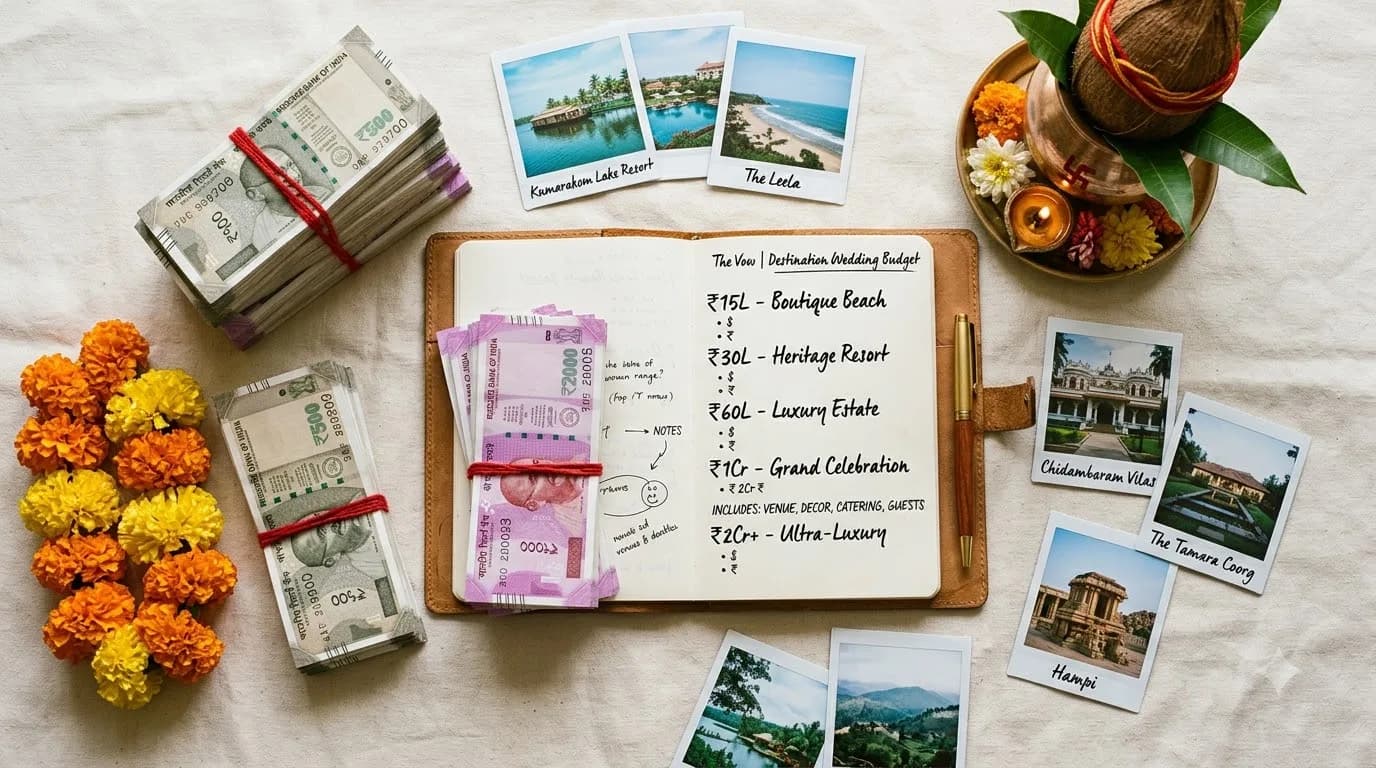
Destination Wedding Cost in South India 2026: 5-Tier Budget Guide
Destination Wedding in South India: Complete 2026 Planning Guide
Still planning?
Get quotes from India's best vendors
Tell us what you're planning and we'll match you with verified photographers, venues, decorators, and more.
Get free quotes