
Vokkaliga Wedding Traditions: Karnataka's Gowda Community Guide
Complete Vokkaliga (Gowda) wedding guide — the Moi gift-exchange ledger system, Dhare ceremony, agricultural mandap decor, and guest lists of 1,000–5,000.

On this page
Vokkaliga (Gowda) weddings are known for their scale — guest lists of 1,000–5,000 are common in the Mandya-Mysore heartland, and even urban Bangalore events typically host 500–1,500 guests. The defining custom is the Moi: a formal gift-exchange where every relative's contribution is logged in a ledger and reciprocated at future family weddings, binding community networks across generations.
Quick Answer
Quick answer: Vokkaliga (Gowda) weddings are known for their scale — guest lists of 1,000–5,000 are common in the Mandya-Mysore heartland, and even urban Bangalore events typically host 500–1,500 guests. The defining custom is the Moi: a formal gift-exchange where every relative's contribution is logged in a ledger and reciprocated at future family weddings, binding community networks across generations.
Note
Pricing methodology: Cost ranges in this guide are based on vendor pricing data from the itsmy.wedding marketplace and published industry reports, collected in Q4 2025 – Q1 2026.
Vokkaliga (Gowda) weddings are the marriage tradition of Karnataka's largest agricultural community — a community rooted in the fertile sugar cane and rice paddies of the Mandya-Mysore-Hassan belt, with deep family networks and a distinctive gift-exchange system called Moi that turns every wedding into an elaborate exercise in community reciprocity. They are part of an Indian wedding industry valued at ₹10.79 lakh crore and projected to reach ₹24 lakh crore by 2030, with Karnataka being one of its strongest contributing states. The ceremony follows the broader Kannada Hindu structure — Dhare, Saptapadi, Mangalsutra — but layers in agricultural symbolism, a stronger emphasis on extended family participation, and a feast culture that reflects generations of landed prosperity.
If your family carries the Gowda title, or if you are marrying into a Vokkaliga household, this guide walks you through every ritual, the Moi system in detail, attire traditions, the wedding feast, and practical planning advice for 2026 celebrations in Bangalore (officially Bengaluru) and across southern Karnataka. Couples should also be aware that marriage registration in Karnataka is now handled through the Kavivaha Mitra portal, which simplifies the legal process. For the broader state-level context, see our Bangalore wedding planning guide.
Who Are the Vokkaligas of Karnataka?
The Vokkaligas are Karnataka's largest agricultural community, concentrated across the fertile southern districts that formed the historic Kingdom of Mysore. They are found primarily in Mandya, Mysore (Mysuru), Hassan, Ramanagara, Tumkur, and the rural belt surrounding Bangalore. The word Vokkaliga derives from the Kannada term for tilling or cultivation, and the community's identity is deeply intertwined with the land — rice paddies, sugar cane fields, coconut groves, and areca nut plantations form the economic and cultural backbone. Having coordinated weddings across Bangalore for several years, I have seen first-hand how deeply the agricultural heritage shapes every aspect of a Vokkaliga celebration. The community's historical ties to the Mysore royal court and its cultural legacy are visible in everything from silk saree choices to mandap aesthetics.
Gowda is the community's honorific title — roughly equivalent to "headman" or "landowner." Historically, Gowda families were village leaders who managed agricultural lands and local governance. Today, the community's influence extends far beyond agriculture into politics, business, and the professions, but the agricultural identity remains central to the cultural vocabulary, including wedding rituals. For example, the Vokkaliga Sangha continues to play a significant role in community gatherings and cultural preservation across the state.
Vokkaliga weddings are known for their scale. Guest lists of 1,000 to 5,000 are common in the Mandya-Mysore heartland, reflecting the extensive family and community networks. Even in urban Bangalore, where weddings are more compact, Vokkaliga celebrations tend to be larger than average — 500 to 1,500 guests is typical — because the community places enormous value on family attendance and community witness. Specifically, families in the Ramanagara and Kanakapura belt often invite entire village clusters, which is why venue managers I speak with along Kanakapura Road consistently say that Vokkaliga bookings are their largest events of the year.
Note
What Are the Key Pre-Wedding Rituals?
Nischitartha (Engagement)
The Vokkaliga engagement places heavier emphasis on family elder participation than most other Kannada Hindu engagements. The Vokkaliga Nischitartha follows the standard Kannada engagement format but with this distinctive elder-driven character. The groom's family formally visits the bride's home, and the match is agreed upon in the presence of respected elders from both sides — often uncles, community heads, or family friends who serve as intermediaries. The priest consults the panchangam for auspicious dates, and the couple exchanges rings.
What distinguishes the Vokkaliga engagement is the post-ceremony discussion of Moi logistics. Family elders from both sides begin the complex process of planning who will contribute what, and the Moi ledger is consulted for outstanding reciprocal obligations. This practical, community-minded conversation happens alongside the spiritual ceremony — a reflection of the Vokkaliga balance between devotion and pragmatism.
How Does Moi Planning Begin Before the Wedding?
Moi coordination starts immediately after the engagement and involves reviewing decades of reciprocal gift records. Between the engagement and the wedding, significant effort goes into Moi coordination. The family reviews its Moi ledger — a record of every gift received at previous family weddings — and identifies which relatives and community members are expected to contribute. Invitations for the wedding are hand-delivered (not posted) to close family members, with specific Moi conversations happening alongside the invitation.
Naandi (Ancestral Prayers)
The Naandi is the emotional anchor of the pre-wedding period, connecting the living family to their departed elders. The Naandi is a prayer to ancestors performed one or two days before the wedding at both the bride's and groom's homes. A priest leads the family through Vedic chants honouring deceased elders, seeking their blessings for the marriage. For Vokkaliga families with deep generational ties to a particular village or piece of land, the Naandi often takes place at the ancestral family home rather than a city residence, even if the couple lives in Bangalore.
What Happens During the Turmeric Ceremony?
The arisina ceremony is where Vokkaliga folk music traditions come alive, with elder women performing agricultural songs passed down across generations. The arisina (turmeric) ceremony is a joyful, pre-wedding event where married women from the family apply turmeric paste to the bride (and separately, the groom at their home). In Vokkaliga families, this event often includes folk songs specific to the community — songs about farming, harvests, and the blessings of the earth — performed by elder women. From the ceremonies I have attended in Ramanagara and Channapatna, these songs carry a raw emotional power that no professional performance can replicate. These songs are passed down orally and represent an intangible cultural heritage that younger generations are making efforts to preserve.
How Does the Wedding Day Ceremony Unfold?
The core ceremony follows the Kannada Hindu template but carries Vokkaliga-specific inflections at several key moments, especially the agricultural symbolism woven into the Kanyadaan and mandap decor.
Vara Puje (Groom Welcome)
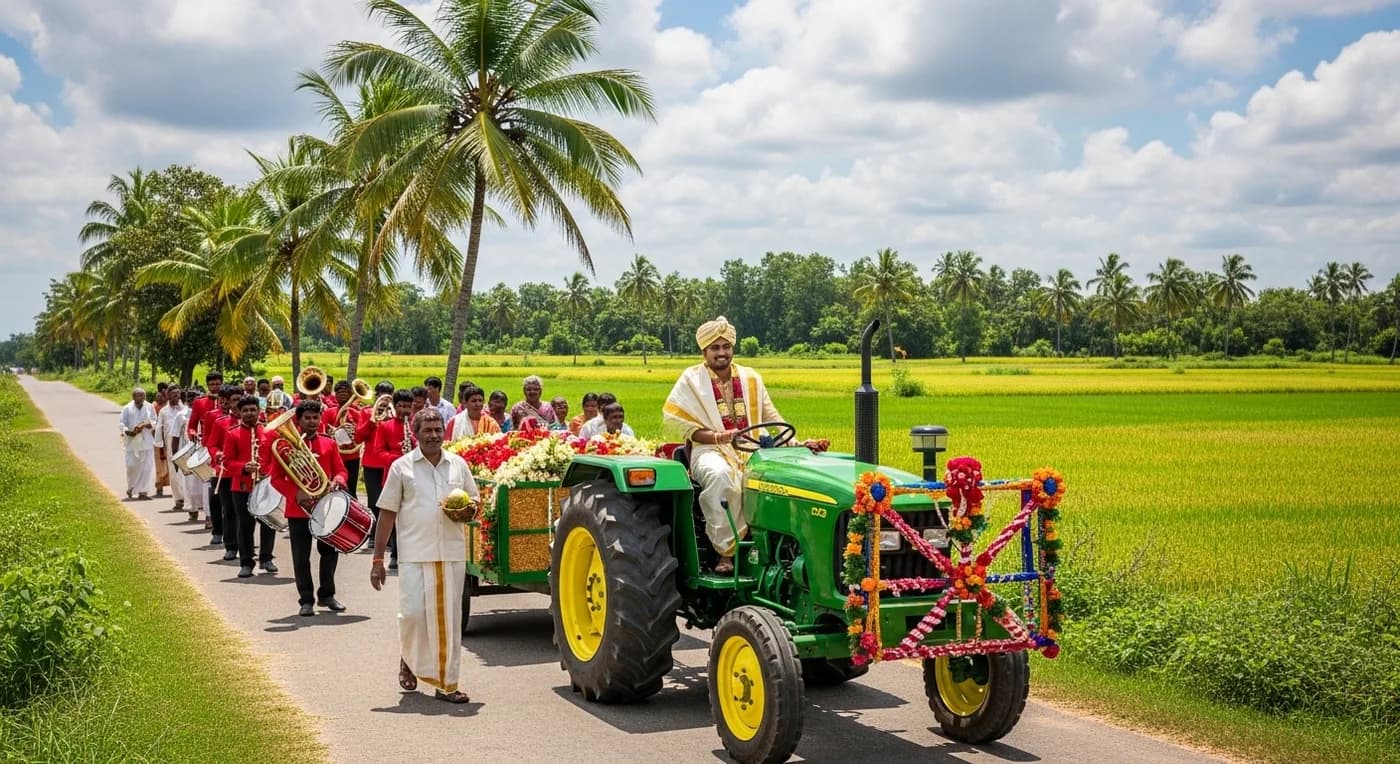
The groom's entrance at a Vokkaliga wedding is a spectacle that can include decorated tractors and bullock carts as nods to the community's farming roots. The bride's family receives the groom at the entrance of the wedding venue with full honours — aarti, washing of feet, and gifts. In traditional Vokkaliga weddings, particularly in the Mandya-Mysore belt, the groom's procession may include a bullock cart or a decorated tractor — nods to the agricultural heritage — alongside the standard brass band and fireworks.
How Is the Kanyadaan Different in Vokkaliga Weddings?
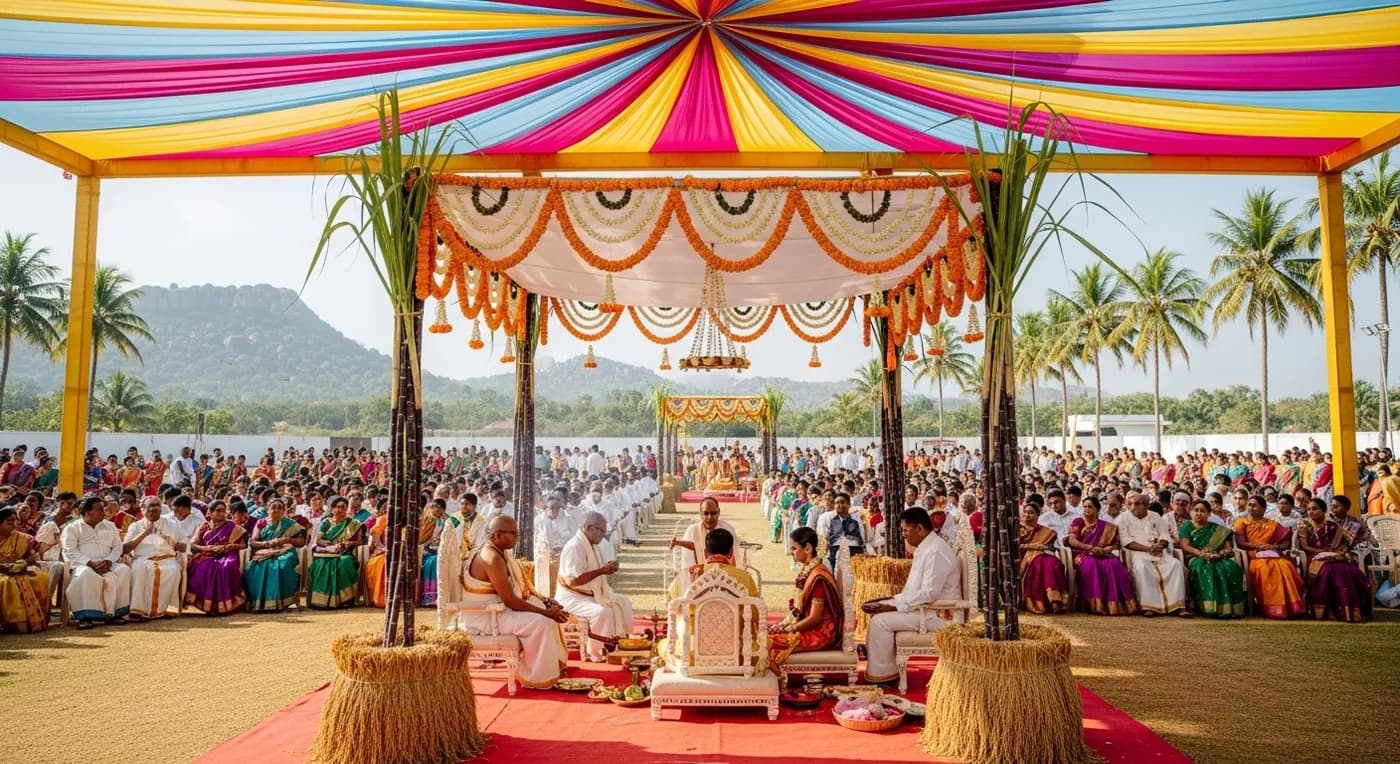
The Vokkaliga Kanyadaan is uniquely enriched with agricultural elements — sugar cane stalks as mandap pillars, banana plants at the entrance, and rice grains woven into the decoration. The Kanyadaan — the formal giving of the daughter by her father — takes on added layers of symbolism in Vokkaliga ceremonies. Mandya is India's "sugar bowl," with the Mandya district administration overseeing one of the country's most productive cane-growing regions, and that identity is reflected directly in the mandap design. During the Kanyadaan itself, the father may place a handful of earth or rice in the couple's joined hands, symbolising the transfer of the family's most precious asset — not just the daughter, but the blessings of the land itself.
Tip
What Is the Dhare Ceremony?
The Dhare — sacred water poured over the couple's joined hands — is the single moment that legally and spiritually seals a Vokkaliga marriage. The ritual is identical in form to the broader Kannada tradition. The bride sits on her father's lap, the groom faces her, and as their right hands are joined, the bride's parents pour a continuous stream of sacred water while Vedic mantras are chanted. This is the moment the marriage becomes official.
For Vokkaliga families, the Dhare is often the most emotionally charged moment of the wedding — particularly for the father, who is symbolically transferring his daughter's care to the groom. In large Vokkaliga weddings, a respectful silence descends over even the most boisterous crowd during the Dhare.
Mangalsutra and Saptapadi
The mangalsutra carries two pendants — one from each family — symbolising the union of two households and their agricultural legacies. The groom ties the mangalsutra (sacred necklace with gold pendants) around the bride's neck. This is followed by the Saptapadi — seven steps around the sacred fire, with each step representing a mutual vow of nourishment, strength, prosperity, happiness, progeny, longevity, and friendship.
Vokkaliga-specific chants and songs may accompany the Saptapadi, particularly if the ceremony is officiated by a priest familiar with the community's traditions. The seven vows often include references to agricultural abundance and family continuity that resonate with the community's values.
What Is the Moi System and How Does It Work?
The Moi is a formal, structured gift-exchange system that functions as a social contract binding the extended Vokkaliga community together — some families maintain ledgers spanning 40 or more years. It is the most distinctive element of Vokkaliga wedding culture.
How Does Gift-Exchange Work at a Vokkaliga Wedding?
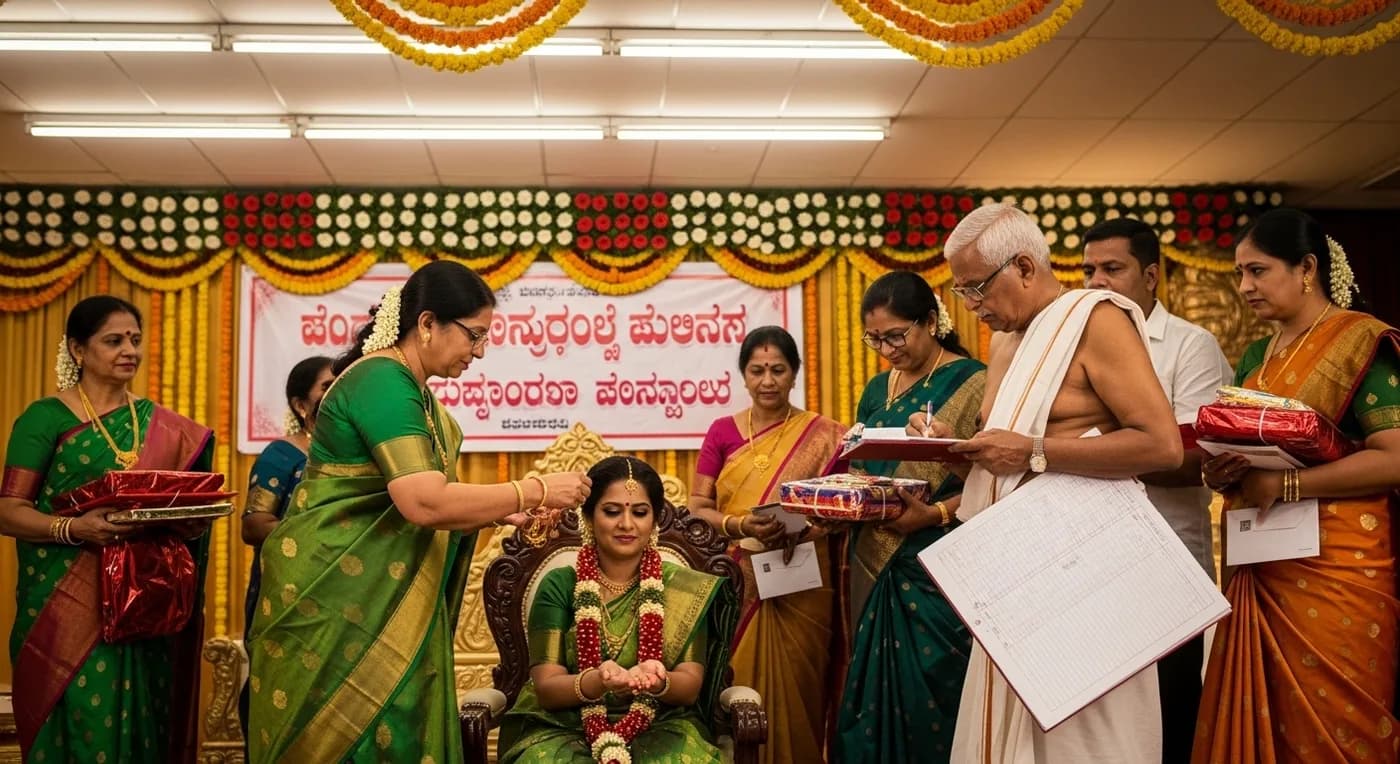
Every contribution at a Vokkaliga wedding is publicly announced and meticulously recorded in a ledger for future reciprocity. At a Vokkaliga wedding, relatives and close family friends contribute gifts to the couple — typically cash, gold jewellery, or household items. Each contribution is publicly announced and recorded in a Moi ledger (traditionally a physical book, now increasingly a digital spreadsheet). The amount, the giver's name, their relationship to the family, and the date are all documented.
The critical principle: Moi is reciprocal. When the giver's family has a wedding in the future, the receiving family is expected to return a gift of equal or greater value. This creates a web of mutual obligation that spans generations and ensures that no family bears the full financial burden of a wedding alone.
Why Is Moi More Than Just Gift-Giving?
Moi is a social architecture that ensures community attendance, maintains inter-family relationships, and distributes the financial burden of weddings across a network of hundreds of households. In contrast to simple wedding gifts, Moi is far more than a financial mechanism. It ensures community attendance at weddings (you must be present to give and receive Moi), maintains relationships across families, and creates a structured framework for mutual support. In the Mandya-Mysore belt, a family's Moi network can extend to hundreds of households.
How Have Moi Amounts Changed Over the Decades?
Moi contributions have escalated from a few hundred rupees a generation ago to ₹5,000–50,000 in cash among close relatives today, with gold contributions adding significantly more. Traditionally, Moi contributions were modest — appropriate to an agricultural community where cash was seasonal. A generation ago, typical contributions were a few hundred rupees and perhaps a piece of cloth. However, particularly in the Bangalore Vokkaliga community, the amounts have risen considerably. The couples I advise in Bangalore typically receive Moi totals that cover 30 to 50 percent of the total wedding expenditure, which underscores how central this system remains to wedding financing. Meanwhile, in the rural Mandya-Mysore belt, contributions tend to be smaller per individual but come from a much wider network — families there tell me they may receive Moi from 200 to 400 distinct households. Gold contributions — chains, bangles, earrings — are common from immediate family members, and according to data from the India Bullion and Jewellers Association (IBJA), gold purchases for wedding Moi remain a major driver of jewellery demand in southern Karnataka.
Important
How Are Families Digitising Moi Records?
Younger Vokkaliga families in Bangalore have begun replacing handwritten Moi ledgers with Google Sheets, specialised mobile apps, and even custom-built software. This shift is happening rapidly. This is a practical evolution that preserves the tradition's core function (reciprocal record-keeping) while making it easier to track across a large family network. Some families have decades of Moi records that they maintain meticulously.
What Do the Bride and Groom Wear?
Attire
A Vokkaliga bride may wear two to three kilograms of gold jewellery, much of it inherited across generations, paired with a Mysore silk or Ilkal saree. The Vokkaliga bride wears a Mysore silk saree or Ilkal saree in rich, auspicious colours — deep red, emerald green, or burnished gold. The Karnataka Silk Industries Corporation (KSIC) is the authoritative source for authentic Mysore silk, and many Vokkaliga families specifically seek KSIC sarees for their bridal attire. The silk is heavy, the zari work elaborate, and the overall aesthetic is one of landed prosperity. Temple jewellery dominates — jhumkas (chandelier earrings), vanki (armlet), odyanam (waist belt), nettikalli (forehead piece) — all in gold, often heavy and heirloom. Green glass bangles line both arms, and jasmine flowers cascade from the hair.
The gold is a cultural statement. Vokkaliga families, rooted in agricultural prosperity, have historically expressed their wealth through gold — and the wedding is the occasion where this heritage is displayed most visibly. A bride may wear two to three kilograms of gold jewellery, much of it inherited across generations. For current pricing on temple jewellery, gold sets, and rental options, see our bridal jewellery cost guide for Bangalore.
The groom wears a silk panche (dhoti), angavastram (upper cloth), and a Mysore Peta (turban). The Peta is essential — it signifies respect, honour, and regional identity. At Bangalore receptions, grooms often switch to a designer sherwani or suit.
What Is Served at the Wedding Feast?
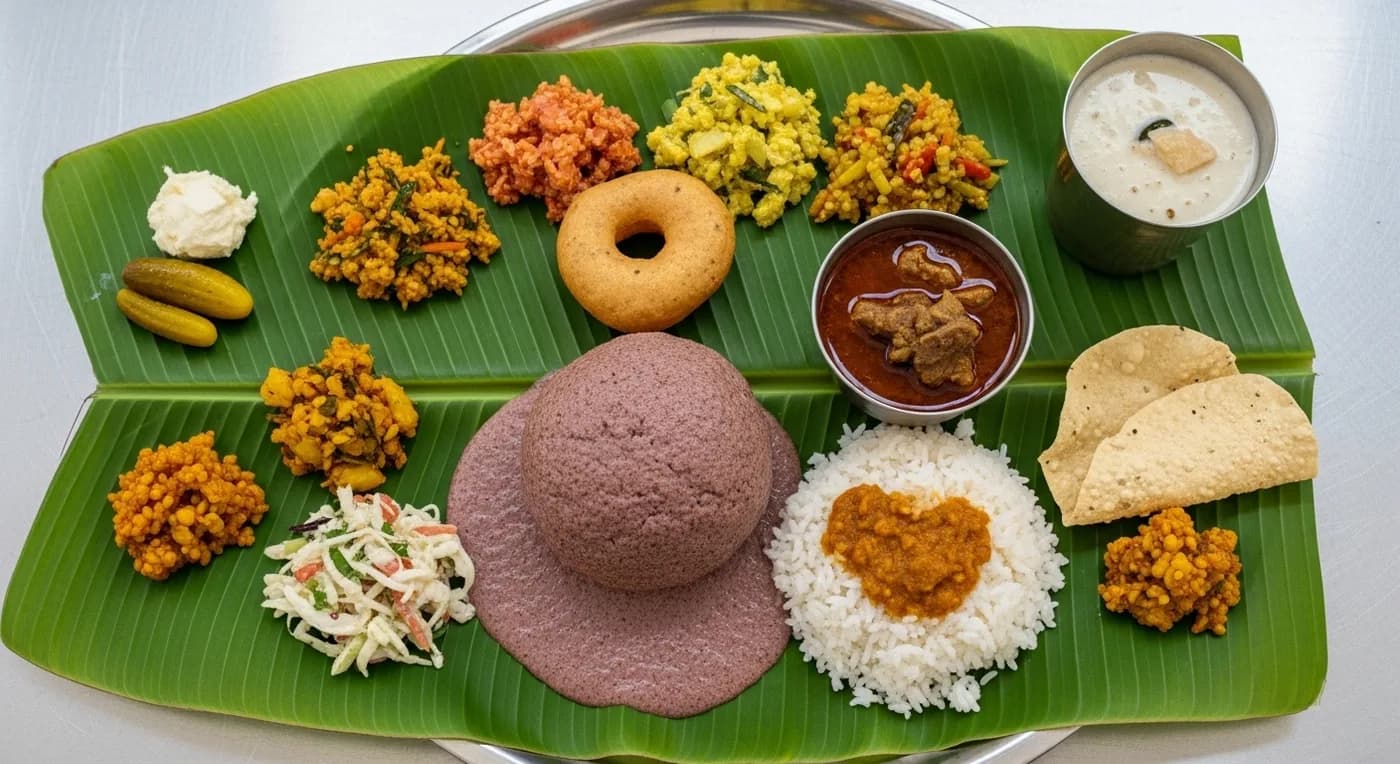
The Vokkaliga wedding feast is a banana leaf meal of 10–15 items, anchored by Ragi Mudde and Bassaru — the signature comfort food of southern Karnataka's farming communities. Vokkaliga wedding feasts reflect the community's agricultural bounty. In the Mandya-Mysore belt, the banana leaf meal is standard — a multi-course spread served on fresh banana leaves, eaten while seated on the floor in long rows. Caterers in Jayanagar and JP Nagar tell me that demand for authentic Vokkaliga banana leaf meals has grown steadily among Bangalore's Gowda families, even as buffet-style catering dominates other communities. For a detailed breakdown of per-plate pricing and caterer selection tips, see our wedding catering cost guide for Bangalore.
The signature dish varies by family tradition. Many Vokkaliga families serve Ragi Mudde (steamed finger millet balls) — the staple food of southern Karnataka's farming communities — with Bassaru (lentil-based curry) and Saaru (rasam). The meal typically includes rice, sambar, palya (vegetable stir-fry), kosambari (salad), payasa (kheer), and a selection of pickles.
Mutton is common at Vokkaliga weddings, particularly in families that are non-vegetarian — which is a significant proportion of the community. Mutton saaru (mutton in a thin, peppery broth) is a beloved centerpiece. Some families serve both vegetarian and non-vegetarian meals on separate leaf-lines.
What Music and Dance Traditions Feature at the Celebration?
Vokkaliga weddings feature janapada geethegalu — folk songs celebrating agricultural life, love, and community bonds — alongside contemporary entertainment. Traditional Vokkaliga celebrations include this folk music as a core cultural element. In village weddings, professional folk performers may be hired. In Bangalore, these traditions are often compressed into a brief cultural segment during the reception, with professional bands or DJs handling the rest of the entertainment.
How Are Modern Vokkaliga Weddings Evolving?
What Are the Differences Between Mysore and Bangalore Celebrations?
Mysore Vokkaliga weddings retain their full traditional scale while Bangalore celebrations are trending toward premium farmhouses that blend community identity with contemporary amenities. In Mysore, Vokkaliga weddings retain their traditional scale and structure — large guest lists, multi-day events, banana leaf meals, and strong Moi culture. Palace venues, including the Rajendra Vilas and Lalitha Mahal, are aspirational settings for wealthy Gowda families. The Karnataka State Tourism Development Corporation lists Mysore among the state's premier heritage destinations, and that palace-city grandeur is reflected in the wedding venue choices.
In Bangalore, the trend is toward premium farmhouses and boutique venues that offer the space for large guest lists (the community's signature) while providing contemporary amenities. Kanakapura Road and Ramanagara belt farmhouses are particularly popular — they are close to the traditional Vokkaliga heartland and offer an outdoor, semi-rural setting that resonates with the community's agricultural identity. For families who prefer a traditional indoor setting, a kalyana mantapa in Bangalore remains the most affordable and purpose-built option, with community-run halls often offering subsidised rates for Vokkaliga Sangha members.
What Does a Vokkaliga Wedding Typically Cost?
- Traditional (community hall, Mandya-Mysore, 500-2000 guests): ₹5,00,000 – ₹15,00,000
- Mid-range Bangalore (farmhouse or premium hall, 500-1000 guests): ₹15,00,000 – ₹35,00,000 — well above the national average of ₹29.6 lakhs for 330 guests given the community's larger guest counts
- Premium (5-star hotel or palace venue, 500-1500 guests): ₹35,00,000 – ₹80,00,000
Looking for Caterings in Bangalore?
Tell us what you need and get quotes from verified caterings
How Can Couples Balance Tradition With Contemporary Style?
Modern Vokkaliga couples in Bangalore are finding creative ways to honour their heritage — pre-wedding shoots at family farms in Mandya, elevated Ragi Mudde tasting courses, and digital Moi portals on their wedding websites. These couples are expressing their own aesthetic while respecting community expectations. Pre-wedding shoots at family farms in Mandya or Mysore, mandap designs that incorporate sugar cane and paddy motifs, and reception menus that feature elevated versions of traditional dishes (Ragi Mudde presented as a tasting course, for instance) are all ways that the community's agricultural identity is celebrated rather than suppressed.
The Moi system, too, is adapting. Some families are transitioning from physical ledgers to digital records, setting suggested contribution ranges to ease social pressure, or incorporating Moi into the wedding website so guests can contribute online. The core principle — reciprocal generosity — remains unchanged.
On itsmy.wedding, you can browse Bangalore vendors who understand the specific requirements of Vokkaliga weddings — from caterers who serve authentic Ragi Mudde and Bassaru to venues with the capacity for the community's characteristically large guest lists.
Looking for Venues in Bangalore?
Tell us what you need and get quotes from verified venues
Bangalore vs Mandya-Mysore: Vokkaliga Wedding Style Comparison
The same community, separated by 150 kilometres, produces two distinctly different wedding experiences — understanding these differences helps you plan for the right context.
| Aspect | Bangalore Vokkaliga Wedding | Mandya / Mysore Vokkaliga Wedding |
|---|---|---|
| Typical Guest Count | 500–1,500 | 1,000–5,000 |
| Venue Type | Premium farmhouse, 5-star hotel ballroom, or convention centre | Community hall (samudaya bhavana), temple grounds, or palace venue |
| Budget Range | ₹15,00,000 – ₹80,00,000 | ₹5,00,000 – ₹15,00,000 |
| Cuisine Style | Multi-cuisine buffet with banana leaf option | Traditional banana leaf sit-down (pangat) — floor seating in rows |
| Signature Dish | Ragi Mudde served alongside continental, North Indian items | Ragi Mudde with Bassaru and Mutton Saaru as centrepieces |
| Moi Contributions (Close Relatives) | ₹10,000–50,000 cash + gold | ₹2,000–20,000 cash + gold |
| Moi Network Size | 80–200 households | 200–400 households |
| Duration | Single-day event (ceremony + reception) | Two to three days (Naandi, ceremony, reception, family meals) |
| Groom's Procession | Decorated car, brass band | Bullock cart or decorated tractor alongside brass band |
| Mandap Aesthetic | Contemporary floral with agricultural accents | Full agricultural motifs — sugar cane pillars, paddy sheaves, banana plants |
At a Vokkaliga wedding I helped coordinate in Ramanagara last season, the family chose a farmhouse venue midway between Bangalore and Mandya — a deliberate compromise that allowed their urban friends easy access while retaining the open-air, semi-rural atmosphere that their Mandya relatives expected. The result was a celebration that felt authentically Gowda without the logistical strain of hosting 3,000 guests deep in the heartland. It is a pattern I am seeing more frequently among younger Vokkaliga couples who want to honour both worlds.
Common Questions About Vokkaliga Wedding Traditions
How far in advance should we book vendors for a Vokkaliga wedding in Bangalore?
For peak wedding season (November through February), start booking at least six to eight months ahead. Farmhouse venues along Kanakapura Road and in the Ramanagara belt fill up quickly for weekend dates, and caterers who specialise in authentic banana leaf meals have limited capacity since each event requires a large kitchen team. Photography vendors in Bangalore and decor vendors can usually be confirmed four to five months out.
Can the Moi system be adapted for inter-community or inter-caste marriages?
Yes, and this is increasingly common among Bangalore Vokkaliga families. When one partner is from outside the community, families typically maintain the Moi tradition on the Vokkaliga side while explaining the system to the other family. Some couples create a hybrid approach — Moi from the Gowda family network, conventional gift-giving from the other side. The key is transparency: brief the non-Vokkaliga family on the public announcement and ledger customs well before the wedding day.
Is it mandatory to serve non-vegetarian food at a Vokkaliga wedding?
No, it is not mandatory, but it is extremely common. A significant proportion of the Vokkaliga community is non-vegetarian, and mutton saaru is considered a hallmark of a generous Gowda feast. Families who prefer a vegetarian spread do host fully vegetarian weddings without any social stigma — the quality and abundance of the food matters more than whether meat is included. If serving both, separate leaf-lines for vegetarian and non-vegetarian guests are the standard arrangement.
What role do Vokkaliga community associations play in wedding planning?
Community associations like the Vokkaliga Sangha and local Gowda sabhas can be valuable resources. They maintain lists of community halls available at subsidised rates, can recommend priests familiar with Vokkaliga-specific rituals, and sometimes help mediate Moi-related questions between families. In Bangalore, the associations also host community gatherings where eligible families network — though modern couples are more likely to meet independently and then engage the associations for venue and logistics support.
How do destination Vokkaliga weddings work outside Karnataka?
Destination weddings among Vokkaligas are still relatively rare compared to some other communities, but they are growing — particularly among NRI families. The critical challenge is replicating the Moi ceremony, which requires physical presence. Some families hold a small destination ceremony for close friends and the couple's social circle, followed by a full-scale traditional celebration with Moi in Mandya or Bangalore for the extended community. This two-event model preserves the community obligation while giving the couple creative freedom for their personal celebration.
A Vokkaliga wedding is a celebration of community in its truest sense — not just the union of two people, but the affirmation of a network of families bound together by reciprocal generosity, agricultural heritage, and shared identity. The Moi ledger is not merely an accounting tool; it is a living record of relationships that span decades. Whether your wedding takes place in a Mandya village hall or a Bangalore farmhouse, that web of community is what makes a Gowda wedding unforgettable. For more on Karnataka's diverse traditions, explore our guides to Kannada wedding traditions and Muslim weddings in Karnataka.
Tip
Start planning your wedding — generate a personalised checklist with our AI Wedding Checklist, estimate your budget with the Cost Calculator, or create a beautiful digital invitation.
Topics
vokkaliga wedding ritualsgowda wedding traditionsvokkaliga marriagemoi ceremony karnatakakarnataka gowda weddingbengaluru weddingsExplore more
Frequently Asked Questions
1What are the main Vokkaliga wedding rituals?
2What is the Moi ceremony?
3What does a Vokkaliga bride wear?
4Are Vokkaliga and Gowda weddings the same?
5How much does a typical Vokkaliga wedding cost in Bangalore?
6What food is served at a Vokkaliga wedding feast?
Continue reading
Related Articles
Bangalore Wedding Planning: ₹5-60L Costs & Venues (2026)
Kannada Wedding Traditions: Rituals, Meaning & Modern Twists
Muslim Wedding in Karnataka: Nikah Traditions in Bangalore
Best Season for South India Destination Weddings: Month-by-Month Western Ghats Guide
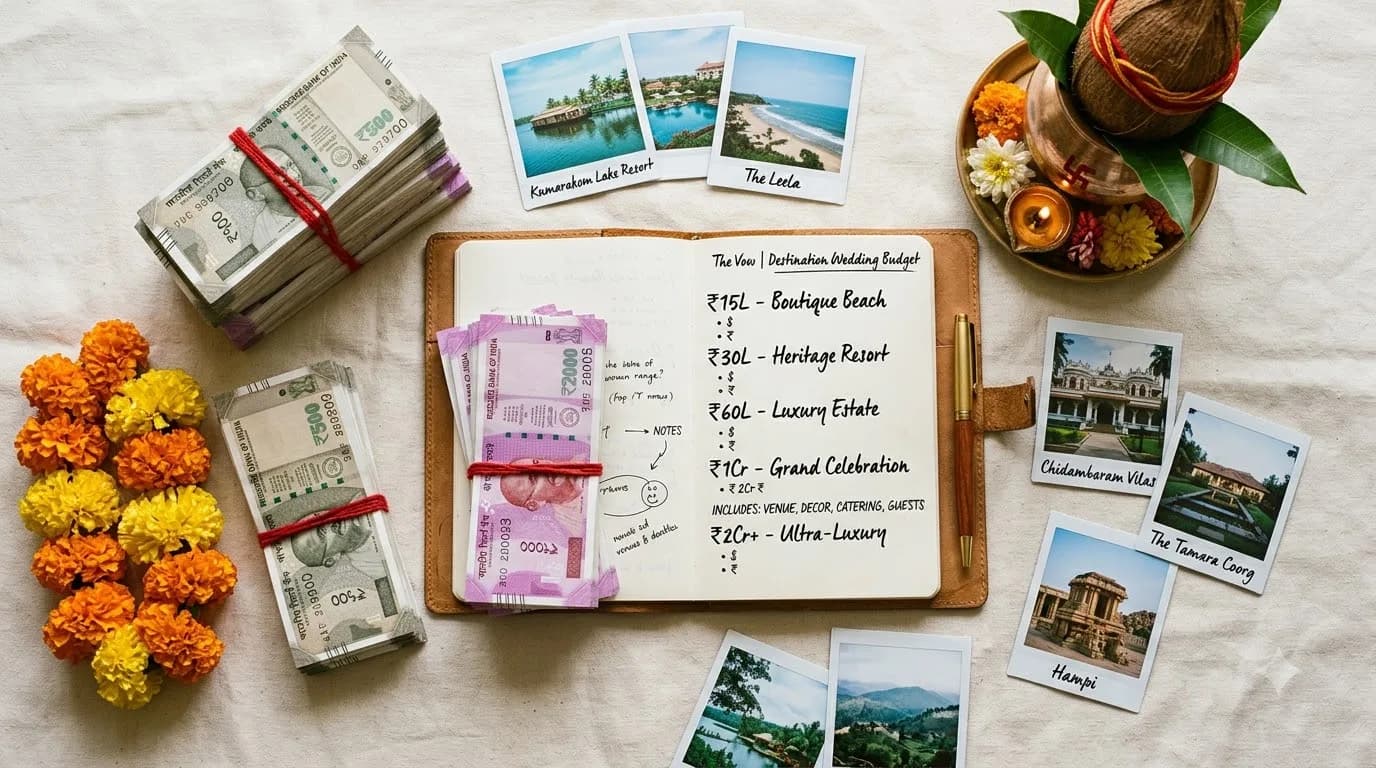
Destination Wedding Cost in South India 2026: 5-Tier Budget Guide
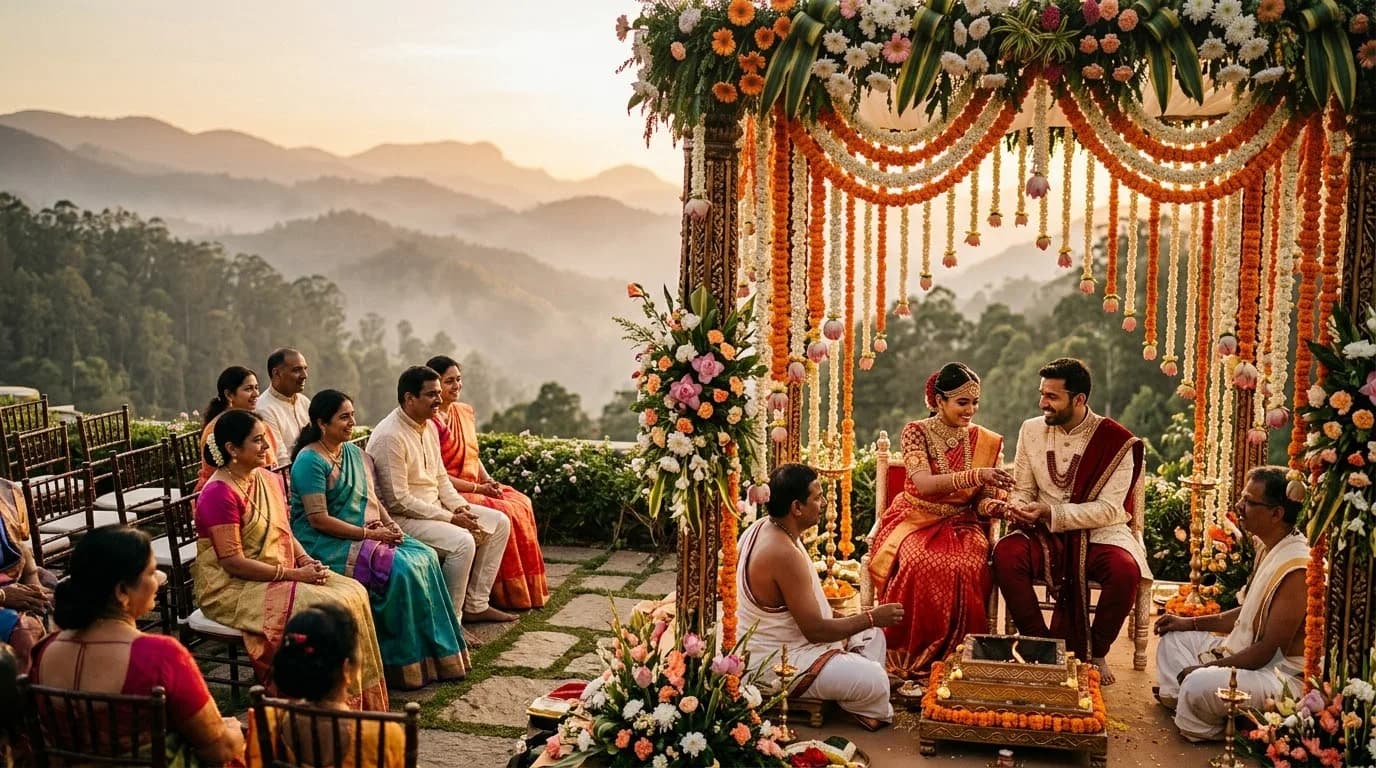
Destination Wedding in South India: Complete 2026 Planning Guide
Still planning?
Get quotes from India's best vendors
Tell us what you're planning and we'll match you with verified photographers, venues, decorators, and more.
Get free quotes