
Traditional vs Destination Kerala Wedding: Which Is Right for You?
Comparing traditional Kerala weddings with destination celebrations — costs, logistics, guest experience, and cultural considerations to help you choose.

Venue & Destination Specialist
Deepak Krishnan is a venue and destination wedding specialist who has personally visited and reviewed over two hundred wedding venues across Kerala, Karnataka, and Tamil Nadu.
On this page
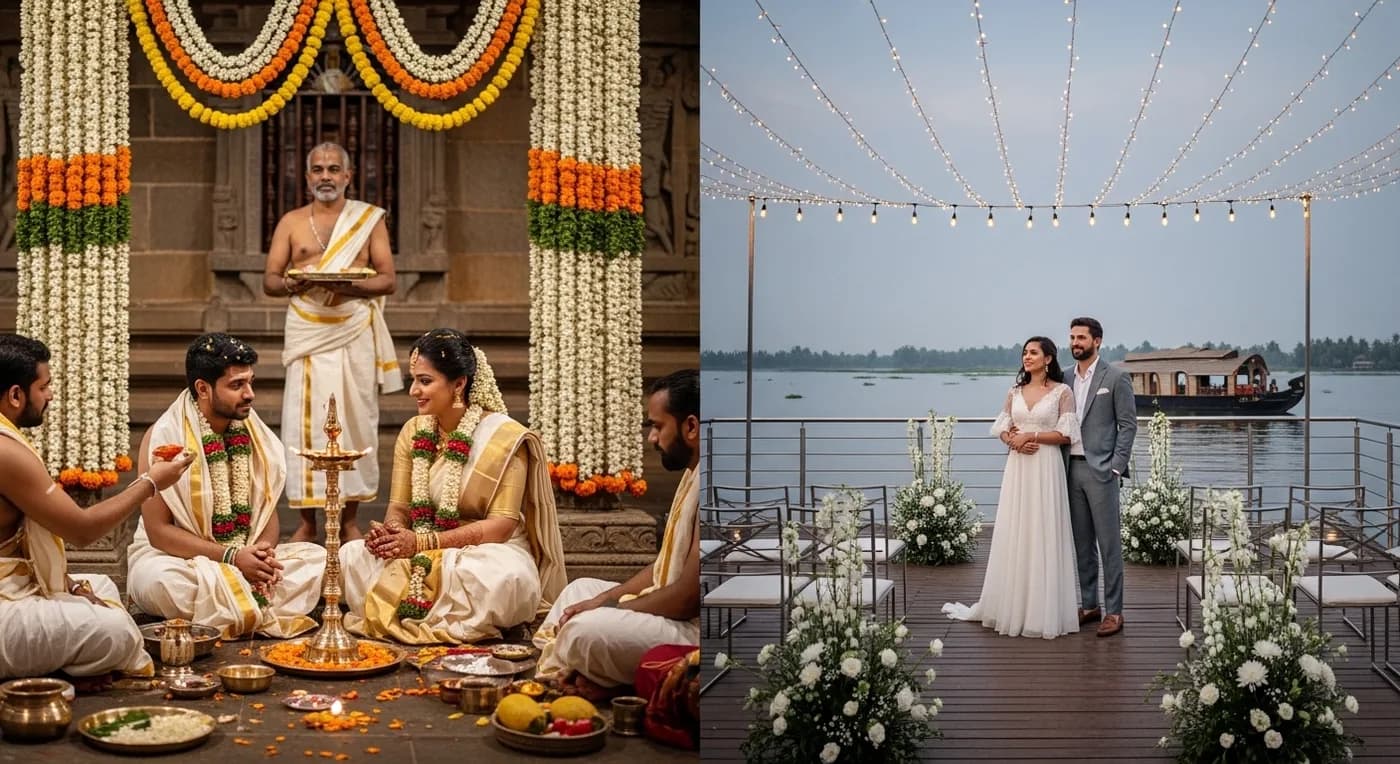
A traditional Kerala wedding for 300 guests costs ₹5–25 lakh; a destination wedding runs 2–4x more per guest but with smaller guest lists. Traditional celebrations offer cultural authenticity and temple access (Guruvayur hosts 100+ weddings on auspicious days), while destination venues across Kumarakom and Alappuzha backwaters deliver intimacy and visual drama that convention centres cannot replicate.
Quick Answer
Quick answer: Traditional Kerala wedding (300 guests): ₹5–25 lakh. Destination wedding (80–150 guests): ₹15–50 lakh — 2–4x more per guest but smaller lists often keep totals similar. Choose traditional for large guest counts, temple access, and community continuity. Choose destination for intimacy, visual drama, and a residential-retreat experience for close family.
Note
Pricing methodology: All cost figures in this guide reflect 2026 market rates based on industry patterns across traditional and destination venue categories in Kerala. Actual costs vary significantly by guest count, property, season, and services included. Use these as planning benchmarks.
India's wedding industry is now worth ₹10.79 lakh crore and projected to reach ₹24 lakh crore by 2030, and Kerala has always been one of the most visually stunning backdrops for weddings within it. Between the quiet grandeur of an ancient temple ceremony and the romantic allure of a houseboat reception on the backwaters, couples planning a Kerala wedding today face a genuinely exciting choice. Do you honour the familiar rhythms of a traditional celebration, or do you craft something entirely new at a destination that takes everyone's breath away?
This guide walks you through both Kerala wedding styles in honest detail — the costs, the logistics, the guest experience, and the cultural weight of each option — so you can make a decision that feels right for your story.
What Makes a "Traditional" Kerala Wedding
A traditional Kerala wedding is defined less by a single template and more by a set of deeply rooted customs that vary across communities. Hindu ceremonies often take place in temples or family homes, Christian weddings unfold in historic churches, and Muslim nikahs follow their own rich protocols. What they share is a sense of continuity — rituals passed down through generations, performed in spaces that carry emotional and spiritual significance.
The Temple or Church Ceremony
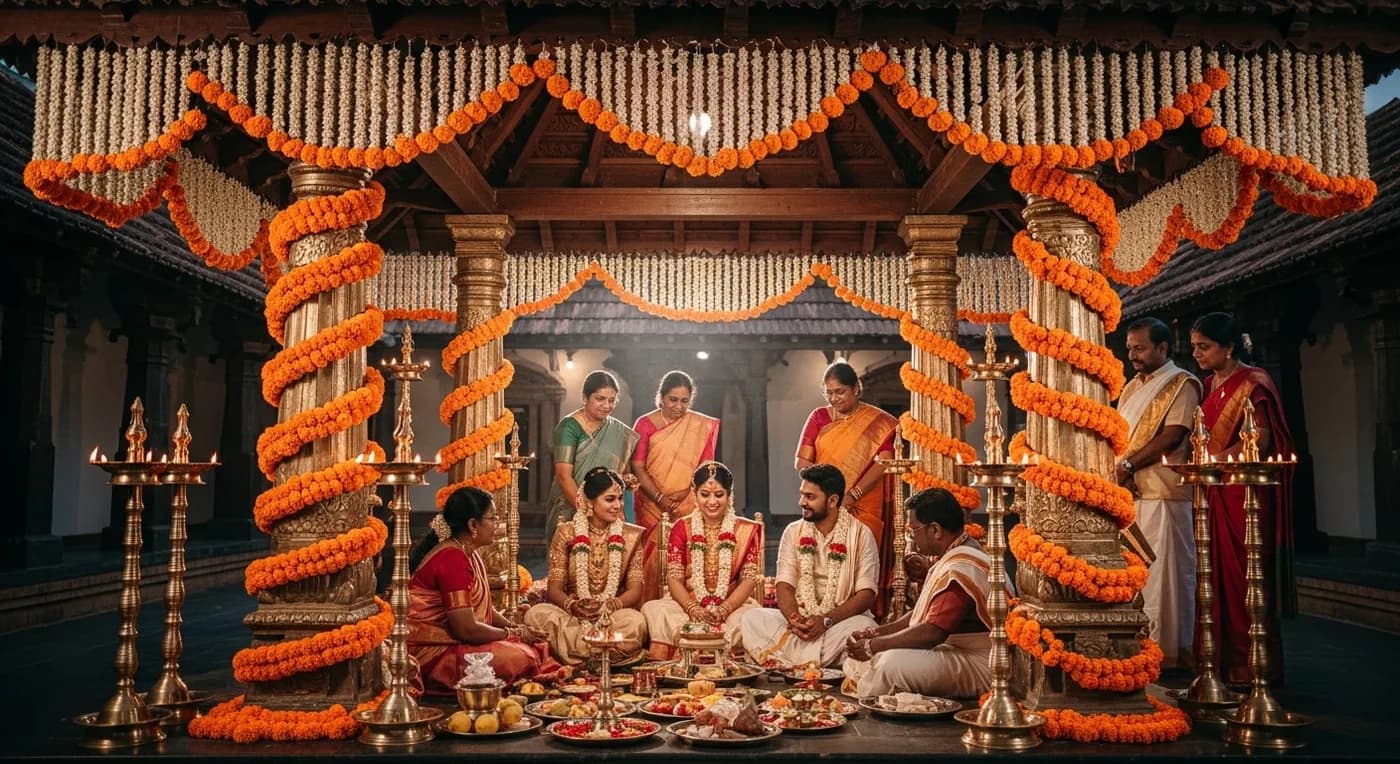
For Hindu couples, venues like the Guruvayur Temple in Thrissur or the Vadakkunnathan Temple remain among the most sought-after settings. The ceremony itself — the thalikettu (tying of the mangalsutra) at the auspicious muhurtham — is brief but deeply meaningful, often lasting under thirty minutes. Syrian Christian weddings in churches across Kochi and Kottayam bring their own solemnity, with the mantrakodi (wedding sari) playing a central symbolic role.
Note
The Family Home and Convention Centre
After the ceremony, the reception typically moves to a convention centre or, in smaller celebrations, the family home itself. Convention centres in cities like Thrissur, Trivandrum, and Kochi can accommodate anywhere from 500 to 3,000 guests. The sadya — a lavish vegetarian feast served on banana leaves — is a centrepiece of Hindu receptions, while Christian and Muslim receptions often feature elaborate multi-course meals.
Why Couples Choose Traditional
The appeal is straightforward: cultural authenticity, family comfort, and a well-understood playbook. For couples exploring how ceremonies differ across Hindu, Christian, and Muslim traditions, our Kerala wedding by religion guide covers each community's customs in detail. Grandparents know where to stand, aunts know which rituals to prepare for, and the entire event operates within a framework that everyone recognises. There is a deep emotional security in that.
₹5,00,000 – ₹25,00,000Traditional Kerala wedding budgets vary widely. A modest ceremony with 300 guests at a local convention centre in a tier-two city might come in around five lakh, while a large-scale celebration with 1,500 guests in Kochi or Thrissur can comfortably reach twenty-five lakh or more, depending on catering, decor, and entertainment.
Looking for Venues in Thrissur?
Tell us what you need and get quotes from verified venues
The Rise of Destination Weddings in Kerala
Over the last decade, destination weddings in Kerala have grown from a niche trend into a genuine alternative for couples who want something more intimate, more curated, and more visually distinctive. With 2.3 crore tourists visiting the state in 2024, Kerala's hospitality infrastructure has matured to support wedding-scale events at scenic properties across districts. Kerala's geography makes it uniquely suited to this — you can marry on a beach, in a tea plantation, beside a lake, or on a houseboat, all within a single state. Couples weighing other South Indian destinations may also want to compare Coorg vs Kerala for a destination wedding — Coorg offers a very different mountain-and-coffee-estate atmosphere at comparable price points.
Backwater Weddings in Kumarakom and Alleppey
The backwaters of Kumarakom and Alleppey remain the most iconic destination wedding setting in Kerala. Luxury resorts along the Vembanad Lake offer private ceremony lawns that open directly onto the water. Some couples opt for a houseboat procession as part of the celebration, creating a visual spectacle that is impossible to replicate anywhere else in India.
Hill Station Celebrations in Munnar and Wayanad
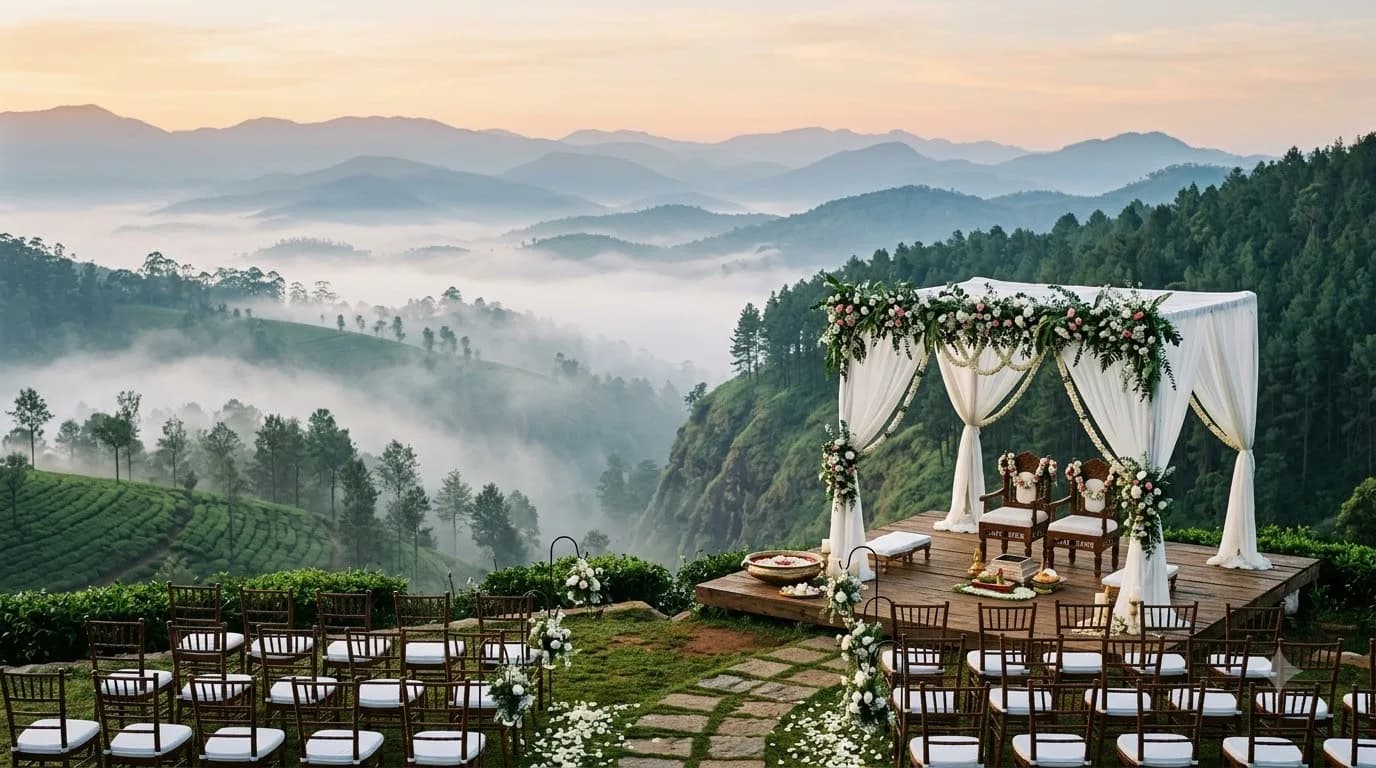
For couples who prefer cool air and green horizons, Munnar and Wayanad offer tea estate resorts and boutique properties that feel worlds away from the city. These locations work particularly well for intimate weddings of 50 to 150 guests, where the landscape itself becomes the primary decor element.
Beach Weddings in Kovalam and Beyond
Kovalam, Varkala, and Marari Beach have all emerged as popular beach wedding destinations. Sunset ceremonies on the sand, followed by seafood dinners under string lights, have a relaxed elegance that appeals to couples blending Kerala and Western wedding sensibilities. Couples who want a livelier beach party atmosphere with a wider venue range should explore Goa as a destination wedding alternative — Goa's 100+ wedding-ready properties span ₹15 lakh villas to ₹1 crore resort celebrations with direct flights from every Indian metro. Couples who want coral-reef water clarity rather than Arabian Sea waves may prefer the Andaman Islands for a destination wedding — Radhanagar Beach on Havelock is ranked Asia's #1 beach, and the premium island setting attracts intimate celebrations of 50-150 guests. For couples weighing an international option that is still close to home, Sri Lanka's south coast and hill country venues are a one-hour flight from Trivandrum and offer colonial-era estates that Kerala cannot match.
Tip
Looking for Venues in Kochi?
Tell us what you need and get quotes from verified venues
Head-to-Head Comparison
Here is a direct comparison across the factors that matter most when choosing between a traditional Kerala wedding and a destination celebration.
| Factor | Traditional Kerala Wedding | Destination Kerala Wedding |
|---|---|---|
| Typical Budget | 5 - 25 lakh | 15 - 60 lakh |
| Guest Count | 500 - 2,000+ | 50 - 300 |
| Planning Timeline | 3 - 6 months | 6 - 12 months |
| Cultural Rituals | Fully integrated | Adapted or selectively included |
| Photography Variety | Moderate (indoor/temple) | High (landscapes, water, greenery) |
| Guest Travel | Minimal for most | Significant for most |
| Weather Risk | Low (mostly indoor) | Moderate to high (outdoor) |
| Accommodation | Guests arrange their own | Typically host-arranged |
| Personalisation | Limited by tradition | Highly customisable |
Cost
This is where the two options diverge most sharply. A traditional wedding can be surprisingly economical per guest because convention centres and temple venues are priced for volume. Destination weddings, on the other hand, carry higher per-head costs due to resort pricing, guest accommodation, and the logistics of transporting vendors and equipment to remote locations.
₹15,00,000 – ₹60,00,000That said, because destination weddings typically involve far fewer guests, the total spend can sometimes be comparable. According to WeddingWire India, the national average wedding costs ₹29.6 lakh with 330 guests — a per-guest figure that destination couples can match or beat with a smaller, more curated celebration. A traditional wedding for 1,200 guests at fifteen lakh may cost roughly the same as a destination wedding for 100 guests at a Kumarakom resort. The difference is in how the money is distributed. Use our wedding cost calculator guide to model both scenarios side by side.
Guest Experience
Traditional weddings offer familiarity. Guests know what to expect, the food is reliable, and the event usually wraps up within half a day. Destination weddings, by contrast, turn the celebration into a multi-day experience — welcome dinners, morning-after brunches, group excursions. Guests often describe them as mini-vacations.
The trade-off is accessibility. Older family members and those with limited mobility may find it difficult to travel to a hill station or beach resort. If your guest list includes elderly grandparents or very young children, this is a serious practical consideration.
Tip
Logistics and Planning
Traditional weddings benefit from an established ecosystem. Caterers, decorators, priests, and photographers in cities like Thrissur and Kochi have done hundreds of weddings at the same venues. They know the layout, the timing, and the flow. This reduces planning overhead significantly.
Destination weddings require more coordination. You may need to bring in vendors from outside the area, arrange accommodation blocks, manage dietary requirements across multiple meals, and plan around weather contingencies. A dedicated wedding planner is not a luxury here — it is practically a necessity.
Cultural Authenticity
For many families, the rituals are non-negotiable. A temple wedding at Guruvayur or a church wedding in Kottayam carries spiritual and familial weight that a resort lawn simply cannot replicate. If your family places high value on performing every traditional ritual in its proper setting, a traditional wedding is likely the better fit.
That said, many destination weddings in Kerala do incorporate traditional elements. It is entirely possible to have a thalikettu ceremony at a Munnar resort with a priest conducting the rituals, followed by a sadya lunch. The setting changes, but the substance can remain.
Photography Opportunities
This is where destination weddings have a clear advantage. The diversity of backdrops — water, mountains, tea gardens, colonial architecture — gives photographers far more to work with than a conventional hall. Couples who prioritise their wedding album and social media content often lean toward destination venues for this reason.
Note
Weather Considerations
Traditional weddings, held primarily indoors, are largely weather-proof. Destination weddings are not. Kerala's climate is tropical, and even outside the monsoon season, unexpected rain is always possible. Venues in Munnar can get chilly in December and January, while coastal locations in Kovalam can be humid and windy.
Always have a wet-weather backup plan. Most reputable resorts offer indoor alternatives, but confirm this during your initial venue visit.
The Hybrid Approach: Combining Both Styles
An increasingly popular option among Kerala couples is the hybrid wedding — a traditional ceremony in a temple or church, followed by a destination reception or after-party at a resort. This approach lets you honour family expectations and cultural rituals while still creating the intimate, visually striking celebration you envision.
A typical hybrid timeline might look like this:
- Day 1: Traditional ceremony at a temple in Thrissur or a church in Kochi, followed by a family lunch.
- Day 2-3: Move to a resort in Kumarakom or Alleppey for a smaller reception with close friends, cocktail evening, and farewell brunch.
This structure respects the older generation's attachment to tradition while giving the couple a space that feels entirely their own. It does mean managing two sets of logistics, but many families find the compromise well worth the effort.
Looking for Wedding Planners in Kochi?
Tell us what you need and get quotes from verified wedding planners
How to Decide: Questions to Ask Yourselves
If you are still unsure which direction to take, work through these questions together:
- How important is it to your families that every traditional ritual is performed in its customary setting? If the answer is "very," lean traditional.
- What is your ideal guest count? If you want fewer than 200 guests and a curated experience, destination may be the better fit.
- How comfortable are your oldest and youngest guests with travel? If accessibility is a concern, a city venue is safer.
- What is your total budget, and how do you want to allocate it? Destination weddings spend more per guest but on fewer people. Traditional weddings spread the budget across a larger crowd.
- How much do you value your wedding photography and visual storytelling? If your album is a top priority, the varied landscapes of a destination wedding will serve you well.
- Are you comfortable with a longer planning timeline? Destination weddings typically need nine to twelve months of lead time.
If your answers split evenly, the hybrid approach described above might be your ideal solution.
Popular Destination Wedding Locations in Kerala
Here is a quick guide to the most established destination wedding locations in the state:
Kumarakom
Situated on the banks of Vembanad Lake, Kumarakom is home to several luxury resorts that specialise in hosting weddings. The combination of backwater views, tropical gardens, and proximity to Kochi (about 80 km) makes it one of the most practical destination options.
Munnar
At an elevation of around 1,600 metres, Munnar offers cool temperatures and endless tea plantation vistas. It is best suited for intimate weddings of under 150 guests, as most properties here are boutique-scale.
Alleppey (Alappuzha)
Known as the "Venice of the East," Alleppey offers houseboat experiences and lakeside resorts. It is slightly more affordable than Kumarakom while offering a similar backwater aesthetic.
Kovalam
Just 16 km from Trivandrum, Kovalam is the most accessible beach destination in Kerala. Several clifftop and beachfront resorts cater to weddings, with the lighthouse beach providing an iconic backdrop.
Wayanad
For couples who want a forest-and-mountain setting without the tourist density of Munnar, Wayanad is an excellent alternative. Its resorts tend to be more affordable, and the Banasura Sagar Dam and Edakkal Caves offer unique photo locations.
Looking for Venues in Alleppey?
Tell us what you need and get quotes from verified venues
Common Questions About Traditional vs Destination Kerala Weddings
Is a destination wedding in Kerala legal and officially valid?
Yes. As long as you complete the required marriage registration process under the applicable personal law or the Special Marriage Act, a wedding at any venue in Kerala is legally valid. The ceremony location does not affect the legal status of the marriage.
How far in advance should I book a destination wedding venue in Kerala?
For peak season (November to February), booking nine to twelve months in advance is recommended. Popular properties in Kumarakom and Munnar fill up quickly during this window. Off-season bookings (March to May) can sometimes be confirmed with three to six months of lead time.
Can I have a traditional sadya at a destination wedding?
Absolutely. Most destination wedding venues in Kerala either have in-house catering teams experienced in preparing a full sadya, or they allow you to bring in external caterers. Discuss this during your initial venue consultation to confirm logistics and kitchen availability.
What is the average cost difference between a traditional and destination wedding in Kerala?
On a per-guest basis, destination weddings typically cost two to four times more than traditional celebrations. However, because guest lists are usually much smaller, the total expenditure can be similar. A traditional wedding for 1,000 guests might cost fifteen to twenty lakh, while a destination wedding for 80 guests at a luxury resort might fall in the same range.
How do I manage elderly guests at a destination wedding?
Plan proactively. Choose a venue with accessible rooms on the ground floor, arrange dedicated transport from the nearest city, and keep the event schedule relaxed with plenty of downtime between activities. Many couples also designate a family member as a point of contact for elderly guests to coordinate any special needs.
Tip
Ready to start planning? Use our AI Wedding Checklist to build a personalised timeline that includes venue booking deadlines, vendor coordination, and every task leading up to your big day. Estimate your full budget with the Cost Calculator.
Topics
destination weddingtraditional weddingkerala wedding styleswedding planningdestination wedding Kerala costtraditional Kerala wedding venuesExplore more
Frequently Asked Questions
1Is a destination wedding in Kerala legal and officially valid?
2How far in advance should I book a destination wedding venue in Kerala?
3Can I have a traditional sadya at a destination wedding?
4What is the average cost difference between a traditional and destination wedding in Kerala?
5How do I manage elderly guests at a destination wedding?
Continue reading
Related Articles
How to Plan a Kerala Wedding: The Complete 2026 Guide

Kerala Wedding Budget Guide: 2026 Cost Breakdown
Kerala Wedding Cost Calculator: 2026 Budget Estimator
Best Season for South India Destination Weddings: Month-by-Month Western Ghats Guide
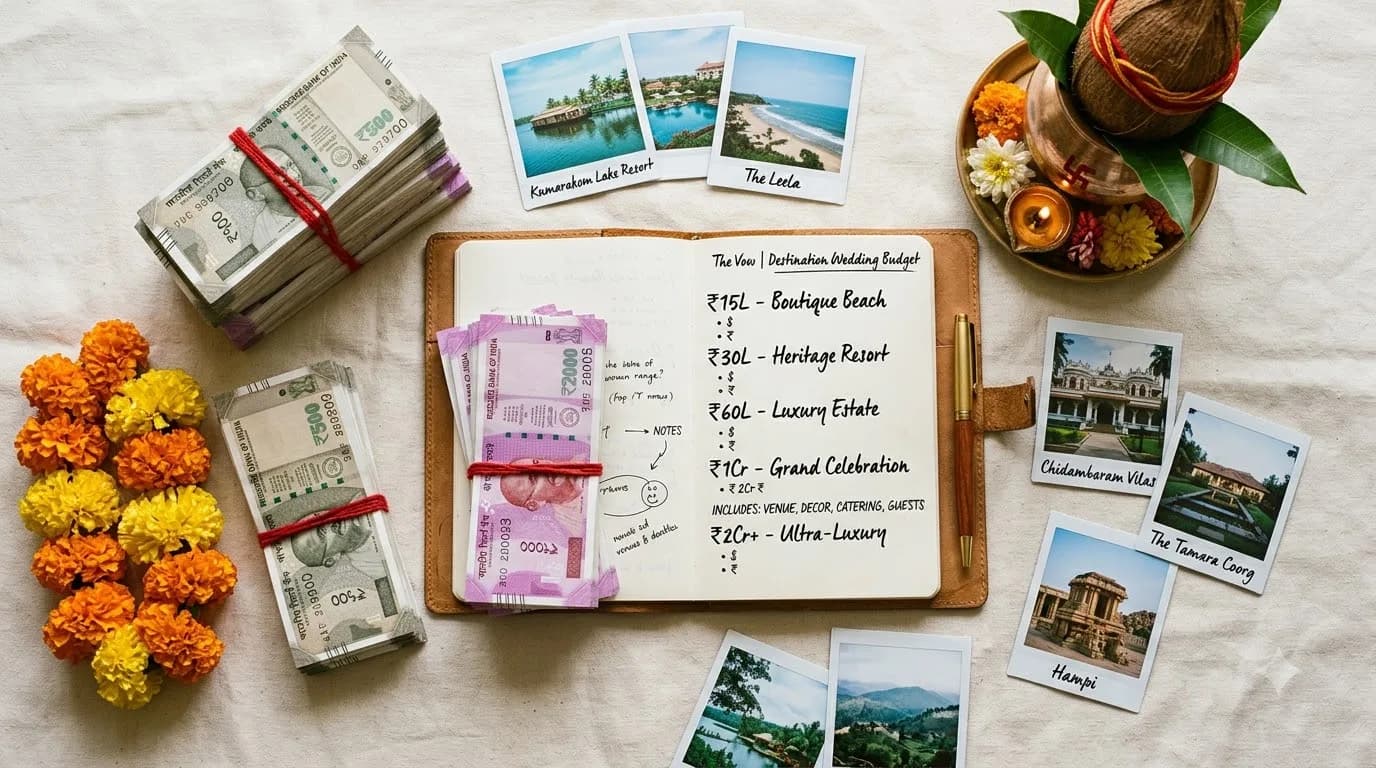
Destination Wedding Cost in South India 2026: 5-Tier Budget Guide
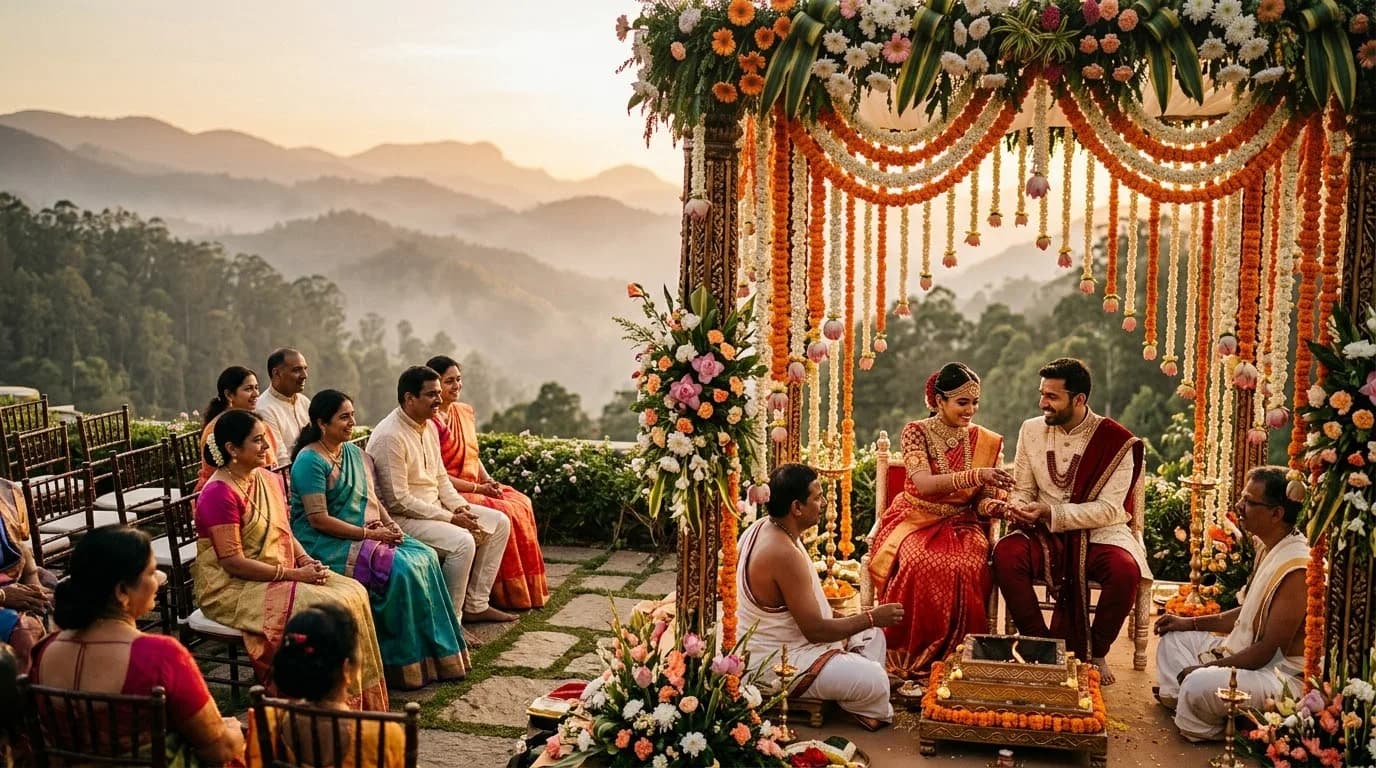
Destination Wedding in South India: Complete 2026 Planning Guide
Still planning?
Get quotes from India's best vendors
Tell us what you're planning and we'll match you with verified photographers, venues, decorators, and more.
Get free quotes