
Kodava Wedding Traditions: Coorg's Unique Marriage Customs
Kodava wedding traditions in Coorg — India's only no-priest Hindu ceremony. Elders lead the 30–45 minute Murta ritual. Full attire, feast, and customs guide.

On this page
Kodava weddings are India's only Hindu ceremony with no priest, no Vedic mantras, and no sacred fire. The Murta — a community elder blessing with rice and flowers — is the central ritual, lasting just 30–45 minutes. The groom wears the traditional kupya coat and carries a peechekathi ornamental dagger. Ceremonies are held at the ancestral ain mane or, increasingly, at Coorg resort venues.
Quick Answer
Quick answer: Kodava weddings are India's only Hindu ceremony with no priest, no Vedic mantras, and no sacred fire. The Murta — a community elder blessing with rice and flowers — is the central ritual, lasting just 30–45 minutes. The groom wears the traditional kupya coat and carries a peechekathi ornamental dagger.
Note
Pricing methodology: Cost ranges in this guide are based on vendor pricing data from the itsmy.wedding marketplace and published industry reports, collected in Q4 2025 – Q1 2026.
Kodava weddings are India's only Hindu marriage tradition conducted entirely without a priest, without Vedic mantras, and without a sacred fire. Rooted in the martial culture of the Kodagu (Coorg) district in Karnataka's Western Ghats, the ceremony is led by community elders. It centres on the Murta — a beautiful blessing with rice and flowers — and lasts just 30 to 45 minutes. This guide covers every element of this unique tradition, from the ancestral ain mane setting to the distinctive Kodava attire, the legendary feast, and practical advice for planning a Kodava wedding in 2026.
The Kodava community stands apart within Karnataka — culturally, linguistically, and in their approach to ritual. Karnataka is one of India's most economically powerful states, and Coorg's emergence as a premium destination wedding hub has brought national attention to these unique customs. The Codava National Council (CNC) and various Kodava Samaja chapters across Karnataka actively work to preserve these traditions for future generations. In contrast to many Hindu communities that have adopted Brahminical ceremony structures over centuries, the Kodavas have steadfastly maintained their own customs. If you are planning a wedding in the Karnataka region, our Bangalore wedding planning guide provides the broader context for how Coorg fits into the state's wedding landscape.
Who Are the Kodavas of Coorg?
The Kodavas are a small community of two to three lakh people with an outsized cultural impact — they are the only civilian community in India permitted to carry firearms without a licence. They are the original inhabitants of Kodagu (anglicised as Coorg), a lush, mountainous district in western Karnataka known for its coffee plantations, spice estates, and misty hill stations. The Kodagu district administration oversees this unique region. Historically, it was an independent kingdom before merging with the Indian union. Having coordinated weddings in both Coorg and Bangalore for several years, I can attest that a Kodava wedding is unlike any other Indian celebration I have encountered.
The Kodavas are historically a martial community. Their right to carry firearms without a licence is codified under Section 3 of the Arms Act, 1959. This provides a specific exemption for residents of the Kodagu district — a recognition of centuries-old warrior traditions. The Indian Army's official history also acknowledges Kodagu's outsized contribution to the armed forces. For example, the community has produced a disproportionate number of Indian Army officers, including Field Marshal K.M. Cariappa, India's first Commander-in-Chief.
Consequently, this martial identity shapes everything about Kodava culture, including weddings. The groom carries an ornamental dagger. The community performs Kolata — a rhythmic, coordinated stick dance that traces its origins to battle drills. What's more, the feast is unapologetically non-vegetarian, reflecting a community that has never adopted Brahminical food restrictions.
The ain mane (ancestral home) is the gravitational centre of Kodava life. Each Kodava family belongs to an okka (clan), and each okka has an ancestral home. This home serves as the family's spiritual and social headquarters. Weddings have traditionally been held at the ain mane — not at temples, not at rented halls, but at the place where the family's identity is rooted.
Note
What Are the Pre-Wedding Rituals?
How Does the Nishchay (Formal Agreement) Work?
The Nishchay is a solemn agreement between two okkas (clans), witnessed by community members and sealed with the exchange of betel leaves, areca nuts, and fruits. The Nishchay is the formal betrothal, typically held at the bride's ain mane. Elders from both families meet, discuss the match, and formally agree to the union. This is not a ring ceremony in the modern sense. Instead, it is a solemn pact between two okkas, witnessed by community members. Betel leaves, areca nuts, and fruits are exchanged as tokens.
How Is the Ain Mane Prepared?
In the days before the wedding, the ancestral home transforms into a bustling venue — family members arrive from across the country, and the kitchen begins operating at scale for the elaborate non-vegetarian feast. The nellakki nadabadi (the central hall of the ain mane) is cleaned and decorated. A pandal (temporary canopy) is erected in the courtyard for the feast. Family members arrive from across the country — Kodava weddings are reunions as much as they are ceremonies. As a result, the kitchen begins operating at scale. Preparations for the elaborate non-vegetarian feast start a day or two before the wedding.
Murta Kalasha Installation
Unlike in Brahminical traditions, no priest consecrates the kalasha — a senior family elder performs the installation, accompanied by community songs in Kodava Takk. A kalasha (sacred pot) is installed at the ain mane, representing divine blessings. In contrast to Brahminical traditions, no priest consecrates it. A senior elder of the family performs the installation, accompanied by community songs and prayers in Kodava Takk.
How Does the Murta Ceremony Work?
The Murta is India's only Hindu wedding ceremony with no priest, no Vedic mantras, and no sacred fire — the entire ritual lasts just 30 to 45 minutes and is led entirely by community elders. It is the heart of the Kodava wedding.
There is no priest. There is no sacred fire. There are no Sanskrit mantras. There are no circumambulations. The ceremony is conducted entirely by the community's elders, in the Kodava language, within the ancestral home.
Here is how it unfolds:
The gathering. Family members and community elders assemble in the nellakki nadabadi (central hall) of the ain mane. The bride and groom sit facing each other, often on a raised platform. As a result, the atmosphere is intimate — this is a family home, not a hall or temple.
The elder's address. A respected elder from the groom's family addresses the assembly. They speak about the significance of the union and the responsibilities of married life. This address is delivered in Kodava Takk, and its content varies by family. There is no fixed script and no liturgical text. The elder speaks from experience, tradition, and the heart.
The pathak tying. The groom ties the pathak — a gold necklace that is the Kodava equivalent of a mangalsutra — around the bride's neck. This is the moment the marriage is formalised. In contrast to other South Indian communities, the pathak is typically a simple, elegant gold chain with a pendant.
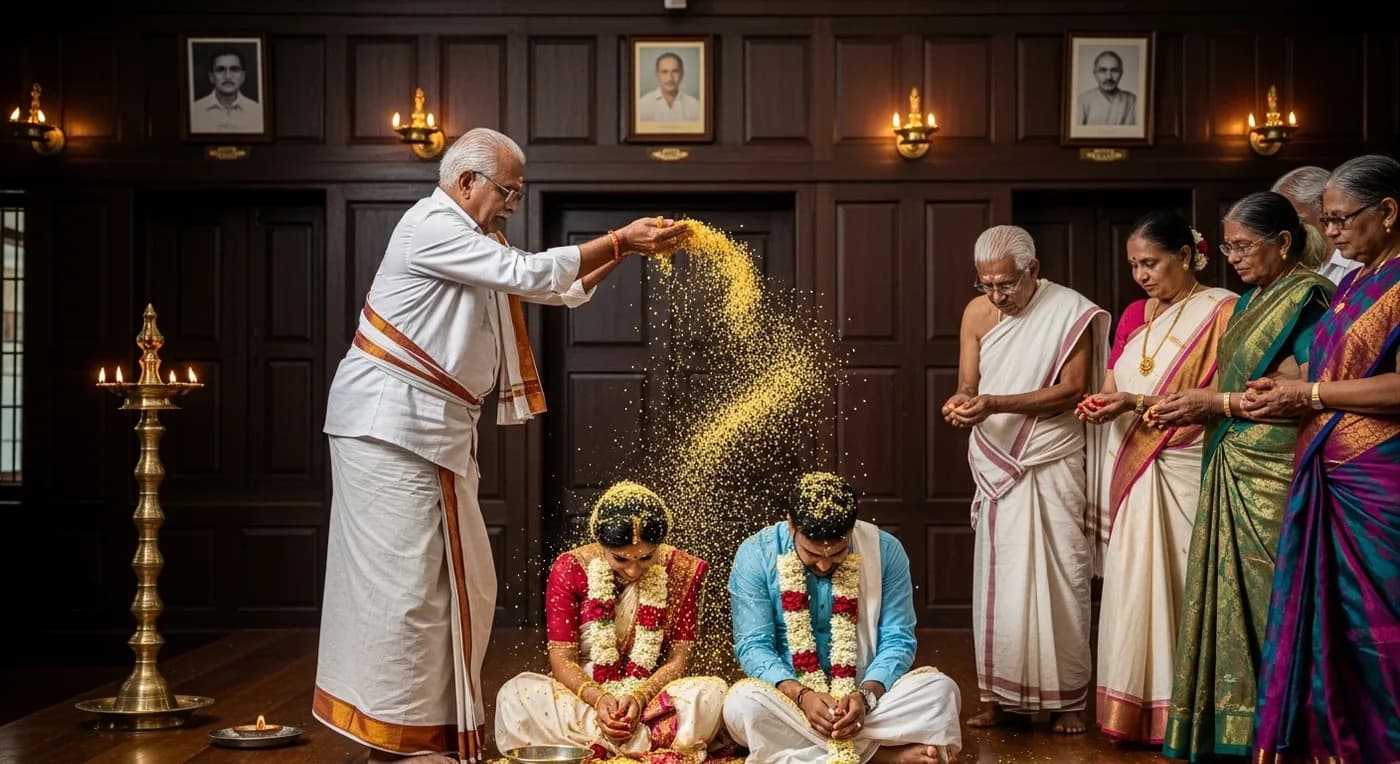
The akshata shower. Immediately after the pathak is tied, the assembled elders shower the couple with akshata (rice mixed with turmeric) and flower petals. This shower of blessings — offered by each elder in turn, with spoken words of goodwill — is the Murta in its purest form. In other words, each elder places their hand on the couple's heads and offers a personal blessing.
Community witness. The ceremony is complete. There are no further rounds, no further rituals. The marriage is sealed by the act of the pathak, the rice, the blessings, and the witness of the community. The entire Murta typically takes 30 to 45 minutes.
Tip
How Does a Kodava Wedding Compare to a Typical Hindu Wedding?
| Element | Kodava Wedding | Typical Hindu Wedding |
|---|---|---|
| Officiant | Community elders | Brahmin priest |
| Sacred fire | Not used | Central to ceremony (Agni) |
| Mantras | None — blessings in Kodava Takk | Sanskrit Vedic mantras |
| Duration | 30–45 minutes | 2–4 hours |
| Central ritual | Murta (rice and flower blessing) | Saptapadi (seven steps around fire) |
| Mangalsutra | Pathak (Kodava equivalent) | Mangalsutra |
| Bride's attire | Kodava-style front-pleated saree | Varies by region |
| Feast | Non-vegetarian (pandi curry) | Often vegetarian |
| Music/dance | Kolata (martial stick dance) | Varies by region |
What Does Kodava Wedding Attire Look Like?
Kodava wedding attire is immediately recognisable and deeply symbolic — every element connects to the community's martial heritage and agricultural identity.
What Does the Kodava Bride Wear?
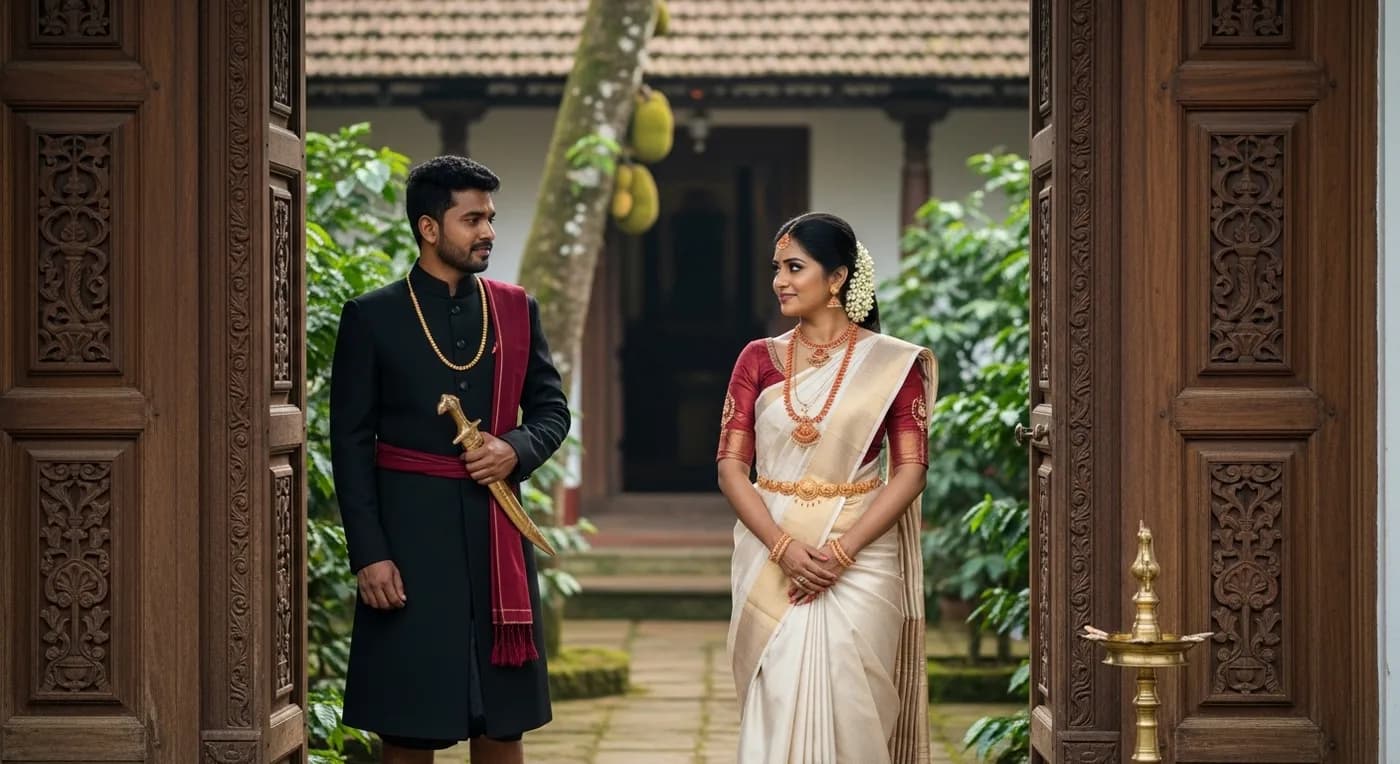
The Kodava bride wears a saree draped in a distinctive front-pleating style found nowhere else in India, paired with jomale — coral-and-gold jewellery unique to the community. The draping method has practical roots. The Kodava style features front pleats arranged differently from Kannada, Tamil, or Maharashtrian methods. The pallu is pinned at the right shoulder rather than the left. The pleats fan outward to allow freedom of movement — a practical choice for a community of women who worked the land alongside men.
The saree itself is typically silk — deep reds, maroons, and greens are traditional choices. Over the saree, the bride may wear a kupasa (a fitted, long-sleeved blouse) that is distinct from the standard saree blouse.
Her jewellery is the jomale — a traditional Kodava ornament set featuring coral stones (pavala) set in gold. The coral-and-gold combination is unique to the Kodava community and instantly identifies the wearer. Key pieces include the jomale necklace (a multi-strand coral and gold chain), kokkethathi (earrings), and pathak (the wedding necklace tied by the groom). What's more, fresh flowers — jasmine and kanakambara (crossandra) — are woven into the hair.
What Does the Kodava Groom Wear?
The groom's attire is martial and striking — the kupya coat, chele sash, and peechekathi ornamental dagger create an ensemble that invariably draws admiration from non-Kodava guests. He wears the kupya — a long, knee-length black coat with a Mandarin collar, fastened with a sash. The chele (a broad, embroidered sash) is tied around the waist over the kupya. From it hangs the peechekathi — an ornamental dagger with a silver or gold handle. The peechekathi is not merely decorative. It is a symbol of the Kodava warrior tradition and the groom's readiness to protect his family.
A white or cream mundu (lower garment) and a turban or headscarf complete the ensemble. The overall effect is regal, martial, and unmistakably Kodava. At Bangalore ceremonies, for example, the groom's entrance in full Kodava attire invariably draws admiration from guests unfamiliar with the tradition.
What Is Served at the Legendary Kodava Feast?
The Kodava wedding feast is unapologetically non-vegetarian and features dishes found nowhere else in Karnataka — pandi curry, kadambuttu, and baimbale curry form the centrepiece of a meal that guests remember for years.
What Makes Pandi Curry the Star Dish?
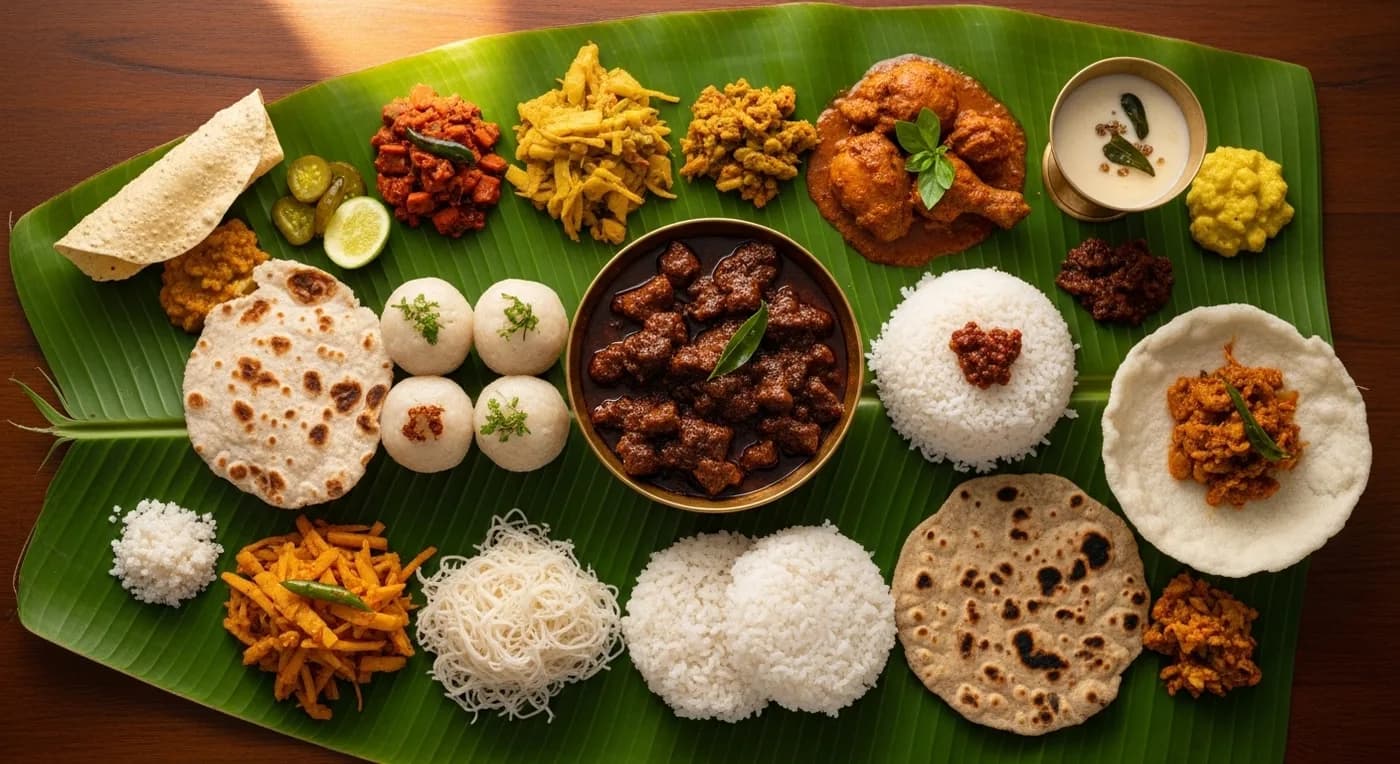
The centrepiece is pandi curry — Coorg's signature pork dish, slow-cooked with kachampuli (Coorg vinegar from the Garcinia fruit) until the gravy is dark, sour, and intensely flavoured. From the wedding feasts I have attended at ain manes in Madikeri and Virajpet, pandi curry is not merely a menu item — it is a cultural statement. The Coorg tourism board actively promotes Kodava cuisine as a reason to visit the region. In other words, pandi curry is not optional at a Kodava wedding — it is the defining dish.
Alongside the pandi curry, the feast includes kadambuttu (steamed rice dumplings designed to be broken and dipped into the curry) and nool puttu (string hoppers — delicate nests of steamed rice flour noodles). The spread also features baimbale curry (bamboo shoot curry) and kummu curry (mushroom curry foraged from the coffee estates that the Coffee Board of India recognises as some of the country's finest). Meat preparations extend beyond pork to include mutton, chicken, and sometimes wild boar or venison in rural celebrations.
Important
What Is the Kolata Martial Dance?
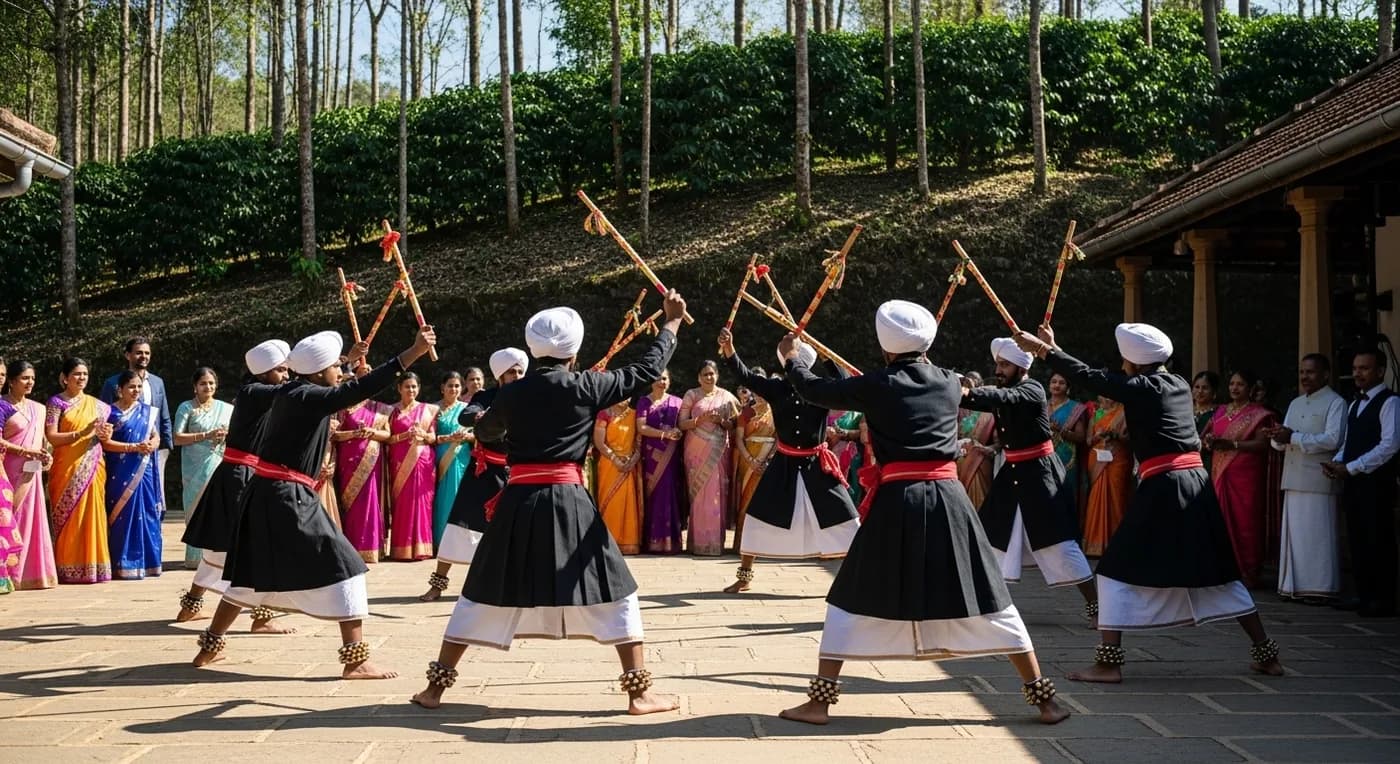
No Kodava wedding is complete without the Kolata — a rhythmic stick dance tracing its origins to ancient battle drills, performed after the feast and often lasting late into the night. The Kolata is a group dance performed by men holding wooden sticks in coordinated formations. The dancers form two facing rows and strike their sticks in increasingly complex patterns. Drums and traditional Kodava folk songs accompany the performance. Participation is a point of community pride.
Women also perform the ummathat — a graceful, circular folk dance without props, moving in a ring with linked arms. Together, the Kolata and ummathat transform the post-ceremony celebration into a vivid expression of Kodava cultural identity.
How Should You Plan a Kodava Wedding Today?
Whether you are a Kodava couple honouring your heritage or an inter-community couple drawn to Coorg traditions, practical guidance on venues, season, and catering is essential. In an Indian wedding industry valued at ₹10.79 lakh crore, Coorg's resort venues are carving out a fast-growing destination wedding niche.
What Are the Best Venue Options in Coorg?
The ancestral ain mane remains the most culturally authentic setting, but Coorg's premium resorts now offer stunning alternatives with professional event management. Not all ain manes can accommodate large guest lists or provide the infrastructure modern celebrations require. That said, venue managers I speak with at Coorg's top properties confirm that Kodava weddings are their most culturally distinctive bookings of the year.
Top resort venues include the Tamara Coorg, Evolve Back (formerly Orange County), Old Kent Estates, and Amanvana. These properties offer dedicated wedding packages that incorporate Kodava elements — from traditional mandap setups to Kodava cuisine. For a full venue-by-venue breakdown with pricing, logistics, and seasonal advice, see our destination wedding in Coorg planning guide.
₹15,00,000 – ₹50,00,000This range covers a two-day destination wedding at a premium Coorg resort for 100-300 guests, inclusive of accommodation, meals, and basic decor.
Can You Hold a Kodava Wedding in Bangalore?
Many Kodava families based in Bangalore hold the wedding in the city for logistical convenience, especially when the guest list includes non-Kodava colleagues and friends. A WedMeGood survey of 2,000+ couples shows that destination weddings now account for a growing share of the Indian wedding market. Coorg consistently ranks among the top choices in South India — our Coorg vs Hyderabad destination wedding comparison explores how these two options stack up. However, many Kodava families based in Bangalore prefer the city for logistical convenience. From Kodava weddings I have helped organise at farmhouses along Kanakapura Road and in Sadashivanagar, I find that outdoor settings complement Kodava traditions beautifully. The Kolata dance especially needs open space. The ceremony, attire, and feast remain authentically Kodava — only the location changes.
₹8,00,000 – ₹25,00,000Looking for Venues in Bangalore?
Tell us what you need and get quotes from verified venues
When Is the Best Season for a Coorg Wedding?
October through February is ideal — the monsoon has receded, the landscape is lush and green, and the weather is cool at 15–25 degrees Celsius. December and January can be cold, especially in the mornings. This adds a romantic mist to outdoor ceremonies but requires planning for guest comfort. March through May is warm and dry — viable but less scenic. In contrast, June through September is full monsoon in Coorg, with heavy rainfall that makes outdoor events risky.
How Does the Murta Work for Inter-Community Couples?
The Murta ceremony is beautifully inclusive — its simplicity and absence of complex religious prerequisites make it accessible to anyone, regardless of faith background. If one partner is Kodava and the other is not, the Murta is a natural choice. Many inter-community couples hold a Kodava Murta alongside a ceremony from the other partner's tradition. This creates a two-part celebration that honours both families. A Kodava elder can explain the ceremony's significance to non-Kodava guests, ensuring everyone feels included in the moment.
On itsmy.wedding, you can find vendors in both Coorg and Bangalore who are experienced with Kodava wedding traditions — from caterers who specialise in authentic pandi curry to photographers who know the rhythm of the Murta ceremony.
Looking for Caterings in Bangalore?
Tell us what you need and get quotes from verified caterings
How Do You Choose the Right Kodava Caterer?
The feast is arguably the element that guests remember most vividly — the kachampuli in the pandi curry, the texture of the kadambuttu, and the balance of the baimbale curry all require specific expertise. When selecting a caterer, ensure they have genuine expertise in Kodava cuisine. The kachampuli in the pandi curry, the texture of the kadambuttu, and the balance of the baimbale curry all require specific knowledge. Ask for a tasting before committing. Several Bangalore-based caterers with Kodava roots offer authentic Coorg cuisine for city weddings. Our wedding catering cost guide for Bangalore covers per-plate pricing across cuisine types to help you compare quotes.
Common Questions About Kodava Wedding Traditions
What sets Kodava weddings apart from other Hindu marriage ceremonies?
Kodava weddings are India's only Hindu tradition where no priest officiates at any stage. Community elders lead the entire ceremony, which omits Vedic mantras and the sacred fire entirely. The central Murta blessing with rice and flowers wraps up in just 30–45 minutes. The community's distinctive attire, martial stick dances, and non-vegetarian feast further distinguish these celebrations.
How does the Murta blessing ritual unfold?
The groom ties the pathak (the Kodava equivalent of a mangalsutra) around the bride's neck while assembled elders shower the couple with akshata — turmeric-tinted rice — and flower petals. Each elder offers spoken blessings in Kodava Takk, the community's oral language. The full ritual typically concludes within 30–45 minutes.
What traditional clothing does a Kodava bride and groom wear?
The bride drapes a silk saree in a distinctive front-pleating style unique to the Kodava community, with the pallu pinned at the right shoulder. Her jewellery features jomale — coral stones set in gold — including the multi-strand jomale necklace and kokkethathi earrings. The groom wears the kupya (a knee-length black coat) with a chele sash and the peechekathi ornamental dagger.
What are the most common venue choices for Kodava weddings today?
The ancestral ain mane (family home) in Coorg remains the most culturally meaningful setting for the ceremony. That said, modern couples often opt for premium Coorg resorts — Tamara, Evolve Back, and Old Kent Estates among them — or hold the celebration at farmhouse venues near Bangalore when logistical convenience is a priority.
A Kodava wedding is a celebration of identity — of a community that has preserved its customs with quiet tenacity across centuries. The absence of priestly intermediaries, the directness of the elder's blessings, and the martial elegance of the attire all reflect a people who do things their own way. The bold flavours of the feast reinforce this spirit of pride and grace. Whether your Murta takes place in a mist-wrapped ain mane in Kodagu or at a sunlit farmhouse outside Bangalore, it will be unlike any other wedding your guests have witnessed. For the broader Karnataka wedding context, explore our Bangalore wedding planning guide and our detailed look at Kannada wedding traditions.
Tip
Start planning your wedding — generate a personalised checklist with our AI Wedding Checklist, estimate your budget with the Cost Calculator, or create a beautiful digital invitation.
Topics
kodava wedding traditionscoorg wedding ritualskodava marriagemurta ceremonycoorg wedding customsExplore more
Frequently Asked Questions
1What makes Kodava weddings unique?
2What is the Murta ceremony in Kodava weddings?
3What do Kodava brides wear?
4Where are Kodava weddings typically held?
Continue reading
Related Articles
Destination Wedding in Coorg: Complete 2026 Planning Guide
Coffee Plantation Wedding in Coorg: Complete Guide
Best Wedding Venues in Coorg: ₹50K-₹40L Pricing Guide (2026)
Best Season for South India Destination Weddings: Month-by-Month Western Ghats Guide
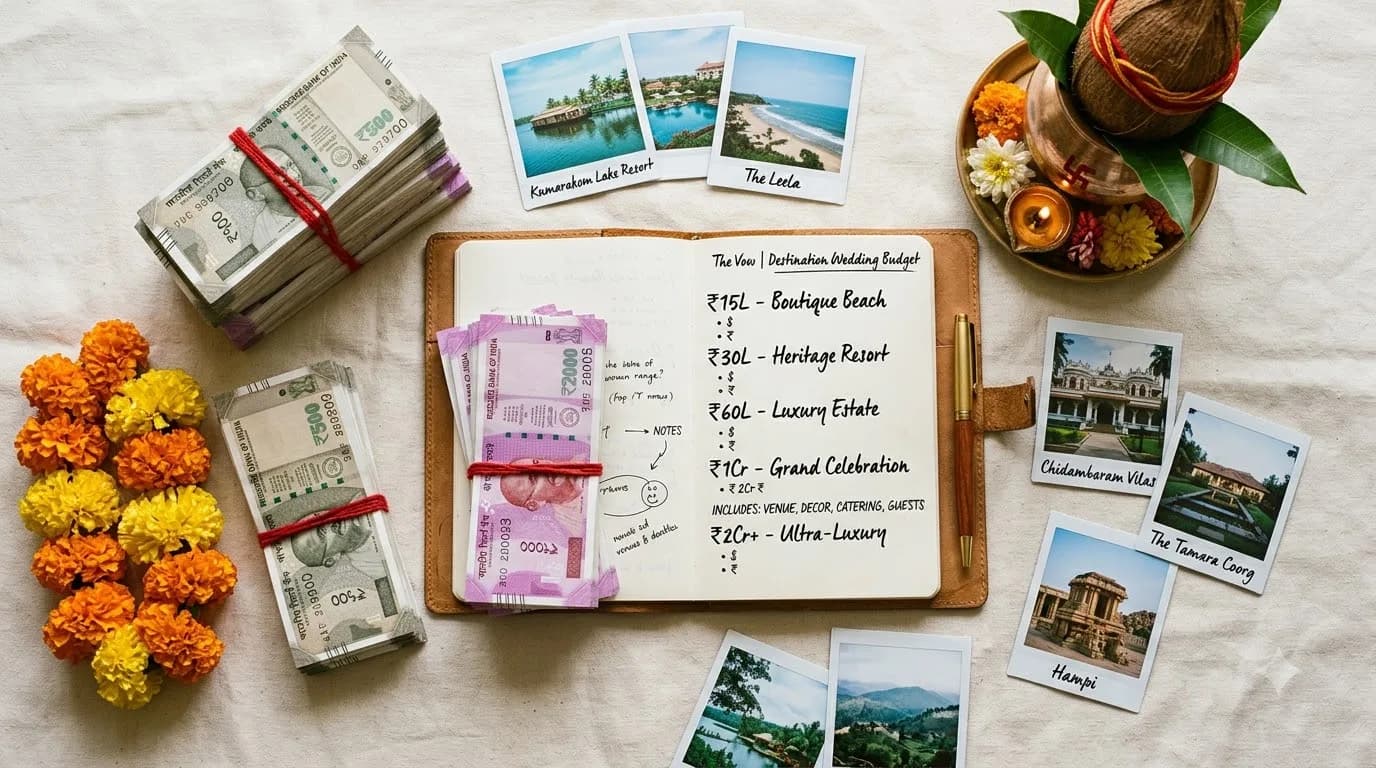
Destination Wedding Cost in South India 2026: 5-Tier Budget Guide
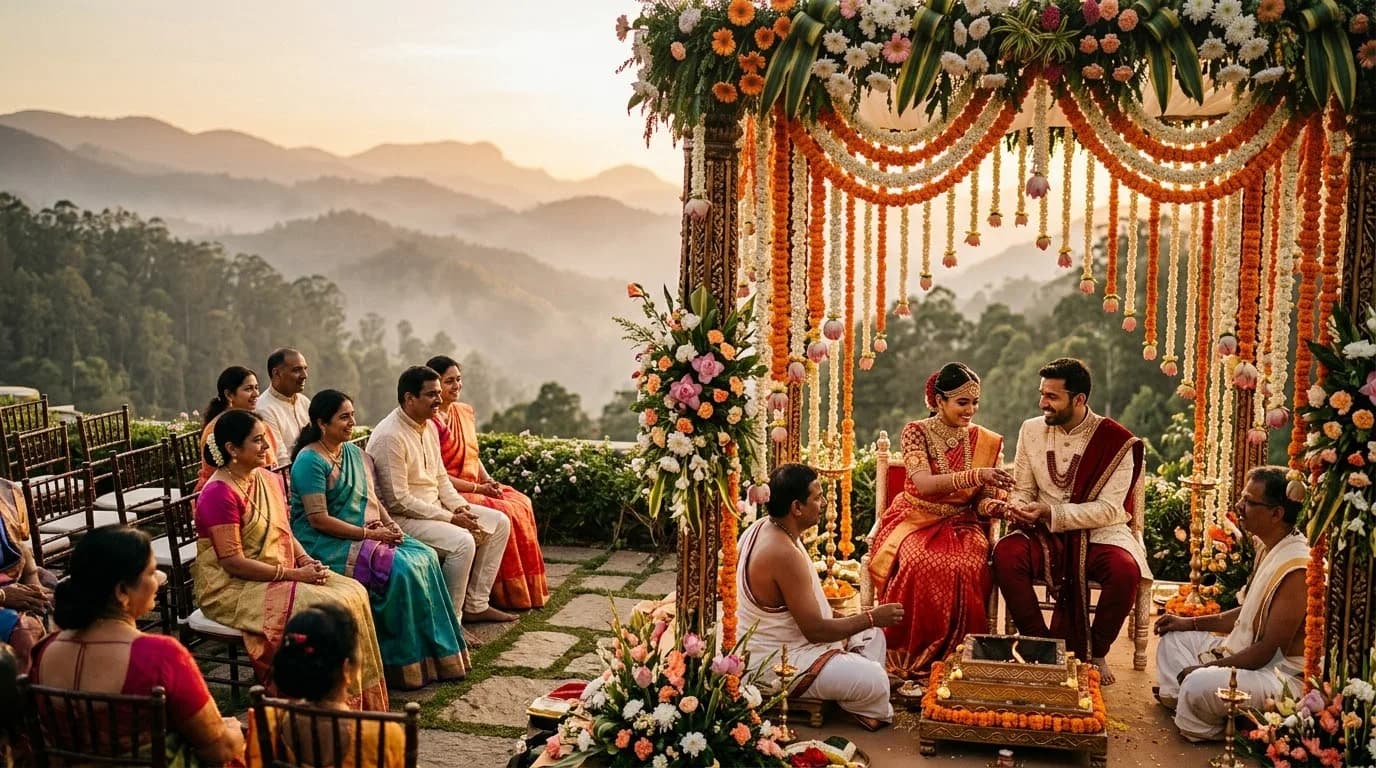
Destination Wedding in South India: Complete 2026 Planning Guide
Still planning?
Get quotes from India's best vendors
Tell us what you're planning and we'll match you with verified photographers, venues, decorators, and more.
Get free quotes