
Tamil Brahmin Wedding: Iyer vs Iyengar Rituals Explained
Iyer and Iyengar weddings share 80% of their rituals but differ in theology, mantras, and cuisine. Compare all 12 ceremony steps side by side for 2026.

On this page
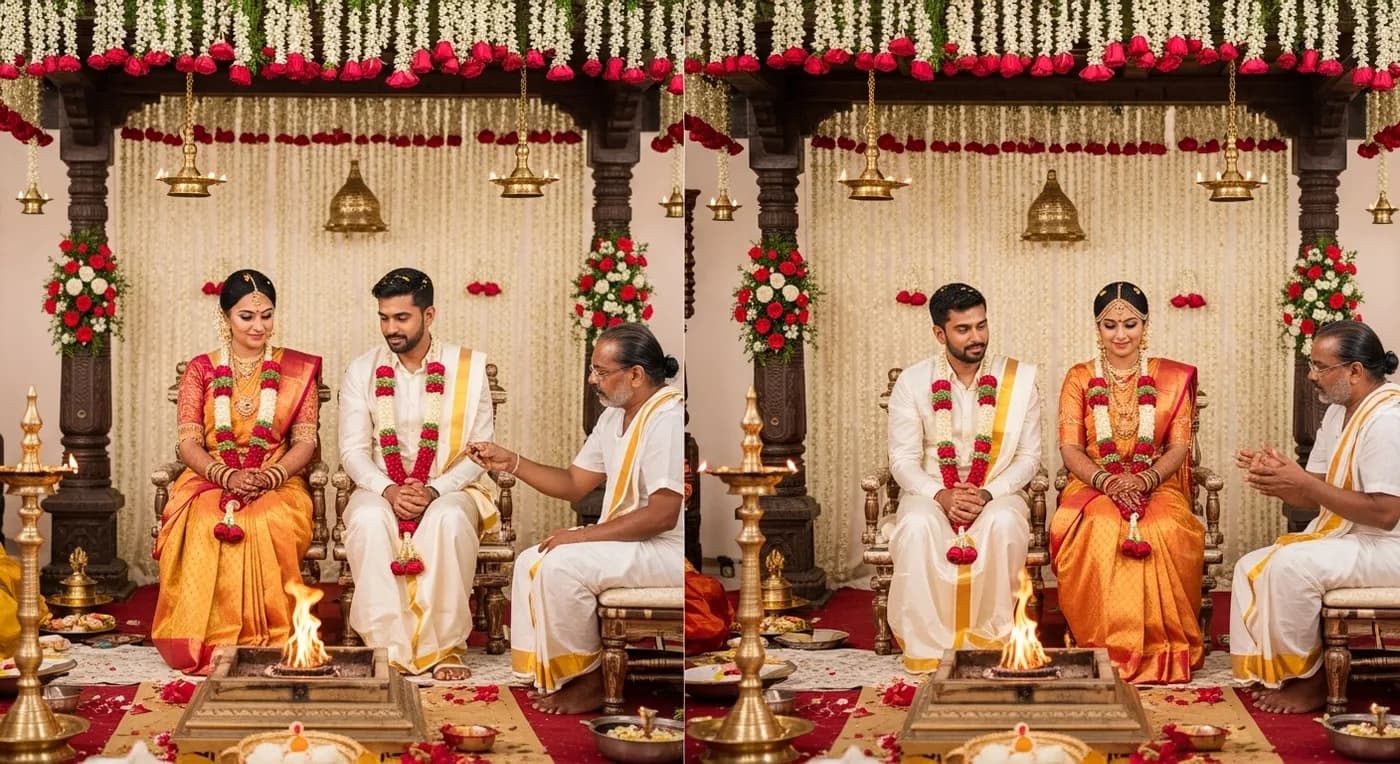
Iyer and Iyengar weddings share approximately 80% of their ritual structure but differ fundamentally in theology — Iyers follow Smartha (multi-deity) Advaita tradition, Iyengars follow Sri Vaishnava (Vishnu-only) Vishishtadvaita. Key visible differences: vibhuti (ash) forehead markings vs Thiruman/Namam (U-shaped), and Iyengar feasts exclude onion and garlic entirely while featuring distinctive dishes like puliyogare and bisibele bath.
Quick Answer
Quick answer: Iyer and Iyengar weddings share approximately 80% of their ritual structure but differ fundamentally in theology — Iyers follow Smartha (multi-deity) Advaita tradition, Iyengars follow Sri Vaishnava (Vishnu-only) Vishishtadvaita. Key visible differences: vibhuti (ash) forehead markings vs Thiruman/Namam (U-shaped), and Iyengar feasts exclude onion and garlic entirely while featuring distinctive dishes like puliyogare and bisibele bath.
Note
Pricing methodology: Cost ranges in this guide are based on vendor pricing data from the itsmy.wedding marketplace and published industry reports, collected in Q4 2025 – Q1 2026.
Iyer (Smartha Brahmin) and Iyengar (Sri Vaishnava Brahmin) are the two branches of the Tamil Brahmin tradition — rooted in Tamil Nadu, one of India's largest state economies — and their weddings share approximately 80 percent of the ritual structure while differing in theological philosophy, specific ceremonial sequences, and cultural markers that range from forehead markings to the food served at the feast. If you are planning a Tamil Brahmin wedding — or attending one and wondering why certain details differ from what you have seen before — this is the definitive comparison.
Despite their shared roots in Tamil Nadu's Brahmin heritage, the two traditions emerge from fundamentally different philosophical schools, and these differences ripple through every element of the wedding day. This guide examines those differences with specificity and respect, covering the theological foundations, a side-by-side ritual comparison, attire distinctions, cuisine, and practical planning advice. For the broader Tamil wedding ritual framework that both communities share, see our complete Tamil wedding traditions guide.
Understanding the Roots: Smartha vs Sri Vaishnava
The Iyer-Iyengar distinction is not merely cultural — it is theological. Understanding the philosophical roots clarifies why the wedding ceremonies differ.
Iyer: The Smartha Tradition
Iyers follow the Smartha tradition, rooted in the teachings of Adi Shankaracharya (8th century CE) and the philosophy of Advaita Vedanta — the concept of non-duality, where the individual soul (atman) and the universal reality (Brahman) are ultimately one. The Smartha approach is inclusive: followers worship five deities equally — Shiva, Vishnu, Shakti, Ganesha, and Surya — through a practice called Pancha-devata Puja (five-deity worship).
This theological inclusiveness means Iyer families might worship at both Shiva and Vishnu temples, and their wedding ceremonies draw from a broader scriptural palette. The forehead marking is vibhuti — three horizontal lines of sacred ash, sometimes with a red kumkum dot at the centre.
Iyengar: The Sri Vaishnava Tradition
Iyengars follow the Sri Vaishnava tradition, founded by Ramanuja (11th-12th century CE) and rooted in Vishishtadvaita — qualified non-duality, which holds that individual souls are real and distinct but exist in a relationship of devotion with Vishnu (or his forms, including Narayana, Ranganatha, and Venkateshwara). Worship is exclusively directed toward Vishnu and his consort Lakshmi.
The Iyengar community itself is divided into two sub-groups: Vadakalai (northern school, following Vedanta Desika's teachings) and Thenkalai (southern school, following Manavala Mamunigal's teachings). The forehead marking differs between them — Vadakalai Iyengars wear a yellow Thiruman with a red line (Sricharanam), while Thenkalai Iyengars wear a white Thiruman with a wider red mark. Both markings are distinctly U-shaped or Y-shaped, immediately distinguishable from the Iyer's horizontal vibhuti lines.
Note
Side-by-Side Ritual Comparison
While both ceremonies follow the same broad arc — pre-wedding ceremonies, groom's arrival, garland exchange, swing ceremony, thali tying, circumambulation of fire — the specific execution, mantras, and emphasis differ at nearly every step.
| Ritual | Iyer (Smartha) | Iyengar (Sri Vaishnava) |
|---|---|---|
| Forehead Marking | Vibhuti (three horizontal ash lines) + kumkum | Thiruman/Namam (U or Y-shaped, Vishnu-oriented) |
| Primary Mantras | Rig Veda or Yajur Veda (varies by gothra/suthra) | Yajur Veda in Pancharatra Agama tradition |
| Devotional Hymns | Vedic chanting only | Vedic chanting + Divya Prabandham (Tamil hymns) |
| Panda Kaal | Performed with Vedic mantras | Performed with Pancharatra mantras |
| Vratham | Groom performs at bride's home, Shiva/Vishnu invocations | Groom performs at bride's home, Vishnu-centric |
| Kasi Yatra | Present — umbrella, stick, towel | Present — similar props, slight dialogue variation |
| Maalai Maatral | Garland exchange, competitive lifting | Garland exchange, competitive lifting (identical spirit) |
| Oonjal | Couple on swing, Tamil folk songs by elders | Couple on swing, includes Divya Prabandham verses |
| Kanyadaanam | Father gives daughter, Vedic mantras | Father gives daughter, Sri Vaishnava mantras |
| Mangalya Dharanam | Thali tied at muhurtham, nadaswaram crescendo | Thali tied at muhurtham, nadaswaram + conch blowing |
| Saptapadi | Seven steps around fire, Vedic vows | Seven steps around fire, Vaishnava-specific mantras |
| Arundhati Darshan | Star-gazing ritual present | Star-gazing ritual present |
| Grihapravesham | Bride enters groom's home | Bride enters groom's home, additional prayers to Vishnu |
What Stays the Same
It is important to emphasise what both traditions share: the centrality of the muhurtham, the structure of the ceremony (groom's arrival to final circumambulation), the emotional significance of Kanyadaanam, the sacredness of the thali tying, the banana-leaf feast, and the nadaswaram-thavil musical accompaniment. A guest who has attended one would recognise the other immediately — the differences are real but they exist within a shared framework.
The Oonjal: Where Differences Come Alive
The Oonjal (swing ceremony) is one ritual where the Iyer-Iyengar distinction becomes most audible. In both traditions, the newly garland-exchanged couple is seated together on a decorated swing and rocked gently while elders sing and pass a lit lamp around them.
The Iyer Oonjal
In Iyer weddings, the songs sung during the Oonjal are typically traditional Tamil folk verses — Oonjal Paattu — that have been passed down through generations. These songs carry blessings, advice, and sometimes gentle humour about married life. The musical character is folk-devotional, drawing from a broad Tamil cultural heritage rather than a specific sectarian tradition. Elders from both families take turns singing, and the emotional warmth of the moment often makes it one of the most memorable parts of the ceremony.
The Iyengar Oonjal
The Iyengar Oonjal includes these Tamil folk elements but layers in verses from the Divya Prabandham — the collection of 4,000 Tamil hymns composed by the twelve Alvars (Vaishnava poet-saints). These hymns are specifically dedicated to Vishnu and Lakshmi, and their inclusion gives the Iyengar Oonjal a distinctly devotional character. The singing alternates between folk verses and Prabandham recitations, creating a ceremony that is simultaneously cultural and theological. For families deeply connected to the Sri Vaishnava tradition, hearing the Prabandham at their child's wedding is profoundly meaningful.
Attire Differences
The Bride
Both Iyer and Iyengar brides wear Kanjivaram silk sarees — the queen of South Indian wedding textiles. The distinction lies in the draping style, colour preferences, and symbolic markings.
Iyer Bride: Traditionally wears a Madisar — a nine-yard saree draped in a distinctive style where the fabric passes between the legs, creating a dhoti-like lower portion. The Madisar is worn in auspicious colours — deep red, maroon, green, or a combination. The forehead bears vibhuti and a large red kumkum dot. Temple jewellery is standard: nethi chutti (forehead ornament), jimikki (chandelier earrings), vanki (armlet), and multiple gold necklace layers.
Iyengar Bride: Also wears a Madisar, but the forehead marking is the Thiruman Namam — the U or Y-shaped Vishnu mark that is the most immediately visible identifier of the Sri Vaishnava tradition. Colour preferences traditionally lean toward bright yellow, red, and green — yellow carrying particular significance as it is associated with Vishnu. The jewellery is similar in style to the Iyer bride's but may include specific Vaishnava motifs in the pendant designs.
Tip
The Groom
Both grooms wear a veshti (silk dhoti) with an angavastram (upper cloth). The Iyer groom applies vibhuti on his forehead, while the Iyengar groom wears the Thiruman Namam. During the Vratham (pre-wedding ritual), both grooms adopt a simple, almost ascetic appearance — symbolising the student (brahmachari) phase they are about to leave behind.
The Wedding Feast: A Study in Subtle Distinction
The banana-leaf feast is central to both Iyer and Iyengar weddings, and both are strictly vegetarian. The distinction — important to families and essential for caterers to understand — lies in ingredient philosophy.
Iyer Cuisine
Traditional Iyer cooking follows a broad Brahmin vegetarian approach. Onion and garlic are used in some families (though purists avoid them), and the cuisine draws from the full range of South Indian vegetarian tradition. A typical Iyer wedding banana-leaf meal includes sambar, rasam, kootu, poriyal (dry vegetable), aviyal, payasam (dessert), curd rice, and a range of pickles and accompaniments. The meal follows a specific left-to-right serving sequence on the banana leaf that any Tamil Brahmin caterer will know instinctively.
Iyengar Cuisine
Traditional Iyengar cooking strictly avoids onion and garlic — these ingredients are classified as rajasic (stimulating) or tamasic (dulling) in the Vaishnava dietary framework and are considered incompatible with sattvic (pure, balanced) living. This restriction shapes the entire flavour profile: Iyengar cuisine achieves depth through asafoetida (perungayam), tamarind, coconut, and a more complex spice layering that compensates for the absence of alliums.
Distinctive Iyengar wedding dishes include puliyogare (tamarind rice, often associated with temple prasadam), bisibele bath (a spiced rice-lentil dish with roots in Karnataka's Mysore Iyengar community), chitranna (lemon rice), and specific preparations of kootu and rasam that are recognisably different from their Iyer counterparts. The Iyengar payasam (dessert) tends toward saffron and cardamom flavours, and rava kesari (semolina sweet) is a staple.
Modern Catering Reality
Professional caterers in Chennai (formerly Madras) who serve the Tamil Brahmin community are well aware of the Iyer-Iyengar distinction and will confirm which tradition to follow as one of their first questions. For inter-community weddings — an Iyer marrying an Iyengar — the catering decision often becomes a family negotiation. Some families choose to follow the stricter standard (no onion, no garlic) to accommodate both sides. Others serve the Iyengar menu for the morning wedding meal and a broader menu at the evening reception.
Looking for Caterings in Chennai?
Tell us what you need and get quotes from verified caterings
The Modern Reality: Navigating Traditions in 2026
Inter-Community Marriages
Marriages between Iyers and Iyengars are increasingly common in urban Chennai, Bangalore, and among the global Tamil diaspora. These unions raise a practical question: whose rituals do you follow?
The most common approaches include choosing one tradition entirely (typically determined by family seniority or mutual agreement), conducting a blended ceremony where the core rituals follow one tradition but specific elements from the other are incorporated (such as including Divya Prabandham verses in an otherwise Smartha ceremony), and hiring two purohits — one from each tradition — who collaborate on a ceremony that honours both lineages. The last option is increasingly popular among families who want both communities to feel represented.
Shorter Ceremonies
Both Iyer and Iyengar weddings have undergone significant compression over the past two decades. A ceremony that once lasted four to five hours is now routinely completed in two to two and a half hours. The essential rituals remain — Kasi Yatra, Maalai Maatral, Oonjal, Kanyadaanam, Mangalya Dharanam, Saptapadi — but the extended Vedic chanting between major rituals is often abbreviated. Younger families increasingly request that the purohit explain each ritual in Tamil or English as it happens, transforming the ceremony from an opaque priestly performance into a shared, understood experience.
Evening Receptions
The evening reception has become the primary social event for both Iyer and Iyengar families — a trend reflected across India's ₹10.79 lakh crore wedding industry. While the morning ceremony is attended by close family and elders, the reception draws the wider community — 500 to 1,500 guests is common for families in Chennai. The reception is where modern elements dominate: DJ entertainment, cocktail areas (once unthinkable in Brahmin weddings, now increasingly accepted), themed decor, and multi-cuisine buffets that may include North Indian, Chinese, and Continental options alongside the traditional vegetarian spread.
Important
Planning Your Tamil Brahmin Wedding
Finding the Right Purohit
The vadhyar (priest) is the single most important booking for a Tamil Brahmin wedding. For an Iyer wedding, you need a Smartha purohit who is familiar with your family's specific gothra (lineage) and suthra (Vedic school). For an Iyengar wedding, you need a Sri Vaishnava vadhyar — and you must specify whether your family follows the Vadakalai or Thenkalai tradition. The best purohits are booked six to twelve months in advance for peak muhurtham dates.
Mandapam Booking
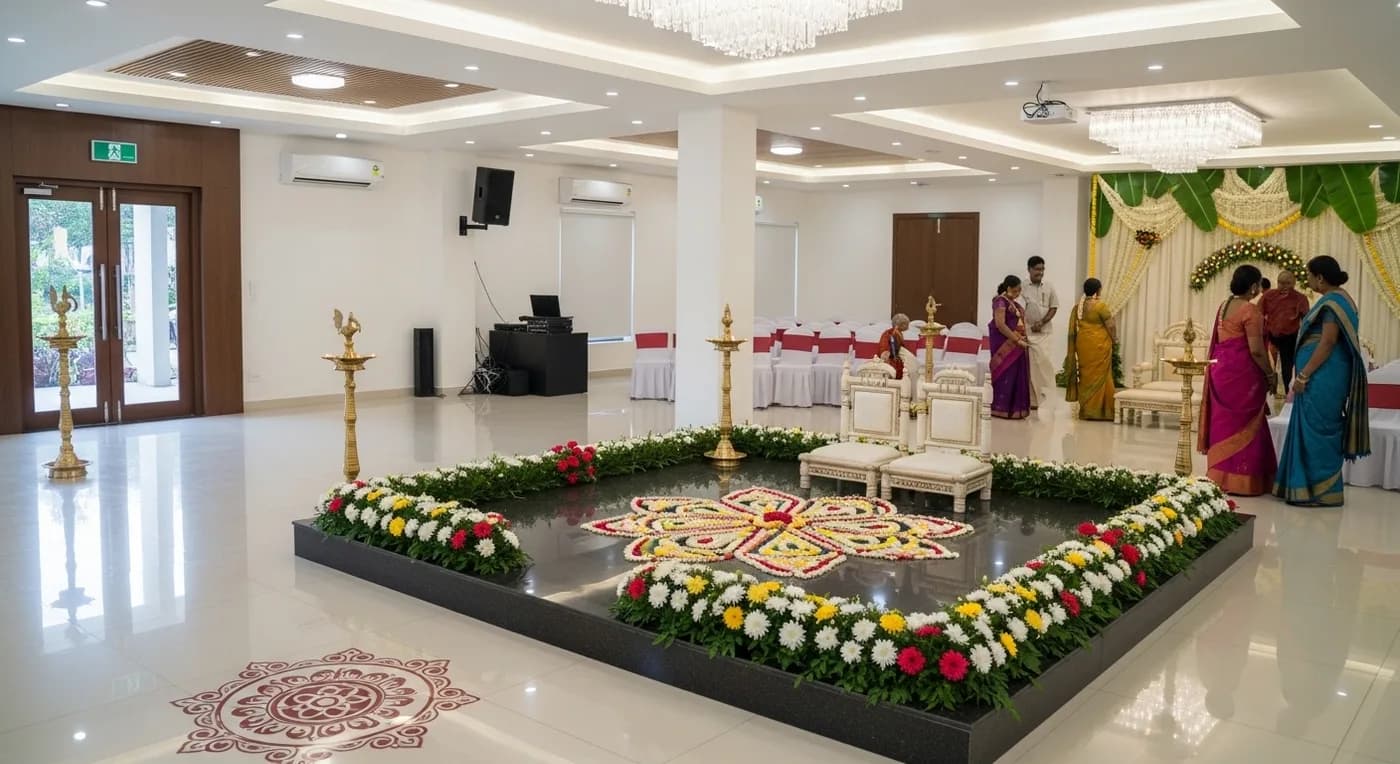
Both communities favour traditional kalyana mandapams for the morning ceremony, particularly community-run halls that are familiar with the specific ritual requirements. The mandapam must accommodate the sacred fire pit (homa kundam), a raised platform for the ceremony, space for the Oonjal swing, and a banana-leaf dining area. For an overview of the best options, see our Chennai wedding planning guide. For a striking contrast, the Kongu Gounder wedding tradition in Coimbatore uses no sacred fire or Vedic hymns at all — community elders officiate in Tamil, following Sangam-era customs that predate Brahminical influence.
Budget Expectations
Tamil Brahmin weddings in Chennai, whether Iyer or Iyengar, typically fall within these ranges:
- Traditional (community mandapam, 300-500 guests): ₹5,00,000 – ₹12,00,000
- Mid-range (premium hall, 500-800 guests): ₹12,00,000 – ₹25,00,000
- Premium (5-star hotel or heritage venue, 800-1500 guests): ₹25,00,000 – ₹50,00,000
These ranges include the ceremony, morning saapadu, and evening reception. A survey of 2,000+ couples found that ceremony and reception together account for the largest share of wedding budgets. They do not include jewellery, trousseau, or gifts between families — which can significantly exceed the wedding event costs, particularly in families that follow traditional gold-giving customs.
Looking for Photographers in Chennai?
Tell us what you need and get quotes from verified photographers
The Nadaswaram Question
Both Iyer and Iyengar weddings are accompanied by nadaswaram (double-reed wind instrument) and thavil (percussion). The nadaswaram ensemble plays throughout the ceremony, reaching its emotional peak at the muhurtham moment of thali tying. Booking a skilled nadaswaram vidwan (master) is essential — the quality of musicianship directly affects the emotional intensity of the ceremony. Chennai has a deep pool of nadaswaram artists, but the most sought-after performers are booked months in advance.
On itsmy.wedding, you can find verified nadaswaram ensembles, experienced purohits for both Iyer and Iyengar traditions, and caterers who understand the precise dietary distinctions between the two communities.
An Iyer wedding and an Iyengar wedding are not two different types of ceremony — they are two expressions of a shared Tamil Brahmin heritage, shaped by different philosophical traditions but united in their reverence for family, scripture, and the sacred act of two lives becoming one. The vibhuti lines and the Thiruman Namam may look different on the forehead, but the tears at Kanyadaanam, the laughter at Kasi Yatra, and the silence at the moment of thali tying are exactly the same. Understanding the distinctions deepens your appreciation; recognising the common ground reminds you what weddings are actually about.
For the latest on reception trends in Chennai for 2026, including how both communities are reimagining the evening celebration, explore our dedicated guide.
Tip
Start planning your wedding — generate a personalised checklist with our AI Wedding Checklist, estimate your budget with the Cost Calculator, or create a beautiful digital invitation.
Topics
iyer vs iyengar weddingiyer wedding ritualsiyengar wedding ritualstamil brahmin weddingsmartha vs vaishnavite weddingmadras weddingsExplore more
Frequently Asked Questions
1What is the main difference between Iyer and Iyengar weddings?
2Do Iyer and Iyengar weddings have different mantras?
3What is Kasi Yatra — do both Iyer and Iyengar weddings have it?
4Can an Iyer and Iyengar marry each other?
5What are the dietary differences between Iyer and Iyengar wedding feasts?
Continue reading
Related Articles
How to Plan a Chennai Wedding: The Complete 2026 Guide
Tamil Wedding Traditions: Rituals, Meaning & Modern Adaptations
Best Kalyana Mandapams in Chennai: AC Halls & Pricing
Best Season for South India Destination Weddings: Month-by-Month Western Ghats Guide
Destination Wedding Cost in South India 2026: 5-Tier Budget Guide
Destination Wedding in South India: Complete 2026 Planning Guide
Still planning?
Get quotes from India's best vendors
Tell us what you're planning and we'll match you with verified photographers, venues, decorators, and more.
Get free quotes