
Kerala Bridal Makeup Guide: Techniques, Trends, and Costs for 2026
Kerala bridal makeup guide for 2026 — HD vs airbrush in 70–85% humidity, costs from ₹8,000 to ₹1.5 lakh, district-wise pricing, and skin prep timelines.

Senior Wedding Planner
Priya Nair is a senior wedding planner based in Kochi with over eight years of experience coordinating Hindu, Christian, and destination weddings across Kerala.
On this page
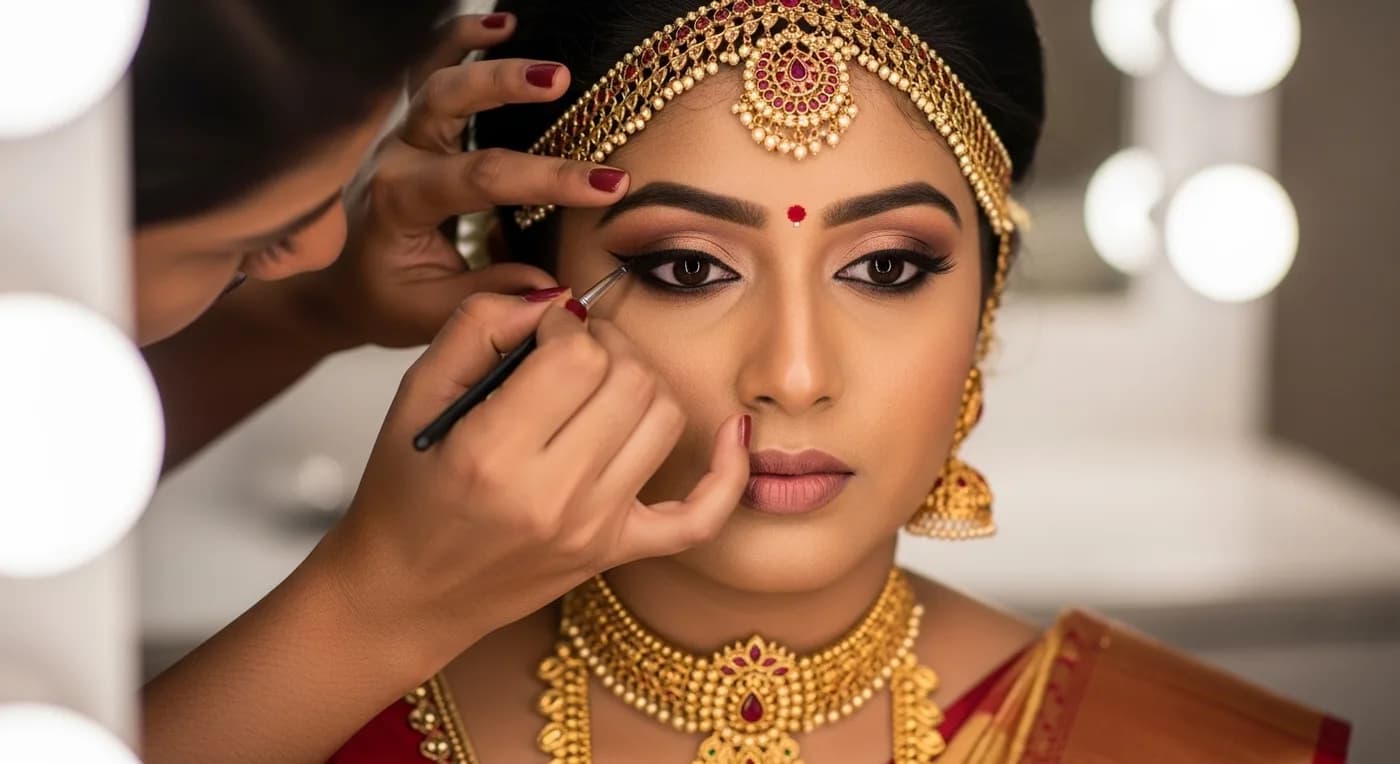
Bridal makeup in Kerala costs ₹8,000–15,000 for basic packages and ₹25,000–50,000 for premium HD or airbrush from top artists, with celebrity MUAs in Kochi and Trivandrum charging ₹60,000–1.5 lakh. Kerala's humidity averages 70–85% during peak wedding season, making technique and prep more critical than product brand. Airbrush creates the thinnest, most sweat-resistant layer for outdoor ceremonies.
Quick Answer
Basic packages (traditional technique) run ₹8,000–15,000; premium HD or airbrush from established artists costs ₹25,000–50,000; celebrity MUAs in Kochi and Trivandrum charge ₹60,000–1.5 lakh+ (based on itsmy.wedding marketplace data). Book your trial 2–3 months ahead and test the look for 4–6 hours in conditions matching your wedding day.
Note
Pricing methodology: Cost ranges in this guide are based on vendor pricing data from the itsmy.wedding marketplace and published industry reports, collected in Q4 2025 – Q1 2026.
In an industry worth ₹10.79 lakh crore according to IBEF, bridal services are among the fastest-growing segments. Your bridal makeup is one of the most photographed, scrutinised, and emotionally significant elements of your Kerala wedding day. Unlike brides in drier parts of India who can rely on a standard foundation and setting powder to carry them through, a Kerala bride faces a unique set of environmental challenges that demand a more deliberate approach. The state's tropical climate — with relative humidity that rarely dips below 70% even in the "dry" season — means that makeup application in Kerala is as much a science of longevity as it is an art of beauty. Add in the reality that most Kerala weddings span 6 to 10 hours across multiple venues (a morning temple ceremony followed by an air-conditioned hotel reception, for instance), and it becomes clear why choosing the right technique, the right products, and the right makeup artist is a decision that deserves serious attention.
This guide covers everything you need to make that decision with confidence. We will walk through the three major makeup techniques available to Kerala brides in 2026 — HD, airbrush, and traditional — with an honest comparison of how each performs in humidity. You will find a month-by-month skin preparation timeline, a detailed pricing breakdown by district and tier, a full trend report for 2026, and a practical framework for communicating your vision to your MUA so that the final result matches the picture in your head.
Understanding Kerala's Makeup Challenge
Kerala's climate is not uniformly humid — it varies meaningfully by geography and season, and understanding those differences is the first step toward makeup that actually lasts your entire wedding day.
During peak wedding season (November through February), the average relative humidity across Kerala ranges from 70% to 85%. Coastal cities like Kochi and Alappuzha sit at the higher end of that range, with morning humidity regularly touching 85% to 90% before settling to 72% to 78% by afternoon. Thrissur and Palakkad, located inland, experience slightly lower humidity (65% to 75%) but compensate with higher daytime temperatures — often reaching 33 to 35 degrees Celsius during December and January weddings. Hill station venues in Munnar and Wayanad offer the most forgiving conditions, with humidity around 55% to 65% and temperatures between 18 and 24 degrees, making them the easiest environments for makeup longevity.
These differences have real consequences for your foundation. Water-based foundations, which feel light and breathable, tend to break down faster in high humidity because sweat dilutes the formula. Silicone-based foundations offer better resistance but can feel heavy after 6 hours in warm conditions. Oil-based products, once popular in traditional bridal makeup, are almost unusable in coastal Kerala — they slide off within 2 to 3 hours unless heavily set with powder, which creates an unnatural, cakey appearance on camera.
Temperature compounds the problem. When your skin heats up during an outdoor temple ceremony at Guruvayur or Thrissur Vadakkunnathan, your pores open and release more sebum. That sebum mixes with your foundation and breaks the seal between product and skin. This is why even expensive foundations fail for some Kerala brides — the product itself was fine, but the prep work (primer, setting spray, blotting strategy) was not calibrated for the specific venue conditions.
Important
Humidity Reality Check: Kerala's average relative humidity during peak wedding season (November-February) ranges from 70-85%. Even the best foundation will slide without proper prep. Budget at least 30 minutes of skin preparation before your MUA begins the actual makeup application.
HD vs Airbrush vs Traditional: Technique Comparison
The three makeup techniques available to Kerala brides each have distinct strengths. The right choice depends on your venue type, skin concerns, event duration, and budget — not on which technique is "best" in the abstract.
HD Makeup
HD (High Definition) makeup uses finely milled, light-diffusing pigments that scatter light evenly across the skin's surface. Originally developed for film and television, HD makeup has become the most popular bridal technique in Kerala over the past five years. The foundation is applied with brushes or sponges and can be built up in layers to cover acne scars, pigmentation, dark circles, and uneven skin tone.
Pros: Excellent coverage and buildability. Photographs exceptionally well under studio lighting. Allows precise contouring and highlighting. Wide shade range from most brands. Your MUA can blend custom shades to match your exact skin tone.
Cons: Can feel heavier than airbrush after 5 to 6 hours. Requires skilled application to avoid looking cakey in humid conditions. More prone to transfer (staining your kasavu saree neckline or groom's outfit during garland exchange).
Best for: Indoor receptions at air-conditioned venues, brides with significant scarring or pigmentation that needs heavy coverage, evening events with controlled lighting.
Airbrush Makeup
Airbrush makeup is applied using a small compressor that sprays a fine mist of foundation onto the skin in thin, even layers. The result is a remarkably lightweight finish that bonds directly to the skin's surface, creating a semi-permanent layer that resists sweat and humidity better than any brush-applied product.
Pros: Superior longevity in humid conditions (8 to 10 hours without significant touch-up). Extremely lightweight — most brides forget they are wearing it. Minimal transfer onto clothing. Natural, skin-like finish that looks beautiful in both photographs and real life.
Cons: Less buildable than HD — if you need heavy coverage for deep acne scars or vitiligo, airbrush alone may not be sufficient (though a skilled MUA can combine spot concealing with airbrush overlay). Requires specialised equipment, so not all MUAs offer it. Slightly higher price point than HD.
Best for: Outdoor temple ceremonies, backwater and beach weddings, events spanning 8 or more hours, brides who want a "my skin but better" finish, summer and monsoon weddings.
Traditional Makeup
Traditional bridal makeup in Kerala uses conventional cosmetics — cream or liquid foundations, powder compacts, and standard brushes — applied by hand. This is the technique most parlour-trained makeup artists use, and it remains widely available across all districts.
Pros: Most affordable option. Widely available, even in smaller towns like Thodupuzha, Changanassery, and Payyanur. Familiar to most MUAs. Easy to touch up yourself during the event.
Cons: Shortest longevity (3 to 5 hours in humid conditions). Photographs less smoothly than HD or airbrush at close range. More prone to oxidation (foundation turning darker or orangey after a few hours). Transfer is significant.
Best for: Short ceremonies under 3 hours, intimate gatherings with minimal photography, budget-conscious brides who prioritise comfort over camera-ready perfection.
Technique Comparison Table
| Factor | HD Makeup | Airbrush Makeup | Traditional Makeup |
|---|---|---|---|
| Finish | Soft matte, flawless on camera | Natural, skin-like | Variable, depends on products |
| Longevity | 6-8 hours with touch-ups | 8-10 hours minimal touch-up | 3-5 hours |
| Humidity Score | 7/10 (with proper prep) | 9/10 | 4/10 |
| Coverage | Heavy, buildable | Light to medium | Medium |
| Feel on Skin | Medium weight | Very lightweight | Varies |
| Transfer Resistance | Moderate | Excellent | Low |
| Best For | Indoor receptions, acne-prone skin | Outdoor ceremonies, long events | Short ceremonies, tight budgets |
| Price Range | 15,000-45,000 | 20,000-55,000 | 8,000-18,000 |
Note
Combination Approach: Many top Kerala MUAs in 2026 use a hybrid technique — airbrush for the base layer (longevity) with HD products for targeted concealing, contouring, and eye work (precision). If your MUA offers this, it is often the best of both worlds. Ask about it during your trial.
The 6-Month Skin Prep Timeline
Approximately 60 percent of a bridal makeup result depends on skin condition, not the products applied — which is why a structured 6-month skin preparation timeline is essential for Kerala brides. Starting a structured skincare routine six months before your wedding gives your skin time to respond, heal, and stabilise.
6 Months Before: Foundation Assessment
Visit a dermatologist — not a salon aesthetician, but a qualified dermatologist — for a baseline skin assessment. This is especially important if you have active acne, hyperpigmentation, melasma, or any condition that requires prescription treatment. In Kerala, Dr. Paul's Skin Laser Centre (Kochi), Kaya Skin Clinic (Trivandrum), and several reputed dermatologists in Kozhikode offer bridal skin consultations. Expect to pay 1,000 to 2,500 for this initial consultation. The dermatologist will establish a daily skincare routine tailored to your skin type and Kerala's climate — typically a gentle cleanser, niacinamide serum, sunscreen (non-negotiable in Kerala's UV exposure), and a night treatment.
4 Months Before: Targeted Treatments
If your dermatologist has prescribed treatments for pigmentation, acne scarring, or uneven texture, this is when they begin producing visible results. Chemical peels, microdermabrasion, and laser treatments require multiple sessions spaced 3 to 4 weeks apart, so starting at the 4-month mark gives you enough runway for 3 to 4 sessions without rushing.
3 Months Before: Professional Facials Begin
Start monthly professional facials. In Kerala, a bridal facial series typically includes deep cleansing, exfoliation, extraction (if needed), hydration, and a calming mask. HydraFacial and oxygenation facials are popular choices for 2026 brides. Space them exactly 4 weeks apart. Avoid facials that use harsh peels or aggressive extraction — you want to build your skin up, not traumatise it.
2 Months Before: The Bridal Trial
This is when you do your makeup trial (covered in detail below). The trial serves double duty — it tests the makeup look AND reveals how your skin currently holds product. If the foundation creases around your nose or slides off your forehead during the 4-hour test wear, your MUA and dermatologist can adjust your skincare routine for the final stretch.
1 Month Before: Lock It In
Have your final professional facial. After this point, introduce absolutely no new products — no new serums, no new moisturisers, no new sunscreens. Your skin has a rhythm now, and disrupting it with an unfamiliar product risks breakouts or allergic reactions with no time to recover. Continue your established routine exactly as is.
1 Week Before: Final Details
Complete threading, waxing, and any hair removal at least 5 to 7 days before the wedding — never the day before, as post-waxing redness and sensitivity can interfere with foundation application. Focus on hydration: drink 2 to 3 litres of water daily, avoid excess salt and alcohol, and get 7 to 8 hours of sleep. Apply a hydrating sheet mask the night before the wedding for a plump, well-rested canvas.
Tip
Kerala-Specific Skin Prep: Kerala's humidity means your skin is already hydrated — focus on oil control and pore-minimizing products rather than heavy moisturizers. A good niacinamide serum started 3 months before the wedding can transform oily T-zones.
2026 Bridal Makeup Trends in Kerala
Kerala bridal makeup trends in 2026 reflect a broader shift toward authenticity, skin-first beauty, and understated sophistication. The heavy, Instagram-contoured looks that dominated from 2018 to 2022 have given way to a more refined aesthetic that lets the bride's natural features — and her gold jewellery — take centre stage.
Glass Skin and Dewy Finish
The glass skin trend, which originated in Korean beauty, has been thoughtfully adapted for Kerala's climate in 2026. Rather than the intensely reflective finish you see on K-beauty influencers, Kerala MUAs are achieving a "satin glow" — luminous but not slippery. The technique involves layering a hydrating primer with light-reflecting particles under a semi-matte foundation, then strategically applying a liquid highlighter only on the cheekbone tops, brow bones, and cupid's bow. The result is skin that looks healthy and lit from within, without the oil-slick effect that uncontrolled dewiness can create in humidity. Setting spray is critical here — a mattifying setting spray on the T-zone with a dewy-finish spray on the high points creates dimension that lasts.
Soft Glam Eyes
Heavy smokey eyes in jet black and charcoal have been replaced by warm earth tones — terracotta, copper, burnt sienna, antique gold, and deep mauve. These shades complement the warm undertones of most Kerala skin tones and harmonise beautifully with traditional gold temple jewellery. The application style is softer too: diffused edges, blended transitions, and a focus on the crease rather than the entire lid. For Hindu ceremonies with the white-and-gold kasavu saree, warm copper or muted bronze on the lids creates a cohesive look. For the reception, deeper burgundy or plum tones add drama without overwhelming the face.
Bold Lips Making a Comeback
After several years of nude and MLBB (my lips but better) lip trends, 2026 sees a confident return to bold lip colour for Kerala brides — particularly during the ceremony. Deep reds (think true crimson, not orange-red), wine-stained berry tones, and rich maroon are the most requested shades. These pair naturally with the traditional red bindi and the warm gold of the mala (wedding garland). For the reception look, many brides switch to a softer rose or dusty pink to complement a contemporary outfit.
Lash Lifts over False Lashes
The natural beauty movement has reached lash choices. In 2026, more Kerala brides are opting for lash lifts and tints done 48 hours before the wedding, rather than strip or individual false lashes. A lash lift curls your natural lashes permanently (for 6 to 8 weeks) and, combined with a dark tint, gives the appearance of mascara without any product. This means no risk of lash glue failing in humidity, no heavy feeling on the lids, and no lashes peeling at the corners during an 8-hour event. For brides who want extra volume, individual lash clusters applied sparingly at the outer corners offer a compromise between full falsies and natural lashes.
Minimal Contouring
The sculpted, angular contouring of previous years has softened into diffused, barely-there dimension. Kerala MUAs in 2026 are using cream contour products (rather than powder) applied with damp sponges to create subtle shadows under the cheekbones and along the jawline. The goal is to enhance facial structure without creating visible lines — on camera or in person. Heavy contouring photographs well in ring lights and studio setups but looks artificial under the warm tungsten lighting common in temple mandapams and the natural daylight of outdoor ceremonies.
Multi-Chrome Eye Accents
For the reception look, multi-chrome (colour-shifting) pigments are the statement element of 2026. These are applied as a thin layer over a base eyeshadow on the centre of the lid, creating a subtle colour shift — teal to purple, gold to rose, copper to green — that catches light as the bride moves. It is a modern, fashion-forward touch that photographs beautifully in flash photography and adds visual interest to reception videos.
Pricing by District and Tier
Bridal makeup pricing in Kerala varies significantly by geography. A WedMeGood survey of 2,000+ Indian couples found that bridal grooming is one of the top five expense categories that has grown fastest year-over-year. MUAs in metro centres like Kochi and Trivandrum command higher rates due to demand, higher operating costs, and portfolio prestige. Tier-2 cities like Thrissur, Kottayam, and Kozhikode offer excellent quality at more moderate rates. In smaller towns and rural districts, pricing is considerably lower, though the range of techniques available (particularly airbrush) may be more limited.
The following table reflects 2026 market rates based on our vendor data. All prices are for a single bridal look including base makeup, eye makeup, lip colour, basic hair styling, and saree draping.
| Tier | Kochi / Trivandrum | Thrissur / Kottayam | Kozhikode / Kannur | Palakkad / Idukki |
|---|---|---|---|---|
| Budget (Traditional) | 10,000-18,000 | 8,000-15,000 | 8,000-14,000 | 6,000-12,000 |
| Mid-Range (HD) | 20,000-35,000 | 15,000-28,000 | 14,000-25,000 | 12,000-22,000 |
| Premium (HD/Airbrush) | 35,000-55,000 | 28,000-45,000 | 25,000-40,000 | 20,000-35,000 |
| Celebrity MUA | 60,000-1,50,000+ | 50,000-1,00,000 | 45,000-80,000 | 40,000-70,000 |
Additional cost factors to account for:
- Travel charges: MUAs based in Kochi or Trivandrum typically charge 2,000 to 5,000 for travel to other districts, plus accommodation if the wedding is more than 100 km from their base.
- Early morning surcharge: Weddings with a 6 AM or 7 AM muhurtham may carry a 2,000-to-5,000 surcharge, as the MUA needs to arrive by 3 AM or 4 AM.
- Multi-look discount: Booking 2 or 3 looks with the same MUA typically saves 15% to 25% compared to booking each look separately.
- Bridesmaid and family packages: Many MUAs offer group rates — the bride's mother, sisters, and bridesmaids at 3,000 to 8,000 per person when bundled with the bridal booking.
Looking for Makeup Artists in Kochi?
Tell us what you need and get quotes from verified makeup artists
What is Included in a Bridal Makeup Package
Not all packages are created equal. Understanding exactly what is included — and what costs extra — prevents surprises on your wedding day. Here is what each tier typically includes in the Kerala market in 2026.
| Feature | Basic Package | Premium Package | Luxury Package |
|---|---|---|---|
| Number of Looks | 1 | 2 (ceremony + reception) | 2-3 (engagement + ceremony + reception) |
| Skin Prep | Basic cleansing and moisturiser | Professional pre-bridal facial-grade prep | Full prep with ice therapy and serum infusion |
| Foundation Technique | Traditional or basic HD | HD or airbrush | Hybrid airbrush + HD |
| Eye Makeup | Standard eyeshadow and liner | Custom palette matched to outfits | Multi-chrome, cut-crease, or editorial options |
| Lashes | Strip lashes (basic) | Individual cluster lashes | Customised lash mapping |
| Hair Styling | Basic bun or braid | Styled updo or waves with accessories | Multiple styles for each look |
| Flower Arrangement | Simple gajra | Styled jasmine/rose arrangement | Designer floral headpiece |
| Saree/Outfit Draping | Basic draping | Styled draping with pins and pleats | Multiple draping styles per look |
| Touch-Up Support | Not included | Touch-up kit left with bride | Dedicated assistant on-site for full event |
| Trial Session | Not included | 1 trial | 2 trials |
| Travel | Extra charge | Included within district | Included statewide |
| Price Range | 8,000-18,000 | 25,000-50,000 | 55,000-1,50,000+ |
Questions to Ask Before Booking
Before signing with any MUA, get clear written answers to these questions:
- How many looks are included, and what counts as a "look"? (Some MUAs consider a lip colour change a separate look; others don't.)
- Is saree draping included, or is it charged separately? In Kerala, draping is often bundled, but confirm.
- What happens if the wedding timeline shifts? If the muhurtham is delayed by an hour, does the MUA charge overtime?
- Do you provide a touch-up assistant, or are you personally available for touch-ups?
- What products and brands do you use? Reputable MUAs will readily share their kit brands.
- What is your cancellation and rescheduling policy?
- Is travel and accommodation included, or billed separately?
How to Brief Your MUA
The difference between a good bridal look and a perfect one often comes down to communication. Your MUA is skilled at applying makeup — but only you know what "beautiful" means to you. A clear, structured brief bridges that gap.
Share Visual References — Strategically
Collect 10 to 15 reference images that capture the overall aesthetic you want. Save them to a folder on your phone or, better yet, a shared Pinterest board. But be specific about what you are referencing in each image. Is it the lip colour? The eye shape? The skin finish? The overall vibe? Telling your MUA "I like this photo" without specifying what you like about it leaves too much to interpretation.
Equally important: include 2 to 3 images of looks you explicitly do not want. Perhaps you dislike heavy contouring, or glitter eyeshadow, or nude lips. Negative references are often more useful than positive ones because they draw clear boundaries.
Tip
The Pinterest Board Trick: Create a private Pinterest board with 10-15 images and share it with your MUA at the trial. But always include 2-3 photos of looks you don't want — this helps your MUA understand your boundaries better than positive references alone.
Send Your Outfit and Jewellery Details in Advance
Share clear, well-lit photographs of your ceremony saree, reception outfit, jewellery set, and any hair accessories at least 2 weeks before the trial. Your MUA needs to see the fabric colour, texture, and embroidery detail to choose complementary eyeshadow tones, lip colours, and overall makeup intensity. A heavily embellished reception lehenga can handle bolder makeup; a minimalist kasavu saree looks best with restrained elegance.
Communicate Your Comfort Level Honestly
If you wear minimal makeup daily and feel uncomfortable in a full-glam look, say so directly. A skilled MUA can create a polished, camera-ready look that still feels like "you." Conversely, if you want full glamour with dramatic eyes and sculpted contour, own that preference. The trial exists precisely to calibrate this — do not wait until the wedding morning to voice discomfort.
Share Practical Details
Your MUA needs to know your wedding timeline (muhurtham time, reception start, expected end), venue details (indoor or outdoor, air-conditioned or not), and lighting conditions (natural light, tungsten, LED). A temple ceremony at 10 AM under natural light requires a fundamentally different makeup approach than a 7 PM hotel reception under warm spotlights. Also share any allergies, skin sensitivities, or products that have caused reactions in the past.
The Bridal Trial: What to Expect
The bridal trial is not a luxury — it is a necessity. Think of it as a dress rehearsal for your face. A trial gives you and your MUA a chance to test the look, evaluate product performance, and make adjustments with zero pressure.
When to Schedule
Book your trial 2 to 3 months before the wedding. This allows time for a second trial if the first one does not meet expectations. Schedule it at the same time of day as your wedding makeup will be done — if your MUA will start at 5 AM on the wedding day, the trial should also begin early morning so you see how the makeup holds through similar conditions.
What to Wear and Bring
Wear a top with a neckline similar to your wedding outfit so your MUA can blend the foundation seamlessly down the neck and chest. Bring your jewellery (or similar-weight pieces) so the hair styling accounts for the weight of your jimikki and mala. Bring your reference photos and Pinterest board.
The 4-Hour Staying Power Test
After the trial application, wear the makeup for at least 4 to 6 hours. Go about your normal activities — step outside, eat a meal, laugh, cry (wedding-day tears are real). Check the makeup at the 2-hour and 4-hour marks under different lighting: natural daylight, indoor fluorescent, and your phone's front camera flash. Note where it creases, fades, or transfers. Take close-up photographs at each checkpoint.
Red Flags at the Trial
- The MUA is defensive about feedback or reluctant to make changes.
- The foundation oxidises (turns darker or orangey) within 2 hours.
- Heavy transfer onto your clothing or tissue when you blot.
- The MUA cannot match your neck and chest colour to your face.
- They rush through the trial in under 45 minutes.
- They refuse to share the brands and products they are using.
If you encounter any of these, it is not too late to find a different MUA. A bad trial is a clear warning — do not ignore it hoping the wedding day will be different.
Note
Trial Photography Tip: At your trial, take selfies AND have someone photograph you from 3 to 5 feet away in three lighting conditions: direct sunlight, indoor ambient light, and camera flash. What looks perfect in the mirror can appear completely different on camera, and your wedding photos will capture you from every angle and in every light.
Common Mistakes Kerala Brides Make
Having worked with hundreds of brides across the state, these are the mistakes that come up repeatedly — and all of them are avoidable with basic awareness.
1. Over-Contouring for the Camera
Heavy contour looks dramatic in ring-light selfies but creates harsh shadows under the mixed lighting of a real wedding venue. Kerala temple mandapams use warm yellow lighting, outdoor ceremonies use natural daylight, and reception halls use cool LED — your contour needs to look natural across all three. Ask your MUA for diffused, soft contour rather than sharp sculpting.
2. Skipping Primer in Humid Conditions
Primer is not optional in Kerala. It creates a barrier between your skin's natural oils and your foundation, extending wear time by 2 to 4 hours. A silicone-based, pore-filling primer for oily zones and a hydrating primer for dry patches (most Kerala brides have combination skin) is the standard prep. Skipping this step is the single most common reason for midday makeup breakdown.
3. Mismatched Foundation on Neck and Chest
Your face, neck, and chest are often three different shades — especially if you have been wearing sunscreen on your face but not your neck. A skilled MUA will blend a custom shade that unifies all three areas, but this takes time and the right products. If your MUA only colour-matches your jawline, the mismatch will be glaringly obvious in photographs, especially with the deep necklines of many Kerala bridal blouses.
4. Not Testing in Both Natural and Artificial Light
Makeup that looks flawless indoors can appear completely different under the midday sun of a temple courtyard. Always evaluate your trial look in both settings. Walk outside. Stand near a window. Take flash photos. If you are only checking your makeup in the MUA's studio mirror with their professional lighting, you are seeing a best-case scenario that may not match your wedding venue conditions.
5. Last-Minute MUA Changes
Changing your makeup artist within 3 to 4 weeks of the wedding is stressful and risky. Your trial, product selection, and skin prep strategy were all calibrated for a specific MUA's approach. A new artist starts from zero. Unless there is a serious red flag, work with your existing MUA to adjust the look rather than switching entirely.
6. Ignoring Skin Prep Entirely
No amount of product can compensate for dehydrated, unexfoliated, or actively breaking-out skin. Brides who skip the 3-to-6-month prep window and expect their MUA to "fix everything" on the day are consistently disappointed. Foundation sits on textured skin differently — it emphasises dry patches and clings to flaky areas. Start your skincare routine early.
7. Choosing Based on Price Alone
The cheapest MUA is rarely the best value, and the most expensive is not automatically the best fit. Choose based on portfolio quality (do their past brides have your skin type and tone?), trial performance, communication style, and reviews from brides who had similar weddings. A mid-range MUA who understands your vision and has experience with your venue type will outperform a celebrity MUA who applies their signature look regardless of context.
Important
Trial Timing Matters: Never schedule your bridal trial during monsoon months if your wedding is in winter, or vice versa. Kerala's humidity varies dramatically between seasons, and what works in August's 95% humidity may feel completely different in December's 75%.
Common Questions About Kerala Bridal Makeup
How much does bridal makeup cost in Kerala in 2026?
Bridal makeup in Kerala ranges from 8,000 to 15,000 for basic packages using traditional techniques to 25,000 to 50,000 for premium HD or airbrush makeup from established artists. Celebrity MUAs based in Kochi and Trivandrum — those with large social media followings, magazine features, and high-profile wedding portfolios — charge between 60,000 and 1,50,000 or more. With the national average wedding cost at ₹29.6 lakhs according to WeddingWire India, premium makeup represents a significant but proportional investment. Most packages include one or two looks (ceremony and reception), saree or outfit draping, hair styling, and basic flower arrangement. Touch-up support, travel charges, and trial sessions may or may not be included depending on the tier, so always confirm in writing before booking.
Is HD or airbrush makeup better for Kerala's humid climate?
Airbrush makeup is generally the stronger performer in Kerala's humidity because it creates a thinner, more uniform layer that bonds directly to the skin and resists sweat more effectively than brush-applied products. However, the gap between the two techniques has narrowed significantly in 2026 as HD formulations and setting products have improved. A skilled MUA using high-quality HD foundations with proper humidity-proof prep — mattifying primer, targeted setting powder on oil-prone zones, and a professional setting spray — can achieve longevity comparable to airbrush. The more important factor is your MUA's experience working in Kerala's climate specifically. An MUA who has done 200 weddings in Kochi knows exactly how to prep for coastal humidity, regardless of whether they use HD or airbrush.
When should I book my bridal makeup trial?
Book your trial 2 to 3 months before the wedding date. This gives you enough time for a second trial if the first does not meet expectations, and it aligns with the point in your skincare timeline when your skin should be approaching its best condition. The trial should replicate actual wedding conditions as closely as possible — schedule it at the same time of day your wedding makeup will begin, wear a top with a similar neckline to your bridal outfit, and keep the makeup on for 4 to 6 hours to test its staying power in conditions that approximate your wedding day. If your wedding is in December, do the trial in October or November so the humidity levels are similar.
What is included in a typical Kerala bridal makeup package?
A standard Kerala bridal makeup package includes pre-bridal skin prep (cleansing, toning, moisturising, and primer application), full base makeup (foundation, concealer, colour correction, and setting powder), eye makeup (eyeshadow, liner, lashes, and brow shaping), lip colour, saree or outfit draping, hair styling (updo, braids, or waves), and flower arrangement (typically jasmine gajra for the ceremony). Premium packages add a second look for the reception, a professional touch-up kit for the bride to carry, and a dedicated assistant who remains on-site throughout the event for real-time adjustments. Luxury packages extend to 3 looks, include 2 trial sessions, cover statewide travel, and assign a two-person team (lead artist plus assistant) for the full day.
How many makeup looks do I need for my Kerala wedding?
Most Kerala brides need 2 to 3 distinct looks. The first is for the ceremony — this is typically traditional and elegant, complementing the kasavu saree with soft, timeless makeup that photographs well in the mandapam's warm lighting. The second is for the reception — usually more glamorous and contemporary, with bolder eyes or lips to match a designer lehenga or modern saree. A third look, if desired, covers the engagement or mehendi event with a lighter, more playful aesthetic. Some MUAs offer multi-look packages at a bundled rate that saves 15% to 25% compared to booking each look individually. Discuss the number of looks early in your planning so your MUA can design a cohesive but distinct aesthetic for each event.
Further Reading
- How to Plan a Kerala Wedding
- Kerala Wedding Budget Guide
- Kerala Wedding Checklist
- Best Makeup Artists in Kochi — curated directory of top-rated MUAs in Ernakulam district
Looking for Makeup Artists in Trivandrum?
Tell us what you need and get quotes from verified makeup artists
Tip
Plan your wedding with free tools — try our AI Wedding Checklist for a personalised timeline, or use the Cost Calculator to estimate your budget.
Topics
Kerala bridal makeupbridal makeup cost KeralaHD makeup Kerala brideairbrush bridal makeupwedding makeup artist Keralabridal makeup trends 2026Explore more
Frequently Asked Questions
1How much does bridal makeup cost in Kerala in 2026?
2Is HD or airbrush makeup better for Kerala's humid climate?
3When should I book my bridal makeup trial?
4What is included in a typical Kerala bridal makeup package?
5How many makeup looks do I need for my Kerala wedding?
Continue reading
Related Articles
How to Plan a Kerala Wedding: The Complete 2026 Guide
Kerala Wedding Budget Guide: 2026 Cost Breakdown
Kerala Wedding Checklist: Complete Printable Planner for 2026
How to Choose a Wedding Photographer in Kerala: The Complete 2026 Guide
Best Season for South India Destination Weddings: Month-by-Month Western Ghats Guide
Destination Wedding Cost in South India 2026: 5-Tier Budget Guide
Still planning?
Get quotes from India's best vendors
Tell us what you're planning and we'll match you with verified photographers, venues, decorators, and more.
Get free quotes