Tamil Wedding Pathrikai Guide: Invitation Designs & Etiquette
Tamil wedding pathrikai costs ₹20–₹200 per card for print, ₹2,000–₹10,000 for digital. Traditional motifs, wording etiquette, and top Chennai printers.

On this page
A Tamil wedding pathrikai is far more than an invitation — it is a ritual announcement whose personal hand-delivery to close family is considered an act of honour. Printed cards cost ₹20–₹200+ per piece (₹10,000–₹1 lakh for 500 cards); digital pathrikai designs run ₹2,000–₹10,000. Order from Mint Street (Sowcarpet) printers 4–6 weeks before delivery, and allow 2–4 weekends for in-person distribution to elders.
Quick Answer
Quick answer: A Tamil wedding pathrikai is far more than an invitation — it is a ritual announcement whose personal hand-delivery to close family is considered an act of honour. Printed cards cost ₹20–₹200+ per piece (₹10,000–₹1 lakh for 500 cards); digital pathrikai designs run ₹2,000–₹10,000. Order from Mint Street (Sowcarpet) printers 4–6 weeks before delivery, and allow 2–4 weekends for in-person distribution to elders.
Note
Pricing methodology: Cost ranges in this guide are based on vendor pricing data from the itsmy.wedding marketplace and published industry reports, collected in Q4 2025 – Q1 2026.
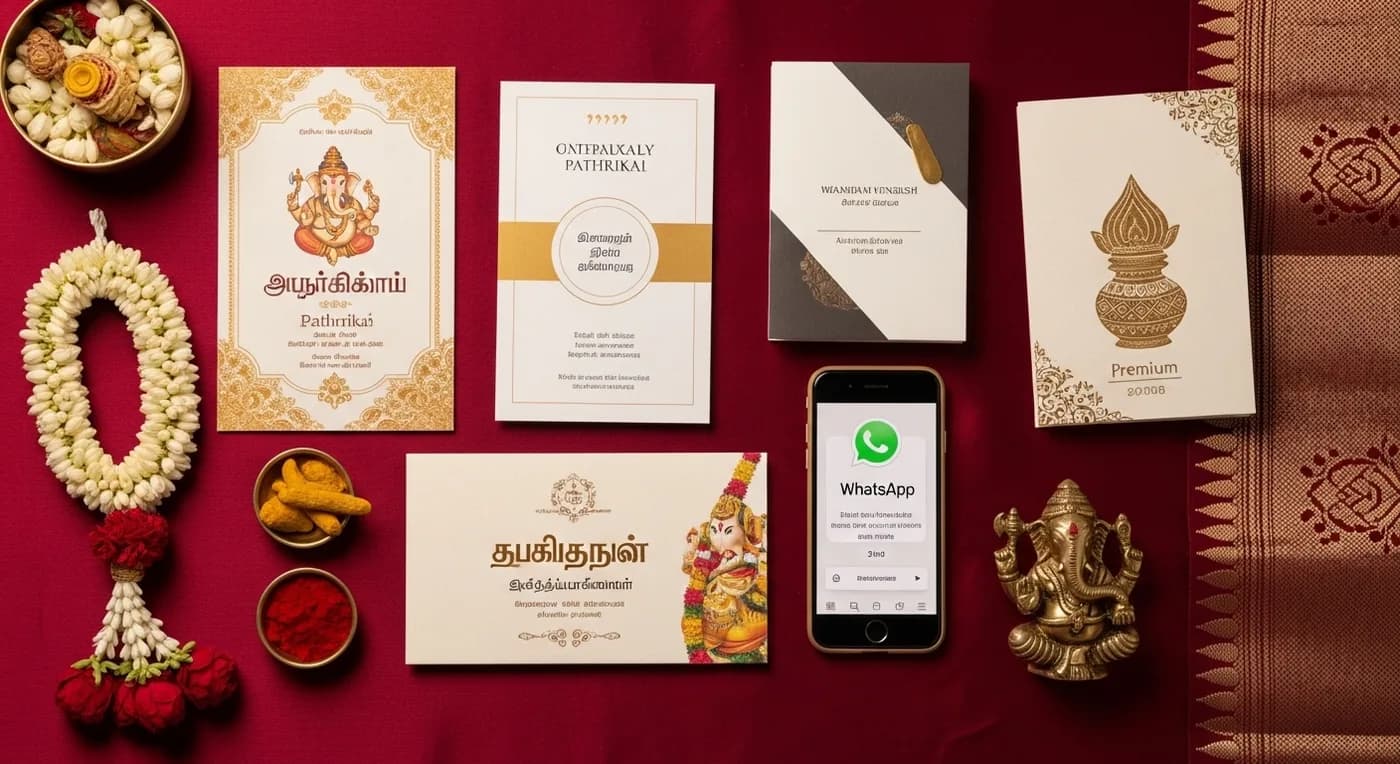
The pathrikai is Tamil wedding culture's formal invitation — part ritual announcement, part family honour, part art form — in an Indian wedding industry valued at ₹10.79 lakh crore where stationery and invitations are a growing spend category. More than a card you drop in the mail, the pathrikai (also spelled pathirikai or pathrigai) carries the weight of tradition: receiving one in person, hand-delivered by a family member, signals that you are being formally and respectfully invited to witness the marriage. In 2026, pathrikai design spans a wide spectrum from gold-embossed traditional cards with Ganesha motifs and Tamil script to minimalist bilingual designs and fully digital invitations sent via WhatsApp — and most Chennai (formerly Madras) families use a combination of formats to cover their entire guest list.
This guide covers every aspect of Tamil wedding pathrikai: the cultural significance behind the tradition, community-specific design elements, wording etiquette that honours hierarchy, modern and digital options for today's couples, and a practical printing guide with Chennai-specific vendor recommendations. For the full wedding planning timeline that shows where pathrikai fits into your schedule, see the Chennai wedding checklist.
What Makes Pathrikai Special
The Tamil word pathrikai derives from the Sanskrit patra (letter/document) and carries a formality that the English word "invitation" does not fully capture. In Tamil wedding culture, the pathrikai is not merely informational — it is a ritual object with social and emotional significance.
The Personal Delivery Tradition
In traditional Tamil culture, close family members and the parents of the bride and groom personally visit the homes of important guests to hand-deliver the pathrikai. This is not a task delegated to a courier. The act of delivery is itself an expression of respect — it says, "your presence matters enough that we came to your home to invite you." For elders, community leaders, and the family purohit, receiving the pathrikai in person is expected and honoured.
This tradition is alive and well in Chennai in 2026. While digital invitations have become standard for friends, colleagues, and acquaintances, the personal delivery of a physical pathrikai remains non-negotiable for close family and respected elders. Many families spend two to four weekends visiting homes across Chennai, sometimes travelling to other cities (Madurai, Coimbatore, Tiruchirappalli) to deliver pathrikai to relatives in person.
Community Announcement
Beyond the individual invitation, the pathrikai serves as a formal announcement of the marriage to the community. It establishes the families involved (through the careful listing of names and lineage), the auspicious timing chosen (legitimised by the muhurtham details), and the venue (establishing the scale and nature of the celebration). In communities where family reputation is built through generations of weddings, the pathrikai is the first public signal of the event's character.
A Keepsake
Many Tamil families preserve pathrikai for decades — sometimes generations. The invitation from a grandparent's wedding, yellowed and fragile, carries family history. This keepsake quality means that the physical craft of the pathrikai matters: the paper weight, the print quality, the embossing, the gold foil — these are not decorative indulgences but investments in a family artifact.
Traditional Pathrikai Designs
Traditional Tamil pathrikai follows established design conventions that vary by community and religion, but share a common grammar of sacred motifs, hierarchical text layout, and rich materiality.
Hindu Tamil Pathrikai
Ganesha motif: The most common design element for Hindu Tamil pathrikai. Lord Ganesha, the remover of obstacles, is invoked at the top of the card — often in an ornate frame or as a silhouette in gold foil. The Ganesha is typically accompanied by the syllable "Om" or "Pillayarpatti" in Tamil script.
Kalasam (sacred pot): An alternative or companion motif to Ganesha. The kalasam — a brass pot topped with coconut and mango leaves — symbolises prosperity and auspiciousness. It appears at the top of the card or as a border element.
Lotus motif: Symbolising purity and divine beauty, the lotus appears as a central design element or as a repeating pattern in the border.
Mango leaf border (thoranam): The festive mango leaf garland that adorns doorways during celebrations is translated into a printed or embossed border framing the entire pathrikai.
Gold printing: Traditional pathrikai is printed in deep red and gold on cream or ivory card stock. The gold — whether foil-stamped, screen-printed, or digitally rendered — carries the association of thali gold and wedding jewellery.
Community-Specific Variations
Iyer (Smartha Brahmin): Ganesha motif with vibhuti (sacred ash) markings. The invocation typically opens with "Sri" or "Om Sri Ganeshaya Namaha." Text is in Tamil, often with a Sanskrit shloka. Design tends toward elegant simplicity — detailed but not ostentatious.
Iyengar (Sri Vaishnava Brahmin): Vishnu symbols take precedence — the Namam (the V-shaped forehead mark), the conch (shanku), and the discus (chakra). The invocation opens with "Sri" or references to Lord Vishnu/Narayana. The Thiruman-Namam mark may appear as a design motif. For a deeper understanding of Iyer and Iyengar wedding distinctions, see our Iyer vs Iyengar wedding guide.
Chettinad: Known for elaborate, large-format pathrikai with extensive gold work. Chettinad pathrikai often features more ornate borders, heavier card stock, and detailed family lineage listings. The design reflects the community's tradition of opulence and craftsmanship.
Nadar: Pathrikai typically features Ganesha with community-specific design flourishes. The card may include references to the kula deivam (family deity) temple.
Note
Christian Tamil Pathrikai
Christian Tamil pathrikai features the cross, dove, or intertwined rings as central motifs, often with a Bible verse or prayer in Tamil and English. The design language leans toward Western wedding invitation aesthetics while retaining Tamil text for the family details.
Muslim Tamil Pathrikai
Muslim Tamil pathrikai opens with "Bismillah-ir-Rahman-ir-Rahim" (In the name of God, the Most Gracious, the Most Merciful) in Arabic calligraphy, followed by event details in Tamil and/or English. The crescent moon and star motif, geometric Islamic patterns, and green-gold colour schemes are common.
Wording and Etiquette
The wording of a Tamil pathrikai follows a strict hierarchical structure that reflects the family's social grammar. Getting it wrong — misspelling a name, misordering the family hierarchy, or omitting a key detail — is a genuine social error that families take seriously.
The Name Hierarchy
The traditional Tamil pathrikai lists names in a specific order:
- Paternal grandfather (or his memory, if deceased: "Late Sri...")
- Father of the bride/groom
- Mother of the bride/groom
- The bride or groom — name, nakshatra (birth star), and rashi (zodiac sign)
This hierarchy applies to both sides — the bride's family details on one panel (or one side) and the groom's family details on the other.
Muhurtham Details
The muhurtham information must be precise and typically includes:
- Tamil calendar date: The Tamil month, star (nakshatra), and tithi
- Gregorian date: Day, date, month, and year in English
- Exact muhurtham time: Listed as a window (e.g., "Muhurtham: 6:12 AM to 6:24 AM")
- Day of the week: In both Tamil (Nyayiru, Thingal, etc.) and English
The Invocation
The opening line sets the tone and signals the family's religious tradition:
- General Hindu: "Om Sri Ganeshaya Namaha" (Salutations to Lord Ganesha)
- Iyer: "Sri" followed by a Sanskrit shloka or Tamil verse invoking Ganesha
- Iyengar: "Srimathe Ramanujaya Namaha" or "Sri Vaishnava" invocations referencing Vishnu
- Chettinad: Often a Murugan or Ganesha invocation reflecting the family's kula deivam
Bilingual Wording
Most modern Chennai pathrikai is bilingual — Tamil on one side (or panel) and English on the other. In a survey of 2,000+ couples by WedMeGood, invitations and stationery consistently rank among the earliest wedding budget decisions. The Tamil text follows traditional wording conventions, while the English version is often a more accessible translation. Some families include Hindi or Telugu text for a third community audience.
Tip
Example Wording Structure (General Tamil Hindu)
The basic structure for the bride's side (simplified English version):
Om Sri Ganeshaya Namaha
[Grandfather's name] [Father's name] and [Mother's name] cordially invite you to the marriage of their daughter [Bride's name] (Nakshatra: [star], Rashi: [zodiac]) with [Groom's name] (son of [Father] and [Mother])
Muhurtham: [Day], [Date] [Month] [Year], [Time] Venue: [Mandapam/Hotel name], [Address]
With blessings of the Almighty, please grace the occasion with your presence.
The groom's side follows a mirrored structure. In practice, both sides are printed together — either on facing pages, back-to-back, or on a fold-out card.
Modern and Digital Options
The pathrikai landscape is evolving rapidly, with digital formats now playing a significant role alongside traditional printed cards.
Modern Print Designs
Minimalist: Clean typography, subtle motifs, generous white space. Tamil and English in contemporary fonts. No gold foil, no heavy borders — just elegant simplicity. Popular with younger couples and design-conscious families. Cost: ₹50 – ₹120 per piece.
Illustrated: Custom illustrations — a line drawing of the mandapam, a portrait of the couple, a sketch of the family temple — replacing stock motifs. These require a designer's commission (₹5,000 to ₹20,000 for the illustration) plus printing. The result is a one-of-a-kind pathrikai that doubles as art.
Eco-conscious: Recycled paper, seed paper (plantable after the wedding), or cotton rag paper with vegetable-based inks. A growing niche among environmentally aware Chennai couples. Cost: ₹60 – ₹150 per piece.
Digital Pathrikai
A designed digital invitation — essentially a high-quality image or PDF — sent via WhatsApp, email, or a wedding website. The design mirrors the printed version, adapted for screen viewing. A professional digital pathrikai design costs ₹2,000 – ₹10,000.
When digital is appropriate: Friends, colleagues, acquaintances, and distant relatives who the family does not have a personal-delivery relationship with. Younger guests (under 40) generally prefer receiving a digital invitation — it is easier to save, share, and reference.
When printed is essential: Close family members, elders (parents' generation and older), the family purohit, community leaders, and anyone the family has a tradition of personally inviting. Sending only a digital invitation to an elder aunt or the family's long-standing purohit would be considered disrespectful in most Chennai families.
Video Invitations
A short (60 to 90 second) animated or filmed invitation video, typically shared on WhatsApp and social media. These range from simple motion-graphic animations of the pathrikai design (₹5,000 – ₹10,000) to cinematic mini-films featuring the couple (₹10,000 – ₹20,000). Video invitations work best as supplements to the physical pathrikai, not replacements.
Wedding Websites
Some couples create a simple wedding website with RSVP functionality, travel information, and event details. These are more common for destination weddings or weddings with significant outstation guest lists. The website URL is printed on the physical pathrikai or shared alongside the digital version.
Important
Printing Guide: Where, When, and How Much
Where to Print in Chennai
Mint Street, Sowcarpet: Chennai's traditional wedding printing centre. Dozens of printing shops line Mint Street and the surrounding lanes, specialising in wedding cards for every community — Hindu, Christian, Muslim, and secular. The advantage of Mint Street is volume, experience, and competitive pricing. The disadvantage is that it can be overwhelming, and quality varies between shops. Visit at least three shops, compare samples, and negotiate. Established names include SPI Printers, Muthu Cards, and several shops near the Broadway junction.
T. Nagar (Usman Road area): A few quality printers near the silk and gold shopping corridor cater to wedding cards. Less variety than Mint Street but often higher-quality finishing options.
Online and Instagram designers: A growing number of independent designers and small studios create custom pathrikai designs and coordinate printing through their network. Search Instagram for "Tamil wedding invitation designer" or "pathrikai design." Expect to pay ₹5,000 to ₹15,000 for the design, with printing coordinated separately or through the designer.
National online platforms: Services like WeddingWishlist, CraftyArt, and others offer template-based and custom design options with delivery to Chennai. Tamil Nadu's growing digital economy has fuelled the rise of these online design services. Convenient for NRI couples planning remotely.
Timeline
- Design phase: 2 to 3 weeks (from initial concept to final proof approval)
- Printing phase: 2 to 3 weeks (for a standard order of 300 to 500 cards)
- Distribution phase: 4 to 8 weeks (personal delivery takes time — budget generously)
- Total lead time: Start the pathrikai process 3 to 4 months before the wedding
Cost Ranges
| Type | Per-Piece Cost | Cost for 500 | Notes |
|---|---|---|---|
| Basic printed (single fold) | ₹15 – ₹40 | ₹7,500 – ₹20,000 | Standard quality, stock designs |
| Mid-range (gatefold, embossed) | ₹40 – ₹80 | ₹20,000 – ₹40,000 | Better paper, foil details |
| Premium (designer, boxed) | ₹80 – ₹200 | ₹40,000 – ₹1,00,000+ | Custom design, luxury materials |
| Digital design only | ₹2,000 – ₹10,000 (flat fee) | — | For WhatsApp/email distribution |
| Video invitation | ₹5,000 – ₹20,000 (flat fee) | — | Animated or filmed |
Paper and Finish Options
Card stock: 250 to 350 GSM for standard cards, 400+ GSM for premium. Heavier stock feels more substantial and lasts longer as a keepsake.
Finish: Matte (elegant, modern feel), glossy (traditional, vibrant colours), textured (handmade paper feel, premium). Matte with spot UV (selective glossy coating on motifs) is a popular mid-range option.
Foil: Gold foil stamping is the traditional choice. Silver, rose gold, and copper are modern alternatives. Foil adds ₹5 to ₹15 per piece depending on the area covered.
Envelope: Many traditional pathrikai use a simple fold-and-tuck design without a separate envelope. Premium versions include a matching envelope with the family name printed or embossed. Boxed pathrikai (the card inside a decorated box) is a luxury option popular with Chettinad families.
Distribution Etiquette
The distribution of pathrikai follows an unwritten but well-understood hierarchy in Tamil wedding culture.
Who Gets Personal Delivery
- Grandparents, parents' siblings, and their families — always in person
- The family purohit — in person, often with a formal invitation to conduct the ceremony
- Close family friends (those with multi-generational connections)
- Community elders and leaders
- Neighbours (a tradition that persists even in apartment complexes)
Who Gets Postal Delivery
- Relatives in other cities who cannot be visited in person
- Family connections where a personal visit is impractical but a physical card is expected
Who Gets Digital Delivery
- Friends of the couple (college, work, social circles)
- Colleagues and professional contacts
- Acquaintances and extended social network
- NRI relatives (supplemented by a physical card sent by post if desired)
Timing of Distribution
Begin distributing pathrikai 6 to 8 weeks before the wedding. Start with the closest family (first two weekends), then expand to the broader circle. The final week of distribution covers colleagues and acquaintances. Digital invitations can be sent 4 to 6 weeks before the wedding.
Who Delivers
Traditionally, the parents of the bride and groom deliver the pathrikai together or in coordinated visits. In practice, the task is shared across the family — aunts, uncles, and siblings join the delivery circuit. The couple themselves may deliver to their own friends and colleagues. The key etiquette point: a senior family member (not just the couple) should deliver to elders and important guests.
Tip
Your Pathrikai, Your Legacy
The pathrikai is one of the few tangible artifacts that outlasts the wedding day itself. Long after the flowers have wilted and the saapadu has been savoured, the card sits in a drawer, a shelf, a family album — a record of two families coming together, an auspicious time chosen with care, and a community invited to witness. Whether you choose a traditional gold-embossed card hand-delivered across Chennai or a beautifully designed digital invitation shared instantly across continents, the pathrikai carries your family's story forward.
Use itsmy.wedding to explore the full landscape of your Chennai wedding planning — from the mandapam that the pathrikai will name to the photographer who will capture the day it announces. For the complete planning timeline, return to the Chennai wedding planning guide. For the month-by-month task list, see the Chennai wedding checklist.
Looking for Photographers in Chennai?
Tell us what you need and get quotes from verified photographers
Looking for Decorators in Chennai?
Tell us what you need and get quotes from verified decorators
Tip
Start planning your wedding — generate a personalised checklist with our AI Wedding Checklist, estimate your budget with the Cost Calculator, or create a beautiful digital invitation.
Topics
tamil wedding pathrikaitamil wedding invitation designwedding card tamilpathrikai wording tamildigital pathrikaimadras weddingsExplore more
Frequently Asked Questions
1What is a pathrikai?
2What information must a Tamil pathrikai include?
3How much do pathrikai cost in Chennai?
4Where are the best places to print pathrikai in Chennai?
Continue reading
Related Articles
How to Plan a Chennai Wedding: The Complete 2026 Guide
Chennai Wedding Checklist: Complete Planning Timeline
Tamil Brahmin Wedding: Iyer vs Iyengar Rituals Explained
Best Season for South India Destination Weddings: Month-by-Month Western Ghats Guide
Destination Wedding Cost in South India 2026: 5-Tier Budget Guide
Destination Wedding in South India: Complete 2026 Planning Guide
Still planning?
Get quotes from India's best vendors
Tell us what you're planning and we'll match you with verified photographers, venues, decorators, and more.
Get free quotes