
Munnar Destination Wedding Guide: Hill Station Celebrations in 2026
Everything you need to plan a Munnar wedding — luxury resorts, tea estate venues, 2026 costs, weather windows, transport logistics, and guest accommodation.

Venue & Destination Specialist
Deepak Krishnan is a venue and destination wedding specialist who has personally visited and reviewed over two hundred wedding venues across Kerala, Karnataka, and Tamil Nadu.
On this page
A Munnar destination wedding for 100–150 guests costs ₹20–45 lakhs, with cool 15–25°C temperatures enabling outdoor afternoon ceremonies impossible in coastal Kerala. Tea estate venues range from ₹2.5–6 lakh per day in rental. September–March is the ideal window; avoid June–August entirely due to heavy monsoon and landslide risk. Guests arrive by road, 4 hours from Kochi airport.
Quick Answer
Quick answer: Munnar destination weddings suit 80–200 guests at ₹20–45 lakh all-inclusive (venue, accommodation, catering, decor). Tea estate venues cost ₹2.5–6 lakh/day rental. Season: September–March; avoid June–August (monsoon, landslide risk). No airport or railway — guests arrive by road, 4 hours from Kochi. Accommodation (30–40% of budget) is the biggest cost driver.
Note
Pricing methodology: All cost estimates in this guide reflect 2026 market rates based on industry patterns across Munnar resort and tea estate properties. Actual costs vary by property, guest count, accommodation nights, and season. Request itemised quotes from at least three venues before committing.
A Munnar destination wedding is the closest thing Kerala offers to a celebration that feels transplanted from another continent entirely, and it consistently ranks among the most distinctive choices on any South India destination wedding shortlist. With Kerala welcoming 2.3 crore tourists in 2024, the state's appeal as a destination — for holidays and weddings alike — continues to grow. At 1,600 metres above sea level, surrounded by endless tea estates that fold into misty valleys, this small hill station in Idukki district has become the state's most compelling alternative to the traditional wedding hall. Couples who choose Munnar are not simply picking a venue -- they are choosing a shared experience for their guests, a two or three-day gathering in a landscape that strips away the ordinary and replaces it with something genuinely memorable.
Having worked on destination weddings across Munnar's properties for the better part of a decade, I can tell you this: the place delivers on atmosphere like nowhere else in Kerala. But it also demands more logistical planning than any coastal or city wedding. This guide covers everything -- the real costs, the specific venues worth considering, the transport headaches, and the weather windows that separate a magical weekend from a miserable one.
Why Munnar Works for Weddings
The Climate Advantage
The single biggest reason couples choose Munnar is temperature. Coastal Kerala -- Kochi, Trivandrum, Alappuzha -- sits at sea level with daytime temperatures of 30-35 degrees Celsius and humidity that can exceed 80 percent. An outdoor afternoon ceremony in Kochi in January means guests in mundu and kasavu sarees are visibly uncomfortable within twenty minutes.
Munnar's altitude changes the equation entirely. Daytime temperatures range from 15-25 degrees Celsius year-round. Even in February, the warmest wedding-season month, afternoons rarely cross 26 degrees. You can hold a 2 PM outdoor ceremony on a tea estate lawn and guests will be comfortable in their silk sarees. That alone opens up scheduling possibilities that simply do not exist at sea level.
Humidity hovers between 40-60 percent during the dry months -- roughly half of what you experience on the coast. Hair and makeup hold better. Flowers last longer through the day. Guests do not retreat indoors after thirty minutes.
Visual Drama
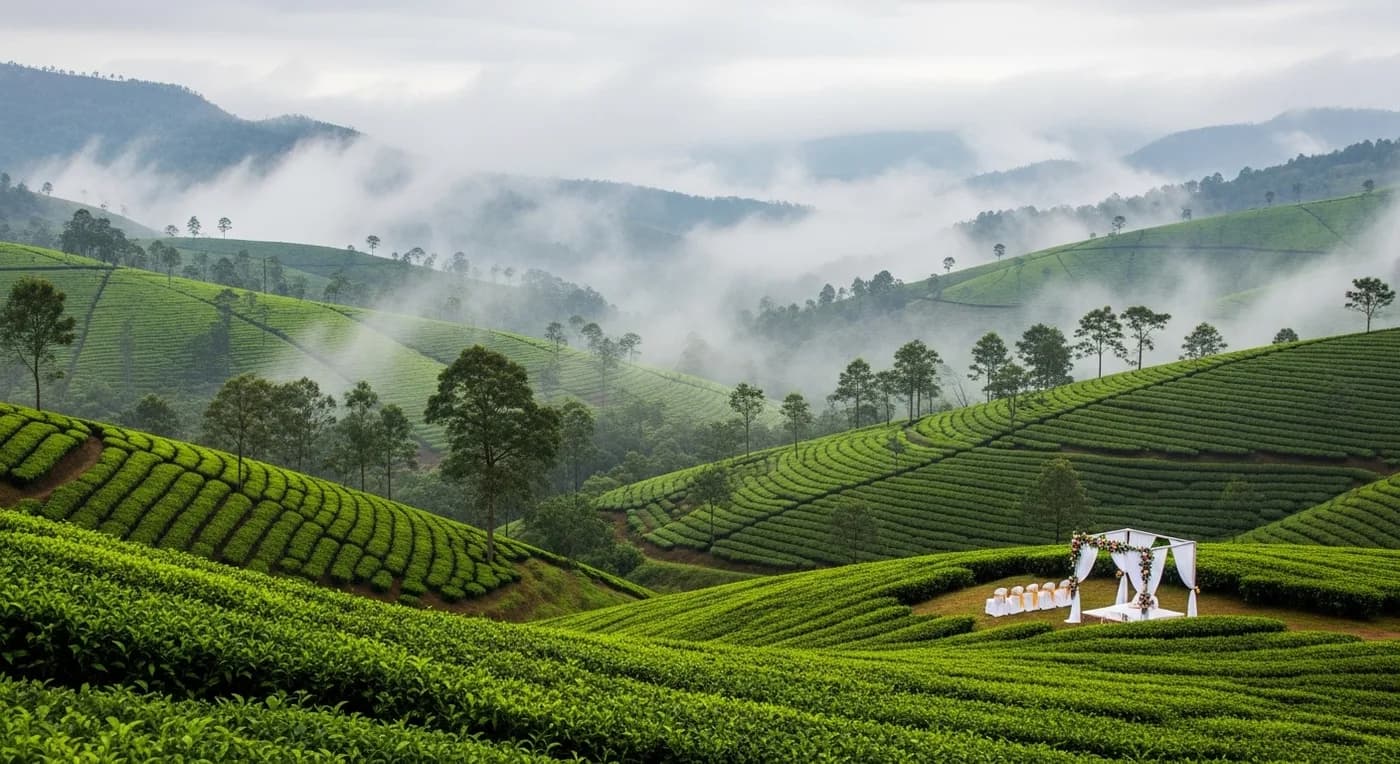
No amount of decor spending can replicate what Munnar gives you for free. The rolling geometry of tea estates, with their manicured rows of bushes climbing hillsides in every direction, creates a backdrop that photographs as strikingly in wide shots as it does in close portraits. The Western Ghats ridgeline provides a natural horizon. Morning mist drifts through valleys and burns off by late morning, giving you two distinct visual moods in a single day.
The altitude also affects light quality in ways photographers understand immediately. At 1,600 metres, sunlight passes through less atmospheric haze. The result is softer, more even illumination -- none of the harsh midday shadows that plague lowland outdoor shoots. Golden hour lasts longer, and the light during it is warmer and more diffused. Several photographers I have worked with describe Munnar light as "naturally graded," meaning their images need less post-processing.
The Intimacy Factor
Munnar is remote. There is no airport, no railway station, and the road from Kochi takes four hours through a ghat section of hairpin bends. This remoteness, which is the biggest logistical challenge, is also the biggest emotional advantage. When guests commit to travelling to Munnar, they are committing to being present. There are no people slipping out after lunch or showing up for thirty minutes during the reception. Everyone arrives, stays for the full event, and the result is a wedding with a residential-retreat quality that city celebrations cannot match.
Families who might otherwise scatter across a wedding day end up spending mornings together on resort verandahs, sharing meals, exploring the tea gardens. The wedding becomes the centrepiece of a shared holiday rather than a standalone event.
Top Venues by Category
Munnar's venue landscape breaks down into five distinct categories, each suited to different wedding sizes, styles, and budgets.
Tea Estate Resorts
These are the properties most people picture when they think of a Munnar wedding. Large lawns surrounded by working tea plantations, with accommodation blocks integrated into the estate.
Windermere Estate remains the gold standard. Perched above the Munnar valley with unobstructed views in three directions, it offers a terraced lawn that seats 120 comfortably for a ceremony. The estate has 20 rooms across its main building and cottages, so you will need supplementary accommodation at nearby properties for larger guest lists. Windermere's kitchen handles multi-cuisine menus well, and their events team has managed enough weddings to anticipate the common issues.
Tea County by KTDC is the largest property in the category, with over 50 rooms and a banquet lawn that handles up to 250 guests. It lacks the boutique character of Windermere but compensates with capacity and simpler logistics -- you can house most of your guest list on-site. Its location on the Kannan Devan Hills is central to Munnar town, making coordination with external vendors easier.
Spice Tree Munnar is the premium option. Their treehouse suites and cantilevered pool make it a strong choice for couples who want luxury accommodation as part of the guest experience. The ceremony lawn is intimate -- 80 guests maximum -- but the setting is extraordinary. Expect premium pricing.
Eastend Munnar offers a mid-range option with 30-plus rooms and a lawn overlooking a valley. It handles weddings of 100-150 guests and is popular with couples looking for solid infrastructure without the top-tier price tag.
₹3,00,000 – ₹12,00,000Venue hire for tea estate resorts varies widely based on season, guest count, and whether accommodation is bundled.
Colonial Heritage Bungalows
Munnar's history as a British tea-planting station left behind a collection of colonial bungalows, many now operated as heritage stays. These are best suited for intimate weddings of 30-60 guests. Properties like the Lockhart Tea Factory bungalow and various KDHP heritage bungalows offer period architecture -- wooden floors, fireplaces, wraparound verandahs -- that gives photographs a timeless quality. Capacity is the limitation. Most have 6-10 rooms. But for a small family wedding or an elopement-style celebration, nothing in Kerala matches the character.
Luxury Cliff-Side Hotels
Several newer properties have been built along the ridgelines west of Munnar town, offering panoramic valley views. Blanket Hotel & Spa is the most established, with contemporary architecture, a full-service spa, and event spaces that handle 100-150 guests. Parakkat Nature Hotels and Resorts near Chinnakanal (about 20 km from Munnar town) offers dramatic cliff-edge lawns with Western Ghats panoramas.
These properties charge a premium for the views, but the photography opportunities -- particularly at sunset with the valley stretching below -- justify the cost for many couples.
Eco-Lodges and Plantation Stays
For couples prioritising sustainability, Munnar has a growing number of eco-conscious properties. Kaivalyam Retreat near Bison Valley operates on solar power and uses locally sourced materials. Deshadan Mountain Resort emphasises organic food and minimal environmental footprint. These properties typically accommodate 60-100 guests and suit couples who want a lower-impact celebration. Decor tends to work with natural materials -- local flowers, bamboo, and jute -- rather than imported elements.
₹2,00,000 – ₹6,00,000Eco-lodge venue costs are generally lower, but may require external catering arrangements.
Outdoor Tent and Glamping Setups
A growing trend since 2024 is the temporary glamping-style wedding, where a tea estate or private land is used as a blank canvas. Luxury tents are erected for accommodation, a separate marquee serves as the ceremony space, and the entire setup is removed after the event. This approach gives complete creative control over the layout and aesthetic. Companies operating in the Chinnakanal-Suryanelli corridor offer turnkey glamping packages.
The trade-off is complexity. You are essentially building temporary infrastructure -- power, water, sanitation, cooking facilities -- from scratch. Budget accordingly.
₹5,00,000 – ₹15,00,000Glamping setup costs vary significantly based on tent count, amenities, and duration.
Looking for Venues in Munnar?
Tell us what you need and get quotes from verified venues
Cost Breakdown: A 120-Guest, 2-Day Munnar Wedding
The total cost of a Munnar destination wedding for approximately 120 guests over two nights breaks down as follows:
₹20,00,000 – ₹45,00,000| Category | Budget (in lakhs) | Mid-Range (in lakhs) | Premium (in lakhs) |
|---|---|---|---|
| Guest Accommodation (2 nights, 50-60 rooms) | 6.0 - 8.0 | 9.0 - 12.0 | 14.0 - 18.0 |
| Venue Hire & Setup | 2.0 - 3.0 | 4.0 - 6.0 | 7.0 - 12.0 |
| Catering (all meals, 2 days) | 3.0 - 4.0 | 5.0 - 7.0 | 8.0 - 10.0 |
| Decor & Florals | 1.5 - 2.5 | 3.0 - 5.0 | 5.0 - 8.0 |
| Photography & Video | 1.5 - 2.0 | 2.5 - 3.5 | 4.0 - 6.0 |
| Guest Transport (Kochi-Munnar return) | 1.0 - 1.5 | 1.5 - 2.0 | 2.0 - 3.0 |
| Sound, Lighting, Entertainment | 0.5 - 1.0 | 1.0 - 2.0 | 2.0 - 3.0 |
| Miscellaneous & Contingency | 1.0 - 1.5 | 1.5 - 2.0 | 2.0 - 3.0 |
| Total | 16.5 - 23.5 | 27.5 - 39.5 | 44.0 - 63.0 |
The critical thing to notice is accommodation. It consumes 30-40 percent of your total budget, which is fundamentally different from a city wedding where most guests drive home. For context, the national average wedding cost is ₹29.6 lakh according to WeddingWire India — a Munnar destination wedding often exceeds this due to the accommodation component alone. To benchmark Munnar's numbers against other regions, see our destination wedding cost guide for South India, which lays out five tiered budgets across hill stations, beaches and heritage cities. Every guest at a Munnar wedding needs a room, and rooms at hill-station properties during wedding season are not cheap.
Important
Do not treat the "Budget" column as a bare-minimum figure. It assumes simpler decor, in-house resort catering, and transport by standard buses. Cutting below this range usually means compromising on guest comfort in ways that undermine the destination-wedding experience you are paying for.
The Logistics Challenge: Getting Everyone There
This is the section that separates Munnar weddings from every other Kerala destination. The logistics of moving 100-plus guests (many of them elderly) up a mountain road is the single most underestimated aspect of planning.
The Road from Kochi
Cochin International Airport (CIAL) at Nedumbassery is the primary gateway. The drive to Munnar covers approximately 130 kilometres, but the time is 3.5 to 4.5 hours depending on the vehicle, driver, and traffic through the ghat sections.
The route goes: Nedumbassery to Aluva to Perumbavoor to Kothamangalam to Adimali to Munnar. The first half, to Kothamangalam, is flat and straightforward. After Kothamangalam, you enter the ghat road -- a two-lane highway that climbs through Neriamangalam, crosses the Idukki district boundary, and winds through 15-20 kilometres of continuous hairpin bends before reaching Adimali. From Adimali to Munnar is another hour through tea estates.
Travel time by vehicle type:
| Vehicle | Kochi Airport to Munnar | Comfort Level | Capacity |
|---|---|---|---|
| Sedan (Innova/Ertiga) | 3.5 - 4 hours | High | 4-6 passengers |
| Tempo Traveller (12-seater) | 4 - 4.5 hours | Moderate | 10-12 passengers |
| Mini Bus (25-seater) | 4.5 - 5 hours | Moderate | 20-25 passengers |
| Full-size Bus (45-seater) | 5 - 5.5 hours | Low-Moderate | 40-45 passengers |
Full-size buses handle the ghat road but move slowly on the hairpin sections. Tempo travellers are the most popular choice for wedding groups -- they are agile enough for the bends and large enough to keep the vehicle count manageable.
₹50,000 – ₹2,00,000Group transport costs for Kochi-Munnar return, covering 8-12 vehicles depending on guest count and vehicle mix.
From Madurai
Guests flying into Madurai International Airport face a 5 to 5.5 hour drive via Theni and Bodimettu. The Bodimettu ghat road is steeper and narrower than the Kochi approach. It is scenic but not suitable for large buses. Use SUVs or tempo travellers only on this route.
From Coimbatore
Coimbatore airport is roughly 5 hours away via Pollachi and Udumalpet. This route through Chinnar Wildlife Sanctuary has restricted night-driving hours (no vehicles allowed between 9 PM and 6 AM in the sanctuary stretch). Plan arrivals accordingly. If you prefer a shorter drive, consider destination wedding venues near Coimbatore in Pollachi and Valparai — all within 1-3 hours of the airport.
Important
Never schedule guest travel to Munnar during the monsoon months of June through August. The ghat roads are prone to landslides, particularly the Neriamangalam-Adimali stretch. In 2024 and 2025, this road was closed for multiple days during heavy rainfall events. Road closures are not a rare inconvenience -- they are a near-certainty during peak monsoon.
Practical Transport Tips
- Stagger arrivals. Do not try to move all guests in a single convoy. Split into two batches -- one morning, one afternoon -- to reduce bottlenecks on the ghat road.
- Pre-position a vehicle in Munnar. You will need at least one vehicle already at the destination for last-minute runs -- pharmacy, hospital, forgotten items.
- Motion sickness is real. Stock Avomine or similar medication in every vehicle. The ghat bends affect a significant percentage of passengers, especially elderly guests and children.
- Night driving is risky. The ghat road has no street lighting and fog descends after sunset. Schedule all arrivals before 5 PM.
Guest Accommodation Strategy
Accommodation planning for a Munnar wedding is fundamentally different from booking a hall in Kochi or Thrissur. Every single guest needs a room, and the town's total luxury-room inventory is limited.
Three Approaches
Option A: Buy out a single property. For weddings under 100 guests, find a resort with 40-50 rooms and book the entire property. This gives you exclusive use of all public areas, simplifies catering, and eliminates conflicts with other hotel guests. Windermere Estate, Eastend Munnar, and Tea County are all feasible for full buyouts.
Option B: Hub-and-spoke. Book the ceremony and reception at one property, and house overflow guests at 2-3 nearby hotels within a 5-10 minute drive. Assign a coordinator and dedicated vehicles for shuttling between properties. This is the most common approach for 120-200 guest weddings.
Option C: Multi-property cluster. In the Chinnakanal-Suryanelli corridor (about 20 km from Munnar town), several properties sit within walking distance of each other. You can spread guests across 3-4 smaller resorts and use one central lawn for the ceremony. This works well but requires meticulous coordination.
Room Budget Tiers
₹3,000 – ₹15,000Per room per night during wedding season (Oct-Feb). Rates climb 20-30 percent during Christmas-New Year week.
| Tier | Rate per Night | What You Get |
|---|---|---|
| Standard | 3,000 - 5,000 | Clean rooms at 3-star properties, basic amenities, may be 10-15 min from venue |
| Comfort | 5,000 - 9,000 | 4-star resorts, valley or garden views, on-site restaurant |
| Premium | 9,000 - 15,000 | Luxury suites, tea estate views, spa access, heritage or boutique properties |
Tip
Book accommodation 14 months before your wedding date. Munnar's total luxury-room count within a reasonable radius of the main venues is approximately 500-600 rooms. During peak wedding season (November-February), rooms fill weeks in advance. Couples who wait until 8-10 months out often find their preferred properties fully committed.
Weather Guide: Month by Month
Munnar's weather is the most consequential variable in your planning. A clear February morning and a foggy July afternoon are entirely different experiences.
The Wedding Season Window: September to March
September - October: The monsoon retreats. Rainfall drops sharply through September, and by October you get mostly dry days with occasional afternoon showers. The landscape is at its most intensely green -- every shade from emerald to lime covers the hillsides. Temperatures sit between 15-22 degrees Celsius. Fog is common in early mornings but usually clears by 9-10 AM. This is an underrated window: fewer competing bookings, lower rates, and the most dramatic greenery of the year.
November: The sweet spot begins. Rainfall is minimal, skies clear, and temperatures hold at 14-20 degrees. Morning mist is lighter and burns off faster. Visibility is excellent for valley-view venues. This is when bookings start to compete.
December - January: Peak season. Clear skies, crisp mornings (10-15 degrees), comfortable afternoons (18-22 degrees). Nights can drop to single digits, so evening outdoor events need warmth planning -- blankets, fire pits, or covered spaces with heaters. This is also peak tourist season, so room rates are at their highest.
February - March: Warming slightly (16-26 degrees) with very low rainfall. February is the driest month. By mid-March, temperatures start creeping up and the pre-summer haze begins to reduce visibility. Early March is still excellent; late March is borderline.
Months to Avoid
June - August: Heavy southwest monsoon. IMD's Kerala monsoon data confirms rainfall exceeds 300mm per month during this period. Landslide risk on access roads is high. Fog can reduce visibility to under 50 metres for entire days. Road closures are frequent. No reputable wedding planner will recommend these months, and most outdoor venues refuse bookings entirely.
April - May: Hot by Munnar standards (22-30 degrees), with increasing pre-monsoon showers. The tea estates lose their deep green, turning brownish between harvest cycles. Not ideal, but technically possible for a covered-venue wedding.
Catering at 1,600 Metres
Catering is the second-biggest logistical puzzle after transport. Munnar town has a limited pool of professional wedding caterers. Most large-scale wedding catering in Munnar is handled in one of two ways.
Resort In-House Catering
The larger resorts -- Tea County, Blanket Hotel, Eastend -- have banquet kitchens capable of producing multi-cuisine menus for 100-200 guests. Quality is generally reliable but not exceptional. You get a standard hotel banquet menu: North Indian, Kerala, Continental, and Chinese options. For couples who want simplicity and fewer moving parts, in-house catering eliminates a huge coordination burden.
Transporting Kochi-Based Caterers
For a traditional Kerala Sadya or a higher-end culinary experience, most couples bring caterers up from Kochi or Thrissur. This is standard practice. The caterer's team -- typically 15-25 people for a 120-guest wedding -- travels with their own equipment, vessels, and key ingredients. Perishable items (fresh fish, certain vegetables) are sourced locally in Adimali or Munnar town.
The additional cost for transporting an external caterer includes: vehicle hire for crew and equipment (typically 2 tempos), two nights accommodation for the catering team, and a travel surcharge that caterers typically add at 10-15 percent of the food bill. Budget an extra 1-1.5 lakhs beyond the base catering quote for these logistics.
Tip
If you are planning a Kerala Sadya, discuss the logistics of banana-leaf sourcing with your caterer well in advance. Banana plants grow at lower altitudes. Leaves need to be transported fresh from Kothamangalam or Adimali the morning of the event. Your caterer should have a supply chain for this already established -- if they hesitate when asked, they have not done a Munnar wedding before.
Looking for Caterings in Kochi?
Tell us what you need and get quotes from verified caterings
Decor at Altitude: Working With the Landscape
The most common mistake in Munnar wedding decor is over-decorating. Couples (or their decorators) bring a full lowland wedding setup -- massive floral arches, fabric draping, heavy mandap structures -- and plant it in front of a tea estate vista. The effect is jarring. The artificial competes with the natural, and the natural always wins.
The Minimal Intervention Approach
The best Munnar weddings lean into the landscape rather than covering it up. Tea bushes, when trimmed to uniform height, function as natural borders and aisle markers. The rows of bushes climbing the hillside behind the mandap are more visually compelling than any floral backdrop.
Flowers That Work at Altitude
Munnar's climate supports different flora than the coast. At 1,600 metres, tropical flowers like jasmine and lotus do not last as long once cut. Instead, work with:
- Neelakurinji-adjacent wildflowers (seasonal, check availability)
- Hydrangeas -- they thrive at this altitude and come in blues, purples, and whites
- English roses -- available from Munnar-area nurseries
- Eucalyptus and fern fronds -- abundant locally, excellent for greenery arrangements
- Marigolds and chrysanthemums -- reliable at any altitude for traditional setups
Using the Mist
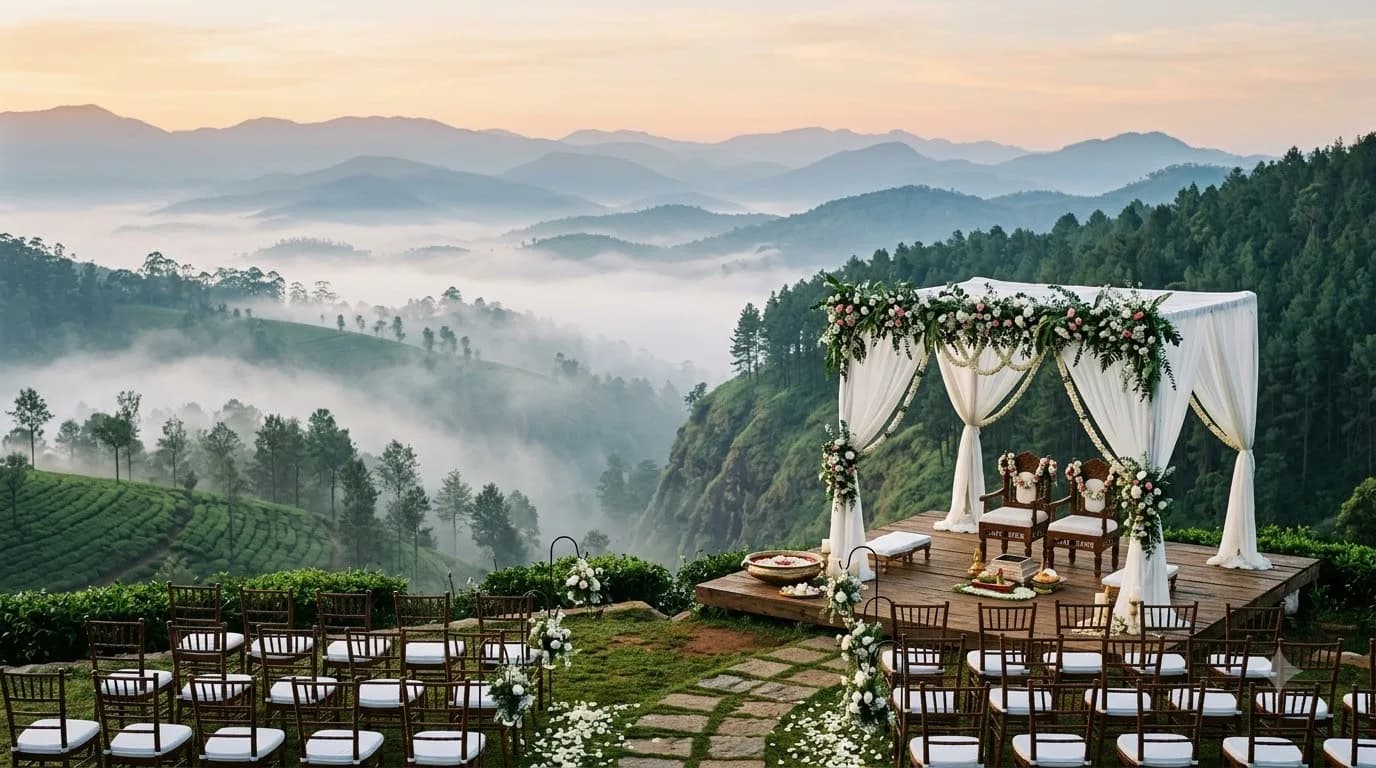
Morning mist in Munnar is not a problem to solve -- it is a design element. Ceremonies scheduled for 7-8 AM get a natural diffusion layer that softens everything. Fire elements (brass lamps, oil torches) glow with halos in the mist. If your ceremony is early morning, embrace the fog rather than fighting it with excess lighting.
Photography in Munnar
If there is one area where Munnar consistently outperforms every other Kerala wedding destination, it is photography. The combination of altitude light, landscape variety, and cool temperatures creates conditions that professional photographers actively prefer.
The Light Advantage
At 1,600 metres, the sun's light passes through less atmospheric moisture and pollution than at sea level. The result is a cleaner, softer quality -- shadows are less harsh, highlights do not blow out as easily, and skin tones render more naturally. Photographers spend less time wrestling with exposure and more time on composition.
Golden hour at Munnar altitude is notably longer than at sea level. The sun dips behind the Western Ghats ridge gradually, giving you a usable golden-light window of 40-50 minutes compared to the 15-20 minutes typical of a flat coastal horizon.
Signature Munnar Shots
- Tea garden couple portraits: The geometric rows of tea bushes create leading lines that draw the eye to the couple. Best shot in late afternoon light.
- Mist portraits at dawn: If you can get the couple out at 6:30 AM, the valley fog produces ethereal images that are impossible to replicate with any amount of post-processing.
- Valley panoramas: Drone footage of the ceremony site with the Kannan Devan Hills stretching to the horizon is Munnar's signature wide shot.
- Sunrise sessions: The sun rises over the eastern ridge with a clean, warm light. A 15-minute sunrise session the morning after the wedding consistently produces the best images of the entire event.
Tip
Schedule a dedicated sunrise portrait session for the morning after the wedding. The 6:00-6:45 AM window at Munnar delivers extraordinary light -- warm, directional, with mist still in the valleys below. Most couples skip this because they are exhausted. Those who do it consistently say the resulting photographs are their favourites from the entire wedding.
Drone Considerations
Munnar falls within certain restricted airspace zones near the Eravikulam National Park boundary. Your photographer's drone operator should verify clearances in advance. Most of the resort areas south and west of Munnar town are unrestricted, but confirm with the local police station as a courtesy -- it avoids disruptions on the day.
Common Questions About Munnar Destination Weddings
How much does a destination wedding in Munnar cost?
A Munnar destination wedding for 100-150 guests typically costs 20-45 lakhs including 2-night guest accommodation, venue, catering, decor, and photography. The accommodation component (often 30-40% of budget) is the biggest cost driver since all guests need lodging. Budget-conscious couples can bring costs closer to 16-20 lakhs with in-house resort catering, minimal decor, and standard-tier accommodation, while premium celebrations at top properties with imported decor and celebrity photographers can exceed 50 lakhs.
What is the best season for a Munnar wedding?
September to March offers the best conditions. September-November provides the lush post-monsoon greenery with pleasant 15-22 degree temperatures. December-February is peak season with clear skies and crisp mornings. Avoid June-August entirely due to heavy monsoon and landslide risk. Within the safe window, November and February offer the best balance of weather reliability and pricing -- they sit just outside the absolute peak of December-January.
Can Munnar venues handle large weddings?
Most Munnar properties accommodate 80-200 guests. Only a handful of larger resorts can handle 250-plus. Tea County by KTDC is the largest single-property option at around 250 guests. For large weddings, couples often book multiple properties within walking distance or a short drive and use one for the ceremony and another for accommodation. Weddings exceeding 300 guests are possible but require multi-venue coordination that significantly increases planning complexity and cost.
How do guests reach Munnar?
Munnar is approximately 4 hours by road from Cochin International Airport (CIAL) in Nedumbassery and 5 hours from Madurai airport. There is no railway station in Munnar -- the nearest is Aluva, which is still 3.5 hours away by road. Most couples arrange group transport from Kochi airport with chartered tempo travellers (the most popular option) or a mix of buses and sedans. Guests arriving from Tamil Nadu can use the Madurai or Coimbatore airports, though the Bodimettu ghat road from Theni is narrower and steeper than the Kochi route.
What are the unique advantages of a Munnar wedding?
Cool temperatures (15-25 degrees year-round) allow comfortable outdoor afternoon ceremonies that are impossible in coastal Kerala during most months. Tea estate backdrops are visually unique -- no other wedding destination in South India offers anything comparable. The altitude gives naturally soft, diffused light that photographers genuinely prefer over lowland conditions. And the remoteness creates a "world apart" feeling that turns a wedding into a shared adventure for the entire guest list. The residential nature of the event -- everyone staying together for two or three days -- builds a sense of togetherness that single-day city weddings rarely achieve.
Further Reading
Planning a Munnar wedding involves decisions that intersect with broader Kerala wedding planning. These guides cover the wider context:
- Best Wedding Venues in Kerala -- A comprehensive look at venue options across the state, from backwater resorts to heritage halls, to help you compare Munnar against other destinations.
- Traditional vs. Destination Kerala Wedding -- If you are still deciding between a destination celebration and a traditional local wedding, this guide breaks down the trade-offs in cost, logistics, and guest experience.
- Kerala Wedding Budget Guide -- A detailed budgeting framework for Kerala weddings at all price points, useful for benchmarking your Munnar plans against state-wide averages.
Tip
Ready to start planning? Use our AI Wedding Checklist to build a personalised timeline that includes venue booking deadlines, vendor coordination, and every task leading up to your big day. Estimate your full budget with the Cost Calculator.
Topics
Munnar destination weddingMunnar wedding venuehill station wedding Keralatea estate weddingMunnar resort weddingKerala destination weddingExplore more
Frequently Asked Questions
1How much does a destination wedding in Munnar cost?
2What is the best season for a Munnar wedding?
3Can Munnar venues handle large weddings?
4How do guests reach Munnar?
5What are the unique advantages of a Munnar wedding?
Continue reading
Related Articles
Best Wedding Venues Kerala: ₹50K-₹25L With Prices (2026)
Traditional vs Destination Kerala Wedding: Which Is Right for You?

Kerala Wedding Budget Guide: 2026 Cost Breakdown
Best Season for South India Destination Weddings: Month-by-Month Western Ghats Guide
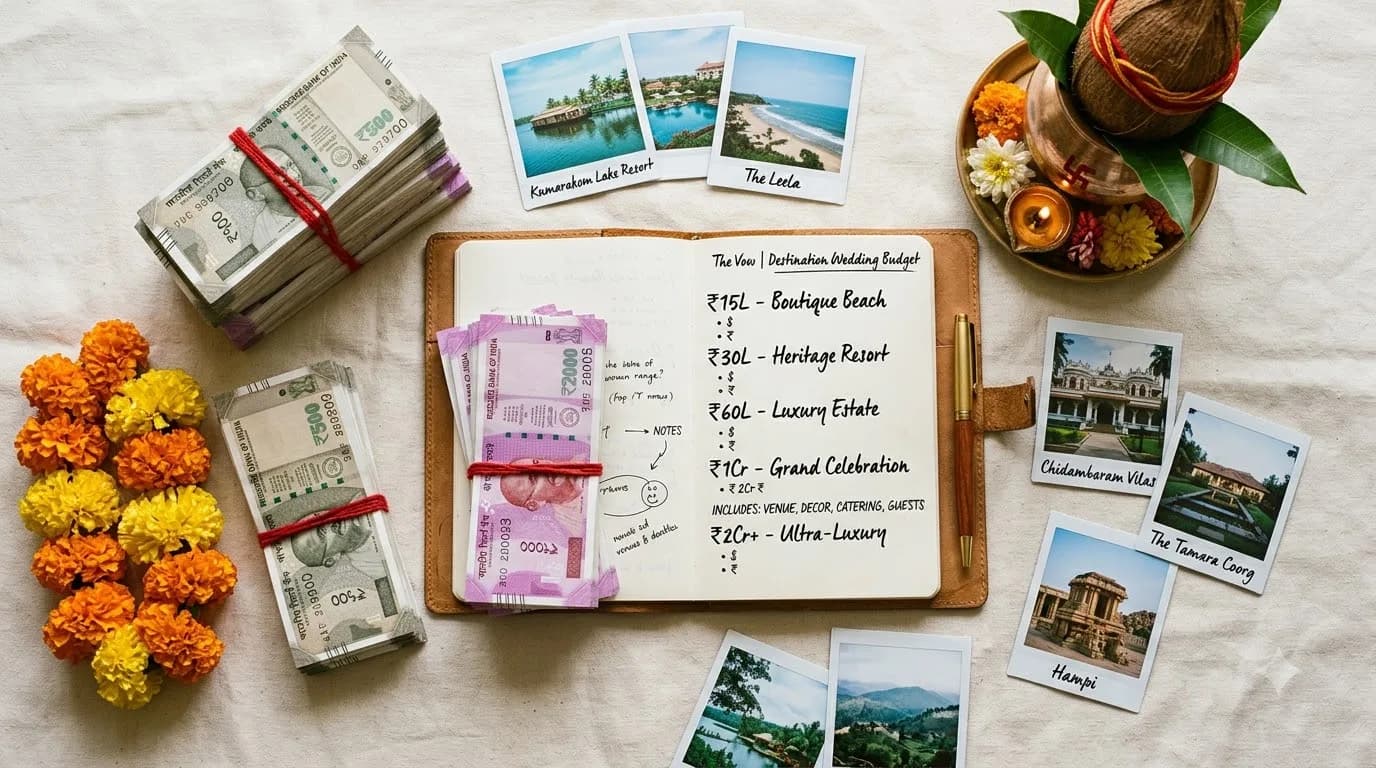
Destination Wedding Cost in South India 2026: 5-Tier Budget Guide
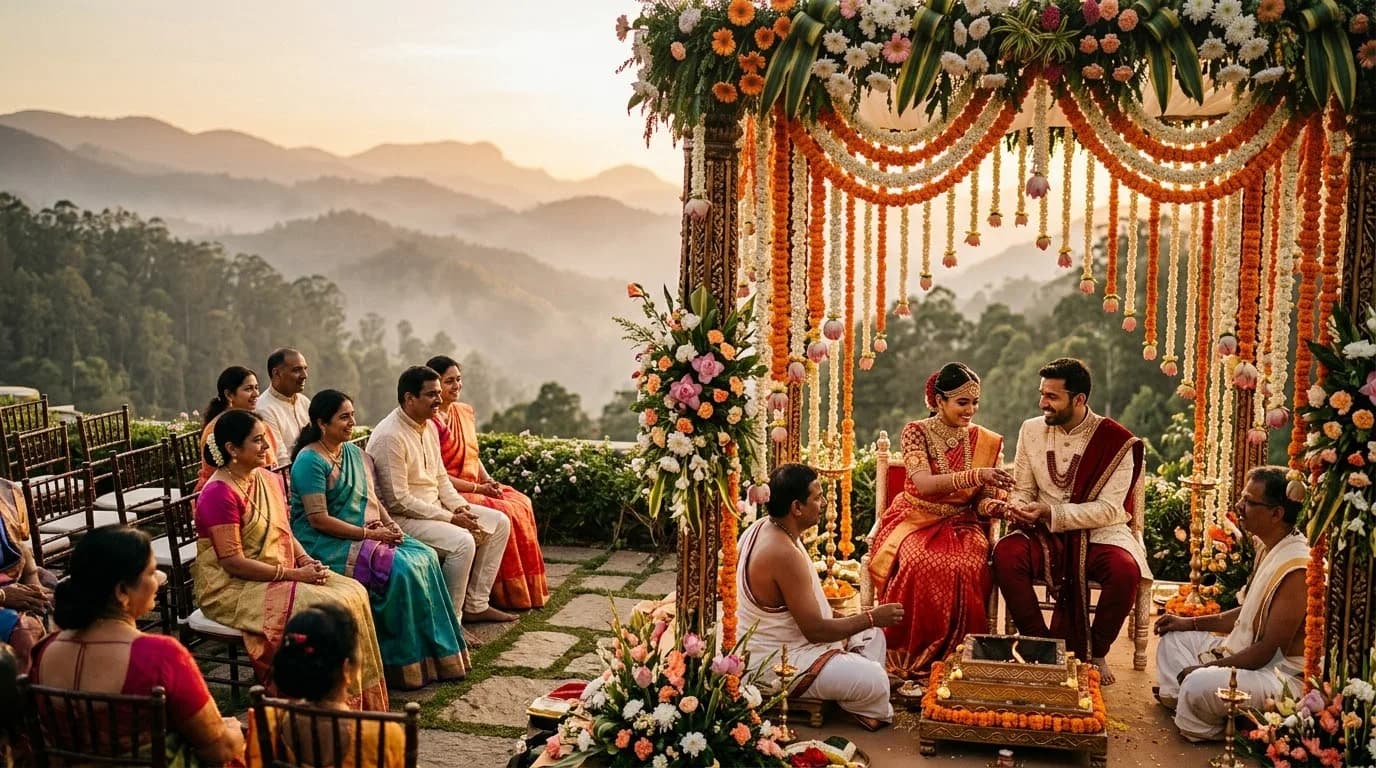
Destination Wedding in South India: Complete 2026 Planning Guide
Still planning?
Get quotes from India's best vendors
Tell us what you're planning and we'll match you with verified photographers, venues, decorators, and more.
Get free quotes