
Kerala Wedding Industry Report 2026: Trends, Costs & Market Data
Kerala's ₹20,000–30,000 crore wedding market spans 1 lakh+ marriages per year. Costs rose 25–30% since 2023. Vendor trends, pricing shifts, and 2026 market data.

Wedding Finance Advisor
Arjun Das is a wedding finance advisor who helps couples across Kerala plan celebrations that match their vision without breaking the bank.
On this page
The Kerala wedding market is estimated at ₹20,000–30,000 crore annually across over 1 lakh registered marriages per year. The average wedding spend has risen 25–30% since 2023, driven by smaller guest lists but higher per-head budgets. Key 2026 trends: destination weddings within Kerala (1 in 4 Indian weddings are now destination), AI-powered vendor discovery, sustainable celebrations, and the 2-day wedding format replacing multi-day events.
Quick Answer
Quick answer: Kerala's wedding market is worth ₹20,000–30,000 crore annually across 1 lakh+ weddings per year. Average spend per wedding has risen 25–30% since 2023, ranging from ₹5–9 lakhs at the economy tier to ₹75 lakhs–2 crore+ at the ultra-luxury level. Key 2026 trends include smaller guest lists with higher per-head spend, destination weddings within Kerala, and AI-powered vendor discovery.
Note
Pricing methodology: Cost ranges in this guide are based on vendor pricing data from the itsmy.wedding marketplace and published industry reports, collected in Q4 2025 – Q1 2026.
Introduction: Why Kerala Needs a Wedding Industry Report
Kerala's wedding industry has no shortage of opinions. Every family has a view on what a wedding should cost, every vendor has a sense of how the market is moving, and every wedding planner has a theory about where things are headed. What Kerala has lacked — until now — is a consolidated, data-grounded account of what is actually happening: how many weddings take place each year, what couples are spending, which vendor categories are growing or shrinking, how pricing has moved across the state's five major markets, and what structural forces are reshaping the industry.
This is the first annual Kerala Wedding Industry Report published by itsmy.wedding, drawing on platform data, industry research, public economic data from the Kerala State Planning Board and Civil Registration System, and on-the-ground insights gathered across Kochi, Trivandrum, Thrissur, Kozhikode, and Alappuzha. The goal is straightforward: to give couples, vendors, planners, and investors a clear-eyed picture of the Kerala wedding economy as it actually stands in 2026 — not as it is imagined or hoped to be.
A few important caveats before we begin. Kerala's wedding market is genuinely heterogeneous. A Hindu temple wedding in rural Palakkad and a five-star hotel reception in Ernakulam both qualify as Kerala weddings, but they occupy completely different economic universes. Community practices — Christian, Muslim, Hindu Nair, Hindu Ezhava, Syrian Christian, Mappila — shape everything from venue choice to catering scale to vendor mix. Geographic variation is real: Kochi and Trivandrum prices are consistently 20-30% higher than secondary markets. Any aggregate number is therefore a weighted average that conceals as much as it reveals. We have tried to be specific wherever specificity is possible, and honest about uncertainty where it is not.
What is beyond dispute is that the Kerala wedding industry is in a period of genuine transition. The assumptions that governed the market five years ago — bigger is better, guest lists are social capital, multi-day formats are non-negotiable — are being questioned, revised, or abandoned outright. The couple planning a wedding in 2026 has fundamentally different expectations from their parents, and the industry is adapting, sometimes smoothly and sometimes not, to meet them.
Market Overview: Size, Scale, and Spending
Estimated Market Size
The Kerala wedding market generates an estimated ₹20,000–30,000 crore in annual economic activity, representing approximately 2–3% of India's total wedding economy by value despite Kerala accounting for only 2.8% of the national population. This disproportionate value share — relative to Kerala's roughly 1% share of India's wedding volume — reflects a structural reality: Kerala's per-capita income of ₹3.7 lakh (2024-25) is among the highest of any Indian state (approximately 50% above the national average), its 4-million-strong Non-Resident Keralite (NRK) diaspora channels ₹2.17 lakh crore in annual remittances (23.2% of Kerala's NSDP, per the 2023 Kerala Migration Survey), and deeply embedded cultural norms around celebration scale and hospitality push per-wedding spending well above national averages.
India's overall wedding economy is estimated at approximately $130 billion (₹10+ lakh crore) annually — IBEF values it at ₹10.79 lakh crore, projected to reach ₹24 lakh crore by 2030 — according to IBEF and The Economist, making it the country's fourth-largest industry. The Confederation of All India Traders (CAIT) estimated that the November-December 2025 wedding season alone — a 45-day window covering 4.6 million weddings — generated ₹6.5 lakh crore in economic activity. Within this, the organized wedding services market — the vendors, venues, and planning infrastructure that couples hire — is valued at approximately $104 billion and growing at a 14.3% CAGR through 2030 (Grand View Research). The remainder goes to gold, jewellery, and direct family-to-family transfers.
Annual Wedding Volume
Kerala sees over 1 lakh registered marriages per year, based on Civil Registration System data and the Kerala Registration Department. Between January 2024 and September 2025, 1,44,416 marriages were registered across the state, with 62,524 processed through the K-SMART digital platform. Actual wedding celebrations likely exceed registered events, as some couples register separately from their ceremonial wedding and others delay registration. For context, India as a whole sees approximately 10 million weddings annually, with 4.8 million occurring in the October-December 2024 peak season alone (CAIT).
Seasonality is sharp. The peak wedding season runs from November through March, covering the cooler months and avoiding the heaviest monsoon period. Within this window, auspicious dates — muhurtham days for Hindu weddings, specific calendar markers for Christian weddings, and post-Ramadan periods for Muslim weddings — create extreme demand spikes that compress bookings and drive prices up 15–25% at the most popular venues.
Average Wedding Spend by Tier
| Wedding Tier | Guest Count | Average Total Spend | Average Per-Head Spend | Primary Venue Type |
|---|---|---|---|---|
| Economy | 150–300 | ₹5–9 lakhs | ₹2,000–3,500 | Community halls, temple halls |
| Mid-Range | 300–600 | ₹10–18 lakhs | ₹2,500–4,000 | Convention centres, banquet halls |
| Premium | 200–400 | ₹18–35 lakhs | ₹5,000–9,000 | 4-star hotels, luxury convention venues |
| Luxury | 100–250 | ₹35–75 lakhs | ₹15,000–35,000 | 5-star hotels, destination resorts |
| Ultra-Luxury | 50–150 | ₹75 lakhs–2 crore+ | ₹50,000–1,50,000+ | Private venue buyouts, destination |
These tiers are not rigid; they represent general clusters rather than precise boundaries. For context, the WedMeGood Annual Report 2025-26 places the national average wedding cost at ₹36.5 lakhs and the average destination wedding at ₹58 lakhs, while WeddingWire India's survey puts the national average at ₹29.6 lakhs for 330 guests. Kerala's average sits below these national figures for conventional weddings — reflecting moderate venue and catering costs relative to Delhi or Jaipur — but premium and destination segments in Kochi and Kumarakom approach or exceed national averages.
The most important structural change since 2023 is the growth of the "Premium Small" segment: weddings with 150–300 guests but luxury-tier per-head spending, driven by couples who are consciously reducing guest counts to redirect budget toward quality.
Growth Trajectory
The India wedding services market has grown at approximately 7–8% annually during 2022–2024 in the post-pandemic recovery phase, with the organized segment projected to grow at 14.3% CAGR through 2030 (Grand View Research). The 2023 wedding season saw a 26% year-on-year surge to ₹4.74 trillion (Business Standard). Average wedding spends rose a further 8% in 2025 versus 2024 (WedMeGood).
According to market indicators, Kerala's growth has tracked slightly above the national average, driven by three primary engines: post-pandemic pent-up demand that has not fully normalised, rising NRK remittances enabling larger budgets among diaspora families (remittances as a share of NSDP grew from 13.5% in 2018 to 23.2% in 2023), and a significant shift in spending patterns away from gold and jewellery toward experiences, decor, and professional services.
The experience economy shift is the most structurally significant trend. In 2018, a typical mid-range Kerala wedding might allocate 40% of its budget to jewellery and attire, 30% to catering, 15% to venue, and 15% to all other services combined. In 2026, that split has changed: jewellery remains significant but has declined as a share, while professional services — photography, decor, planning, entertainment — have grown from 15% to 25–35% of total budgets at the premium and luxury tiers. This shift is creating the conditions for rapid professionalisation of the vendor ecosystem.
The Vendor Landscape: Categories, Count, and Pricing
The following table draws on platform data and industry estimates to map the current vendor ecosystem in Kerala. Vendor counts reflect active professionals, not registered businesses — many Kerala vendors operate informally without business registration.
| Category | Estimated Active Vendors in Kerala | Average Starting Price | Average Mid-Range Price |
|---|---|---|---|
| Wedding Venues (banquet halls, convention centres) | 2,800–3,200 | ₹50,000 | ₹1,50,000–3,00,000 |
| Caterers (full-service) | 3,500–4,000 | ₹400/plate | ₹650–1,200/plate |
| Photographers (candid/traditional) | 4,000–5,000 | ₹30,000 | ₹75,000–2,00,000 |
| Videographers | 2,500–3,000 | ₹25,000 | ₹60,000–1,50,000 |
| Decorators / Florists | 3,000–3,500 | ₹40,000 | ₹1,00,000–3,00,000 |
| Bridal Makeup Artists | 2,000–2,500 | ₹8,000 | ₹20,000–60,000 |
| Wedding Planners / Coordinators | 300–500 | ₹50,000 | ₹1,50,000–5,00,000 |
| Mehendi Artists | 800–1,200 | ₹5,000 | ₹12,000–35,000 |
| Entertainment (live music, DJ, orchestra) | 600–900 | ₹15,000 | ₹35,000–1,50,000 |
| Invitation Designers (digital + print) | 400–600 | ₹3,000 | ₹8,000–25,000 |
| Drone Operators | 250–400 | ₹8,000 | ₹20,000–50,000 |
| Destination Wedding Resorts | 150–200 | ₹2,00,000 | ₹4,50,000–12,00,000 |
Note
Data Note: Vendor count estimates above are based on platform listings, registration data from district-level industry bodies, and field research across Kerala's five major markets. The informal economy in categories like catering and traditional photography is large — total active vendor numbers are likely 30–40% higher than the estimates above.
The vendor landscape has several important structural characteristics. First, the market is heavily fragmented at the bottom — most categories have hundreds of micro-operators working with minimal equipment, no formal contracts, and pricing that undercuts established professionals significantly. Second, the premium end is thin but growing rapidly, with full-time professional wedding planners and high-end photographer-videographer duos that charge 3–5x the market average and are consistently booked 12+ months in advance. Third, the fastest-growing categories by both vendor count and revenue are drone videography, destination wedding planning, and digital invitation design — all three driven by demand shifts we examine later in this report.
For a deeper dive into what these vendors charge and how to evaluate them, see our Kerala Wedding Budget Guide and the detailed city-by-city cost comparison.
Price Trends: 2023 to 2026
The three-year period from 2023 to 2026 has seen meaningful price inflation across all major wedding vendor categories in Kerala, driven by post-pandemic demand recovery, rising raw material and labour costs, and the professionalisation of the vendor market at the premium end. The table below tracks average mid-range pricing (not starting rates) across the four largest spend categories.
| Category | 2023 Average (Mid-Range) | 2024 Average | 2025 Average | 2026 Average | 3-Year Change |
|---|---|---|---|---|---|
| Venue (banquet hall, full-day rental) | ₹1,10,000 | ₹1,25,000 | ₹1,40,000 | ₹1,60,000 | +45% |
| Catering (per plate, vegetarian sadya) | ₹450 | ₹520 | ₹580 | ₹650 | +44% |
| Photography (full-day candid) | ₹60,000 | ₹70,000 | ₹80,000 | ₹95,000 | +58% |
| Decor (full venue, mandap + hall) | ₹1,50,000 | ₹1,75,000 | ₹2,10,000 | ₹2,40,000 | +60% |
| Wedding Planning (full-service) | ₹1,20,000 | ₹1,50,000 | ₹1,90,000 | ₹2,50,000 | +108% |
| Videography (full-day + edited film) | ₹55,000 | ₹65,000 | ₹75,000 | ₹90,000 | +64% |
| Bridal Makeup (full bridal) | ₹15,000 | ₹18,000 | ₹22,000 | ₹28,000 | +87% |
Several patterns stand out. Photography and videography have seen above-average price increases because of a genuine supply-demand imbalance: the number of genuinely skilled candid photographers has not kept pace with the explosion in demand from premium couples. The result is that Kerala's top 50–100 photographer-videographer teams have been able to raise prices aggressively, pulling the category average up. At the same time, the floor price has stayed relatively low because there is an oversupply of entry-level photographers with adequate equipment but limited skill.
Wedding planning has seen the most dramatic price increase — 108% in three years — reflecting the category's transition from a niche luxury service to a mainstream expectation among premium couples. As guest lists shrink and per-event budgets rise, couples are hiring coordinators at rates that simply did not exist in Kerala's market before 2022.
Catering and venue price increases, while significant at 44–45%, largely track broader inflation in food costs, fuel, and labour. The Kerala minimum wage revisions in 2024 and 2025 had a measurable upward effect on catering labour costs, which caterers have passed on to clients. This aligns with the national trend: WedMeGood's 2025-26 report found that hospitality and venue prices rose 10%+ year-on-year across India.
Important
Booking Timing Matters: The price gap between peak-season and off-season bookings has widened. In 2023, peak-season venues were priced 10–15% above their off-season equivalents. In 2026, that premium has risen to 20–30% for the most sought-after venues and photographers. Book early, or consider a February-March or October-November date over the December-January peak.
Geographic Distribution: Kerala's Five Major Wedding Markets
Kerala's wedding vendor ecosystem is distributed unevenly across the state, reflecting population density, economic activity, NRK diaspora concentrations, and the historical geography of the major communities.
| City / Market | Vendor Density | Venue Avg. Price | Catering Avg. (Per Plate) | Photography Avg. | Price Premium vs State Avg. | Dominant Wedding Style |
|---|---|---|---|---|---|---|
| Kochi (Ernakulam) | Very High | ₹2,00,000–5,00,000 | ₹700–1,400 | ₹1,00,000–2,50,000 | +25–35% | Premium, cosmopolitan, destination-adjacent |
| Trivandrum (Thiruvananthapuram) | High | ₹1,50,000–4,00,000 | ₹600–1,200 | ₹80,000–2,00,000 | +15–25% | Government/professional families, temple weddings |
| Thrissur | High | ₹1,20,000–3,00,000 | ₹550–1,000 | ₹70,000–1,80,000 | +5–15% | Cultural heartland, traditional large-scale weddings |
| Kozhikode (Calicut) | Moderate–High | ₹1,00,000–2,50,000 | ₹500–950 | ₹60,000–1,50,000 | 0–10% | Malabar Muslim celebrations, growing premium tier |
| Alappuzha (Alleppey) | Moderate | ₹80,000–2,00,000 | ₹450–850 | ₹50,000–1,20,000 | -10–0% | Backwater destination weddings, mid-range base |
Kochi's premium pricing is explained by a combination of factors: the highest concentration of 4- and 5-star hotels, the largest NRK diaspora in any single Kerala city, the presence of a large corporate and professional class that treats premium wedding services as a baseline expectation, and the simple reality that real estate and labour costs in Ernakulam district are the highest in the state.
Thrissur occupies a unique position. It is Kerala's "cultural capital," with an exceptionally dense network of traditional vendors, temple-adjacent community halls, and caterers who have served weddings of 1,000+ guests for generations. Thrissur's market is bifurcating: the traditional large-scale economy remains robust, but a growing premium segment in Irinjalakuda, Guruvayoor, and central Thrissur town is beginning to resemble Kochi-style spending patterns.
Kozhikode is the market most shaped by community dynamics. The Malabar Muslim community's nikah celebrations are among the most elaborate wedding events in Kerala, with large guest counts, extensive catering spreads, and premium decor. The city has seen rapid growth in premium makeup artists, photographers who specialise in Muslim wedding traditions, and caterers offering both traditional Malabar cuisine and multi-cuisine options.
Alappuzha is the outlier: its pricing is the lowest among the five markets for conventional services, but it is the gateway to Kerala's backwater destination wedding economy. The confluence of houseboat operators, eco-resort properties, and scenic backdrops makes it the state's premier location for small, premium destination weddings — a segment where per-event spend can exceed any Kochi hotel wedding despite the lower "baseline" pricing.
For a detailed breakdown of how these city markets compare on specific vendor categories, read our Kochi vs Trivandrum vs Thrissur cost comparison.
Looking for Venues in Kochi?
Tell us what you need and get quotes from verified venues
Trend 1: The "Small & Premium" Shift
If there is one data point that defines the Kerala wedding market in 2026, it is this: the average guest list has shrunk by approximately 30–35% compared to pre-pandemic levels (based on itsmy.wedding booking data and industry surveys), while average per-head spending has risen by 50–60% (according to vendor pricing trends on our platform). The two movements are causally linked and mutually reinforcing.
The traditional Kerala wedding — particularly at the mid-range and above — was structurally defined by large guest counts. 600, 800, 1,000 guests were standard at many Hindu and Muslim celebrations in the 2010s. Guest lists were social capital: an index of the family's community standing, network, and generosity. The caterer's head count was a proxy for the family's importance.
What has changed is not the desire for status — that persists — but the definition of it. Among the generation now marrying (primarily 28–35-year-olds, disproportionately with NRK backgrounds or urban professional careers), the statement of status has shifted from "look how many people we fed" to "look at the quality of experience we created." A 250-guest wedding in a boutique Kochi venue with premium decor, a renowned photography team, and an artisanal catering menu now signals wealth and taste more effectively than a 900-guest function in a standard convention centre.
The data supports this shift at the vendor level. Venues reporting the strongest revenue growth in 2025–2026 are not the largest halls — it is mid-capacity properties (200–400 guests) that have invested in aesthetics, food and beverage quality, and in-house coordination services. The 1,000+ guest convention centres are under pricing pressure and increasingly dependent on budget-conscious bookings that reduce their per-event revenue.
Per-head spending in the Premium tier has risen from approximately ₹3,500–4,500 in 2023 to ₹5,500–8,000 in 2026. The additional spend goes primarily to decor (thematic, Instagrammable installations), photography and videography (often hiring two photographer-videographer teams for comprehensive coverage), food and beverage quality (curated menus, live counters, artisanal desserts), and entertainment (live bands, classical performers, international DJs for receptions).
The practical implication for couples is significant: if your family has traditionally had 700+ guests and you want to reduce to 300, you will face social pressure but have real financial latitude. The savings from 400 fewer guests — at even ₹3,000/head in catering alone — is ₹12 lakhs. That budget can transform the quality of what you offer the guests who are present.
For guidance on planning at any scale, see How to Plan a Kerala Wedding.
Trend 2: Destination Weddings Within Kerala
Destination weddings are booming across India — 1 in 4 Indian weddings in 2025 were destination weddings (WedMeGood 2025-26), up from 18% just two years earlier, with 90% hosted within India. Kerala is a primary beneficiary of this shift, ranking alongside Rajasthan and Goa as a top-three destination wedding location nationally. Kerala specifically leads the beach and island destination segment, which accounts for 33% of India's destination wedding market (Grand View Research).
The growth story in Kerala is specifically about couples choosing destinations within the state rather than Goa, Rajasthan, or overseas. This reflects both economic calculation and cultural confidence.
Kerala has, in the past three years, built the infrastructure to make destination weddings logistically viable at a range of price points. In 2020, the conversation was about a handful of luxury resorts in Kumarakom and Kovalam. In 2026, it encompasses backwater properties in Alappuzha, heritage mansions in Fort Kochi, hill station estates in Munnar and Wayanad, cliff-top resorts in Varkala, and private island facilities in Bekal and Poovar. The variety means couples can design a destination experience on a ₹20-lakh budget (intimate Alleppey backwater property for 80 guests) or a ₹1.5-crore budget (full Kumarakom resort buyout with 250 guests across three days).
The economics increasingly favour Kerala over the traditional alternative of a Goa destination wedding. A comparable 100-guest, two-night destination wedding in North Goa runs ₹30–45 lakhs including venue and accommodation; a similar experience at a backwater resort in Kuttanad runs ₹18–28 lakhs. The saving is not marginal, and it comes with a geographic and cultural comfort — familiar food, familiar rituals, familiar vendors — that many Kerala families genuinely value over the Goa experience. The national average destination wedding budget is ₹58 lakhs (WedMeGood 2025-26); Kerala's backwater and hill station options can deliver a comparable experience at 40–60% of that cost.
The most popular destination areas by booking volume in 2026 are: Kumarakom (largest resort infrastructure, houseboat experience), Alappuzha backwaters (range of price points, accessibility), Munnar (cool climate, tea estate aesthetics, monsoon weddings), Varkala (cliff-top setting, growing resort inventory), and Wayanad (forest settings, adventure tourism infrastructure, Theyyam cultural experiences for guests).
The trend is also reshaping the vendor ecosystem: destination-capable caterers, decorators who transport full setups to remote resorts, photographers experienced with challenging lighting in natural settings, and full-service destination wedding planners who coordinate multi-day guest experiences are all in high demand and premium-priced. India's destination wedding market is valued at $16.25 billion (2024), projected to reach $55.39 billion by 2033 at a CAGR of 14.8% (IMARC Group).
Looking for Wedding Planners in Kochi?
Tell us what you need and get quotes from verified wedding planners
For a curated guide to the best destination venues, see Top Destination Wedding Venues in Kerala.
Trend 3: AI and Technology Adoption
The technology transformation of Kerala's wedding industry is happening at two levels simultaneously: at the couple's discovery and planning stage, and at the vendor's operational and marketing level.
AI-Powered Vendor Discovery
Over half of couples now use AI at least occasionally in their wedding planning process, with 1 in 4 using it regularly — a figure that doubled from 10% in 2023 to 20% in 2024 and has continued accelerating (The Knot Worldwide 2025 Trends Report). Meanwhile, Google AI Overviews now appear in approximately 60% of all search results (WordStream, November 2025), though the figure for local business searches — the category most relevant to wedding vendors — is significantly lower at roughly 7–8% (Semrush). Wedding vendor searches, being high-intent and high-specificity queries ("best candid photographer in Thrissur under 1 lakh," "wedding venue in Kochi for 200 guests"), are increasingly triggering these AI-generated summaries, fundamentally changing which vendors get discovered. Vendors with strong digital presence — professional portfolios, consistent reviews, verified business information — are benefiting disproportionately; those relying on word-of-mouth alone are experiencing declining enquiry volumes.
Platforms like itsmy.wedding have responded by building AI search tools that allow couples to query in natural language: "I need a photographer and decorator in Kozhikode for 300 guests in December, budget under 3 lakhs." The AI parses this into structured filters, returning a shortlist of compatible vendors rather than a generic results page. This use pattern — conversational vendor discovery — is accelerating adoption, particularly among younger couples who find traditional directory browsing tedious.
On the vendor side, approximately 24% of wedding vendors have started using AI in some form (WedMeGood 2025-26), primarily for communication (auto-replies, proposal generation), social media content creation, and portfolio editing.
Digital Invitations
Digital invitations have reached a tipping point in urban India: approximately 49% of couples now use e-invites as an eco-friendly alternative (WedMeGood 2024-25 survey of 3,500+ couples), while 54% still prefer physical cards (WeddingWire India 2024-25 survey of 1,500+ couples). In urban Kerala — Kochi, Trivandrum, and Thrissur — adoption runs slightly higher, with digital invitations serving as the primary distribution method and physical cards reserved for elders and a VIP list. WhatsApp-delivered digital cards, animated video invitations, and interactive wedding websites with RSVP functions have normalised rapidly since 2022. The average digital invitation suite costs ₹3,000–12,000; a full printed card run for 500 guests costs ₹20,000–50,000. The economics are decisive at scale. Some 58.6% of couples now use WhatsApp as their primary channel for all wedding-related communication (WedMeGood).
Virtual Vendor Consultations
NRK families, who constitute a disproportionate share of Kerala's premium wedding market, have driven the adoption of virtual consultations. A couple based in Dubai or Riyadh cannot visit six venues and five decorators in person. The vendors who built virtual consultation processes — video calls, digital mood boards, online contract execution — captured this segment and have not let it go. As of 2026, virtual-first consultations are standard practice among Kerala's top 20% of wedding professionals, regardless of whether the client is abroad.
Wedding Websites and Guest Apps
A growing number of Kerala weddings now feature a dedicated wedding website — typically a simple page with event schedule, venue maps, accommodation recommendations, and RSVP tracking. Small web studios in Ernakulam and Kozhikode have built brisk businesses producing these micro-sites for ₹5,000–20,000. WhatsApp-integrated guest management tools — which send automated reminders, collect food preferences, and manage accommodation bookings — are transitioning from novelty to expectation at the premium tier.
Trend 4: Sustainability and Eco-Conscious Celebrations
Kerala's wedding industry is seeing genuine, measurable movement toward sustainability — and unlike in many markets where "eco-friendly weddings" are a marketing positioning with minimal substance, Kerala's version is rooted in real cultural practice.
The foundational sustainability story in Kerala weddings is the sadya itself. The traditional banana leaf feast is, by its nature, a near-zero-waste meal system: biodegradable serving surface, no cutlery required, seasonal local ingredients, and a supply chain that is overwhelmingly regional. A sadya for 500 guests on banana leaves generates a fraction of the plastic and paper waste of a comparable multi-cuisine buffet. Caterers who specialise in traditional sadya — and there are thousands across Kerala — are, without any marketing effort, offering the most sustainable wedding meal option in India.
Building on this foundation, Kerala's government-backed Green Protocol certification has expanded from government events to private weddings and venues. Certified venues across all fourteen districts now offer infrastructure for zero-waste events: composting facilities, segregated waste bins, banned single-use plastics, and partnerships with food donation organisations. The certification is becoming a selection criterion for eco-conscious couples.
The eco-decor movement is accelerating. Local flowers — jasmine, marigold, lotus, kanikkonna — are recovering market share from imported Dutch roses and Thai orchids, driven by both cost (local flowers are 40–60% cheaper, based on florist quotes across Kerala) and aesthetics (couples increasingly recognise the cultural authenticity of indigenous floral palettes). Bamboo mandap structures, potted plant centrepieces, and fabric draping over thermocol are becoming mainstream choices rather than niche requests.
Sustainable fashion is another area of genuine movement. Handloom cooperatives in Balaramapuram, Chendamangalam, and Kuthampully report increased order volumes from wedding parties, driven by couples who want authentic, artisan-made kasavu sarees rather than machine-woven alternatives. These pieces cost more and take longer to produce, but their cultural and environmental credentials resonate with a specific and growing customer segment.
For a comprehensive guide to eco-friendly wedding planning in Kerala, read our eco-friendly wedding trends guide.
Tip
Sustainability Savings: An eco-conscious Kerala wedding — banana leaf sadya, local flowers, digital invitations, Green Protocol venue — typically costs 5–10% less than a conventional equivalent. Sustainability, at Kerala's scale and with Kerala's cultural traditions, is not a luxury premium. It is smart planning.
Looking for Caterings in Thrissur?
Tell us what you need and get quotes from verified caterings
Trend 5: The Two-Day Wedding Format
Perhaps the most striking behavioural shift in Kerala's wedding culture is the compression of the event format. The traditional Kerala wedding — particularly for Hindu and Christian communities — was a multi-day affair: pre-wedding rituals across two to three days, the main ceremony, and a reception often held days later. Many large Hindu weddings operated across four to five days of related events. Wedding homes were social hubs for a week.
This is changing, and changing rapidly. The two-day format — a condensed pre-wedding event (mehendi/sangeet/family gathering) on day one, main ceremony and reception combined or closely sequenced on day two — has become the dominant structure for urban, premium Kerala weddings in 2026.
The drivers are multiple and interconnected. Venue costs have made multi-day bookings financially painful — a 4-star hotel venue at ₹2.5–5 lakhs per day means a four-day wedding costs ₹10–20 lakhs in venue fees alone before a single plate of food is served. Working couples, who increasingly make up both parties in an urban Kerala marriage, cannot take a week of leave for wedding-related activities. Out-of-town guests, particularly the NRK diaspora, can manage two days off work more easily than five.
The two-day format has also created new opportunities for the entertainment and experience economy. With a condensed timeline, each event needs to be more intentional and memorable. The pre-wedding event has evolved from an informal family gathering into a designed experience — a sunset cocktail on a resort lawn, a themed sangeet with professional choreography, or an intimate mehendi ceremony with cultural performances. The vendors who specialise in these "experience design" elements — event planners, entertainment coordinators, experience-focused decorators — are among the fastest-growing segments of the market.
The religious and ritual dimensions of this shift deserve acknowledgement. Many families experience genuine tension between the compressed two-day format and the traditional ritual calendar, which has its own logic and cannot always be reduced without omitting meaningful ceremonies. The practical resolution in most premium families is to retain the essential ritual sequence within the two days, moving some subsidiary events to the evening or morning of the same days, while acknowledging that the extended multi-day format is becoming culturally exceptional rather than standard.
Note
For Tradition-Conscious Families: The two-day format does not require abandoning any core ritual. Most Hindu and Christian wedding ceremonies can be conducted fully within a well-structured two-day schedule. The ceremonies that typically get condensed are the subsidiary social events — casual family gatherings, neighbourhood visits — rather than the rituals themselves. Work with a knowledgeable coordinator to design a two-day schedule that honours the full ritual sequence.
Methodology and Data Sources
This report draws on four primary data sources.
First, vendor profiles and pricing data from the itsmy.wedding platform, covering verified vendor listings across Kerala's major markets. This data provides granular pricing and category-level information, though it over-represents the premium and digitally active vendor segment relative to the broader market.
Second, public data from Kerala's Civil Registration System (marriage registration volumes), the Kerala Migration Survey 2023 conducted by GIFT-IIMAD (remittance and NRK population data), and the Economic Review published annually by the Kerala State Planning Board (household expenditure data by district).
Third, industry-wide data from the WedMeGood Annual Wedding Industry Reports (2024-25 and 2025-26, surveying 3,500+ couples), the WeddingWire India Newly Wed Survey (2024-25, 1,500+ couples), market sizing from Grand View Research and IMARC Group, and CAIT seasonal spending estimates.
Fourth, field research conducted by our editorial team between October 2025 and February 2026, including structured interviews with vendors and recently married couples across all five major markets. Industry inputs from caterers' associations, venue operator networks, and wedding planner collectives across Kochi, Thrissur, Kozhikode, and Trivandrum supplemented these interviews.
All pricing figures represent mid-range averages for the stated market and tier; they should not be treated as quotes. Actual prices vary by vendor reputation, booking date, event complexity, and negotiation.
Note
Annual Update Commitment: This report will be updated annually each March with the latest pricing data, vendor count changes, and trend analysis. If you are a vendor or industry professional with data to contribute, contact our editorial team at info@itsmy.wedding. The next edition is planned for March 2027.
The Kerala wedding industry is complex, community-specific, and rapidly evolving. No single report can capture every dimension of a market this heterogeneous. We have prioritised accuracy over comprehensiveness, transparency about uncertainty over false precision, and structural insight over anecdote. Where the data is clear, we have stated it directly. Where it carries meaningful uncertainty, we have said so. We believe this is the appropriate posture for a first-edition industry report in a market that deserves honest analysis.
Further Reading
- Kerala Wedding Budget Guide
- Kochi vs Trivandrum vs Thrissur: Wedding Cost Comparison
- How to Plan a Kerala Wedding
- Eco-Friendly Wedding Trends in Kerala
- Browse Kerala Wedding Vendors
Tip
Plan your wedding with free tools — try our AI Wedding Checklist for a personalised timeline, or use the Cost Calculator to estimate your budget.
Topics
Kerala wedding industrywedding market India 2026Kerala wedding trendswedding cost trendswedding vendor statisticsExplore more
Frequently Asked Questions
1How big is the Kerala wedding industry in 2026?
2What are the biggest wedding trends in Kerala for 2026?
3Which wedding vendor category is growing fastest in Kerala?
4How is technology changing Kerala weddings?
Continue reading
Related Articles

Kerala Wedding Budget Guide: 2026 Cost Breakdown
Wedding Cost: Kochi vs Trivandrum vs Thrissur (2026)
How to Plan a Kerala Wedding: The Complete 2026 Guide
Best Free Wedding Planning Tools in 2026: The Complete Guide
Kerala Wedding Cost Calculator: 2026 Budget Estimator
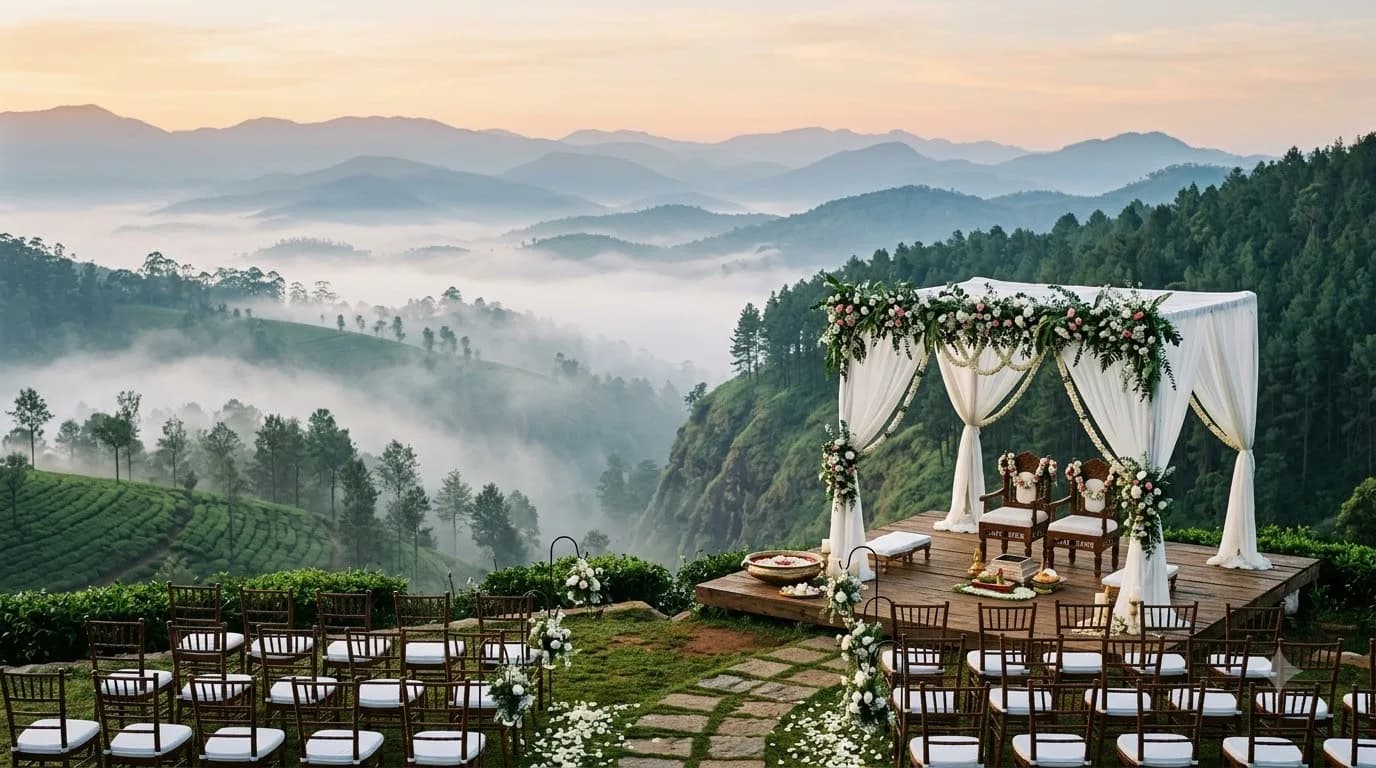
Best Season for South India Destination Weddings: Month-by-Month Western Ghats Guide
Still planning?
Get quotes from India's best vendors
Tell us what you're planning and we'll match you with verified photographers, venues, decorators, and more.
Get free quotes