
Bunt Wedding Traditions: Murthasese to Dhareyeruna Guide
A complete guide to Bunt wedding traditions: the Murthasese ritual bath, Dhareyeruna water ceremony, matriarchal customs, bridal attire and 2026 costs.

Coastal Karnataka Wedding Editor
Deepa Shetty is the coastal Karnataka wedding editor at itsmy.
On this page
A traditional Bunt wedding spans two days and more than ten distinct ceremonies, rooted in one of India's few matrilineal traditions. From the Murthasese, where five sumangalis adorn the bride, to the Dhareyeruna water-pouring that seals the union, nearly every ritual reflects a culture where women hold household authority along coastal Karnataka's Tulu-speaking belt.
Quick Answer
Quick answer: A traditional Bunt wedding spans two days and more than ten distinct ceremonies, rooted in one of India's few matrilineal traditions. From the Murthasese, where five sumangalis adorn the bride, to the Dhareyeruna water-pouring that seals the union, nearly every ritual reflects a culture where women hold household authority along coastal Karnataka's Tulu-speaking belt.
Note
Pricing methodology: Cost ranges in this guide are based on vendor pricing data from the itsmy.wedding marketplace and published industry reports, collected in Q4 2025 – Q1 2026. Gold prices are as listed on 29 November 2026.
Growing up in a Bunt family in Mangalore, I've watched the Murthasese turn our living room into a sacred space more times than I can count. The scent of jasmine mixed with turmeric, the Kombu horn piercing the morning air, my grandmother's generation running every ritual with absolute authority — these are not distant customs for me. They are the backdrop of my childhood, and they inform every word of this guide.
The Bunt community of coastal Karnataka carries forward a wedding tradition unlike anything else in South India. Most Hindu weddings in India are patriarchal in structure. Bunt ceremonies place women at the centre of nearly every ritual. This matriarchal thread runs from the engagement to the bride's send-off, and it makes a Bunt wedding instantly recognisable. For the full picture across the region's communities, start with our Mangalore wedding planning guide. This guide goes deep on Bunt-specific traditions.
The MangaloreHeritage.com documentation of Bunt wedding traditions is the most detailed ritual-by-ritual reference I have found, and I use it here wherever my family's practice needs a cross-check. The BuntsDaily overview of traditional rituals makes a point worth holding onto throughout: not every wedding includes every element, and practice varies by family and region.
Who Are the Bunts of Coastal Karnataka?
The Bunts are a Tulu-speaking Hindu community from Tulu Nadu: the Udupi and Dakshina Kannada districts of Karnataka and neighbouring Kasaragod in Kerala. Historically a warrior clan and later landholders and cultivators, they are among the most recognisable communities on this coast. Pernia's Pop-Up Shop's note on the Murthasese places the community across Udupi, Dakshina Kannada and Kasaragod, and records its other name, Nadava.
Migration has reshaped the community. DNA's profile of the Bunts describes how land reforms pushed many families to Mumbai, Bengaluru and the Gulf. It puts the worldwide population at about 10 lakh, with only around 4 lakh still in the coastal heartland. That spread is why so many Bunt weddings today involve relatives flying in from three or four cities.
Tulu itself is a South Dravidian language with a growing modern literature, though no early texts survive. The Government of Karnataka supports it through the Karnataka Tulu Sahitya Academy, which works on Tulu literature, script and folk culture. The ritual names in this guide — Murthasese, Dhareyeruna, Sese Padunu, Ponnu Vocchidu Korpunu — are Tulu. That is why they sound unfamiliar even to Kannada speakers from inland Karnataka.
Every Bunt belongs to a bari, a clan traced through the mother's line. Marriage within the same clan is not permitted, much as a shared gotra rules out a match elsewhere, according to The South First's account of Aliyasantana. A surname tells you little here. Shetty, Rai, Alva and Hegde are family names, not baris, so elders confirm both clans directly before a match goes any further.
Note
Daiva, Naga and the Family Calendar
Bunt religious life blends temple Hinduism with older Tulu worship of daivas (spirit deities) and the Naga (serpent). Bhuta Kola, the ritual performance in which a performer embodies a daiva, is the pride of Tulu Nadu for many families. PARI's reporting on kola performances quotes folklorist B.A. Viveka Rai: "The worshipers of bhutas were mainly land-owning communities like Bunts." Each family keeps its own hereditary set of daivas. ThePrint's excerpt from K. Hari Kumar's book Daiva explains why the old colonial label of "devil worship" misreads the tradition entirely.
Naga worship reaches the wedding itself. Bunts trace their lineage to the Nagavamsha, and the vadungila ring many brides wear is shaped like a cobra's raised hood. More on that in the attire section below.
Some Tulu families, Bunt households among them, also perform Kule Madime, a symbolic "marriage of spirits" for relatives who died unmarried. The South First reports that it is usually held in the Aati month, between July and August. Some families believe restless unmarried ancestors can cause hurdles for weddings in the household. If your elders raise it before your wedding, this is why.
Why Are Bunt Weddings Matriarchal?
Bunts traditionally followed Aliyasantana, a matrilineal system in which lineage and ancestral property passed through women. Only a handful of Indian communities have lived this way. This is not a ceremonial nod to women's participation. It is the foundational structure of the community, a system Deccan Herald summed up as one where the accent is on women.
Under Aliyasantana, a woman and her children, sons and daughters alike, held shares in the family's ancestral property. A man received a share too, but his wife and children had no claim on it. His heirs sat in his sister's line. The family was headed by the eldest man of the female line, the yejaman, alongside the eldest woman, the yejamanthi, as The South First explains. Udayavani's history of the system traces how this maternal line defined both family and inheritance across Tulu Nadu.
The historical roots run deep. The word "Bunt" is commonly glossed as "powerful man" or "warrior" in Tulu, and DNA describes the community as a former warrior clan. With men frequently away, women ran households, land and finances. Pernia's draws a straight line from that warrior past to why women of the bride's family lead so much of the ritual today.
This matriarchal authority is visible at every stage of a Bunt wedding. Women orchestrate the Murthasese from start to finish. The bride's mother and grandmother carry more ceremonial weight than the priest during several rituals. The Ponnu Vocchidu Korpunu, the bride's formal handover, happens between the women of both families, not the men. Even the garland exchange begins with the bride.
Note
The Nikshaya (Engagement)
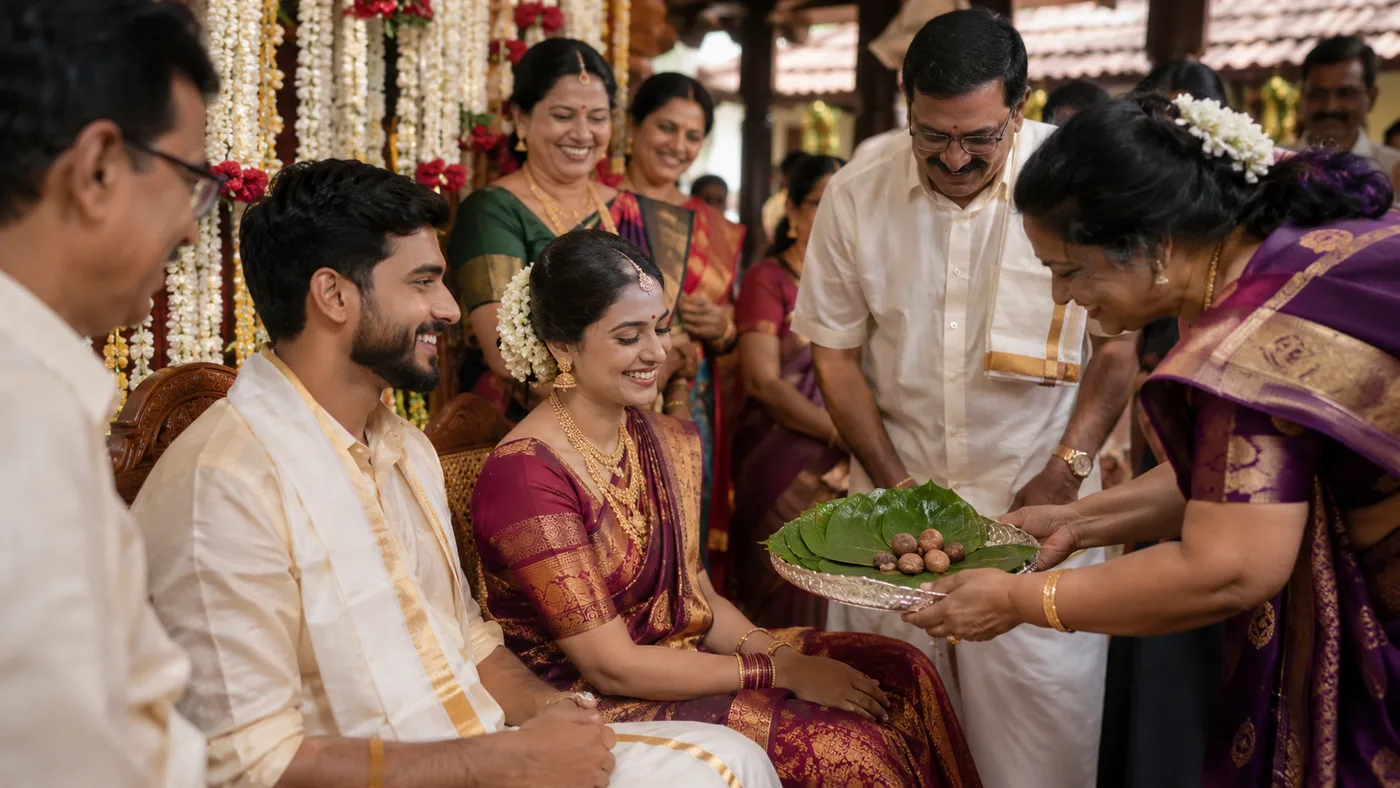
The Nikshaya is the formal Bunt engagement, when the men of the bride's family visit the groom's house to confirm the match. They carry a silver platter of betel leaves, areca nuts and flowers, and the wedding date is fixed. Unlike the elaborate engagement parties of many North Indian weddings, the Nikshaya is an intimate family affair focused on ritual rather than spectacle.
The groundwork is the Jataka kudunu, the exchange of horoscopes. Both families present their child's jataka, and an astrologer checks compatibility and fixes an auspicious date and time. Families take this seriously. In my experience, many consult more than one astrologer before confirming a match.
The exchange of betel leaves and areca nuts then seals the agreement. As MangaloreHeritage puts it, this exchange confirms the alliance, with the elders as witnesses. The areca nut (adike) is central to coastal Karnataka's cultural identity. It appears at births, deaths, festivals and every ceremony in between, so offering it signals commitment and good faith.
The Nikshaya usually happens weeks or months before the wedding. These days, many families in Mangalore and Udupi add a ring exchange to it, which makes it feel more like a conventional engagement while keeping the betel-and-areca core. The visit closes with a shared meal at the groom's home, and the two families begin planning together.
The Madarengee (Mehendi) Ceremony
The Madarengee is the Bunt mehendi ceremony, held separately at the bride's and groom's homes the day before the wedding. The bride's hands are decorated with henna, while the groom receives a single symbolic dot on his palm.
Traditionally, the bride's henna covered her palms and fingertips. Today most brides choose full bridal designs, with intricate floral and paisley patterns running over the backs of the hands and onto the feet. The groom's involvement stays deliberately minimal. One dot acknowledges the tradition without claiming equal space in a ceremony that centres the bride.
The Madarengee is one of the most relaxed gatherings of the wedding. Female relatives and friends surround the bride as the artist works, and the mood shifts between teasing, singing and emotional conversations about the life ahead. It is also a practical milestone. Plan it so the henna has time to dry before the Murthasese, when the sumangalis need the bride's hands for bangles.
₹5,000 – ₹25,000This covers a professional mehendi artist for the bride, the groom's symbolic dot and designs for close female relatives. Intricate full-arm bridal designs from top Mangalore artists push towards the higher end.
What Happens at the Ritual Bath and Murthasese?
The day before the wedding holds two intimate rituals. First, female elders bathe the bride with oil, turmeric and coconut milk; then, at the Murthasese, five sumangalis adorn her for marriage. Many families, mine included, speak of the whole sequence as the Murthasese day, but the bath and the adornment are distinct steps.
My grandmother always explained it this way: "We are bathing her as a daughter one last time, and then dressing her as Laxmi." That single sentence captures the arc of the day, from purification to deification.
The Ritual Bath
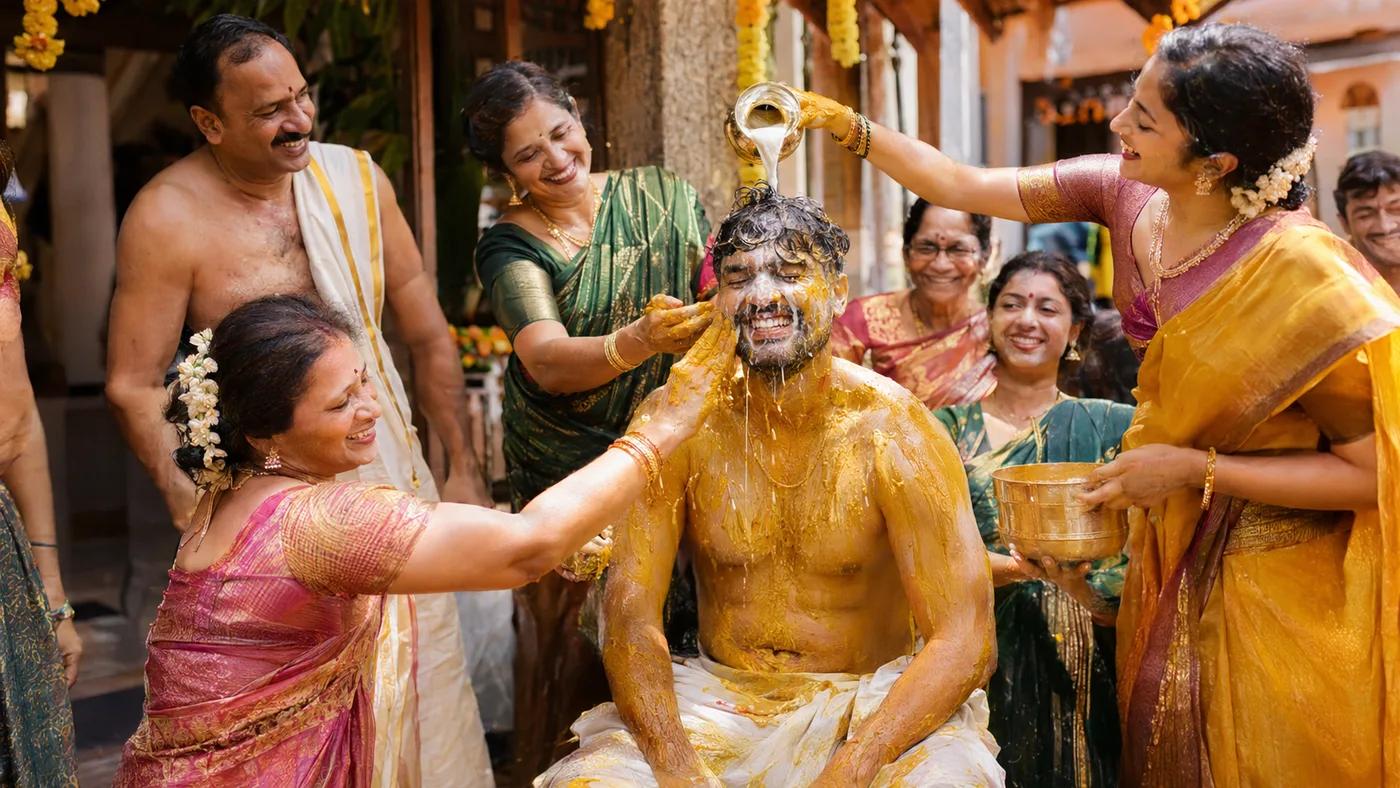
The bath is held separately at both homes. The bride sits in the main hall or a prepared corner of the family home. Female elders — her mother, grandmothers and aunts — take turns applying oil to her hair and body, followed by turmeric paste and coconut milk. Each application is a blessing. The turmeric also serves a practical purpose, giving the bride's skin a warm glow for the wedding day.
The groom goes through the same preparation at his home. According to MangaloreHeritage, he is then bathed and led by his sister's husband or a maternal cousin.
The Murthasese Adornment
The Murthasese takes place at the bride's home, and the guest list is tight: the bride's relatives and the groom's parents. The groom himself stays away. Pernia's notes that the bride's paternal aunt often oversees proceedings, and that the ritual opens with prayers at the tulsi plant.
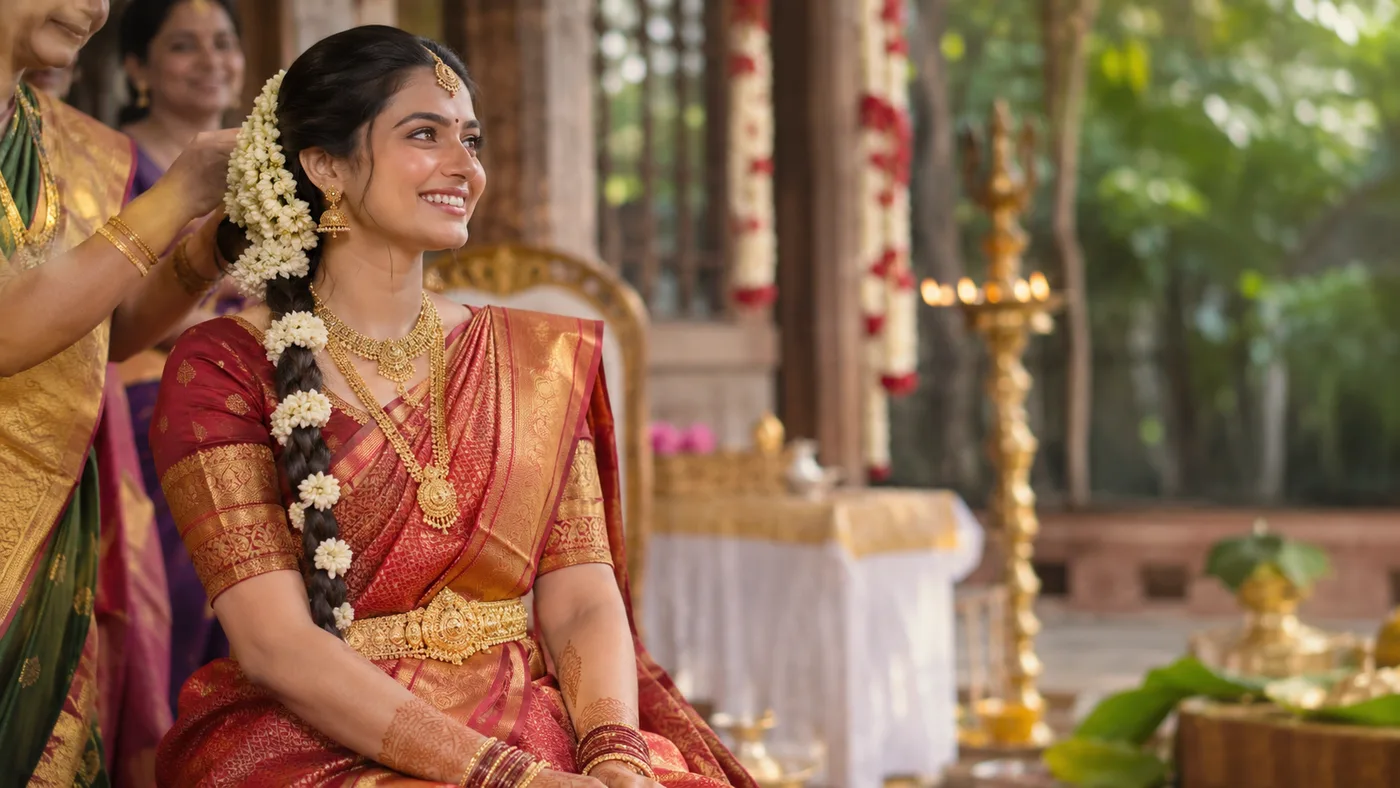
The bride sits facing east. MangaloreHeritage records the sequence. A female relative hands out red and green glass bangles. The eldest sumangali slips a toe ring onto the bride's second toe. Five sumangalis then slide red and green bangles onto her wrists, adding one black bangle to ward off drishti, the evil eye. Finally, every sumangali tucks jasmine into her hair.
Then the bride is dressed in her complete wedding attire, and the Murthasese turns from intimate to magnificent:
- Red or maroon Kancheevaram silk sari — the signature garment, rich with gold zari
- Mallige (Mangalore jasmine) plait — fresh jasmine woven through a long braid, filling the room with fragrance
- Gold patti — a broad gold waist belt cinched around the sari
- Gold vanki — an ornamental armlet worn on the upper arm
- Gold mundale — the Bunt version of a maang tikka, placed on the forehead
- Red and green glass bangles, plus one black bangle — placed by five sumangalis, married women whose husbands are living
- Toe ring — placed by the eldest sumangali
- Diamond studs with jhumkas — completing the jewellery ensemble
The five sumangalis hold particular significance. They are not chosen at random. Families pick them for the auspiciousness of their own marriages and the prosperity of their households. When five such women place bangles on the bride's wrists, it is a collective blessing — a transfer of their married good fortune to her.
After the bangles and toe ring, the sumangalis perform aarti for the bride. In my family, this is the moment she stops being simply a young woman preparing for her wedding. She is honoured as Laxmi, the goddess of prosperity, about to enter a new household.
The Groom's Murtha
The groom has his own, much smaller Murtha on the morning of the wedding. His maternal uncle's wife or his paternal aunt slips gold toe rings onto his feet, and he wears them through the ceremony.
Tip
Looking for Photographers in Mangalore?
Tell us what you need and get quotes from verified photographers
What Does the Bunt Bride Wear?
A Bunt bride is one of South India's most elaborately adorned. Her red Kancheevaram silk, gold patti waist belt, vanki armlet, mundale forehead ornament and jasmine-laden plait create a look that is distinctly coastal Karnataka. MangaloreHeritage lists the same core ensemble, down to the Mangalore jasmine in the plait.
The sari. Traditionally a red or deep maroon Kancheevaram silk with gold zari borders and pallu. Red is non-negotiable in traditional families because it symbolises fertility, prosperity and Laxmi. The quality of the silk is a matter of family pride. In my experience, many families buy from Kanchipuram itself or from Mangaluru silk houses they have trusted for generations.
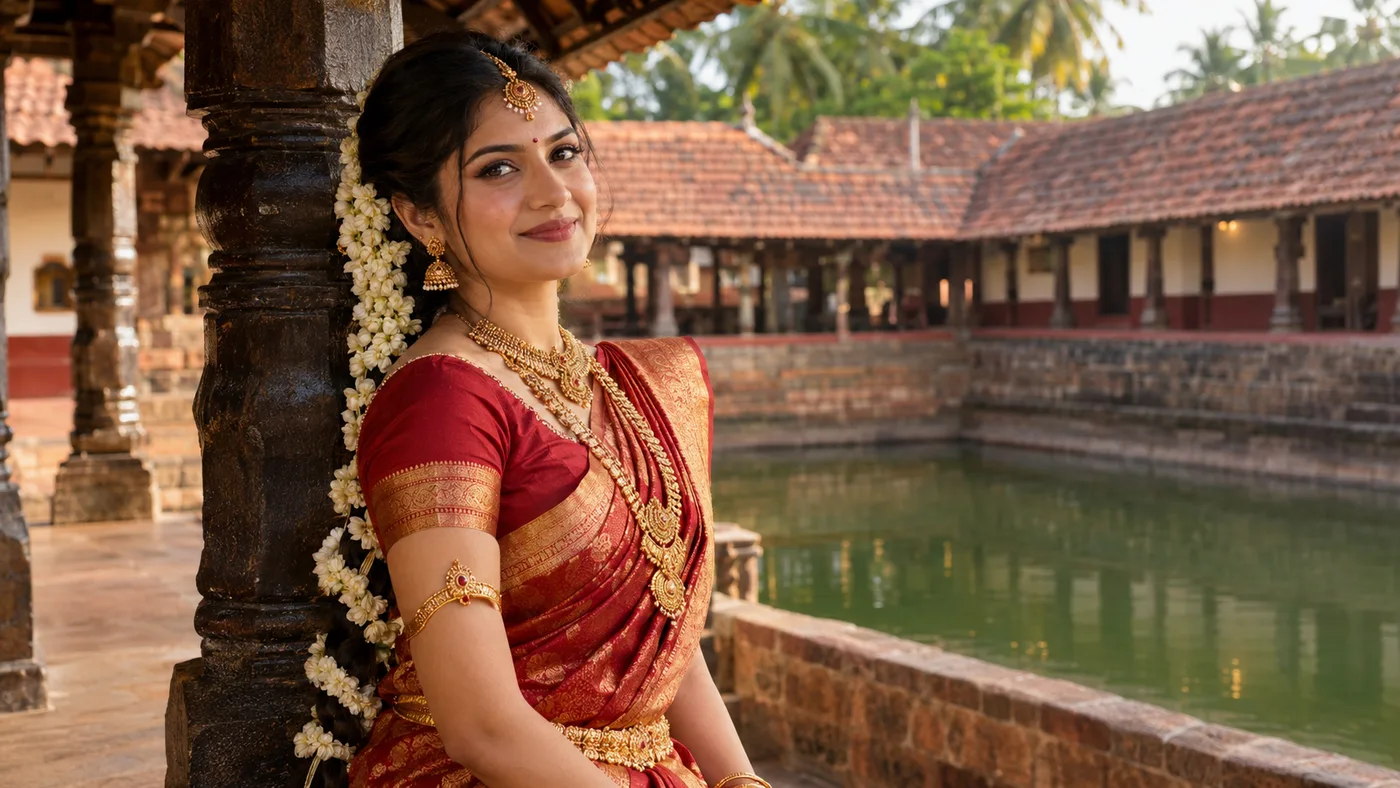
The jewellery. The gold patti is the most striking piece — a broad belt that cinches the sari at the waist and gives the bride a regal silhouette. The vanki sits on the upper arm, the mundale adorns the forehead, and diamond studs with jhumkas frame the face. The red and green bangles from the Murthasese stack on both wrists.
The piece most specific to the community is the vadungila, a V-shaped gold ring. The South First explains that it echoes a cobra's raised hood, a nod to the Bunts' Naga worship. It is believed to protect a new bride from unforeseen obstacles. Female relatives often present it along with its toe-ring counterpart, the kaarungila, and at the ceremony the groom slips the vadungila onto the bride's right ring finger.
The hair. A long plait studded with mallige is essential. The jasmine is not only decorative; in Tulu culture its fragrance is believed to invite auspiciousness into the wedding space. The coast takes its jasmine seriously. Udupi Mallige has been a registered Geographical Indication since 2007, with Karnataka's Department of Horticulture as the applicant.
Sari and bridal styling: ₹50,000 – ₹3,00,000
This covers the Kancheevaram sari (₹30,000–₹2,00,000), blouse, fresh jasmine and accessories.
New gold jewellery: ₹5,00,000 – ₹30,00,000
Gold is priced by weight, so this line swings more than any other. On 29 November 2026, Business Today listed 22-carat gold in Mangalore at ₹1,17,350 per 10 grams, before making charges and 3% GST. Put simply, every 10 grams of new jewellery adds roughly ₹1.2 lakh. Heirlooms change the picture completely. Fittingly for a matrilineal community, many Bunt families pass pattis, vankis and vadungilas down the female line.
Looking for Makeup Artists in Mangalore?
Tell us what you need and get quotes from verified makeup artists
What the Bunt Groom Wears
Traditionally, the Bunt groom wears a cream or white silk dhoti with a gold-bordered angavastram. Many modern grooms switch to a sherwani for the main ceremony. MangaloreHeritage notes the same shift: the dhoti is traditional, while modern Bunts wear sherwanis. The groom's attire stays deliberately understated next to the bride's, a reflection of the tradition that centres women in the ceremony.
In traditional families, the angavastram is draped over one shoulder. The groom adds a simple gold chain, a ring, the gold toe rings from his morning Murtha and, occasionally, a turban for the processional entry.
The modern compromise is a sherwani or bandhgala, usually ivory, cream or gold, for the main ceremony and photographs. Grooms then change into a dhoti for the Homa and Saptapadi. This hybrid has become the default for urban Bunt weddings in Mangalore and Bengaluru.
₹3,000 – ₹50,000A traditional silk dhoti set costs ₹3,000–₹8,000. A tailored designer sherwani runs ₹15,000–₹50,000.
How Is the Wedding Mantap (Stage) Set Up?
The Bunt mantap is dressed in areca nut bunches, mango leaves and jasmine. At its centre sit a silver chambu of holy water, a tall jasmine-garlanded lamp and a plate of haldi-kumkum rice. MangaloreHeritage describes each of these elements.
Each one carries meaning:
- Areca nut bunches and mango leaves — strung along the mantap frame to signal auspiciousness and prosperity; areca palms define the farmland of Dakshina Kannada
- Silver chambu — filled with holy water and topped with a coconut flower and a coconut, signifying the presence of Lord Ganapati, who is invoked before every Bunt ceremony
- Tall deepa (lamp) with jasmine — lit before any ritual begins and kept burning throughout
- Harivana of raw rice with haldi-kumkum — turmeric-and-vermilion rice used for blessings throughout the day
The family priest usually manages the setup in coordination with the decorator. North Indian mandaps tend towards heavy fabric draping. Bunt mantaps lean towards natural greenery, with coconut fronds, mango leaves and fresh flowers dominating the look.
₹50,000 – ₹2,50,000This covers mantap decoration for a mid-range to premium Bunt wedding in Mangalore. Community hall ceremonies sit at the lower end; hotel or resort mantaps at the upper end.
What Happens When the Groom and Bride Arrive?
Both arrivals are choreographed blessings, with feet-washing, aarti and a blast of the Kombu as each person takes their place on the stage. These entrances turn two family members into sacred figures entering the ceremonial space.
The groom arrives first. According to MangaloreHeritage, the bride's brother washes his feet, and the groom's brother-in-law leads him to the mantap.
Then comes the bride. Before she enters, her sister-in-law washes her feet with water, a gesture of welcome and purification. Her aunt and the other sumangalis step forward to perform aarti and apply haldi and kumkum to her forehead. Each blessing is deliberate and unhurried.
The Kombu, a long brass horn, sounds as each of them takes their place. Its deep, resonant tone cuts through the chatter and signals that the formal ceremony has begun. If you have never heard a Kombu played live at a Tulu wedding, the sound is startling — a single sustained note that vibrates in the chest.
The Bunt Wedding Gift Exchange
Once the bride is seated, the groom's family welcomes her with the Poov Sere, a ceremonial gift of flowers and a sari. Haldi-kumkum and jewellery come with it. In most families I know, the groom's mother leads this exchange rather than the groom or his father, once again reflecting the matriarchal structure.
The Poov Sere, literally "flower sari", is a carefully chosen silk sari presented on a decorated plate with fresh flowers. The groom's mother applies haldi-kumkum to the bride's forehead and presents jewellery, typically a gold chain or necklace. The exchange is a promise. She is accepting the bride as her daughter, not merely as her son's wife.
How Do the Seven Rounds and Garland Exchange Work?
The couple first walks around the stage seven times, then exchanges floral garlands — with the bride placing hers first. The order matters. MangaloreHeritage is explicit that "the girl goes first followed by the boy", a direct expression of the matriarchal tradition.
The couple walks side by side around the stage, not one behind the other. I have always read this as a quiet statement of equality within the marriage.
The garland exchange follows immediately. The bride lifts her garland and places it around the groom's neck, and then he garlands her. Guests shower the couple with flower petals and haldi-kumkum rice. Then the Kombu sounds once more, signalling that the Dhare is about to begin.
Note
What Is the Dhareyeruna (Water-Pouring) Ceremony?
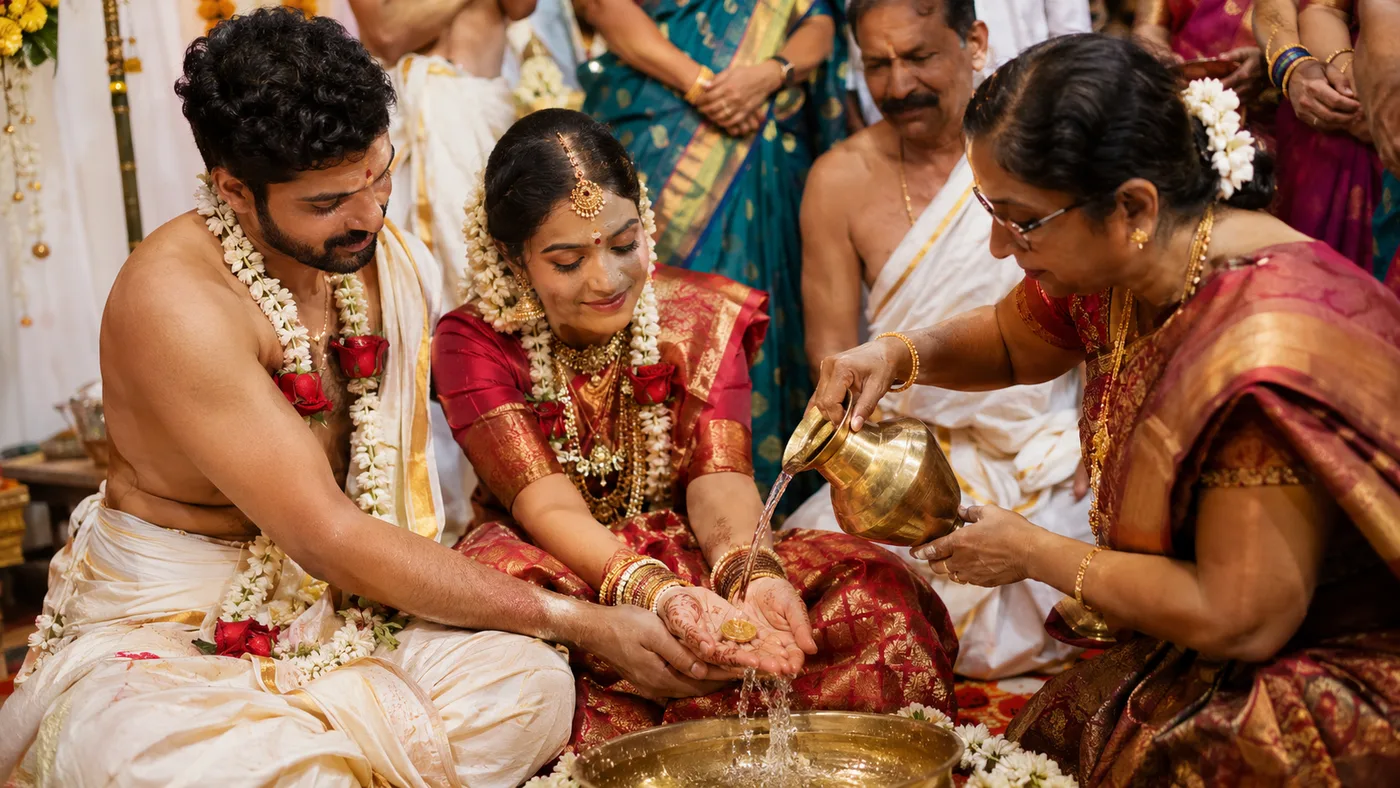
The Dhareyeruna is the moment that seals a Bunt marriage. The bride's parents pour water from a spouted brass vessel over the couple's joined hands, while an antique gold coin rests on the bride's palm. Once the water flows, the families consider the marriage binding.
Here are the mechanics. The nanya, a small antique gold coin that has often been in the family for generations, is placed on the bride's palm. The groom cups his hands beneath hers. The bride's parents then pour water from the Dareda chambu, whose long, narrow spout gives a thin, controlled stream. MangaloreHeritage notes that the pouring itself is called dhare. The water runs over the coin, through the couple's fingers and into a plate below. The priest chants, and the assembled family watches in silence.
Dhare is a wider Karnataka custom of giving the bride away with water, and Kannada weddings have their own Dhare ceremony. The Bunt version keeps its Tulu particulars: the spouted chambu, the heirloom nanya and blessings from elders in Tulu.
The Dhareyeruna is the most photographed moment at any Bunt wedding. Think of the thin stream catching light, the gold coin glinting in the bride's palm, the parents' faces as they pour. I have always read the flowing water as a fitting symbol for a coastal community that has lived beside the Arabian Sea for centuries.
Important
How Are the Mangalsutra and Rings Exchanged?
The groom ties the mangalsutra after five sumangalis have blessed it, and the couple then exchange rings. These are the same five women who adorned the bride at the Murthasese. That continuity reinforces the idea that the same women have guided the bride's transformation throughout.
MangaloreHeritage describes the mangalsutra as a gold chain with black beads; The South First notes that some Bunt brides wear a coral-beaded version. The five sumangalis hold it, touch it to their own mangalsutras to pass on their married good fortune, and hand it to the groom. He ties it with three knots while the priest chants.
The rings follow. The groom slips the vadungila onto the bride's right ring finger, and the bride places a plain gold ring on his. The visual drama of Bunt bridal jewellery lives elsewhere; the groom's ring stays simple.
The Chambu Sit-and-Rise
Next comes one of the most charming moments of the day. As MangaloreHeritage records, the couple holds a chambu together and sits down and rises three times in unison. Families explain it in different ways, but most read it as the couple learning to move as one. It takes barely a minute, and it usually draws smiles from the guests.
What Happens During the Homa (Sacred Fire)?
A Brahmin priest lights the sacred fire and leads the chants. The bride's brother then hands puffed rice to the couple, who offer it into the flames over three rounds. The Homa follows the pan-Hindu Vedic structure closely, though the Bunt version keeps its own details.
The fire is lit in a copper or brass kund at the centre of the mantap. The priest feeds it with ghee, camphor and dried herbs while chanting mantras from the Vedic marriage liturgy.
The bride's brother, typically the eldest, steps forward with puffed rice (laaja) and places it in the couple's hands. They offer it into the fire, and the offering is repeated three times as they go around the flames. The laaja homa marks the brother's role in sustaining his sister's new marriage. That gesture is especially poignant in a matrilineal community, where a brother's bond with his sister and her children carried such cultural weight.
How Does the Saptapadi (Seven Steps) Work?
The Saptapadi is the final formal ritual. The couple takes seven steps around the sacred fire, and at each step the bride tips over a heap of rice with her right foot. Each step carries a marital vow, and the rice she scatters symbolises the abundance she brings into the union.
Seven heaps of rice sit in a line near the fire. The groom takes the bride's hand, and together they walk, one step at a time. At each stop she extends her right foot and tips over the rice. The priest recites a vow with each step: nourishment, strength, prosperity, happiness, progeny, long life and friendship.
This is where the Bunt wedding aligns most closely with Hindu weddings everywhere. The earlier rituals carry distinctly Tulu and matrilineal flavours. The seven steps around the fire are the act that pan-Hindu tradition treats as completing the marriage.
What Post-Wedding Rituals Follow the Ceremony?
Sese Padunu (Blessing with Rice)
Immediately after the Saptapadi, guests line up to bless the couple. Each takes a handful of raw rice mixed with haldi-kumkum and showers it gently over the couple's heads, and the sumangalis perform a final aarti. Older relatives often add a few words of advice in Tulu. In a large family the queue can take half an hour. It is one of the most joyful moments of the day, as the solemnity of the fire gives way to laughter and embraces.
Neer Maipunu (Surya Darshan)
The couple then steps out of the hall — into a courtyard, onto a balcony or to the venue entrance — to pray to Surya, the Sun God. This ritual needs real sunlight, which is one reason Bunt weddings are daytime affairs. According to MangaloreHeritage, the bride's brother washes the groom's feet, and the groom rewards him with a gift. Back inside, the groom sips a little tender coconut water and hands the rest to his wife, a very coastal touch. The bride also receives a gold memento.
Ponnu Vocchidu Korpunu (Bride's Formal Handover)
My grandmother always says the Ponnu Vocchidu Korpunu was the most emotional moment of any wedding she attended. After witnessing it dozens of times, I agree. The bride's female relatives — her mother, grandmothers, aunts and sisters — formally present her to the groom's mother or a senior woman of his family. Sometimes they sing or offer words of praise. It is not a casual hand-off. The women of one family speak directly to the women of the other, entrusting their daughter to their care. MangaloreHeritage records the pledge that follows: the groom's side says they will accept her as their daughter, not as their daughter-in-law.
The emotional weight is immense. In a community where women are the custodians of family honour and welfare, one group of women entrusting a young woman to another carries a gravity beyond ceremony. Many families weep openly. The bride touches the feet of her elders, and the groom's mother embraces her. After the feast, the bride receives her parents' and elders' blessings and leaves for her husband's home at the auspicious time.
Important
What Is Served at the Bunt Wedding Feast?
The Bunt wedding feast is a traditional five-course vegetarian meal served on fresh banana leaves — a deliberate choice in a region famous for its fish and chicken. MangaloreHeritage confirms the five-course vegetarian format. Everyday Bunt food is anything but vegetarian; The Federal's guide to Mangaluru food traces kori rotti, the chicken curry with crisp rice wafers, to the Bunt kitchen. The ritual lunch stays vegetarian as a mark of the ceremony's sacred character.
A banana leaf is laid before each guest, and dishes arrive in sequence:
- Pickle, papad and salt — placed on the leaf first
- Vegetable dishes — typically four or five, featuring local ingredients like jackfruit, ash gourd, raw banana and drumstick, often alongside a kosambari (lentil salad)
- Sambar and rasam — the liquid courses, served with steamed rice
- Ghee rice — fragrant rice cooked with ghee and whole spices
- Payasa — a sweet finish, typically made with coconut milk or vermicelli
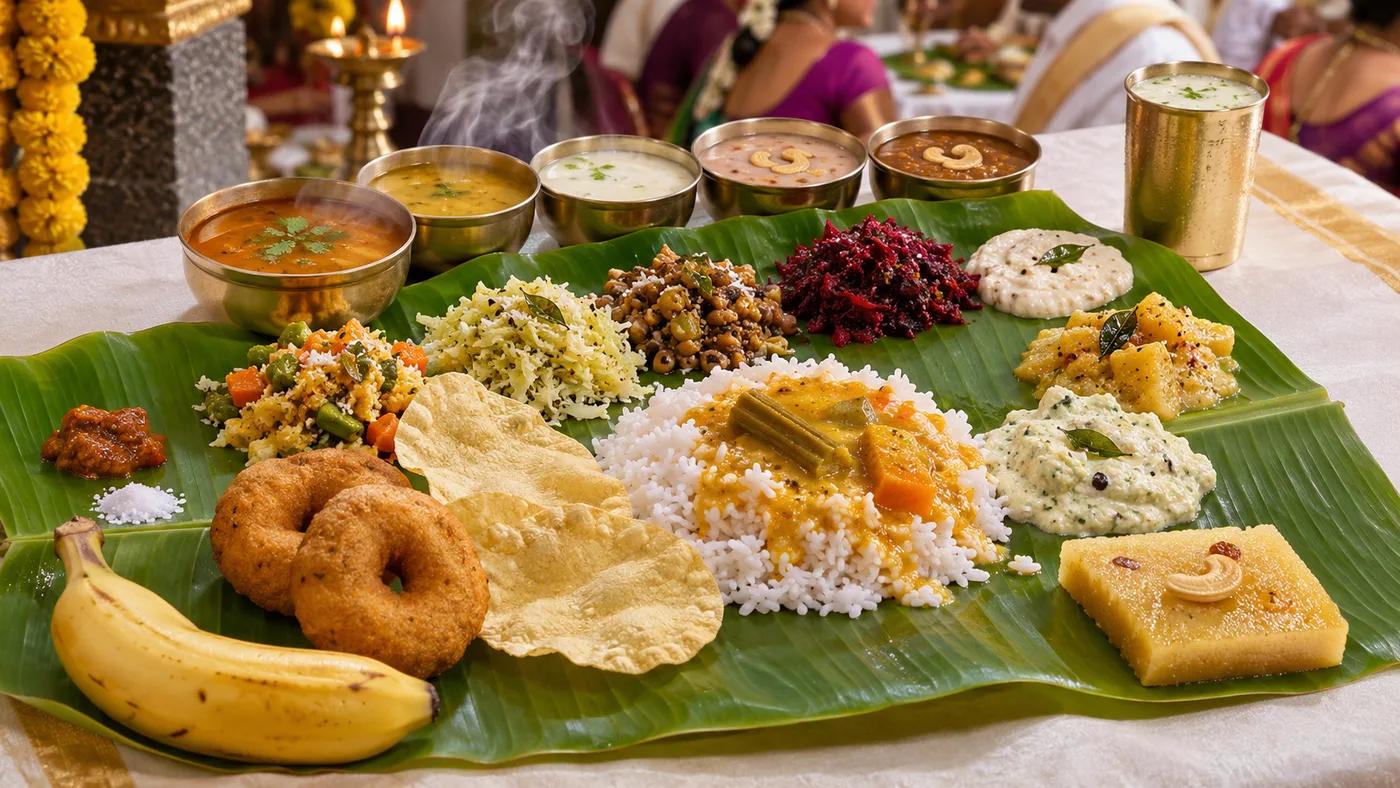
The feast is eaten by hand, seated in rows on the floor or at long tables. Servers move continuously along the rows, refilling leaves with each course. The hospitality is relentless; refusing a second serving is treated as a mild insult to the host family. For menu planning and caterer costs across the coast, see our Udupi wedding food guide.
₹350 – ₹1,250Per-plate cost for the vegetarian wedding feast in Mangalore. WedMeGood's Mangaluru banquet listings show vegetarian rates from about ₹300–₹500 a plate at budget halls and around ₹850 at the Gateway Hotel, with non-vegetarian menus reaching about ₹1,250, often before taxes. Community hall weddings with local caterers sit at the lower end; hotel-catered events with expanded menus push towards the upper end.
What Does the Complete Wedding Timeline Look Like?
Here is a ceremony-by-ceremony template for a traditional two-day Bunt wedding. The Nikshaya happens weeks or months earlier, and your actual times will follow the muhurta your priest fixes.
Day 1 — The Day Before the Wedding
| Time | Ceremony | Duration | Key Participants |
|---|---|---|---|
| 8:00 AM | Ritual bath (at both homes) | 1–1.5 hours | Bride and female elders; groom with his sister's husband or a maternal cousin |
| 3:00 PM | Madarengee (mehendi, at both homes) | 2–3 hours | Bride, female relatives, mehendi artist |
| 6:30 PM | Murthasese (bride's home) | 1.5–2 hours | Bride, female relatives, 5 sumangalis, groom's parents |
Day 2 — The Wedding Day
| Time | Ceremony | Duration | Key Participants |
|---|---|---|---|
| 6:30 AM | Groom's Murtha (toe rings) | 20 min | Groom, maternal uncle's wife or paternal aunt |
| 7:00 AM | Mantap setup complete | — | Decorator, priest |
| 9:00 AM | Groom's and bride's entrances | 30 min | Bride's brother, sister-in-law, sumangalis, Kombu player |
| 9:30 AM | Poov Sere gift exchange | 20 min | Groom's family, bride |
| 10:00 AM | Seven rounds and garland exchange | 30 min | Couple, Kombu player |
| 10:30 AM | Dhareyeruna (water pouring) | 20 min | Couple, bride's parents, priest |
| 10:50 AM | Mangalsutra, rings and chambu sit-and-rise | 25 min | Couple, 5 sumangalis, priest |
| 11:15 AM | Homa (sacred fire) | 45 min | Couple, priest, bride's brother |
| 12:00 PM | Saptapadi (seven steps) | 30 min | Couple, priest |
| 12:30 PM | Sese Padunu (rice blessings) | 30 min | All guests |
| 1:00 PM | Neer Maipunu (Surya Darshan) | 15 min | Couple, bride's brother |
| 1:15 PM | Ponnu Vocchidu Korpunu (handover) | 30–45 min | Women of both families |
| 2:00 PM | Wedding feast | 1–1.5 hours | All guests |
| 3:30 PM | Bride leaves for the groom's home | — | Couple, both families |
Tip
How Modern Bunt Weddings Are Changing
The core structure of a Bunt wedding has stayed remarkably stable, but several elements are evolving as urban families in Mangalore, Bengaluru and Mumbai adapt traditions to contemporary life.
What is staying. The Murthasese, Dhareyeruna and Ponnu Vocchidu Korpunu are non-negotiable for the vast majority of families. These three ceremonies carry too much matriarchal identity to be shortened or skipped. The five sumangalis, the Kombu and the banana-leaf feast also remain firmly in place. Migration has scattered the community, as DNA's reporting shows. Even so, many families I know who have lived in Bengaluru or Mumbai for decades come home to Mangaluru for these rituals.
What is changing. Several shifts are visible:
- Venue shift — community halls and family homes are giving way to hotel banquet halls and resorts, particularly for Bengaluru-based families
- Groom's attire — sherwanis and bandhgalas are replacing the dhoti for the main ceremony, with the dhoti kept for the Homa
- Engagement rings — a ring exchange is now commonly added to the Nikshaya
- Evening receptions — many families add a separate evening reception with a DJ and non-vegetarian food, distinct from the daytime ceremony
- Compressed timelines — two-day ceremonies are sometimes squeezed into one, with the bath and Murthasese early in the morning and the wedding by noon
- Destination formats — some families host at Goa or Kerala beach resorts and fly in a Mangalore priest to conduct every ritual in traditional form
- Photography investment — pre-wedding shoots at Mangalore's beaches, temples and heritage sites have become standard, with couples spending ₹25,000 – ₹1,00,000 on them
What should not change (but sometimes does). The most common compromise I see — and the one that draws the most pushback from elders — is cutting the number of sumangalis below five, or choosing them for convenience rather than auspiciousness. The five sumangalis are not decorative participants. The Murthasese tradition requires them, and reducing their number undermines the ceremony's integrity.
For couples balancing tradition and modernity, the Mangalore wedding planning guide offers practical vendor advice across budget levels. The Kannada wedding traditions overview shows how other Karnataka communities are handling similar tensions.
How Much Does a Bunt Wedding Cost in 2026?
A complete two-day Bunt wedding in Mangalore for 400–600 guests typically costs between six and twenty-two lakh rupees before any new gold. A new bridal gold set can lift the total to roughly ₹11–50 lakh:
- Venue (2 days, community hall or banquet): ₹1,00,000 – ₹4,00,000
- Venue (2 days, hotel or resort, if you upgrade): ₹5,00,000 – ₹15,00,000
- Catering (feast plus pre-wedding meals): ₹2,00,000 – ₹8,00,000
- Bride's sari and styling: ₹50,000 – ₹3,00,000
- New bridal gold (optional with heirlooms): ₹5,00,000 – ₹30,00,000
- Mantap decoration: ₹50,000 – ₹3,00,000
- Photography and videography (2-day): ₹75,000 – ₹3,00,000
- Priest and Kombu player: ₹10,000 – ₹30,000
- Mehendi artist: ₹5,000 – ₹25,000
- Invitations and logistics: ₹30,000 – ₹1,00,000
The bride's family traditionally bears the wedding expenses, according to MangaloreHeritage, though many couples now split costs. Bengaluru-based families hosting in Mangalore should budget an extra 10–15% for travel, accommodation and coordination. In our experience, families hosting in Bengaluru pay a 30–40% premium on venue and catering but save on logistics. For a line-by-line breakdown, see our Mangalore wedding cost guide, and compare halls in our guides to wedding venues in Mangalore and Udupi.
Tip
Looking for Venues in Mangalore?
Tell us what you need and get quotes from verified venues
Common Questions About Bunt Wedding Traditions
Can Bunt wedding rituals be performed outside Mangalore?
Yes. Families in Bengaluru, Mumbai, the Gulf and further afield hold complete Bunt ceremonies regularly. The usual approach is to bring a Mangaluru priest who knows the Tulu sequence. Families also carry the ritual items from home: the spouted Dareda chambu, the nanya coin, jasmine and puja materials. The harder task is people. You need five sumangalis from the family, plus elders who know the Murthasese order. Ask relatives to commit early, because their presence matters more than the venue.
What does the Kombu do during the ceremony?
The Kombu is a long brass horn that works as the ceremony's announcer. It sounds as the groom and the bride each take their place on the stage, and again just before the Dhare. Guests at the back of a crowded hall use those blasts to follow what is happening at the mantap. Book the player through your priest, who will cue him. In Mangalore, the priest and Kombu player together usually cost ₹10,000 to ₹30,000.
Why is the ritual lunch vegetarian when Bunts eat meat and fish?
Everyday Bunt food is far from vegetarian. Kori rotti, chicken ghee roast and fish curries are part of the community's food identity. The wedding lunch is different because it belongs to the ritual, and ritual food is traditionally kept vegetarian. That is why the banana-leaf meal skips meat even at families famous for their non-vegetarian cooking. Couples who want chicken or fish on the menu usually serve it at a separate evening reception.
How do I find a priest who knows Bunt rituals?
Start with family. Relatives who hosted a Bunt wedding recently will know which priests handle the Tulu sequence well. The community body in Mangaluru, the Bunts Yane Nadavara Mathru Sangha, founded in 1908, is another useful contact. Check that the priest knows the Murthasese, Dhare and chambu steps, not just a generic Vedic format. Mangaluru priests travel for out-of-town weddings, typically for ₹10,000 to ₹30,000 including travel. Book four to six months ahead for peak muhurthams.
Why does the nanya coin matter so much?
The nanya is the small antique gold coin placed on the bride's palm during the Dhare. Its value lies in its history rather than its weight. Many families bring out a coin that has already sealed earlier marriages in the family, so the water flowing over it links the couple to those unions. If your family has no heirloom coin, a Mangaluru jeweller can source an old gold coin. Keep it safely afterwards for the next family wedding.
Is the Saptapadi part of a Bunt wedding?
Yes. After the Homa, the couple takes seven steps around the sacred fire. Seven small heaps of rice sit beside the fire, and at each step the bride tips one over with her right foot while the priest recites a vow. This part of the ceremony looks much like other Hindu weddings. The distinctly Bunt rites, such as the Murthasese, the Dhare and the chambu sit-and-rise, come earlier in the day.
Can two Bunts from the same bari marry?
Traditionally, no. A bari is a clan traced through the mother, and people from the same bari count as kin, much like a shared gotra elsewhere. Elders confirm both baris when the match is first discussed, well before the Nikshaya. A surname such as Shetty, Rai or Hegde does not reveal the bari, so families ask directly. Because the bari follows the mother, a bride keeps hers after marriage, and her children inherit it.
A Bunt wedding is more than a marriage ceremony — it is a matriarchal declaration. Every ritual tells the same story, from the Murthasese where women dress the bride as Laxmi to the Ponnu Vocchidu Korpunu where women entrust her to a new family. In this community, women are the custodians of tradition, the architects of ceremony and the spiritual centre of the household. Whether your celebration unfolds in a Mangalore community hall, a Bengaluru hotel ballroom or a Goa beach resort, these rituals carry centuries of coastal Karnataka heritage. For the full regional picture, start with our Mangalore wedding planning guide and the Udupi wedding planning guide, and explore related traditions in the Mangalorean Catholic and Kannada wedding guides.
Tip
Start planning your wedding — generate a personalised checklist with our AI Wedding Checklist, estimate your budget with the Cost Calculator, or make your own wedding website.
Topics
bunt wedding traditionsbunt wedding ritualsmurthasese ceremonytulu wedding customsmangalore bunt weddingdhareyeruna ritualcoastal karnataka weddingExplore more
Frequently Asked Questions
1What is the Murthasese ceremony in a Bunt wedding?
2What is Dhareyeruna in a Bunt wedding?
3How many days does a Bunt wedding last?
4Why are Bunt weddings matriarchal?
5What does a Bunt bride wear?
6What is served at a Bunt wedding feast?
7What is the Ponnu Vocchidu Korpunu ceremony?
8How much does a Bunt wedding cost in 2026?
Continue reading
Related Articles
How to Plan a Mangalore Wedding: Complete 2026 Guide
Konkani GSB Wedding Rituals: Naandi to Saptapadi Guide
Mangalorean Catholic Wedding: Roce, Sado & Baila Traditions
Assam Destination Wedding: Kaziranga, Majuli & Guwahati
Best Time for a Northeast India Wedding: Month by Month
14 Best Wedding Venues in Northeast India (2026)
Still planning?
Get quotes from India's best vendors
Tell us what you're planning and we'll match you with verified photographers, venues, decorators, and more.
Get free quotes