
Mangalorean Catholic Wedding: Roce, Sado & Baila Traditions
Mangalorean Catholic wedding traditions across 3 days: the Roce coconut milk ceremony, Sado saree, Karyamani necklace, Voyo songs and the Baila reception.

Coastal Karnataka Wedding Editor
Deepa Shetty is the coastal Karnataka wedding editor at itsmy.
On this page
A Mangalorean Catholic wedding unfolds across about three days, blending Catholic sacraments with deep-rooted Konkani customs. The Roce coconut-milk ceremony, the bride's change from white gown to red Sado, the Karyamani tying and a Baila-fuelled reception make it one of India's most culturally layered celebrations. Expect 300–600 guests, a ₹10–30 lakh budget and a dance floor that never empties.
Quick Answer
Quick answer: A Mangalorean Catholic wedding runs about three days: the Roce on the eve, the church service and reception on the wedding day, and often a day-after feast. The bride changes from a white gown into a red Sado at the reception, the groom ties the Karyamani, and a Baila band takes over. Budget ₹10–30 lakh for 300–600 guests.
Note
Pricing methodology: Cost ranges combine itsmy.wedding marketplace data from Q4 2025 – Q1 2026 with venue and menu rates listed on WedMeGood, rechecked in November 2026.
The first time I attended a Mangalorean Catholic wedding, as a teenager, the Baila had me dancing before I understood the Konkani lyrics. My friend's cousin was marrying at a parish church near Hampankatta. By the time the reception hit full swing, I realised I was seeing something new. It felt like a Western cocktail party and a deeply Indian family gathering at once, and neither identity gave an inch.
Mangalorean Catholic weddings are unlike anything else in South India. The community, Konkani-speaking Catholics of the Dakshina Kannada and Udupi coast, has kept a tradition where Catholic liturgy and older Konkani customs sit side by side. Wikipedia's overview of the culture lists Indian customs such as the Sado wedding sari and the Pirduk wedding necklace alongside the church rites.
For couples planning in the region, our Mangalore wedding planning guide covers the full multi-community picture. This post focuses on the Catholic tradition: every ceremony, every dish and every dance.
Who Are the Mangalorean Catholics?
The Mangalorean Catholics are a Konkani-speaking Catholic community whose ancestors migrated south from Goa between the 16th and 18th centuries. War, famine and the pressures of the Goa Inquisition pushed many Konkani families down the coast. There, under the Keladi Nayaka rulers, they built parishes and a distinct identity that fused Catholic faith with Konkani tradition.
What they preserved is remarkable. Despite centuries of Catholic practice, the community kept older Konkani customs: coconut in ritual, the folk-song tradition, the wedding feast structure and close kinship networks. Surnames such as D'Souza, Pinto and Fernandes sound Portuguese. Even so, the wedding customs are rooted in Indian soil.
The community is sizeable. The Diocese of Mangalore alone counted about 2.55 lakh Catholics across 123 parishes at the end of 2022, and Udupi has its own diocese. Large branches also live in Bangalore, Mumbai and the Gulf. Their Konkani is distinct from Goan Konkani, their cuisine is one of India's great regional food traditions, and their wedding is a multi-day event no guest forgets.
Note
What Happens at the Roce Ceremony?
The Roce is the emotional centrepiece of a Mangalorean Catholic wedding: close family anoint the bride and groom with coconut milk and oil while women sing Voyo folk songs. Ros is the Konkani word for coconut milk. Every wedding in the community includes it, and MangaluruOnline's guide to the tradition treats it as the key pre-wedding rite.
My Catholic friends tell me the Roce is the one ceremony that makes everyone cry: parents, grandparents, siblings and the couple themselves. It is raw, unscripted emotion in a way the formal church service rarely matches.
The Roce is held separately for the bride and the groom, usually on the eve of the wedding at each family's home. It typically unfolds like this:
- The bride or groom sits on a low wooden stool in the courtyard or main hall
- The yejman, the master of ceremonies, opens with a prayer and the first blessing
- Parents come next, and the mother's blessing is usually the most emotional moment
- Grandparents, godparents, uncles and aunts follow in order of seniority
- Each person applies coconut milk mixed with oil to the head, arms and face
- Many families trace a cross on the forehead, joining Konkani custom with Catholic devotion
The Roce can also open with a formal blessing. The Archdiocese of Bombay's Commission for Liturgy Roce template has a priest bless the coconut milk and oil. If no priest is present, an elder adds a few drops of holy water instead. Family representatives then apply the blessed oil to the forehead with the sign of the cross.
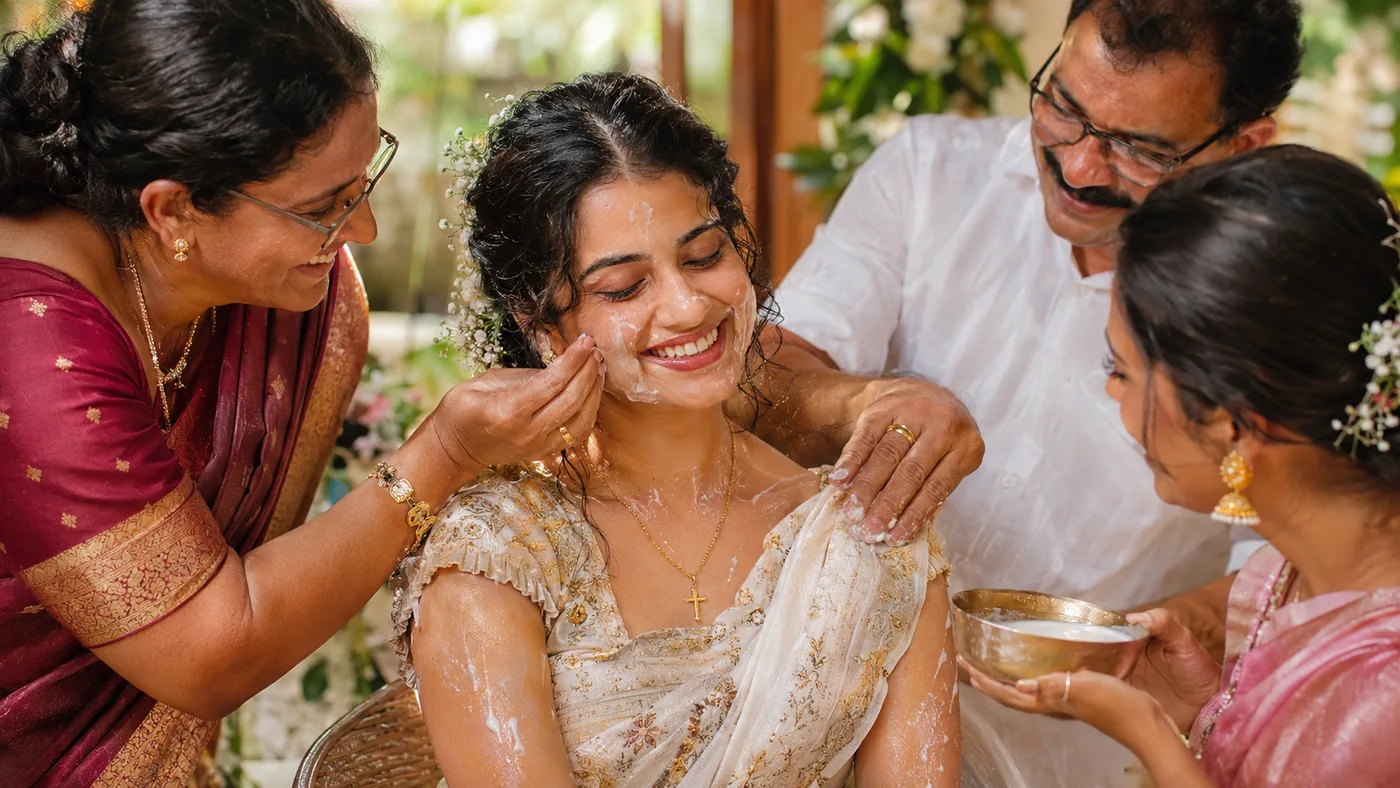
Afterwards, the couple bathe, and many families serve ros curry, a coconut-milk fish curry linked to the ceremony. Throughout, the women sing their Voyos, and the mood shifts from reverent to raucous.
Tip
What Are Voyo Songs and When Are They Sung?
Voyos (voviyos) are Konkani folk verses sung by women during the Roce and other wedding rituals, mixing blessings with gentle teasing of the couple and their families. According to Wikipedia's account of the tradition, an elderly woman, usually the yejmani (wife of the master of ceremonies), leads each verse while the others sing along. Traditionally, only women whose husbands are living may sing.
Each Voyo is just a few lines long. Older verses invoke God's blessing on the couple and their families. Others tease the groom, the bride or the in-laws with affectionate wit. CookLikeCecilia's account of Mangalorean marriage customs notes that the women also sing as they dress the bride in her Sado at the reception.
What makes Voyos special is how they thread through the wedding. They are not confined to one moment. You will hear them at the Roce, during the preparations and again at the reception. In my experience, the best Voyo singers are the most sought-after guests at any Catholic wedding in Mangaluru.
The Engagement and Ring Ceremony
The engagement is a ring-exchange ceremony held weeks or months before the wedding, now a standalone social event for most families. In earlier generations, elders handled the betrothal with little ceremony. Today, however, it has grown into a celebration of its own.
The ring exchange usually takes place at a family home, a restaurant or a parish hall. Both families gather, the couple exchange rings, and the event formally announces the wedding. Some families add a short prayer service led by the parish priest. The engagement carries less cultural weight than the Roce or the church service. Even so, it has become an important occasion, particularly for Mangalorean Catholic families in Bangalore, where it often doubles as the city event before the Mangaluru wedding.
What Happens During the Church Ceremony?
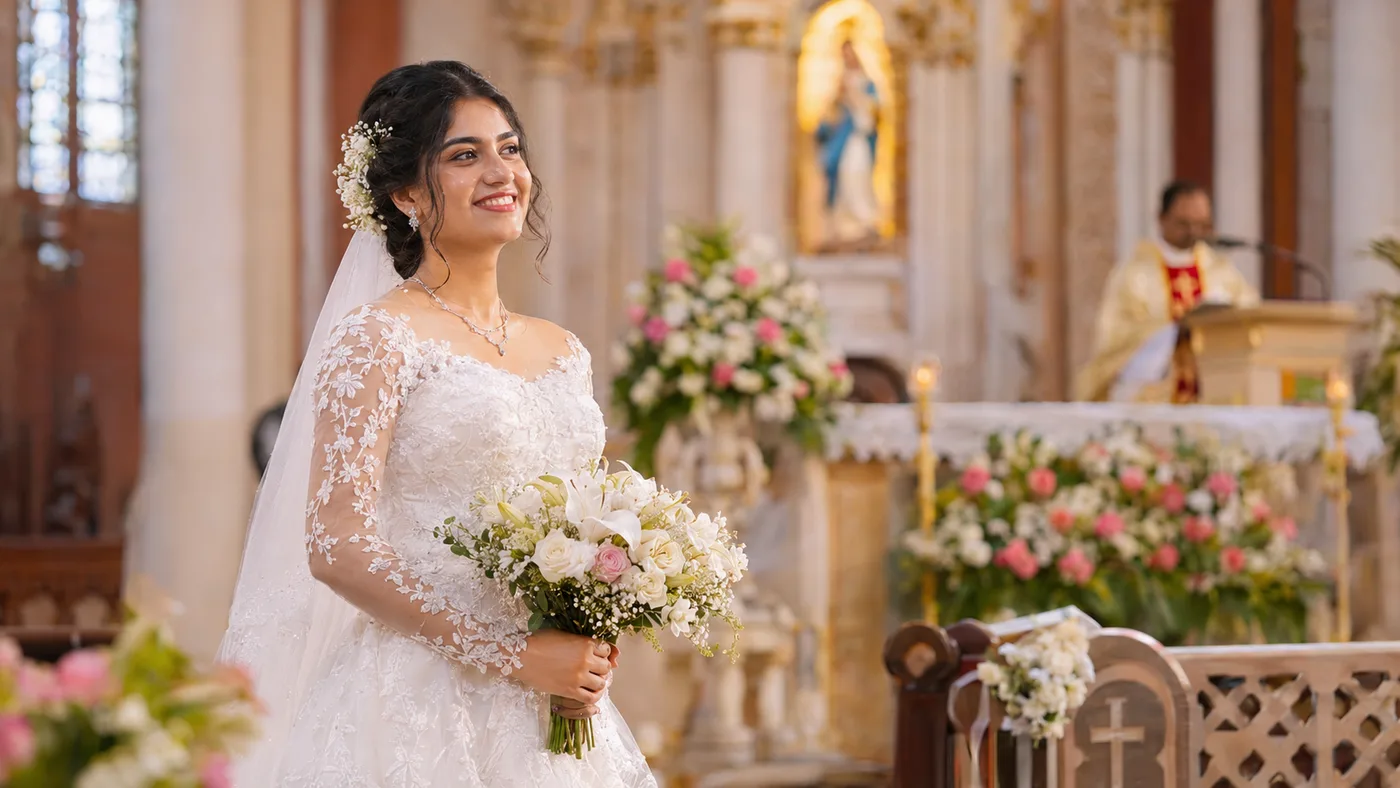
The church ceremony follows the Catholic marriage rite, usually within a Nuptial Mass, with vows, rings and the nuptial blessing led by the parish priest. Mangalore On My Mind's first-hand account notes that the church rites resemble those followed in Portugal, reflecting the community's history.
Before leaving for church, there is a quiet, powerful moment at home. The bride kneels before the family altar, and her parents make the sign of the cross on her forehead. That private blessing sets the emotional tone for the day.
The bride walks down the aisle in a white gown, or sometimes a white sari, and the groom waits in a formal suit. The priest leads the couple through their vows, the exchange of rings and the nuptial blessing. A full Nuptial Mass, with readings, a homily and communion, runs roughly 60–90 minutes. Without the Mass, the rite is shorter.
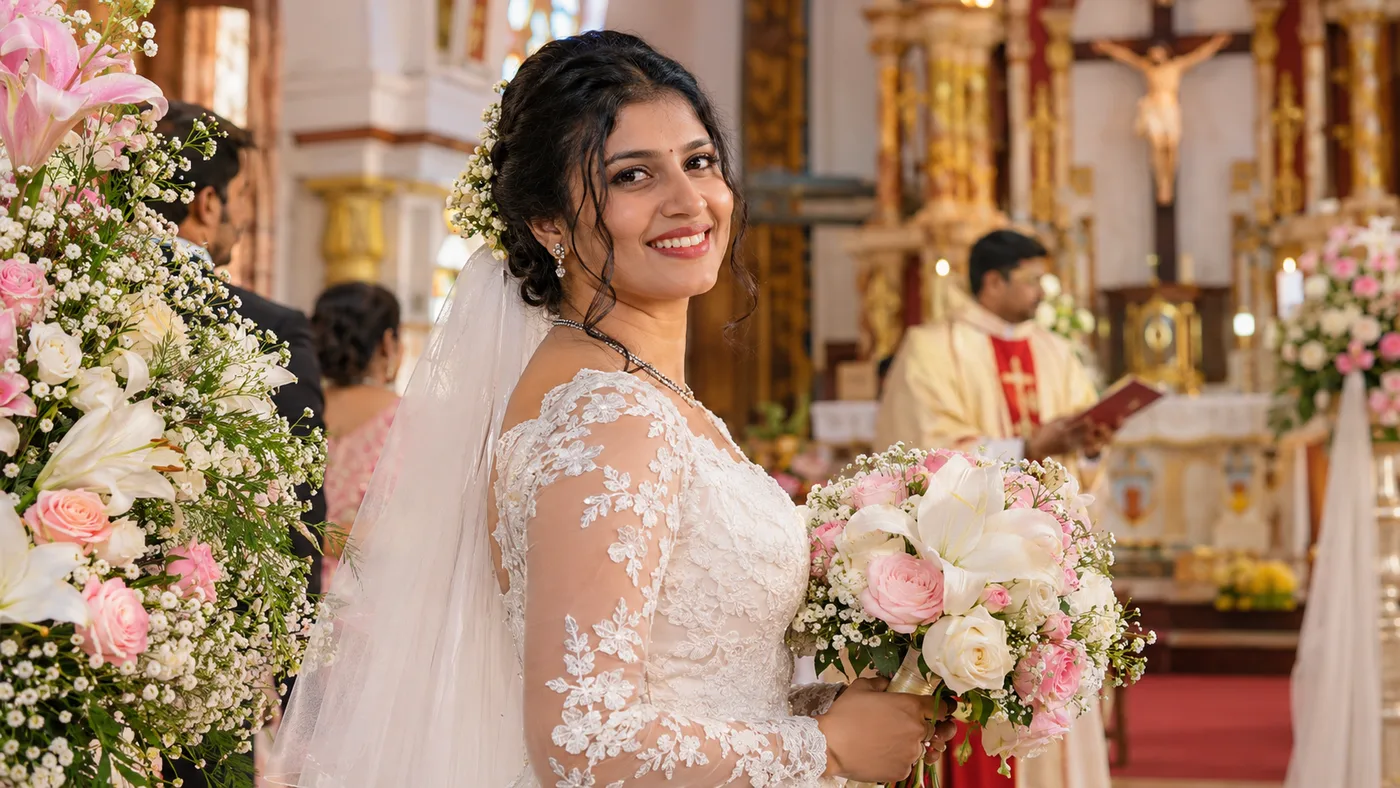
Historic churches are popular. The Rosario Cathedral in Bolar and Milagres Church near the city centre host many weddings each season, and Milagres also runs its own hall complex for receptions. For Christian weddings in the state capital, see our Christian wedding in Bangalore guide.
Parish fees: ₹10,000 – ₹30,000
This typically covers the church donation, choir and organist. Before the date is confirmed, the Diocese of Mangalore asks engaged couples to attend its marriage preparation course at the Family Life Service Centre in Bajjodi. A News Karnataka report on the 2027 schedule describes it as a mandatory formation programme held as full-day sessions on set dates.
Important
How Does the Bride Transform from White Gown to Red Sado?
At the reception, the bride leaves briefly and returns in the Sado, a red Benarasi silk sari, in place of her white church gown. This is far more than a costume change. The white gown honours the Catholic faith, while the red Sado honours Konkani heritage.
Wikipedia describes the Sado as usually a red Benaresi sari of finely woven silk. The bride's hair is dressed with white jasmine and orange abolim (crossandra) flowers, and her jewellery shifts from Western pieces to traditional gold. Close women relatives take her to a side room to dress her, singing as they work.
When the bride re-enters in her Sado, the room changes. Music swells, guests stand, and the evening moves from Western formality to Indian celebration. This dual identity, a Western ceremony and an Indian reception, is the hallmark of a Mangalorean Catholic wedding.
The Karyamani Necklace Tying
After the Sado change, the groom ties the Karyamani, also called the pirduk, around the bride's neck. It is a necklace of black and gold beads. Like a mangalsutra in Hindu weddings, it is the visible sign of a married woman. Traditionally, the mother-in-law or a senior female relative tied it. Today, most families have the groom do it in front of the assembled guests.
Traditional goldsmiths around Hampankatta and Car Street make Karyamani necklaces, and many families commission designs that reuse heirloom gold.
Attire budget: ₹25,000 – ₹1,50,000
This covers the Sado (₹15,000–80,000 for good Benarasi silk), the Karyamani and makeup for both looks. New gold beyond the Karyamani is extra.
What Is Baila Music and Why Does It Define the Reception?
Baila is a fast, percussive dance-music style with Portuguese-era rhythms, and it is the signature sound of a Mangalorean Catholic reception. The moment the band strikes up a Baila number, every generation hits the floor. Stiff-backed uncles, grandmothers and teenagers all join in.
The reception usually features a live band, often a long-running Mangaluru ensemble. Its repertoire spans Baila, classic rock, pop, Bollywood and Konkani ballads. Wedding bands are a point of local pride, and good ones book out early.
And yes, there is almost always a bar. Mangalorean Catholic receptions are known for generous hospitality. Baila, brass-led music and a well-stocked bar create an energy few Indian receptions can match.
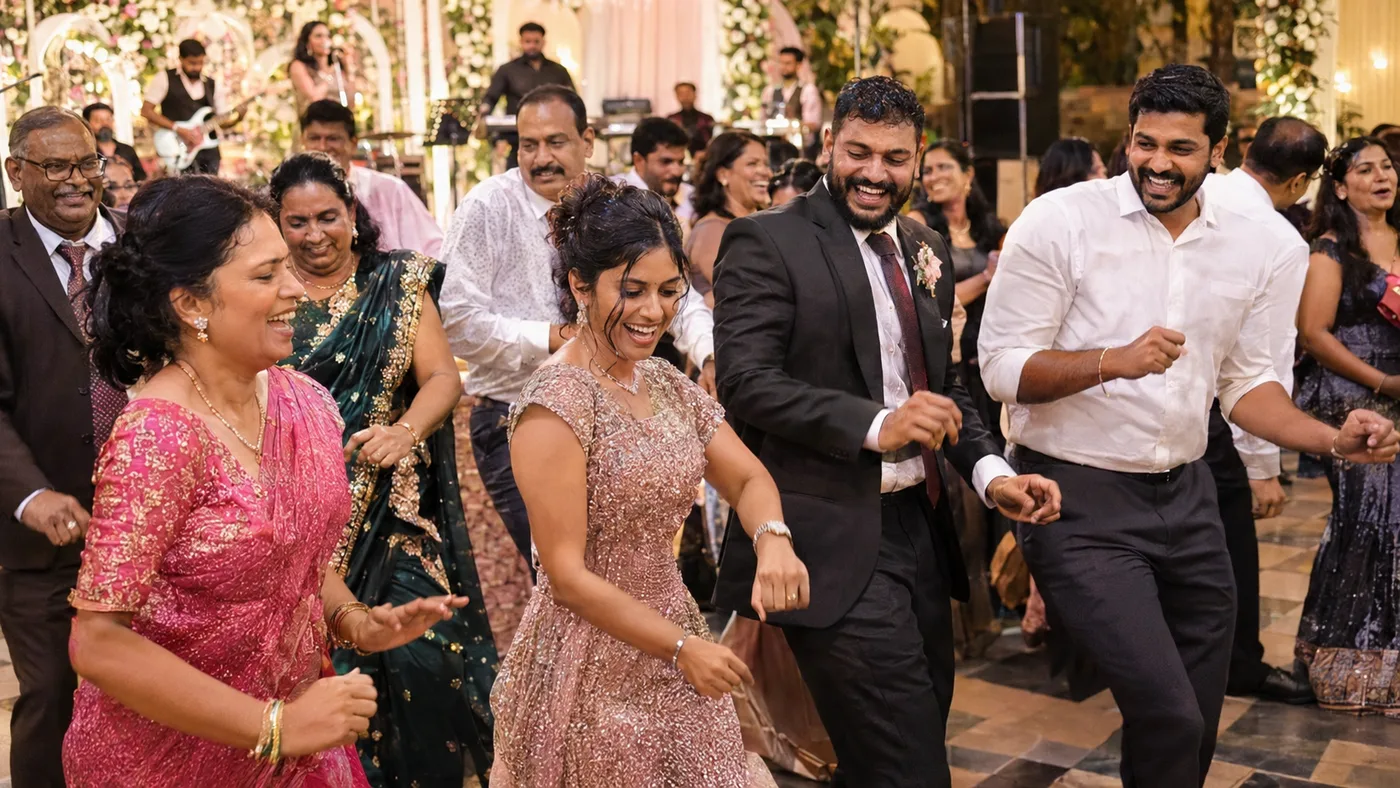
Live band budget: ₹50,000 – ₹2,00,000
Top bands with a full Baila, Western, Bollywood and Konkani repertoire charge at the higher end, especially in peak season.
Looking for Venues in Mangalore?
Tell us what you need and get quotes from verified venues
What Food Is Served at a Mangalorean Catholic Wedding?
A Mangalorean Catholic wedding feast centres on sanna-dukra maas, pork curry with soft rice cakes, alongside chicken ghee roast, fish fry, sorpotel and god pulao. It is a coconut-and-spice celebration and one of South India's most distinctive wedding menus. Here are the signature dishes.
Pork bafat with sannas. This is the centrepiece. Pork is slow-cooked in bafat masala, a roasted blend of Byadgi chillies, coriander, cumin and other spices. It comes with sannas, soft steamed rice cakes traditionally leavened with toddy. Wikipedia calls sanna-dukra maas one of the community's most popular dishes.
Chicken ghee roast. Mangaluru's most famous dish beyond the community: chicken in a deep-red, ghee-rich masala of Byadgi chillies.
Fish fry. Seer fish or pomfret, coated in red chilli and turmeric paste and shallow-fried until crisp.
Sorpotel. A Portuguese-influenced pork dish in a vinegar-laced gravy. Its presence links the table to the community's Goan roots.
Bibik. A layered coconut-milk and egg cake, similar to Goan bebinca, baked one layer at a time.
God pulao. Sweet pulao with cashews and raisins, served towards the end as a semi-dessert.
The bar is part of the feast. Beer, whisky and other spirits flow through the reception, and drinks are a significant part of the catering budget.
Food per plate: ₹600 – ₹1,200
This covers the food, with the bar billed separately. For context, WedMeGood's Mangaluru banquet listings show non-vegetarian menus from about ₹500 at budget halls to ₹1,250 at hotels. The final figure depends on the number of meat and seafood dishes and the scale of the event.
Looking for Caterers in Mangalore?
Tell us what you need and get quotes from verified caterers
The Day-After Feast
Many Mangalorean Catholic families host a relaxed feast the day after the wedding, so relatives and neighbours can congratulate the couple over another meal. It stretches the celebration into a third or fourth day.
This gathering is calmer than the reception. There is no band and no formal programme, just good food and family. In practice, it is a decompression event. The couple can finally talk to relatives they barely saw during the Roce and reception. Leftover dishes, fresh preparations and long conversations make it an intimate counterpoint to the night before.
Mangalorean Catholic vs Hindu Weddings: Key Differences
The biggest differences are the church service, the white-to-red outfit change, the Karyamani instead of a mangalsutra, Baila music and a non-vegetarian menu with a bar. For interfaith families or first-time guests, here is how the traditions compare with Hindu weddings in the same region.
| Aspect | Mangalorean Catholic Wedding | Hindu Wedding (Bunt/Konkani) |
|---|---|---|
| Duration | About 3 days (Roce, church and reception, day-after feast) | 2-3 days (pre-wedding rituals, ceremony, reception) |
| Core ritual | Marriage rite at church | Dhareyeruna or Kanyadaan, homa and Saptapadi |
| Pre-wedding | Roce (coconut milk and oil blessing) | Ritual bath; Murthasese (Bunt) or Uddida Muhurat (GSB) |
| Bridal attire | White gown, then red Sado | Kanchipuram silk sari |
| Marriage symbol | Karyamani (black-gold beads) | Mangalsutra (black-bead or coral) and toe rings |
| Music | Baila band | Chende drums, Kombu horn, nadaswaram or band |
| Food | Non-veg (pork, seafood) plus bar | Vegetarian ceremony feast; non-veg at many Bunt receptions |
| Guest count | 300-600 typical | 300-1,500 typical |
| Total cost | ₹10-30 lakh | ₹8-25 lakh |
The most striking difference is the bridal transformation. No Hindu tradition on this coast has a mid-celebration outfit change as charged as the gown-to-Sado moment. For more, see our Bunt wedding traditions and Konkani wedding rituals guides.
Modern Trends in Mangalorean Catholic Weddings
The core traditions, Roce, church service, Sado, Karyamani and Baila, remain non-negotiable, but their execution is evolving. Each generation adds its own touches.
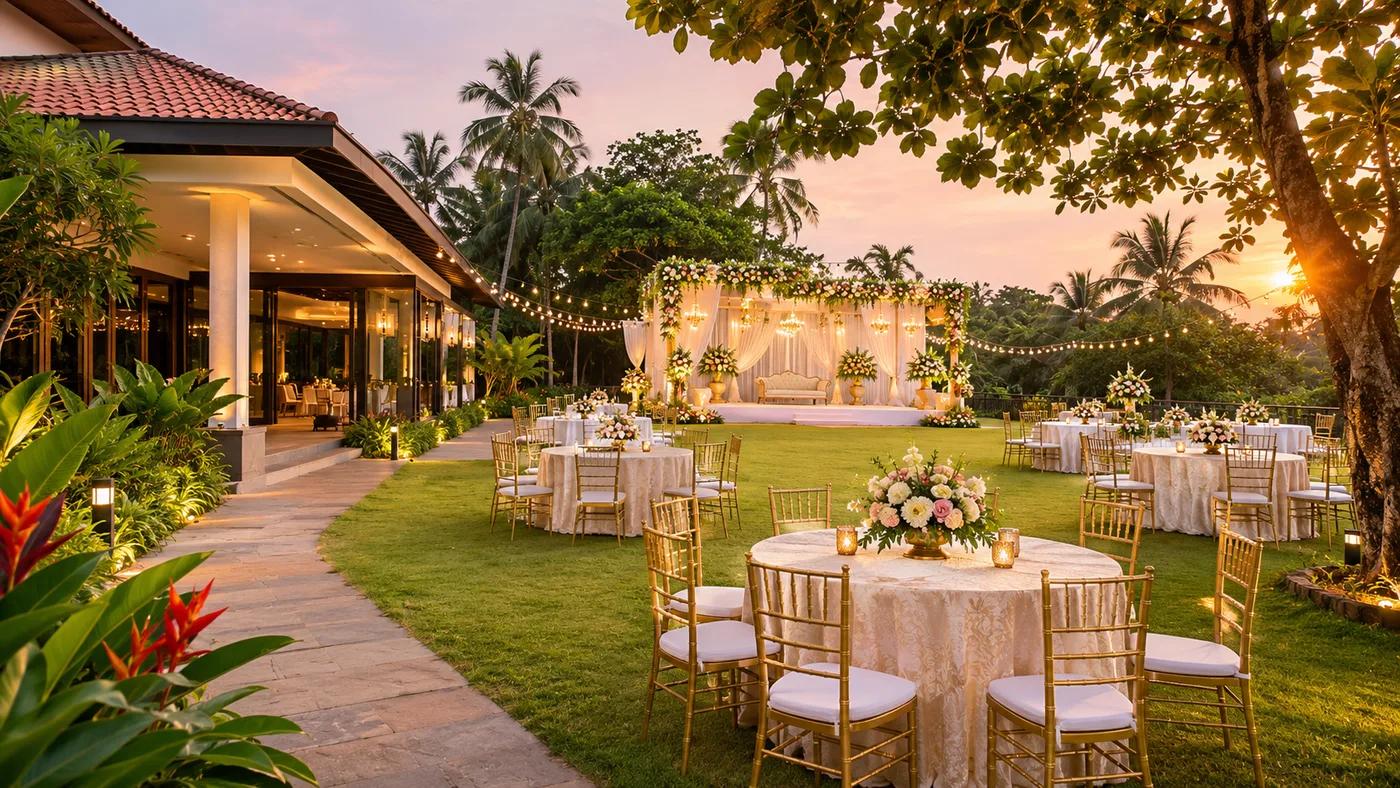
Outdoor receptions. Some couples now hold the reception at garden venues or farmhouses near Mangaluru, which allow more creative decor and photography. The church service stays indoors, but the reception is fair game.
Destination receptions. Couples based in Bangalore, Mumbai or abroad increasingly host the reception at resorts along the Mangaluru–Udupi coast, turning the wedding into a weekend for guests. Our best wedding venues in Mangalore guide covers the options.
Fusion menus. Pork bafat and sannas stay at the heart of the menu. Even so, some couples add live counters such as pasta stations or cocktail bars, mirroring the community's dual identity.
Baila remixes. Young Mangaluru musicians are remixing classic Baila songs with electronic beats and Konkani lyrics. These now play alongside live-band sets.
Interfaith weddings. Mangaluru's mix of communities means Catholic–Hindu marriages are not unusual. These weddings often pair a church ceremony with Hindu elements at the reception. Our interfaith wedding planning guide offers broader context.
How Much Does a Mangalorean Catholic Wedding Cost in 2026?
A complete Mangalorean Catholic wedding in Mangaluru costs ₹10–30 lakh for 300–600 guests, with food and drink the largest single expense. The bar and the rich non-vegetarian feast push catering well above a vegetarian Hindu wedding in the same city.
| Expense | Typical 2026 range | Notes |
|---|---|---|
| Parish fees | ₹10,000 – ₹30,000 | Church donation, choir and organist |
| Roce ceremony | ₹20,000 – ₹75,000 | Home setup and food for 50–100 guests |
| Reception venue | ₹1,00,000 – ₹5,00,000 | Parish halls at the low end; hotels and resorts at the top |
| Catering (food) | ₹2,00,000 – ₹7,00,000 | 300–600 guests at ₹600–1,200 per plate |
| Bar | ₹1,00,000 – ₹3,00,000 | Beer and wine only at the low end; premium spirits at the top |
| Bride's attire and Karyamani | ₹50,000 – ₹2,00,000 | White gown, Sado, makeup for both looks |
| Live band and Baila | ₹50,000 – ₹2,00,000 | Peak-season bands cost more |
| Photography and video | ₹75,000 – ₹3,00,000 | Coverage from Roce through reception |
| Day-after feast | ₹30,000 – ₹1,00,000 | Smaller guest count, simpler setup |
The biggest variable is the bar. A premium setup with imported spirits can add ₹2–3 lakh on its own. So couples watching costs often agree a fixed bar menu with the caterer. For a full breakdown across communities, see our Mangalore wedding cost guide.
Note
Common Questions About Mangalorean Catholic Weddings
Why is the Roce such an emotional ceremony?
The Roce happens at home, among the people who raised the bride or groom. On the eve of the wedding, the master of ceremonies opens with a prayer. Then parents, grandparents and relatives anoint the head, arms and face with coconut milk and oil, often tracing a cross on the forehead. Meanwhile, the women sing Voyo verses that mix blessings with teasing. It is the last evening at home before married life, and the physical touch of each blessing makes it deeply moving.
When and how does the bride change into the Sado?
The change happens at the reception, after the church service. The bride wears a white gown or sari to church. Later in the evening, close women relatives take her aside, dress her in the red Benarasi Sado and arrange jasmine and abolim flowers in her hair, often singing as they work. She then re-enters to a grand welcome. A good makeup artist can manage the full transformation in about 30–45 minutes, so plan the timeline around it.
What exactly are Voyo songs?
Voyos, also spelt voviyos, are short Konkani folk verses sung by women during the Roce and other wedding rituals. An elderly woman, often the wife of the master of ceremonies, leads each line while the others repeat it. Traditionally, only women whose husbands are living may sing. Some verses ask God to bless the couple, while others tease the families affectionately. Many older verses have been lost, so families who still know them are treasured.
Is the Karyamani a kind of mangalsutra?
Yes, in purpose if not in design. The Karyamani, also called the pirduk, marks a woman as married, just as a mangalsutra does in Hindu weddings. It is a chain of black and gold beads, often with heirloom gold reworked into it. The groom usually ties it at the reception, after the Sado change. That timing neatly separates the Catholic rite at church, with its ring exchange, from the Konkani custom that follows in the evening.
Can non-Catholic guests attend the church service?
Absolutely. The church ceremony is open to guests of every faith, and Mangaluru parishes are used to mixed congregations. Non-Catholic guests usually stay seated during communion while Catholic guests go forward to receive the Eucharist. Dress modestly, with shoulders covered, and arrive a little early, because popular churches fill quickly in wedding season. After the service, everyone heads to the reception together.
Why is the bar such a big part of the reception?
Generous hospitality is central to Mangalorean Catholic celebrations, and the bar has become part of that tradition. It goes hand in hand with the Baila band: the music, the dancing and the drinks feed each other through the evening. Beer, whisky and rum are standard. The bar is often one of the largest catering costs, so many couples now agree a fixed menu or a beer-and-wine bar with the caterer.
How early should we book the church?
Book your parish church 6–12 months ahead, especially for Rosario Cathedral, Milagres Church or other popular parishes between November and February. At the same time, book a place on the Diocese of Mangalore's marriage preparation course at its Family Life Service Centre, because sessions run only on fixed dates. Couples marrying in Udupi should check the requirements of the Diocese of Udupi instead. Then lock the reception venue and band.
A Mangalorean Catholic wedding is a celebration where two cultural worlds meet and neither yields. The coconut milk of the Roce speaks to Konkani soil. The white gown speaks to the church, and the red Sado to Indian tradition. The Karyamani speaks for a community that has spent four centuries refusing to choose between its identities. Whether you celebrate at a parish church in Mangaluru, a venue in the city or a banquet hall in Bangalore, these traditions carry real weight, and a Baila beat that keeps guests dancing to the last song.
Tip
Start planning your Mangalore wedding — generate a personalised checklist with our AI Wedding Checklist, estimate your budget with the Cost Calculator, or make your own wedding website.
Topics
mangalorean catholic weddingroce ceremonysado traditionbaila musicmangalore christian weddingvoyo songskaryamani necklaceExplore more
Frequently Asked Questions
1What is the Roce ceremony in a Mangalorean Catholic wedding?
2What is the Sado saree and when does the bride wear it?
3What is the Karyamani necklace?
4What is Baila music and why is it central to the reception?
5What food is served at a Mangalorean Catholic wedding?
6How many days does a Mangalorean Catholic wedding last?
7How much does a Mangalorean Catholic wedding cost in 2026?
Continue reading
Related Articles
How to Plan a Mangalore Wedding: Complete 2026 Guide
Best Wedding Venues in Mangalore: Halls & Resorts 2026
Mangalore Wedding Cost: Realistic 2026 Budget Breakdown
Konkani GSB Wedding Rituals: Naandi to Saptapadi Guide
Assam Destination Wedding: Kaziranga, Majuli & Guwahati
Best Time for a Northeast India Wedding: Month by Month
Still planning?
Get quotes from India's best vendors
Tell us what you're planning and we'll match you with verified photographers, venues, decorators, and more.
Get free quotes