
Brihadeeswarar Temple Wedding: The Ultimate Planning Guide
Plan your dream wedding at the 1,000-year-old Brihadeeswarar Temple in Thanjavur. Complete guide to Shaiva-Agamic protocols, photography rules, costs, and logistics.

On this page
A wedding at the Brihadeeswarar Temple means marrying inside a 1,000-year-old UNESCO World Heritage monument built by Rajaraja Chola I. Temple ceremony coordination costs approximately Rs 4,000, with complete wedding packages from Rs 2-5 lakh. Ceremonies follow Shaiva-Agamic protocols and must be scheduled during auspicious muhurthams, typically between 5 AM and 11 AM.
Quick Answer
Quick answer: A wedding at the Brihadeeswarar Temple means marrying inside a 1,000-year-old UNESCO World Heritage monument built by Rajaraja Chola I. Temple ceremony coordination costs approximately Rs 4,000, with complete wedding packages from Rs 2-5 lakh. Ceremonies follow Shaiva-Agamic protocols and must be scheduled during auspicious muhurthams, typically between 5 AM and 11 AM.
Note
Pricing methodology: Cost ranges in this guide are based on vendor pricing data from the itsmy.wedding marketplace and published industry reports, collected in Q4 2025 – Q1 2026.
The first wedding I covered at the Big Temple changed my perspective entirely — no convention centre stage can compete with standing before a vimana that has witnessed 1,000 years of ceremonies. The stone corridors amplified the nadaswaram in a way no sound system can replicate. The morning light through the gopuram cast patterns on the bride's silk that a decorator could never manufacture. That was eight years ago, and I have since helped plan dozens of Brihadeeswarar Temple weddings. This guide covers every practical detail — from Shaiva-Agamic ritual protocols and HR&CE coordination to photography rules, costs, and reception logistics.
For a broader overview of planning a wedding in Thanjavur (historically Tanjore), see our complete Thanjavur wedding planning guide.
Why Choose the Brihadeeswarar Temple for Your Wedding?
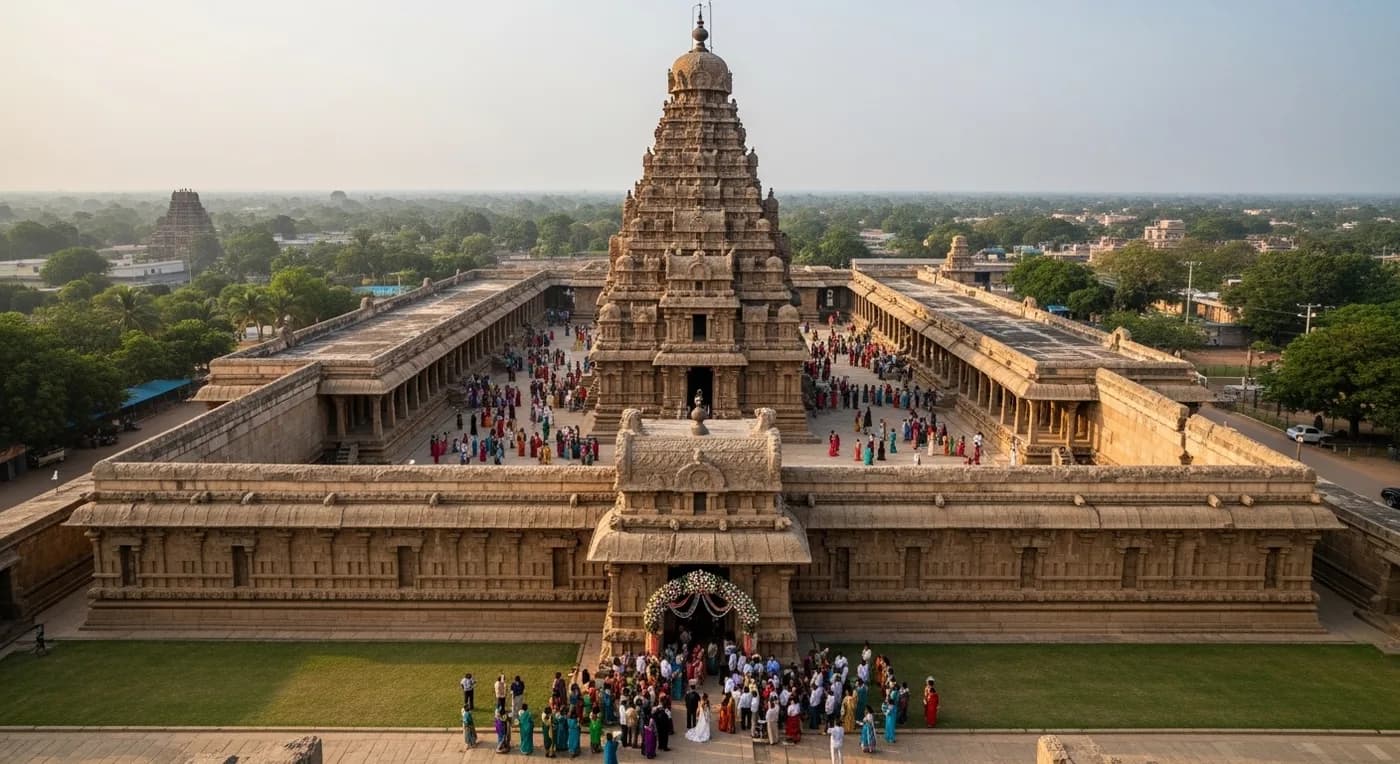
The Brihadeeswarar Temple is a UNESCO World Heritage Site built in 1010 CE by Rajaraja Chola I, with a 63.4-metre vimana across 16 storeys and a 25-tonne monolithic capstone — making it one of India's most architecturally significant living temples for wedding ceremonies.
A UNESCO World Heritage Monument
The Brihadeeswarar Temple received its UNESCO World Heritage designation in 1987 as part of the Great Living Chola Temples. That phrase — "living" — matters. Unlike archaeological sites where visitors observe from behind ropes, this temple conducts daily pujas, annual festivals, and family ceremonies exactly as it has for a millennium. Your wedding here is a continuation of living tradition.
Chola Architectural Grandeur
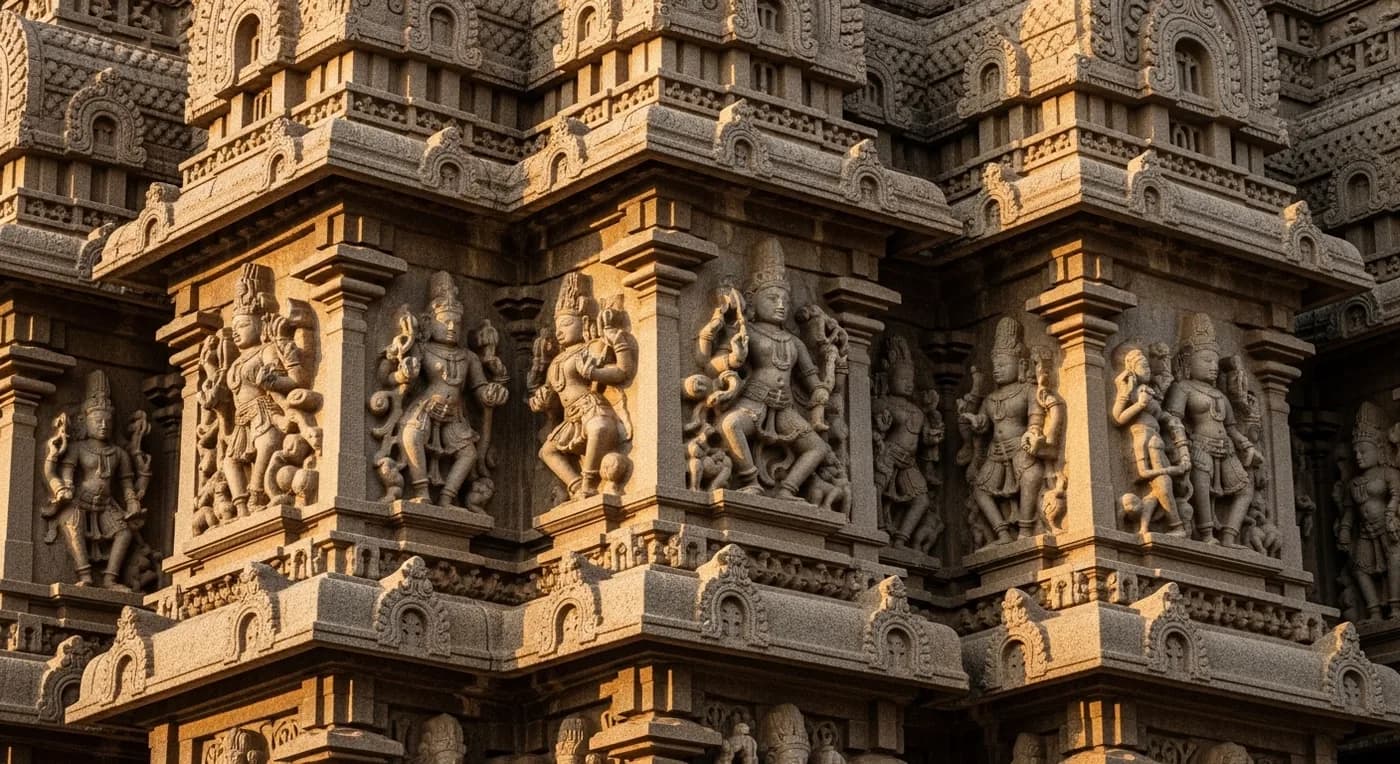
Rajaraja Chola I commissioned this temple in 1003 CE and completed it in 1010 CE. The vimana rises to 63.4 metres across 16 storeys, crowned by a monolithic capstone weighing approximately 25 tonnes. The temple complex spans 240.79 metres by 121.92 metres, covering 18.07 hectares. The sacred Nandi at the entrance stands 3.65 metres high and 5.94 metres long, carved from a single piece of granite weighing roughly 25 tonnes. Along the temple walls, 81 of the 108 karanas — dance poses from the ancient Natya Sastra — are carved in exquisite detail.
More Than a Photo Opportunity
Many couples first consider a Big Temple wedding for the photographs. But the deeper reason is what the space does to the ceremony itself. The stone corridors carry the priest's mantras with a resonance no microphone can match. The oil lamps cast a warm glow that feels fundamentally different from LED stage lighting. Camphor and jasmine mingle with cool stone in a way that anchors everything in something ancient.
Note
What Are the Shaiva-Agamic Wedding Protocols?
The Brihadeeswarar Temple is dedicated to Lord Shiva, and all ceremonies follow the Shaiva-Agamic tradition. This is not a generic Hindu wedding with flexible formatting — the rituals follow a temple-prescribed sequence rooted in Shaiva Siddhanta philosophy.
The Ceremony Sequence
Ganapati Puja. An invocation to Lord Ganesha to remove obstacles, performed by the temple priest.
Punyaha Vachanam. A purification ritual using sanctified water to consecrate the ceremony space and the couple.
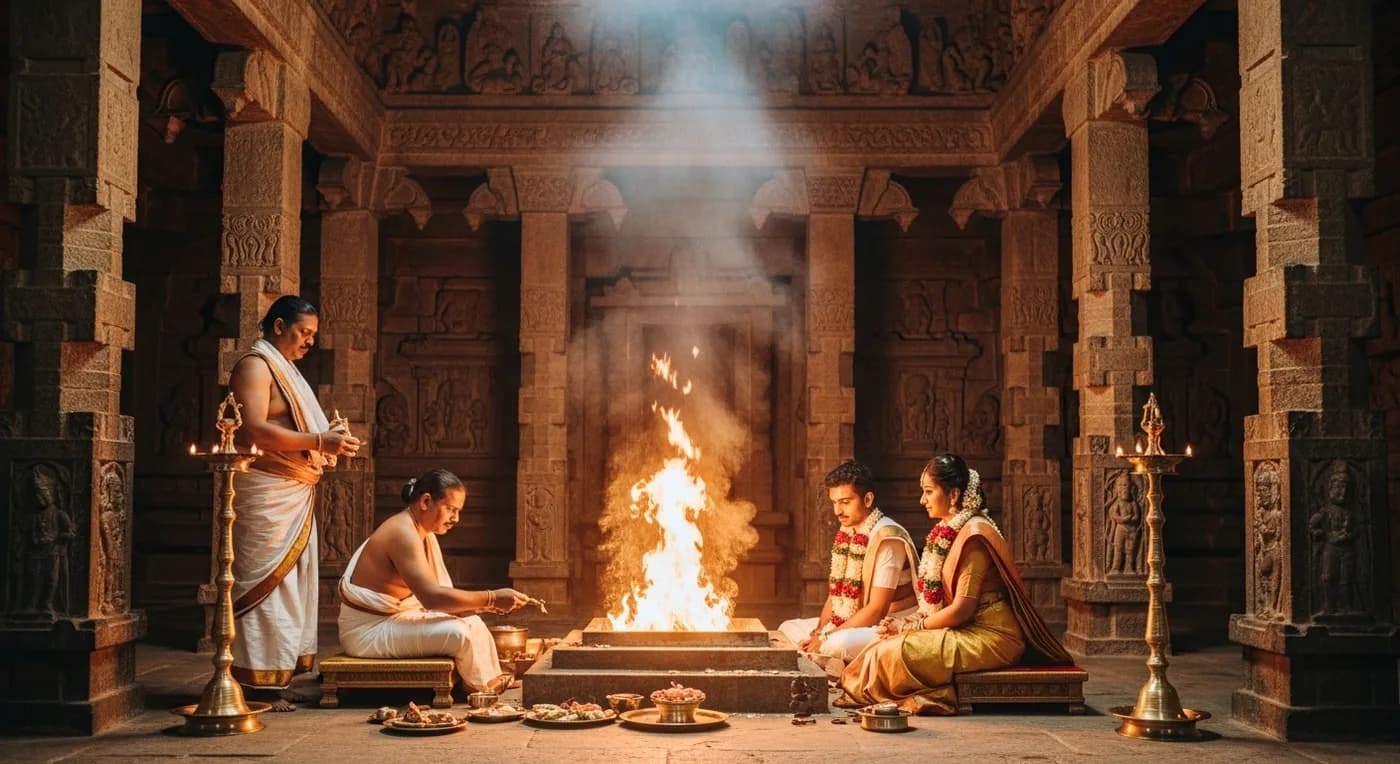
Homam (Sacred Fire Ceremony). The central ritual. The couple makes offerings into the agni while Shaiva mantras are chanted — these specific mantras invoke Shiva as the witness, distinguishing the ceremony from Vaishnavite traditions.
Kanyadaanam. The bride's father formally entrusts his daughter to the groom, performed before the deity as witness.
Thali Tying at Muhurtham. The climactic moment. The groom ties the thali around the bride's neck at the exact auspicious moment. The temple bell rings, the nadaswaram reaches its crescendo, and guests shower the couple with rice and flowers.
Saptapadi (Seven Steps). The couple takes seven steps around the sacred fire, each step representing a vow for their married life.
Temple Priest vs Family Priest
The temple's own archakas are authorised to conduct ceremonies within the precinct. In many cases, families bring their own priest who works alongside the temple archaka — the temple priest handles deity-specific rituals while the family priest manages family-customary elements. Discuss this arrangement when you book.
Important
How Do You Book a Wedding at the Big Temple?
The process requires coordination with the Tamil Nadu Hindu Religious and Charitable Endowments Department (HR&CE), which manages all government-administered temples in the state.
Step-by-Step Process
Step 1: Contact the temple administration. Visit the temple office in person or reach the HR&CE department through hrce.tn.gov.in. In-person visits are more productive — the office is within the temple complex.
Step 2: Select your muhurtham date. Share your preferred dates based on the couple's horoscopes. Peak wedding season runs January through March — begin this process 4 to 6 months ahead.
Step 3: Submit documentation. Identity documents for both bride and groom, along with muhurtham details. The administration confirms availability and provides ceremony guidelines.
Step 4: Pay the coordination fee. Temple coordination costs approximately Rs 4,000. This is not a "venue rental" — the temple does not charge a venue fee in the conventional sense.
Step 5: Coordinate logistics. Discuss decoration rules, photography guidelines, and ceremony timing. The administration specifies which temple areas are available and what restrictions apply.
Off-season dates (July through September, excluding festivals) may be available with shorter notice. Donations are customary but not mandatory — the amount is at the family's discretion.
What Are the Photography Rules and Best Spots?
Photography is permitted but governed by rules every couple and photographer must understand before the wedding day.
The Rules
Outer mandapams and corridors: Professional photography is generally permitted — the Nandi mandapam, cloistered corridors, temple entrance, and open courtyard.
Inner sanctum: Photography is restricted within the garbhagriha (sanctum sanctorum). Ceremony photos come primarily from the mandapam where the wedding takes place.
Drone photography: Not allowed within the temple precinct — strict rule at all major heritage temples in India.
Video recording: Permitted in the same zones as still photography. Discuss specific equipment with the administration in advance.
The Six Best Photo Locations
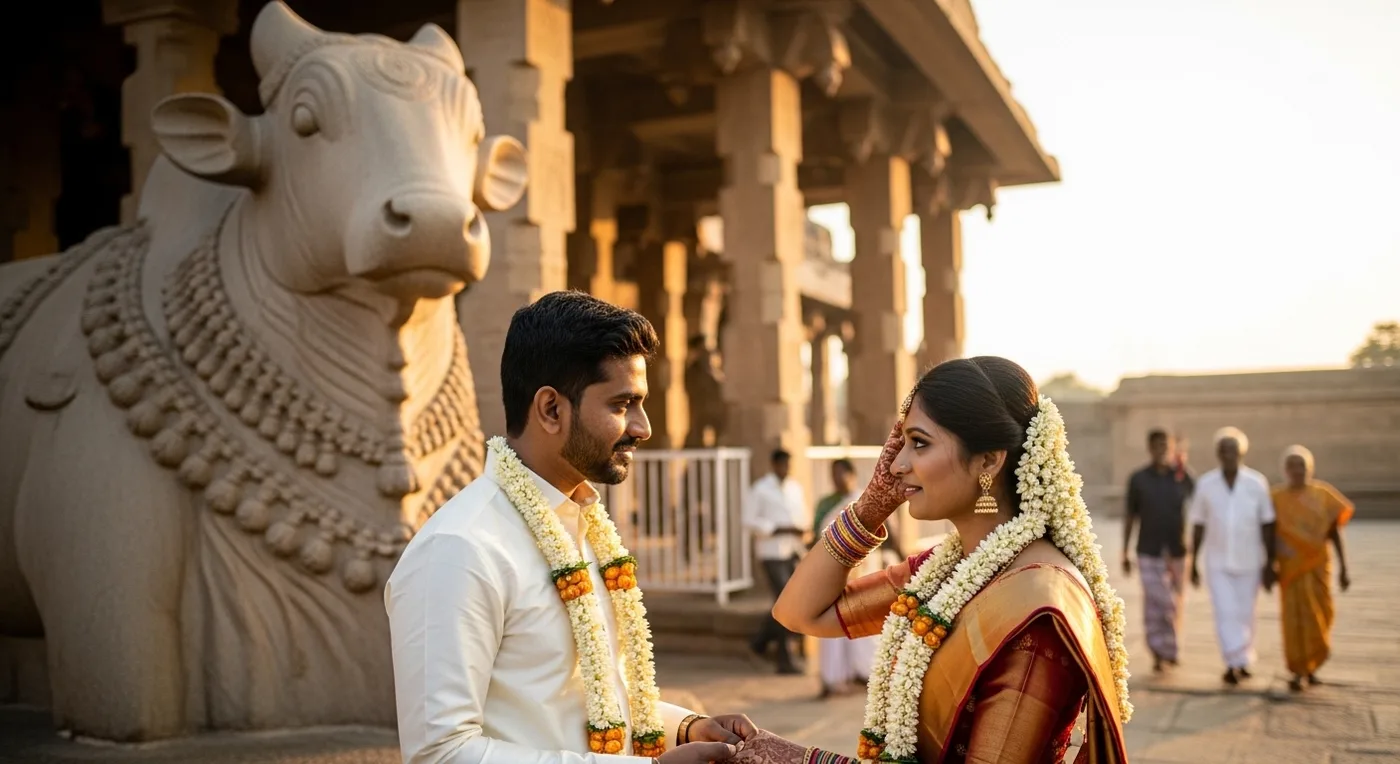
1. Nandi Mandapam. The monolithic Nandi with the vimana towering behind. Morning light between 6 and 8 AM is ideal. The single most photographed spot for temple wedding portraits.
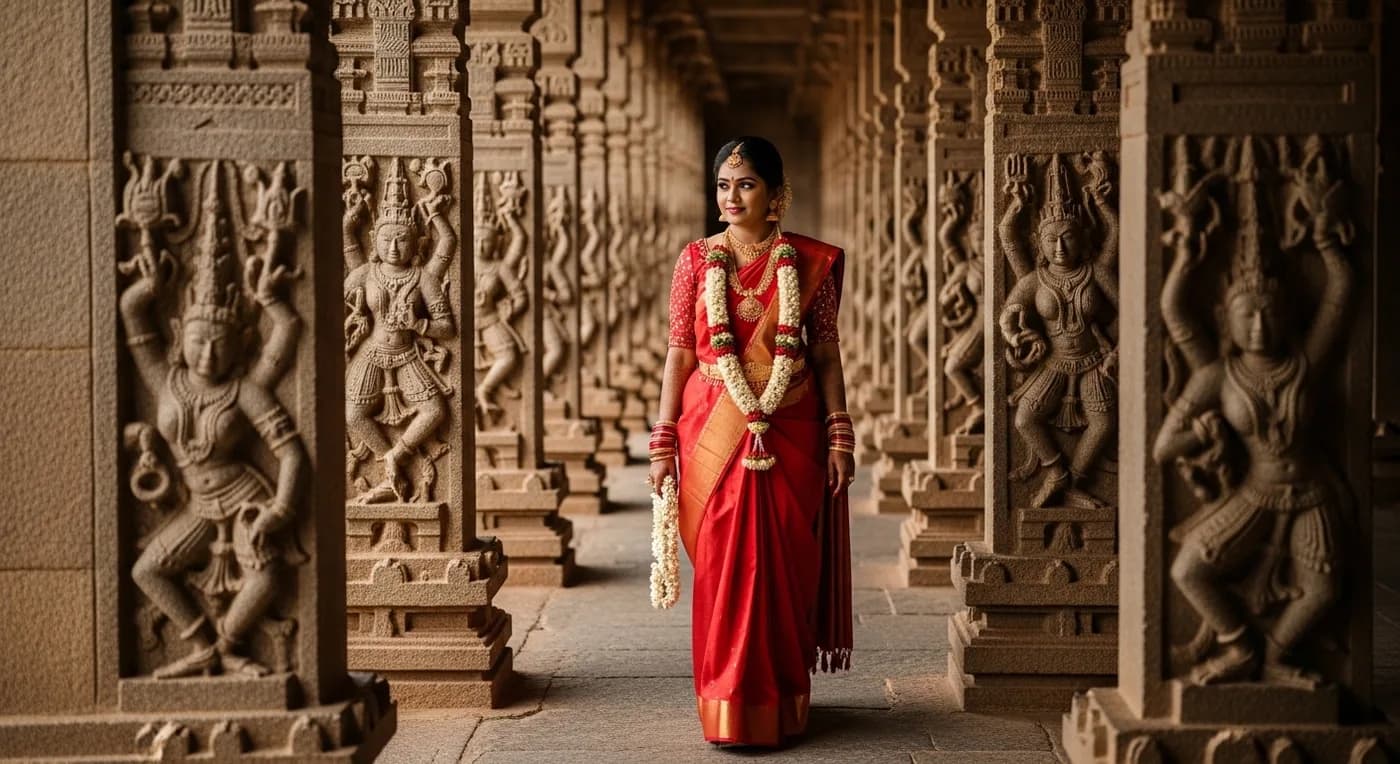
2. The Cloistered Corridor. Early morning light creates alternating bands of light and shadow between the pillars — a bride in silk walking through here produces one of the most compelling compositions at any Indian wedding venue.
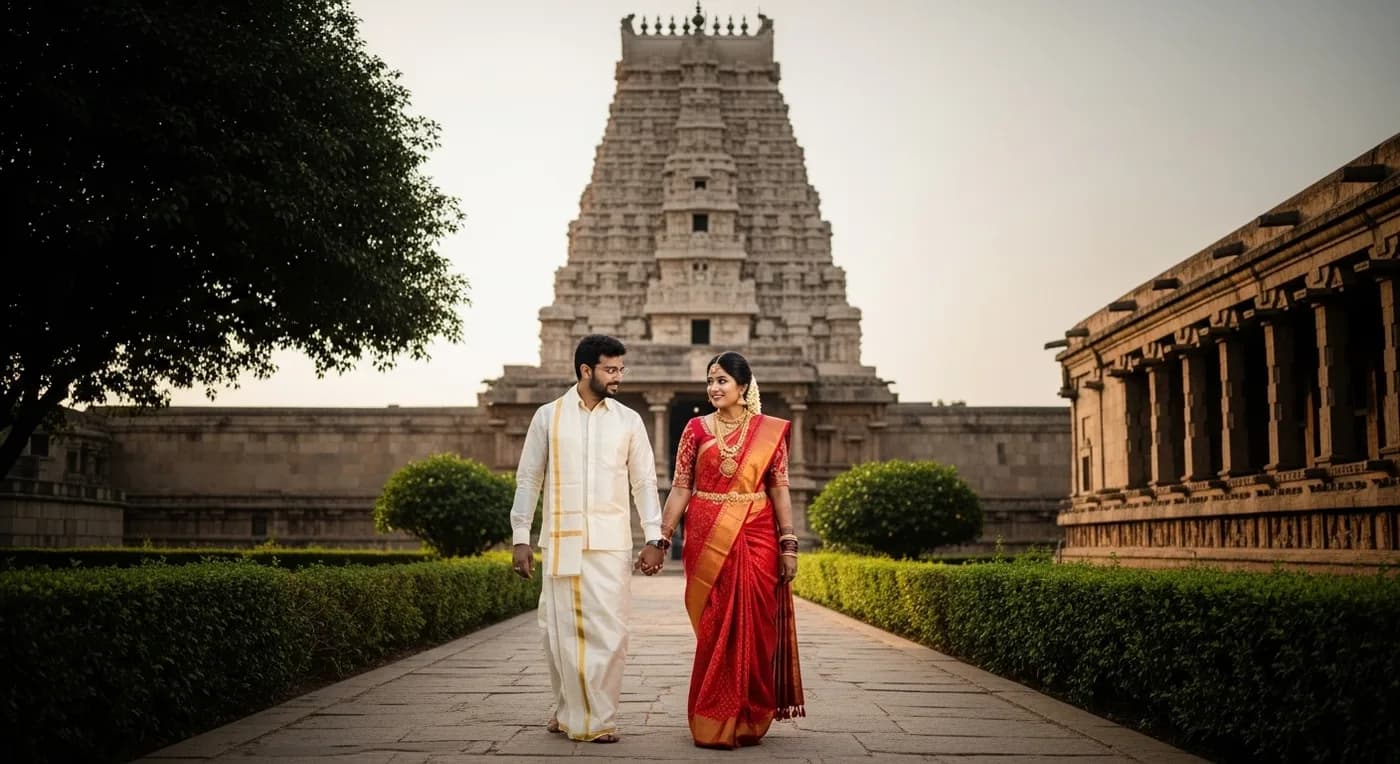
3. Temple Entrance with Gopuram Framing. The couple at the main entrance with the gopuram rising above. Best immediately after the ceremony.
4. The Courtyard. Expansive backdrop with the vimana dominating the skyline. Ideal for group photographs.
5. Perimeter Pathway. Unobstructed vimana views from various angles, less crowded for intimate couple portraits.
6. Opposite the Entrance. Wide-angle perspective capturing the full gopuram and temple complex.
Photographer Briefing
Brief your photographer at least two weeks before. Arrange a pre-wedding site visit at the same time of day as your muhurtham so they can study the light. The golden window for outdoor portraits is 6 to 9 AM — by 10 AM, the Thanjavur sun creates harsh shadows. Sources such as Focuz Studios and Mystic Studios have published Big Temple wedding portfolios showcasing what is achievable within permitted zones.
Looking for Photographers in Thanjavur?
Tell us what you need and get quotes from verified photographers
What Decoration Rules Apply Inside the Temple?
The Brihadeeswarar Temple's own architectural grandeur is the decoration. Your role as a planner is to complement — never compete with — a thousand years of Chola artistry.
What Is Permitted
Fresh flowers — jasmine garlands, marigold strings, lotus arrangements, rose petals. Flowers are integral to temple worship and appropriate anywhere your ceremony takes place.
Bronze oil lamps (kuthuvilakku) — traditional brass or bronze standing lamps that align with the temple's aesthetic and photograph beautifully.
Banana stalks and mango leaf toran — standard entrance decorations at all Tamil temple ceremonies.
Kolam (rangoli) — traditional rice flour designs at the ceremony entrance add authentic cultural detail.
What Is Not Permitted
No fixtures on any temple surface. No nails, tape, or screws. This is a UNESCO World Heritage Site — all decorations must be freestanding or draped without attachment to the stonework.
No synthetic materials. Plastic flowers, synthetic draping, and foam decorations are not permitted.
No electric lighting attached to the temple. Freestanding lamp stands may be permitted, but nothing wired to the structure.
No elaborate stage setups. The ceremony happens at ground level in the mandapam, as it has for centuries.
Tip
How Much Does a Complete Temple Wedding Cost?
The Brihadeeswarar Temple ceremony itself is remarkably affordable. The significant costs come from the supporting services — photography, catering, and the reception venue — which the temple does not provide.
Temple Ceremony Costs
| Category | Estimated Cost |
|---|---|
| Temple ceremony coordination | ₹3,500 – ₹5,000 |
| Priest dakshina (customary offering) | ₹2,000 – ₹5,000 |
| Temple donation (voluntary) | ₹1,000 – ₹10,000 |
| Flower decorations for mandapam | ₹5,000 – ₹15,000 |
| Nadaswaram musicians | ₹5,000 – ₹15,000 |
| Temple ceremony subtotal | ₹16,500 – ₹50,000 |
Full Wedding Costs (Including Reception)
| Category | Budget Range | Premium Range |
|---|---|---|
| Temple ceremony (above) | ₹16,500 – ₹30,000 | ₹30,000 – ₹50,000 |
| Photography and videography | ₹60,000 – ₹1,50,000 | ₹1,50,000 – ₹3,00,000 |
| Bride's silk saree and jewellery | ₹50,000 – ₹1,50,000 | ₹1,50,000 – ₹5,00,000 |
| Reception venue rental | ₹40,000 – ₹75,000 | ₹75,000 – ₹2,00,000 |
| Catering (200-300 guests) | ₹80,000 – ₹1,50,000 | ₹1,50,000 – ₹3,50,000 |
| Reception decorations | ₹30,000 – ₹75,000 | ₹75,000 – ₹2,00,000 |
| Guest transport and logistics | ₹10,000 – ₹30,000 | ₹30,000 – ₹75,000 |
| Total estimate | ₹2,86,500 – ₹6,60,000 | ₹6,60,000 – ₹16,75,000 |
These figures are based on 2026 Thanjavur market rates. Because the temple does not charge a conventional venue rental fee, your ceremony venue cost is a fraction of what a hotel or convention hall would charge. For a detailed citywide breakdown, see our Thanjavur wedding budget guide.
Note
Where Should You Host the Reception?
The temple does not have catering facilities or a reception hall — the ceremony happens at the temple in the early morning, and the wedding feast takes place at a nearby venue. This is standard practice for all Big Temple weddings.
Top Reception Venues Near the Temple
All within 10 to 15 minutes of the Brihadeeswarar Temple:
Gurudhayal Mandapam. Thanjavur's most popular kalyana mandapam. Capacity for 500-plus guests, in-house catering, air-conditioned halls. Rental: ₹50,000 – ₹1,25,000.
Sangam Hotel. Combined accommodation and event space — outstation guests stay where the reception is held. Banquet hall: ₹75,000 – ₹2,00,000.
Andal Mandapam. Budget-friendly, reliable kitchen, 300-plus guest capacity. Rental: ₹40,000 – ₹60,000.
Hotel Parisutham. Heritage ambiance with modern amenities. Packages: ₹60,000 – ₹1,50,000.
The Ceremony-to-Reception Flow
4:00 - 4:30 AM: Family arrives at the temple. Bride preparation in nearby hotel room.
5:00 - 8:00 AM: Ceremony at the auspicious muhurtham — homam, kanyadaanam, thali tying, saptapadi.
8:00 - 9:30 AM: Post-ceremony photographs in the temple complex (golden window before harsh sunlight).
10:00 AM onward: Move to the reception venue. Guests who missed the early ceremony join here.
12:00 - 2:00 PM: Main reception with lunch for the full guest list.
Looking for Venues in Thanjavur?
Tell us what you need and get quotes from verified venues
What Should Guests Know?
Guests attending a Brihadeeswarar Temple wedding must follow specific dress code, etiquette, and logistics rules — traditional attire is mandatory, footwear must be removed, and the ceremony starts at the exact muhurtham time regardless of attendance.
Dress Code
Traditional attire is expected. The bride wears a Kanchipuram silk saree. The groom wears a white veshti with angavastram. Guests dress conservatively — shoulders and knees covered. All footwear must be removed before entering the temple. Leather items may need to be removed in certain areas. Advise guests to wear easily removable shoes and leave valuables in vehicles.
Temple Etiquette
Arrive early. If your muhurtham is at 5:47 AM, the ceremony begins at 5:47 AM — whether all guests have arrived or not. Communicate this clearly.
Phone cameras. Guests should not crowd the ceremony space. Designate the professional photographer as the only person shooting during the ceremony.
No food or drinks inside the temple. Guests eat at the reception venue after the ceremony.
Silence during mantras. The temple's acoustics carry sound — conversations during the ceremony are more disruptive than in a large hall.
Practical Considerations
Parking. Space can be limited during peak season. Arrange overflow parking nearby with shuttle service.
Sun and heat. Thanjavur mornings can be warm even at 7 AM from March onward. Having worked with families through Thanjavur's hottest months, I always recommend keeping bottled water and hand fans in vehicles for guests who step out during the ceremony.
Accessibility. The temple complex has steps and uneven stone surfaces. Elderly guests should be accompanied. Discuss specific accessibility needs with the administration.
Tip
Common Questions About Brihadeeswarar Temple Weddings
Is a Brihadeeswarar Temple wedding legally valid?
Yes, a Brihadeeswarar Temple wedding is legally valid under the Hindu Marriage Act, 1955, which recognises ceremonies conducted according to the customs and rites of either party. The Shaiva-Agamic ceremony at the temple — including the Homam, Kanyadaanam, thali tying, and Saptapadi — constitutes the religious solemnisation of the marriage. However, you must separately register the marriage at the local sub-registrar's office in Thanjavur to obtain a legal marriage certificate. Registration requires identity documents for both partners, two witnesses, and the ceremony date details. Most families complete the registration within 30 days of the wedding. The temple administration can provide documentation confirming the ceremony was conducted at the temple if needed for the registration process.
Can non-Hindu couples marry at the temple?
The Brihadeeswarar Temple conducts Hindu ceremonies exclusively, following Shaiva-Agamic protocols since the temple is dedicated to Lord Shiva. Interfaith couples where one partner is Hindu can discuss options with the temple administration — in many cases, the Hindu ceremony can be conducted at the temple while the other tradition's ceremony takes place at a separate venue. The temple functions as an active place of worship with daily pujas and annual festivals, not as a general event space available for non-religious bookings. Couples from Vaishnavite Hindu traditions should also discuss compatibility with the administration early, as certain Vaishnavite rituals may need to be adapted or conducted separately at the reception venue since the temple follows specifically Shaiva protocols.
What happens if it rains during the ceremony?
Ceremonies take place in covered mandapams within the temple precinct, so light rain does not affect proceedings at all. Heavy rain during the peak wedding season of January to March is uncommon in Thanjavur — India Meteorological Department records show that the city's bulk precipitation falls in October and November during the northeast monsoon, with average rainfall dropping below 30 mm per month from January through March. The covered corridors and mandapams provide protection for guests moving between temple areas. However, post-ceremony outdoor photographs at the Nandi mandapam and courtyard may be affected by rain, so discuss backup photo locations with your photographer during the pre-wedding site visit. The cloistered corridor offers excellent covered alternatives with dramatic pillar-and-light compositions.
How many guests can attend the temple ceremony?
The ceremony mandapam at Brihadeeswarar Temple accommodates 50 to 100 people for the actual wedding rituals. The broader temple courtyard holds several hundred more guests who can witness the proceedings from a short distance. Most families plan for 50 to 80 close family members at the mandapam ceremony, with the larger celebration of 300 to 500 guests hosted at a separate reception venue. Popular reception venues within 10 to 15 minutes of the temple include Gurudhayal Mandapam with 500-plus capacity, Sangam Hotel with accommodation-and-event facilities, and Andal Mandapam for budget-friendly gatherings. The standard flow is an early morning ceremony at the temple from 5 to 8 AM followed by a lunch reception from noon to 2 PM at the nearby venue.
Should we hire a wedding planner?
The temple ceremony itself is straightforward enough to coordinate directly with the HR&CE administration — the process involves contacting the temple office, selecting the muhurtham date, submitting documentation, and paying the coordination fee of approximately ₹4,000. However, managing the full wedding day — early morning temple logistics, photography coordination within permitted zones, guest transport between temple and reception venue, catering timing, and decorator management — benefits significantly from a local planner with specific Big Temple experience. A planner who knows the temple's protocols, the best photo locations at each hour, and the ceremony-to-reception transition logistics can prevent the common pitfalls of first-time temple wedding coordination. Day-of coordinators in Thanjavur typically charge ₹25,000 to ₹50,000.
Can we do a pre-wedding photoshoot at the temple?
Yes, pre-wedding photoshoots at the Brihadeeswarar Temple are popular and produce extraordinary results. The Nandi mandapam with the vimana towering behind, the cloistered corridor with alternating bands of light and shadow between pillars, and the temple entrance with the gopuram framing provide backdrops unmatched by any studio or convention centre. Visit early morning between 6 and 9 AM for the best natural light — by 10 AM, Thanjavur's sun creates harsh shadows that compromise image quality. Check with the temple administration about photography permits for professional equipment, as requirements may differ from casual photography. Drone photography is not permitted anywhere within the temple precinct. Consider scheduling the pre-wedding shoot 2 to 4 weeks before the wedding so that the images can be displayed at the reception venue or shared via digital invitation.
A Brihadeeswarar Temple wedding strips away the manufactured spectacle of modern wedding stages and replaces it with something no decorator can create — a thousand years of consecrated history. The vimana will tower above your ceremony just as it towered above weddings in the eleventh century. The stone will hold the same coolness under bare feet. Your wedding becomes part of a story carved in granite by the Chola dynasty and continued, ceremony by ceremony, for a millennium.
For more on planning your Thanjavur celebration, explore our complete Thanjavur wedding planning guide, best wedding venues in Thanjavur, and Thanjavur wedding traditions. Considering other temple options? Our south Indian temple wedding guide compares Brihadeeswarar with 11 more sacred venues across four states.
Topics
brihadeeswarar temple weddingbig temple wedding thanjavurthanjavur temple weddingchola temple weddingUNESCO heritage weddingtanjore weddingsExplore more
Frequently Asked Questions
1Can you legally get married at Brihadeeswarar Temple?
2How much does a Brihadeeswarar Temple wedding cost?
3Are there photography restrictions inside the temple?
4What time do temple weddings take place?
5What dress code applies for a Brihadeeswarar Temple wedding?
6Where do guests eat after a Brihadeeswarar Temple wedding?
Continue reading
Related Articles
Meenakshi Temple Wedding in Madurai: Cost, Booking & Complete Guide
Srirangam Temple Wedding: Booking, Cost & Rituals at Ranganathaswamy Temple
Temple Wedding in Tirupati: Sacred Venues, Rituals & Planning Guide
South Indian Temple Weddings: Complete Planning Guide for 2026
South Indian Temple Wedding Costs Compared: Kerala vs Tamil Nadu vs Karnataka
Best Wedding Venues in Kanchipuram: ₹25K-₹3L Mandapams & Resorts (2026)
Still planning?
Get quotes from India's best vendors
Tell us what you're planning and we'll match you with verified photographers, venues, decorators, and more.
Get free quotes