
Best Wedding Caterers in Chennai (2026) | Saapadu to Buffet
Find the best wedding caterers in Chennai for 2026. Compare 6 caterer types — saapadu, Brahmin, Chettinad, halal — with tasting tips and FSSAI checks.

On this page
Chennai has over 4,000 registered wedding caterers serving everything from ₹350-per-plate banana-leaf saapadu to ₹3,000+ premium multi-cuisine buffets. The best caterers in Chennai specialise by community — Brahmin, Chettinad, Muslim halal, and multi-cuisine — with T. Nagar, Mylapore, and Sowcarpet as the major caterer hubs. Book 6-10 months ahead for peak muhurtham dates.
Quick Answer
Quick answer: Chennai has over 4,000 registered wedding caterers serving everything from ₹350-per-plate banana-leaf saapadu to ₹3,000+ premium multi-cuisine buffets. The best caterers in Chennai specialise by community — Brahmin, Chettinad, Muslim halal, and multi-cuisine — with T. Nagar, Mylapore, and Sowcarpet as the major caterer hubs.
Note
Pricing methodology: Cost ranges in this guide are based on vendor pricing data from the itsmy.wedding marketplace and published industry reports, collected in Q4 2025 – Q1 2026.
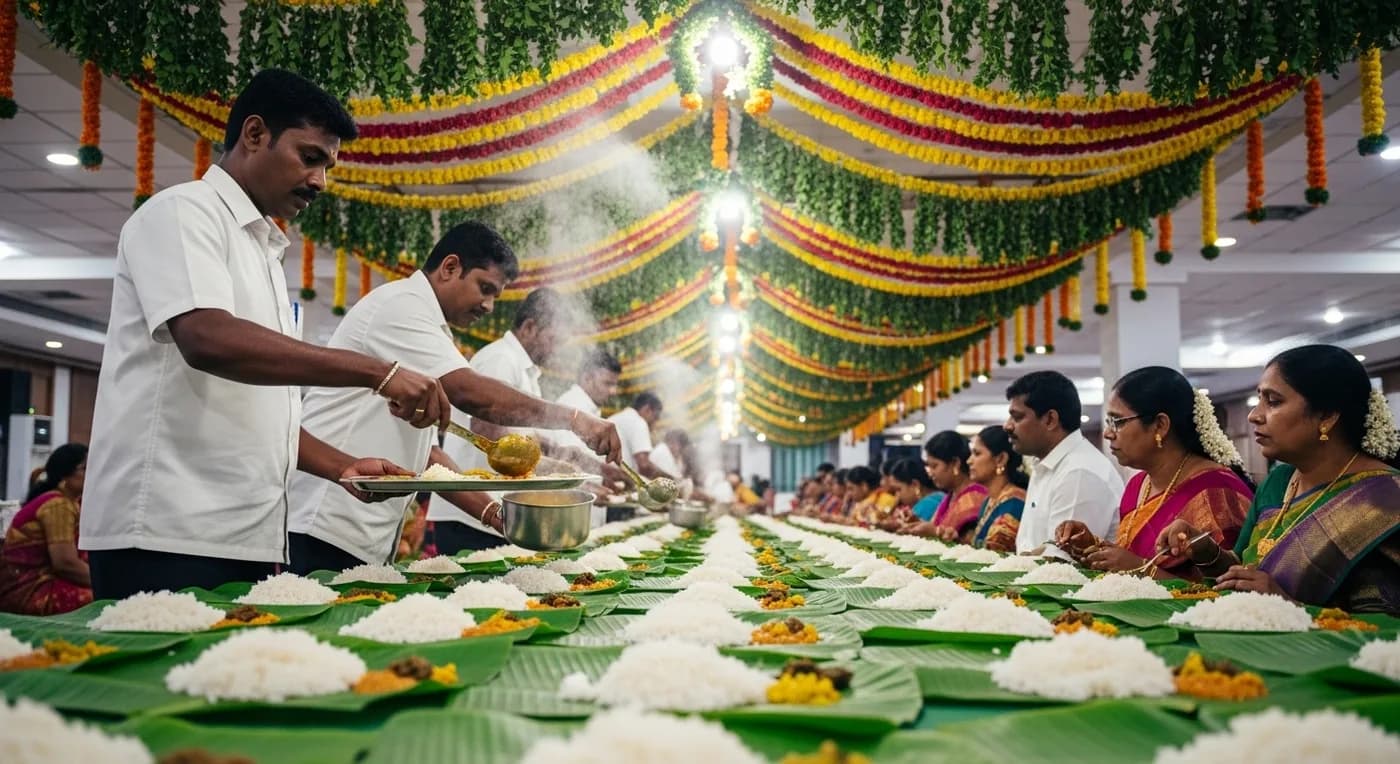
In Chennai (formerly Madras), the saapadu is the wedding. I have watched guests at a Mylapore mandapam skip the photo booth, ignore the flower arrangements, and head straight for the banana-leaf dining hall — because in Tamil culture, the food is how a family's hospitality is measured. A wedding where the sambar is flat or the payasam count disappoints will be remembered for the wrong reasons, no matter how expensive the venue or how famous the photographer.
With India's wedding catering market valued at USD 16.19 billion in 2025 and CAIT estimating 4.8 million weddings generating ₹6 lakh crore in a single season, the caterer you choose is the single most consequential vendor decision for your Chennai wedding. Catering typically consumes 30-40% of your total budget — more than venue, photography, and decor combined.
This guide covers how to choose the right caterer for your Chennai wedding: the six caterer types, community-specific specialisations, the traditional Tamil saapadu course sequence, tasting session strategies, FSSAI verification, and contract terms you must get in writing. Whether you are planning an Iyer wedding in Mylapore, a Chettinad celebration in Perambur, or a Muslim nikah in Sowcarpet, the right caterer is the one who knows your community's food traditions as well as your family does.
For detailed per-plate costs and total budget calculations across every format, see our comprehensive catering cost guide. For the full planning picture, start with our Chennai wedding planning guide. And if you are working with a tight budget, our budget wedding in Chennai guide has catering-specific strategies.
What Are the Main Types of Wedding Caterers in Chennai?
Chennai's catering market spans over 4,000 registered operators across six distinct categories — banana-leaf saapadu specialists, Brahmin caterers, Chettinad non-veg specialists, Muslim halal caterers, multi-cuisine buffet operators, and premium live-counter services. Understanding these caterer types helps you narrow your search before collecting quotes.
1. Banana-Leaf Saapadu Specialists
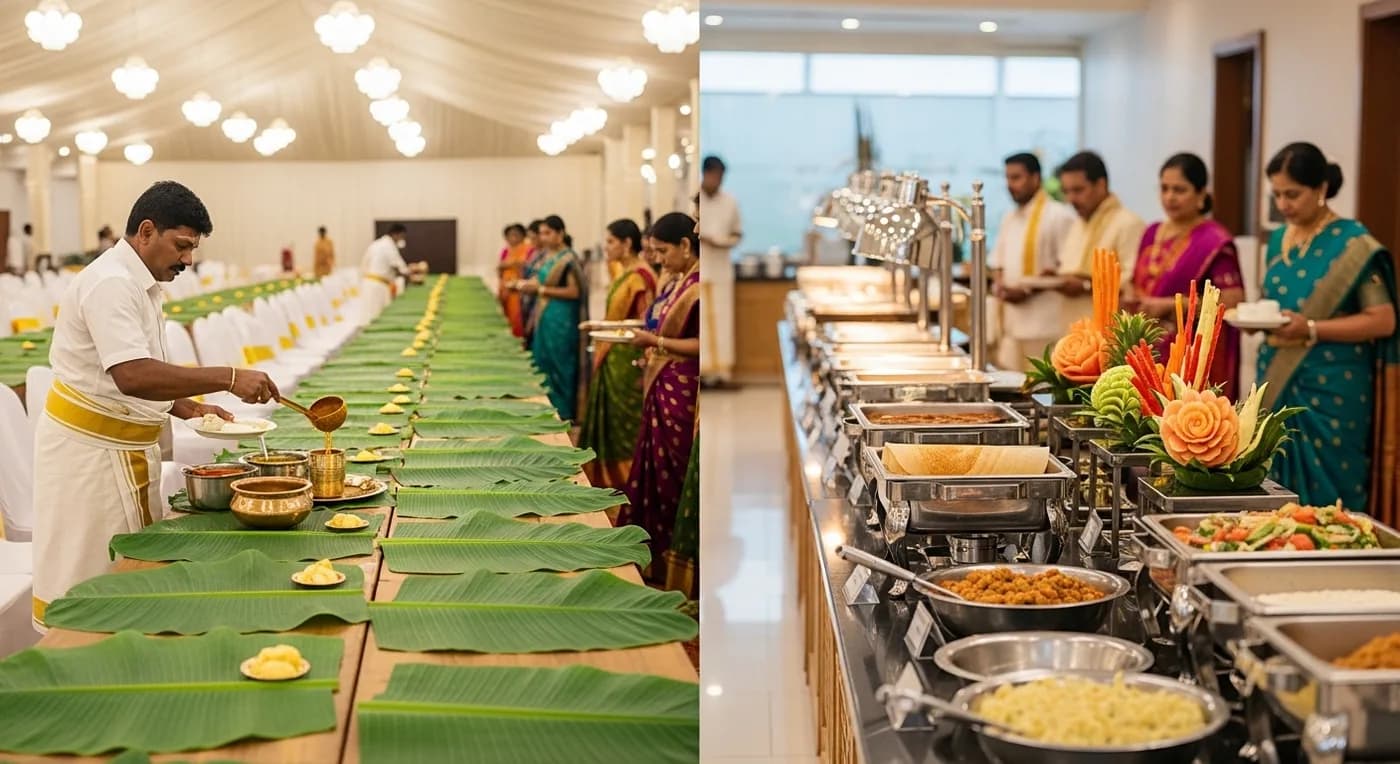
These caterers do one thing: traditional Tamil banana-leaf meals. Their entire operation — kitchen setup, serving crew, logistics — is optimised for speed and consistency at scale. A good saapadu specialist serves 500 guests in 35-40 minutes with every dish at the right temperature. T. Nagar and Mylapore are the traditional hubs for these operators, with several families running catering businesses across three or four generations.
Best for: Morning muhurtham meals, traditional Hindu weddings, families who prioritise authenticity.
Per plate: ₹350 – ₹800
2. Brahmin Caterers (Iyer and Iyengar)
A subset of saapadu specialists who cater exclusively to Brahmin weddings. The distinction matters — Brahmin caterers follow strict no-onion, no-garlic preparation rules that many general caterers overlook. Iyer and Iyengar wedding traditions require different menu items: Iyengar families expect bisibele bath and puliyogare, while Iyer families lean toward puli sadam and thakkali sadam.
With over 4,100 Brahmin caterers listed in Chennai alone, this is a deep and competitive market. Established names like Vivahaa Catering Services and Sri Ram Marriage Catering Services in T. Nagar have decades of reputation built on getting the Brahmin menu exactly right.
Best for: Tamil Brahmin weddings (Iyer, Iyengar), Upanayanam, and religious ceremonies.
Per plate: ₹400 – ₹700
3. Chettinad Non-Veg Specialists
Chettinad cuisine is not just non-veg food — it is a distinct culinary tradition built on complex spice blends, peppercorn-heavy preparations, and techniques that general caterers rarely master. Chettinad wedding caterers handle the full spread: mutton pepper fry, chicken Chettinad, kuzhambu varieties with proprietary spice mixes, and unique desserts like paniyaram.
Best for: Chettinad family weddings, non-veg evening receptions seeking authentic South Indian flavour.
Per plate: ₹600 – ₹1,200
4. Muslim/Halal Caterers (Biryani Specialists)
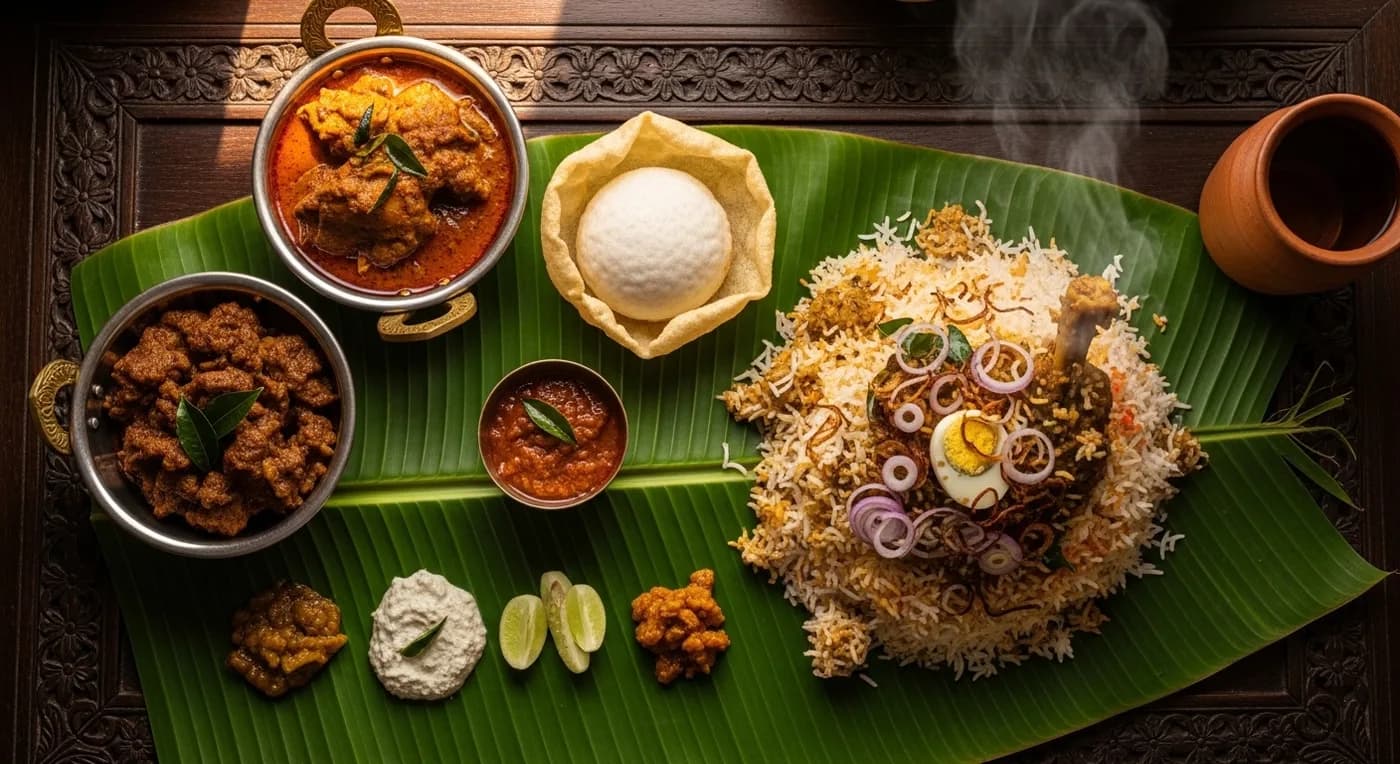
For Chennai's Muslim weddings, the biryani caterer is the most important vendor. The Ambur (Arcot) style biryani — made with seeraga samba rice, a lighter spice profile, and less oil than Hyderabadi dum biryani — is the native Chennai wedding biryani. Caterers in Sowcarpet and Triplicane have perfected this over generations. Prominent names include Zam Zam Caterers and Ahmed Catering, both of whom maintain dedicated halal supply chains.
Best for: Muslim nikah ceremonies, walima receptions, and any event requiring halal certification.
Per plate: ₹500 – ₹1,000
5. Multi-Cuisine Buffet Operators
These caterers handle evening receptions, Christian weddings, and modern celebrations where variety matters more than a single culinary tradition. The menu spans South Indian, North Indian, Chinese, and Continental stations. Anna Nagar and Velachery have seen a concentration of mid-to-large-scale buffet operators emerge over the past five years.
Best for: Evening receptions, Christian weddings, inter-community celebrations.
Per plate: ₹800 – ₹2,000
6. Premium Caterers with Live Counters
The top tier of Chennai catering — live dosa stations, tandoor counters, biryani handis, gelato bars, and filter coffee setups alongside a full buffet. These operations work with 5-star hotel venues on ECR and at luxury mandapams across the city.
Best for: High-end receptions, destination-style celebrations, luxury hotel weddings.
Per plate: ₹1,500 – ₹3,500
Note
Caterer Types at a Glance
| Caterer Type | Speciality | Per Plate | Best Areas | Community Focus |
|---|---|---|---|---|
| Saapadu specialist | Banana-leaf meals | ₹350 – ₹800 | T. Nagar, Mylapore | All Hindu |
| Brahmin caterer | No onion/garlic veg | ₹400 – ₹700 | T. Nagar, Mylapore, Adyar | Iyer, Iyengar |
| Chettinad specialist | Spice-heavy non-veg | ₹600 – ₹1,200 | Perambur, Sowcarpet | Chettinad, Nadar |
| Muslim/halal caterer | Biryani-centred | ₹500 – ₹1,000 | Sowcarpet, Triplicane | Muslim |
| Multi-cuisine buffet | 4-5 cuisine range | ₹800 – ₹2,000 | Anna Nagar, Velachery | All communities |
| Premium with live counters | Full spread + stations | ₹1,500 – ₹3,500 | ECR, city-wide | High-end events |
For the exact per-plate costs across all formats and guest count tiers, our wedding catering cost Chennai guide has the full breakdown.
Looking for Caterings in Chennai?
Tell us what you need and get quotes from verified caterings
What Is Served in a Traditional Tamil Wedding Saapadu?
The Tamil wedding feast — known as virundhu sappadu or elai sappadu — follows a precise sequence on the banana leaf. This is not a random assortment of dishes. Each item has a fixed position on the leaf and a specific order in which it is served and eaten. Understanding this sequence helps you evaluate whether a caterer truly knows the tradition or is simply filling a leaf with food.
The Banana-Leaf Arrangement (Before Serving Begins)
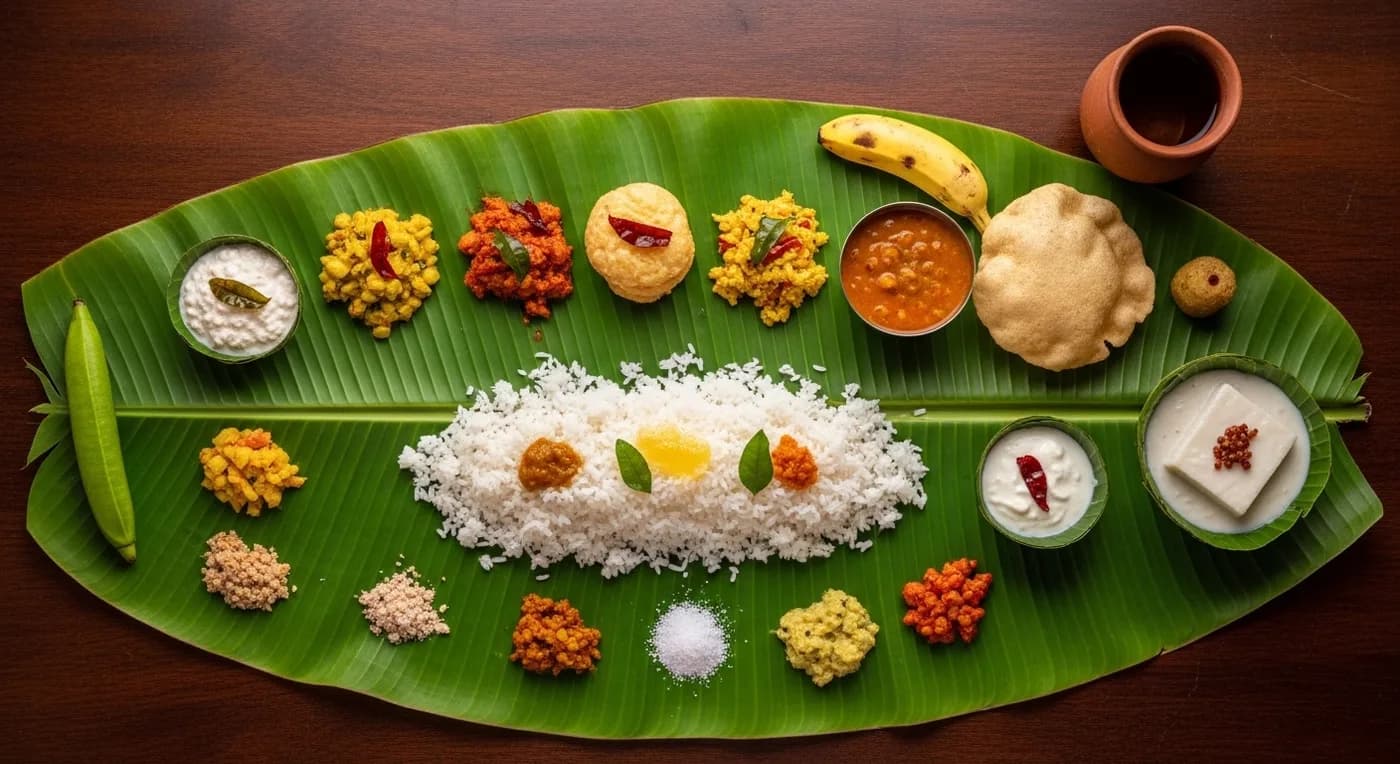
The leaf is placed with the narrow end to the left. Before any rice arrives, these items are set in their traditional positions:
- Top left corner: Pinch of salt, lime pickle, mango pickle
- Top edge: Banana chips, murukku, thattai (fried snacks)
- Upper section: Appalam (papadum), poriyal (2-3 varieties of dry vegetable), kootu, thokku (spicy chutney)
- Centre left: Vadai
- Sweet corner: One or two dry sweets (Mysore pak, badusha, or jangiri)
The Serving Sequence (With Rice)
Once rice is placed in the centre of the leaf, the courses follow a specific order. Each course involves a small serving of rice mixed with the accompanying dish:
- Paruppu with ghee — The first course. Generous ghee on the paruppu signals quality. A stingy ghee pour is the fastest way for a caterer to lose credibility with Tamil guests.
- Sambar — The anchor dish. This is the item guests judge most critically. It must be complex, well-spiced, and thick enough to coat the rice.
- Ennai kathirikai kuzhambu or another signature kuzhambu — A tangy, oil-based gravy.
- Rasam — The palate cleanser. Pepper rasam is traditional; tomato rasam is acceptable.
- Mor kuzhambu (spiced buttermilk curry) — The cooling transition course.
- Curd rice — The final savoury course. Eaten with pickle.
- Payasam — The grand finale. Served in 2-5 varieties depending on the wedding's prestige tier.
The Payasam Question
I have seen families spend more time discussing the payasam count than the mandapam budget. At Tamil weddings, the number of payasam varieties directly signals the family's generosity and the wedding's status:
- 2 varieties (basic): Paruppu pradhaman and semiya payasam. Acceptable for weekday or budget weddings.
- 3 varieties (standard): Adds kesari or badam kheer. The norm for most mid-range Chennai weddings.
- 4-5 varieties (premium): Adds paal payasam, rava kesari, javvarisi payasam, or seasonal fruit payasam. Expected at large celebrations.
Tip
How Do Community-Specific Menus Differ in Chennai?
Chennai is home to a remarkable range of communities, each with distinct wedding food traditions. The caterer you choose must understand your community's specific requirements — a generic "South Indian" caterer will not produce an authentic Chettinad feast or a proper Iyengar wedding menu.
Iyer Weddings
Strictly vegetarian, no onion, no garlic. The menu centres on sambar, rasam, kootu, poriyal, and multiple payasam varieties. Puli sadam (tamarind rice), thakkali sadam (tomato rice), and lemon rice are expected extras. Specify the no-onion/no-garlic rule explicitly in your contract — I have seen caterers "forget" this restriction when scaling up for large events.
Iyengar Weddings
Also strictly vegetarian with no onion and no garlic, but the menu includes distinct items: bisibele bath (the signature Iyengar wedding dish), puliyogare, kosambari, and specific payasam varieties like rawa kesari. The cooking style differs subtly from Iyer preparation — an experienced Brahmin caterer knows these differences without being told.
Chettinad Weddings
Non-vegetarian is the centrepiece. Mutton pepper fry, chicken Chettinad, prawn masala, kuzhambu varieties with proprietary spice blends, and idiyappam or appam as accompaniments. The spice-forward Chettinad palate cannot be replicated by a general non-veg caterer — the masala mixes are closely guarded family recipes passed down through generations.
Nadar Weddings
A blend of vegetarian and non-veg depending on the family. The distinctive Ponn Urukku ceremony includes specific food offerings. Non-veg Nadar wedding menus feature Tirunelveli-style preparations with tamarind-heavy gravies and palm jaggery desserts.
Muslim Weddings (Nikah)
Ambur-style biryani is the non-negotiable centrepiece. The full nikah spread includes mutton biryani, chicken 65, mutton stew, pathiri, haleem for larger celebrations, and rose-flavoured desserts. All meat must come from verified halal sources. Caterers in Sowcarpet and Royapettah specialise in this format with supply chains built for halal compliance.
Christian Weddings
Multi-cuisine is standard, with no dietary restrictions. The evening reception format dominates — buffet with South Indian, North Indian, and Continental stations. Biriyani, fish fry, chicken roast, and Western-influenced desserts are expected. See our Christian wedding in Chennai guide for the full planning picture.
Telugu Weddings in Chennai
Telugu families in Chennai blend Andhra flavours into the Tamil format. Pulihora (tamarind rice), pesarattu, gongura-based dishes, and Andhra-style pickles appear alongside standard Tamil items. Caterers in Anna Nagar and Ambattur — areas with larger Telugu populations — handle this fusion well.
Important
How Do You Verify a Caterer's FSSAI Licence?
Every commercial caterer in India must hold a valid FSSAI licence — this is a legal requirement under the Food Safety and Standards Act, not an optional credential. When I evaluate caterers for couples planning through our platform, FSSAI verification is the first check.
FSSAI Licence Types for Caterers
The licence type depends on annual turnover, as defined by FSSAI's eligibility criteria:
- Basic Registration: Turnover below ₹12 lakhs per annum. Suitable only for small-scale operations.
- State FSSAI Licence: Turnover between ₹12 lakhs and ₹20 crores. This covers the majority of wedding caterers in Chennai.
- Central FSSAI Licence: Turnover above ₹20 crores. Required for large-scale operations.
For a caterer handling 300+ guest weddings, a State FSSAI licence is the minimum you should expect. A caterer operating at wedding scale with only a basic registration is technically non-compliant.
How to Verify
- Ask for the 14-digit FSSAI licence number.
- Visit the FoSCoS verification portal and enter the number.
- Check the licence status (active vs expired) and the licence type.
- Confirm the business name matches the caterer you are hiring.
Red Flags
- The caterer cannot produce a licence number when asked.
- The licence is expired — this means they have skipped mandated food safety inspections.
- The licence is registered under a different business name or address.
- They claim "we are in the process of getting it" — this means they are currently operating illegally.
Important
What Should You Look for During a Tasting Session?
The tasting is your most important evaluation moment — more reliable than online reviews, more honest than a caterer's brochure photos, and more revealing than any conversation.
How Tastings Work in Chennai
- Free for large orders: Most reputable caterers offer free tastings for confirmed orders above 300 plates.
- Paid for smaller events: ₹2,000 – ₹5,000, typically adjusted against the final bill.
- Timing: Schedule tastings 4-6 months before the wedding. This gives you time to compare three caterers and make a confident decision.
- Who to bring: Both families. In Tamil weddings, the groom's family's satisfaction with the food carries significant cultural weight.
What to Taste (Saapadu)
- Paruppu with ghee — Is the ghee generous and aromatic, or a thin drizzle?
- Sambar — Is it complex and well-balanced, or flat and generic?
- Rasam — Does it have pepper kick and depth?
- Payasam — Is it thick and flavourful, or watery and over-sweetened?
- Rice quality — Is the grain separate and well-cooked, or mushy?
What to Taste (Buffet)
- Proteins — Chicken should be tender and fully cooked. Fish should taste fresh. Biryani rice should have separate grains, never mushy.
- Starters — These are the first thing guests eat and judge.
- Desserts — Often the weakest link in mid-range buffets. Taste them.
Red Flags at a Tasting
- The caterer selects which items you taste instead of offering the full menu
- Food is pre-prepared hours ahead rather than freshly cooked
- Portion sizes at the tasting are clearly larger than what they will serve at scale
- They refuse to let you visit their base kitchen
- The tasting venue is spotless but the caterer has no permanent kitchen facility
Looking for Caterings in Chennai?
Tell us what you need and get quotes from verified caterings
What Contract Terms Must You Get in Writing?
A verbal agreement with a caterer is a recipe for disputes. Every detail must be in writing — and in Chennai's competitive market, reputable caterers expect this.
Essential Contract Clauses
Menu specification: The exact dish list with item names — not "standard saapadu items" but "paruppu, sambar, rasam, mor kuzhambu, 3 poriyals (beans, cabbage, carrot), kootu, vadai, appalam, 3 pickles, 3 payasam (paruppu pradhaman, semiya payasam, kesari)." If it is not written, it will not appear on the banana leaf.
Per-plate rate and total cost: The agreed rate, the minimum guest guarantee (typically 80-90% of expected count), and the per-plate rate for additional guests above the guarantee.
Serving staff count: For saapadu, the minimum is 8-10 servers per 100 guests. For buffet, each station needs at least one dedicated server. Understaffing destroys the dining experience.
Timing: Exact service start and end times. For a morning muhurtham, specify when the kitchen setup begins (typically 3-4 hours before service) and when the meal must be ready for service.
Equipment and banana leaves: Who supplies the banana leaves (critical during peak November-January season when sourcing is tight), chafing dishes, serving plates, water service, and dining furniture.
Payment schedule: The standard Chennai catering payment is:
- 10-20% advance at booking
- 30-40% two weeks before the event
- Balance on the day or within one week after
GST and service charges: Confirm whether the quoted per-plate rate includes or excludes GST (5% on catering services) and service charges (10-15% at many operations). A ₹600 per-plate quote that excludes both becomes ₹693 per plate after taxes and charges — across 600 guests, that is an additional ₹55,800 you did not budget for.
Cancellation terms: What happens if you cancel or reduce the guest count. Most caterers allow reductions up to 10-15% without penalty if communicated 7-10 days before the event. Larger reductions typically incur charges on 50-70% of the cancelled plates, since the caterer has already committed to ingredient procurement.
Tip
Where Are Chennai's Best Caterer Hubs?
Chennai's catering market is geographically concentrated in a few key areas. Knowing where to look narrows your search.
T. Nagar
The traditional heart of Chennai's catering industry. Multi-generational saapadu specialists, Brahmin caterers, and large-scale operations are concentrated here. Arusuvai Arasu, with over 75 years and 75,000+ weddings, is headquartered on Usman Road. GR Iyer Caterers operates from Griffith Road. If you are looking for a proven saapadu or Brahmin caterer, T. Nagar is where you start. The density of kalyana mandapams in T. Nagar — including some of the city's most popular wedding halls — means caterers here are accustomed to the specific kitchen layouts, water supply configurations, and serving logistics of these venues. For venue details, see our best kalyana mandapams in Chennai guide.
Mylapore
Home to established Brahmin and saapadu caterers serving the traditional wedding circuit around Mylapore, Triplicane, and Mandaveli. The caterers here work closely with community kalyana mandapams and temple wedding halls — they know the kitchen layouts, the timing constraints, and the guest flow patterns of these venues.
Sowcarpet
Chennai's hub for Muslim and halal caterers. Biryani specialists who handle nikah ceremonies and walima receptions are concentrated in this area and neighbouring Royapettah. If you need Ambur-style biryani at scale with verified halal sourcing, Sowcarpet caterers are your primary option.
Anna Nagar
A growing hub for multi-cuisine and modern buffet operators serving the north Chennai and west Chennai wedding market. Caterers here tend to be newer operations with contemporary presentation — live counters, themed stations, and fusion menus — compared to the traditional operators in T. Nagar and Mylapore. Anna Nagar caterers also serve Ambattur, Mogappair, and Padi — areas with significant Telugu populations where Andhra-Tamil fusion menus are common.
ECR (East Coast Road)
For destination-style and beach wedding venues on ECR, caterers must handle outdoor kitchen setups, generator-dependent refrigeration, and sand-and-wind challenges. A small but growing number of premium caterers specialise in ECR events, working with resort venues like Fisherman's Cove and Ideal Beach Resort. Expect a 15-25% premium over city venue rates due to transport and logistics.
Perambur and Kolathur
The north Chennai corridor with a strong base of mid-range caterers serving both vegetarian and non-veg markets. Perambur caterers have a reputation for competitive pricing and large-scale execution — many handle the 800-1,000 guest events that are common in north Chennai communities.
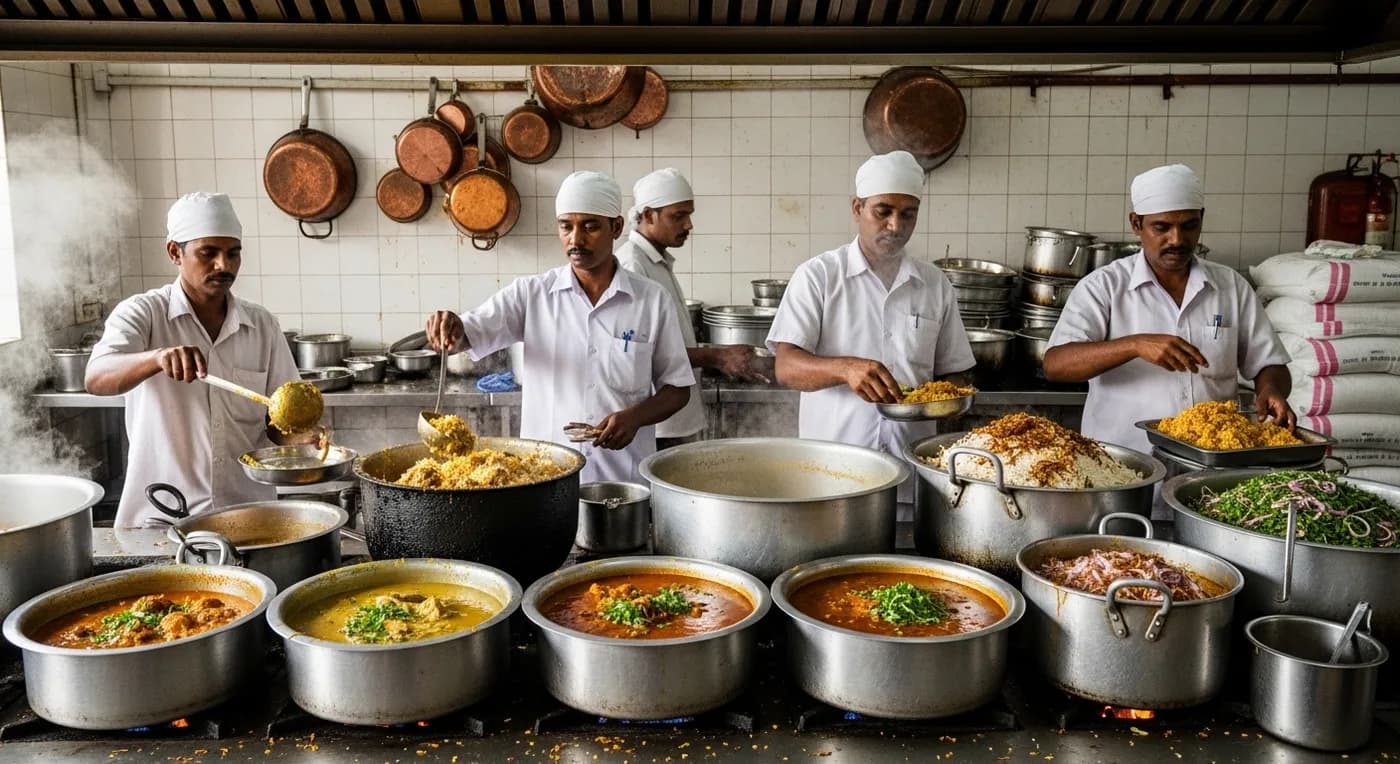
How Do Non-Veg Catering Trends Shape Chennai Weddings?
Non-veg evening reception buffets are now standard across most communities in Chennai, with the hybrid format — vegetarian saapadu morning, non-veg buffet evening — dominating the city's wedding catering landscape in 2026. The morning muhurtham meal remains vegetarian for Hindu families.
The Evening Reception Shift
The pattern I see most often in 2026: a traditional vegetarian saapadu for the morning ceremony, followed by a non-veg multi-cuisine buffet at the evening reception. This gives families the best of both worlds — cultural authenticity in the morning, modern variety at night. India's wedding industry, valued at ₹10.79 lakh crore, is seeing this hybrid format become the dominant model in metro cities.
The shift is driven partly by younger couples who want variety at their receptions, and partly by the fact that evening guests — work colleagues, college friends, business associates — expect a multi-cuisine spread. In areas like Anna Nagar, Velachery, and OMR where younger professional families dominate, the non-veg evening reception is now the default rather than the exception.
What Non-Veg Options Cost
| Non-Veg Format | Per Plate | Proteins Included |
|---|---|---|
| Biryani-focused (Muslim style) | ₹500 – ₹1,000 | Chicken or mutton biryani, starters |
| Chettinad spread | ₹600 – ₹1,200 | Mutton pepper fry, chicken Chettinad, fish |
| Standard non-veg buffet | ₹800 – ₹1,500 | Chicken, fish, 2 non-veg mains |
| Premium non-veg with seafood | ₹1,500 – ₹2,500 | Mutton, prawns, crab, multiple preparations |
Biryani Styles Available in Chennai
Chennai's biryani catering market offers three distinct styles:
- Ambur (Arcot) biryani: Seeraga samba rice, lighter preparation, star anise and mint notes. The native Chennai Muslim wedding biryani.
- Hyderabadi dum biryani: Basmati rice, heavier ghee usage, layered dum-cooking method. Popular at premium receptions.
- Dindigul biryani: Short-grain rice, tangy flavour profile with curd and lemon notes. Gaining popularity at Chettinad and South Tamil Nadu community weddings.
The protein you choose drives the per-plate cost more than any other variable. Mutton adds ₹150-250 per plate over chicken. Prawns or crab add another ₹100-200. A chicken-and-fish buffet at ₹900 per plate is a fundamentally different offering from a spread with mutton biryani, prawn masala, and crab curry at ₹1,800. When comparing quotes, make sure you are comparing identical protein selections — not just the headline per-plate number.
How Should You Plan Guest Count for Catering?
Getting the guest count right is the single most powerful budget lever in Chennai wedding catering. Every additional 100 guests adds ₹35,000 – ₹2,00,000 to your food bill depending on the format.
The Chennai Attendance Rule
From weddings I have helped coordinate across the city, actual attendance in Chennai runs at:
- Morning muhurtham saapadu: 85-95% of invited guests. Chennai's compact geography and the cultural importance of attending the muhurtham ceremony push attendance very high.
- Evening reception: 60-75% of invited guests. Work colleagues and distant relatives are more selective about evening events.
The Minimum Guarantee
Every caterer contract includes a minimum guarantee — the number of plates you pay for regardless of actual attendance. Negotiate this carefully:
- Set the minimum at 80% of your realistic guest estimate
- Confirm the per-plate rate for guests above the minimum
- Clarify the deadline for final count communication (typically 5-7 days before)
- Build a 10-15% buffer above your expected count — Tamil weddings frequently have walk-in guests (uninvited but culturally accepted neighbours and extended family)
Running out of food at a Tamil wedding is a social disaster that families talk about for years. It is far better to have 50 extra plates prepared than to have 50 guests waiting while the kitchen scrambles. The cost of overpreparation (₹15,000 – ₹40,000 for 50 extra plates) is trivial compared to the reputational damage of running short.
For the detailed cost impact of guest count tiers — from 300 to 1,000 guests across every format — see our catering cost calculator. For a broader understanding of how catering fits within your total wedding budget, see our Chennai wedding budget guide.
What Questions Should You Ask Before Booking?
These ten questions separate serious caterers from mediocre ones. Ask all of them during your first meeting.
- What is your exact dish count and menu? Get specific item names in writing. "Standard items" is not a menu.
- What is your FSSAI licence number? Verify it before the tasting.
- How many serving staff per 100 guests? Minimum 8-10 for saapadu, 1 per station for buffet.
- Do you source your own banana leaves? During peak muhurtham season (November-February), banana leaf sourcing becomes a genuine logistical problem.
- Can I attend a live event you are catering? Seeing them work at someone else's wedding is the gold standard for evaluation.
- Who will be the head chef or supervisor at my event? Get a name in the contract.
- What is your cancellation and reduction policy? Understand the penalties before you sign.
- Do you provide crockery, water service, and dining furniture? Or is that a separate charge?
- What is your experience with my community's cuisine? Ask for references from recent weddings in your specific community.
- What happens if you undercount and run short? A reputable caterer has a contingency protocol for unexpected guest surges.
Common Questions About Best Wedding Caterers in Chennai
What types of wedding caterers are available in Chennai?
Chennai has six main caterer categories: banana-leaf saapadu specialists (₹350 – ₹800 per plate), Brahmin caterers serving Iyer/Iyengar menus with no onion or garlic, Chettinad non-veg specialists, Muslim halal and biryani caterers based primarily in Sowcarpet, multi-cuisine buffet operators, and premium caterers offering live counters. Most Chennai families hire a saapadu specialist for the morning muhurtham and a separate buffet caterer for the evening reception.
How do I check if a wedding caterer has a valid FSSAI licence?
Request the caterer's 14-digit FSSAI licence number and verify it on the FoSCoS portal. Wedding caterers serving 300+ guests should hold a State FSSAI licence at minimum. Check that the licence is active (not expired), the business name matches, and the licence type aligns with the caterer's scale. An unlicensed caterer is both a health risk and a legal liability.
What does a traditional Tamil wedding banana-leaf saapadu include?
A full saapadu includes 18-28 items arranged on a banana leaf in a fixed sequence. Before rice arrives: salt, pickle, chips, appalam, poriyal, kootu, vadai, and sweets. With rice: paruppu and ghee (first), sambar, kuzhambu, rasam, mor kuzhambu, curd rice. The meal ends with 2-5 payasam varieties. The payasam count signals the wedding's prestige — guests notice this above everything else.
Is it better to use two different caterers for the morning and evening events?
Yes. A saapadu specialist's entire workflow is built for banana-leaf service — the crew positions, the kitchen setup, the serving cadence. A multi-cuisine buffet caterer optimises for variety and presentation across stations. Using specialists for each format delivers better quality at both events. This is the standard approach for mid-range and premium Chennai weddings.
When should I book my wedding caterer in Chennai?
For auspicious muhurtham dates in peak months — Thai (Jan-Feb), Panguni (Mar-Apr), and Aippasi (Oct-Nov) — book 6-10 months in advance. The best saapadu specialists in T. Nagar and Mylapore fill peak-season slots a full year ahead. Off-season dates need 3-5 months of lead time. For the full booking timeline, see our Chennai wedding checklist.
What should I focus on during a catering tasting session?
Taste the core items: sambar (must be complex, not flat), paruppu with ghee (generosity matters), rasam (should have pepper depth), and at least two payasam varieties. Check food temperature — lukewarm sambar at a tasting predicts the same problem at your wedding. Bring both families. Schedule tastings 4-6 months ahead so you can compare three caterers.
How common is non-veg catering at Chennai weddings now?
Non-veg evening reception buffets are now standard across most communities in Chennai, though the morning muhurtham meal remains vegetarian for Hindu families. Muslim nikah ceremonies feature Ambur-style biryani as the centrepiece. Chettinad weddings serve spice-heavy mutton and chicken preparations. The hybrid format — vegetarian saapadu morning, non-veg buffet evening — is the dominant pattern in 2026.
What is the difference between Ambur and Hyderabadi biryani at weddings?
Ambur biryani uses seeraga samba rice, lighter spicing with star anise and mint, and less oil — it is the native Chennai Muslim wedding biryani and is slightly more affordable. Hyderabadi dum biryani uses basmati rice, more ghee, and a layered cooking method. Most Chennai nikah caterers default to Ambur-style. Premium receptions sometimes offer both as parallel stations.
Further Reading
- Wedding Catering Cost in Chennai — Detailed per-plate pricing and total budget calculations for every format
- Chennai Wedding Budget Guide — How catering fits into your total wedding budget
- Chennai Wedding Planning Guide — Complete planning timeline with vendor booking milestones
- Budget Wedding in Chennai — Strategies for keeping catering costs under control
- Best Kalyana Mandapams in Chennai — Venue guide with catering kitchen details
- Iyer vs Iyengar Wedding — Community-specific traditions that affect your caterer choice
Browse all verified wedding caterers in Chennai to compare menus, pricing, and reviews.
Tip
Plan your wedding with free tools — generate a personalised timeline with our AI Wedding Checklist, estimate your full budget with the Cost Calculator, or create a beautiful digital invitation.
Looking for Caterings in Chennai?
Tell us what you need and get quotes from verified caterings
Topics
best wedding caterers in ChennaiTamil wedding food menubrahmin catering Chennainon-veg catering Chennaiwedding caterers near me ChennaiChennai wedding saapaduFSSAI caterer verificationmadras weddingsExplore more
Frequently Asked Questions
1What types of wedding caterers are available in Chennai?
2How do I verify if a Chennai wedding caterer has an FSSAI licence?
3What is served in a traditional Tamil wedding banana-leaf saapadu?
4Should I hire separate caterers for the morning ceremony and evening reception?
5How far in advance should I book a wedding caterer in Chennai?
6What should I look for during a catering tasting session?
7Is non-veg catering common at Chennai weddings?
8What is the difference between Ambur biryani and Hyderabadi biryani for weddings?
Continue reading
Related Articles
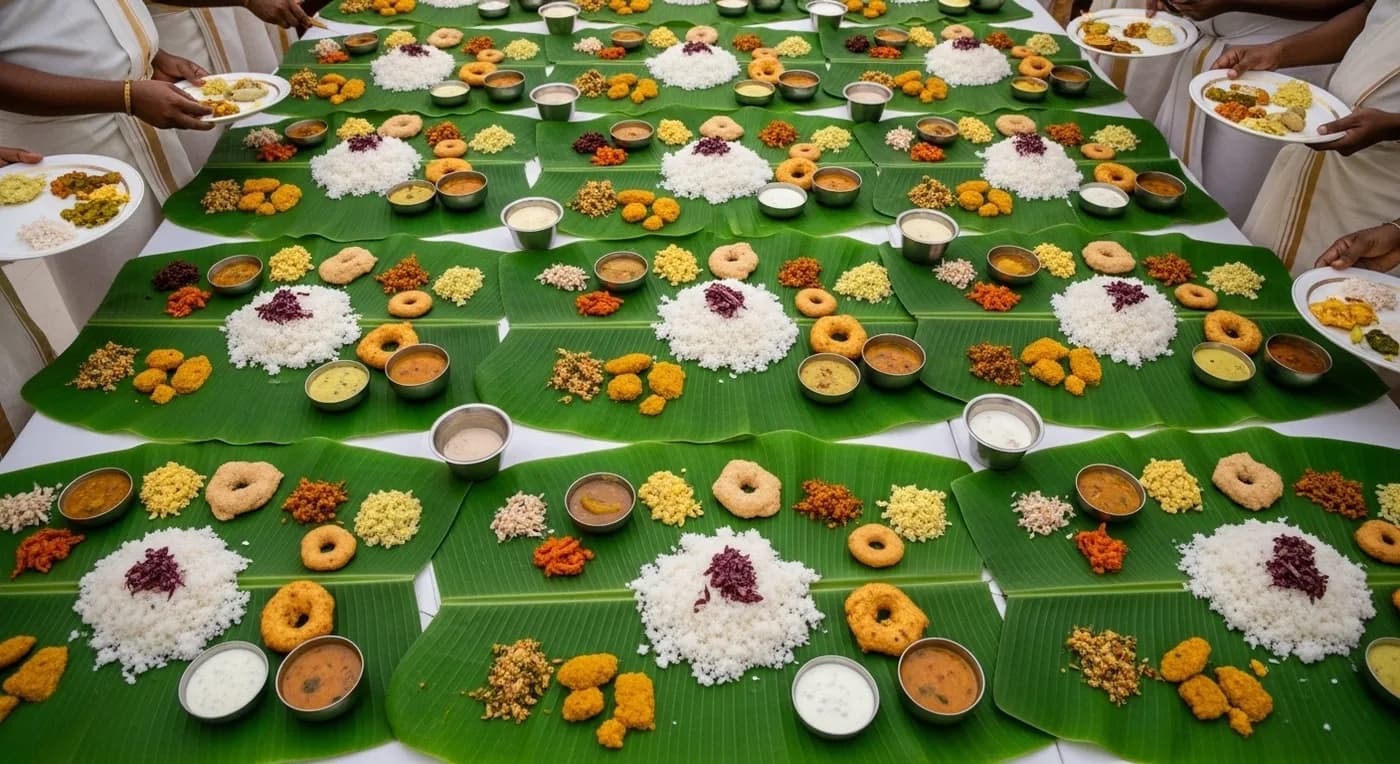
Wedding Catering Cost in Chennai: Saapadu to Multi-Cuisine
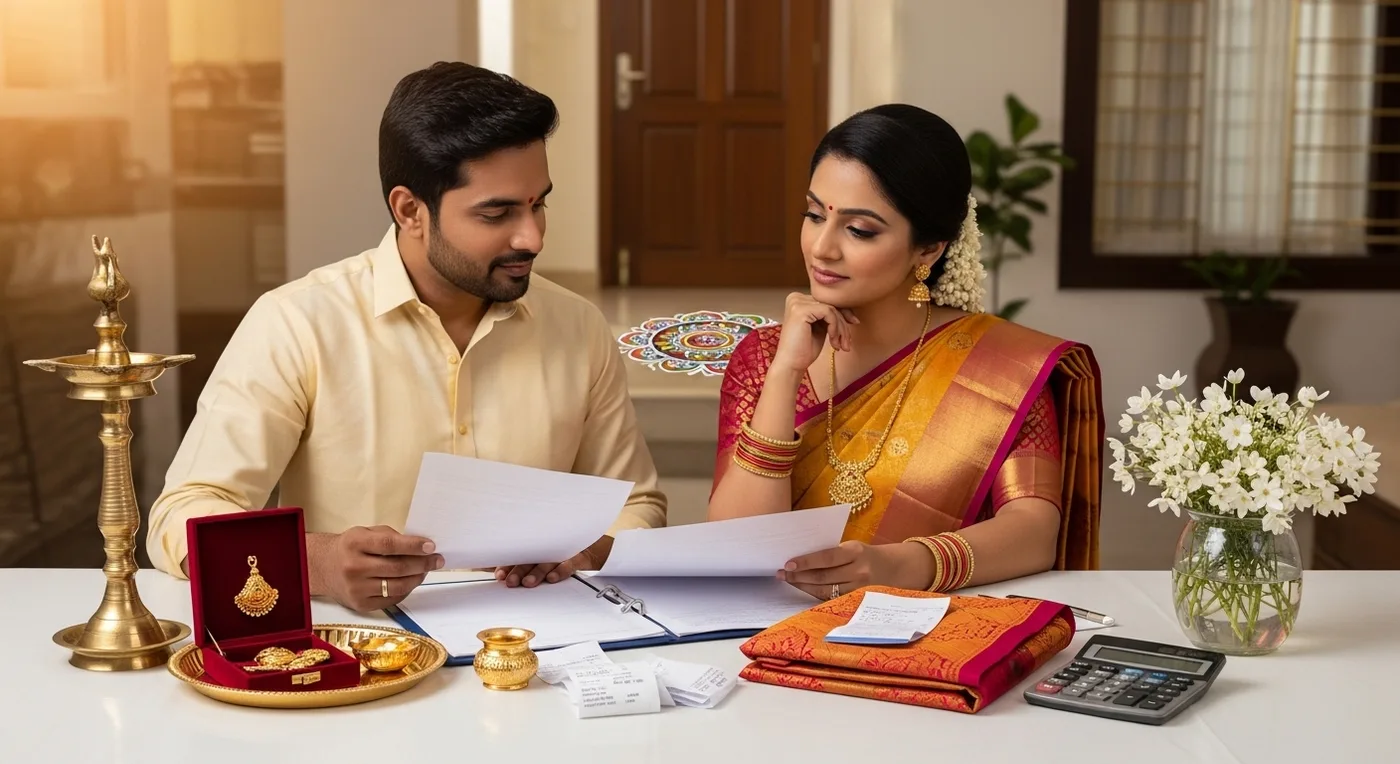
Chennai Wedding Cost in 2026: ₹5–20 Lakhs Full Budget Breakdown
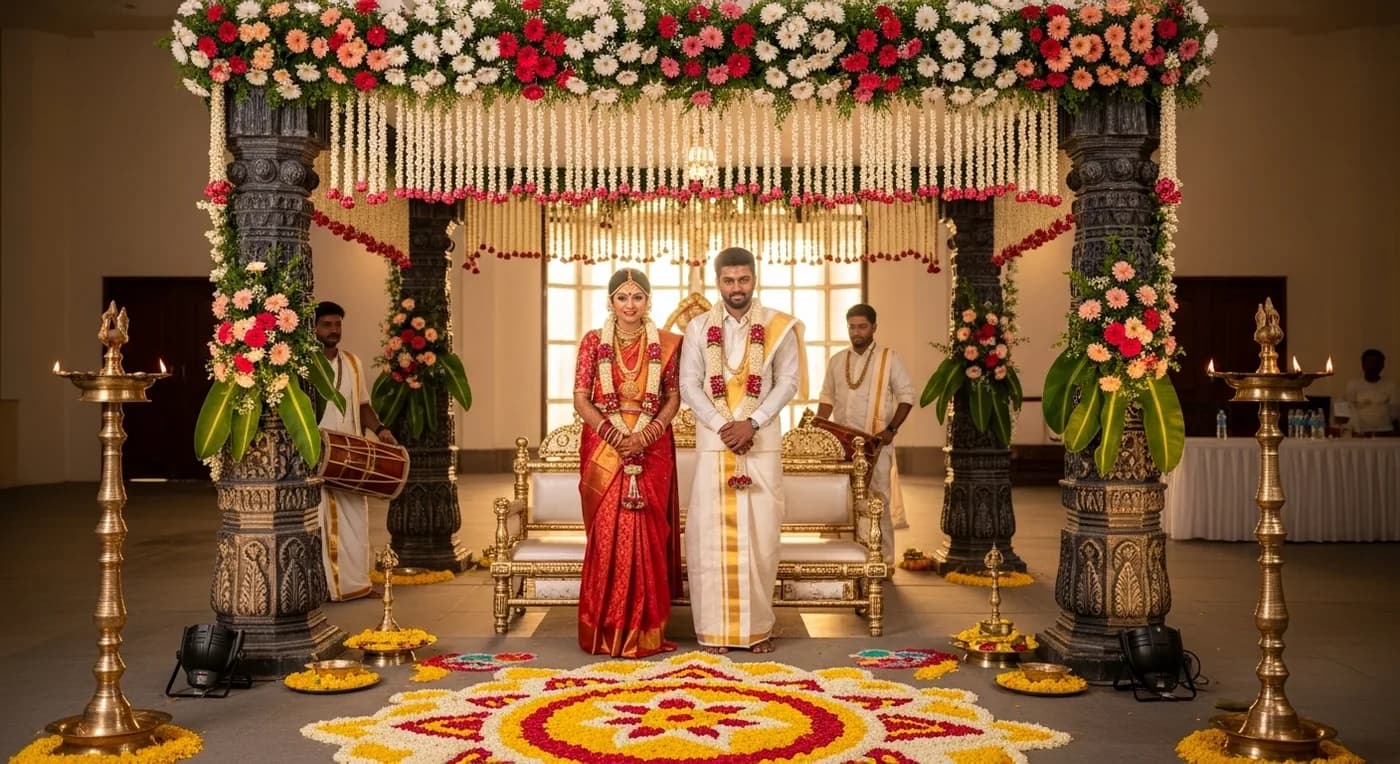
How to Plan a Chennai Wedding: The Complete 2026 Guide

Best Season for South India Destination Weddings: Month-by-Month Western Ghats Guide
Destination Wedding Cost in South India 2026: 5-Tier Budget Guide

Destination Wedding in South India: Complete 2026 Planning Guide
Still planning?
Get quotes from India's best vendors
Tell us what you're planning and we'll match you with verified photographers, venues, decorators, and more.
Get free quotes