
Telugu Wedding in Chennai: Pelli Ceremony & Planning Guide
Plan a Telugu wedding in Chennai — complete Pelli ceremony guide covering Jeelakarra-Bellam, Talambralu, 3–4 hour ritual sequence, Telugu-speaking purohits, and mandapam venues.

On this page
Chennai hosts one of the largest Telugu-speaking populations outside Andhra Pradesh and Telangana, concentrated in T. Nagar, Anna Nagar, and Sowcarpet. Telugu weddings here blend Andhra rituals — Jeelakarra-Bellam (cumin-jaggery paste), the joyful Talambralu rice shower, and Saptapadi — within Tamil Nadu's kalyana mandapam infrastructure and muhurtham-first scheduling tradition, creating a distinctly Chennai-Telugu wedding culture.
Quick Answer
Quick answer: Chennai hosts one of the largest Telugu-speaking populations outside Andhra Pradesh and Telangana, concentrated in T. Nagar, Anna Nagar, and Sowcarpet. Telugu weddings here blend Andhra rituals — Jeelakarra-Bellam (cumin-jaggery paste), the joyful Talambralu rice shower, and Saptapadi — within Tamil Nadu's kalyana mandapam infrastructure and muhurtham-first scheduling tradition, creating a distinctly Chennai-Telugu wedding culture.
Note
Pricing methodology: Cost ranges in this guide are based on vendor pricing data from the itsmy.wedding marketplace and published industry reports, collected in Q4 2025 – Q1 2026.
Chennai (formerly Madras) is home to one of the largest Telugu-speaking populations outside Andhra Pradesh and Telangana, and Telugu weddings in the city have developed their own distinctive character — blending the complete Andhra and Telangana ritual framework with Tamil Nadu's wedding infrastructure, muhurtham-centric scheduling, and local venue traditions. If you are planning a Pelli (Telugu wedding) in Chennai, you are navigating a cultural space where Jeelakarra-Bellam (cumin-jaggery) meets the kalyana mandapam, and Talambralu (the joyful rice shower) happens under the same roof where Tamil families tie the thali.
This guide covers the full Telugu wedding ceremony, its pre-wedding rituals, attire, cuisine, and — critically — the practical details of planning a Telugu wedding specifically in Chennai: finding Telugu-speaking purohits, sourcing Andhra-style catering, booking venues that accommodate Telugu ceremony requirements, and navigating the subtle cultural blend that makes Chennai's Telugu weddings unique. For the broader Chennai wedding landscape, see our Chennai wedding planning guide.
The Telugu Community in Chennai
Demographics and History
The Telugu presence in Chennai is not recent. Telugu-speaking communities have been part of the city's fabric for centuries — traders, administrators, artisans, and professionals who migrated from the Andhra and Rayalaseema regions during the Vijayanagara, Nayak, and British periods. Chennai's historic Sowcarpet area, originally a textile trading hub, has a significant Telugu-speaking population. T. Nagar — the city's commercial heart — was partly shaped by Telugu business families, as were Anna Nagar, West Mambalam, Kodambakkam, and Virugambakkam.
Today, the Telugu community in Chennai spans every economic and professional segment — from business families who have been here for generations to IT professionals who arrived in the 2000s. Their weddings contribute to Tamil Nadu's position as one of India's largest state economies and its thriving wedding services market. This demographic diversity means Telugu weddings in Chennai range from intimate family ceremonies at community halls to elaborate celebrations at five-star hotels.
Cultural Identity Maintenance
What makes Chennai's Telugu community remarkable is its cultural continuity. Families who have lived in Tamil Nadu for three or four generations continue to conduct their weddings in Telugu, following Andhra or Telangana rituals, hiring Telugu-speaking purohits, and serving Telugu cuisine alongside or instead of Tamil food. Children grow up speaking Tamil at school and Telugu at home, and the wedding is often the event where Telugu identity is most visibly, joyfully expressed.
Note
Pre-Wedding Ceremonies
Pelli Choopulu: The Formal First Meeting
The Pelli Choopulu (literally "wedding glances") is the Telugu engagement tradition that has gained mainstream fame through the 2016 Telugu film of the same name. In practice, it is the formal first meeting between the bride, groom, and their families — typically held at the bride's home, a temple, or a restaurant.
The families exchange pleasantries, the couple is given a brief opportunity to see and speak with each other, and the elders assess compatibility. Gifts — typically fruits, sweets, a silk saree for the bride, and a silk dhoti for the groom — are exchanged. If both families agree, the match is considered fixed, and the Pelli Choopulu transitions into a celebration with a shared meal.
In modern Chennai, the Pelli Choopulu has evolved from a formal, elder-driven evaluation to a more relaxed meeting — though the ritual elements (gift exchange, elder presence, shared food) remain. Some families combine the Pelli Choopulu with the formal engagement, especially when both the bride and groom live in Chennai and have already met through professional or family networks.
Nishchitartham (Engagement)
The Nishchitartham is the formal engagement ceremony. Both families gather — often at a temple, community hall, or the bride's home — and the match is publicly announced. The groom's family presents the bride with a silk saree and gold jewellery; the bride's family presents the groom with a silk dhoti and a new outfit. Rings are exchanged, and the wedding date — determined by consulting the panchangam (almanac) — is formally fixed.
In Chennai, the Nishchitartham is sometimes held at a Venkateswara or Srinivasa temple, reflecting the Telugu community's deep devotion to Lord Venkateswara of Tirupati. The Tirumala Tirupati Devasthanam (TTD) trust has affiliated temples in Chennai where Telugu families frequently hold engagement ceremonies and other auspicious events.
Pellikuthuru and Pellikoduku (Haldi Ceremonies)
The Pellikuthuru (bride's haldi) and Pellikoduku (groom's haldi) are performed separately at their respective homes on the day before or the morning of the wedding. Turmeric paste mixed with oil is applied to the bride and groom by married women of the family. The ceremony is accompanied by singing — traditional Telugu folk songs that carry blessings, advice, and playful teasing.
In Telugu tradition, the bride's Pellikuthuru is a major social event — female relatives and friends gather for hours of song, laughter, and application of elaborate turmeric and sandalwood designs. The groom's Pellikoduku is typically shorter but equally joyful.
Wedding Day Rituals Step by Step
The Telugu wedding ceremony — the Pelli — follows a carefully sequenced progression of rituals, each carrying specific symbolic weight. The core ceremony takes three to four hours, though streamlined modern versions can be completed in two to two and a half hours.
Ganapathi Puja (Ganesh Worship)
Every Telugu wedding begins with Ganapathi Puja — prayers offered to Lord Ganesha, the remover of obstacles. The purohit invokes Ganesha's blessings to ensure the ceremony proceeds without hindrance. This is performed at the mandapam before the bride and groom take their places, and it sets the spiritual tone for everything that follows.
Kanya Pravesham and Kashi Yatra
The bride is escorted to the mandapam by her maternal uncle — a tradition that gives the mama (maternal uncle) a position of honour in Telugu weddings. In some Telugu sub-communities, the Kashi Yatra is also performed — similar to the Tamil version, the groom pretends to leave for Kashi and is persuaded to return by the bride's father.
Jeelakarra-Bellam: The Binding of Sweetness
The Jeelakarra-Bellam ceremony is one of the most distinctive Telugu wedding rituals. A paste made from jeelakarra (cumin seeds) and bellam (jaggery) is placed on the couple's heads — first on the bride's head by the groom, then on the groom's head by the bride. The couple then places their hands on each other's heads simultaneously, symbolically blending the paste.
The symbolism is direct and beautiful: cumin represents the bitter or difficult aspects of life, jaggery represents sweetness and happiness. By mixing them and placing the paste on each other's heads, the couple commits to sharing both the bitter and the sweet — experiencing all of life's dimensions together. The act of simultaneous placement represents equality and mutuality in the partnership.
Tip
Kanyadaanam
The Kanyadaanam — the giving away of the bride — follows the broad Hindu structure. The bride's father places her right hand in the groom's, pouring sacred water over their joined hands while Vedic mantras are chanted. This is one of the most emotionally charged moments, and in Telugu tradition, it is accompanied by the recitation of the bride's gothra (lineage) and the groom's gothra, formally joining the two families.
Mangalsutra Dharanam
The groom ties the mangalsutra (sacred necklace with two gold pendants) around the bride's neck, securing it with three knots. The nadaswaram reaches its peak, drums thunder, and the assembled guests shower the couple with rice and flower petals. In Telugu tradition, the mangalsutra features two pendant discs — bottu — one from each family, strung on a yellow thread infused with turmeric.
Saptapadi (Seven Steps)
The Saptapadi — the seven steps around the sacred fire — gives the marriage its formal Vedic validity. The couple walks together around the agni, taking one step for each vow. The Telugu Saptapadi vows are specific in their promises: food and sustenance, strength and mutual support, wealth and prosperity, happiness, progeny, seasonal abundance, and lifelong friendship and devotion.
Talambralu: The Joyful Rice Shower
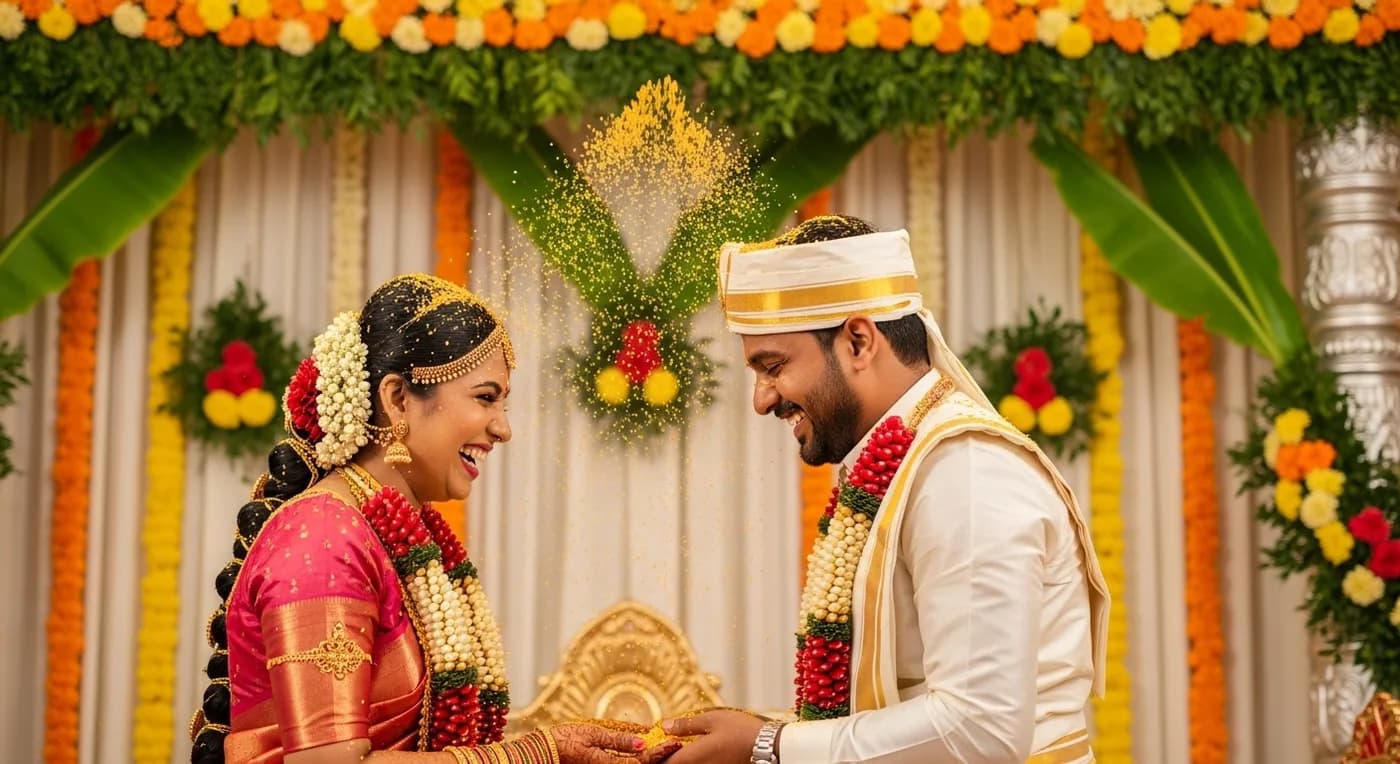
The Talambralu is the Telugu wedding's signature celebratory moment — and one of the most photographed rituals in any South Indian wedding tradition. The bride and groom shower each other with akshintalu — rice grains mixed with turmeric, creating a golden cascade — pouring handfuls over each other's heads. The ritual is often competitive and playful, with each partner trying to pour more rice on the other, eliciting cheers and laughter from the crowd.
The Talambralu symbolises prosperity, fertility, and the couple's compatibility. It is also, practically, the moment when the ceremony's solemnity breaks into pure joy — after hours of Vedic chanting, fire rituals, and formal vows, the rice shower is a release of happiness, a communal celebration of the union that has just been sealed. Guests often join in, throwing rice and petals, and the moment is filled with movement, sound, and colour.
Arundhati Darshan
The ceremony concludes with the couple gazing at the Arundhati star — the symbolic ideal of marital devotion and constancy. The purohit points out the star (or its direction, for daytime weddings) and narrates the story of Arundhati and Vasishtha as models of marital partnership.
Attire and Jewellery
The Bride
The Telugu bride's attire is a study in richness and colour. The most traditional choice is the Pattu Langa Voni (silk half-saree) — a three-piece ensemble of a fitted blouse, a pleated skirt (langa), and a draped upper cloth (voni or dupatta) — which is the iconic Telugu bridal silhouette, distinct from the saree drape of Tamil and Kannada traditions. Modern Telugu brides also choose Kanjivaram sarees, Pochampalli silk, or Dharmavaram silk sarees, depending on family preference and sub-regional tradition.
Jewellery is elaborate: uncut diamond (Hyderabadi polki) sets are increasingly popular alongside traditional temple gold jewellery. Key pieces include the maang tikka (forehead ornament), jhumkas (layered chandelier earrings), choker and layered necklaces, vanki (armlet), vaddanam (gold waist belt — one of the heaviest and most visually striking pieces), and pearl strands (Hyderabadi mothi mala). Fresh flowers — jasmine and roses — are woven into the hair in an elaborate arrangement.
The Groom
The Telugu groom traditionally wears a pancha (dhoti) in white or cream silk with a gold border, paired with a kanduva (upper cloth draped over one shoulder). For the ceremony, simplicity is key — the formal, ornate attire is reserved for the reception. Modern grooms in Chennai often wear a silk kurta-pyjama or sherwani for the morning ceremony, switching to a designer bandhgala or suit for the evening reception.
Looking for Photographers in Chennai?
Tell us what you need and get quotes from verified photographers
Planning a Telugu Wedding in Chennai
Finding Telugu-Speaking Purohits
Chennai has a significant pool of Telugu-speaking Brahmin priests who specialise in Andhra and Telangana wedding ceremonies. However, not all Telugu purohits are interchangeable — a priest familiar with Coastal Andhra rituals may not know the specific variations of a Rayalaseema or Telangana ceremony. When hiring, confirm the purohit's familiarity with your family's sub-regional traditions and gothra lineage.
The best Telugu purohits in Chennai are typically found through family networks, the local Andhra Association, or Telugu community groups. Alternatively, on itsmy.wedding, you can find verified priests who specify their regional expertise and language capabilities.
Venue Considerations
Telugu weddings in Chennai use the same venue infrastructure as Tamil weddings — kalyana mandapams, hotel ballrooms, and convention centres. The key requirement is a venue that can accommodate the Telugu ceremony layout: a raised mandapam with space for the fire pit (homa kundam), adequate room for the Talambralu (which involves significant rice-throwing and needs a space that is easy to clean), and a dining area for the wedding meal.
Popular venue areas for Telugu families include T. Nagar (central, accessible, and home to many Telugu community halls), Anna Nagar (spacious venues with parking), and the OMR/ECR corridor (modern halls with premium amenities). Community halls run by the Andhra Association and Telangana Association in Chennai are budget-friendly options that understand Telugu ceremony requirements. For a comprehensive venue overview, see our Chennai wedding planning guide.
Telugu Catering in Chennai
The Telugu wedding meal in Chennai presents a delicious planning challenge: how to serve authentic Andhra or Telangana cuisine in a Tamil-dominated catering market.
Andhra-style meals feature a distinctive flavour profile — spicier, tangier, and more coconut-forward than typical Tamil fare. Signature dishes include pulihora (tamarind rice), pesarattu (green moong dal dosa), gongura pachadi (sorrel leaf chutney — a quintessential Andhra taste), avakaya (raw mango pickle), gutti vankaya (stuffed brinjal), pappu (lentil dal cooked Andhra-style with cumin and ghee), and pootharekulu (paper-thin sweet — a Coastal Andhra speciality).
Chennai has several caterers who specialise in Andhra cuisine — many run by Telugu families who migrated to the city. For mid-range to premium weddings, some families bring caterers directly from Vijayawada, Guntur, or Hyderabad, particularly for the payasam and pootharekulu, which require specific expertise.
A common approach at Chennai Telugu weddings is a dual menu: Andhra-style dishes for the morning wedding meal (reflecting the family's Telugu identity) and a multi-cuisine buffet at the evening reception (accommodating guests from all backgrounds).
Important
Budget Expectations
Telugu weddings in Chennai fall within ranges similar to Tamil weddings, with some variation based on community customs and scale. For reference, India's wedding industry is valued at ₹10.79 lakh crore, and Chennai's competitive vendor market keeps costs below the national average of ₹29.6 lakhs for equivalent guest counts:
- Budget-friendly (community hall or basic mandapam, 300-500 guests): ₹4,00,000 – ₹10,00,000
- Mid-range (premium mandapam or mid-tier hotel, 500-800 guests): ₹10,00,000 – ₹25,00,000
- Premium (5-star hotel or resort, 800-1500 guests): ₹25,00,000 – ₹50,00,000
The Chennai-Telugu Blend
What makes a Telugu wedding in Chennai genuinely distinctive is the blend. The morning muhurtham timing follows Tamil convention (many Andhra weddings in Hyderabad are held later in the morning or even in the evening). The mandapam-style venue is Tamil. The nadaswaram may play alongside the Telugu shehnai. The return gifts might include both the Tamil thamboolam (betel leaf packet) and the Telugu tambulam (coconut with blouse piece). And the wedding album captures the Talambralu rice shower against the backdrop of a T. Nagar kalyana mandapam.
This blend is not dilution — it is evolution. It is the product of generations of a community living within and alongside another culture, maintaining its core identity while gracefully absorbing local elements. Chennai's Telugu weddings are, in this sense, a beautiful example of how traditions travel and adapt without losing their essence.
Looking for Venues in Chennai?
Tell us what you need and get quotes from verified venues
On itsmy.wedding, you can find Telugu-speaking photographers, purohits, caterers, and decorators across Chennai who understand the specific requirements of a Pelli — from the Jeelakarra-Bellam setup to the Talambralu cleanup. Browse our verified vendor directory to build a team that honours your Telugu traditions within Chennai's wedding ecosystem.
For the latest in reception trends and entertainment ideas for 2026, our dedicated guide covers everything from themed decor to live food counters — applicable to Telugu and Tamil receptions alike.
Tip
Start planning your wedding — generate a personalised checklist with our AI Wedding Checklist, estimate your budget with the Cost Calculator, or create a beautiful digital invitation.
Topics
telugu wedding chennaipelli ceremonytelugu marriage customs chennaitalambralu ritualtelugu wedding planningmadras weddingsExplore more
Frequently Asked Questions
1How large is the Telugu community in Chennai?
2What are the main Telugu wedding rituals?
3Is a Telugu wedding in Chennai different from one in Hyderabad?
4What is Talambralu?
Continue reading
Related Articles
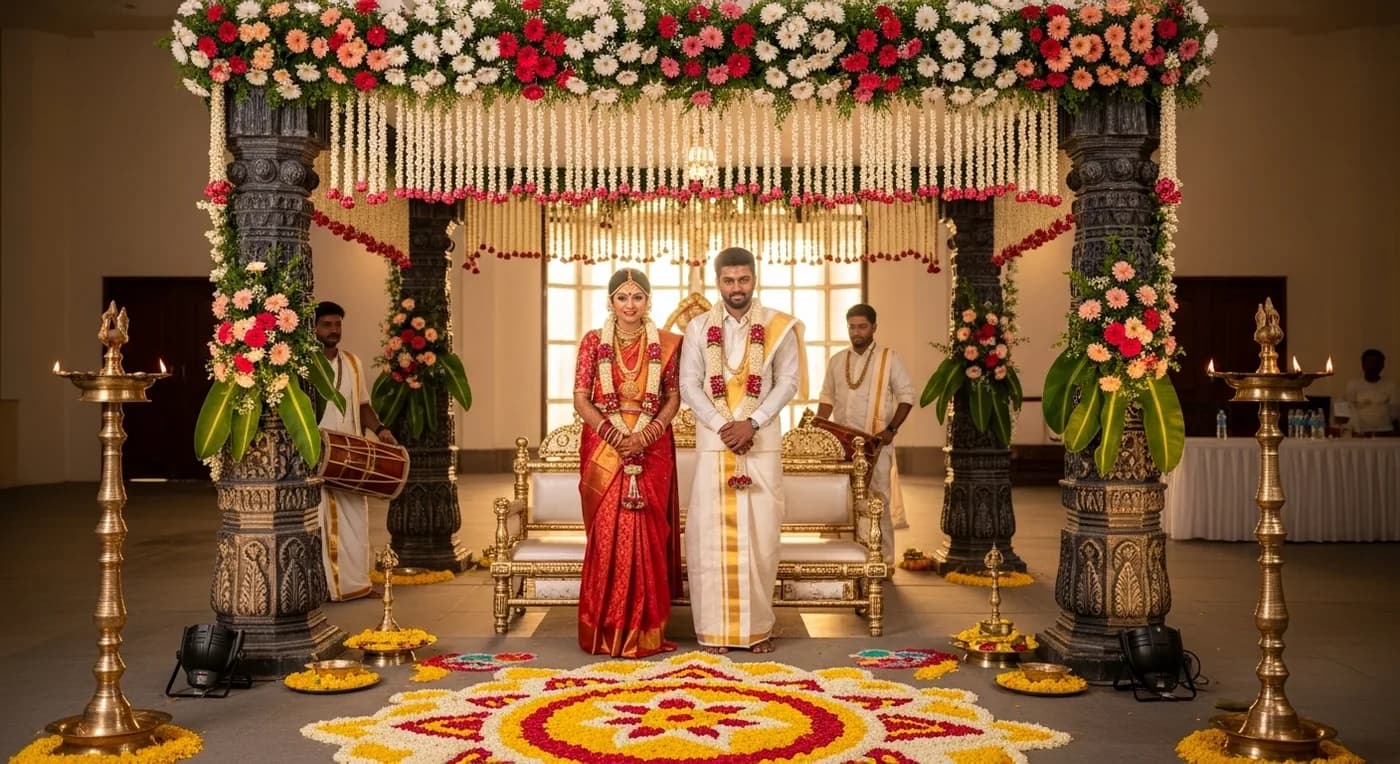
How to Plan a Chennai Wedding: The Complete 2026 Guide
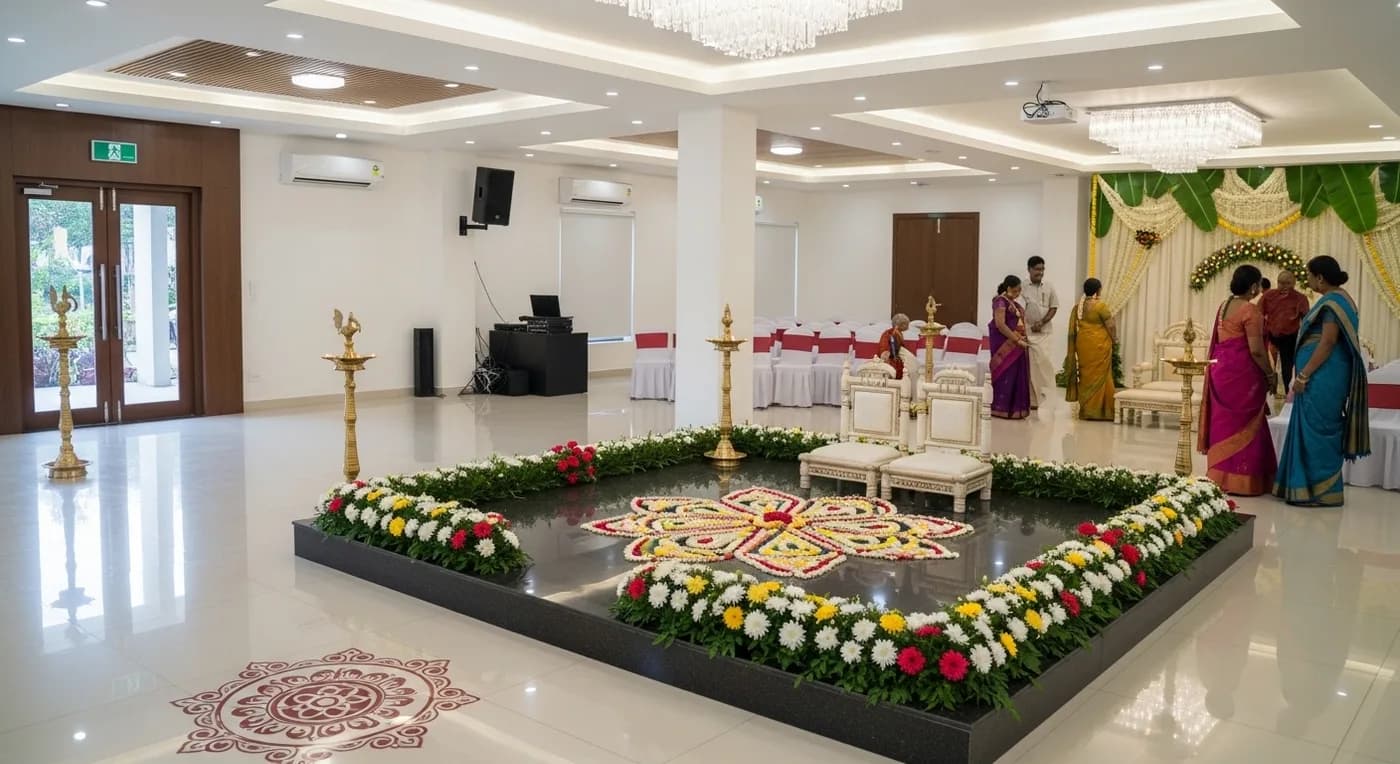
Best Kalyana Mandapams in Chennai: AC Halls & Pricing
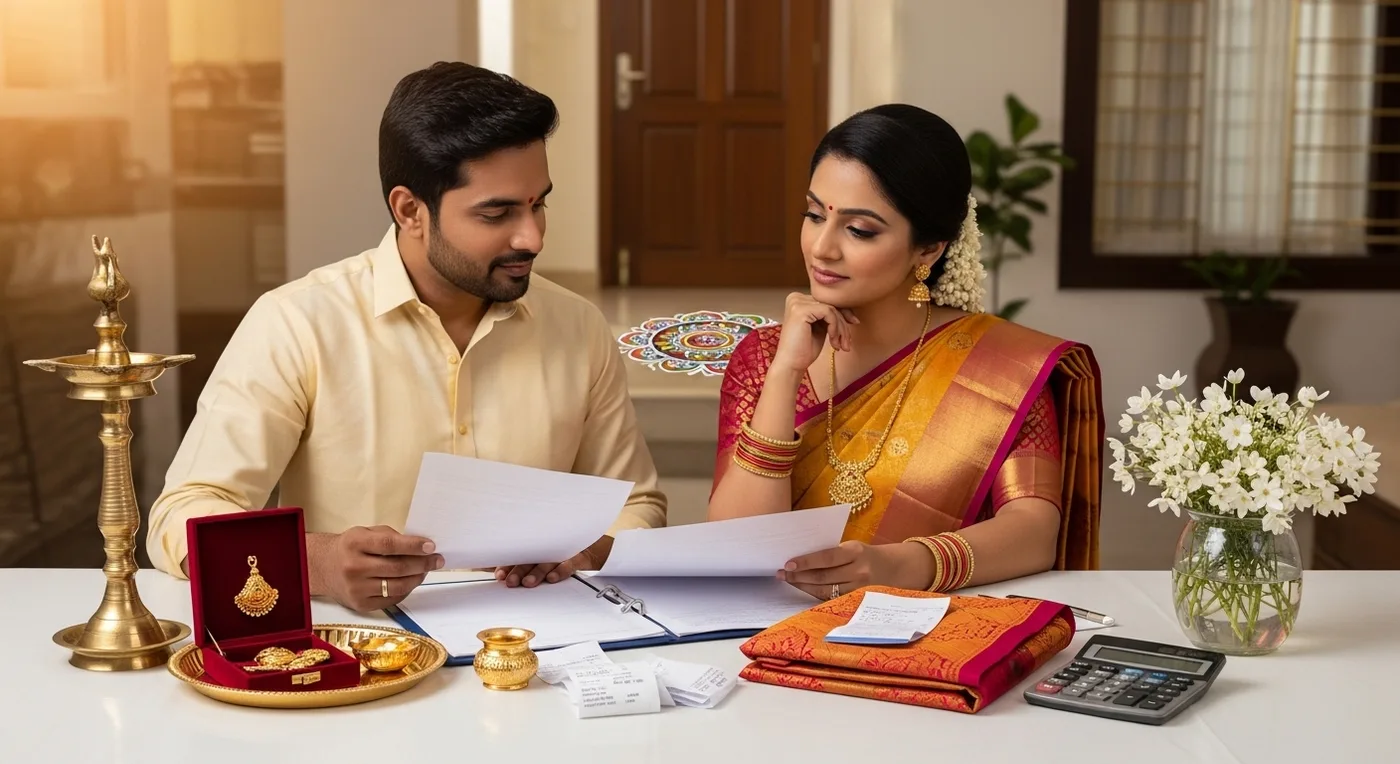
Chennai Wedding Cost in 2026: ₹5–20 Lakhs Full Budget Breakdown
Best Season for South India Destination Weddings: Month-by-Month Western Ghats Guide
Destination Wedding Cost in South India 2026: 5-Tier Budget Guide
Destination Wedding in South India: Complete 2026 Planning Guide
Still planning?
Get quotes from India's best vendors
Tell us what you're planning and we'll match you with verified photographers, venues, decorators, and more.
Get free quotes