
Marathi Wedding Traditions: Rituals, Sequence & Meaning
Guide to 12+ Marathi wedding rituals — Sakhar Puda, Halad, Antarpat, Saptapadi, Grihapravesh — with ceremony timing, meaning, and modern Mumbai adaptations.

Mumbai & Maharashtra Wedding Editor
Priya Sharma is the Mumbai and Maharashtra wedding editor at itsmy.
On this page
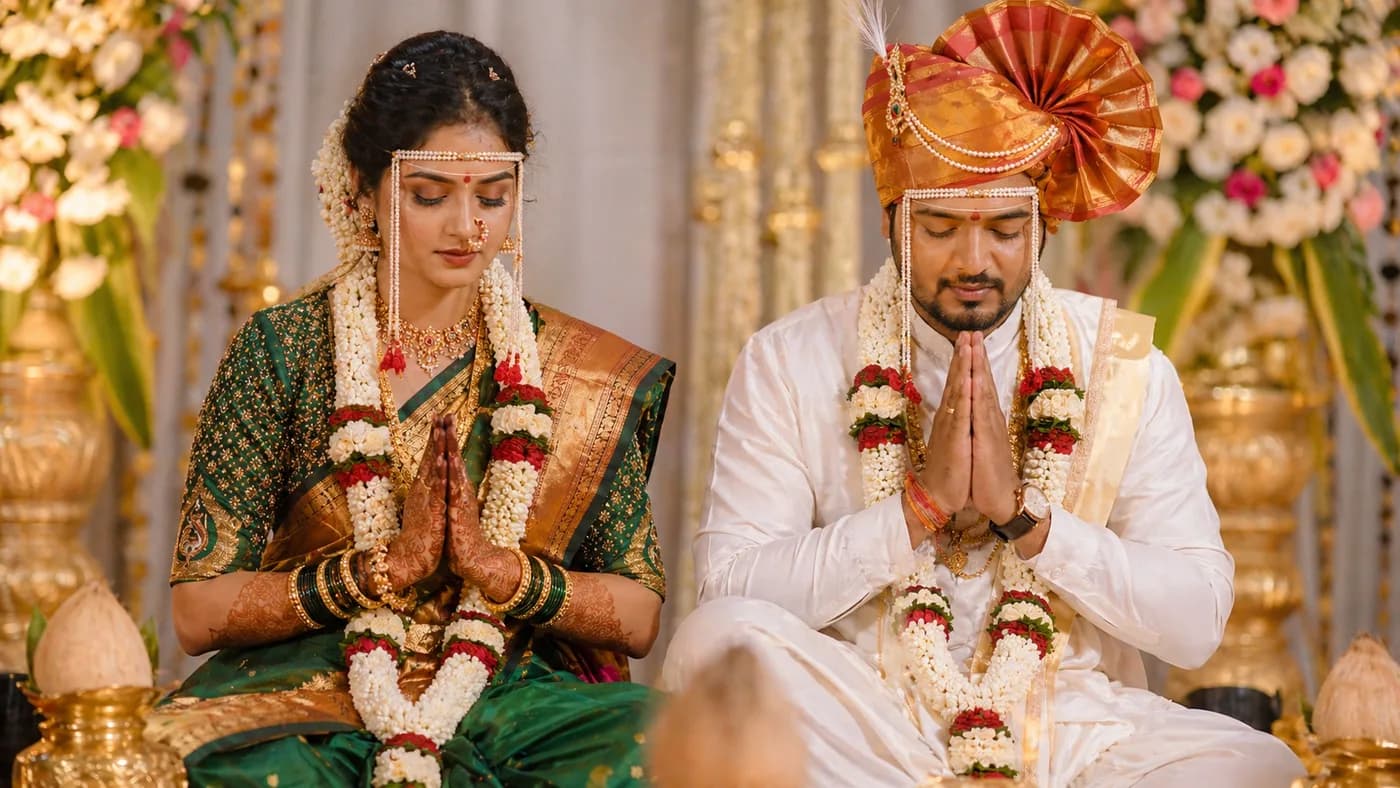
The Antarpat — the silk curtain held between the bride and groom that drops at the exact muhurat moment — is the signature ritual of every Marathi wedding. The core ceremony runs 3-5 hours, the full event spans 2-3 days, and the bride wears a Paithani saree or 9-yard nauvari kaashta with the unmistakable nath nose ring and mundavalya pearl headband.
Quick Answer
Quick answer: A Marathi (Maharashtrian) wedding centres on the Antarpat — a silk curtain held between bride and groom, dropped at the exact auspicious muhurat as the priest finishes chanting the Mangalashtak. The ritual sequence runs Sakhar Puda → Kelvan → Halad Chadavane → Ganpati Puja → Seemanpujan → Gurihar Puja → Antarpat & Mangalashtak → Kanyadaan → Saptapadi → Mangalsutra Bandhan → Sindoor → Grihapravesh. Bride wears Paithani or nauvari kaashta saree with nath, mundavalya, and green glass bangles. Modern Mumbai weddings compress the format from 3 days to 1.
Note
Cultural methodology: Ritual descriptions in this guide are based on direct attendance at Marathi weddings across the Mumbai Metropolitan Region, Pune, Kolhapur, and Nashik between 2021 and 2026, supplemented by interviews with practising purohits and Maharashtrian cultural authorities.
A Marathi wedding is Maharashtra's signature marriage tradition — quieter than a Punjabi sangeet-heavy celebration, more ritual-dense than a Gujarati ceremony, and built around one moment when a silk curtain drops between bride and groom. Having attended dozens of Maharashtrian weddings across Pune, Dadar, and Thane over five years, I can say the Marathi wedding has a character all its own — family-centric, ritual-focused, defiantly understated. Mumbai (officially Bombay until 1995, but always Mumbai in Marathi) is the largest urban hub for this tradition. The Department of Cultural Affairs treats wedding traditions as core intangible heritage, and Cultural India's documentation confirms the ritual sequence has remained stable for centuries.
This guide walks through every ritual, what each means, attire, food, and how Mumbai couples are adapting these customs in 2026. For broader logistical context, see our Mumbai wedding planning guide.
| Phase | Ritual | When | Duration |
|---|---|---|---|
| Pre-wedding | Lagnaach Bedior | Months before | 1–2 hours |
| Pre-wedding | Sakhar Puda (engagement) | Weeks before | 2–3 hours |
| Pre-wedding | Kelvan (family meal) | 2–3 days before | 2–3 hours |
| Pre-wedding | Halad Chadavane (turmeric) | Day before | 1–2 hours |
| Wedding day | Ganpati Puja | Morning | 15–20 min |
| Wedding day | Seemanpujan (groom welcome) | Groom arrival | 20–30 min |
| Wedding day | Gurihar Puja (bride's prayer) | During Seemanpujan | 15–20 min |
| Wedding day | Antarpat & Mangalashtak | At muhurat | 20–40 min |
| Wedding day | Kanyadaan | After Antarpat | 15–20 min |
| Wedding day | Vivaha Homa & Saptapadi | After Kanyadaan | 30–45 min |
| Wedding day | Mangalsutra Bandhan | After Saptapadi | 10–15 min |
| Wedding day | Sindoor application | After Mangalsutra | 5 min |
| Post-wedding | Lakshmi Pujan & Grihapravesh | At groom's home | 20–30 min |
| Post-wedding | Reception | Same/next evening | 3–4 hours |
What Defines a Marathi Wedding?
A Marathi wedding is best understood by what it is not. It is not a Punjabi dholki affair, a Gujarati garba night, or a Vedic-chant-heavy South Indian ceremony. The Maharashtrian wedding sits in its own register — restrained, family-centric, emotionally precise.
The defining qualities are four. First, simplicity over extravagance — a single mandap, modest decor. Second, family centrality — guest lists rarely exceed 200-300 traditionally, though Mumbai weddings now scale to 500-700. Third, ritual density — 12-15 named events, each carrying theological meaning. Fourth, the Antarpat moment — the entire ceremony is structured around the second the silk curtain drops.
The WeddingWire Maharashtrian overview notes Marathi weddings retain an "earthy, rooted quality" that has resisted Bollywood-style pressure — though Mumbai couples now mix sangeet nights with traditional Halad.
What Are the Pre-Wedding Marathi Rituals?
The pre-wedding phase of a Marathi wedding stretches from weeks before the muhurat to the morning of the ceremony, with each ritual layering preparation, blessing, and family bonding.
What Is the Lagnaach Bedior (Horoscope Matching)?
The first ritual — sometimes months before the wedding — is the Lagnaach Bedior, the formal matching of horoscopes by the family pandit. Both families bring the kundali (birth chart), and the priest analyses planetary alignments, gun milan compatibility, and mangal dosha concerns. If favourable, the priest fixes the muhurat — the precise date and time. In urban Mumbai this often happens at the bride's home or at temple complexes in Dadar's Kashi Math or Prabhadevi's Siddhivinayak.
Note
What Is the Sakhar Puda (Engagement)?
The Sakhar Puda — literally "packet of sugar" — is the formal Marathi engagement. The groom's family visits the bride's home with sugar, kumkum, fruits, and a saree. The groom's mother applies haldi-kumkum to the bride's forehead, presents the saree, and feeds her a piece of sugar to mark the sweet bond. The bride's family reciprocates. The traditional Sakhar Puda has no ring exchange — that is a modern addition. In Mumbai most families now combine the traditional elements with a ring ceremony and an evening reception. See WeddingSutra's Maharashtrian traditions piece for regional variations.
What Is the Kelvan?
Two to three days before the wedding, the Kelvan is held — a family-bonding meal at the bride's home for close family and the kuladaivat (family deity). The deity is invoked, prayers are offered, and a Maharashtrian thali is served. Its purpose is twofold — to seek the family deity's blessings, and to give the bride one last private meal at her parents' home. Modern Mumbai families often compress it into a single morning meal on the day of the Halad. Lagnavaarta's documentation of the seven key rituals in a traditional Marathi wedding places Kelvan as foundational.
What Is Halad Chadavane (the Turmeric Ceremony)?
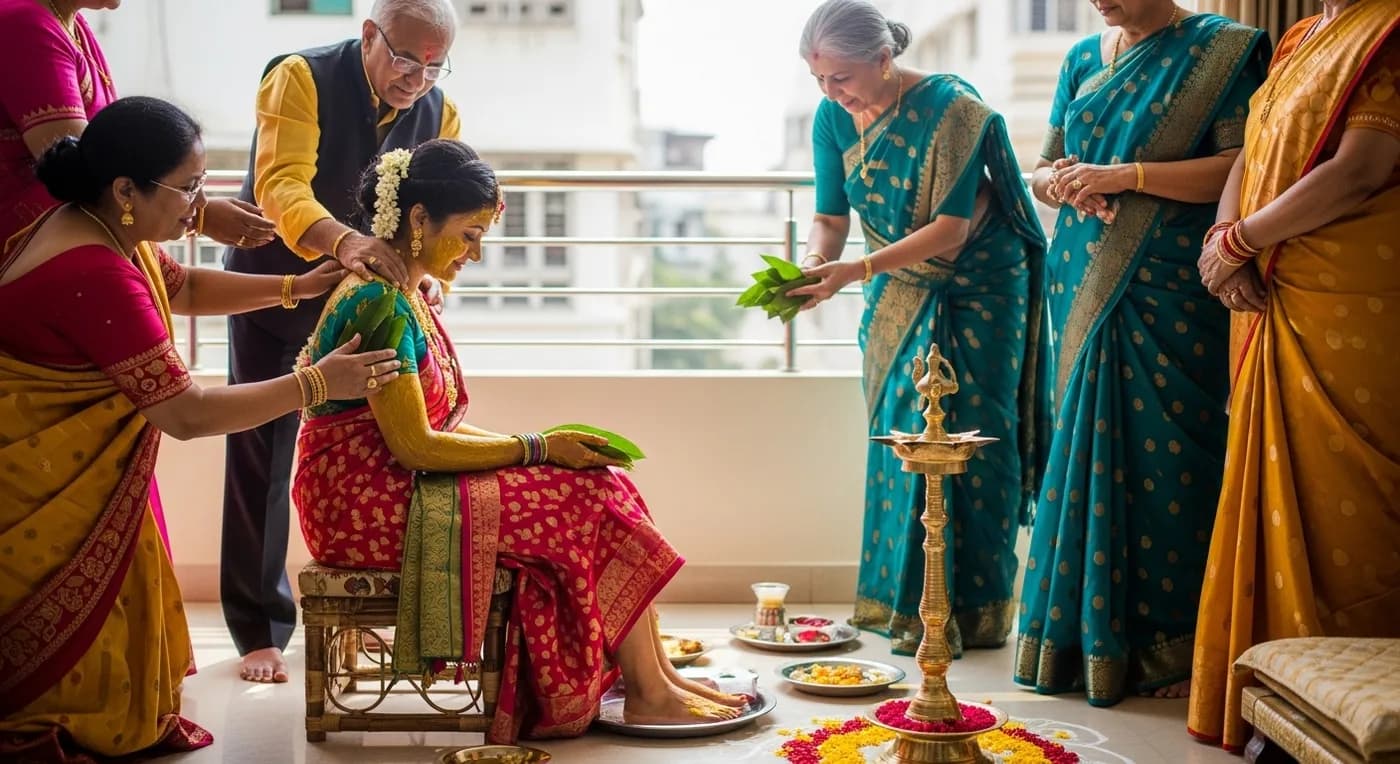
The day before the wedding, the Halad Chadavane takes place. One detail sets it apart from Gujarati or Punjabi haldi rituals: the turmeric paste is applied first at the groom's house, then leftover paste is sent to the bride's house in a ceremonial pot with mango leaves — signifying the journey from groom to bride. Married women apply turmeric on the couple, first to feet, then knees, shoulders, and face, singing traditional halad gani (turmeric songs).
Tip
What Happens on the Marathi Wedding Day?
The wedding day itself is a tightly sequenced progression of rituals, beginning with prayers and culminating in the Sindoor application after the Saptapadi.
What Is the Ganpati Puja?
Every Marathi ritual opens with a Ganpati Puja, invoking Lord Ganesha as remover of obstacles. The priest lights incense, offers modaks, and chants Sanskrit verses. Maharashtra is Ganesha's spiritual heartland — no auspicious event begins without his blessing.
What Is Seemanpujan?
The groom arrives at the venue in procession, often with shehnai and taasha drums. At the entrance, the bride's mother performs the Seemanpujan — she welcomes him with aarti, washes his feet, applies tilak, and presents new clothes. Today's Traveller's feature on traditional weddings in Maharashtra describes this as the "first time the two families formally meet at the wedding venue."
What Is the Gurihar Puja?
The Gurihar Puja is unique to Marathi weddings. While the groom is welcomed at the entrance, the bride privately worships goddess Parvati at the mandap, offering rice, turmeric, kumkum, and prayers for marital prosperity, fertility, and a happy life. WeddingBazaar's overview of Marathi wedding rituals notes the Gurihar is one of the most spiritually grounding moments — and one of the most likely to be skipped in compressed weddings.
What Happens During the Antarpat & Mangalashtak?
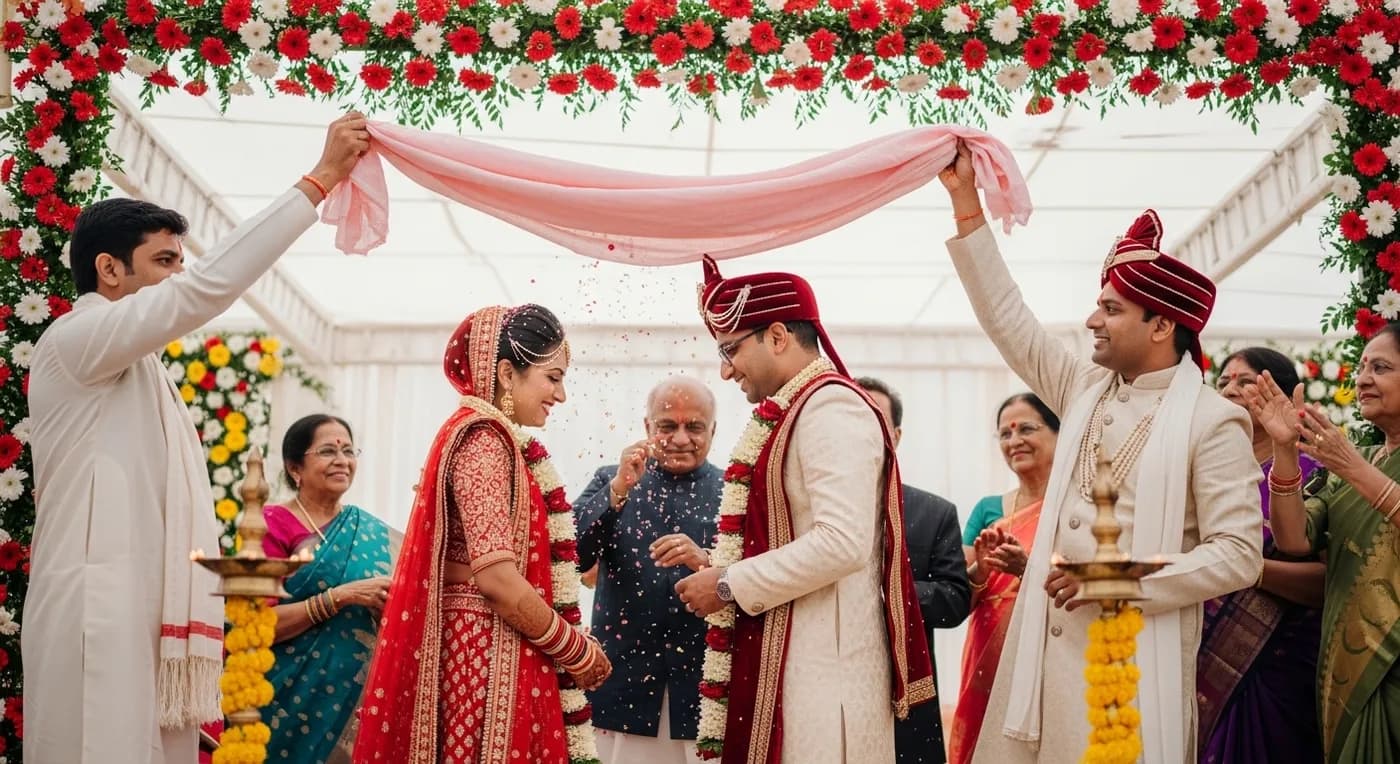
This is the signature moment of every Marathi wedding. The bride and groom face each other, but a silk curtain — the Antarpat — is held vertically between them, preventing eye contact. The priest chants the Mangalashtak — eight Sanskrit verses invoking gods, elements, ancestors, and cosmic order to bless the union. Each verse ends with "shubha mangala saavadhaan" — "auspicious blessings, be alert" — and guests shower the curtain with akshata (rice and vermillion).
The priest tracks the muhurat. As the final verse arrives, the curtain drops. The couple sees each other for the first time. They exchange flower garlands (varmala) over the fallen curtain, and relatives erupt in applause and akshata. For Maharashtrians, this is the emotional peak — the instant the marriage becomes real.
Important
What Is the Kanyadaan?
Following the Antarpat, the Kanyadaan — the giving of the bride — takes place. The bride's father places her right hand in the groom's, entrusting his daughter to his care. Vedic mantras are chanted. This is the most emotionally heavy moment for the family — fathers often weep openly. The mother washes the couple's feet with water and milk to seal the gesture.
What Are the Vivaha Homa & Saptapadi?
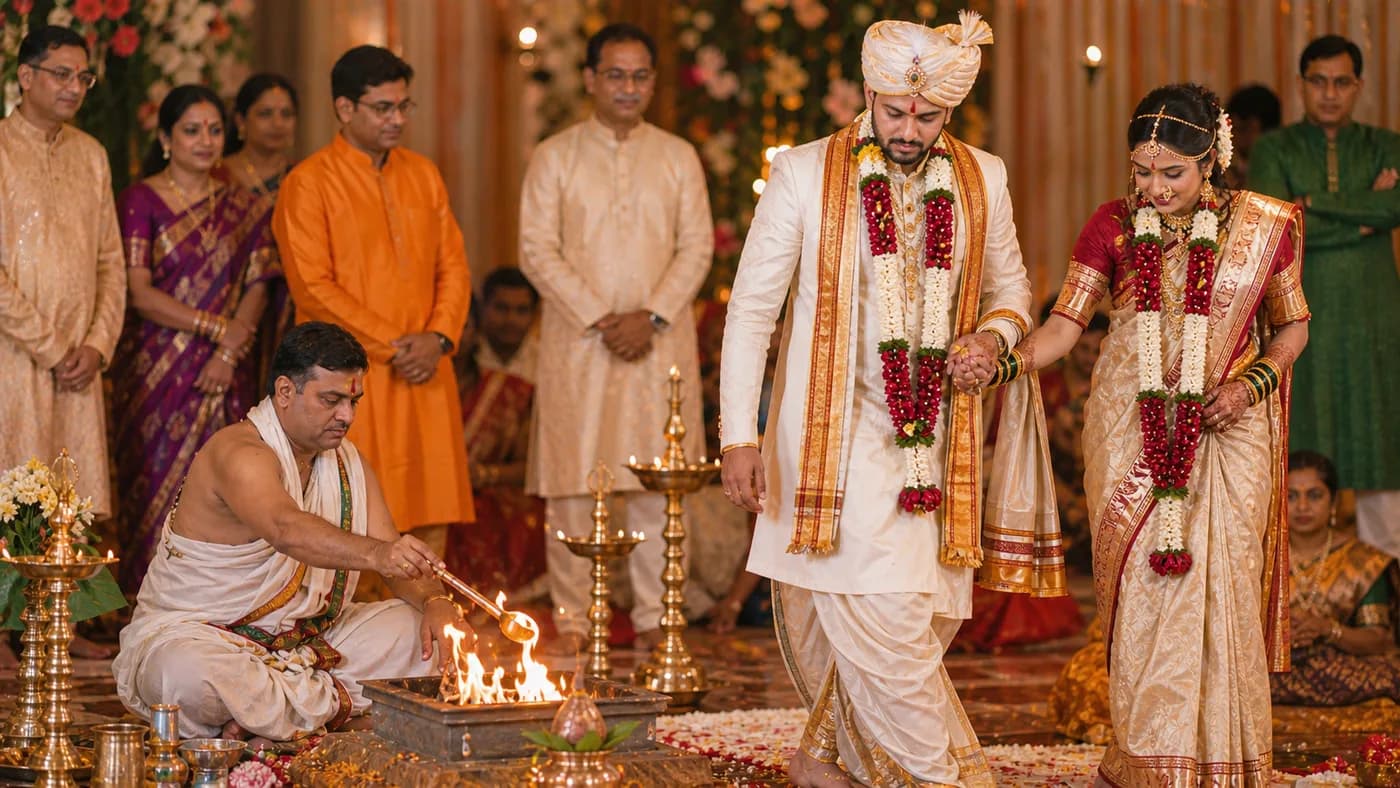
The Vivaha Homa — the sacred fire ritual — is then lit, invoking Agni as witness. The couple offers ghee, rice, and herbs while mantras are chanted. They then perform the Saptapadi — the seven steps. In Marathi tradition, the bride's right toe touches seven small heaps of rice placed in a row as the couple walks together. Each step represents a vow: nourishment, strength, prosperity, happiness, progeny, longevity, and friendship. After the seventh step, the marriage is complete under Hindu law.
What Is Mangalsutra Bandhan?
The groom ties the mangalsutra around the bride's neck. The Marathi mangalsutra has a specific design — a black-bead chain with two small gold pendants (vati), one from each family. The groom ties three knots, each with a Sanskrit mantra, and the bride wears it for the rest of her married life.
What Is the Sindoor Application?
The groom applies sindoor (vermillion) to the parting of the bride's hair. From this moment she is sumangali — an auspiciously married woman.
Looking for Decorators in Mumbai?
Tell us what you need and get quotes from verified decorators
What Are the Post-Wedding Marathi Rituals?
The wedding does not end at the venue — the bride's transition to her new home is accompanied by its own set of rituals.
What Are Lakshmi Pujan & Grihapravesh?
When the couple arrives at the groom's home, Grihapravesh begins at the threshold. A small kalash filled with rice is placed at the doorway, and the bride gently kicks it over with her right foot, scattering rice — symbolising the abundance and prosperity she brings as Lakshmi entering. She then steps into a tray of kumkum-mixed milk and walks inside, leaving auspicious red footprints. The Lakshmi Pujan follows — the family worships her as the new keeper of the household's prosperity.
What Happens at the Reception?
The reception is held the same evening or the next day. In modern Mumbai weddings it is the largest single event — 400-700 guests, multi-cuisine buffets, live music, cake-cutting. Traditional Marathi receptions are simpler — the couple sits on a stage, guests bless them with akshata and gifts, and a Maharashtrian thali is served. Most Mumbai couples now run a hybrid format.
What Does the Marathi Bride and Groom Wear?
What Does the Marathi Bride Wear?
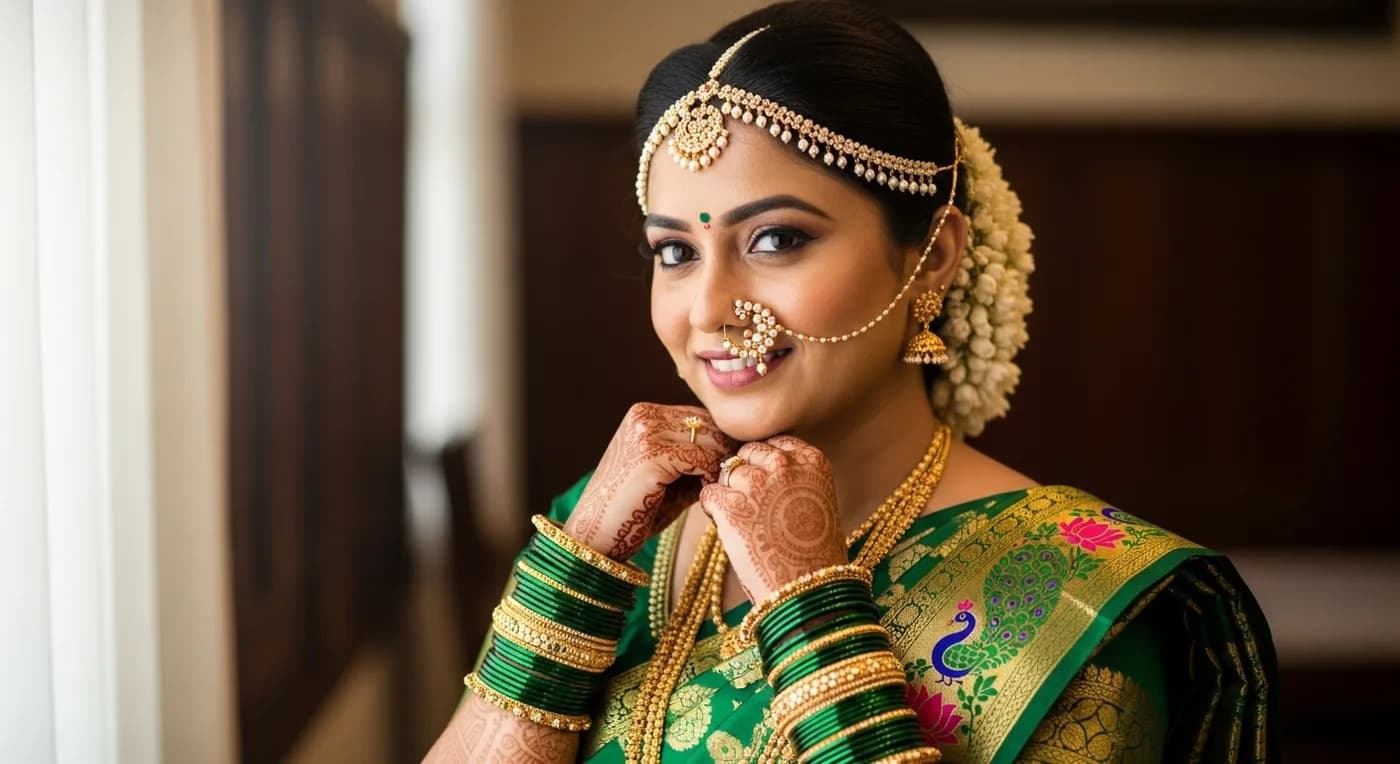
A Marathi bride's look is one of the most distinctive in Indian wedding aesthetics. The traditional saree is a Paithani — a heritage silk woven in Paithan near Aurangabad, with zari work depicting peacocks, lotuses, and parrots. A genuine Paithani takes 6-18 months to weave by hand and costs between ₹50,000 and ₹5 lakhs. The alternative is a 9-yard nauvari kaashta draped in the dhoti style — historically allowing Maharashtrian women to ride horses and move freely. Auspicious colours dominate: deep green, rich red, mustard yellow, gold.
The jewellery makes the look unmistakable. The mundavalya — a string of pearls or beads across the forehead — is uniquely Marathi (the groom wears one too). The nath, a curved pearl-and-gold nose ring shaped like a paisley, is the single most recognisable Marathi bridal element. Green glass bangles (chuda) are mandatory — they signify Saubhagya. A kolhapuri saaj necklace, thushi choker, kamarpatta (waist belt), jodavi (toe rings), and vaaki (armlet) complete the ensemble. Fresh jasmine frames the bun. Makeup is traditionally minimal.
What Does the Marathi Groom Wear?
The groom wears a dhoti-kurta (white or cream silk) or a sherwani. The signature element is the pheta — the Marathi turban — in saffron, red, or deep gold, wrapped fresh on the morning by a specialist. A uparna (shawl) is draped over one shoulder, and the groom wears a mundavalya across his forehead, mirroring the bride. For grooms weighing attire across traditions, our groom attire mundu vs sherwani guide covers the comparison.
What Food Is Served at a Marathi Wedding?
The Maharashtrian wedding feast is built around the thali format. Served on a banana leaf, the traditional thali features bhakri (sorghum flatbread) with seasonal bhajis, varan-bhaat (lentil dal with rice), masale-bhaat (spiced rice with peanuts and coconut), batata bhaji, kosambari (lentil salad), aamti, and pickles.
The desserts are non-negotiable. Shrikhand-puri is the headline — strained sweetened yoghurt with cardamom and saffron, served with deep-fried puris. Modak — steamed rice-flour dumplings stuffed with jaggery and coconut — must appear, given Ganesha's role. Basundi, jilebi, and puran poli round out the sweet course.
Modern Mumbai weddings layer additional cuisines, but the smart move is to anchor at least one meal on a strict Maharashtrian thali in the traditional banana-leaf format. Older guests rate the meal by the thali, regardless of how much else is served.
Tip
Looking for Venues in Mumbai?
Tell us what you need and get quotes from verified venues
How Have Modern Mumbai Marathi Weddings Evolved?
The Marathi wedding has changed more in the last 15 years than in the previous century.
The most significant change is timeline compression. A traditional rural Marathi wedding unfolded across 3 days — Halad on day one, ceremony day two, reception day three. Most Mumbai weddings in 2026 compress this into a single day. Even the core ceremony has shortened from 5 hours to 3, with priests trimming supporting chants while preserving Antarpat, Saptapadi, and Mangalsutra intact.
The second shift is the addition of pan-Indian events. Traditional Marathi weddings had no sangeet nights or mehndi functions — those are North Indian imports. Mumbai's cosmopolitan weddings have absorbed both, with sangeet nights and a separate mehndi function now standard.
The third evolution is fusion receptions — Marathi-Catholic, Marathi-Gujarati, Marathi-Punjabi pairings are all common. Finally, destination Marathi weddings in Lonavala, Alibaug, and Mahabaleshwar have surged since 2024. For venue inspiration, see our best wedding venues in Mumbai and banquet halls in Mumbai price list, or consider Lonavala destination weddings and Alibaug destination weddings.
How Do Inter-Community Marathi Weddings Work in Mumbai?
Mumbai's cosmopolitan demographic means inter-community weddings are common. The most frequent pairings are Marathi-Catholic (East Indian and Mangalorean Catholic communities concentrated in Bandra, Vasai, and Dadar), Marathi-Gujarati, and Marathi-North Indian.
The standard solution is dual-format ceremonies with sequenced rituals. For a Marathi-Catholic wedding, the structure is a morning Marathi ceremony at a mandap with all Hindu rituals — Antarpat, Saptapadi, Mangalsutra — followed by an evening Catholic nuptial Mass at a church. Two priests, two ceremonies, one couple. For a Marathi-Gujarati wedding, the priest merges the Marathi Saptapadi with the Gujarati Pheras (four steps instead of seven), with the Antarpat retained as the Marathi signature.
Brief both priests well in advance and run a joint walkthrough at the venue. The Maharashtra government's marriage registration portal provides single legal registration regardless of religious format.
Common Questions About Marathi Wedding Traditions
What rituals make up a complete Marathi wedding?
Lagnaach Bedior (horoscope matching), Sakhar Puda (engagement), Kelvan (family meal 2-3 days before), Halad Chadavane (turmeric — applied first at groom's house, leftover sent to bride with mango leaves). On the wedding day: Ganpati Puja, Seemanpujan, Gurihar Puja (unique to Marathi), Antarpat and Mangalashtak, Kanyadaan, Saptapadi, Mangalsutra Bandhan, Sindoor. Post-wedding: Lakshmi Pujan, Grihapravesh, Reception.
What exactly happens during the Antarpat ritual?
A silk curtain is held vertically between bride and groom while the priest chants the eight Mangalashtak verses. Guests shower akshata on the curtain. The priest tracks the muhurat, and at that exact second, the curtain drops. The couple sees each other for the first time, exchanges flower garlands, and the marriage moves into Kanyadaan. This is the signature emotional peak of every Marathi wedding.
How long is a typical Marathi wedding event?
The core ceremony runs 3-5 hours — traditional families closer to 5, modern Mumbai couples streamlining to 3. Including Halad and Grihapravesh, the full event spans 2-3 days traditionally or a single day for compressed modern formats. The muhurat itself is a 20-40 minute window when the Antarpat must drop.
What does a Marathi bride traditionally wear?
A Paithani saree (heritage silk from Paithan) or a 9-yard nauvari kaashta in the dhoti drape. Jewellery includes the mundavalya (pearl headband, also worn by groom), nath (curved pearl nose ring — uniquely Marathi), green glass bangles, kolhapuri saaj, thushi, kamarpatta, and toe rings. Fresh jasmine in the hair. Makeup is traditionally minimal.
How are Mumbai Marathi weddings different from rural Maharashtrian ones?
Mumbai weddings compress 3-day formats into 1-2 days, add sangeet and mehndi functions (North Indian imports), feature pastel floral mandap decor instead of banana-stalk setups, run multi-cuisine receptions alongside the traditional thali, and are increasingly held at destination resorts in Lonavala, Alibaug, or Mahabaleshwar.
A Marathi wedding, at its heart, is a celebration of restraint and ritual precision. The Antarpat moment — that single second when the curtain drops at the muhurat — captures everything distinctive about this tradition. For the logistics of pulling off a Marathi wedding in Mumbai, read our Mumbai wedding planning guide and Mumbai wedding budget guide.
Tip
Start planning your wedding — generate a personalised checklist with our AI Wedding Checklist, estimate your budget with the Cost Calculator, or create a beautiful digital invitation.
Topics
marathi wedding traditionsmaharashtrian wedding ritualsmarathi wedding ritualsmarathi shadi ritualsantarpat ceremonysaptapadi marathiExplore more
Frequently Asked Questions
1What are the main Marathi wedding rituals?
2What is the Antarpat ritual?
3How long does a Marathi wedding ceremony last?
4What does the bride wear in a Marathi wedding?
5How do modern Mumbai Marathi weddings differ from traditional ones?
Continue reading
Related Articles
How to Plan a Mumbai Wedding: ₹20-60L Costs & Venues (2026)
Top Wedding Venues in Mumbai: 5-Star, Banquet & Beach (2026)
Mumbai Wedding Budget Guide: ₹20-60L Breakdown for 2026
Best Season for South India Destination Weddings: Month-by-Month Western Ghats Guide
Destination Wedding Cost in South India 2026: 5-Tier Budget Guide
Destination Wedding in South India: Complete 2026 Planning Guide
Still planning?
Get quotes from India's best vendors
Tell us what you're planning and we'll match you with verified photographers, venues, decorators, and more.
Get free quotes