
Catholic Wedding in Goa: Traditions, Churches & Planning
Goan Catholic wedding traditions from Ros to reception — church requirements, top venues like Basilica of Bom Jesus, costs, and planning timeline for 2026.

On this page
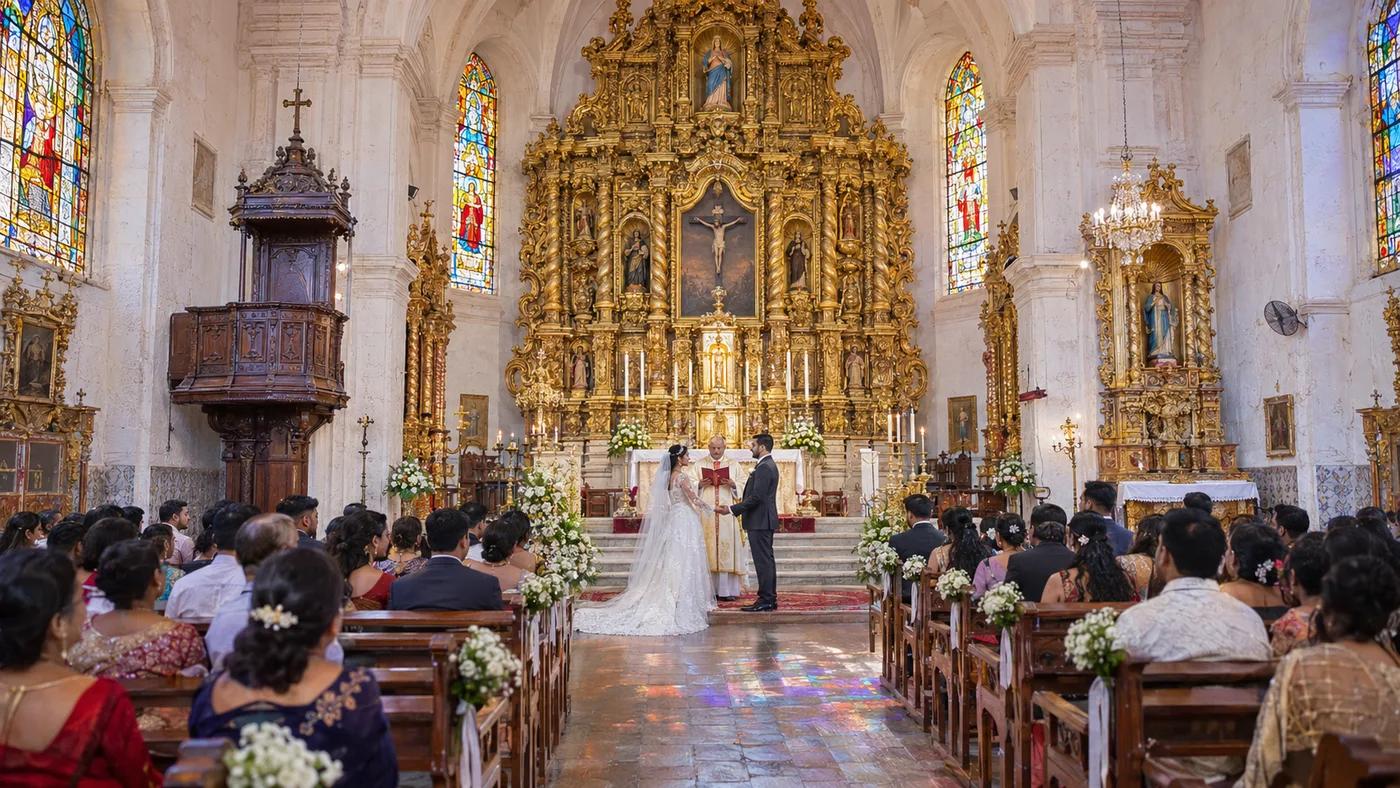
Goan Catholic weddings blend 450 years of Portuguese-influenced tradition with Konkani culture across several days. The sequence runs from the Chuddo (bangles) and Ros (coconut-milk anointing) to the church nuptial blessing and the Vor (reception feast). A typical celebration costs ₹8–35 lakh. The Archdiocese of Goa and Daman asks couples to start church paperwork at least 3 months ahead.
Quick Answer
Quick answer: A Goan Catholic wedding spans several days. The Chuddo (bangles) comes about a month before and the Ros (coconut-milk anointing) on the eve. The wedding day brings the nuptial Mass and blessing (Resper), followed by the Vor (reception feast). Church fees run ₹5,000-₹30,000, and the full celebration costs ₹8-35 lakh depending on scale.
Growing up in Salcete taluka, I attended my first Goan Catholic wedding before I could read. I do not remember the church or the homily. I remember my grandmother's hands, slick with coconut milk, pressing against my cousin's forehead during the Ros. Around us, the women sang mandos so old that nobody could trace their origin. That tactile, musical, communal warmth is what separates a Goan Catholic wedding from every other Christian celebration in India.
Roughly a quarter of the population of Goa (officially the State of Goa) is Christian, most of them Catholic, one of the highest shares in India. The wedding traditions here reflect centuries of Portuguese influence layered over deep Konkani roots. This guide covers every ritual, church requirement and practical detail. It is written for Goan Catholics planning their own wedding, partners marrying into a Goan family, and couples drawn to a church ceremony in Goa.
For the broader destination wedding picture, see our complete Goa destination wedding guide. For legal permits and paperwork, we have a separate deep-dive. And for church weddings elsewhere in the south, read our South Indian church wedding guide.
What Makes a Goan Catholic Wedding Unique?
Three things set Goan Catholic weddings apart: a Portuguese-Konkani blend of ritual and music, a multi-day arc, and a tradition of feeding the poor before the celebrations.
The Portuguese-Konkani fusion. Four and a half centuries of Portuguese rule left a deep mark on Goan Catholic life. The church rites, the white gowns and the ballroom dancing came with the Portuguese, while the language, food and emotional core are Konkani. You will hear mandos at every stage, from the Chuddo to the reception dance floor. The mando is a Goan song form that blends Portuguese fado melancholy with Konkani poetry, and the wedding is where this hybrid identity comes alive most vividly.
The multi-day arc. Many modern Indian weddings compress rituals into a single day. A traditional Goan Catholic wedding, by contrast, unfolds over weeks. The Chuddo happens about a month ahead, and the Ros falls on the eve of the wedding. The wedding day brings the nuptial Mass, and the Vor is the grand feast. Each event has its own location, dress code and emotional register, building from intimate family gatherings to a full community celebration.
The feeding of the poor. Before the festivities, many families still observe Bhikarianchem Jevonn, a meal for the poor offered in memory of departed relatives. It is not a token gesture but a quiet belief that a marriage should begin with generosity. I have seen families in Bardez and Salcete lay out full meals of sorpotel and sannas for dozens of guests in the days before a wedding. It remains one of the most moving traditions I know.
What Are the Key Goan Catholic Wedding Rituals?
The key rituals are the Chuddo, the Ros, the nuptial Mass with its blessing (Resper), the Vor and the meal for the poor. The table gives the order at a glance, and the sections below explain each one.
| Ritual | When | Where | What Happens |
|---|---|---|---|
| Chuddo | About a month before, on the day of the first banns | Maternal uncle's home | Bride receives an odd-numbered set of glass bangles |
| Bhikarianchem Jevonn | Traditionally about five days before | Both family homes | A meal for the poor, in memory of departed relatives |
| Ros (Roce) | Evening before the wedding | Bride's and groom's homes, separately | Coconut milk applied with prayers and songs |
| Resper (nuptial blessing) | Wedding day | Parish church | Vows, rings and the nuptial blessing at Mass |
| Vor | After the church ceremony | Hall, hotel or family home | Reception feast, toasts and dancing |
Sources: Museum of Goa and Culture of Goan Catholics. Timing varies by village and family.
Chuddo — The Bangles Ceremony
The Chuddo usually takes place about a month before the wedding, on the day the first wedding bann (announcement) is read in church. The bride's maternal uncle invites her home for a final meal as a single woman. After lunch and a short prayer, the local kankonkar (bangle seller) arrives and fits an odd-numbered set of glass bangles on her wrists. Traditionally, red stands for love, green for fertility, yellow for middle age and white for old age. The women present sing zotim (commemorative wedding songs), and red flowers are placed in the bride's hair.
The Chuddo bangles are worn until the wedding day and carry deep symbolic weight. Traditionally, a widow broke her bangles over her husband's coffin. That custom shows how seriously these glass circles are treated as markers of married life.
Ros (Roce) — The Coconut Milk Anointing
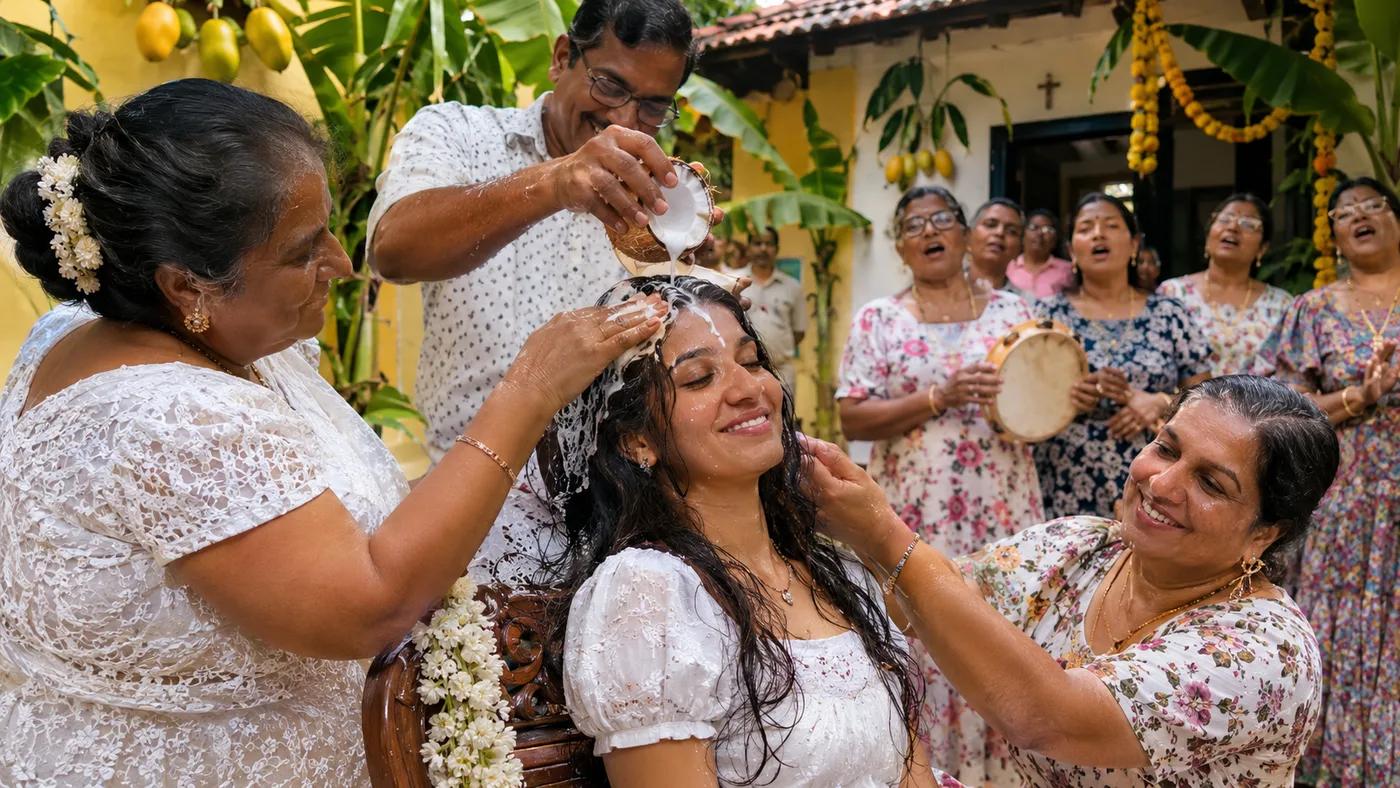
The Ros is traditionally held on the evening before the wedding, at the bride's and groom's homes separately. Many families now hold it a day or two earlier to suit guests' travel. After a short prayer, family members, neighbours and friends take turns applying warm coconut milk to the bride's or groom's head and face. The ritual symbolises purification, marking the end of single life before the sacrament of marriage.
The Ros is loud, joyful and thoroughly drenched in coconut milk by the end. Guests sing mandos and dulpods, and the house is decorated with banana leaves and mango garlands. In many families, the Ros doubles as the main pre-wedding party, with a brass band, Konkani songs and a feast of sorpotel, sannas and bebinca.
Tip
Planning tip: If you are hosting the Ros at home, cover floors and furniture with white sheets — coconut milk stains fabric permanently. Most families set up an open-air area in the courtyard or garden for the anointing, with a decorated chair for the bride or groom.
Resper — The Nuptial Blessing
In Konkani usage, Resper refers to the nuptial blessing at which the couple receive the Sacrament of Marriage. It is the solemn heart of the church ceremony. Some families use the word for the whole church service, and the exact usage varies from village to village. Either way, it is the moment the priest blesses the couple and their rings. It is a quiet, solemn counterpoint to the noisy Ros the night before.
Kazar — The Wedding Day
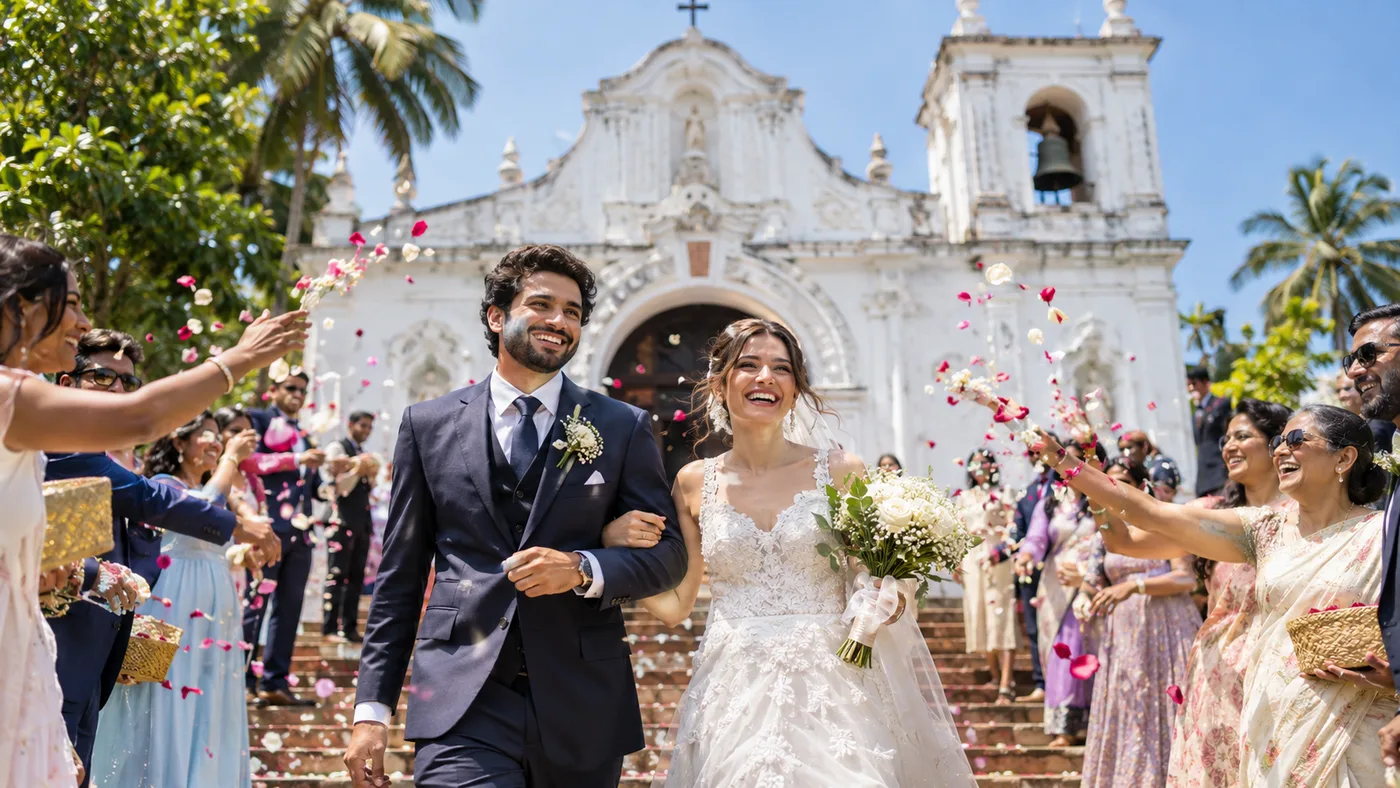
The Kazar is the wedding day itself, centred on a Catholic Nuptial Mass that typically lasts 45 minutes to 1.5 hours. Traditionally the ceremony took place in the morning at the groom's parish church, though afternoon Masses are common today. The Mass follows the Roman Rite with Konkani adaptations: readings in Konkani and English, a homily on marriage, the vows and rings, and the nuptial blessing. The bride traditionally wears a white gown or white saree, and the groom a formal suit. Afterwards, the couple walk out to church bells and a shower of rice and petals.
The Kazar is where the community witness is strongest. Goan Catholic parishes are tight-knit, so a wedding Mass often draws the wider congregation as well as invited guests. The church fills to standing room. Then comes the walk back down the aisle, with every pew clapping and calling out blessings in Konkani. It is something you feel in your chest.
Vor — The Reception Feast
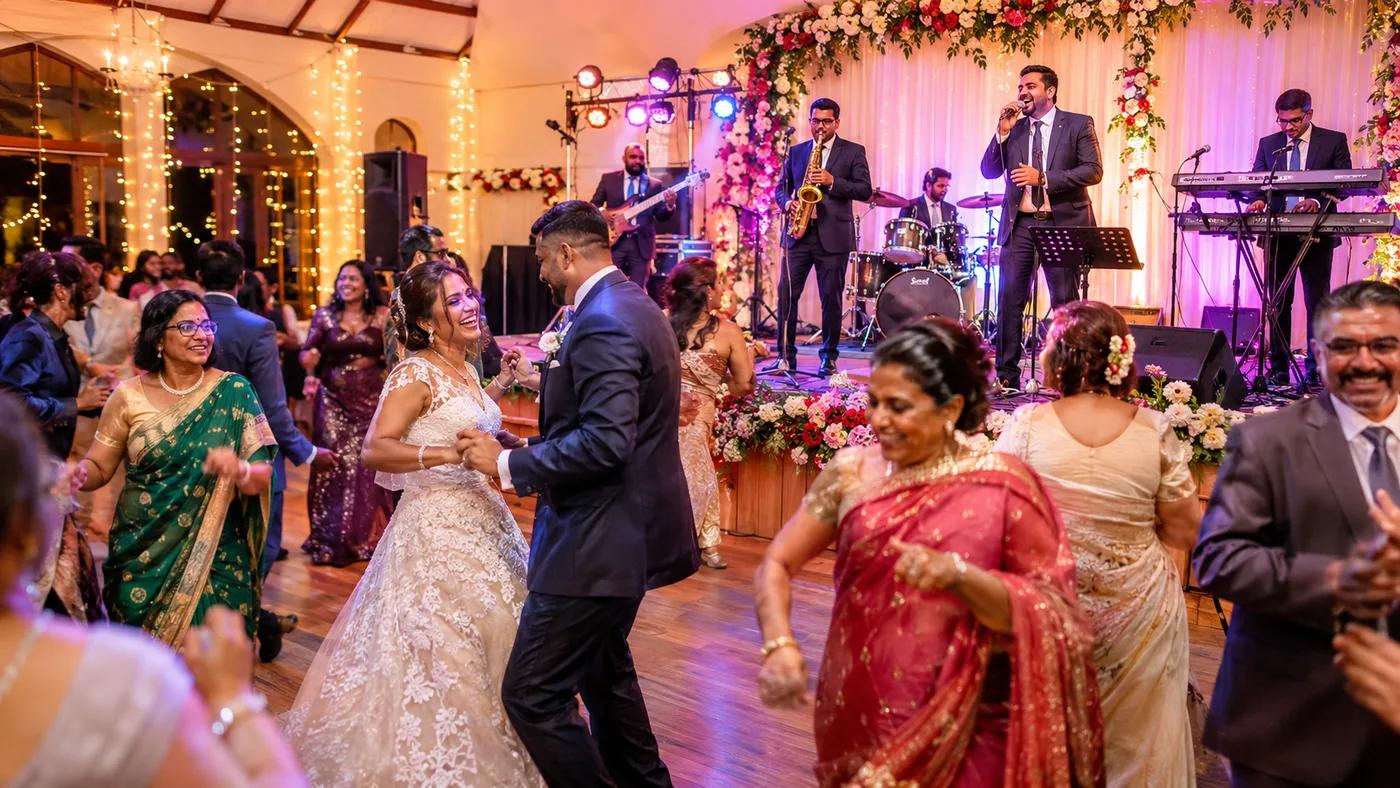
The Vor is the grand reception. It was traditionally hosted at the groom's house but is now almost always held at a banquet hall, hotel or outdoor venue. Expect the cake cutting, toasts, a sit-down meal or buffet and hours of dancing. Ballroom-style dancing to a live band playing Konkani and Western music is a hallmark of Goan Catholic receptions, and it is rare in other Indian traditions. The families perform the mando and the faster, more playful dulpod. By the time the evening hits its stride, every guest is expected on the dance floor.
Bhikarianchem Jevonn — Feeding the Poor
Before the wedding, many families prepare Bhikarianchem Jevonn, a meal for the poor. According to the Museum of Goa, it traditionally took place about five days before the wedding, and only for the marriage of the family's eldest child. Guests were seated after prayers and served on leaf plates, in memory of departed relatives. Today the meal is usually smaller and quieter. Many wedding guests never know it happened, which is precisely the point.
Which Churches in Goa Are Best for Weddings?
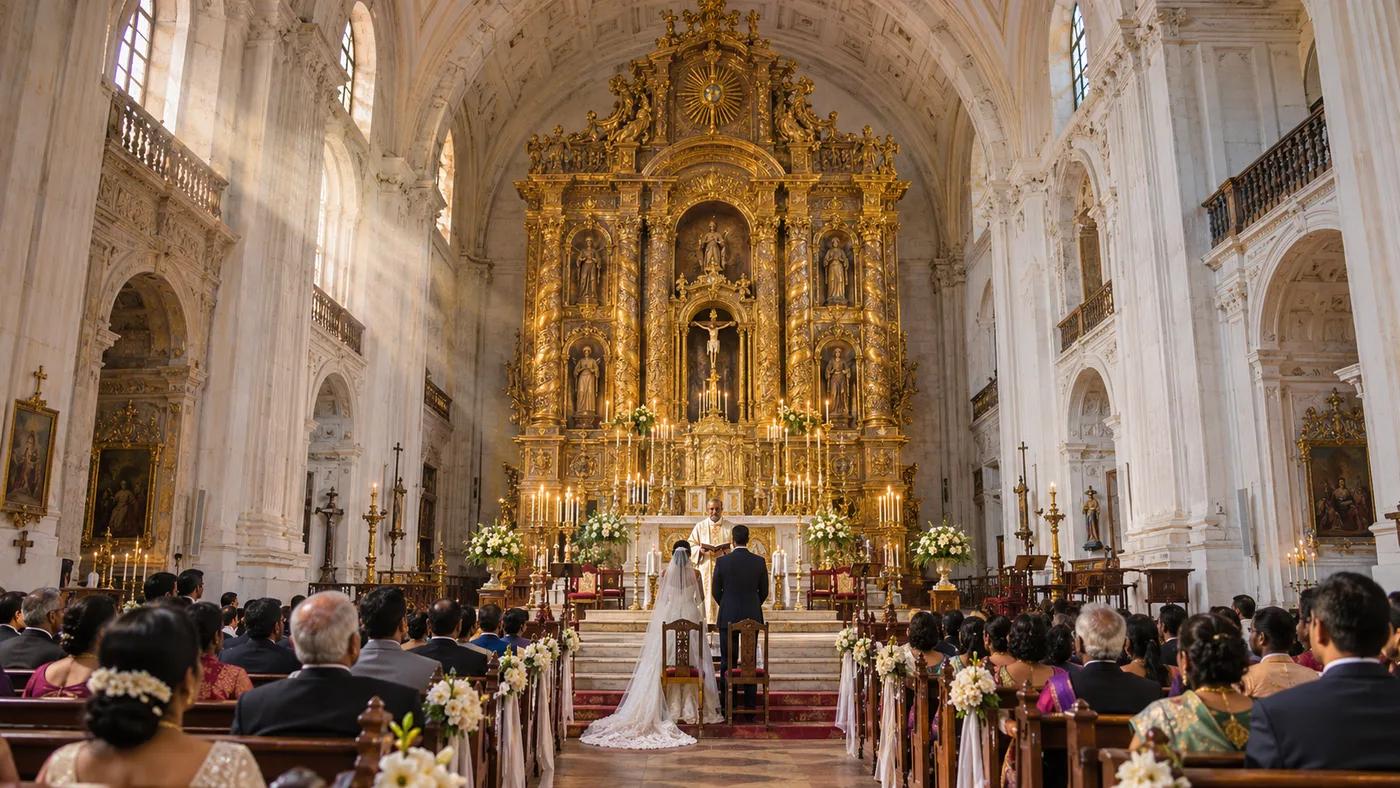
The most sought-after wedding churches in Goa are the Basilica of Bom Jesus and Se Cathedral in Old Goa, and Our Lady of the Immaculate Conception in Panaji. Mae de Deus in Saligao and the Chapel of Our Lady of the Mount complete the list. Goa has hundreds of churches and chapels, but these five stand out for history, architecture and setting. Remember, though, that your own parish church is the default under Church rules.
| Church | Location | Approx. Seated Capacity | Best For |
|---|---|---|---|
| Basilica of Bom Jesus | Old Goa | 250–300 | Prestige and history; minimal decor allowed |
| Se Cathedral | Old Goa | 400+ | Large family weddings |
| Our Lady of the Immaculate Conception | Panaji | 200–250 | Easy access to Panaji hotels |
| Mae de Deus | Saligao, Bardez | About 150 | Neo-Gothic setting in North Goa |
| Chapel of Our Lady of the Mount | Old Goa | 60–80 | Intimate ceremonies with a view |
Basilica of Bom Jesus, Old Goa
The Basilica of Bom Jesus is part of a UNESCO World Heritage Site and Goa's most iconic church, housing the remains of St. Francis Xavier. Its laterite-and-basalt facade, gilded baroque altar and sheer weight of history make it Goa's most prestigious Catholic wedding venue. The Jesuits manage the basilica, so weddings are arranged through them, and decor must be kept to a bare minimum. Capacity is roughly 250-300 guests seated. Expect a long lead time, because popular dates can book 8-12 months ahead.
Se Cathedral of Santa Catarina, Old Goa
Se Cathedral is often described as the largest church in Asia at the time it was completed in the 17th century. It is a landmark of Portuguese-Manueline architecture, with a cavernous nave, a gilded main altar and the famous Golden Bell. The cathedral seats 400+ guests, which suits large family weddings where the grandeur of the space matches the guest list.
Church of Our Lady of the Immaculate Conception, Panaji (also Panjim)
This whitewashed church with its dramatic zigzag staircase sits on a hillside in the heart of the state capital. It is one of Goa's most photographed landmarks. It began as a chapel in 1541 and was rebuilt in its current baroque form in 1619. Today it is a practical choice for a heritage setting close to the hotels and reception venues of Panaji (also Panjim). Capacity is approximately 200-250 guests.
Mae de Deus Church, Saligao
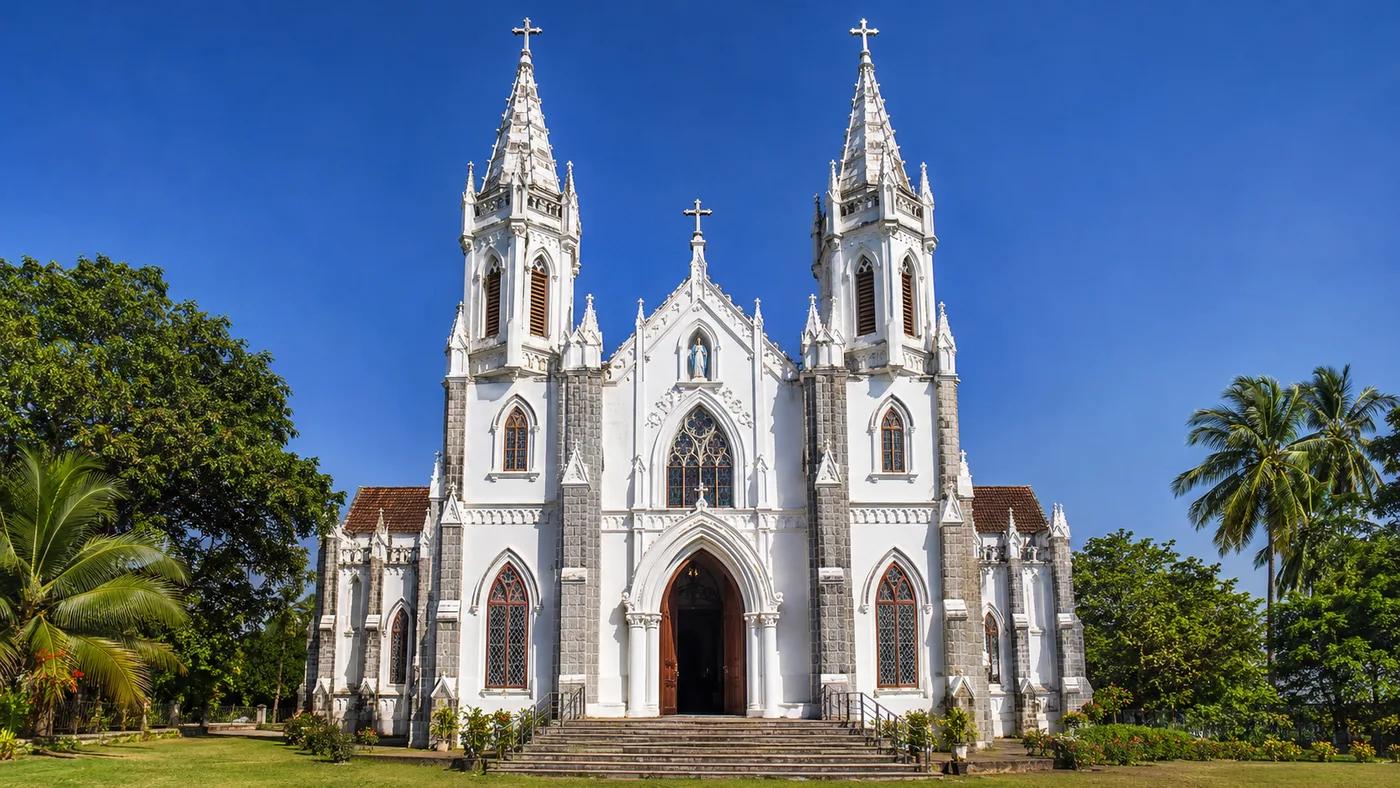
In Bardez taluka, Mae de Deus is a striking neo-Gothic church set in the green countryside of North Goa. Its spires and buttressed walls are memorable, and so is its statue of Mae de Deus (Mother of God), brought from the ruins of a convent in Old Goa. If you plan to marry here, check availability early. You should also complete the diocesan marriage preparation course at least 6 months before the wedding. I have attended two weddings here, and the late-afternoon light through the Gothic windows is unforgettable.
Chapel of Our Lady of the Mount, Old Goa
Set on a hilltop above the Mandovi River and the Old Goa churches, this small chapel suits couples who want a private ceremony. Capacity is limited to 60-80 guests, which makes it ideal for compact destination weddings. The view from the chapel grounds is one of the best in Goa and makes a breathtaking backdrop for photographs.
Note
Parish church priority: Under Canon Law, Catholics are expected to marry in their own parish church. If you want to marry in a church outside your parish, you will need a letter of permission (litterae dimissoriae) from your parish priest. Start this process early — it adds 2-4 weeks to the paperwork timeline.
Looking for Wedding Planners in Goa?
Tell us what you need and get quotes from verified wedding planners
What Does the Church Require from Couples?
The Church asks for fresh sacramental certificates, a pre-nuptial enquiry, a marriage preparation course and proof of civil registration. The Archdiocese of Goa and Daman sets these requirements, and every couple must meet them before a wedding can be scheduled.
Documents You Need
- Fresh baptism certificates for both parties, issued not more than 6 months before the wedding date
- Confirmation certificates for both parties
- Pre-nuptial enquiry forms, filled in with the parish priest
- Marriage preparation course certificate (issued by the Diocesan Family Service Centre)
- Certificate of civil registration in view of marriage, or a certificate of civil marriage already solemnised — this must be submitted to the parish priest before the nuptials
- No Objection Certificate from the relevant parish if either party belongs to a different parish
The Marriage Preparation Course
The Diocesan Family Service Centre conducts a two-day programme (morning to evening) in both Konkani and English. Centres operate in North Goa (St. Inez, Panaji) and South Goa (Margao). The certificate is valid for 2 years, so couples can complete it well in advance. Topics covered include communication in marriage, family planning (from the Catholic perspective), conflict resolution, financial management, and the theology of the sacrament.
Timeline
Inform your parish priest at least 3 months before your intended wedding date. The priest will:
- Conduct the pre-nuptial enquiry
- Arrange for the reading of Banns — announcements made during Sunday Mass for three consecutive weeks
- Coordinate with the other party's parish if they belong to a different church
- Schedule a rehearsal (recommended but not always required)
Important
Civil registration is mandatory. A church wedding in Goa is not automatically legally valid. You must register your marriage at the civil registrar's office — the church will require proof of this before or after the ceremony. See our Goa wedding laws and permits guide for the full civil registration process.
How to Plan the Reception After a Church Ceremony
Plan the Vor around three things: a Goan menu, a live band, and enough time for the mando and the dancing. It is where Goan Catholic hospitality reaches its peak, so here is how to honour tradition while reflecting your own style.
The Feast
Goan Catholic wedding food is a non-negotiable highlight. The traditional menu centres on:
- Sorpotel and Sannas — the signature pairing of spiced pork stew with steamed rice cakes, present at every Goan Catholic celebration
- Vindalho — the fiery pork vindaloo that Goa is famous for, with roots in the Portuguese carne de vinha d'alhos
- Assado de Porco — roasted pork, often the centrepiece of the buffet
- Chouriço Pulão — Goan pork sausage rice, a crowd favourite
- Bebinca — Goa's iconic layered coconut dessert, traditionally made with 16 layers and served as the wedding sweet
- Dodol, Cocada, and Maçapão (cashew nut marzipan) — the doce tray of Goan sweets prepared at the bride's and groom's homes in the days before the wedding
That range covers per-plate catering costs for a Goan Catholic wedding reception. Expect to budget separately for alcohol, which is a standard part of the celebration.
Music and Dancing
The reception band is not background music; it is the engine of the entire evening. A typical Goan Catholic reception features a live band playing Konkani mandos and dulpods, classic rock, Bollywood and ballroom numbers. The mando, a slow, graceful couples' dance set to melancholic Konkani lyrics, is the cultural centrepiece. The bride's and groom's families perform it in formal attire. As the evening goes on, the tempo shifts to faster dulpods and then to Western and Bollywood dance music.
The wedding march (Marcha Nupcial) is a distinctly Goan tradition in which the whole gathering forms a dancing procession behind the couple. It erases the line between hosts and guests and pulls everyone into one joyful movement.
What Does a Catholic Wedding in Goa Cost?
A Catholic wedding in Goa costs ₹8–15 lakh for an intimate parish wedding and ₹25–35 lakh for a large or destination-style celebration, plus a church donation of ₹5,000–30,000. The spread depends on whether you host a local parish wedding or a destination event. Here is an honest breakdown.
Church Ceremony Costs
₹5,000 – ₹30,000This covers the church donation, priest's stipend, and choir fees. Heritage churches like the Basilica of Bom Jesus may have higher suggested donations. Flower arrangements for the church altar and pews add ₹15,000 – ₹60,000 depending on scale.
Full Wedding Budget Ranges
Intimate local wedding (50-100 guests):
₹8,00,000 – ₹15,00,000This covers the church ceremony, a reception at a parish hall or local restaurant, traditional catering, basic decor, and a photographer.
Mid-range celebration (150-300 guests):
₹15,00,000 – ₹25,00,000A banquet hall or hotel venue, professional catering with full bar, a live band, quality photography and videography, and professional decor.
Large or destination-style wedding (300-500+ guests):
₹25,00,000 – ₹35,00,000A premium hotel or resort venue, extensive catering, a top-tier band, luxury decor, guest accommodation coordination, and a wedding planner.
For a detailed cost breakdown across all wedding categories in Goa, see our Goa wedding cost guide. For venue-specific pricing, check best wedding venues in Goa.
Looking for Wedding Planners in Goa?
Tell us what you need and get quotes from verified wedding planners
Can Non-Catholic Couples Marry in a Goa Church?
Only if one partner is Catholic: two non-Catholics cannot have a sacramental Catholic wedding. Beyond that, the details depend on each partner's faith.
One Catholic, one non-Catholic partner: Yes, this is possible. If the other partner is not baptised, the Catholic partner's parish priest requests a dispensation from the Bishop for "disparity of cult". If the other partner is a baptised non-Catholic Christian, the priest seeks the Bishop's permission for a mixed marriage instead. The Archdiocese of Goa and Daman asks the Catholic party for baptism and confirmation certificates. A baptised non-Catholic partner provides a baptism certificate from their own church. Both partners attend the marriage preparation course. The ceremony is often held outside of Mass, with a liturgy of the word, vows and blessings but no full Eucharist.
Two non-Catholic partners: A sacramental Catholic wedding is not possible if neither partner is Catholic. Instead, some couples register a civil marriage under Goa's civil code and then hold a separate blessing or commitment ceremony at a chapel or heritage venue. Several Goa wedding planners arrange these non-sacramental ceremonies for destination couples.
Lapsed Catholics returning to the faith: If you were baptised Catholic but have not practised in years, you can still marry in the church. Speak with the parish priest honestly about your situation. In my experience, most priests in Goa are welcoming and will guide you through the preparation without judgement.
Common Questions About Catholic Weddings in Goa
How far in advance should I book a church in Goa for my wedding?
Book 8-12 months ahead for heritage churches like the Basilica of Bom Jesus or Se Cathedral, especially for Saturday dates in the October-to-February peak. Parish churches in smaller villages may be more flexible. Even so, aim for at least six months, so you can finish the paperwork and the marriage preparation course. If you are marrying outside your own parish, add two to four weeks for the permission letter from your parish priest.
What should guests wear to a Goan Catholic church wedding?
Dress modestly for the church ceremony: shoulders and knees should be covered, and sleeveless tops or very short dresses are considered inappropriate. Men typically wear formal trousers with a shirt, or a suit, while women wear sarees, dresses or formal outfits. The reception dress code is more relaxed, and semi-formal or cocktail attire is standard. If the Vor includes ballroom dancing, comfortable shoes are a quiet blessing.
Is the Ros ceremony the same as Haldi?
The Ros is sometimes compared to the Hindu Haldi ceremony because both involve anointing the bride or groom before the wedding. But the Ros uses coconut milk, not turmeric paste, and its cultural and religious roots are entirely different. The Ros is a Catholic Konkani tradition shaped by the Portuguese era. Its mandos and prayers give it a character distinct from any Hindu pre-wedding ritual.
Do Goan Catholic weddings serve alcohol?
Yes. Unlike many other Indian wedding traditions, alcohol is a standard and expected part of a Goan Catholic reception. Feni (cashew or coconut spirit), beer, wine and spirits are served freely, usually from the first toast. Budget for alcohol separately from catering, because it can account for 15-25% of the total reception spend. If the venue has no bar licence, you will also need a temporary excise permit.
How long does the full Goan Catholic wedding celebration last?
The full arc, from the Chuddo weeks before through the Ros, the wedding Mass and the Vor, spans several weeks in total. The concentrated celebrations typically cover 2-3 days, starting with the Ros on the eve. The church ceremony itself runs 45 minutes to 1.5 hours, and the reception lasts well into the night. Some families also keep Portonnem, when the bride's family escort the newlyweds towards the groom's village and then return home.
Rhea D'Souza covers weddings across Western India for itsmy.wedding. She grew up attending Catholic weddings in Salcete and Bardez talukas. She has a particular love for any celebration with live mandos and a properly layered bebinca.
Topics
catholic wedding in goagoan catholic wedding traditionschurch wedding goagoa church wedding venuesros ceremony goabasilica bom jesus weddingExplore more
Frequently Asked Questions
1What are the main rituals in a Goan Catholic wedding?
2How much does a Catholic church wedding in Goa cost?
3Can non-Catholic couples marry in a Goa church?
4What documents are needed for a church wedding in Goa?
5What is the Ros ceremony in a Goan wedding?
6Which is the best church for a wedding in Goa?
Continue reading
Related Articles
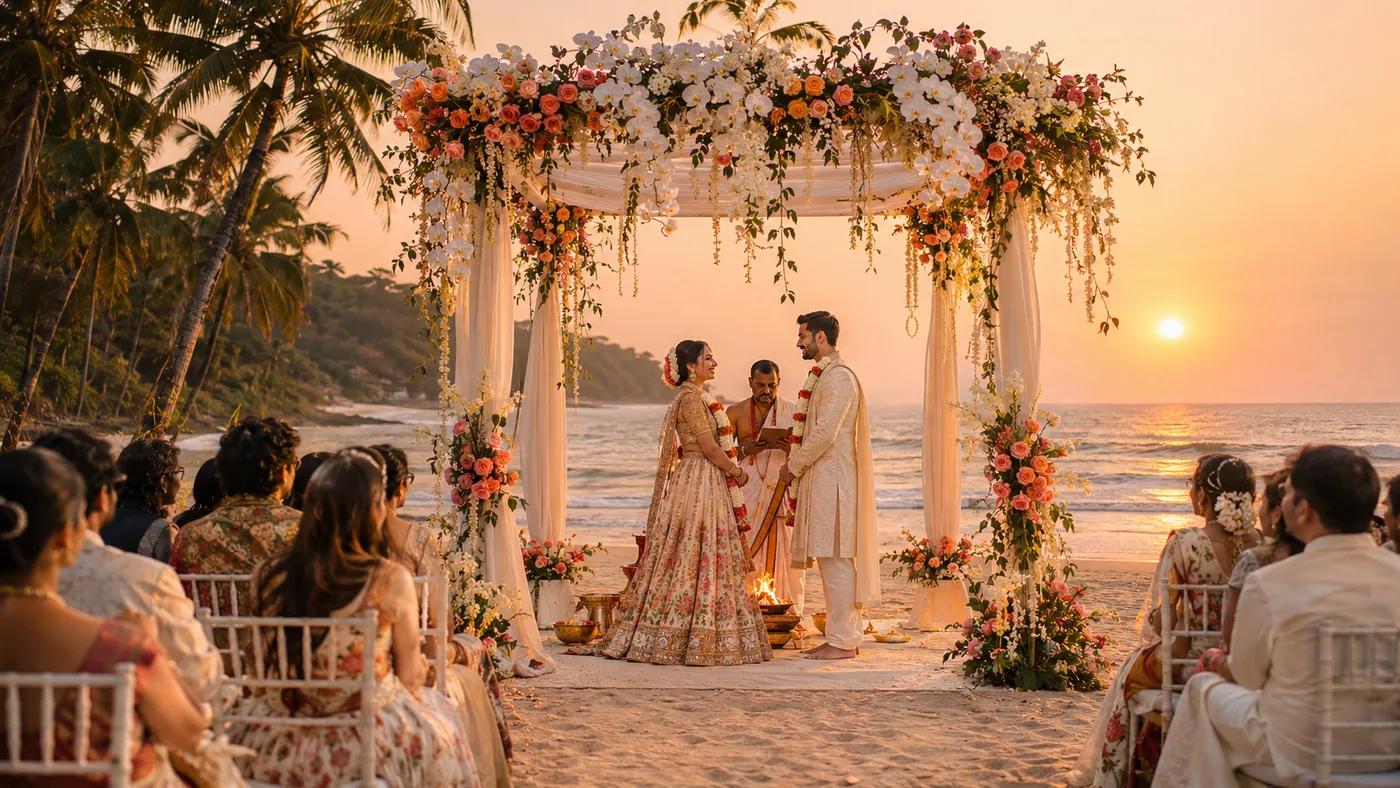
Destination Wedding in Goa: The Complete 2026 Planning Guide

Goa Wedding Laws and Permits: Everything Couples Must Know
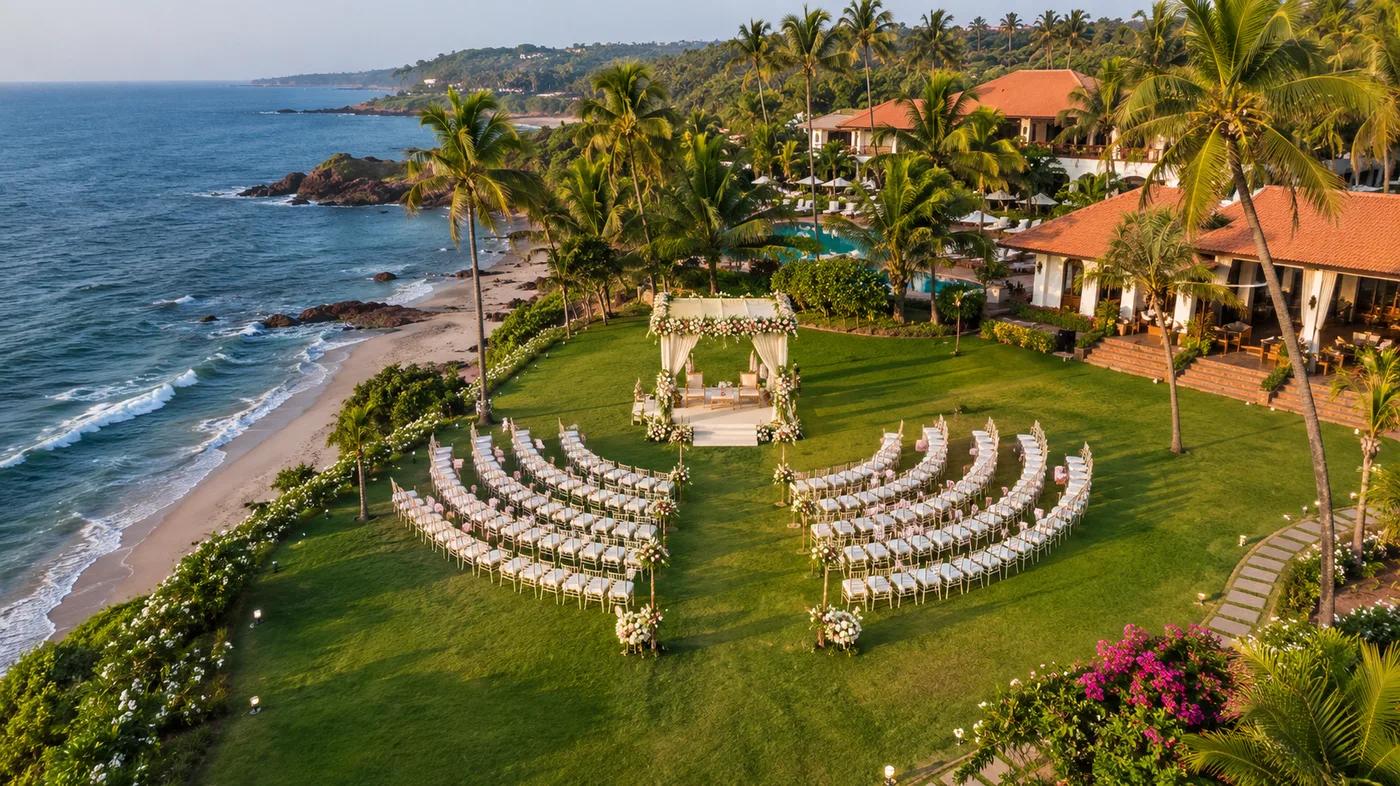
Best Wedding Venues in Goa: 20+ Options with Prices (2026)
Kerala Christian Wedding Traditions: A Complete Guide to Rituals and Customs
Assam Destination Wedding: Kaziranga, Majuli & Guwahati
Best Time for a Northeast India Wedding: Month by Month
Still planning?
Get quotes from India's best vendors
Tell us what you're planning and we'll match you with verified photographers, venues, decorators, and more.
Get free quotes