Choosing the right wedding invitations for your wedding in India
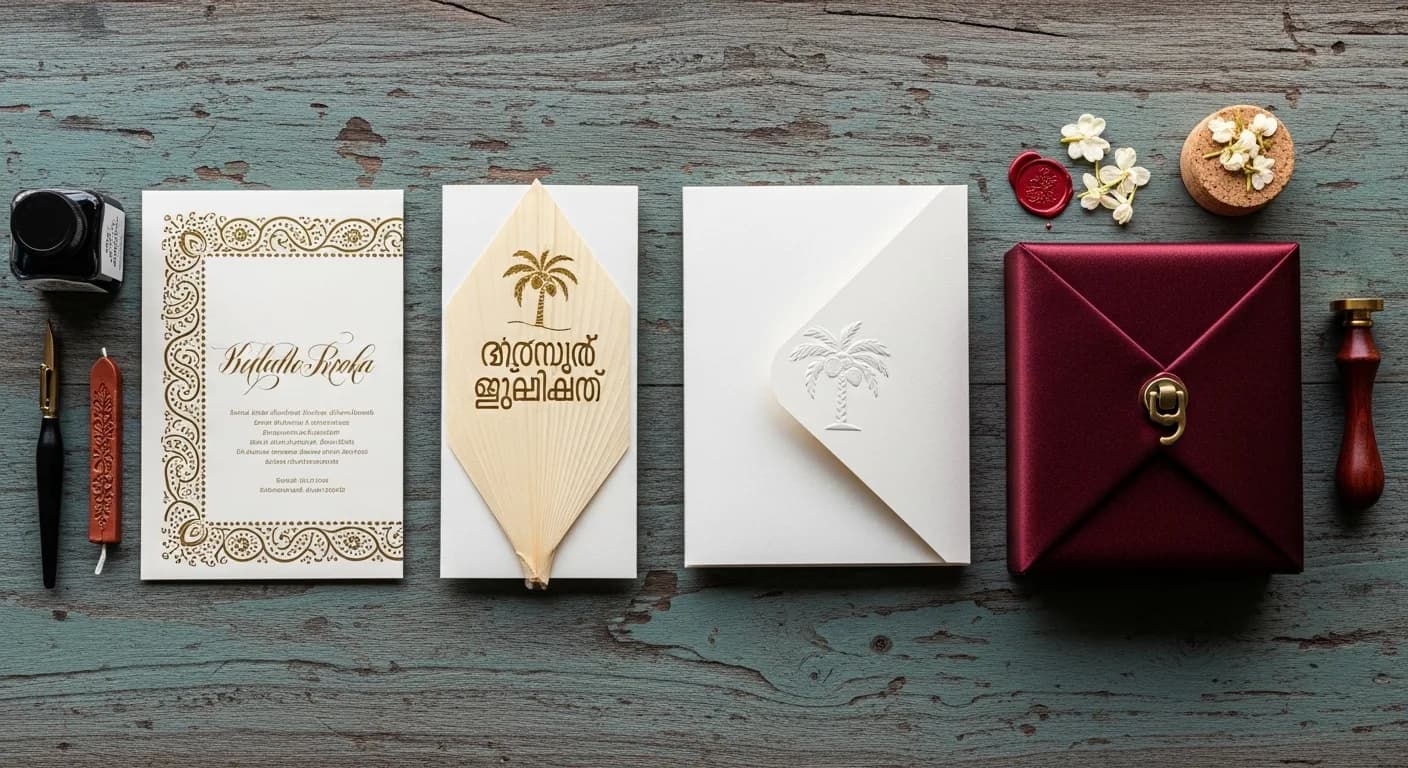
Kerala wedding invitations span a wide range of formats and price points — traditional digital-printed cards, premium letterpressed invitations, laser-cut designs, foil-stamped luxury cards, and increasingly digital-first e-invites that couples use either to replace printed cards entirely or to complement a smaller print run. Traditional Kerala invitation design leans heavily on community-specific visual language: Hindu cards typically feature gold-foil Kasavu motif borders, temple-inspired imagery, palm-leaf effects, elephant motifs, and ornate dual-language calligraphy in Malayalam and English. Syrian Christian invitations often feature cross motifs, traditional wedding verses drawn from scripture, dove imagery, and dual-language copy with English primary and Malayalam secondary — the tone is often more restrained than Hindu cards, with cleaner typography and subtler foil detailing. Mappila Muslim wedding cards feature crescent and geometric Islamic motifs, often in emerald green, gold, and ivory palettes, with Arabic calligraphy accompanying the English text. Modern couples in India increasingly choose digital-first e-invites — the savings on printing, postage, and logistics are substantial, and e-invite platforms provide automatic RSVP tracking, guest list management, and the ability to update event details or directions in real-time if plans shift. Major invitation suppliers in India range from traditional print studios in Ernakulam, Thiruvananthapuram, and Kozhikode to luxury letterpress boutiques, online-first e-invite specialists, and bespoke designer stationers who handle handwritten calligraphy and wax-sealed envelopes.
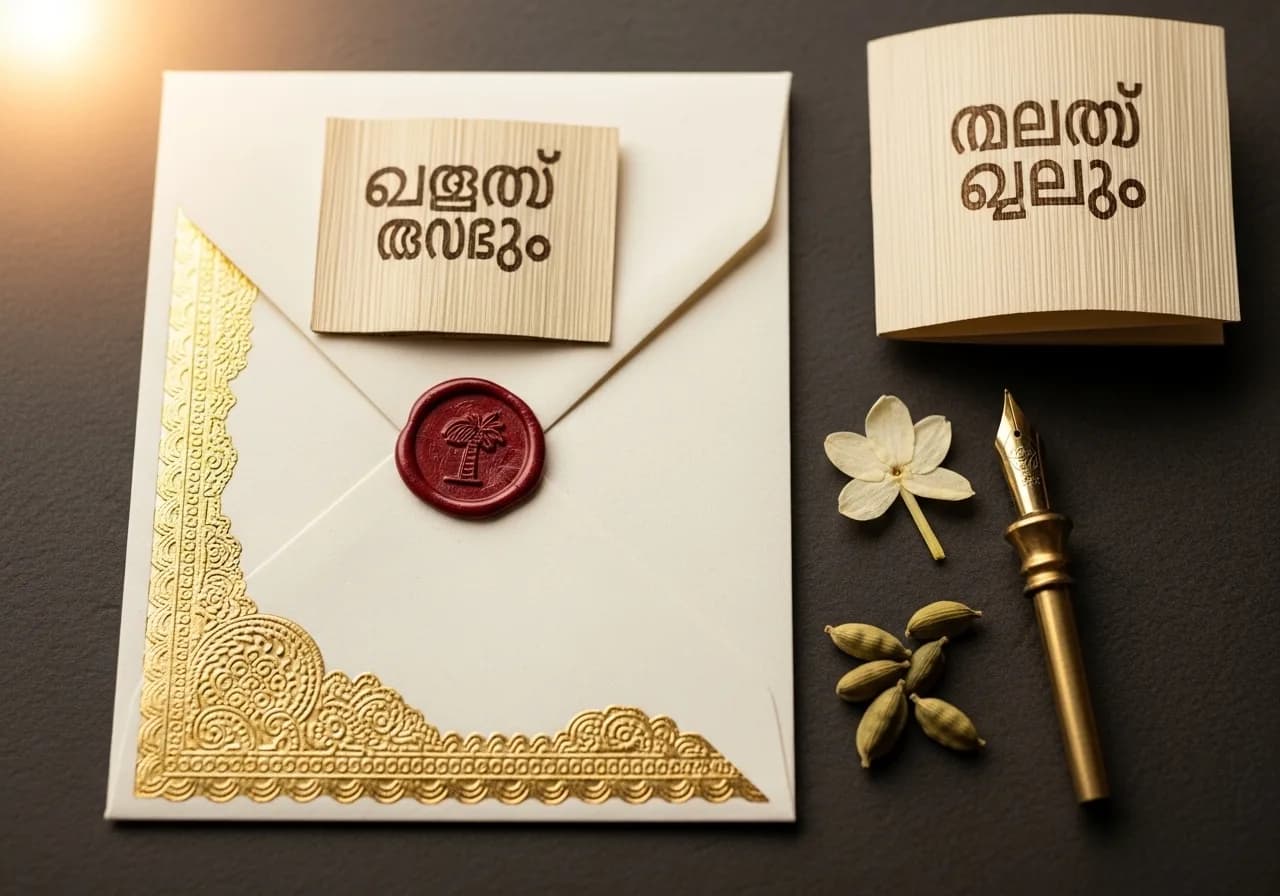
Traditional digital-printed cards in India for orders of 500+ typically cost ₹15–₹75 per card depending on paper weight, finish (matte, glossy, textured), and whether there's single or multi-colour printing. Premium letterpressed or foil-stamped invitations — where the design is pressed into thick cotton paper with real metallic foil detailing — run ₹150–₹1,000 per card, and are increasingly popular for smaller intimate weddings where invitation quality is a meaningful signal of the event's tone. Luxury designer invitations with boxed presentation, wax seals, handwritten calligraphy, ribbon wrapping, and custom fabric liners cost ₹500–₹3,000 per card — often reserved for high-end weddings where every detail is considered. E-invite platforms offer a genuinely wide range: free tiers for simple designs, ₹2,000–₹10,000 for premium templates with custom branding and RSVP management, and ₹10,000+ for fully custom designed e-invite microsites with motion design, photo galleries, and integrated travel and accommodation information (itsmy.wedding sits in this space among other platforms serving Indian couples). Add-on services — envelope addressing, RSVP card printing, calligraphy, custom illustrations, return envelopes — typically add ₹3–₹25 per card depending on complexity. For a 500-guest wedding, total invitation spend in India ranges from ₹7,500 for basic digital-printed cards to ₹5,00,000+ for luxury designer letterpressed invitations with full accessory suites.
Order invitations 8–12 weeks before the wedding — traditional printing in India needs genuine lead time for proofs, corrections, paper sourcing (especially for imported papers like Canson, Fabriano, or Somerset), letterpress plate-making if relevant, and the actual print run itself. Save-the-date announcements should go out 5–6 months before the wedding, particularly for destination weddings at Kumarakom or Kovalam where out-of-town guests need to book travel and accommodation early. Formal invitations follow 8 weeks before the wedding — this gives guests enough time to RSVP, arrange travel, and acknowledge receipt, while not so far out that the event feels distant. Always proofread a physical printed sample at actual size before committing to the full print run — font legibility, kerning, and colour saturation all shift between screen preview and printed output, and a single spelling error discovered after 500 cards are printed is an expensive lesson. For multilingual invitations in India, have a native Malayalam speaker with editing experience review the Malayalam text specifically — auto-translation and non-native proofing produces embarrassingly common errors in traditional formal Malayalam, particularly in honorifics, relationship terms, and the wedding-specific vocabulary used in ceremonial text. For destination weddings at Kumarakom, Marari, Kovalam, Varkala, or Bekal, invitations need to include map links, transport instructions, accommodation blocks, and the wedding-day schedule — this volume of logistics is substantially easier to manage through an e-invite microsite than printed inserts, and most India couples combining printed cards with an e-invite deliver the printed card as a ceremonial keepsake while using the e-invite for all logistics. Finally, keep 10–15% extra cards beyond your headcount — last-minute additions, damaged cards, and keepsake copies for family members add up quickly.