
Sri Lanka vs Goa vs Bali vs Kerala for Indian Destination Weddings (Honest 2026 Comparison)
Sri Lanka vs Goa vs Bali vs Kerala destination wedding comparison for 2026: costs ₹12-75L, visa rules, food, vendor maturity, and which wins for your guest count.

Cross-Border Destination Wedding Consultant
Anita Sundaram is a Chennai-based destination wedding consultant who specialises in cross-border ceremonies for South Indian families, with a focus on Sri Lanka and the Konkan coast.
On this page
Comparing Sri Lanka, Goa, Bali and Kerala for an Indian destination wedding? Sri Lanka costs ₹15-50 lakh for 100-250 guests, Goa runs ₹18-65 lakh, Bali reaches ₹35-75 lakh, and Kerala holds at ₹12-40 lakh. The right pick depends on guest count, budget ceiling, food requirements and whether your family needs a domestic flight or a passport.
Quick Answer
Quick answer: Sri Lanka is the strongest value pick for 80-200 guest Indian weddings that want international aesthetics without Bali's price tag. Kerala wins on pure cost and zero visa friction. Goa wins on scale (500+ guests) and vendor maturity. Bali wins on visual uniqueness but costs 40-60 percent more than Sri Lanka for equivalent guest counts.
I plan cross-border weddings out of Chennai, and "Should we do Sri Lanka or just stick with Goa?" has overtaken the budget question as the first thing couples ask in 2026. The answer is never a single winner — it depends on variables that interact differently for every family. This guide lays out honest trade-offs with real numbers from Q1 2026 vendor pricing.
For the full Sri Lanka picture, our Sri Lanka destination wedding guide covers the island end-to-end. This spoke is the four-way comparison.
How Do the Four Destinations Compare at a Glance?
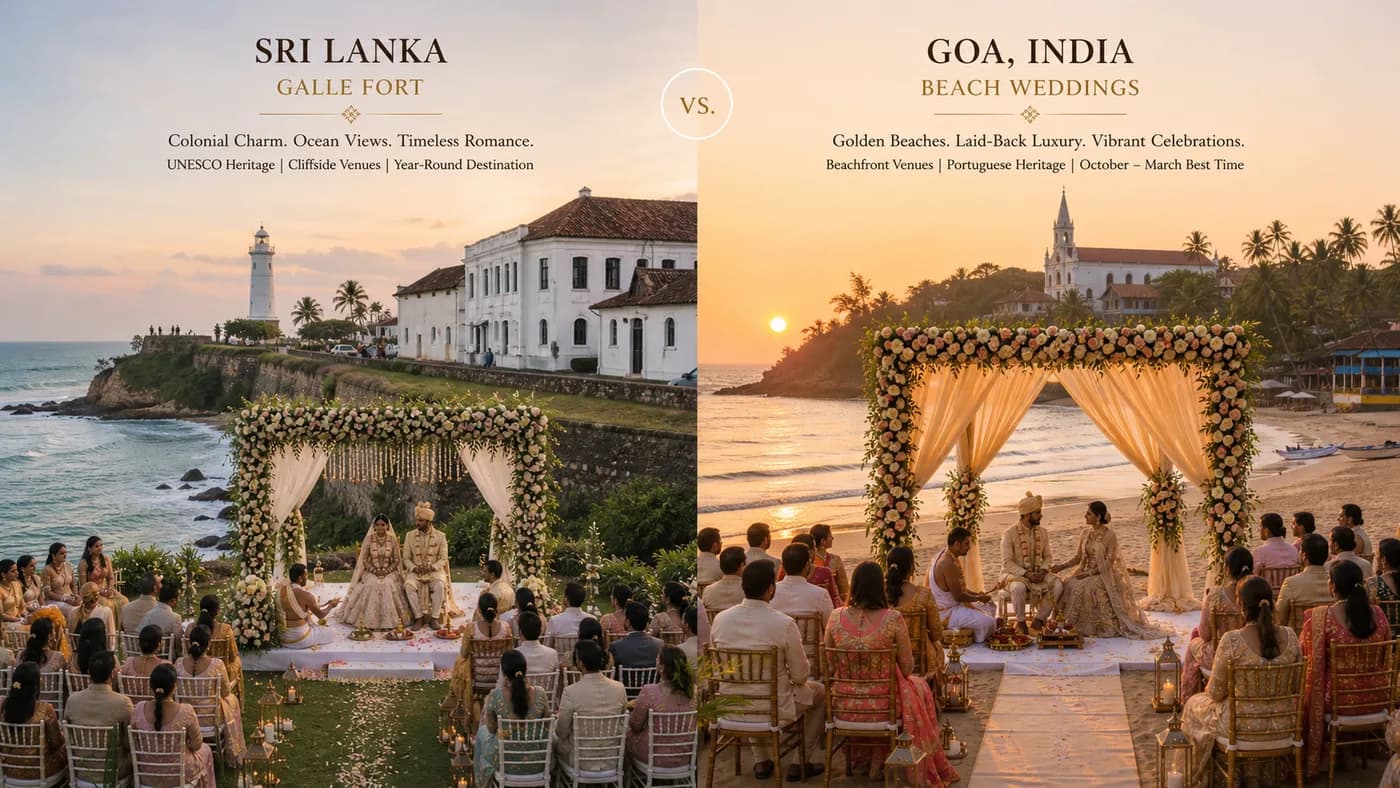
Sri Lanka Tourism Promotion Bureau data shows Indian wedding bookings on the island doubled between 2024 and 2026, yet most Indian couples still default to Goa without running the numbers. The table below puts all four destinations side by side on the seven factors that actually move the decision.
| Factor | Sri Lanka | Goa | Bali | Kerala |
|---|---|---|---|---|
| Cost (150 guests, 5-star, 2 nights) | ₹25-35L | ₹28-45L | ₹45-65L | ₹20-32L |
| Ease of planning | Medium — cross-border logistics | Easy — domestic, mature market | Hard — 8hr flights, language gap | Easiest — domestic, local networks |
| Indian food compatibility | Strong (South Indian overlap) | Good (weaker on pure-veg spreads) | Weak (import-dependent) | Best (native cuisine) |
| Alcohol policy | Resort-only, no corkage | Flexible, external vendors allowed | Flexible, local spirits cheap | State-controlled, limited hours |
| Visa/legal | ETA USD 50/guest, 4-day residency | None | VOA USD 35/guest, religious ceremony required | None |
| Vendor maturity | Growing fast, still thin outside Colombo | Deepest in India | Mature for Bali-style, thin for Indian | Deep in South India niche |
| Vibe | Colonial heritage + tropical | Indo-Portuguese beach party | Hindu-Balinese temple + rice terrace | Backwater serenity + temple tradition |
Note
Pricing methodology: All cost bands in this comparison are built from vendor pricing collected in Q1 2026 across marketplace listings, published resort wedding packages, and cross-referencing with Sri Lanka Tourism Promotion Bureau industry briefings, WeddingSutra annual reports, and Bali Wedding Association published rates. INR conversions use a USD reference of ₹83-85.
What Does Each Destination Actually Cost?
Industry data shows venue and F&B alone account for 35-45 percent of the total, and that line item varies by 2-3x across destinations.
Sri Lanka — ₹15,00,000 – ₹50,00,000 for 100-250 guests. The cost structure breaks along three bands: Colombo urban at a 15-20 percent premium, south coast as the mainstream, east coast at 25-30 percent below south coast. Shoulder months (April, November) shave another 20-30 percent.
Goa — ₹18,00,000 – ₹65,00,000 for 100-300 guests. Goa 5-star rates climbed 20-30 percent since 2023 per WeddingSutra. Our Goa destination wedding guide covers the full picture. The domestic advantage — no flights to sponsor, no visa costs — claws back ₹4-8 lakh versus the venue premium.
Bali — ₹35,00,000 – ₹75,00,000 for 100-200 guests. The premium stacks from eight-hour flights, imported Indian catering, and Uluwatu/Ubud venue rates. TTG Asia reports Bali packages run 40-60 percent above equivalent Sri Lanka ones.
Kerala — ₹12,00,000 – ₹40,00,000 for 100-250 guests. Cheapest of the four — no flights for most South Indian lists, no visa costs, native cuisine. The trade-off is domestic familiarity: Kerala can read as a regular wedding rather than a destination event.
Looking for wedding-plannerss in Colombo?
Tell us what you need and get quotes from verified wedding-plannerss
How Do Logistics and Accessibility Stack Up?
Flight time from Chennai — the most common departure city for South Indian destination weddings — is the clearest proxy for logistics friction.
| Route | Flight time | Direct flights | Visa | Currency |
|---|---|---|---|---|
| Chennai → Colombo | 1 hr | Daily (SriLankan, IndiGo) | ETA (USD 50) | LKR |
| Chennai → Goa | 1.5 hrs | Daily (IndiGo, SpiceJet) | None | INR |
| Chennai → Bali | 8 hrs (via KL/SIN) | No direct | VOA (USD 35) | IDR |
| Chennai → Kochi | 1.5 hrs | Daily (IndiGo, Air India) | None | INR |
From Mumbai, the picture shifts — Mumbai to Goa is a 1-hour flight or 8-hour drive, the easiest in this list. Group transfers on arrival add hidden cost: BIA to Bentota is 90 minutes, BIA to Galle is 2.5 hours, and the east coast is 5-6 hours. In Goa, airport to south Goa venues is 45-90 minutes. In Bali, the airport to Ubud is 90 minutes in traffic.
Tip
The passport coordination tax is real. For a 150-guest Sri Lanka or Bali wedding, every guest needs a valid passport. In my experience, 10-15 percent of a typical South Indian guest list does not hold a current passport. Factor 8-12 weeks for renewals, or accept that your cross-border list will be smaller than your domestic one.
Is Your Marriage Legally Recognised in Each Destination?
Indian couples marrying in Goa or Kerala do so under Indian law — the Hindu Marriage Act, Special Marriage Act, or applicable personal law — and the marriage certificate is immediately valid across India. No attestation, no apostille, no embassy visit.
Sri Lanka requires a four-day physical residency before the Registrar of Marriages can solemnise the union. The certificate then needs Ministry of Foreign Affairs attestation in Colombo and Indian High Commission attestation before it is recognised in India. Total paperwork overhead: ₹35,000-60,000 and 2-3 weeks of post-wedding processing.
Bali requires a government-recognised religious officiant, a ceremony at a registered venue, and legalisation through the Indonesian Civil Registry Office. The Indonesian embassy in Delhi processes apostille and attestation. The full cycle takes 4-6 weeks post-wedding.
The practical reality: roughly 70 percent of Indian couples doing cross-border weddings in Sri Lanka or Bali register a simple court marriage in India first and treat the destination event as a celebratory ceremony. This eliminates the legal overhead entirely and lets you focus the destination days on the wedding itself.
Which Destination Handles Indian Food Best?
Kerala serves native South Indian cuisine — sadya, Kerala non-vegetarian, North Indian stations — at standard domestic catering rates. No import premiums, no chef-flying costs. This is a non-comparison.
Sri Lanka ranks second. The culinary base shares coconut, curry leaf, rice and sambar with South India. Outlook Traveller noted that most 5-star south coast resorts now staff dedicated Indian chef brigades. I have run veg weddings at Vivanta Bentota where elderly guests from Thanjavur could not distinguish the appam-avial spread from home.
Goa excels at seafood and Konkani-fusion but pure-veg North or South Indian spreads outside Taj, ITC and Marriott remain inconsistent. For a 200-guest, 60 percent veg wedding, budget for a flown-in caterer.
Bali is weakest. Indonesian cuisine is pork- and shellfish-heavy, and most Indian ingredients must be sourced from Singapore. This import overhead adds ₹8,00,000 – ₹15,00,000 to a 150-guest food budget.
What Vibe and Aesthetic Does Each Destination Offer?
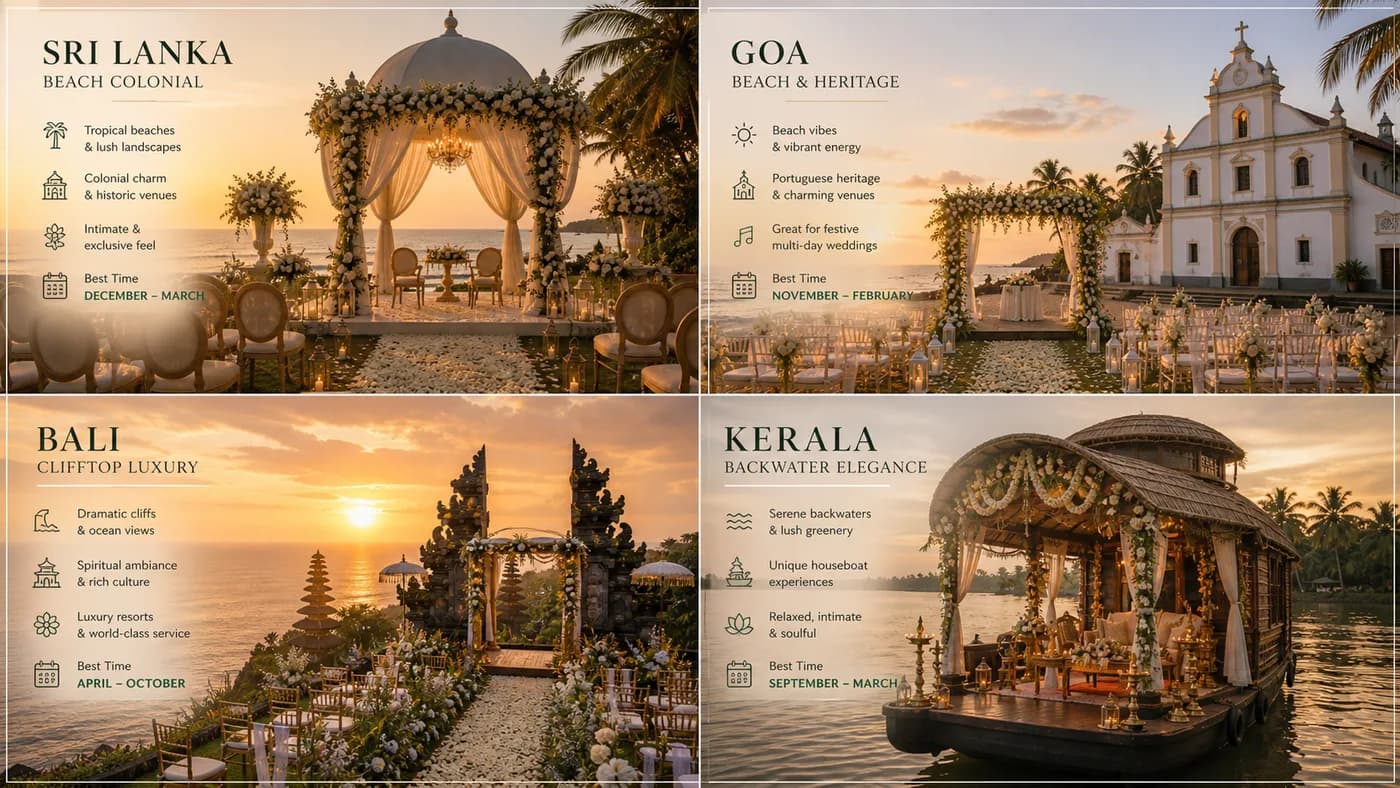
Each destination occupies a distinct visual register that photographs differently and appeals to different couple profiles.
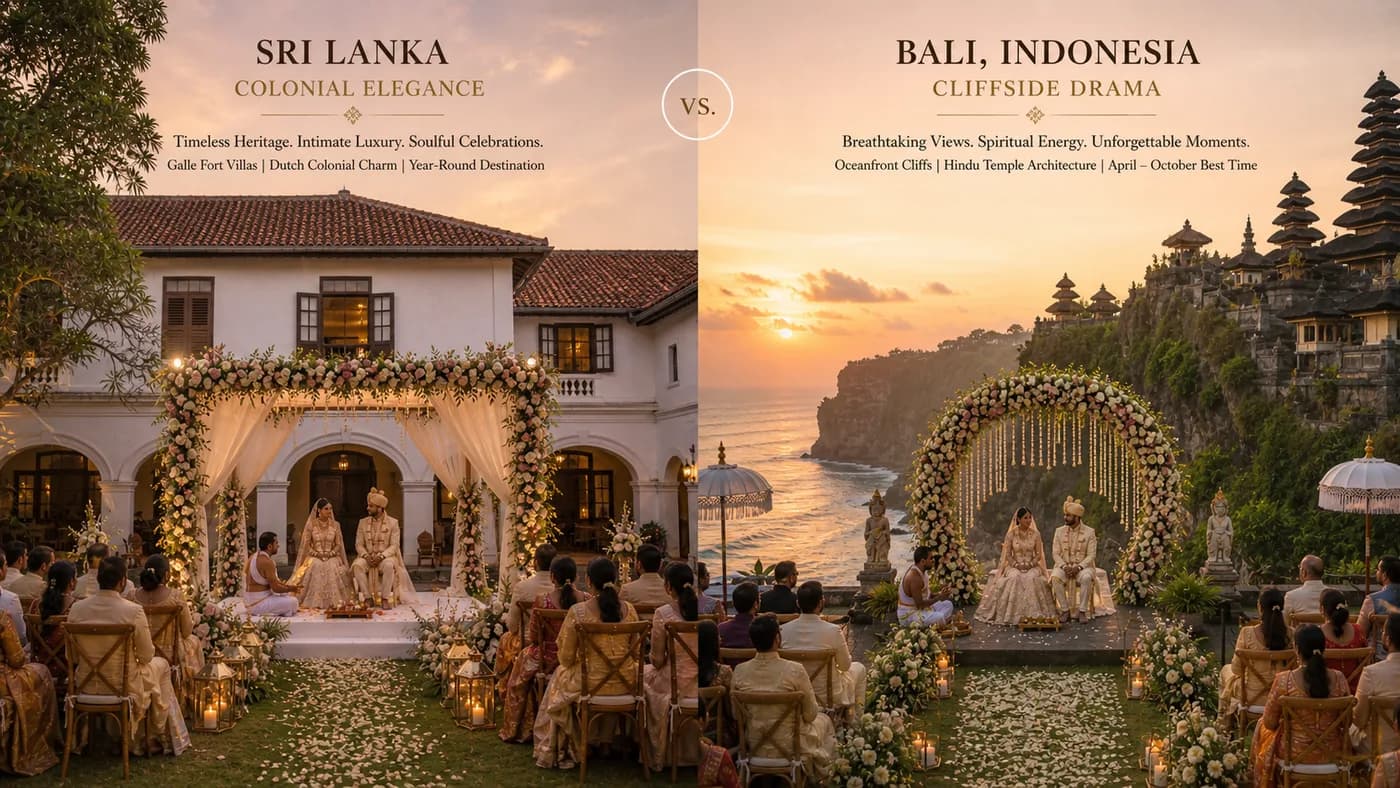
Sri Lanka — Colonial heritage meets tropical coast. Galle Fort's Dutch ramparts, Anantara-grade infinity pools, and Ceylon Tea Trails bungalows at 1,200 metres. The palette runs warm neutrals — stone, teak, white linen — against tea fields or turquoise water. It photographs closer to a refined European destination than a typical South Asian beach wedding.
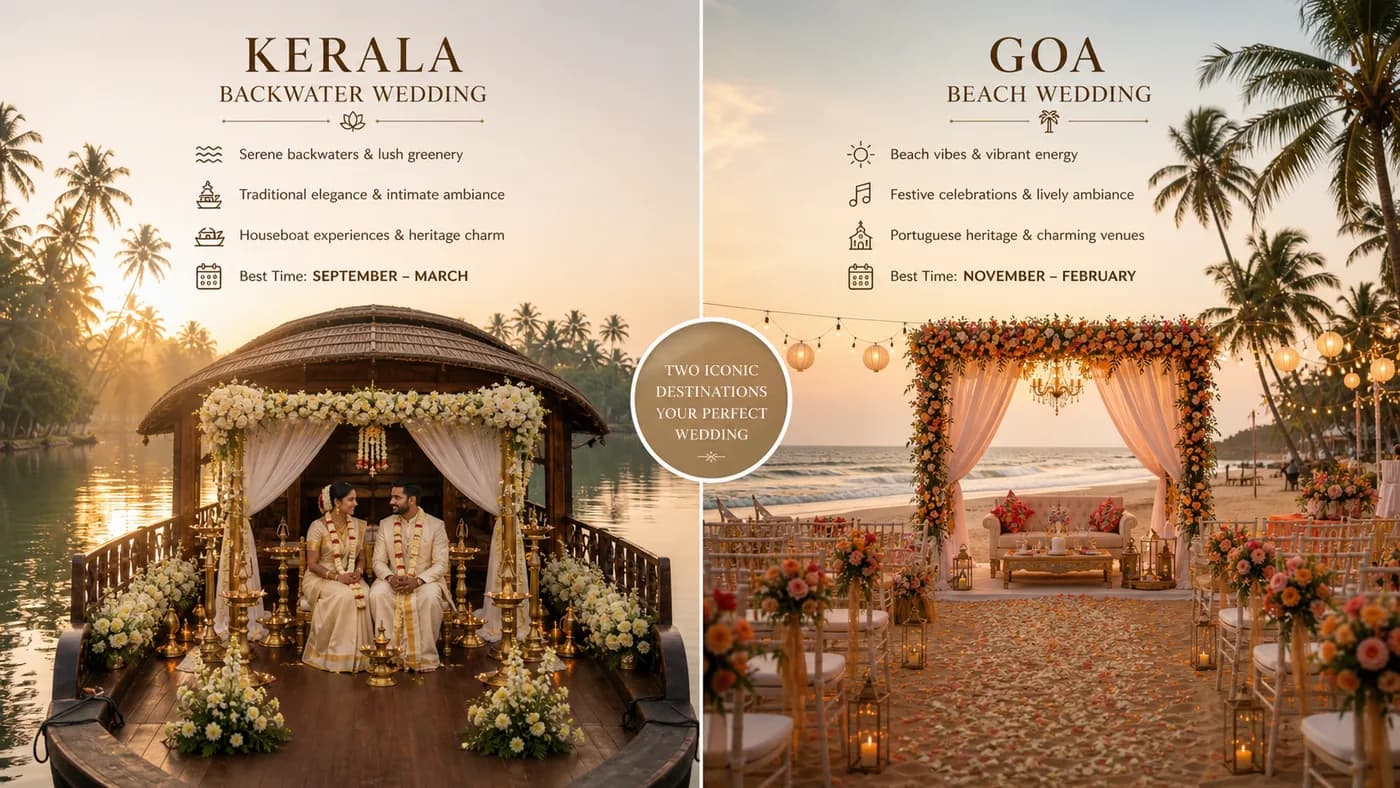
Goa — Indo-Portuguese beach celebration. Whitewashed chapels, laterite-stone havelis, palm-fringed beaches with a party undercurrent. The aesthetic is the most familiar to Indian guests — festive and relaxed rather than exotic. The Goa market has the deepest styling vendor ecosystem in India.
Bali — Hindu-Balinese temple and rice terrace. Ubud's terraced paddies, Uluwatu's 70-metre cliffside temples, and Seminyak's black-sand beaches. The Hindu cultural substrate — temple ceremonies, gamelan, floral offerings — resonates with Indian Hindu couples in a way secular resort weddings do not.
Kerala — Backwater serenity and temple tradition. Houseboat ceremonies on Vembanad Lake, Kumarakom's mangroves, Guruvayoor-adjacent temple weddings. The most grounded in Indian tradition — couples who want cultural rootedness without urban chaos pick Kerala for exactly that.
Who Should Pick Which Destination?
The right destination depends on the intersection of five variables — guest count, budget ceiling, dietary requirements, NRI mix, and legal preference. The matrix below maps the most common couple profiles to the strongest-fit destination.
| Profile | Best fit | Why |
|---|---|---|
| 80-150 guests, ₹20-35L budget, South Indian veg-heavy | Sri Lanka | Best value-to-aesthetics ratio, strong veg capability, 1hr from Chennai |
| 200-500 guests, ₹30-65L budget, mixed cuisine | Goa | Only destination with proven 500+ guest infrastructure |
| 50-120 guests, ₹35-75L budget, Instagram-first aesthetic | Bali | Unique visual register, but premium pricing and food import costs |
| 100-250 guests, ₹12-32L budget, zero friction priority | Kerala | Cheapest, no visa, no passport coordination, native cuisine |
| NRI couple, guests from 3+ countries | Bali or Sri Lanka | Bali for APAC/US-based guests, Sri Lanka for India + Middle East |
| Large joint family, 60+ elderly guests | Goa or Kerala | Domestic = no passport friction, familiar food, shorter travel |
| Intimate luxury, 30-80 guests, ₹25-40L | Sri Lanka hill country | Ceylon Tea Trails and Kandy heritage venues at exclusive-use pricing |
| Beach wedding, 100-200 guests, December-March | Sri Lanka south coast | Bentota and Tangalle beat Goa on beach width, crowd control, and cost at 5-star tier |
| Cooler climate, mountain backdrop, distinct cultural layer | Northeast India | Shillong, Gangtok and Kaziranga — pine forests, Kanchenjunga views, Khasi or Assamese ceremony layers; no visa, no Inner Line Permit for the wedding-ready states |
Note
The religion variable matters more than couples expect. Sri Lanka is a Buddhist-majority country with Hindu temples primarily in the north and east. Hindu couples wanting a temple-adjacent ceremony should look at Kandy (Temple of the Tooth area) or the Jaffna peninsula. For a temple wedding within the ceremony itself, Kerala's Guruvayoor and Thrissur belt, or Bali's Hindu temples, are structurally better fits.
What Are the Strongest Arguments for Sri Lanka?
Three structural advantages make Sri Lanka the most interesting destination in this comparison for mid-budget Indian couples.
Value-to-aesthetics ratio. No other destination delivers Anantara-grade resorts, Galle Fort heritage photography, and tea estate exclusivity in a ₹25-35 lakh band. Goa charges more for equivalent tiers. Bali charges substantially more. Kerala is cheaper but cannot match the international visual register.
Proximity to South India. Colombo is one hour from Chennai, 90 minutes from Bangalore. That proximity means airfare blocks of ₹4,00,000 – ₹7,00,000 for 100 economy tickets from Chennai versus ₹8,00,000 – ₹15,00,000 to Bali. Elderly relatives and last-minute guests can realistically make the trip.
Indian food fluency without import premiums. The south coast resort belt now has enough Indian wedding volume that dedicated veg chef brigades are standard at 5-star properties — a genuine operational advantage over Bali, where flying in Indian catering adds ₹8-15 lakh.
The best time for a Sri Lanka wedding aligns well with Indian wedding season — December to March on the south coast, with the east coast counter-monsoon covering May to September.
Looking for wedding-plannerss in Goa?
Tell us what you need and get quotes from verified wedding-plannerss
When Does Sri Lanka Lose to the Other Three?
Honesty matters more than advocacy in a comparison guide. Here are the scenarios where Sri Lanka is not the right pick.
When your guest count exceeds 300. Sri Lanka's largest resort wedding formats cap around 250-300 guests (Colombo urban hotels can push to 400-500 in banquet mode, but that defeats the destination purpose). Goa handles 500-800 guest weddings routinely. If your family's minimum viable guest list starts at 350, Sri Lanka is structurally wrong.
When zero visa friction is non-negotiable. The ETA is simple (online, USD 50, 24-48 hours), but it requires every guest to hold a valid passport. For guest lists where 20 percent of invitees will not apply, Goa and Kerala eliminate this filter entirely.
When you want a temple ceremony. Sri Lanka lacks the Hindu temple infrastructure for a full traditional ceremony. Kerala (Guruvayoor, Thrissur) and Bali (Hindu-Balinese temples) are structurally better for temple weddings.
When the alcohol budget matters. Sri Lanka's import duties are high and most resorts prohibit external alcohol. Our cost breakdown shows ₹2,500-4,500 per guest per night at a 5-star. Goa allows external liquor vendors. For a 200-guest, three-night open bar, the alcohol line alone swings ₹5-10 lakh in Goa's favour.
When novelty drives the decision. I have had couples in 2025-2026 choose Bali because "everyone in our circle has done Goa and now Sri Lanka is becoming the next Goa." For Instagram differentiation, Bali's rice-terrace aesthetic remains genuinely unique.
Common Questions About Destination Wedding Comparisons
How far in advance should we book for each destination?
Twelve months is the baseline at peak-season 5-star properties. Bali requires the longest lead — 14-18 months for Uluwatu and Ubud venues during April-October, because the global market competes for those dates. Goa's November-February window books 10-14 months ahead at Taj, W, and ITC properties. Sri Lanka's south coast peak needs 10-12 months, though the east coast May-September season remains less competitive at 6-8 months. Kerala is the most flexible — outside Onam season and the December-January peak, 6-10 months lands good availability at Kumarakom Lake Resort or Le Meridien Kochi.
What is the real flight cost difference for a 150-guest wedding?
For 100 economy return tickets from Chennai: ₹3,50,000 – ₹6,00,000 to Colombo, ₹5,00,000 – ₹9,00,000 to Goa, ₹12,00,000 – ₹20,00,000 to Bali, and ₹4,00,000 – ₹7,00,000 to Kochi. From Mumbai the picture compresses — Mumbai to Goa is cheaper than Mumbai to Colombo. From Delhi, all four are roughly equal except Bali, which costs double. Sponsor the inner family circle (30-40 tickets) and let other guests book at group-negotiated rates.
Can we split the wedding across two destinations?
Yes — this format gained traction in 2025-2026. The common split is sangeet in one city and ceremony-reception in another. A Colombo sangeet followed by a Bentota beach ceremony is a natural within-Sri Lanka split. A Mumbai sangeet then Goa ceremony is the classic domestic version. The cross-country split (Chennai sangeet, Colombo ceremony) works only if the guest list stays sub-100 to avoid flight-rebooking attrition. Budget ₹3-5 lakh extra for two-destination logistics.
Do any of these destinations offer all-inclusive wedding packages?
Sri Lanka's 5-star properties are most aggressive on all-inclusive pricing. Anantara Tangalle, Cinnamon Hotels, and Vivanta Bentota publish packages bundling venue, catering, decor, accommodation, and coordination. Goa's Taj and ITC offer similar bundles at a 15-25 percent premium. Bali tends toward venue-only packages — catering, decor, and photography are unbundled. Kerala resort packages exist at Kumarakom Lake Resort and Coconut Lagoon but are less standardised. Treat published packages as a scaffold — the final bill after customisation typically runs 30-50 percent above the listed price.
How do we handle currency and payments across borders?
Goa and Kerala are INR — no friction. Sri Lanka contracts quote in USD; the LKR-INR-USD triangle can move 5-8 percent across a 12-month planning cycle, so lock rates early or negotiate INR-denominated contracts. Bali contracts are in USD or IDR, with IDR more volatile than LKR. RBI's Liberalised Remittance Scheme allows USD 250,000 per person per year, comfortably covering wedding payments. Use a forex card or wire transfer — avoid credit card payments, as the 3.5 percent cross-border surcharge on a ₹30 lakh bill exceeds ₹1 lakh in unnecessary fees.
Topics
sri lanka vs goa weddingsri lanka vs bali weddingdestination wedding comparisonindian destination weddingsri lanka kerala weddingdestination wedding south asiaExplore more
Frequently Asked Questions
1Is Sri Lanka cheaper than Goa for a destination wedding?
2Which destination is best for a 500+ guest Indian wedding?
3Can you legally marry in all four destinations?
4Which destination has the best Indian food options?
5Is Bali worth the extra cost compared to Sri Lanka?
Continue reading
Related Articles
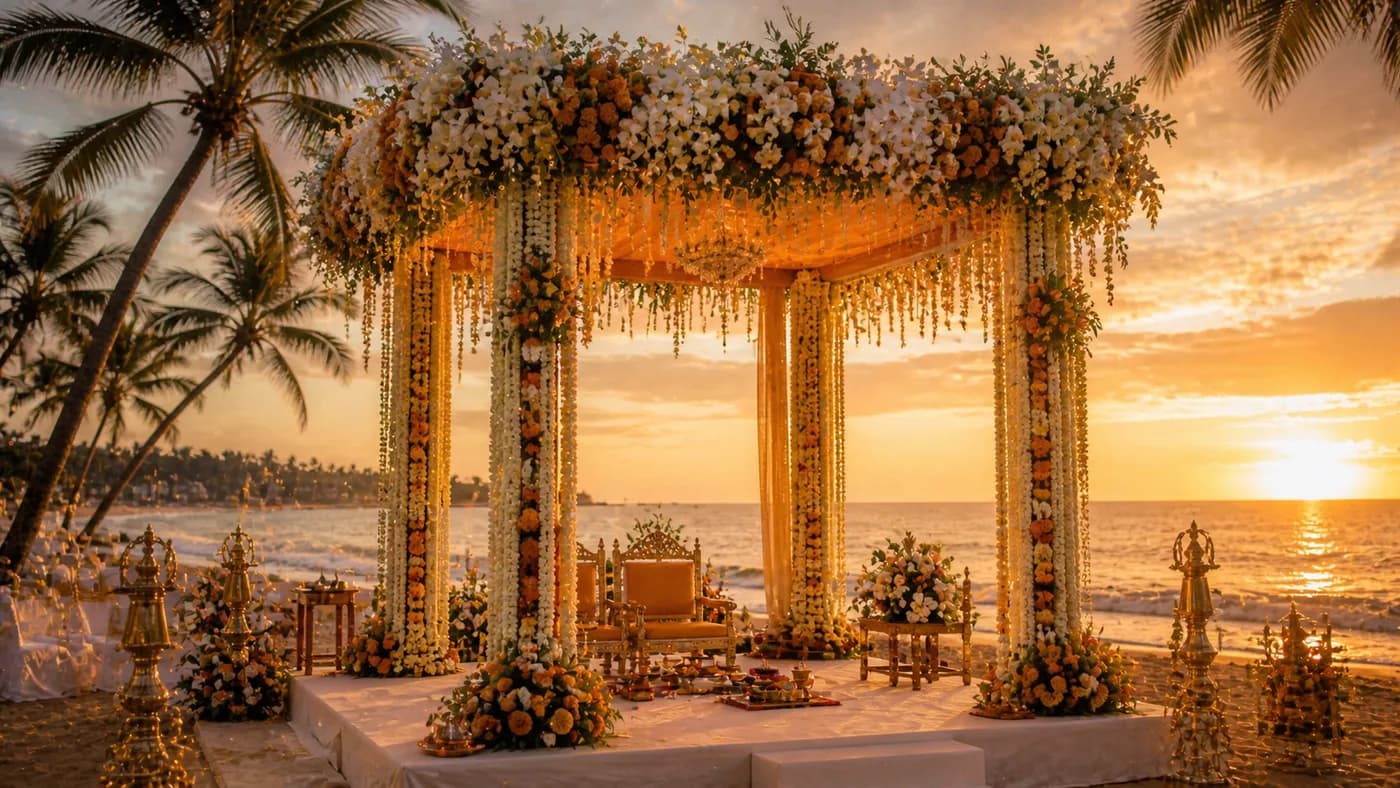
Sri Lanka Destination Wedding Guide for Indian Couples (₹15-50L, 2026)
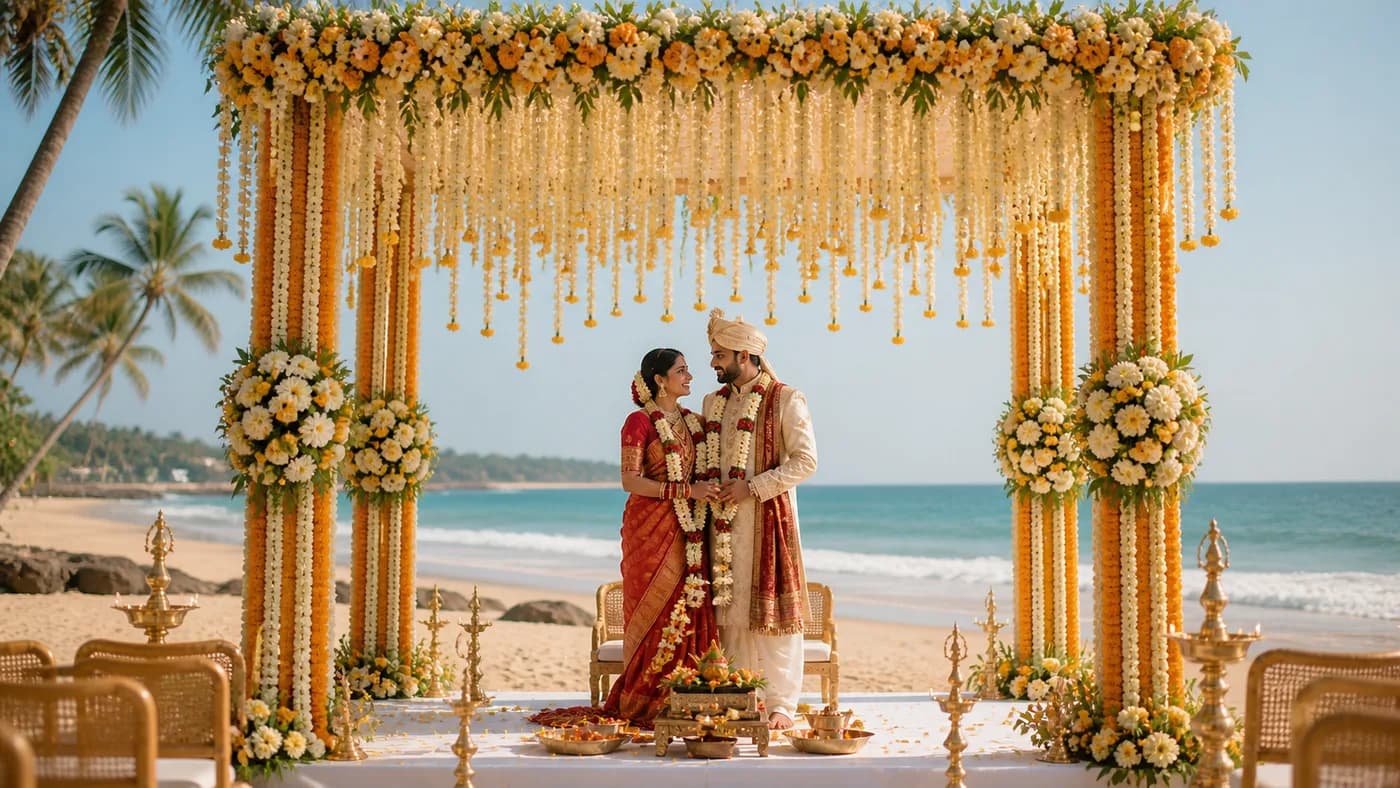
Sri Lanka Destination Wedding Cost (₹12-50L for 100-300 Guests, 2026)
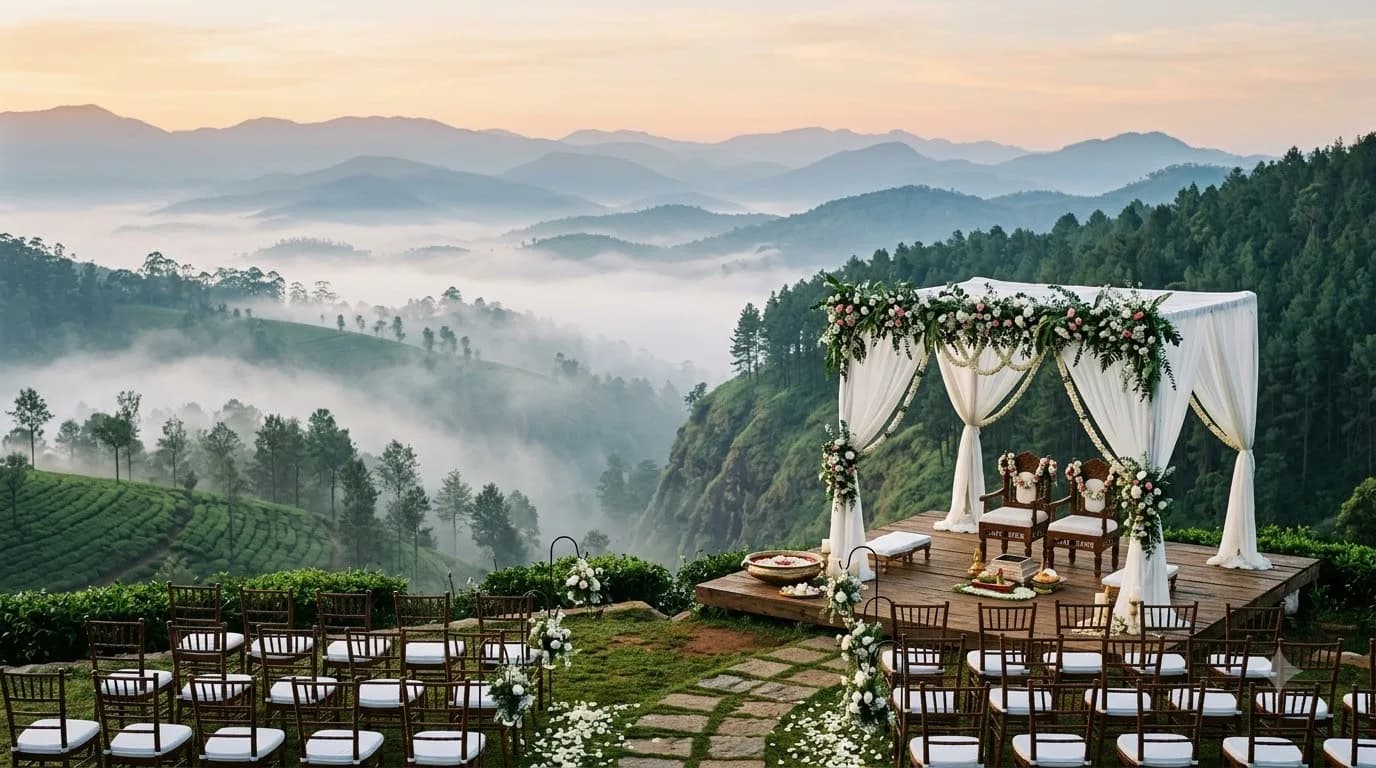
Best Season for South India Destination Weddings: Month-by-Month Western Ghats Guide
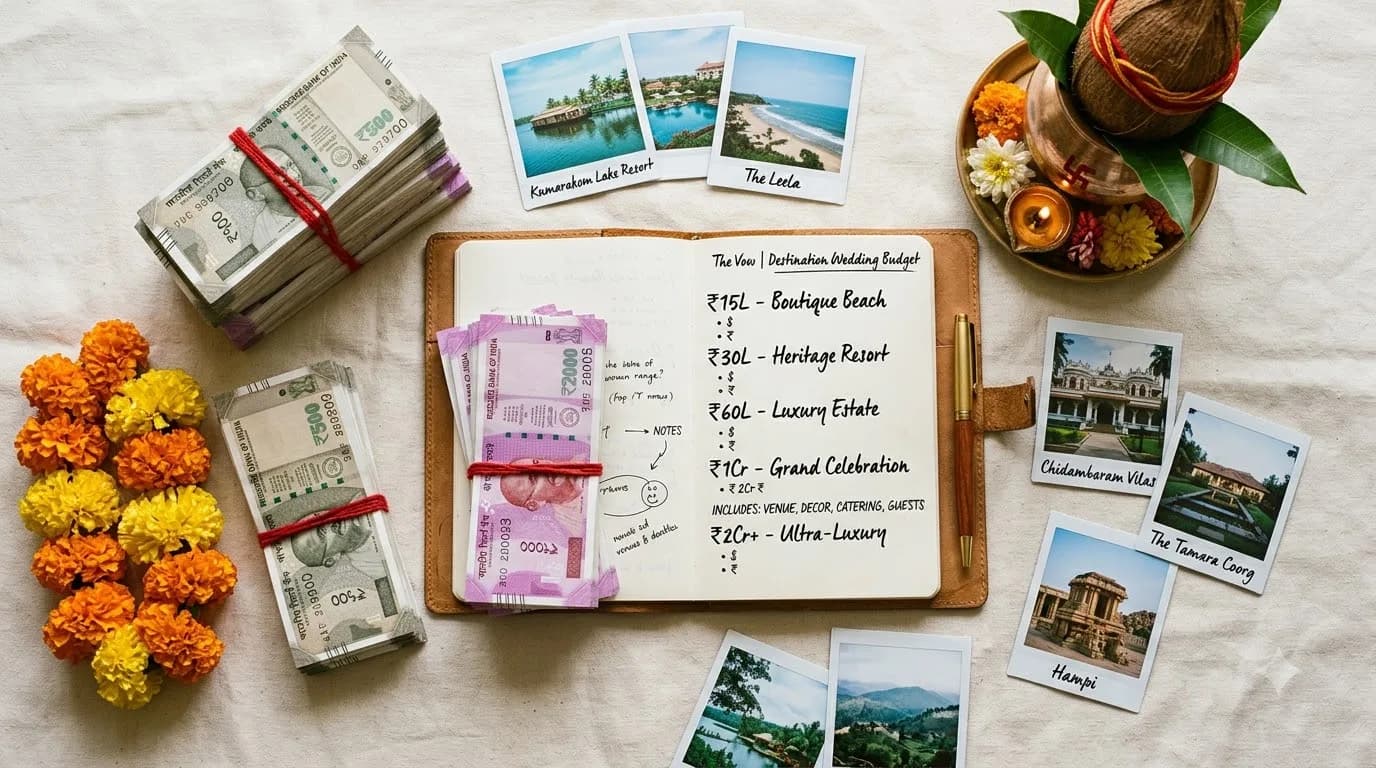
Destination Wedding Cost in South India 2026: 5-Tier Budget Guide
Destination Wedding in South India: Complete 2026 Planning Guide

Coorg vs Munnar vs Wayanad vs Kodaikanal vs Ooty: Hill Station Wedding Comparison 2026
Still planning?
Get quotes from India's best vendors
Tell us what you're planning and we'll match you with verified photographers, venues, decorators, and more.
Get free quotes